Category Archives: travel

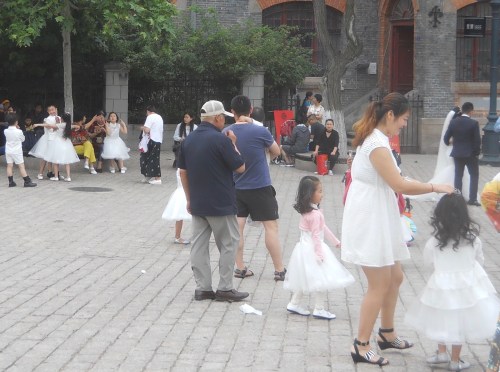
Chinese Girls in Frilly Dresses

little girls in frilly dresses, Qingdao, China

Chinese Girls in Frilly Dresses    —by Jinny Batterson

Last fall, one of our favorite former students in China emailed us exciting news—she was about to get married.  A few weeks later, our former student, “Mona,”  sent a second message with an attachment: a picture of her and her new husband in their wedding clothes.  Mona looked fetching, much dressier than the Mona I was used to—she posed, seated on a high stool, in an elegant flower-print dress with a brimmed hat to match. Her husband, decked out in a casual summer suit, looked over her shoulder.

For much of June this year, I had a chance to travel in mainland China and to reconnect with some former students and colleagues. Especially wonderful was a chance to visit Mona, whose new husband had been a high school classmate I didn’t yet know. They’d chosen each other after a long, sometimes long-distance courtship. I got to spend a couple of days with them. While I was visiting, Mona explained the logistics of arranging her wedding pictures, an increasingly common part of Chinese wedding preparations:

Few people actually buy clothes for their wedding pictures or have pictures taken on the wedding day itself, she explained. Rather, they rent dressy attire from specialized businesses and pick out a place and time to have professional still pictures taken, sometimes adding a brief video. They usually choose a historic or natural beauty spot, on a weekend day when both partners are off work. Because Mona is short for a woman of her generation in China, preparations were somewhat complicated. One weekend, she and her groom-to-be visited a rental agency and picked out clothes they liked in close to the proper size. The following weekend, they went back to the agency to pick up the clothes, which had been altered slightly for better fit.  On still a third weekend, she and her fiancé dressed in their rented finery and met a hired wedding photographer at the agreed upon site and time. Scheduling was tight and did not make allowances for weather. The day Mona’s pictures were taken, it poured down rain. The search for a “perfect shot” took most of a very long day and left both photographer and subjects tired and bedraggled. It took a fourth week to get the rental clothes dried, cleaned, and returned to the rental agency.   

Not long after my visit with Mona and her new spouse, I ventured out on my own to parts of central and northern China where I’d never visited before. In the northern seaside town of Qingdao, I came across a cobblestone plaza more filled than usual with elaborately dressed Chinese.  Primed by Mona’s descriptions of her wedding picture adventures, I realized that what I was viewing were a whole series of wedding photo shoots. June is a prime wedding month in China, just as in the U.S.  I counted eighteen different couples having their wedding pictures taken. The weather was windy and blustery—gowns and photo accessories were hard to keep steady. A dozen of the brides were wearing western-style dresses in white, while others had flowing formals in red, considered a lucky color in China. For one set of pictures, an entire wedding party was assembled, including five or six young girls in frilly white dresses. 

Over the course of this China visit, I noticed more and more young girls dressed in frills and bows, and not always in wedding groups. I’d see them on public busses, on trains and subways, in public parks. All were with at least one parent or grandparent. Often, a parkland family group would be taking selfies, the grandparents somewhat subdued in both manner and dress, the dads fairly casual, the moms dressier, anchored with the latest shoe fashions, the daughters often in white or pastel lacy dresses not much less formal than bridal finery. I crossed my fingers that the attention these girls were getting was a sign that the traditional stigma of having a daughter in China was lessening. None of the girls I saw looked neglected or abused. Many were far from docile. Most seemed valued family members, confident without being arrogant.

A few times, I saw girls and young women in less frilly outfits—on one park walk, the mom and dad in front of me strolled along at a normal pace, while their two daughters in trainers, shorts and tank tops raced ahead running sprints. At another public square, I noticed a young woman in jeans and a t-shirt with an English-language slogan: “Women are the Future,” it proclaimed.

My re-entry into the U.S. was through our 49th state, Alaska, where few women are shrinking violets. I saw the kennels run by the family of Susan Butcher, who’d earlier won the  long-distance Iditerod sled dog race four times.  I got to meet her elder daughter, now actively involved in training new generations of sled dogs for new challenges. Perhaps China’s daughters, and America’s, will one day soon be ready to take their places in a rapidly changing world that needs and welcomes their skills.   

Didace’s Garden

Didace’s Garden   —by Jinny Batterson

It’s a magical time of year here in central North Carolina. The trees have leaves of that vibrant green that’s unique to early spring, before they gradually darken and fade in the heat and dust of later seasons. Shrubs and flowers bloom in profusion, both in cultivated spaces and in parks and woodlands where they’ve either originated or escaped. Recently I spent a couple of hours “tidying up” parts of a traveling friend’s back yard. Mostly, I wanted an excuse to revel in the colors and blooms of the nearly solid wall of azaleas along one side of her property.   

As I raked and pruned, I remembered a different garden, a different season, a different part of the world. For a couple of years in the 1980’s, I had a temporary assignment in the small central African country of Burundi. Most weekdays, I worked in a rural development office in the country’s capital city of Bujumbura, participating in a project to strengthen and diversify a network of consumer/producer cooperatives throughout the country. Burundi then had a few business people and high government officials with great material wealth, a local and expatriate community of civil servants and shop owners who lived modestly, and over 90% of its populace who ground out a bare living as subsistence farmers. It is somewhat ironic that this Peace-Corps-like assignment was the only time in my life when I had human household help. Modern appliances were few; electricity was expensive and intermittent; having an employee to tend the yard was a godsend. My duplex neighbor and I shared a gardener/night watchman, Didace.

Any lasting impact I had in the country was more likely a result of my interactions with Didace than of any tasks I accomplished at the office. Though he had little formal education, Didace was proud of his skills as a small-hold farmer. While he scoffed at my feeble attempts to grow temperate-climate vegetables in the tropics, he faithfully dug small plots for me in September and January, at the beginnings of each of the country’s two rainy seasons. Later, he tracked down supports for the pea and bean vines that straggled upward. The income he got from maintaining foreigners’ gardens supplemented what he could grow on his farm to eat or sell, helping provide a better life for his family.

Before the first Christmas season of my assignment (which occurred during a lull between the shorter and longer of the two rainy seasons), I mentioned to Didace that I would be traveling to Greece to see family over the holiday. Was there anything I could bring back for him and his family as a small gift?  He thought for a while, then explained that what he’d really enjoy were some pictures of his family and his small farm. Didace had noticed the snapshots of family and travels that I kept on the room divider in our open-plan bungalow. Would I be willing to visit his home, take pictures with my (traditional) camera, then get the film developed on my trip and bring back several of the best photos?

We made plans for me to borrow a project vehicle one weekend in early December and to drive, then walk, to his family’s home in the hills above town. The paved road quickly became dirt, which gradually got more potholed and rutted. Didace met me at the intersection of the road and a person-wide path that led further into the hills. Once we arrived at his house, he pointed with pride to the tin roof he’d recently installed with a loan/advance on his monthly wages. He introduced me to his wife and two young sons, and then showed me around the small plots where they grew beans, corn, and cassava, a root vegetable whose tubers provided most of the carbohydrates of the Burundian diet. At one edge of the house was a small banana grove. A few chickens scratched in the dirt.

Then, in a small fenced area, I saw a flower garden. If memory serves, it had a mixture of gladiolas, dahlias, and other showy flowers I didn’t recognize. They were beautiful. I asked why his family chose to grow flowers on some of their limited acreage. Partly, he said, so they could sell the best blooms at the Bujumbura central market for additional income. But mainly, just because they were pretty. I wish I had made and kept copies of the pictures of Didace and his garden. Beauty knows no boundaries.            

International Women’s Day Thoughts

International Women’s Day Thoughts  —by Jinny Batterson

March 8, 2017 will be celebrated in many countries as International Women’s Day, a holiday that gradually has taken hold since the early 20th century as a way to honor women’s economic and social contributions and to press for more equitable treatment of the “fairer sex.”  No one agency, country, or non-profit is a primary sponsor for International Women’s Day. Some companies have underwritten celebrations in various places, perhaps hoping to get their names associated with being good corporate citizens, perhaps welcoming this occasion to market their products more emphatically to women.    

The first time I had a chance to participate in an International Women’s Day celebration came a decade ago, when I was teaching English at a small agricultural college on the far northwestern fringes of China. That year the holiday fell on a Thursday, and our classes were shortened to allow for an afternoon of amateur intramural sports. According to the journal entry I made at the time, I participated in “water bottle bowling” and jump rope competitions, winning an extra liter of cooking oil and a ribbon for my efforts.

In 2014, I attended a North Carolina International Women’s Day gathering in a local church hall on a Saturday afternoon. I don’t remember a whole lot about the celebration—it was small and fairly informal. Among the participants were several older nuns and a different group of singing elders, the “Raging Grannies.” The grannies wore aprons and floppy garden hats and belted out political satire words set to traditional tunes. After a while, all of us went home.

International Women’s Day was first recognized by the United Nations in 1975, in conjunction with the first International Women’s Conference and a U.N. themed “Year of the Woman.”  That same year, though not on International Women’s Day, women in the Nordic country of Iceland decided to take a day off to illustrate how vital women were to the smooth functioning of Icelandic society, despite what was then a 40% pay gap. According to excerpts from the account given by the BBC in 2015, the October, 1975 “Women’s Day Off” was a turning point in the relationship between the sexes in Iceland:

“Instead of going to the office, doing housework or childcare they took to the streets in their thousands to rally for equal rights with men. (An estimated 90% of Icelandic women took part, including rural women.)

It is known in Iceland as the Women’s Day Off, and Vigdis Finnbogadottir (Iceland’s first woman Prime Minister, elected initially in 1980) sees it as a watershed moment.

‘What happened that day was the first step for women’s emancipation in Iceland,’ she says. ‘It completely paralysed the country and opened the eyes of many men.’

Banks, factories and some shops had to close, as did schools and nurseries – leaving many fathers with no choice but to take their children to work. There were reports of men arming themselves with sweets and colouring pencils to entertain the crowds of overexcited children in their workplaces. Sausages – easy to cook and popular with children – were in such demand the shops sold out.

It was a baptism of fire for some fathers, which may explain the other name the day has been given – “the Long Friday.”

The pay gap in Iceland has not entirely disappeared, though it has shrunk to one of the smallest of any nation. In 2016, Icelandic women for a single day staged a smaller work stoppage as a protest of the enduring part of the wage gap—figuring that they were paid 14% less than men for equal work, many quit work at 2:38 p.m. rather than “work for free” for the rest of the day.   

So far, International Women’s Day has not caught on in a big way in the United States of America, where the gender wage gap hovers at about 20% nationwide, with considerable variation by state and a much larger gap for women of color. One of the initiatives favored by the current U.S. administration is support for childcare expenses, which typically helps families with working parents. So far, there is little detail about how such support would be administered or financed.  Considerable skepticism exists about whether that support would be structured to help improve the lives and earning capacity of those at the bottom of the wage scale.

In my family, women through the generations have carried at least their share of both nurturing and earnings responsibilities. If I do nothing else this International Women’s Day, I will pause for a moment to honor these foremothers who farmed, ran households, got educated, taught, provided vital family income, and invested for the future. Once they got the right to vote, they for darn sure did their best to make fulfillment and advancement easier for their daughters as well as for their sons.    

Eating Out in Twenty-Nine Palms: Honoring National Service

Eating Out in Twenty-Nine Palms, Honoring National Service   

                                                  —by Jinny Batterson

During part of our most recent political transition, in late 2016, I spent several days in the desert interior of southern California, exploring the area around Joshua Tree National Park. From a small vacation rental home in the town of Twenty-Nine Palms, my husband and I could drive several miles uphill to a park entrance. We could explore the park’s trails, marvel at its unique geological formations, view the large members of the yucca family that gave the park its name, and experience the variety of its altitudes and desert landscapes. Toward the end of our stay, a heavy wind kicked up, making hiking less appealing, so we spent some time indoors, learning about the town. At the Chamber of Commerce, we watched a film about the town’s history and viewed displays and pamphlets. We learned that the town’s first growth spurt had come in the wake of World War I. Then, a sympathetic veteran physician specializing in lung ailments had begun to recommend the climate around Twenty-Nine Palms to fellow veterans suffering from mustard gas exposure or tuberculosis. The dry air and moderate altitude provided an ideal setting for recovery. Several hundred veterans filed homestead claims in the area.

We also learned that a large modern U.S. Marine base existed nearby, in the opposite direction from the park. Soldiers could be stationed there for periods ranging from a few months to several years, with over 50,000 military personnel receiving training the preceding year. We drove out to the base gate—the Marine Corps Air Ground Combat Center/Marine Air Ground Task Force Training Command—but were unable to enter without an approved escort.

That evening, we ate in town at a small local restaurant that catered to a burgers-and-milkshakes clientele.  When we first arrived, the restaurant’s central area was completely filled by a set of pushed-together tables where a dozen young people, five men and seven women, were chatting and ordering food. They looked fit and tired, primed to enjoy a simple evening meal. Several were wearing matching sweatshirts with the initials “NCCC” on the back.  I guessed they might be members of some rock climbing club, since the park was a mecca for climbers. After a bit, my curiosity got the better of me and I walked over to one end of their table.

“What does ‘NCCC’ stand for?”  I asked. “Are you a rock climbing group?”

“No ma’am,” responded one of the young men. “We’re a team from the National Civilian Community Corps. We’re on our way back to our base in Sacramento after an eight-week assignment helping repair homes in Baton Rouge, Louisiana that were damaged by last summer’s floods.”

As my husband and I ordered our food and waited while it was prepared, half a dozen young men with short haircuts arrived and settled into two booths nearby. They were in civilian clothes, but I guessed they might be on leave from the marine base: several barber shops in town advertised “Marine haircuts,” and these fit the bill. The men talked quietly among themselves as they too ordered and waited for their suppers. 

Both the Marines and NCCC volunteers I saw at dinner in Twenty-Nine Palms were training and practicing to meet whatever threats and emergencies might require a military response, civilian action, or some combination of the two. I was grateful for their service, as I remembered previous generations of Americans who had participated in larger numbers in either military or civilian service—the Civilian Conservation Corps of the 1930’s depression years, or the military draftees of the 1940’s World War II era and beyond.  Surveying these young service men and women at supper in 2016, I also imagined what it might look like for similar service again to become a bigger part of our American society.

Various bills introduced in Congress since 2003 have attempted to create a framework for some sort of mandatory service component for young people, including a modest monetary stipend and educational funding assistance. Our nation’s physical and educational infrastructures are aging. Elements of our natural environment are threatened. The needs are great; the potential even greater. On this Presidents’ Day, let’s renew the value of public service as part of our heritage and responsibility as Americans. From the loftiest tasks to the most humble, each of us has something worthwhile to contribute. When a service ethic is lacking, we are all impoverished, and not just monetarily.        

White Privilege, the Capacity to Leave, and the World’s Changing Games

White Privilege, the Capacity to Leave, and the World’s Changing Games   

                                                       —by Jinny Batterson

As our nation veers closer and closer to fascism, I’m dismayed and unbalanced. How did we come to this point, I ask myself? How was I complicit? How can we as a society rebalance? 

As a “leading edge boomer white female,” I’ve followed a similar trajectory to that of many liberal-leaning members of my cohort: protesting the Vietnam war; attending Earth Days; joining various consciousness-raising groups; experimenting briefly with consciousness-altering substances; absorbing uplifting books, films and workshops about human possibilities; doing a Peace Corps stint in sub-Saharan Africa; later, in semi-retirement, doing shorter volunteer or low-paid assignments teaching English in rural China.

Where I may have diverged from classmates who moved to the suburbs, raised families, and enrolled their children in “superior” school systems, is that for over twenty years, I lived in America’s core cities. The neighborhoods where I settled were “marginal,” working class, multi-racial. At first, this was an economic necessity—my twenty-somethings were littered with lots of employment mis-steps and accidents. Rents and mortgage payments were lower in areas that had been written off by most of the real estate establishment. But I stayed. Partly this was a semi-conscious effort to atone for some slaveholding ancestors who conferred on me an undeserved inherited advantage. Later, it was partly to help prepare our children for a global society with no single dominant group. As I got to know my neighbors better, my staying got to be more and more about their kind and forgiving natures, and their partial immunity to the materialism I saw so much of elsewhere. I chose to be a visible “minority” presence. And there’s the rub.

The neighbors who surrounded me in inner city Baltimore or inner city Richmond had fewer options for leaving than I did. Legal discrimination, or, increasingly, lack of income or of inherited wealth, made it difficult or impossible for them to afford housing in “better” areas. When I lived in Burundi and visited with peasant families in Burundi and Rwanda, most had little chance for schooling beyond the most elementary levels, in crowded, under-equipped classrooms. Few could travel, either in their own countries or abroad. Their prospects for improving their lot in life were terribly limited. In high schools or agricultural colleges where I taught English in China, students were not likely to be able to use their skills—after graduation, most would work long hours at soul-destroying jobs in big cities. They might at best be able to show off for their parents or grandparents on holiday visits back home.

By contrast, I could take time away from Baltimore or Richmond to recharge at a summer cabin by a pristine lake in Vermont. When sub-Saharan Africa got too depressing, I could join my family on extended holiday in Europe. In China, I spent a winter break at a posh beach resort, a summer interval being escorted by a high-ranking official around the historic sights of Beijing.

The world I grew up in is changing at ever-increasing speed. Within the U.S., we are becoming more immigrant, more “non-white,” more interethnic than ever. Globally, we’ve expanded travel and communications by orders of magnitude. However, we’re also changing our earth’s atmosphere and oceans in ways that will make life less predictable and probably more difficult for all living creatures. Movie fantasies aside, precious few of us have the wealth and/or training to be able to leave the planet and survive. This changes the game, even for those of us with privilege.

The new game requires me and others with privileges conferred by birth, inheritance, skill and/or luck to practice “not leaving.” Of course, I will still need to protest injustices, to improve my environmental stewardship, to raise my awareness, to celebrate human possibilities. But I will need to do more. Even in situations that make me uncomfortable or defensive, I will need to remain fully present, and then to listen, deeply. I will need to practice staying, and staying, and staying. I can no longer afford not to.

Welcoming the Year of the Rooster

Welcoming the Year of the Rooster    —by Jinny Batterson

Cock-a-doodle-doo!  (Or maybe wo-wo-wo!, the Chinese Mandarin equivalent.) This Saturday, January 28, 2017, will mark the beginning of the Year of the Rooster according to the Chinese lunar calendar. People of Chinese background throughout the world may gather to celebrate what is known in most Western countries as Chinese New Year. This festival has been celebrated for hundreds, if not thousands, of years. It remains China’s most important annual festival, even in modern times. Visiting extended family is an important part of festival traditions, somewhat like Thanksgiving in the United States. (For more traditions, check out a recent series in the English-language version of China Daily. (http://www.chinadaily.com.cn/culture/2017-01/22/content_28023167.htm). In previous blog posts, I’ve written about personal experiences of living in China during two different sets of New Year’s festivities, and also about the meanings of various zodiac years. (Spring Festival in LipuBeasts of the Chinese Zodiac, More New Year…

As China’s economy has developed and more and more Chinese families have spread out geographically, this period of the year has also become known for the largest human migration on the planet. In 2017, nearly 3 billion trips are expected to be taken by Chinese in, from, or to China during the period between January 13 and February 21. People will travel by automobile, motorcycle, train, plane, boat or any other way possible. A feature in a recent edition of China Daily chronicled the journey of one migrant worker who was going home by bicycle. He’d left his temporary restaurant job in Shanghai on January 12 for Chongqing, a distance of over 1,000 miles. He expects to make it home by January 27, New Year’s Eve.     

Different employers, schools, and institutions in China vary somewhat on the timing and length of holiday break awarded for this most important festival of the Chinese calendar, but nearly everyone gets at least a week of time off. China has nearly 280 million migrant workers, typically young adults who’ve left their birthplaces in rural areas to seek better job opportunities in China’s burgeoning cities but want to get home to visit family at Spring Festival, as it’s called in China. 

Wealthier Chinese families increasingly use this time to travel internationally. According to an online travel service, Chinese will travel to 174 destinations outside mainland China during the holiday period. Within China, favorite spots include the tropical tourist city of Sanya, Hainan, dubbed “the Hawaii of China.” Although Sanya flight and hotel prices peak during the holiday, winter-weary travelers from colder parts of China still flock here to swim, snorkel, or just lie on the beach in the sunshine.  

Within the U.S., there will be Chinese New Year celebrations in many major cities, including the dowager of all celebrations—an annual parade and festival in San Francisco that has been held since the 1860’s.  Disneyland in Anaheim, California will hold two full weeks of celebrations, hosted by cartoon figure Mulan, plus Mickey and Minnie Mouse in Chinese costumes. For sheer glitz, it will be difficult to beat Las Vegas, where several hotels are vying for the most extravagant display. Lunar New Year parades will also be held in Washington, D.C. on January 29; in Chicago on February 5; and in Orlando, Florida, on February 11.

So, wherever and whenever you choose to celebrate, Happy Year of the Rooster!  Some of your Chinese friends may appreciate a Mandarin Happy New Year greeting(pronounced roughly shin-nyen how):  Xinnian Hao !


Winter Beach Respite

Winter Beach Respite     —by Jinny Batterson

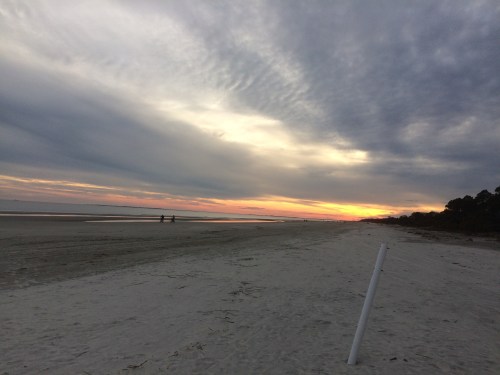
Barrier island beach at sunset

Barrier island beach at sunset

Just after New Year, we packed the car: layers and layers
Of casual clothes, plus assorted toys and games.
We headed for one of the barrier islands that
Dot the Atlantic from the Carolinas to Florida.

We’d spend a few days at the beachside condo
Of old friends, a final annual chance to reconnect
Before tax season swallowed them
And potential citizen activism swallowed us.

We arrived to balmy weather, with time for a brief
Beach stroll before sunset. Little view yet of the miles
Of downed vegetation and splintered piers and decks,
Remnants of Hurricane Matthew’s October impact.

It was after dark before our friends arrived, having
Battled urban traffic on their different trajectory east.
A brief political discussion gave way to reminiscences:
The guys had known each other since youth. 

One afternoon proved too chilly and windy for outdoor activity,
But often we walked–carrying binoculars to hone in on shore birds,
Or exclaiming as our more experienced friends pointed out the
Dolphins that sometimes trolled for fish in the breakers at low tide.

A morning guided excursion took us through parts of this island
Once owned by Gullah families descended from slaves.
Before resorts and tourism took over, they earned decent livings
Farming or fishing or ferrying neighbors to and from the mainland.

Predictions of an approaching winter storm cut our idyll short.
Several days of shivering and stabbing at recalcitrant ice have
Partially diminished our relish for January in the Southeast,
But not entirely. Our beach respite memories remain.

Tribute to Leonard Cohen

Tribute to Leonard Cohen (1934-2016)    —by Jinny Batterson

(Leonard Cohen, peripatetic Canadian poet and singer-songwriter, died in Los Angeles on November 7, 2016, a bit too early to absorb the results of the latest U.S. election.  I’m convinced, though, that his spirit still prowls. This short tribute incorporates snippets of several of Cohen’s best-known lyrics: Anthem, You Want it Darker, Suzanne, The Story of Isaac, and Democracy)  For a picture of Cohen near the end of his long life, see:

http://www.billboard.com/files/styles/article_main_image/public/media/leonard-cohen-2013-billboard-650×430.jpg

The bells that still will ring
These post-election days are ringing darker.
Though some the victor’s fulsome praises sing,
For others, the rifts are getting starker.

I saw him only once, we both were young.
In an Expo coffeehouse near Suzanne’s river,
He curled his raspy voice, lips, teeth and tongue
Around the credo that we lean toward love forever.

Bombastic tweets of blunt and bloodied hammering
May make hate and fear here for a time hold sway.
Yet, through the crack in everything
Democracy’s still coming to the U.S.A.

The Myth of Objectivity: Choosing our Facts

The Myth of Objectivity: Choosing Our Facts     —by Jinny Batterson

This fall’s election season left me both physically and emotionally exhausted. In October, as attack advertising on all sides escalated and early voting started, I finalized plans to visit extended family on the west coast shortly after the election was over. It seemed a good way to regain some longer term perspective—the two generations that come after me would help me regain balance.

Now that I’m in sunny California, we’ve mostly avoided talking politics. I’m sure we don’t agree on everything. Avoiding hasty words is an antidote for having to take them back later. The grandkids are cute, and generally uninterested in grown-up concerns.

However, I haven’t escaped political repartee entirely.  My first Sunday here, I was sitting under a shade tree, watching the kids play as the awards ceremony for our son’s final cross country race of the season droned on. A man also watching from nearby piped up with unsolicited advice: several of the kids were playing in a way that might result in injury, he said. A friend of his had had a dangerous fall and lost an eye. I thanked him, mentioned his concern to the kids, asking them to be a little more careful, and thought that would be the end of our interaction. No such luck. 

“What do you think about the results of the election?”  he inquired.

“I’m not too happy,” I responded. “I would have preferred that the other presidential candidate had won.” 

“How could anyone support someone who violated the first tenet of public service?” he jibed. “I was in the Coast Guard. If I had sent classified information over a private email server, I’d forever have been disqualified from further service, let alone from becoming Commander in Chief.” 

Not wanting to get further enmeshed in a discussion that didn’t seem likely to have any positive result, I tried for more neutral ground.

  “Neither candidate was all that appealing,” I ventured. “I didn’t like the way Mr. Trump repeatedly insulted all sorts of people.” 

“Most of that was just bluster,” he responded. “After all, Trump is a brash New Yorker. Still, he has valid points. For example, there are over 750,000 illegal immigrants in New York City alone. That makes more than 10% of the population. They’re taking up housing that should be available to those of us who were born here or came here legally.”

Succumbing to continuing a conversation that I was pretty sure would end badly, I responded, “In the part of the country where I live, immigrant labor harvests nearly all of the crops. We need those workers.”

“Ha!” he said. “There was a time, during World War II, when there was a shortage of local workers for harvesting because so many American men were serving overseas, so immigrants were allowed in. However, once the war was over, Eisenhower sent them all back where they came from.”    

‘Look,” I said, “it seems that you and I view very different parts of reality. I respect your perspective, but I can’t agree with it.”

“Lady,” he said, “you’re entitled to choose your opinions, but you cannot choose your facts.”  With that, he strode off, triumphant. 

Not one gifted in coming up with snappy responses, I later did a bit of further research. Estimates of illegal immigrants/undocumented workers in New York vary widely, with the high-end 750,000 figure most likely coming from an online 2015  post by conservative-leaning publisher Newsmax. Every article about immigration has an editorial slant, explicit or implied—emphasizing either the costs or the contributions of this section of the American population. Some sources stress the need to keep families together, the need for skilled workers, or the aging of the U.S.’s native-born population. Others emphasize the need to reserve jobs/housing/advancement opportunities for the native-born. During the presidential transition, immigration remains a hot-button issue. 

I don’t have a pat answer. I’m not hopeful that our national immigration policies will become either more sensible or more humane for the near-term future. However, I believe that there is a way toward consensus in our nation of immigrants.  As recently as 2013, the U.S. Senate managed to pass a comprehensive immigration reform bill,  S.744, with a substantial bi-partisan majority.  No comparable bill has so far passed the House of Representatives.

To further chances for reform, I believe we’ll need to listen to each other’s stories more deeply. We’ll need to broaden our array of “facts” beyond the mostly biased reporting we’re being subjected to on all sides.

To get a more general view, I turned to a different Internet site and searched for TED talks about “search engines.” I found the following brief talk by Swedish journalist Andreas Ekstrom—“The moral bias behind your search results.”  (http://www.ted.com/talks/andreas_ekstrom_the_moral_bias_behind_your_search_results/transcript?language=en)  

Ekstrom uses two examples of image search results that got temporarily distorted by massive bias: the first, a 2009 derogatory representation of Michelle Obama, was quickly removed by Google; the second, an equally derogatory 2011 representation of mass murderer Anders Breivik, was allowed to continue until it died out on its own. Ekstrom concludes: “And I (emphasize) this because I believe we’ve reached a point in time when it’s absolutely imperative … to remind (ourselves) that that wonderfully seductive idea of the unbiased, clean search result is, and is likely to remain, a myth.” 

Let’s choose our “facts” carefully.