Category Archives: travel

Softening Hearts, Hardening Infrastructure, Widening Perspectives

Softening Hearts, Hardening Infrastructure, Widening Perspectives

                                            —by Jinny Batterson

It’s been a rough couple of months here in North Carolina: two hurricanes (Florence, then Michael), a polarized government, widespread agricultural losses, increasing poverty, damaged schools and infrastructure. 

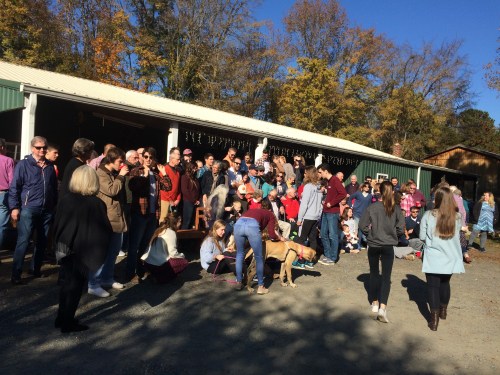
Yet there’s been heartening news as well. Many established charities such as the American Red Cross have sent disaster recovery teams to the worst impacted areas. Local citizens in areas less damaged by the storms have created both short-term and long-term relief efforts. A neighbor who specializes in local fundraising set up a Sunday-afternoon event at a nearby shopping center and raised over $10,000 in cash plus thousands of dollars worth of non-perishable food and household goods for hurricane relief. Because of the extent of the damage, both in the Carolinas and elsewhere, it will take continued efforts by private donors, non-profits, government agencies, and financial institutions to help promote recovery.  The natural environment will never be the same; repairs, rebuilding, and/or relocation of homes and businesses will take months if not years. 

After hurricane Florence decimated the coastal Carolinas, major roads and interstates were flooded and impassable for over a week, making cities such as Wilmington, North Carolina effectively islands.  Residents who’d evacuated were asked not even to try to return home as soon as the first few roads were reopened—what limited road travel was possible needed to be reserved for emergency and supply crews.  Now that the immediate crises are over, people are starting to grapple with longer-term problems: should rebuilding be limited in areas that seem more and more prone to drastic weather?  Should building codes be changed? How do we adapt our infrastructure to be more resilient? Do we need to pursue alternatives to a predominately road-based transportation network?

Simple solutions seem elusive and likely counterproductive. Perhaps we need to rethink some of the implicit assumptions we’ve made about how the world works.  Rather than considering ourselves outside nature, it may be time to widen our perspectives and acknowledge that we humans are just one piece in a complex, evolving whole.  Among the groups that have challenged some of my existing perceptions are:

Transition networks (https://transitionnetwork.org/), a set of local-global initiatives to work toward more resilient local economies in the face of escalating global challenges

Bioneers (https://bioneers.org/), harnessing scientific knowledge toward solving human problems

Biomimicry 3.8 (https://biomimicry.net/), which looks at other life forms (some with over 3.8 billion years of experience on earth) for innovative ways to re-engineer human-made systems

What partial solutions have you discovered?  What “small/local” actions are you taking to make our future more livable?  Please share some of your thoughts. 

Is Anyone Really Stealing American Jobs?

Is Anyone Really Stealing American Jobs?  —by Jinny Batterson

Recently, a friend forwarded to me an email of guidelines for “buying USA,” comparing some everyday items, from greeting cards to toothpaste, that are marketed in the U.S. but now often made in other countries. I have no objection to buying more of the goods I use from hardworking Americans, but I do object to the thinly veiled inference that workers in China (or Mexico, or some other lower-wage country) are stealing American jobs. Wording of the message forwarded to me matches one posted by a real estate developer from near Charlotte, NC in March, 2016, as that year’s election cycle was heating up (see https://www.linkedin.com/pulse/ace-hardware-made-usa-very-encouraging-david-e-johnson-pe). My initial reaction to the message: Oh, rats! Here we go again, blaming job losses on low-wage workers in other parts of the world, when those workers actually play only a small part in American job losses. This mid-term election cycle, I’m concerned that both recycled and more recent posts and tweets are trying to persuade American voters that a broad trade war with China will help save American jobs. 

Over the past forty years, I’ve been able to spend a fair amount of time visiting with workers in China. They don’t want to steal anyone’s job. They are just trying to improve their lives, like workers everywhere. In the 1940’s,1950’s and 1960’s, many Americans left grinding rural poverty for better manufacturing jobs in cities. In the 1980’s and 1990’s, many Chinese also left the countryside in search of better paying urban jobs. By now, Chinese wages have risen. The Chinese government is starting to tighten regulations to rein in the pollution that significantly shortens Chinese lives. Some jobs are leaving China for other countries with lower wages and/or laxer environmental rules.

After I sent a semi-coherent reply to my friend, I let a later draft sit. I needed more time to simmer down and reflect. I realized that I’m very lucky.  So far, my retirement income is comfortable. I do not have to pinch pennies. I can afford to be selective in my buying habits. As much as possible, I patronize local sources. When we lived in Vermont, I made a special effort to buy cheese from our area farmers’ co-op; in Virginia, I bought a lot of local apples; here in North Carolina, I shop the local farmers’ markets; I eat ribs and barbecue at local restaurants. For less-localized items, I check labels along with prices to see where a product originated and how it was produced. Even if they’re somewhat more expensive,  I will sometimes buy U.S.-made goods to help support American workers. At holidays or when buying specialty items, I often purchase “fair trade” products so that some of my coffee, chocolate, and gift purchases will help support those with the lowest wages. Overall, I try to be an informed, careful, caring consumer.

Despite all sorts of “buy from nearby” campaigns, and despite what we may want to believe about fair and unfair trade, for at least a generation the biggest cause of job losses worldwide has been the quickening pace of replacing human workers using automation. According to a Financial Times article published just after Mr. Trump’s election (https://www.ft.com/content/dec677c0-b7e6-11e6-ba85-95d1533d9a62, December 2, 2016), about 85% of U.S. manufacturing job losses between 2000 and 2010 were due to automation rather than to moving jobs overseas. The same article compared the average hourly wage for a human American welder ($25) with the operating cost to have a robot do the same work ($8). If you include the installation and maintenance costs for the robot, the gap narrows slightly. However, the cost difference is likely to continue growing. 

Some trade agreements can damage the interests of workers and/or put at risk the natural environment that supports human life as we know it. Global trade has rarely been without its distortions and inequities. (For example, ask almost any Chinese about the British practice during the 19th century of exporting opium raised in the British colony of India into China to offset the costs of British imports of tea and porcelain, or consider the trans-Atlantic slave trade.) Negotiating worthwhile trade deals can be both time-consuming and extremely difficult—blogs or tweets alone don’t cut it. 

One of my grandfathers lost his job in 1930 when the company he was working for at the time replaced their human bookkeepers with calculating machines as a cost-cutting measure. On President Herbert Hoover’s final full day in office, March 3, 1933, he signed the “Buy America Act” that had recently passed the U.S. Congress. The Great Depression of the 1930’s was not solved.

Americans suffering from job losses need assistance and encouragement rather than attempts to divert the problem onto others. Automation, used wisely, can help improve lives; used foolishly, it can devastate human workers, even entire communities. Global competition, used wisely and fairly, can help spur innovation and growth. Used foolishly, it can pit groups that have many common interests against each other.

Blaming will not solve anything. Please let’s take time together to consider the deeper issues. 

The Rich Man and Lazarus Revisited

The Rich Man and Lazarus Revisited   —by Jinny Batterson

During my childhood, my most formally religious aunt used to give me books of Bible stories, adapted for children. One of the most difficult stories for me was Jesus’ parable of the rich man and Lazarus. It concerned death, not totally unknown even to small-town American children in the 1950’s, plus a kind of cosmic reckoning:

In a gated estate there lived a rich man, who (revised standard translation, part of Luke’s gospel, chapter 16) “was clothed in purple and fine linen and who feasted sumptuously every day.”  Outside the rich man’s gate was a poor, diseased man named Lazarus, “who desired to be fed with what fell from the rich man’s table.”  Sharing was apparently not part of the rich man’s ethos, so Lazarus languished in distress.

After a time, both Lazarus and the rich man died. Lazarus was carried by angels to heaven, “Abraham’s bosom,” a welcome change. The rich man, by contrast, went to Hades, a realm of fire and brimstone, just near enough to heaven so the rich man could see Lazarus there, hanging out with Abraham in comfort. The rich man cried out: “Father Abraham, have mercy upon me, and send Lazarus to dip the end of his finger in water and cool my tongue; for I am in anguish in this flame.” Nothing doing, Abraham explained. The rich man had had his chance at comfort while alive. Now the chasm between his current locale and Lazarus was deep and impenetrable, allowing for no crossovers.

During the 1990’s, I was briefly exposed to a widening gap in perspectives between rich and not-so-rich. I had a short-term subcontract with a major accounting firm at their downtown office. At the time, I was living in an inner city neighborhood that suffered the side-effects of a worsening epidemic of crack cocaine: robberies, arrests, lengthy prison sentences, even murders. It was a scary time. Occasionally I went out to lunch with my accounting firm colleagues. Once, I asked my supervisor whether the city’s worsening poverty and crime bothered him.

“I don’t have to notice poverty or crime,” he responded. “After work, I ride the elevator down to the guarded basement garage to retrieve my car. Then I drive out the expressway to my home in a gated community in the suburbs. No poor people interact with me at all. It’s not my problem.”  For most of the years since that encounter, I’ve lived in relative comfort, while trying with mixed success to learn and practice the discipline of sharing.

Though some quote an incident near the end of Jesus’ ministry as a justification for ignoring those in poverty, saying, without the surrounding context, “you always have the poor with you,” the vast majority of Jesus’ sayings and actions support the view that caring for “the least of these” is a sacred duty. 

The year 2018 so far has been filled with more than a little fire and brimstone—volcanic eruptions on Hawaii’s big island, huge wildfires in much of the U.S. West. In the part of the country where I live, the major problem has been floods. So far, they have yet to approach Biblical proportions, but the aftermath of Hurricane Florence in eastern North Carolina has been severe enough so that our current equivalent of Noah’s Ark has deployed, in the form of government rescue boats and the “Cajun navy,” a set of volunteers with small boats who previously plied their crafts in last year’s major flooding in Houston, Texas.  Florence drenched already struggling regions with over two feet of rain. Among the hardest hit were the region’s poor. Relieved to have been spared the worst of the storm, I watched media coverage of a flooded housing project where building maintenance had long been ignored or postponed. Videos showed some of the problems: peeling paint, exposed pipes, stained ceilings. Residents complained of asbestos-laced insulation. The electricity had gone out, and no one knew when it might be restored.

Beyond temporary aid, what could be done to help?  Should we as a society put more emphasis on affordable housing, less on high-end real estate? Would rebuilding and/or relocating require higher taxes? Could we somehow craft a renewed ethic of sharing? 

As I struggled to make sense of our society, seemingly rather badly out of kilter, I went out for a walk. The days were getting shorter. It occurred to me that our earth was in the period around an equinox—one of two occasions each year when the sun’s rays hit our tilted planet directly over the equator. Around the vernal and autumnal equinoxes, all creatures everywhere on earth experience days and nights of roughly equal length.

Instead of a chasm between wealth and poverty that gets harder and harder to cross, maybe we need something approaching a human “equinox.” Maybe we can head toward a narrower “wealth gap,” with adequate basic provisions for all living beings. Getting to a more equitable distribution and use of earth’s resources will take skill, political will, and good character. It IS possible, though. Nature creates equinoxes twice each year. Can we learn from her before flood, fire and brimstone get worse?  Happy fall, y’all!             

Happy Interdependence Day!

Happy Interdependence Day!    —by Jinny Batterson

For a good many years now, I’ve bracketed an insertion into my July 4 Independence Day greetings to friends in the American expatriate community:

“Happy In(ter)dependence Day!” I extol them.  It has seemed to me increasingly evident that in an era of global communication and commerce, celebrating “independence” needs a counterweight. We have become more and more dependent on one another across all sorts of boundaries. So I was pleased to find that others more widely known than I am have come up with similar themes. Perhaps the most widely publicized is a September 12 holiday proposed in the years just following the World Trade Center terrorist attacks.  In 2003, a group met to create a day to celebrate our global interconnectedness, and settled on September 12, the day after the terrorist assault, as a day for an annual celebration. According to Parag Khanna, one of its founders:

     “For the event’s organizers (the Democracy Collaborative at the University of Maryland), Interdependence Day is intended to be crucially different from 4 July. Where Americans alone celebrate the latter, the idea of interdependence unites all peoples across national boundaries in a common human destiny. At the same time, there is an element of deep continuity: for Americans in particular will have to struggle as hard to realize the promise of interdependence as they did for independence.”  (For a fuller explanation, please check out the following link: https://www.paragkhanna.com/home/americas-interdependence-day.) 

     I’ve just returned from a cross-country U.S. trip, benefiting from collaborative practices among airline personnel, colleagues, other passengers, and airport employees to adjust schedules and seating to get as many of us as practical back to our homes on the U.S. Atlantic coast in advance of a strong hurricane. My guess is that our skills at interdependence will soon get a good bit of practice, courtesy of Florence and/or other storms later in the season. My best wishes to all for adequate shelter from the storm—Happy Interdependence Day!     

Aubrac’s Fields of Wild Jonquils

Aubrac’s Flelds of Wild Jonquils    —by Jinny Batterson

In late May, as I was walking across a sparsely settled upland French plateau along a stretch of one pilgrimage route of the Camino de Santiago de Compostela, I encountered a delicious fragrance—delicate and sweet and lingering. I wasn’t sure where it was coming from. Despite, or perhaps because of, a fair amount of rainy weather, the meadows and woodlands abounded in spring blooms, many of them unfamiliar to me.  That evening at the small guest house where we had booked a room, I noticed a vase of flowers with the same delicate fragrance. I asked the proprietress what these small white blooms were called. “Jonquils des poètes,” she told me in French.

I’m not sure what the English equivalent is. The internet pictures I’ve found of “Poet’s jonquils” look similar, but not identical to the flowers I remember from my trip. A few days further into my journey, I arrived midmorning at the tiny town of Aubrac, after spending a couple of hours crossing several miles of minimally fenced upland pastures dotted with jonquils des poètes, some being contentedly munched by local cattle. The weather was cool and misty.

At the near edge of town was a forbidding-looking Romanesque structure. A guide was explaining to a group of tourists in a language I could not understand the wonders and historic significance of this church. According to the French signpost I could partly understand, this former Benedictine monastery was at least a thousand years old and likely built on the foundations of an even earlier structure.

Most of the other buildings along the road and edging the upland pastures were hotels, hostels, or small inns. I noticed one small cafe/guest house that seemed to be open. Several of us stopped and picked out an outdoor table under a protective awning. A warm drink seemed a good idea. It took a while for anyone to come to take our orders—after a bit, an elegant young woman showed up, apologizing somewhat for the delay, explaining that she and the other town residents were all still stressed out from the previous weekend’s “transhumance” festival that annually draws thousands to the area. I’d seen pictures and postcards of this celebration of the opening of common upland pastures for the area’s prized cattle. A nearby town square was still littered with floral garlands and signs from the festival. (Find a set of commercial pictures of the 2018 festival here: http://hotel-lion-or.com/aveyron/fete-transhumance-aubrac/

When our hostess finally brought our coffees and hot chocolates, she stopped to take a smoke break and we began to ask her questions. All of us were curious about the town, whose year-round population has dwindled markedly from a peak over a century ago. Until the late 19th century, our hostess told us, Aubrac had been a traditional farming village, but the harshness of the climate and the difficulty of earning an adequate living caused many farm families to leave the area and seek better lives in French cities. Lots of the adults became small shopkeepers or restaurateurs in and around Paris. However, they retained cottages in Aubrac and continued to bring their families for summer vacations in their former hometown. At about the same time, some area doctors discovered that the clean, cool air in the Aubrac highlands helped tubercular patients. Several tuberculosis sanatoria were opened over the next decades—some have since become hotels or hostels. Most of the local economy now revolves around tourism, compressed into the three or four months of warmer weather. The local cattle, a special hardy breed, supply photo opportunities as well as milk or meat. 

Our hostess explained between puffs that she was even busier than she’d expected post-festival: her five rooms were all rented for the week—a group of businessmen from New York City had come to explore the option of buying quantities of jonquils des poètes to use in a new upscale perfume fragrance. She said that this particular type of jonquil only grew in the wild and had not yet been successfully cultivated.  Some of each year’s blooms already were collected by locals to supply French perfumeries in the southern city of Grasse, a noted perfume center.

I never got to meet the businessmen, who most probably were jet-lagged and perhaps also technology-deprived in this isolated small town. My current exposure to a former-NYC-businessman-turned-politician has temporarily soured me on the ethics and business practices of some.  My hope is that if a deal is struck, the good people of Aubrac will be fairly compensated for their labor and their wild-growing fragrant white blossoms.  I also hope that enough flowers will be left in the fields so that cattle, pilgrims, and residents can continue to enjoy their essence in their native habitat.    

Radio Mille Collines and the Limits to Free Speech

Radio Mille Collines and the Limits to Free Speech   —by Jinny Batterson

Each of us beyond infancy is, I believe, a product of both nature and nurture. Genetic traits and predispositions we’re born with get adjusted over time by our experiences and our successive re-interpretations of those experiences. I seem to have been born with a predisposition toward nervousness, so it’s probable that the name-calling and mud-slinging that too often inhabit media and political spaces in current-day America feel more threatening and more repugnant to me than they might to someone with a less nervous temperament.

Still, my “nurture” plays a role as well. During the 1980s, I spent two years in the economically impoverished central African country of Burundi working on rural development. Before I went, I did as much research as I could in those pre-internet days about the country I’d be living in for a time: Burundi was for most of its history a sparsely populated, geographically isolated mountainous kingdom with a preponderance of rural herders and farmers. Then, starting in the late 19th century, Burundi became first a German, then a Belgian colony, administered along with neighboring Rwanda. Neither colonial power provided much development support. During their four-plus decades of rule, Belgian administrators often used “divide and conquer” tactics, exacerbating tensions between the area’s two main ethnic groups: the Tutsis, most of whom owned and herded cattle, and the Hutus, who tended instead to farm multiple small plots owned communally by extended families in the Burundian and Rwandan hillsides, or “collines.” Since its early 1960s independence, Burundi’s trajectory has included political assassinations plus a massive ethnic conflict in the early 1970s that killed an estimated 300,000 Burundians. 

When I first arrived, I spoke none of the local language, Kirundi. I had little notion of which of my coworkers and neighbors were Tutsi and which were Hutu. Physically similar, with the same language and skin tone, Tutsis and Hutus were sometimes characterized as “talls” and “shorts” in an exaggeration of one trait that distinguishes them at the extremes. Because of intermarriage, a fair number of Burundians were and are a mixture of both groups. During my stay, I gradually built up a very basic Kirundi vocabulary. Though fluency remained beyond my grasp, I understood enough so that when I attended a local soccer game about halfway through my assignment, I recognized the derogatory use of a word meaning “short,” yelled at the opposing team by some nearby spectators. Not quite as offensive as the “n” word in American speech, the epithet was still intended to be disrespectful. 

During the 1980s, Burundi and neighboring Rwanda were relatively calm, but starting in 1993 both countries again descended into wholesale bloodletting, with the widely publicized Rwandan genocide of 1994 and a less-media-covered simmering civil war in Burundi.  Part of the build-up to the Rwandan genocide consisted of incitements by a privately owned radio station, Radio Mille Collines (Radio of a Thousand Hillsides), against ethnic Tutsis and moderates of all groups. According to a summary by the Montreal Institute for Genocide and Human Rights Studies:

“From October 1993 to late 1994, Radio-Television-des-Mille-Collines (RTLM) was used by Hutu leaders to advance an extremist Hutu message and anti-Tutsi disinformation, spreading fear of a Tutsi genocide against Hutu, identifying specific Tutsi targets or areas where they could be found, and encouraging the progress of the genocide. In April 1994, Radio Rwanda (the official government station) began to advance a similar message, speaking for the national authorities, issuing directives on how and where to kill Tutsis, and congratulating those who had already taken part.”  The Institute has published detailed transcripts of many of these station broadcasts in English, French, or Kinyarwanda, the Rwandan local language.

After the genocide and a change of government in Rwanda, international criminal proceedings brought to trial some of the political leaders of genocide-era Rwanda, along with some of the media leaders who had helped foment hatred with their increasingly strident broadcasts. Not all ringleaders could be located and brought to justice, but 92  high-ranking defendants were indicted for their roles in a 100-day rampage that killed an estimated 800,000 Rwandans.

As we approach the 50th anniversary of the assassination of Dr. Martin Luther King, Jr., I sometimes fear for my own country and for our planet. Derogatory speech is again on the rise globally, whether from politicians, media pundits, or just disgruntled citizens and residents. Americans belonging to groups who have in the past been targets of repression and/or genocide—African-Americans, Jews, immigrants, LGBTQ persons, among others—feel the impact most deeply, but it affects us all.  As one European Jewish leader put it, “While hate speech and incitement is far too often dismissed as bigoted ranting or merely painful words, it can also serve as an important warning sign for much more severe consequences. Almost every genocide, ethnic cleansing or inter-ethnic conflict in modern history was preceded by violent words. We witnessed inflammatory public speech rise steadily before outbreaks of mass violence, whether in Nazi Germany, Rwanda or in the former Yugoslavia.”   

Of course we need to be able to express opposing views, but we need to be able to express them civilly, rather than by using name-calling, blaming, or personal attacks. Free speech is not the same as hate speech or incitement—please let us learn and teach the difference before it’s too late. 


Dragon Kites on Tiananmen Square

Dragon Kites on Tiananmen Square    —by Jinny Batterson

(Portions of this post have been adapted from my upcoming book, Where the Great Wall Ends: A China Memoir, due out later this year.)

A growing number of locations world-wide are sponsoring kite festivals. In the town where I now live, March winds bring out people of all ages, eager to enjoy the outdoors as winter ebbs, to search for just the right spot and orientation to launch their creations skyward. The basic homemade wrapping-paper-and-balsa-strut diamond shaped kites I flew as a child pale in comparison with the elaborate heirloom and contemporary kites that participate in some of these festivals. A quick internet search turned up an American-based kite flyers association with members in 25 countries, with at least one U.S.-based festival in every month of the year.  (http://kite.org/activities/events/event-calendar/)

One blustery spring day in 2000 on Tiananmen Square in Beijing, China, I got to see a few of the world’s most cherished, most elaborate kites. My husband and I were partway through a tourist stay in Beijing. Our first two days had been filled with organized guided tours: the Forbidden City, a nearby section of the Great Wall, the Summer Palace, some of the subterranean tunnels built under the modern city during the 1960’s and 1970’s to shelter residents in the event of a bombing attack by “the Soviets or another country,” as our tour guide put it. Now we had a free day to explore on our own. We decided to return to the vicinity of Tiananmen Square.

As we approached, we noticed several box kites bobbing and weaving in the sky above.  Once on the square itself, we found several older men preparing their heirloom dragon kites for flight. The kites, nearly fifty feet long, had extensive tails made of circles of paper glued to lightweight wooden rings, all linked together by three parallel strings that ran the kites’ entire length and could be used for steering. The rings were decorated with sturdy feathers for stability. Only when the tail was almost fully aloft was the dragon-shaped head of the kite attached and quickly pulled skyward. We watched until our necks cramped from craning upward. We had little language to express our amazement—Jim gave a thumbs up sign. Perhaps our rapt attention was language enough.

Where the Great Wall Meets the Desert

Where the Great Wall Meets the Desert   —by Jinny Batterson

(This entry is adapted from excerpts of Where the Great Wall Ends: A China Memoir, due out later this year.)

In August 2006, I got to see the western end of the Great Wall, near Jaiyuguan, a small city in Gansu province. Many years earlier, I’d first seen part of the wall near Beijing on a guided group tour. On this 2006 visit, my husband Jim and I were headed in stages by train to our first year-long China teaching assignment, in far western Xinjiang. We hadn’t originally planned to view the western terminus of the Great Wall, but fate (and some poor planning on our part) had landed us in Jaiyuguan for an overnight stay.   

We’d been able to get from our initial arrival city of Beijing as far as Jaiyuguan with the assistance of English-speaking Chinese friends and helpful travel agents. The further we got from Beijing, the fewer local people we knew.  Also, the less likely we were to encounter English-capable travel agents. Once we arrived in Jaiyuguan, we knew no one. We’d met no one on the train we could ask for help. We got ourselves and our luggage off onto the station platform. Then I approached the station clerk to buy tickets that evening for the next stage of our westward journey. I got stonewalled. Pulling out my phrase book, trying different dates, I got repeated exposure to a Chinese expression that’s become one of my least favorites: “Mei you,” (pronounced like the abbreviated version of mayonnaise), meaning roughly, “Don’t have.”

Stymied as far as immediate train travel was concerned, we located a helpful taxi driver who guided us to a comfortable tourist hotel near Jaiyuguan’s city center. Luckily we were able to arrange at least one night’s stay there. After we’d settled into our hotel room, we explored a nearby city park, ate dinner at a local restaurant, checked out some small shops, then spent a quiet night’s sleep away from a clanking, crowded train.

The following morning, we decided to do a little local touring. Using sign language, a bilingual tourist map of the area, and some basic Mandarin, we engaged a taxi to take us to the fort at the “First and Greatest Pass under Heaven,” the westernmost outpost of the Great Wall. Our driver, a middle-aged woman, would wait for about an hour while we toured, then return us to our hotel in town.

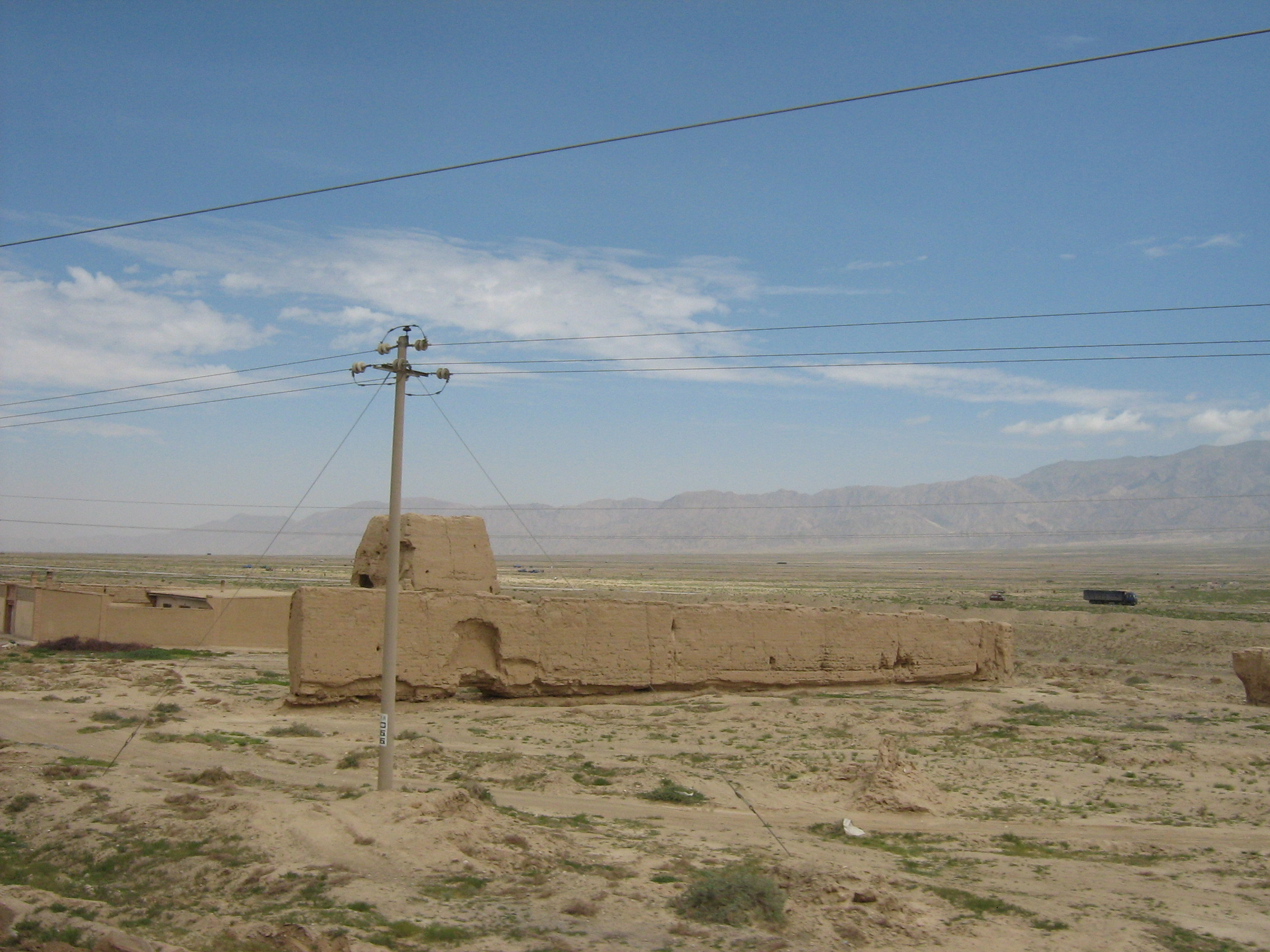
The fort was several miles west, straddling the narrowest portion of a corridor between two high hills. Our map’s brief commentary explained that it had been built to guard against barbarian invaders who could descend toward China through the pass.  Much of the fort had recently been reconstructed. It was tall, square, thick, appropriately forbidding, with concentric sets of walls and gates to keep invaders out and soldiers in. It had its own water supply. A holding pond to one side supported a luxuriant growth of shoreline willows. From the fort’s highest walls, I could see nearby wall remnants that were little more than crumbling mounds of packed earth in a parched landscape.

I saw few other foreigners. There was little English-language signage to explain the construction and history of this portion of the wall. Then a Chinese dad who sported a T-shirt advertising a Charlottesville, Virginia, pizza shop engaged me in conversation and provided some additional information:

“The fort is built mainly of rammed earth. Its initial construction occurred during the Ming Dynasty, starting in the 14th century. In addition to being a military fort, it was also a trading post along the Silk Road between China and the West,” he told me.

When I asked how he’d come by his excellent English and his American-themed shirt, the man told me he was a cardiologist who’d done part of his training at the University of Virginia’s Medical Center. Before I could ask many more questions, he politely bid me good-bye, rounded up his family, and departed the scene in an air-conditioned minivan that looked a great deal more comfortable than our taxi.     

Remnants of the Great Wall near Jaiyuguan, Gansu in northwest China

Why I’m Glad Our Granddaughter is a Girl Scout

Why I’m Glad Our Granddaughter is a Girl Scout    —by Jinny Batterson

I recently spent a week of after-Christmas visit with parts of the next generations of our family on the U.S. West Coast. As visiting grandma, I got to attend some of the children’s after school activities, including a meeting of our granddaughter’s “Daisies and Brownies” troop. Before the meeting, I was curious about how this branch of Girl Scouting had evolved in the generations since I started Brownies in the 1950’s. At first, lacking everyday exposure to younger children, I found this recent meeting’s hubbub a little daunting, though it’s likely that little girls are no more or less squirmy and giggly than my friends and I were so many years ago. For starters, girls now can become “Daisies” a year or two younger than the Brownie program I entered in second grade.  Still, I recognized parts of the program: an opening circle and a check-in when each girl could relate any important events or concerns, lots of singing, lots of running around, a craft activity, time outdoors, a pledge to honor oneself and others, a short-term service project, plus an introduction to this year’s annual cookie sales campaign for the scouts, parents, and grandparents present.

Since the meeting, I’ve ruminated a bit about why I’m glad our granddaughter is in Girl Scouting. Some American girls recently gained admission to Boy Scout troops. The “#metoo” social media movement has gained wide publicity for its attempts to reduce the incidence of sexual assault and sexual harassment (something the Girl Scouts have been doing with less fanfare for decades). Why continue to be a Girl Scout in these changing times?

Based on my previous exposure and my brief reconnection through my granddaughter, these are several aspects that still seem important to me:

—revolving skills-based leadership within a basic structure. No one person has all the skills needed for the many different situations life will throw at us. In Scouting, some will excel at crafts, while others can organize; some are adept song leaders; some have sports skills; some are tech-savvy; still others are gifted at laying campfires. In the troop where I was a member, one girl, Cheryl, was somewhat less athletic than most, not good at crafts, a reluctant camper, quiet and shy. The rest of us knew, though, that she was very important to our troop. She had a family asset missing to the rest of us: her mom worked at a large nearby military base. At cookie sales time, it was Cheryl’s turn to be a star. Though the rest of us were a little jealous as she loaded the family station wagon full of cartons of cookies for distribution, we knew her work was vital to reaching our sales goals each year.

—an international focus in addition to the local, state, and national civic engagement of each Girl Scout. For me, this was best exemplified by the first international Scouting center, a chalet in the Swiss Alps that opened in 1932. Many Scouts know the “Chalet song” with its aspirational closing: “And this its dedication shall never fail nor be undone, each race, each creed, each nation beneath its roof are one.”  The Chalet is now the oldest of five operating international centers, including a recently organized rotating event space among Girl Scouts in Africa. 

—An affirmation of the worth of each individual, along with the importance of working together toward common goals. Like Cheryl in our troop long ago, some Scouts will have less readily visible skills, but Girl Scouting teaches that each of us has an important role to play. No one is inconsequential. When we get overly invested in a “great leader” model, it can be all too easy to forget this basic truth.   

  About this time last year, I was a local participant in one of many “Women’s Marches” that occurred globally on the third weekend of January. At this year’s anniversary weekend, I’ll have to track hometown activities from afar. Yet after having observed our granddaughter’s Girl Scout troop, I’m heartened that, if and when we forget to value all the world’s citizens, she and others like her will continue to show up to remind us:  all of us matter, including women and girls.   

Quilted Dreams

Quilted Dreams    —by Jinny Batterson

There’ve been times, since I outgrew visions of sugarplums,
When I’ve dreaded the coming of winter. Short days, short tempers, cold,
Damp, sniffles, indoor confinement. Winter’s had little to recommend it.

This year’s cold weather was late arriving. Days shortened, but it was
Nearly Thanksgiving before there was frost on the pumpkins. Our schedules
Got disrupted: when to test the furnace, bring houseplants indoors?

Finally, the evening arrived when a blanket was insufficient warmth.
The quilt could be brought out from the linen closet, shaken vigorously,
Then inserted between a fresh sheet and the all-season bedspread.

As my life has grown less hectic, I’ve come to relish the longer
Darkness of late autumn: a chance to sip cocoa before snuggling down
Early, perhaps to drift into episodes of remembered dreams.

I cannot guarantee that the quilt is the cause, but cold weather
Seems to bring more comforting visions: brilliant landscapes visited
Earlier in person or in imagination, peopled with friends and warm welcomes. 

Often I visit cities new to me, revel in explorations and travel that
Can be more pleasant in dreams than in reality–no crowded
Rail cars, no plugged toilets, no mewling youngsters in the seat behind.

The details no longer matter as much. It’s the comfort that counts.
Even when my mind and body are saddest, my waking
Anxieties will sometimes give way to quilted dreams.