
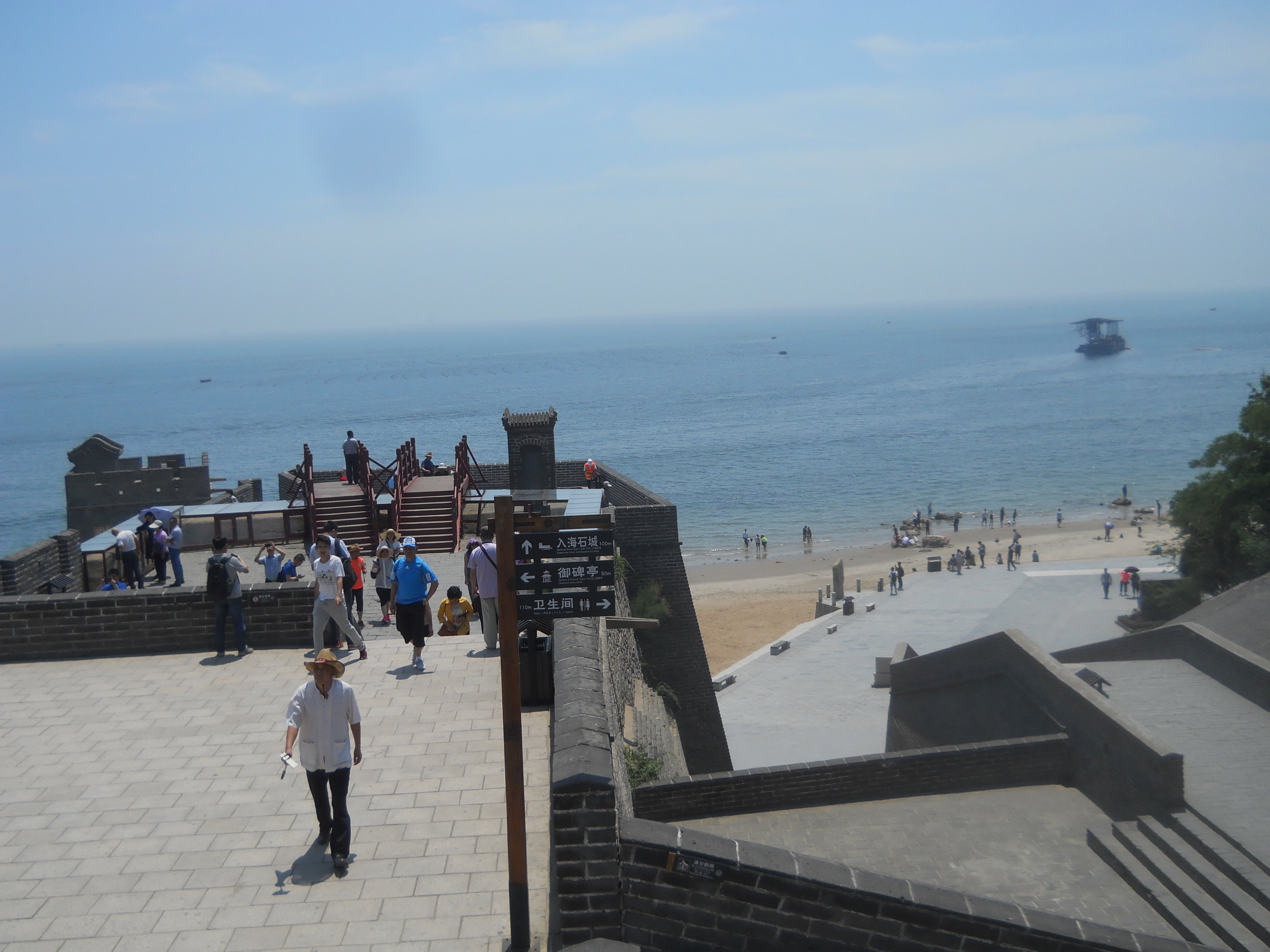
During the summer of 2017, I had a chance to check off a minor item on my “bucket list,” finally visiting an eastern terminus of China’s Great Wall. I’d first seen a section of the wall near Beijing nearly forty years earlier. Much later, I’d visited the wall’s western terminus near Jaiyuguan along a portion of the Silk Road in Gansu Province. Now I wanted to see where this 5,500 mile plus engineering marvel met the sea. One balmy, pleasantly breezy mid-June morning, I got my chance, as part of an extended China trip my husband and I had planned.
On this trip, we’d first reconnect with old friends, then check out areas of northeastern China that were new to both of us. Internet access in China had improved tremendously since our previous travels just five years earlier. My husband, our family’s computer nerd, was able to find enough English-language variants of Chinese travel apps to help craft an unaccompanied land tour in China’s northeast. We also benefited from great advances in China’s transportation and public transit infrastructures, including high-speed rail service between most major cities. As two recent retirees, we could create an itinerary that was more flexible and slower paced than a package tour. My Mandarin skills had advanced to the point where I could carry on very basic conversations: asking directions, purchasing train tickets, ordering in restaurants, swapping basic biographical information with people in more remote areas who were curious about two “big nose” visitors.
For the Great Wall portion of our adventure, we booked several nights’ stay at a luxury hotel in the nearby city of Qinhuangdao, along China’s fashionable “gold coast.” When we arrived, the area was basking in an interval of June weather when the skies were clear and temperatures were comfortable. Our second morning, after a sumptuous breakfast buffet featuring both Chinese and Western dishes, we ordered a taxi and headed the dozen or so miles toward the coast to visit a site where the wall jutted into the sea, at “Old Dragon’s Head” (Laolongtou) along the Bohai Gulf, in northern Hebei province.
Substantial parks surrounded several sections of restored wall. For centuries, walls had been built in this area in attempts to keep marauding northern tribes from attacking Chinese settlements further south. The seaside sections of the wall had been reinforced and greatly expanded during the 16th century, near the end of the Ming dynasty. Close to the wall’s descent to the sea, a few Ming dynasty stones had been left bare to show layers of the original wall’s structure. Along most other accessible portions of the wall, modern stones had been added during restoration efforts in the 1980’s and 1990’s to provide a more uniform surface.
We spent parts of two days exploring several portions of the wall, getting to and from town sometimes by taxi, other times by inexpensive public bus. The area was blanketed with signs in Chinese, Russian, and English. A major toll road, the Jingshen Expressway, ran from Beijing over 400 miles northeast to the city of Shenyang via Tianjin, Qinhuangdao and Beidaihe, a summer hangout for senior Chinese officials. As we skirted parts of the expressway, we saw familiar green and brown highway signs, signaling exits (green) and sights of interest (brown), the same color scheme used along many U.S. interstate highways. Tourist services were abundantly available, including a KFC where we shared a chicken nuggets lunch, surrounded by conversations in Mandarin, Italian, French, and Russian.
Looking right from the final seaside tower at Laolongtou, I could see a wide sandy beach. A little further in the other direction was a major modern container port. I was impressed with the scope and strength of the wall itself, but flummoxed by the notion that the wall could keep out anyone out who desperately, passionately wanted to get past it—a simple small boat under cover of night might suffice. Actually, forces of China’s final imperial dynasty, the Qing, had come from north of the wall and marched south through it at a strategic pass as the Ming Dynasty disintegrated due to corruption and infighting.

