Category Archives: Spiritual musings

A Protest Lullaby Project

A Protest Lullaby Project   —by Jinny Batterson

My hope is that many of you can remember a time in your childhood when your mother or a special adult sang you a soothing lullaby.  One of my favorites is “All Through the Night,” originally a Welsh song. (https://www.youtube.com/watch?v=KzFqirIGVB4) 

The past couple of months, especially the past couple of weeks, have been unsettling for me. As I write, the annual June anniversary of the use of repressive force in China in 1989 has nearly arrived. Many of us living in the United States of America are witnessing the use of repressive force on our own streets. In the wake of another senseless murder of an unarmed black man, demonstrations have begun and persisted in many American cities.  

At the same time, a global viral pandemic has hit our country hard, uncovering many inequities and rifts that those of us in comfortable circumstances have tried for too long to cover over. Concerns over the spread of the virus have dampened the public activism of many older Americans, those of us most vulnerable to serious illness or death from covid-19.

Many who are wiser than me have counseled prayer. Spending time on our knees is one good way to acknowledge both our pain and our solidarity. Another may be songs, both energetic and uplifting, and, at the close of the day, soothing.

My hope is that younger people in areas under curfew will continue peaceful in-person protests, wearing face coverings and observing as much social distancing as possible. Airing long-festering grievances and concerns, both in public protests and in virtual spaces, is crucial to beginning to address them.  

I suggest that we add to other protest rituals, a few minutes before curfews take effect, a lullaby. Let’s sing to each other, to ourselves, to our President and political leaders of all persuasions. Let’s choose whatever language and idiom most suits. Let’s mouth the words, silently or aloud. If we are not under curfew, let’s practice a lullaby a few minutes before sunset. 

Singing and praying to and for each other will not by themselves solve our problems. Nothing but sustained, concerted actions at many levels will. But a lullaby can offer a brief respite, perhaps open a greater possibility for healing our too-fractured world.   

Hush, my worldmates, peace attend thee, all through the night…

Wandering in the Wilderness of COVID-19

Wandering in the Wilderness of Covid-19 —by Jinny Batterson

When as a child I read Bible stories about the forty years the Hebrews spent wandering in the wilderness after they fled Egypt and before they entered the promised land, I could partly identify, as someone who easily becomes lost. However, even as a child, I thought forty years seemed a very long time. I guess they probably didn’t have an app back then for directions on their cell phones, but couldn’t they ask someone for directions?  Didn’t anybody have a map?

As we humans try to navigate our way through the covid-19 pandemic, I’ve become more appreciative of the Hebrews’ difficulties. It wasn’t just physical distance the Hebrews needed to traverse. Turns out, the space between one “normal” and the next was just as much psychological as physical. The Biblical Book of Numbers tells of the challenges of life in the wilderness. At first, some Hebrews wanted to return to Egypt. There, though enslaved, they at least had plenty of varied food:  “We remember the fish we ate in Egypt for nothing, the cucumbers… and the garlic; but now our strength is dried up, and there is nothing at all but this manna to look at.” (Revised Standard Version, Chapter 11, verses 5-6). 

As they neared what they expected to be the promised land, overall leader Moses sent twelve tribal chieftains to assess the area: “Go up into the Negeb yonder, and go up into the hill country, and see what the land is, and whether the people who dwell in it are strong or weak … and whether the land that they dwell in is good or bad… Be of good courage, and bring some of the fruit of the land.” (Chapter 13, verses 17-20). The majority report, ten of the twelve, recommended giving up—the people already in the promised land were too strong. This majority even discounted the land’s good points, saying, in essence, that it was not worth fighting for. A minority of two believed the land was indeed worth trying to possess. They thought the challenges were not insurmountable, given spiritual assistance. It took an entire generation, plus lots of disease and death, before the rest of the Hebrews were persuaded.  

Another example, from the medical field, is closer to modern America in distance and time. It concerns the spread of the use of antiseptics to prevent post-surgical infections. In the nineteenth century, surgical advances made more complex operations possible, but deaths following surgery soared, sometimes taking half of all patients. One British professor of medicine then observed: “A man laid on the operating table in one or our surgical hospitals is exposed to more chance of death than was the English soldier on the field of Waterloo.” 

British surgeon Joseph Lister in 1865 read the results of experiments by French scientist Louis Pasteur, who connected microscopic bacteria with fermentation in foods and wine. Lister wondered whether what caused fermentation in food might also cause infections in wounds. In the late 1860’s, he began experimenting with different procedures and chemicals to reduce the chances of infection. He published the results of his cases in medical journals. Over time, he refined his approaches. Still, it took nearly a generation before antiseptic practices were widely used in hospital surgery wards. 

The wilderness of covid-19 response is disconcerting. Recommendations of currently available best practices can be confusing. As my home state of North Carolina begins the second phase of cautiously reopening its economy, the NC Department of Health and Human Services advises that I’ll still be “safer at home,” but that I’ll have an expanded range of businesses and non-profit groups I may visit. When getting my hair cut at a reduced-occupancy salon or dining in a reduced-occupancy restaurant, I’m advised to “wear, wait, wash”—wear a face covering (except, presumably, while eating), wait at least six feet from other customers, and wash my hands frequently (https://covid19.ncdhhs.gov/materials-resources/know-your-ws-wear-wait-wash). 

My guess is that it will be a good while before we’ll reach a post-covid “normal,” though I hope it will take less than forty years. Those of us who survive this pandemic will mourn our losses. In hindsight, we’ll realize that some preventive measures we tried were more effective than others. Some people will remain unenthusiastic about the longer-term changes we will need to make to reduce the threat of future pandemics. 

Still, we may take heart from the experiences of those venturing toward a promised land or safer surgery. The wilderness, however disorienting or longlasting, is neither uniform nor useless. It provides the venue and the time to develop and practice new skills we need. We cannot go back; with good guidance and courage, we can go forward. Please stay as safe and sane as possible, all, while we venture toward our post-covid world!  


The Wonders of Dual “Virtual Church”

The Wonders of Dual “Virtual Church”  —by Jinny Batterson

For the past few years, I’ve attended services at two different religious congregations, one a predominantly “white” Unitarian-Universalist group, the other a predominantly “black” African Methodist Episcopal church.  This “dual citizenship” religiously has enriched my spiritual life greatly while posing some practical problems. The physical buildings of the two congregations are several miles apart—a ten-minute commute by car. Both churches have traditionally held their in-person services at 11 a.m. on a Sunday morning, so I’ve had to decide each week which service to attend. Sometimes I can “double up” and slip belatedly into the latter part of the AME service, which tends to run a little longer. 

Enter the covid-19 pandemic. This viral scourge has caused lots of changes in our customary ways of ordering our lives, not the least of which has been a temporary set of restrictions on large interpersonal gatherings.  Now both churches hold their Sunday services virtually. If I set up my computer correctly, I can switch instantaneously between the two, catching both sermons and most of the music both places. Most weeks, the recordings of the services stay on the internet for a few days, so if I miss part of a reading or story, I can catch it on Monday or Tuesday.

This past Sunday, the UU sermon centered on learning to slow the pace of our often frenetic lives, to savor time with family, to relearn habits of connecting that may have gotten diminished or lost altogether in our pre-covid frenzy of work/commute/family/physical health activities. The AME service reminded us that God is the ultimate arbiter of our reality, not the latest breaking news, case counts, or polling results. “We shouldn’t discount the very real challenges,” the minister counseled, while he warned us not to focus on them to the exclusion of our connection with the holy.  

The wise words from both sources helped prime me for the week ahead. The music that went with each service was healing, too. In so many ways, I’ll be glad when we have fewer issues related to corona viruses. It will be special to be able to see fellow parishioners face-to-face rather than via computer or smartphone screen. Maybe eventually I’ll have chances again to shake the ministers’ hands. There’s something for me about the experience of physically worshipping together that no virtual environment can fully replace. Still, I don’t want to forget the spiritual gifts and scheduling flexibility that this hiatus from “regular church” has offered me. 

Please stay safe, pray a lot, and remember that the gift of life is just that—a gift, to be used as wisely as we can discern, with as much spiritual help as we can find.  

Earth Has Its Day

Earth Has Its Day   —by Jinny Batterson

Had this been a “normal” year, there would have been big crowds today commemorating the 50th annual Earth Day. There would have been lots of in-person speeches. There would have been live exhibits from corporations and non-profits with a mixture of important initiatives and “greenwashing,” spotlighting small impacts for mainly public relations value. There would have been more exhortations to “reduce, reuse, recycle.” 

This is not a normal year. A small pathogen whose exact origin is still unclear began spreading a respiratory ailment among the global human population in late 2019. As of today, covid-19 had caused nearly 2.5 million known infections and nearly 170,000 deaths. Much of the globe’s human population is on “lockdown.” Public gatherings are few. 

In parts of the world, other variations in nature are wreaking havoc in different ways: a plague of locusts in east Africa is destroying food crops, threatening the food supply of tens of millions; forest fires in Ukraine near the defunct Chernobyl nuclear power plant have recently caused the Ukrainian capital, Kiev, to have the worst air pollution of any place in the world; widespread bush fires during Australia’s 2019-2020 summer have blackened millions of acres and killed roughly a billion animals, endangering such unique species as kangaroos and koalas and putting Australia’s agricultural sector at risk; Greenland and Antarctica have ice sheets that are melting at increasing rates. 

Perhaps earth is reminding us, in increasingly urgent terms, that we are not the masters of the planet, but its guests and its (temporary) stewards. 

For much of my adult life, I’ve accumulated a clipping file of quotations and short pieces of prose that seem meaningful to me. During a personal or societal crisis, I reread them for wisdom. A while ago, I came across the World War II era diaries of Anne Morrow Lindbergh, War Without and Within, edited and first published long after that war was over, in 1980. Anne and her husband, aviator Charles Lindbergh, had spent part of the 1930’s living in Europe to regain some privacy after the highly publicized U.S. kidnapping and murder of their first child.  A pacifist often identified with her isolationist husband, Anne was deeply affected by the 1939 onset of war in Europe and the entry of the U.S. into a globalized conflict in late 1941. A diary entry from Easter Monday during the spring of 1942 expresses both sorrow and hope: 

“Today is the real Easter morning. Yesterday was overcast and chilly. This morning is still, warm, newly awakened. One walks out into it like a flower just opened. …
When I was young, I always felt a morning like this meant a promise of something wonderful … love in someone’s heart far away from me, or the success of some venture of my own. I thought–quite literally–it was a sign from heaven. The person who was ill would get well. … Or maybe something wonderful was happening for the world–some new spirit blooming. … the morning was a ‘sign.’
I still believe it is a ‘sign,’ but not for anything good happening to me or the world, anything specific. The love is not blooming in someone’s heart. The ventures fail. The one who is sick, dies, and the one who is lost is never found. Hate and cruelty and evil are still rampant, war goes on.
And yet it is a sign. It is a sign that in spite of these things beauty still exists and goes on side by side with horror. That there is love and goodness and beauty and spirit in the world–always. This is only one of the times when it is clothed in flesh–in the flesh of a spring morning.”

Amid the global concern about the covid-19 pandemic and the seemingly unending series of recriminations about whose “fault” the pandemic is, there have been occasional notes of clearer air in unexpected places, of a resurgence of birdsong alongside nearly empty highways. 

This morning where I live dawned crisp, cool, bright, with almost jewel-like clarity. May it be a sign. Happy Earth Day!   

Year of the Phoenix?

Year of the Phoenix?   —by Jinny Batterson

During the shortest days of the year for the past several years, an exhibit of lighted figures has come to our town—a multi-acre display of LED-illumined silk lanterns produced in the Chinese city of Zigong, in Sichuan province. Zigong’s artisans have long crafted lanterns for Chinese festivals. In recent decades they’ve gained global fame for their beautiful handiwork. Increasing numbers of U.S. cities are using winter-dormant park spaces to mount both static and interactive displays. 

Our town’s display centerpiece is near the shore of a multi-acre lake: until this year a magnificent dragon (shown in a previous post—https://jinnyoccasionalpoems.com/2018/01/03/chinese-lantern-festival-an-american-version/).  When I attended this year’s event just before (western) New Year, I wondered, as I wandered down a slope decorated with shapes of real and mythical animals, if the dragon had taken its accustomed place. No dragon, not this year. Instead, an equally impressive floating display of a mythical phoenix, complete with pulsing lights going from head to tail.  

The night I saw the display, the weather was fairly mild for late December. Attendees from multiple cultural traditions mingled and oohed and aahed at the depiction of the fabulous bird. A little research about legends of the phoenix show the magic bird as a staple in the mythology of multiple civilizations, including Egyptian, Greek, and Chinese: 

“In Asia the phoenix reigns over all the birds, and is the symbol of the Chinese Empress and feminine grace, as well as the sun and the south. The sighting of the phoenix is a good sign that a wise leader has ascended to the throne and a new era has begun. It was representative of Chinese virtues: goodness, duty, propriety, kindness and reliability. Palaces and temples are guarded by ceramic protective beasts, all led by the phoenix.” ( https://www.ancient-origins.net/myths-legends/ancient-symbolism-magical-phoenix-002020; accessed 2020/03/27) 

When our town’s lantern display was packed up for return to Zigong in mid-January, it was nearly time for Chinese New Year (or “Spring Festival,” celebrated in 2020 starting on January 25). The upcoming Chinese year would start another cycle of the 12-animal Chinese zodiac, which includes the dragon, along with eleven other real-life animals (in sequence: rat, ox, tiger, rabbit, dragon, snake, horse, sheep, monkey, rooster, dog and pig). So far, the phoenix has not become part of the Chinese zodiac, though the mythic bird is often considered the feminine counterpart to the masculine dragon. 

Now that covid-19 has become a global pandemic, I’ve been asked, like more and more people all over the world, to self-isolate at home to reduce the speed of the virus’s spread, allowing health care systems time to adapt by “flattening the curve” of new infections. If I’m a bit bored, it’s a small price to pay for a larger social good. The next generation in our family includes two members of hospital medical staffs, and their safety is a big concern.  

This enforced time at home gives me license to engage in reveries about the mythical bird. Many legends of the phoenix depict it as an extremely long-lived creature who senses approaching death, builds her own funeral pyre, and then dies in fiery majesty. Shortly afterwards, the next generation of phoenix rises from the ashes.  

What might the symbol of the phoenix mean as 2020 begins with a global pandemic—the death of an overly competitive ethos and the dawning of an age of more thorough global cooperation? a rethinking of our interlocking systems of education, health care, corrections, and social welfare? a reining in of our preoccupation with material wealth? renewed reverence for the natural world that supports us all? 

Let’s hope that 2020 will turn out to be a year of the phoenix.   

Phoenix lantern at NC Chinese Lantern Festival

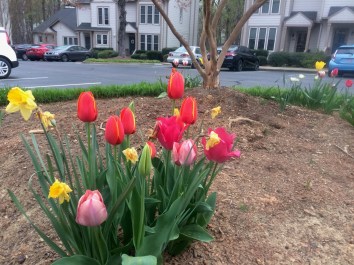
The Tulips Don’t Care about Pandemics…

Tulips and Pandemics –by Jinny Batterson

Doing a bit of “nature therapy” yesterday during a brief shower, and took a couple of pictures in our smallish condo complex. This morning got a link from a more media-literate friend, an opinion piece that long-term astronaut Scott Kelly had penned about coping with isolation. Very grateful that many of us have the technology to stay closer in touch via phone and internet. Glad there are parts of nature that seem little affected/afflicted by our current human pandemic. Please take care, all!

tulips in our condo complex

more tulips, oblivious to human worries

Gardener’s Song

Gardener’s Song   —by Jinny Batterson

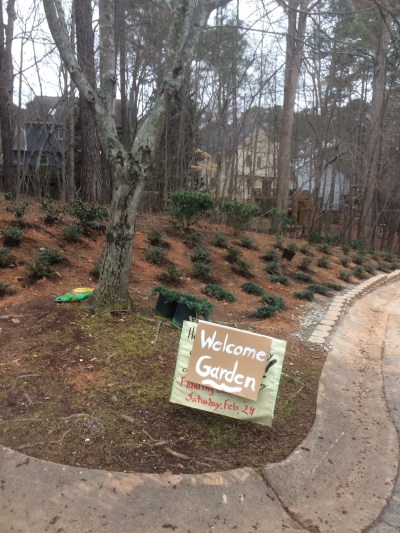
(In memory of Nancy Small Van Dijk on what would have been her 72nd birthday; Nancy served for several years as HOA chair of our condo complex. During her term, she spearheaded an effort to get a “Welcome Garden” of flowering shrubs at our previously clay-slope entry drive.)

This garden is overgrown, the weeds are practically choking it.
I come here and sit alone, and wonder what will become of it.
Yet we started out as gardeners, as workers in the soil,
And we reaped a bounteous harvest from our ever-loving toil.

Some cities are overgrown, with drugs and crime and pollution.
We sit in barred rooms alone, each writing a rational solution.
Yet we’ve cities full of gardeners, of players in the soil,
And the plants and herbs and flowers reward our ever-loving toil.

Our planet is overgrown, wars, strife, disease, aggravation,
We stumble our lone ways home, uncertain of continuation.
If our world should blow to pieces, not survive its own turmoil,
Would we all come back as gardeners, blessed to ever-loving toil?

"Welcome garden" planted February, 2018

“Welcome garden” with Nancy’s sign soon after planting in 2018

The Doors of the Church are Open

The Doors of the Church are Open  —by Jinny Batterson

During my childhood and adolescence, I attended Sunday school. As a young adult, I took a multi-year sabbatical from organized religion, then resumed attending a small congregation—a chance to sing in the choir, I told myself. I liked being an alto. For the past several years, I’ve attended two different congregations. One is mostly white, generally affluent, with a mix of children and adults, trending toward the older end of the age continuum. The other is mostly black, less affluent, with a similar age distribution. The Unitarian-Universalist congregation has slightly more college professors than the African Methodist Episcopal congregation; A.M.E. worshippers include slightly more former college football players and basketball stars. Both groups have several hundred members on their rolls, some of whom show up most Sundays. As older members die off, our numbers dwindle.

The fastest growing religious segment of the overall American population are the “unchurched.” A 2014 Pew Research Center survey of more than 35,000 Americans found that the percentage of adults (ages 18 and older) who describe themselves as Christians had dropped from 78.4% in 2007 to 70.6% just seven years later. Over the same period, the percentage of Americans who are religiously unaffiliated – describing themselves as atheist, agnostic or “nothing in particular” – jumped from 16.1% to 22.8%. 

Many younger adults have little use for Sunday worship. Partly, this is because Sunday morning can be the only unscheduled interval in their increasingly busy lives. Another partial answer may lie in incidents of mass violence, like a 2008 shooting at a UU worship service near Knoxville, Tennessee or the 2015 assault on an evening prayer service at an AME church in Charleston, South Carolina. These two horrendous incidents are part of a series of mass shootings in churches, synagogues, mosques, and temples that can badly damage our sense of safety. The congregations I attend have trained our ushers to be alert to potential violence, defusing it if at all possible, otherwise sounding the alarm and limiting the damage.

In both congregations I attend, we wrestle with questions of how to affirm each other’s dignity, how to forgive each other and ourselves, how to help each other grow spiritually. Both congregations also grapple with hateful rhetoric coming from the highest levels of our government. The U.S. constitution forbids church statements in support of or opposition to specific political figures or groups. However, we allow support of or opposition to specific policies and behaviors. Right now, churches are often centers of opposition to inhumane treatment of immigrants or “others.” 

Despite many similarities, both of the congregations I attend feel incomplete to me. I wonder if it’s partly because they continue to reflect a situation that Dr. Martin Luther King, Jr. noted in a 1960 speech: eleven o’clock on a Sunday morning is among the most segregated hours in Christian America. In a religion whose basic tenets include “love one another,” such segregation of “white” and “black” (or any other group identity) is hypocritical at best. Is how poorly we walk our talk one important explanation of formal Christianity’s dwindling numbers?

Given its recent decline, it’s tempting to conclude that Christianity, even religion more generally, may not survive in 21st century America. I think it can both survive and thrive, but rejuvenating our faiths will take a lot more than one older woman crossing a racial divide to attend two churches.

After both the Knoxville and the Charleston incidents, church leaders reassured and challenged us: whatever losses we’d suffered, “the doors of the church are still open.”  Often I imagine church doors as fully hinged swinging doors—capable of swinging out as well as in, like the doors sometimes found between restaurant kitchens and dining rooms, or fronting saloons in old cowboy movies. 

Many church activities have little doctrine associated with them. They can happen outside the confines of church buildings. They’re not limited to a single day per week. They are just something we can do as Christians, as humans—social outreach, social justice, social uplift. Our faith encourages us to feed the hungry, shelter the homeless, visit the sick and those in prison, comfort the bereaved.

From what I know of church history, the earliest Christians had no special buildings, very little liturgy, no delineated creeds. They just wanted to share the love of God with their fellow humans and with the rest of creation. Such sharing is not limited to Sunday mornings. It recognizes no artificial boundaries. The “doors of the church” in each one of us need to swing both ways. Maybe then the doors of our various denominations will be easier to keep open.      

Choosing Your Starfish

Choosing Your Starfish  —by Jinny Batterson

One of the years when I taught English in China, my students were fascinated by a story about an old man, a young boy, and a beach filled with stranded starfish. Many variants of the story have appeared. The one my students were most familiar with went something like this: 

  One morning after a storm, an older man went out for his customary walk along a gently curving stretch of beach. The weather had cleared. As he looked ahead, the man could see in the distance a small figure, also walking along, sometimes bending down, then throwing something into the waves. As the older man got closer, he saw that the other person was a young boy, perhaps twelve years old. The stretch of beach nearest them was littered with stranded starfish. Once in a while, the boy leaned over, picked up a starfish, and tossed it back into the sea.

“You’ll never succeed in making a difference for every living starfish,” the old man cautioned. “There are too many of them, and they can’t live very long on the beach.”

“That’s not the point,” replied the boy as he tossed another starfish back into the waves. “I made a difference for that one.”  

I didn’t remember having heard the story before. When I recently checked online for the story’s origin, I found it had appeared in slightly different form in 1969 as part of an essay titled “Star Thrower” by philosopher Loren Eiseley. A number of charitable organizations have since taken up the image of a rescued starfish as part of their name or marketing—groups for ex-offenders, for poverty-stricken children, for survivors of childhood abuse, for injured veterans, and so on. A variation of the story’s theme has been made into a children’s film, “Sara and the Starfish.”

The fable is both challenging and reassuring to me in these unsettled times. As someone with a tendency to obsess about all the actual and potential “starfish” I may encounter, I find the story helps me maintain or regain perspective. Of course I can never save all possible starfish. It’s important, though, that I pay attention to the starfish who get stranded on “my” beach with problems that match my resources and the solution skills I’ve developed. 

Who/what is your starfish?  

Building Lop-Sided Bridges

Building Lop-Sided Bridges    —by Jinny Batterson

About this time of year in 1997, I got a nasty shock. I was diagnosed with breast cancer. A set of cells had gone malignant and might soon invade the rest of my body. Several months earlier, I’d had my annual mammogram and was told it was normal. So at first, I wrote off the lump that showed up around Hallowe’en as just another annoying symptom of menopause. I was a healthy, middle-aged white woman. I ate well, exercised regularly, had gotten all my prescribed screenings. I made a comfortable living as a consultant, had two college-age sons, a husband who loved me, and no family history of breast cancer. The lump would go away on its own. It didn’t. Further tests showed an aggressive tumor. By early December, I’d had a modified radical mastectomy without reconstruction. I was pretty shaky both physically and mentally. 

As I began to heal, I tried to use my experiences as a teaching tool. Our Unitarian-Universalist congregation in Richmond, Virginia had long engaged in efforts to help promote racial healing. Each year about the time of the MLK holiday, we had a special service with a racial justice theme. This particular year, I’d been working for several months before my diagnosis on the planning committee for the service. As I began to regain strength after surgery, I asked if I could do a short talk about my “lop-sidedness,” using my body as a metaphor for the way our entire society was lop-sided and hampered by our history of individual prejudice and systemic racism. We all needed healing. I composed and rehearsed my talk. By early January I was confident that I’d have the physical stamina and the psychological strength to deliver a 10-minute talk, even with the prospect of six months of chemotherapy looming. 

Then I went to choir rehearsal. Our young choir director wanted to use spirituals to accompany the service. He’d chosen “Soon I will be done with the troubles of this world, goin’ home to live with God…” as the meditation hymn. I flinched. Jamie was a wonderful musician, but I really didn’t want to identify with that particular song at that particular time in my life. Privately, I asked if we could substitute something more upbeat. I got a reprieve. We wound up singing “I’m so busy servin’ my Master, ain’t got time to die…”  Both the congregation and I survived to continue our work. 

A decade later, I learned that my favorite college roommate had developed breast cancer. Beth had grown up near Richmond, graduated from our small liberal arts school, then gotten an advanced degree in library science. She’d moved to different parts of the country. She spent much of her career administering college libraries—first in Ohio, then South Dakota, then Florida. We kept up via holiday cards and occasional phone calls. In her 50’s, Beth had changed focus slightly and taken a post as director of a set of public libraries in an economically depressed part of lowland South Carolina. Beth had been in her new job only a year or so when the cancer hit. Her family and friends rallied to her support. Once her most intensive treatments were over, I went down for a weekend visit. We traded survivor stories. When she passed the five year mark without a recurrence, I sent hearty congratulations. Then, a couple of years later, a non-cancerous illness destroyed her kidneys and took her life with little warning. That April, I drove south through timber plantations, palmetto swamps, and railroad cuts festooned with blooming wisteria vines to get to South Carolina for Beth’s memorial service. I didn’t know much about her town, but suspected it would be as highly segregated racially as much of the South I’d previously been exposed to.

The small Methodist church was nearly full. Some of the mourners were family members I recognized, but I was surprised to see half a dozen older black women among the mostly white worshippers. I guessed at first that perhaps the women were maintenance workers at some of the libraries Beth supervised, then chided myself for stereotyping. At the reception after the service, I had a chance to talk with one of the women.

“How did you know Beth?” I asked.

“We were part of a local support group called ‘Bosom Buddies’,” the woman explained, pointing to the discrete pink lapel pin she wore. 

I never learned much about the group. Beth may have had a hand in creating this cross-racial sisters-beneath-the-skin effort in the area she’d made her home. Whatever her role, she’d reached out across any racial divide, creating enough of a bond so that six women had taken the time to attend her memorial service.

Our country remains in need of healing. Pundits of many political leanings expound on all the ways we are polarized— economically, racially, politically, spiritually. Income disparities persist; wealth gaps have gotten worse. Gun violence takes too many lives; “stop and frisk” procedures and mass incarceration further divide us. Health outcomes vary tremendously, based partly on income and ethnicity. We’re still lop-sided. We all need healing. Perhaps those of us who are physically lop-sided can continue to build lop-sided bridges.