Tag Archives: Zigong

NC Chinese Lantern Festival, 2020

This year, 2020, has been an unsettling year, burdened with covid-19 tragedies, leading up to a strange holiday season. As life got more constricted, large-scale gatherings fell by the wayside. Mid-autumn, our town announced that this year’s Chinese Lantern Festival, typically held during the shortest days of fall/winter in a large outdoor park, was reluctantly being canceled due to health and safety concerns. Bummer!  Another feel-good event fallen victim to the scourge of covid-19. 

For several previous years, winter evenings in our part of North Carolina had been brightened by the display of an abundance of LED-lit silk lanterns. The many lifelike or fanciful figures were variations on the traditional Chinese lanterns fabricated in a small Chinese city, Zigong, where the craft of lantern-making is centuries old. A Chicago-based affiliate helped organize American exhibits, which focussed ever more strongly on depictions of animals.

In late November, I finally got a glimmer toward a pandemic-adapted “new normal.” After eight months of closures or “take-out-only books,” our regional library reopened. The spacious new structure had opened only a year or so before the pandemic upended life as we’d known it. To operate safely with in-person patrons, it now incorporated health screenings and stricter limits on patron numbers at any given time. The third day after the reopening, I ventured downtown to the library, passed the screening questions and the temperature check, and got my first “fix” of in-person perusal of its extensive collection of both fiction and non-fiction titles. As I later walked outdoors nearby, I noticed that a small open space (where the old library had been) had a collection of inflatable figures, being blown nearly off their moorings on this windy day—a very scaled down holiday display. A week later, I ventured downtown again—to return some books.
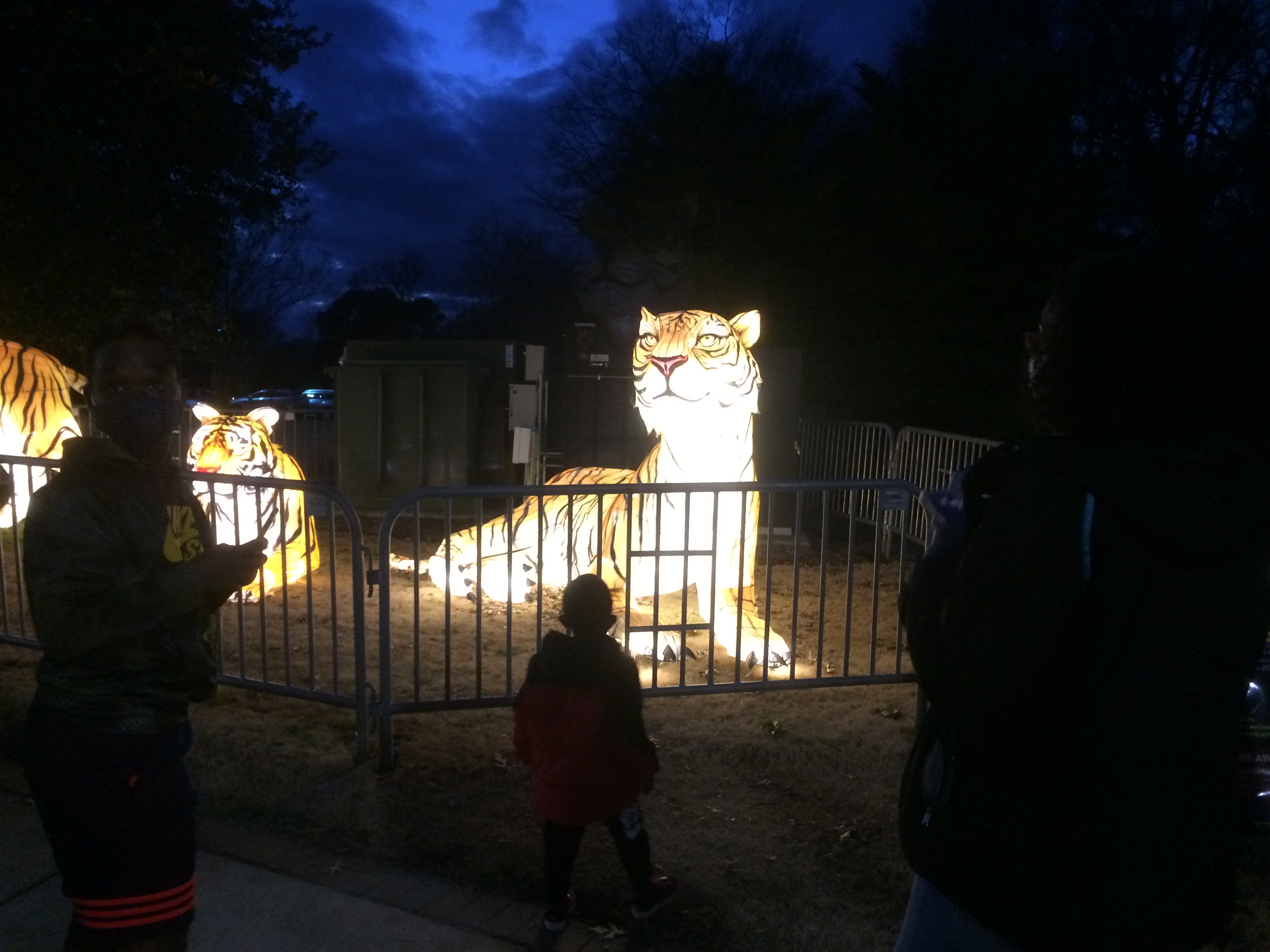
NC Lantern festival tigers, 2020

Lo and behold, the flimsy figures in the open space had been replaced by a display of well-anchored, life-sized silk elephants, with a sign saying they were part of a diminished Chinese Lantern exhibit. I vowed to come back after dark to see them in their LED-infused glory. The display (one of seven, it turned out) had been positioned in a way that minimized the dangers of close contact. It was adorned with cautionary signs about social distancing, maximum numbers of people, and mask wearing. One weekday evening in December, my husband and I met a couple of local friends for a socially distanced ramble to see all of the animals—elephants, tigers, a rhino, red pandas, a bear and a jaguar, snakes, and eagles. 
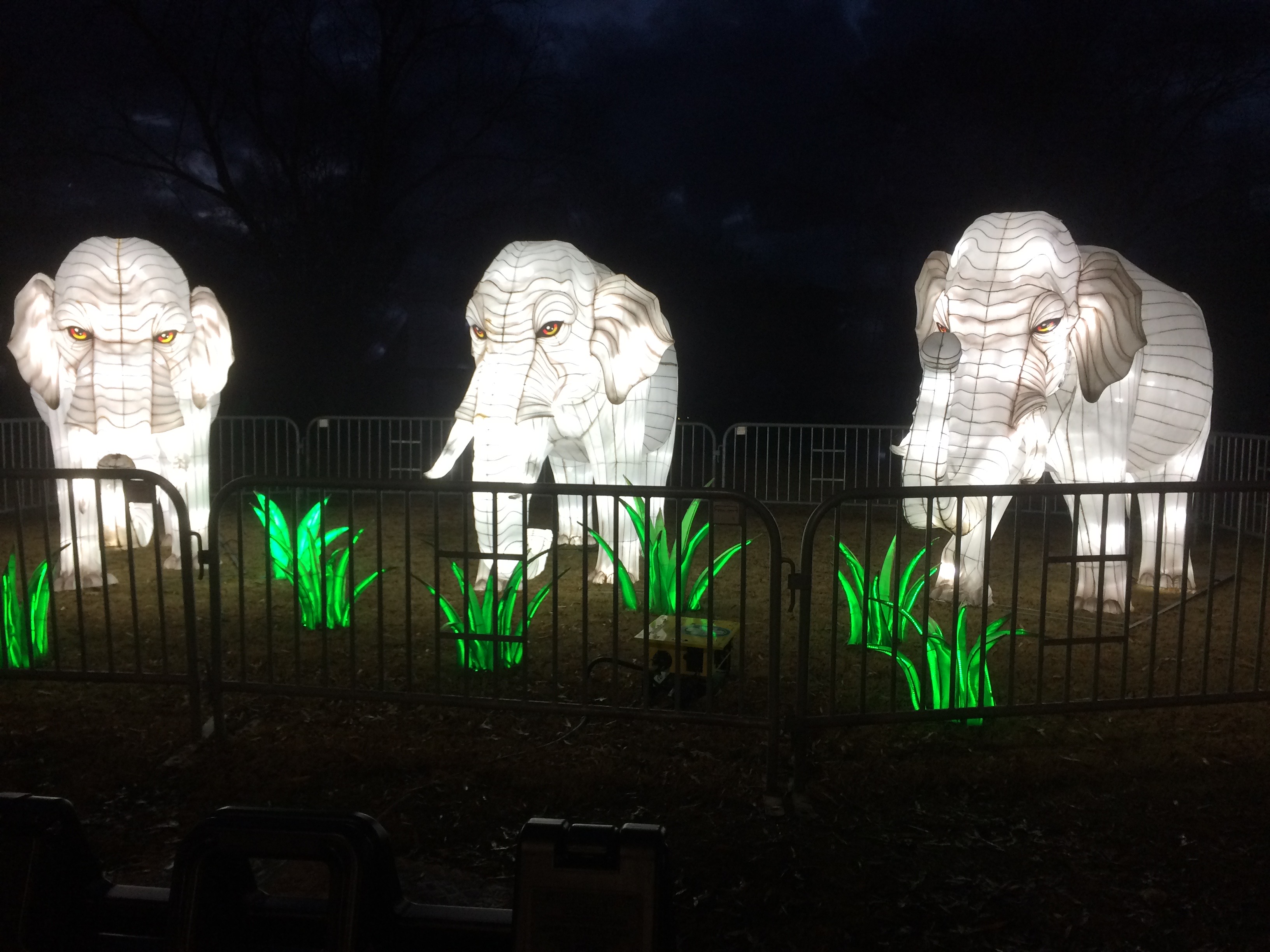
NC Lantern Festival Elephants, 2020

My husband thought he’d seen in an online article that the figures were “on loan” from a zoo in the Midwest. Once we tracked down an appropriate reference, we found that earlier in the year they’d been part of an exhibit at the Cleveland Zoo, so hadn’t needed to make the lengthy trip from Zigong in order to enthrall North Carolina audiences.    

My hope is that the holiday season of 2021 will find the pandemic finally in our rear view mirror. Our town then may again be able to host a full version of the lantern festival. However, I think it’s heartening that even this year, though the lights may have been diminished temporarily, they haven’t been extinguished. Merry Christmas! Happy New Year! Happy (upcoming) Year of the Ox!

Year of the Phoenix?

During the years’ shortest days for the past few years, an exhibit of lighted figures has come to our town—a multi-acre display of LED-illumined silk lanterns produced in the Chinese city of Zigong, in Sichuan province. Zigong’s artisans have long crafted lanterns for Chinese festivals. In recent decades they’ve gained global fame for their beautiful handiwork. Increasing numbers of U.S. cities are using winter-dormant park spaces to mount displays. 

Our town display’s centerpiece is near the shoreline of a multi-acre lake: in prior years a magnificent dragon.  When I attended this year’s 2019-2020 event just before (western) New Year, I wondered, as I wandered down a slope decorated with shapes of real and mythical animals, if the dragon had taken its accustomed place. No dragon, not this year. Instead, an equally impressive floating display of a mythical phoenix, complete with pulsing lights going from head to tail.  

The night I saw the display, the weather was fairly mild for late December. Attendees from multiple cultural traditions mingled and oohed and aahed at the depiction of the fabulous bird. A little research about legends of the phoenix show the magic bird as a staple in the mythology of multiple civilizations, including Egyptian, Greek, and Chinese: 

“In Asia the phoenix reigns over all the birds, and is the symbol of the Chinese Empress and feminine grace, as well as the sun and the south. The sighting of the phoenix is a good sign that a wise leader has ascended to the throne and a new era has begun. It was representative of Chinese virtues: goodness, duty, propriety, kindness and reliability. Palaces and temples are guarded by ceramic protective beasts, all led by the phoenix.” ( https://www.ancient-origins.net/myths-legends/ancient-symbolism-magical-phoenix-002020 ; accessed 2020/03/27) 

In mid-January, our town’s lantern display was packed up to return to Zigong. It was nearly time for Chinese New Year (or “Spring Festival,” celebrated in 2020 starting on January 25). The upcoming Chinese year would start another cycle of the 12-animal Chinese zodiac, which includes the dragon, along with eleven other real-life animals (in sequence: rat, ox, tiger, rabbit, dragon, snake, horse, sheep, monkey, rooster, dog and pig). So far, the phoenix has not become part of the Chinese zodiac, though the mythic bird is often considered the feminine counterpart to the masculine dragon. 

Now that covid-19 has become a global pandemic, I’ve been asked, like many people all over the world, to self-isolate at home to reduce the speed of the virus’s spread. This will allow health care systems more time to adapt by “flattening the curve” of new infections. If I’m bored, it’s a small price to pay for a larger social good. The next generation in our family includes two members of hospital medical staffs. Their safety is a big concern.  

This enforced time at home gives me license to engage in reveries about the mythical bird. Many legends of the phoenix depict it as an extremely long-lived creature who senses approaching death, builds her own funeral pyre, and then dies in fiery majesty. Shortly afterwards, the next generation of phoenix rises from the ashes.  

What might the symbol of the phoenix mean as 2020 begins with a global pandemic—the death of an overly competitive ethos and the dawning of an age of more thorough global cooperation? a rethinking of our interlocking systems of education, health care, corrections, and social welfare? a reining in of our preoccupation with material wealth? renewed reverence for the natural world that supports us all? 

Let’s hope that 2020 will turn out to be a year of the phoenix.   

Phoenix lantern at NC Chinese Lantern Festival