Category Archives: Spiritual musings

The PRC at 70

She’s an impressive dowager,
A real rags to riches story–
Rising from the ashes of
A brutal civil war,
After a century of quasi-colonial
Oppression, she turned inward
And recreated herself.

A few convulsions temporarily
Sidelined her progress,
But now she stands proud–
The world’s greatest factory floor,
Flooding our shelves with goods
We couldn’t have imagined
A scant generation ago.

Of course she suffers from arthritis—
Twinges in her toes.
At her other extremity,
A bowl shaped desert
That refuses to be reeducated.

No pigeons or kites flock or weave
Above the scrubbed multitudes
As tanks again roll down Chang An
Avenue. Onlookers wave
Well-choreographed flags.

May she be wise and gracious
In old age. May her poets
Sleep securely in well-thatched
Cottages. Happy Birthday!
People’s Republic. 
 

The Ripple Effects of Gratitude

The Ripple Effects of Gratitude  —by Jinny Batterson

Lately I’ve been more aware than usual of how much I enjoy being on the receiving end of a “thank you.”  Having been raised partly by an old-fashioned Southern grandmother, I got childhood exposure to the notion that you should do stealthy good deeds for which thanks were a surprise you could then disarmingly dismiss. 

“Oh, it was nothing,” you could say with a shy smile, inwardly puffed up but too “refined” to openly accept the thanks offered.   

Most of my current friends and acquaintances are wise to this blushing maiden/aw-shucks approach, so I’ve gradually gotten better at replying with a simple “you’re welcome.”  

Perhaps it’s the somewhat brusque and derogatory tone of much of our public discourse these days, or the proliferation of mechanistic responses (the “press 1” phenomenon is often just the tip of the iceberg). Perhaps it’s a feature of aging. Whatever, I really thrill to a simple “thank you” after I’ve attempted to do something nice for someone.  

I’ve also tried to get better at thanking others who do nice things for me, from the shop clerk who spends a little extra time explaining the features of the new gadget I’m not very good at using, to the husband who takes out the trash without being asked, to the bus driver who lets me know the closest stop to my downtown Raleigh appointment. The most recent time I rode the bus, I noticed that passengers who got off before me often thanked the driver, so I did, too. It felt nearly as good as being on the receiving end of gratitude.  

Where I’ve noticed others’ gratitude the most is at a mostly African-American church I’ve attended intermittently for the past several years, trying to be inoffensive as a paler pew-sitter than the other church goers.  One of the older men often starts the service with a litany of all the ways the Lord has blessed him, starting with awakening him that morning. Usually I’m not part of the “thank you, Jesus” crowd, but I know this guy’s material circumstances and medical conditions are likely a lot more difficult than mine. If he can start his day with a “thank you,” then maybe I can, too.      

Uncle John

Uncle John   –by Jinny Batterson

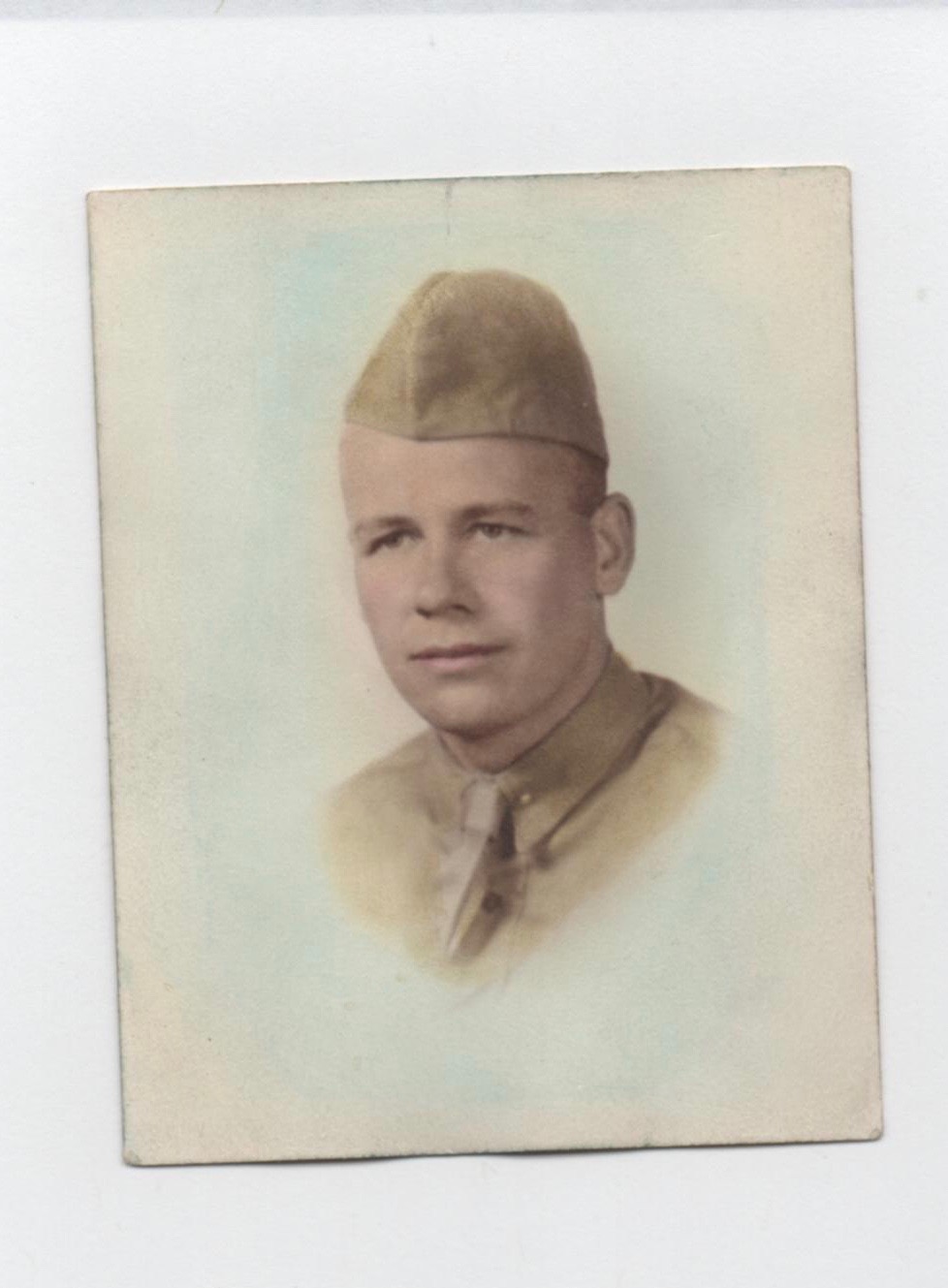
Uncle John in military uniform, 1941

It’s been so long ago now that I barely remember
The annual childhood visits to Arlington’s cemetery,
To put flowers on the gravesite where your family
Eventually had you re-interred after you’d fallen
In Germany near the end of World War II.

Once I’d grown older, I asked for pictures of
What you’d looked like in life–you were blond, like
The stern dad whose name is included in yours.
You’d volunteered early for the military, convinced
That the Third Reich posed a grave danger to
Global civilization, though equally so, you thought,
Did rampant nationalism and materialism. In one of the
Pamphlets that your middle sister had printed in your
Honor and memory, you opined, “Would you die for
Your bathtub?” Perhaps somewhat germane, as I sit
In air-conditioned comfort while soldiers in distant deserts
Sweat out yet another year of armed conflict.

You were an inveterate scribbler, like this niece
You never met in life. An eldest son, one of just two
To survive to adulthood, you died in Europe a month
Shy of your thirty-fourth birthday, at about the same
Time your younger brother was among those not killed
When a kamikaze pilot damaged the aircraft carrier
Where he served in the Pacific. Dad came home and
Rarely talked about his service. He sired four children of the
Family’s next generation. In life, the two of you had argued
Passionately about politics, about human nature, but had
Worked and traveled together before war sent you to opposite
Ends of the earth. Dad had the longer physical life, and
He passed along some of your ideals along with the family genes.

You loved the outdoors, spent time on the family farm,
Went camping with friends–an heirloom snapshot shows you
Holding a coffee pot, with an improvised clothes line
Tied to a tent in the background. It’s somewhat fitting
That what physically remains of you lies among many others
On a grassy incline, partially shaded by trees, in a large area
Of “section 12” between Grant and Eisenhower Drives.

This year I won’t make it physically to your gravesite.
My worsening eyesight cannot totally decipher the
Inscription on the virtual image of your headstone
That I now can pull up thanks to a website and the
Volunteers who maintain it. Our country and others
Still engage far too often in “shooting wars,” both foreign
And domestic. Our technology now allows us to engage also
In vicious foreign and domestic cyber wars, equally dangerous.
Please rest well, Uncle John. Know that your survivors
Are doing our best to continue your legacy of service.

MLK, Jr. Reweaving the Dreams

MLK, Jr.: Reweaving the Dreams   —by Jinny Batterson

While he was alive, I knew little about him.
The mainstream press in Baltimore barely mentioned
This Negro preacher who’d helped marshal a yearlong bus
Boycott and in the mid-1960’s won a Nobel Peace Prize.
There were rumors he might be a Communist.

I was in high school, with other concerns—
Who could I get to take me to the prom?
Would my SAT scores help me get into a good college?
Would my parents take away my driving privileges
After an accident that I at least partially caused?

By the time I got to college, his star was waning,
Eclipsed by rising black militancy and a war in Southeast Asia
That dragged on and on. His tactics and pronouncements were
Less influential, less obviously successful in northern cities than in
Earlier Southern-based campaigns. Non-violence and preaching peace
Didn’t appear to work against big-city political machines and war contractors.

At first it seemed his dreams had come unraveled when his life ended.
As riots broke out in many American cities following his assassination,
I sat distracted in a secluded dating parlor on a small college campus,
My boyfriend’s bent-kneed proposal and diamond ring a pale foreground
To a muted television backdrop of Baltimore and Washington, D.C.,
Two bookends of my youth, engulfed in flames, sirens, and riot police. 

By the time his birthday was declared a national holiday
In November, 1983, I was attempting to learn and implement
Parts of his dream in rural central Africa. My efforts met with
Little success in a country whose few rich and many poor lived in vastly
Different worlds, with a minuscule middle partly made up of expatriates
Like me. I had lots of time to read the contents of a USAID library.

Martin Luther King, Jr., I learned, was a middle child, born just before
The Great Depression. His family lived in a relatively prosperous black enclave
In segregated Atlanta. During his early studies, he drifted, but partway through
High school he was inspired toward the ministry. He went north and completed
An impressive formal education, earning a doctorate by age twenty-five.

The parts we now recite in school start in Montgomery, Alabama,
Where he was nominated, as a young, little-known preacher, to give voice to the
Aspirations of people who had for too long been shunted to the back of the bus.
After the successful conclusion of the bus boycott, sixty civil rights leaders met
In Atlanta, founded the Southern Christian Leadership Conference, and elected
MLK as its first president.  Then came sit-ins, Freedom Summer, Albany,
Birmingham, Selma, Chicago, a Poor People’s Campaign, a sniper’s bullet.

Those of us who call ourselves progressives winced at subsequent American
Foreign and domestic policy, wrote letters, attended rallies and marches,
Wondered what else we might do to stop, or at least reduce, the madness.
For a while, we thought we had found an answer in another young,
Eloquent brown-skinned man. Twice we elected him national president,
Allowing complacency to creep into our ongoing efforts.

Our current national administration is more nightmare than dream.
It wants us to forget that our deepest dreams are inclusive rather
Than exclusionary, spiritual as well as material. MLK knew this.
He tried to tell us, over and over again, but we rarely listened.

We know MLK had flaws—infidelity, sometimes neglecting his family,
Carrying too much of the movement’s burden by himself.
We do not need another plaster saint, of whatever skin hue,
But Coretta was right to insist that we honor MLK with a holiday.
Though not free from sin or error, he was also a prophet
Who recalled us to our best selves. May we remember
His efforts as we redouble ours, reweaving stronger dreams.

The Rich Man and Lazarus Revisited

The Rich Man and Lazarus Revisited   —by Jinny Batterson

During my childhood, my most formally religious aunt used to give me books of Bible stories, adapted for children. One of the most difficult stories for me was Jesus’ parable of the rich man and Lazarus. It concerned death, not totally unknown even to small-town American children in the 1950’s, plus a kind of cosmic reckoning:

In a gated estate there lived a rich man, who (revised standard translation, part of Luke’s gospel, chapter 16) “was clothed in purple and fine linen and who feasted sumptuously every day.”  Outside the rich man’s gate was a poor, diseased man named Lazarus, “who desired to be fed with what fell from the rich man’s table.”  Sharing was apparently not part of the rich man’s ethos, so Lazarus languished in distress.

After a time, both Lazarus and the rich man died. Lazarus was carried by angels to heaven, “Abraham’s bosom,” a welcome change. The rich man, by contrast, went to Hades, a realm of fire and brimstone, just near enough to heaven so the rich man could see Lazarus there, hanging out with Abraham in comfort. The rich man cried out: “Father Abraham, have mercy upon me, and send Lazarus to dip the end of his finger in water and cool my tongue; for I am in anguish in this flame.” Nothing doing, Abraham explained. The rich man had had his chance at comfort while alive. Now the chasm between his current locale and Lazarus was deep and impenetrable, allowing for no crossovers.

During the 1990’s, I was briefly exposed to a widening gap in perspectives between rich and not-so-rich. I had a short-term subcontract with a major accounting firm at their downtown office. At the time, I was living in an inner city neighborhood that suffered the side-effects of a worsening epidemic of crack cocaine: robberies, arrests, lengthy prison sentences, even murders. It was a scary time. Occasionally I went out to lunch with my accounting firm colleagues. Once, I asked my supervisor whether the city’s worsening poverty and crime bothered him.

“I don’t have to notice poverty or crime,” he responded. “After work, I ride the elevator down to the guarded basement garage to retrieve my car. Then I drive out the expressway to my home in a gated community in the suburbs. No poor people interact with me at all. It’s not my problem.”  For most of the years since that encounter, I’ve lived in relative comfort, while trying with mixed success to learn and practice the discipline of sharing.

Though some quote an incident near the end of Jesus’ ministry as a justification for ignoring those in poverty, saying, without the surrounding context, “you always have the poor with you,” the vast majority of Jesus’ sayings and actions support the view that caring for “the least of these” is a sacred duty. 

The year 2018 so far has been filled with more than a little fire and brimstone—volcanic eruptions on Hawaii’s big island, huge wildfires in much of the U.S. West. In the part of the country where I live, the major problem has been floods. So far, they have yet to approach Biblical proportions, but the aftermath of Hurricane Florence in eastern North Carolina has been severe enough so that our current equivalent of Noah’s Ark has deployed, in the form of government rescue boats and the “Cajun navy,” a set of volunteers with small boats who previously plied their crafts in last year’s major flooding in Houston, Texas.  Florence drenched already struggling regions with over two feet of rain. Among the hardest hit were the region’s poor. Relieved to have been spared the worst of the storm, I watched media coverage of a flooded housing project where building maintenance had long been ignored or postponed. Videos showed some of the problems: peeling paint, exposed pipes, stained ceilings. Residents complained of asbestos-laced insulation. The electricity had gone out, and no one knew when it might be restored.

Beyond temporary aid, what could be done to help?  Should we as a society put more emphasis on affordable housing, less on high-end real estate? Would rebuilding and/or relocating require higher taxes? Could we somehow craft a renewed ethic of sharing? 

As I struggled to make sense of our society, seemingly rather badly out of kilter, I went out for a walk. The days were getting shorter. It occurred to me that our earth was in the period around an equinox—one of two occasions each year when the sun’s rays hit our tilted planet directly over the equator. Around the vernal and autumnal equinoxes, all creatures everywhere on earth experience days and nights of roughly equal length.

Instead of a chasm between wealth and poverty that gets harder and harder to cross, maybe we need something approaching a human “equinox.” Maybe we can head toward a narrower “wealth gap,” with adequate basic provisions for all living beings. Getting to a more equitable distribution and use of earth’s resources will take skill, political will, and good character. It IS possible, though. Nature creates equinoxes twice each year. Can we learn from her before flood, fire and brimstone get worse?  Happy fall, y’all!             

Happy Interdependence Day!

Happy Interdependence Day!    —by Jinny Batterson

For a good many years now, I’ve bracketed an insertion into my July 4 Independence Day greetings to friends in the American expatriate community:

“Happy In(ter)dependence Day!” I extol them.  It has seemed to me increasingly evident that in an era of global communication and commerce, celebrating “independence” needs a counterweight. We have become more and more dependent on one another across all sorts of boundaries. So I was pleased to find that others more widely known than I am have come up with similar themes. Perhaps the most widely publicized is a September 12 holiday proposed in the years just following the World Trade Center terrorist attacks.  In 2003, a group met to create a day to celebrate our global interconnectedness, and settled on September 12, the day after the terrorist assault, as a day for an annual celebration. According to Parag Khanna, one of its founders:

     “For the event’s organizers (the Democracy Collaborative at the University of Maryland), Interdependence Day is intended to be crucially different from 4 July. Where Americans alone celebrate the latter, the idea of interdependence unites all peoples across national boundaries in a common human destiny. At the same time, there is an element of deep continuity: for Americans in particular will have to struggle as hard to realize the promise of interdependence as they did for independence.”  (For a fuller explanation, please check out the following link: https://www.paragkhanna.com/home/americas-interdependence-day.) 

     I’ve just returned from a cross-country U.S. trip, benefiting from collaborative practices among airline personnel, colleagues, other passengers, and airport employees to adjust schedules and seating to get as many of us as practical back to our homes on the U.S. Atlantic coast in advance of a strong hurricane. My guess is that our skills at interdependence will soon get a good bit of practice, courtesy of Florence and/or other storms later in the season. My best wishes to all for adequate shelter from the storm—Happy Interdependence Day!     

Entitled, Endowed, Enabled

Entitled, Endowed, Enabled    —by Jinny Batterson

At this year’s Labor Day, I’m likely to be engaged in intense mental labor with friends and former colleagues, trying to make some sense of the somewhat shaky state of civil society in the United States of America in 2018. As the holiday approaches, my sense is that our uneasiness arises partly from confusion about being entitled, endowed, or enabled. Below are some as-yet-unfinished thoughts about how the three might be interrelated:  

A decade or so ago, a leader at an educational institution I value complained that students there had “a sense of entitlement.”  I wasn’t sure what he meant, and I wasn’t in a position to either validate or refuse his claim. Just now I looked up the definition of the phrase, and this is what a search engine produced:

“If someone has a sense of entitlement, that means the person believes he deserves certain privileges — and he’s arrogant about it. The term “culture of entitlement” suggests that many people now have highly unreasonable expectations about what they are entitled to.”  (from www.vocabulary.com)  

         I suppose the term “entitlement” derives from the honorific and/or hereditary titles that certain members of European nobility were given. Over time, such entitlement does not need to have anything to do with the person’s character or accomplishments. It cannot be revoked. 

The most famous phrase about “endowed” comes from one of our founding documents, the U.S. Declaration of Independence:  “We hold these Truths to be self-evident, that all Men are created equal, that they are endowed by their Creator with certain unalienable Rights, that among these are Life, Liberty, and the Pursuit of Happiness.”  

A more recent application of “endowment” is the endowment effect (also known as divestiture aversion), the hypothesis that people ascribe more value to things merely because they own them. Someone who has been “endowed” with say, a house, or a job, may feel that this endowment is permanent and react strongly when there is a perceived threat to his/her ownership. Institutions can also be “endowed” materially—we periodically hear figures about the size of Harvard’s endowment, not  often paying attention to the variability of such funds over time. In a different sense, we may talk of Dolly Parton’s “endowment,” likewise a not-entirely-permanent trait.  

What appeals to me more than either of the previous terms is “enabled.” To me, this term infers more active engagement by the person who’s enabled.  Some stories of enablement based on events at Special Olympics competitions and other sporting events give examples of teamwork, in which someone who may fall behind in the traditional sense is enabled by teammates to finish his/her race, enabling all to succeed together. The term is also used for the process of retraining someone who has lost previously available skills due to illness, accident, or other impediment.  

Reverting to endowment, though, I quote from the lead article of the constitution of my adoptive state of North Carolina. Borrowing from the U.S. Declaration of Independence, the framers of this post-Civil-War constitution added a fourth endowment: the enjoyment of the fruits of their own labor.  

  May we all find ways to better balance entitlement, endowment, enablement as we move forward.    


Birthing a Book

Birthing a Book    —by Jinny Batterson

As I near the May 1, 2018 official launch date of my first-ever published book, Where the Great Wall Ends: A China Memoir, I’ve been pondering the similarities and differences between creating a child and creating a book.  Both are exciting; both can be scary at times; both involve some pain and expense; both require time and energy. 

The specifics, however, can vary. The gestation period for a baby falls within a somewhat predictable range, typically 7-9 months. For a book, the period from first inkling to publication can be as short as a few months or as long as most of a lifetime. The process of going from initial cells/initial words to baby or book nearly always involves a certain amount of risk and uncertainty. There are times in both processes when I’ve been uncomfortable, when I’ve questioned why I ever decided to embark on this adventure in the first place, when what I’ve wanted most of all is for the “pregnancy” to reach completion.

In both types of birthing, I’ve benefited immensely from the help and advice of those with broader, deeper experience than mine. It is only half jokingly that I’ve complimented one of my editors on her midwifing skills. Again, some differences: the labor pains for a book are less physical, but can still be intense—for a couple of weeks now, I’ve often awakened in the middle of the night with a stray thought about one more person I’d like to alert to the book’s impending arrival. I’ve had pangs of regret for not completing the publication process sooner, so some of those who’ve already left the planet might have had a chance to view the finished product.

So now, as my mom used to say once she’d completed the dress rehearsal for a musical or theater production, it’s all over but the shouting. What sort of world will greet my China memoir?  What changes in global politics and natural environment will Where the Great Wall Ends experience as it “grows up”?  These are factors beyond my control.

I can only hope that I’ve written as true an account as I can of my experiences, and that some of what I’ve lived through will help generate greater understanding in the lives of my readers. Happy birthday, book!   

Quilted Dreams

Quilted Dreams    —by Jinny Batterson

There’ve been times, since I outgrew visions of sugarplums,
When I’ve dreaded the coming of winter. Short days, short tempers, cold,
Damp, sniffles, indoor confinement. Winter’s had little to recommend it.

This year’s cold weather was late arriving. Days shortened, but it was
Nearly Thanksgiving before there was frost on the pumpkins. Our schedules
Got disrupted: when to test the furnace, bring houseplants indoors?

Finally, the evening arrived when a blanket was insufficient warmth.
The quilt could be brought out from the linen closet, shaken vigorously,
Then inserted between a fresh sheet and the all-season bedspread.

As my life has grown less hectic, I’ve come to relish the longer
Darkness of late autumn: a chance to sip cocoa before snuggling down
Early, perhaps to drift into episodes of remembered dreams.

I cannot guarantee that the quilt is the cause, but cold weather
Seems to bring more comforting visions: brilliant landscapes visited
Earlier in person or in imagination, peopled with friends and warm welcomes. 

Often I visit cities new to me, revel in explorations and travel that
Can be more pleasant in dreams than in reality–no crowded
Rail cars, no plugged toilets, no mewling youngsters in the seat behind.

The details no longer matter as much. It’s the comfort that counts.
Even when my mind and body are saddest, my waking
Anxieties will sometimes give way to quilted dreams.

Falling into Grace

Falling into Grace    —by Jinny Batterson

Grace Church, the church of my childhood,
Smelled of furniture polish, dust, and old masonry.
It sat squat, tucked into a hillside above a graveyard
Where my mother, at twelve, had sledded into a
Headstone, chipping both front teeth.

From behind the altar, stained-glass-filtered light
Shone on the choir stall where I sat, searching in the
Back of the Book of Common Prayer for my springtime
Birth date in the schedule for each year’s Easter.

My cousin, Grace, came for a week’s visit
As we both teetered at the edge of adolescence.
She had an athletic build, a mane of blond hair.
Not self-conscious about her body like I was,
She shed her day clothes before bed, revealing
The beginnings of breasts and pubes where
I was still flat and hairless.

During college jaunts to the small Shenandoah
Valley town where my boyfriend studied, I walked
Past a different church. Early in the 20th century, it
Was renamed to honor a fallen general with a mixed
Legacy that has become increasingly problematic
In our post-Charlottesville polarizations. 
.

My childhood church is still there, if little used.
My cousin Grace died after a horse riding accident.
Reverting to its original name, Grace Episcopal
In Lexington, Virginia struggles for reconciliation.
Nostalgia renders all more graceful.

It’s the season of falling—leaves blush, then let go.
We notice lengthening darkness, tremble at dark events.
When we pay attention, though, we still have access to
Qualities of bearing, blessing, benediction:
There’s still the possibility of falling into grace.