Category Archives: Spiritual musings

Valuing Connections, Finding Joy

Valuing Connections, Finding Joy   —by Jinny Batterson

The corona virus pandemic has impacted every nation on earth, few more severely than the United States of America, which has rarely seemed less united. Many of us, especially if we are older, have mostly hunkered down in physical isolation at home (assuming we have a home), venturing out rarely, masked and sanitized, for shopping or medical appointments. It’s easy to feel disconnected.  

An American friend who’s widely traveled and now makes her home in France sent me a link to a lengthy article by Colombian-Canadian anthropologist Wade Davis. His early August 2020 commentary is titled “The Unraveling of America,” and includes this quotation: 

“In a dark season of pestilence, COVID has reduced to tatters the illusion of American exceptionalism. At the height of the crisis, with more than 2,000 dying each day, Americans found themselves members of a failed state, ruled by a dysfunctional and incompetent government largely responsible for death rates that added a tragic coda to America’s claim to supremacy in the world.”   (You can read the entire article at https://www.rollingstone.com/politics/political-commentary/covid-19-end-of-american-era-wade-davis-1038206/?fbclid=IwAR1STn3hp2VywUqvGxjPpSUqMItAGBnF7oEPorxsZ1OeUZERQbrTpSHEe78.) 

Some of us Americans are still involved in blaming each other for the mess we currently find ourselves in. Some are foolishly conflating “freedom” with the license to spread harm via a tiny airborne pathogen none of us can see. Some, though, are also remembering glimmers of our underlying interconnectedness, even while physical distancing remains an important tool for reducing the spread of illness, misery, and death. 

Earlier today, I attended this week’s “Friday Action Parking Lot” event at our mostly distanced congregation, a sort of modified “tailgate party.” Since March, Sunday services and most weekday meetings have gone virtual, but we’ve adapted some of our sharing practices to fit our changed circumstances. Before the pandemic, we participated, along with other religious groups and non-profits, in various feeding and affordable housing programs. Hosting an in-person group luncheon is no longer practical, but food still needs to be provided. Lengthy in-person visits to affordable housing complexes are not advisable, either, but families whose children may soon continue “virtual” schooling in apartments lacking air conditioning could really use donated portable fans. Each week a virtual call goes out via email for items especially needed—this week, in addition to fans, there was a premium on face masks and reusable grocery bags.

If few in our congregation are among the wealthiest, few are destitute, either.  It’s important to maintain connections with others who may be economically challenged at the moment, for a whole host of reasons. One of the strongest is that we are all inevitably interconnected, so generosity helps maintain health and brings joy. 

Recently I picked up some books ordered online from my favorite local bookshop, which now has “book take-out.” As I’d ordered a different book by a favorite author, another book he’d co-authored came up as a possible selection: The Book of Joy. The title was especially appealing. Once I got my treasures home, I found the book jacket cover of two famous octogenarians broadly smiling at each other worth the price of the book all by itself. Created from notes and insights garnered during an in-person 2015 meeting between Desmond Tutu, retired Archbishop of South Africa and  convener of that country’s Truth and Reconciliation Commission and Tensin Gyatso, His Holiness the Dalai Lama, The Book of Joy chronicles some of these two Nobel Peace Laureates struggles along the way to developing abiding senses of joy. It examines “eight pillars of joy:” perspective, humility, humor, acceptance, forgiveness, gratitude, compassion, and, finally, generosity. 

Tutu speaks from his religious tradition about the importance of generosity: “I’ve sometimes joked and said God doesn’t know very much math, because when you give to others, it should be that you are subtracting from yourself. But in this incredible kind of way … you give and it then seems in fact you are making space for more to be given to you.” 

“And there is a very physical example. The Dead Sea in the Middle East receives fresh water, but it has no outlet, so it doesn’t pass the water out. It receives beautiful water from the rivers, and the water goes dank. I mean, it just goes bad. And that’s why it is the Dead Sea. …And we are made much that way, too. I mean, we receive and we must give. In the end generosity is the best way of becoming more, more, and more joyful.”   

Of Loaves, Fishes, and Miracles

Of Loaves, Fishes, and Miracles   —by Jinny Batterson

One of the earliest Bible stories ever read to me was an account of the miracle of the loaves and fishes. I remember thinking how special it was that thousands of people could be fed from only a few loaves of bread and a few fish. My knowledge of Biblical lore is not as deep as I’d like, but I’ve recently revisited Biblical loaves and fishes stories, of which there are at least six (Matthew 14, Matthew 15, Mark 6, Mark 8, Luke 9, John 6). Online sources explain that the miracle of loaves and fishes is one of few mentioned in all four Gospels. In all the stories’ variations, Jesus interacts with his disciples, with a spiritual force to whom he gives thanks, and with large crowds. Literalist interpretations stress how many baskets of leftovers were collected at the end of the meal. More metaphorical explanations of the miracles concentrate on the possibility that it was not Jesus’ direct intervention that multiplied the available food, but his unleashing the generosity of members of the crowds who had enough food to share. 

Lately I’ve been thinking a lot about loaves and fishes stories, as the global covid-19 pandemic spotlights and sometimes worsens inequities in our access to material resources.  I’ve been reading the words of former Congressman John Lewis, a champion of principled action and societal equity. I’ve been marveling at the life of this man who was so often told that there was not enough, that HE was not enough, but persevered to blaze a path of non-violent protest and public service. I’ve been thinking, too, about a woman colleague from a couple of generations ago and the lessons she imparted to her daughter.

I’ll call my former colleague Susan. Susan was a single mother. She’d struggled hard to provide a decent living for herself and her daughter. Susan never talked about the child’s father. I never asked. They lived in a very conservative neighborhood. Despite disapproving looks and hurtful comments, Susan insisted on taking her daughter to church and to Sunday school. Over time, Susan saved up enough to provide a summer trip to Disney World, every young princess’s dream. Planning the trip was almost as fun as the actual event. Once Susan returned to work, she was full of stories about the marvelous rides, about the great service at the hotel where they’d stayed, about how thrilled her daughter had been to meet Mickey Mouse.  

“Do you have any special memory that stands out?” I asked her one day. 

After a pause, she told me, “Actually, it wasn’t a ride itself, but something that happened while we were waiting to get into one of the most popular attractions. It was a hot day, and I decided to spend a little extra money to get my daughter a popsicle—nothing fancy, just one of those water ice contraptions with two sticks. When I next looked at my daughter, she’d broken the popsicle in half and given a piece to the little boy in front of us. I didn’t want to make a scene, so I didn’t say anything. The line moved fast, and we all enjoyed the ride. That night at the hotel, I asked my daughter why she’d done what she did—didn’t she like the popsicle?” 

“It’s not that,” she told me, “but I could see that the little boy was just as hot as I was. I remembered my Bible school lesson—‘Jesus wants us to share.’” 

Amen!    

Taking a Media Sabbath

Taking a Media Sabbath  —by Jinny Batterson

In Judeo-Christian traditions, we are taught to “honor the Sabbath, and keep it holy.” According to the strictest interpretations, that means on every seventh day abstaining from all sorts of work and some of our usual daily activities, taking time instead to focus on spiritual growth. The term is related to a longer interval, a “sabbatical,” a seventh year widely observed in academic settings when professors and researchers take an extended break from their standard duties to pursue alternate studies and to recharge.   

The use of a day of prayer is not limited to Christian or Jewish traditions, though, and can have political overtones. In British-controlled India in 1919, a set of repressive new laws were passed giving the British government authority to arrest anyone suspected of “terrorist activity” and to detain them for up to two years without trial. Other laws simultaneously broadened police powers to conduct searches without warrants and curbed press freedoms. When the most egregious law, commonly called the Rowlatt Act, went into effect, opposition figure Mohandas Gandhi proposed that the entire country observe a hartal, a day of fasting, prayer, and abstention from physical labor, in protest. The response was overwhelming–on April 6, 1919, millions of Indians simply did not go to work, and for twenty-four hours (agonizing hours for the British) India simply ground to a halt. (https://www.sparknotes.com/biography/gandhi/section7/)  After continuing protests, the Rowlatt Act was repealed in 1922. 

As internet use has spread globally, much of the world’s population spends at least some time online. Back in 2017, scientists writing in a journal of neuropsychiatry estimated that perhaps 2% of the adult population suffered from “internet addiction,” compulsively spending more and more online time. (abstract from 10.4172/Neuropsychiatry.1000171,  2017) An article from 2019 (https://www.psycom.net/iadcriteria.html) gave a range of estimated internet addiction from below 1% to nearly 38% of adults. Since the onset of the current global covid-19 pandemic, internet use has spiked further as more of us turn to online communications while confined close to home and admonished to maintain social distancing. 

The internet can be a source of valuable new information, publicizing trends and histories that many of us had been unaware of. For example, as someone with no known enslaved ancestors, I’d been less aware of “Juneteenth” than those whose ancestry was less fortunate. (The holiday initially celebrated the anniversary of June 19, 1865, when formerly enslaved people in Galveston, Texas first got official word that they were now free.) Juneteenth is becoming more widely celebrated throughout the United States, and was recently cited as a reason for the postponement of a political rally by our current President. 

However, the internet can also be used to spread spurious information and to inflame tensions. It provides instantaneous feedback as “algorithms” select more and more of the content they believe we might want to be exposed to. We become “products” who are encouraged to buy more and more goods and services. These days, I know that my use and misuse of the internet can drift close to addictive behavior as I search for clues on how to stay well, relatively safe and somewhat sane in this confusing and highly politicized time. 

So I will use this Sunday, July 19, as my individual “Julyteenth,” my media sabbath, a brief freedom from the endless click bait of internet content providers. I’ll disengage as much as possible from internet browsing or virtual meetings. I’ll also try to cut back on television, streaming services, and the like. I’ll try to focus instead on spiritual growth, with perhaps some limited, more direct, but safe offline methods of reconnecting with neighbors and loved ones. I’ll adapt some advice of poet and writer Maya Angelou, who counseled a generation ago:  

“Every person needs to take one day away.  A day in which one consciously separates the past from the future.  …  Each person deserves a day away in which no problems are confronted, no solutions searched for.  Each of us needs to withdraw from the cares which will not withdraw from us.” (Maya Angelou, from Wouldn’t Take Nothing for My Journey Now, 1993) 

If my media sabbath refreshes me, I may make it at least a monthly ritual, if not yet every seventh day. My hope is that the spiritual nourishment of a sabbath will better equip me to confront the complex issues of my community, nation, and world. Good Sabbath, friends.    

Wandering in the Wilderness of COVID-19

When as a child I read Bible stories about the forty years the Hebrews spent wandering in the wilderness after they fled Egypt and before they entered the promised land, I could partly identify, as someone who easily becomes lost. However, even as a child, I thought forty years seemed a very long time. I guess they probably didn’t have an app back then for directions on their cell phones, but couldn’t they ask someone for directions?  Didn’t anybody have a map?

As we humans try to navigate our way through the covid-19 pandemic, I’ve become more appreciative of the Hebrews’ difficulties. It wasn’t just physical distance the Hebrews needed to traverse. Turns out, the space between one “normal” and the next was just as much psychological as physical. The Biblical Book of Numbers tells of the challenges of life in the wilderness. At first, some Hebrews wanted to return to Egypt. There, though enslaved, they at least had plenty of varied food:  “We remember the fish we ate in Egypt for nothing, the cucumbers… and the garlic; but now our strength is dried up, and there is nothing at all but this manna to look at.” (Revised Standard Version, Chapter 11, verses 5-6). 

As they neared what they expected to be the promised land, overall leader Moses sent twelve tribal chieftains to assess the area: “Go up into the Negeb yonder, and go up into the hill country, and see what the land is, and whether the people who dwell in it are strong or weak … and whether the land that they dwell in is good or bad… Be of good courage, and bring some of the fruit of the land.” (Chapter 13, verses 17-20). The majority report, ten of the twelve, recommended giving up—the people already in the promised land were too strong. This majority even discounted the land’s good points, saying, in essence, that it was not worth fighting for. A minority of two believed the land was indeed worth trying to possess. They thought the challenges were not insurmountable, given spiritual assistance. It took an entire generation, plus lots of disease and death, before the rest of the Hebrews were persuaded.  

Another example, from the medical field, is closer to modern America in distance and time. It concerns the spread of the use of antiseptics to prevent post-surgical infections. In the nineteenth century, surgical advances made more complex operations possible, but deaths following surgery soared, sometimes taking half of all patients. One British professor of medicine then observed: “A man laid on the operating table in one or our surgical hospitals is exposed to more chance of death than was the English soldier on the field of Waterloo.” 

British surgeon Joseph Lister in 1865 read the results of experiments by French scientist Louis Pasteur, who connected microscopic bacteria with fermentation in foods and wine. Lister wondered whether what caused fermentation in food might also cause infections in wounds. In the late 1860’s, he began experimenting with different procedures and chemicals to reduce the chances of infection. He published the results of his cases in medical journals. Over time, he refined his approaches. Still, it took nearly a generation before antiseptic practices were widely used in hospital surgery wards. 

The wilderness of covid-19 response is disconcerting. Recommendations of currently available best practices can be confusing. As my home state of North Carolina begins the second phase of cautiously reopening its economy, the NC Department of Health and Human Services advises that I’ll still be “safer at home,” but that I’ll have an expanded range of businesses and non-profit groups I may visit. When getting my hair cut at a reduced-occupancy salon or dining in a reduced-occupancy restaurant, I’m advised to “wear, wait, wash”—wear a face covering (except, presumably, while eating), wait at least six feet from other customers, and wash my hands frequently (https://covid19.ncdhhs.gov/materials-resources/know-your-ws-wear-wait-wash). 

My guess is that it will be a good while before we’ll reach a post-covid “normal,” though I hope it will take less than forty years. Those of us who survive this pandemic will mourn our losses. In hindsight, we’ll realize that some preventive measures we tried were more effective than others. Some people will remain unenthusiastic about the longer-term changes we will need to make to reduce the threat of future pandemics. 

Still, we may take heart from the experiences of those venturing toward a promised land or safer surgery. The wilderness, however disorienting or longlasting, is neither uniform nor useless. It provides the venue and the time to develop and practice new skills we need. We cannot go back; with good guidance and courage, we can go forward. Please stay as safe and sane as possible, all, while we venture toward our post-covid world!  


Earth Has Its Day

Earth Has Its Day   —by Jinny Batterson

Had this been a “normal” year, there would have been big crowds today commemorating the 50th annual Earth Day. There would have been lots of in-person speeches. There would have been live exhibits from corporations and non-profits with a mixture of important initiatives and “greenwashing,” spotlighting small impacts for mainly public relations value. There would have been more exhortations to “reduce, reuse, recycle.” 

This is not a normal year. A small pathogen whose exact origin is still unclear began spreading a respiratory ailment among the global human population in late 2019. As of today, covid-19 had caused nearly 2.5 million known infections and nearly 170,000 deaths. Much of the globe’s human population is on “lockdown.” Public gatherings are few. 

In parts of the world, other variations in nature are wreaking havoc in different ways: a plague of locusts in east Africa is destroying food crops, threatening the food supply of tens of millions; forest fires in Ukraine near the defunct Chernobyl nuclear power plant have recently caused the Ukrainian capital, Kiev, to have the worst air pollution of any place in the world; widespread bush fires during Australia’s 2019-2020 summer have blackened millions of acres and killed roughly a billion animals, endangering such unique species as kangaroos and koalas and putting Australia’s agricultural sector at risk; Greenland and Antarctica have ice sheets that are melting at increasing rates. 

Perhaps earth is reminding us, in increasingly urgent terms, that we are not the masters of the planet, but its guests and its (temporary) stewards. 

For much of my adult life, I’ve accumulated a clipping file of quotations and short pieces of prose that seem meaningful to me. During a personal or societal crisis, I reread them for wisdom. A while ago, I came across the World War II era diaries of Anne Morrow Lindbergh, War Without and Within, edited and first published long after that war was over, in 1980. Anne and her husband, aviator Charles Lindbergh, had spent part of the 1930’s living in Europe to regain some privacy after the highly publicized U.S. kidnapping and murder of their first child.  A pacifist often identified with her isolationist husband, Anne was deeply affected by the 1939 onset of war in Europe and the entry of the U.S. into a globalized conflict in late 1941. A diary entry from Easter Monday during the spring of 1942 expresses both sorrow and hope: 

“Today is the real Easter morning. Yesterday was overcast and chilly. This morning is still, warm, newly awakened. One walks out into it like a flower just opened. …
When I was young, I always felt a morning like this meant a promise of something wonderful … love in someone’s heart far away from me, or the success of some venture of my own. I thought–quite literally–it was a sign from heaven. The person who was ill would get well. … Or maybe something wonderful was happening for the world–some new spirit blooming. … the morning was a ‘sign.’
I still believe it is a ‘sign,’ but not for anything good happening to me or the world, anything specific. The love is not blooming in someone’s heart. The ventures fail. The one who is sick, dies, and the one who is lost is never found. Hate and cruelty and evil are still rampant, war goes on.
And yet it is a sign. It is a sign that in spite of these things beauty still exists and goes on side by side with horror. That there is love and goodness and beauty and spirit in the world–always. This is only one of the times when it is clothed in flesh–in the flesh of a spring morning.”

Amid the global concern about the covid-19 pandemic and the seemingly unending series of recriminations about whose “fault” the pandemic is, there have been occasional notes of clearer air in unexpected places, of a resurgence of birdsong alongside nearly empty highways. 

This morning where I live dawned crisp, cool, bright, with almost jewel-like clarity. May it be a sign. Happy Earth Day!   

Year of the Phoenix?

During the years’ shortest days for the past few years, an exhibit of lighted figures has come to our town—a multi-acre display of LED-illumined silk lanterns produced in the Chinese city of Zigong, in Sichuan province. Zigong’s artisans have long crafted lanterns for Chinese festivals. In recent decades they’ve gained global fame for their beautiful handiwork. Increasing numbers of U.S. cities are using winter-dormant park spaces to mount displays. 

Our town display’s centerpiece is near the shoreline of a multi-acre lake: in prior years a magnificent dragon.  When I attended this year’s 2019-2020 event just before (western) New Year, I wondered, as I wandered down a slope decorated with shapes of real and mythical animals, if the dragon had taken its accustomed place. No dragon, not this year. Instead, an equally impressive floating display of a mythical phoenix, complete with pulsing lights going from head to tail.  

The night I saw the display, the weather was fairly mild for late December. Attendees from multiple cultural traditions mingled and oohed and aahed at the depiction of the fabulous bird. A little research about legends of the phoenix show the magic bird as a staple in the mythology of multiple civilizations, including Egyptian, Greek, and Chinese: 

“In Asia the phoenix reigns over all the birds, and is the symbol of the Chinese Empress and feminine grace, as well as the sun and the south. The sighting of the phoenix is a good sign that a wise leader has ascended to the throne and a new era has begun. It was representative of Chinese virtues: goodness, duty, propriety, kindness and reliability. Palaces and temples are guarded by ceramic protective beasts, all led by the phoenix.” ( https://www.ancient-origins.net/myths-legends/ancient-symbolism-magical-phoenix-002020 ; accessed 2020/03/27) 

In mid-January, our town’s lantern display was packed up to return to Zigong. It was nearly time for Chinese New Year (or “Spring Festival,” celebrated in 2020 starting on January 25). The upcoming Chinese year would start another cycle of the 12-animal Chinese zodiac, which includes the dragon, along with eleven other real-life animals (in sequence: rat, ox, tiger, rabbit, dragon, snake, horse, sheep, monkey, rooster, dog and pig). So far, the phoenix has not become part of the Chinese zodiac, though the mythic bird is often considered the feminine counterpart to the masculine dragon. 

Now that covid-19 has become a global pandemic, I’ve been asked, like many people all over the world, to self-isolate at home to reduce the speed of the virus’s spread. This will allow health care systems more time to adapt by “flattening the curve” of new infections. If I’m bored, it’s a small price to pay for a larger social good. The next generation in our family includes two members of hospital medical staffs. Their safety is a big concern.  

This enforced time at home gives me license to engage in reveries about the mythical bird. Many legends of the phoenix depict it as an extremely long-lived creature who senses approaching death, builds her own funeral pyre, and then dies in fiery majesty. Shortly afterwards, the next generation of phoenix rises from the ashes.  

What might the symbol of the phoenix mean as 2020 begins with a global pandemic—the death of an overly competitive ethos and the dawning of an age of more thorough global cooperation? a rethinking of our interlocking systems of education, health care, corrections, and social welfare? a reining in of our preoccupation with material wealth? renewed reverence for the natural world that supports us all? 

Let’s hope that 2020 will turn out to be a year of the phoenix.   

Phoenix lantern at NC Chinese Lantern Festival

Gardener’s Song

Gardener’s Song   —by Jinny Batterson

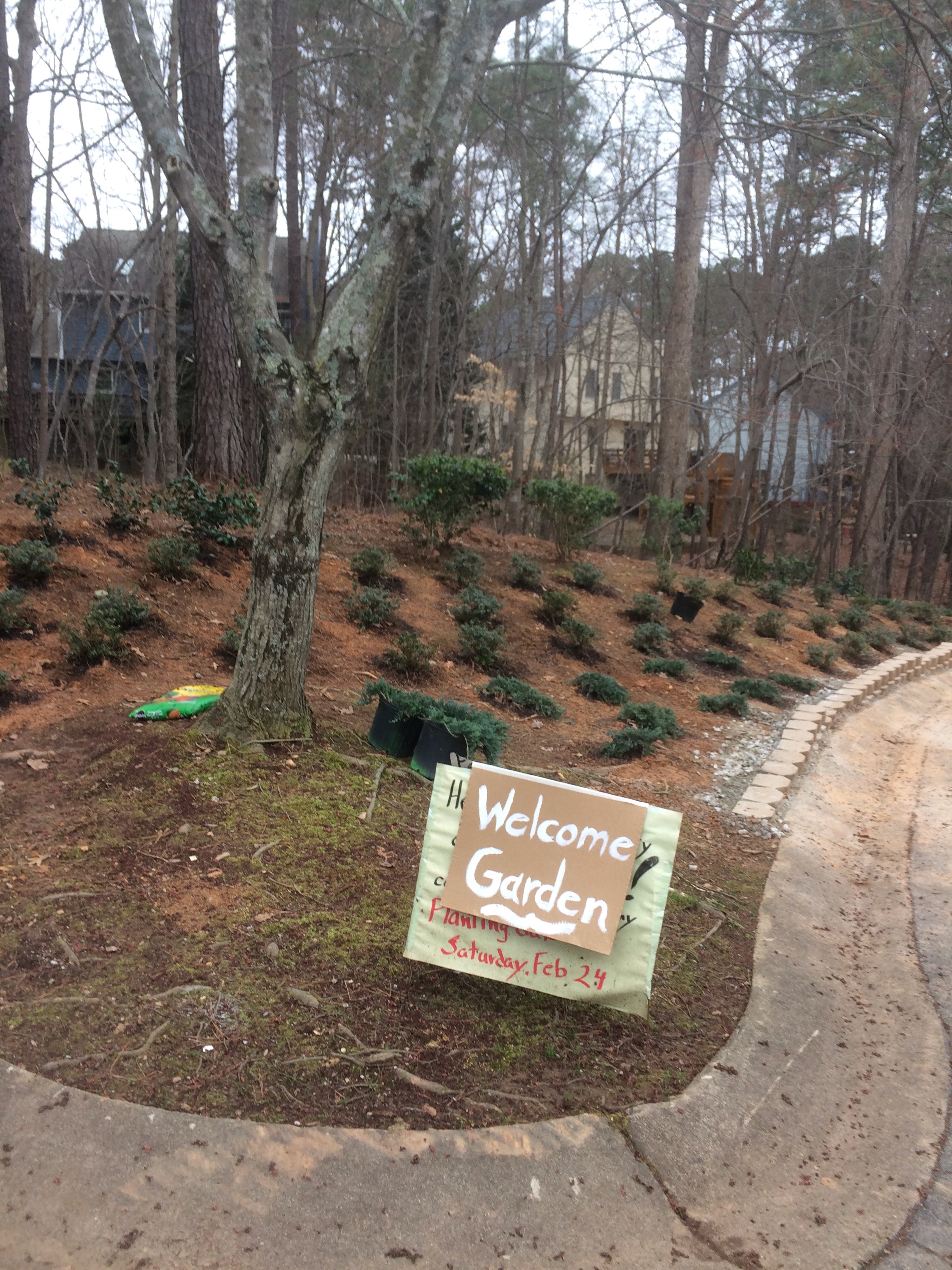
(In memory of Nancy Small Van Dijk on what would have been her 72nd birthday; Nancy served for several years as HOA chair of our condo complex. During her term, she spearheaded an effort to get a “Welcome Garden” of flowering shrubs at our previously clay-slope entry drive.)

This garden is overgrown, the weeds are practically choking it.
I come here and sit alone, and wonder what will become of it.
Yet we started out as gardeners, as workers in the soil,
And we reaped a bounteous harvest from our ever-loving toil.

Some cities are overgrown, with drugs and crime and pollution.
We sit in barred rooms alone, each writing a rational solution.
Yet we’ve cities full of gardeners, of players in the soil,
And the plants and herbs and flowers reward our ever-loving toil.

Our planet is overgrown, wars, strife, disease, aggravation,
We stumble our lone ways home, uncertain of continuation.
If our world should blow to pieces, not survive its own turmoil,
Would we all come back as gardeners, blessed to ever-loving toil?

"Welcome garden" planted February, 2018

“Welcome garden” with Nancy’s sign soon after planting in 2018

The Doors of the Church are Open

The Doors of the Church are Open  —by Jinny Batterson

During my childhood and adolescence, I attended Sunday school. As a young adult, I took a multi-year sabbatical from organized religion, then resumed attending a small congregation—a chance to sing in the choir, I told myself. I liked being an alto. For the past several years, I’ve attended two different congregations. One is mostly white, generally affluent, with a mix of children and adults, trending toward the older end of the age continuum. The other is mostly black, less affluent, with a similar age distribution. The Unitarian-Universalist congregation has slightly more college professors than the African Methodist Episcopal congregation; A.M.E. worshippers include slightly more former college football players and basketball stars. Both groups have several hundred members on their rolls, some of whom show up most Sundays. As older members die off, our numbers dwindle.

The fastest growing religious segment of the overall American population are the “unchurched.” A 2014 Pew Research Center survey of more than 35,000 Americans found that the percentage of adults (ages 18 and older) who describe themselves as Christians had dropped from 78.4% in 2007 to 70.6% just seven years later. Over the same period, the percentage of Americans who are religiously unaffiliated – describing themselves as atheist, agnostic or “nothing in particular” – jumped from 16.1% to 22.8%. 

Many younger adults have little use for Sunday worship. Partly, this is because Sunday morning can be the only unscheduled interval in their increasingly busy lives. Another partial answer may lie in incidents of mass violence, like a 2008 shooting at a UU worship service near Knoxville, Tennessee or the 2015 assault on an evening prayer service at an AME church in Charleston, South Carolina. These two horrendous incidents are part of a series of mass shootings in churches, synagogues, mosques, and temples that can badly damage our sense of safety. The congregations I attend have trained our ushers to be alert to potential violence, defusing it if at all possible, otherwise sounding the alarm and limiting the damage.

In both congregations I attend, we wrestle with questions of how to affirm each other’s dignity, how to forgive each other and ourselves, how to help each other grow spiritually. Both congregations also grapple with hateful rhetoric coming from the highest levels of our government. The U.S. constitution forbids church statements in support of or opposition to specific political figures or groups. However, we allow support of or opposition to specific policies and behaviors. Right now, churches are often centers of opposition to inhumane treatment of immigrants or “others.” 

Despite many similarities, both of the congregations I attend feel incomplete to me. I wonder if it’s partly because they continue to reflect a situation that Dr. Martin Luther King, Jr. noted in a 1960 speech: eleven o’clock on a Sunday morning is among the most segregated hours in Christian America. In a religion whose basic tenets include “love one another,” such segregation of “white” and “black” (or any other group identity) is hypocritical at best. Is how poorly we walk our talk one important explanation of formal Christianity’s dwindling numbers?

Given its recent decline, it’s tempting to conclude that Christianity, even religion more generally, may not survive in 21st century America. I think it can both survive and thrive, but rejuvenating our faiths will take a lot more than one older woman crossing a racial divide to attend two churches.

After both the Knoxville and the Charleston incidents, church leaders reassured and challenged us: whatever losses we’d suffered, “the doors of the church are still open.”  Often I imagine church doors as fully hinged swinging doors—capable of swinging out as well as in, like the doors sometimes found between restaurant kitchens and dining rooms, or fronting saloons in old cowboy movies. 

Many church activities have little doctrine associated with them. They can happen outside the confines of church buildings. They’re not limited to a single day per week. They are just something we can do as Christians, as humans—social outreach, social justice, social uplift. Our faith encourages us to feed the hungry, shelter the homeless, visit the sick and those in prison, comfort the bereaved.

From what I know of church history, the earliest Christians had no special buildings, very little liturgy, no delineated creeds. They just wanted to share the love of God with their fellow humans and with the rest of creation. Such sharing is not limited to Sunday mornings. It recognizes no artificial boundaries. The “doors of the church” in each one of us need to swing both ways. Maybe then the doors of our various denominations will be easier to keep open.      

Choosing Your Starfish

One of the years when I taught English in China, my students were fascinated by a story about an old man, a young boy, and a beach filled with stranded starfish. Many variants of the story exist. The one my students were most familiar with went something like this: 

  One morning after a storm, an older man went out for his customary walk along a gently curving stretch of beach. The weather had cleared. As he looked ahead, the man could see in the distance a small figure, walking in the same direction, sometimes bending down, then throwing something into the waves. As the older man got closer, he saw that the other person was a young boy, perhaps twelve years old. The stretch of beach nearest them was littered with stranded starfish. Once in a while, the boy leaned over, picked up a starfish, and tossed it back into the sea.

“You’ll never succeed in making a difference for every living starfish,” the old man cautioned. “There are too many of them, and they can’t live very long on the beach.”

“That’s not the point,” replied the boy as he tossed another starfish back into the waves. “I made a difference for that one.”  

I didn’t remember having heard the story before. When I recently checked online for the story’s origin, I found it had appeared in slightly different form in 1969 as part of an essay titled “Star Thrower” by philosopher Loren Eiseley. An increasing number of charitable organizations have taken up the image of a rescued starfish as part of their name or marketing—groups for ex-offenders, for poverty-stricken children, for survivors of childhood abuse, for injured veterans, and so on. A variation of the story’s theme has been made into a children’s film, “Sara and the Starfish.”

The fable is both challenging and reassuring to me in these unsettled times. As someone who tends to obsess about all the actual and potential “starfish” I may encounter, I find the story helps me maintain or regain perspective. Of course I can never save all possible starfish. It’s important, though, that I pay attention to the starfish who get stranded on “my” beach with problems that match my resources and the solution skills I’ve developed. 

Who/what is your starfish?  

Building Lop-Sided Bridges

Building Lop-Sided Bridges    —by Jinny Batterson

About this time of year in 1997, I got a nasty shock. I was diagnosed with breast cancer. A set of cells had gone malignant and might soon invade the rest of my body. Several months earlier, I’d had my annual mammogram and was told it was normal. So at first, I wrote off the lump that showed up around Hallowe’en as just another annoying symptom of menopause. I was a healthy, middle-aged white woman. I ate well, exercised regularly, had gotten all my prescribed screenings. I made a comfortable living as a consultant, had two college-age sons, a husband who loved me, and no family history of breast cancer. The lump would go away on its own. It didn’t. Further tests showed an aggressive tumor. By early December, I’d had a modified radical mastectomy without reconstruction. I was pretty shaky both physically and mentally. 

As I began to heal, I tried to use my experiences as a teaching tool. Our Unitarian-Universalist congregation in Richmond, Virginia had long engaged in efforts to help promote racial healing. Each year about the time of the MLK holiday, we had a special service with a racial justice theme. This particular year, I’d been working for several months before my diagnosis on the planning committee for the service. As I began to regain strength after surgery, I asked if I could do a short talk about my “lop-sidedness,” using my body as a metaphor for the way our entire society was lop-sided and hampered by our history of individual prejudice and systemic racism. We all needed healing. I composed and rehearsed my talk. By early January I was confident that I’d have the physical stamina and the psychological strength to deliver a 10-minute talk, even with the prospect of six months of chemotherapy looming. 

Then I went to choir rehearsal. Our young choir director wanted to use spirituals to accompany the service. He’d chosen “Soon I will be done with the troubles of this world, goin’ home to live with God…” as the meditation hymn. I flinched. Jamie was a wonderful musician, but I really didn’t want to identify with that particular song at that particular time in my life. Privately, I asked if we could substitute something more upbeat. I got a reprieve. We wound up singing “I’m so busy servin’ my Master, ain’t got time to die…”  Both the congregation and I survived to continue our work. 

A decade later, I learned that my favorite college roommate had developed breast cancer. Beth had grown up near Richmond, graduated from our small liberal arts school, then gotten an advanced degree in library science. She’d moved to different parts of the country. She spent much of her career administering college libraries—first in Ohio, then South Dakota, then Florida. We kept up via holiday cards and occasional phone calls. In her 50’s, Beth had changed focus slightly and taken a post as director of a set of public libraries in an economically depressed part of lowland South Carolina. Beth had been in her new job only a year or so when the cancer hit. Her family and friends rallied to her support. Once her most intensive treatments were over, I went down for a weekend visit. We traded survivor stories. When she passed the five year mark without a recurrence, I sent hearty congratulations. Then, a couple of years later, a non-cancerous illness destroyed her kidneys and took her life with little warning. That April, I drove south through timber plantations, palmetto swamps, and railroad cuts festooned with blooming wisteria vines to get to South Carolina for Beth’s memorial service. I didn’t know much about her town, but suspected it would be as highly segregated racially as much of the South I’d previously been exposed to.

The small Methodist church was nearly full. Some of the mourners were family members I recognized, but I was surprised to see half a dozen older black women among the mostly white worshippers. I guessed at first that perhaps the women were maintenance workers at some of the libraries Beth supervised, then chided myself for stereotyping. At the reception after the service, I had a chance to talk with one of the women.

“How did you know Beth?” I asked.

“We were part of a local support group called ‘Bosom Buddies’,” the woman explained, pointing to the discrete pink lapel pin she wore. 

I never learned much about the group. Beth may have had a hand in creating this cross-racial sisters-beneath-the-skin effort in the area she’d made her home. Whatever her role, she’d reached out across any racial divide, creating enough of a bond so that six women had taken the time to attend her memorial service.

Our country remains in need of healing. Pundits of many political leanings expound on all the ways we are polarized— economically, racially, politically, spiritually. Income disparities persist; wealth gaps have gotten worse. Gun violence takes too many lives; “stop and frisk” procedures and mass incarceration further divide us. Health outcomes vary tremendously, based partly on income and ethnicity. We’re still lop-sided. We all need healing. Perhaps those of us who are physically lop-sided can continue to build lop-sided bridges.