Category Archives: holidays

Friendly Beasts

The local church whose “back lot” has for over a decade served as a community garden also engages with the wider community in other ways. Recently, on a trip to tend my garden plot, I saw posters for a “live Nativity.” I’d not yet seen one, supposedly initiated by Saint Francis in central Italy during the 12th century as a way of teaching about Christ’s birth. The poster for the local event prominently featured a camel. 

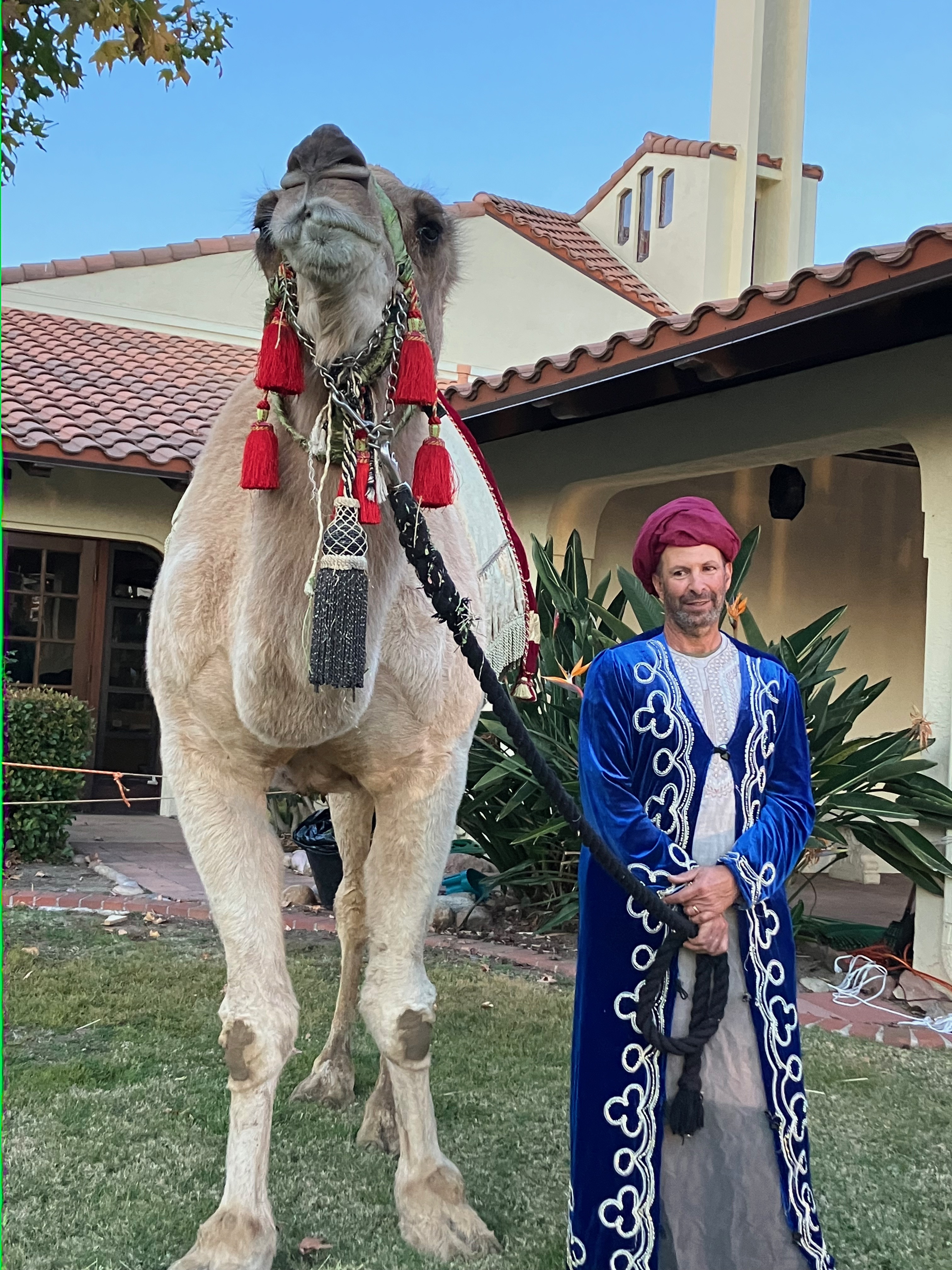
“Where would anybody find a camel around here?” I wondered. “At the zoo?”  Intrigued, I showed up at the church’s front lawn just before sunset on a balmy Saturday evening to see for myself. Sure enough, there was a regal-looking camel, festooned with a decorated blanket and tassels and bells. Standing beside the camel, holding its halter, was a swarthy bearded man in a long embroidered robe. He represented one of the three kings bringing gifts for the baby Jesus. The nativity also included a couple of sheep, some goats, and a donkey, in addition to the three humans representing the Holy Family. 

It was a supremely kid-friendly event. Lots of families with children were taking part—looking at the animals, petting the goats, decorating Christmas cookies, sipping cider or cocoa. I stayed long enough to chat briefly with some of the animal handlers. Turns out, the camel was from the “Oasis Camel Dairy” in a nearby farming area. She’d been rented out for the occasion. 

In most years, the town of Bethlehem in Palestine, site of the original Nativity, sees a huge influx of religiously oriented tourists around Christmas. Pilgrims come from all over the world to see the Basilica of the Nativity and to visit its grotto, the oldest continuously used site of Christian worship. Many suppose it to be the place of Jesus’ birth. This year, though, according to a recent article in the Jerusalem Post, nearly all tourists have canceled, further depressing the local economy. The locality’s struggles to support itself are also complicated by a full-scale war being waged in nearby Gaza.

Even amid sadness and outrage at the ongoing carnage in the Mideast, I’m reminded by the live nativity here of one of my favorite Christmas songs, variously titled “The Gifts They Gave,” or “The Friendly Beasts.” Sung by many different soloists, one of the most popular versions is by Harry Belafonte. Listening to his mellow rendition helps calm and inspire me. In the song, a donkey, a sheep, and a dove in turn explain the gifts they brought for the Christ child: the donkey, transport for Jesus’ mother Mary to Bethlehem; the sheep, a warm blanket for the new baby; the dove, a lullaby. In current news, if we see donkeys at all, they are likely pulling carts of Palestinians fleeing in search of some area of safety. 

At this holy season, may we remember the Christmas song’s friendly beasts and their simple gifts. May we imitate such wise animals more often. 

Gratitude over Resentment

Most days, I remember at some point to be grateful: 
—for life 
—for breathable air, for water that’s safe to drink 
—for access to food, clothing, and shelter 
—for health 
—for family and friends both near and far 
—for sunrises and sunsets, for clear days and for rainy ones.  

It seems totally appropriate to me that we celebrate an autumn holiday in honor of gratitude, “Thanksgiving.” 

Depending on what traditions we’ve been exposed to, we may think that the Thanksgiving holiday in the current territory of the U.S. originated in 1541 in Texas with Spanish explorer Coronado and the Teya Indians. We might suppose that Thanksgiving started in 1619 in eastern Virginia when some British colonists gave thanks for their safe arrival on American shores. Lots of us were taught as primary school students about the 1621 Massachusetts feast when Pilgrims and Wampanoag Indians celebrated together after the immigrants’ first successful harvest. In multiple places in the colonies and then in the U. S., Thanksgiving was celebrated locally or intermittently for a long time, but it only became fixed as a national holiday in 1863. That year, then-President Abraham Lincoln issued a proclamation making the last Thursday of November (later tweaked by Congress to the 4th Thursday) a national celebration of Thanksgiving.

November 2023 has so far often lacked for gratitude—wars and conflicts dominate our headlines; fiscal and military brinksmanship abounds; in many places there’s a general feeling of malaise and discouragement. Resentment often fills our airwaves and screens. It’s so pervasive that it can seem to poison the very air. Few of us will ever let go of our resentments entirely, be they of long-ago childhood slights or traumas, of former lovers who jilted us, or of perceived business or professional snubs. The rich and powerful are not immune, either. Some can seem resentful that they’ve not obtained even more wealth and/or power. So, especially in this fraught season, it’s important to make time for gratitude. 

Fortunately, it’s nearly impossible to be resentful and grateful at exactly the same time. Thanksgiving reminds us to rearrange our lives to expand our proportion of gratitude and to diminish our corresponding “resentment quotient.”  We need Thanksgivings, more than we usually admit.  

Coronado’s party and the long-ago Virginians and Pilgrims had lives filled with deprivation and danger. Back then, there might have seemed little reason to be grateful. At the first national November Thanksgiving in 1863, the American Civil War raged. Though the tide of battle seemed to have turned in favor of preserving the Union, the outcome was far from sure. Deaths and injuries had touched many families both North and South. In many places, basic goods were either in short supply or totally unavailable. The ill will and resentment that had helped spark the war lingered. Even now, it sometimes darkens our politics. 

Happily, for most of us in the U.S. in 2023, Thanksgiving does not equate with privation. It’s sobering, though, that over a tenth of our population fell below the official poverty line in calendar 2022. Moreover, during the period 2020-2022, there were about a million and a half excess deaths, either directly from the covid pandemic, or from other health complications. Many Thanksgiving tables this year are missing one or more previous guests.  

Still, it’s my hope that this Thanksgiving many of us will have things to be grateful for. I hope that most of us will resist temptations either to settle old scores or to prefigure the next election cycle. May we, for at least the better part of a day, let gratitude overtake any resentments.  

A previous Thanksgiving feast

Toward a Healthier Discontent

This Tuesday is the first Tuesday of November, Election Day. Though 2023’s choices are for local and/or state contests, a fair number of eligible voters will show up. They will vote for some candidates or measures, against others, expressing both preferences and discontent. Some voters will show their discontent by refusing to participate, by staying home. 

Next year on the first Tuesday of November, we’ll have national elections, choosing a legislature and a president and vice president, among other contests. Much ink has been spilled about the character and prospects of the man who became our nation’s chief executive from 2017 through the early part of 2021. He is now campaigning to resume that office in early 2025. 

Those of us not enamored of Mr. Trump wonder what combination of factors may motivate those who support him. I’m not a huge fan, but I’m persuaded that the ways I and some others express our discontent could be healthier. I doubt that all “MAGA voters” are without merit. Some may even share some of my own concerns. So I went looking for guidance, for precedents, for wisdom from authors wiser than I am. 

Last week, I revisited an extended quote by a woman of Polish descent who for many years represented my birth state of Maryland in politics. Before Ms. Mikulski ran for political office, she was a social worker and a lay leader at her church. At a 1970 religious conference on activism, she took up the cause of members of her community: 

“America is not a melting pot. It is a sizzling cauldron for the ethnic American who feels that he has been politically courted and legally extorted by both government and private enterprise.
The ethnic American is sick of being stereotyped as a racist and dullard by phony white liberals, pseudo black militants and patronizing bureaucrats… He pays the bill for every major government program and gets nothing or little in the way of return. He himself is the victim of class prejudice…
He has worked hard all his life to become a “good American”; he and his sons have fought on every battlefield—then he is made fun of because he likes the flag.
The ethnic American is overtaxed and underserved at every level of government.
…There is a general decline of community services for his neighborhood, e.g. zoning, libraries, recreation programs, sanitation, etc.
His income … makes him “near poor.” He is the victim of both inflation and anti‐inflationary measures. He is the guy that is hurt by layoffs, (by) tight money that chokes him with high interest rates for installment buying and home improvements.
Manufacturers … are gouging him to death. When he complains about costs, he is told that it is the “high cost of labor” that is to blame. Yet he knows he is the “labor” and that in terms of real dollars he is going backwards.
The ethnic American also feels unappreciated for the contribution he makes to society. He resents the way the working class is looked down upon. … He is tired of being treated like an object of production. The public and private institutions have made him frustrated by their lack of response to his needs. At present he feels powerless in his daily dealings with and efforts to change them.”


Parallels between Mikulski’s “ethnic American” speech in 1970 and various 2015-plus utterances of campaigner Donald Trump abound. Mr. Trump, despite his unparalleled wealth and media access, identifies with ethnic America’s grievances. By the time he was born in 1946, Trump’s family was wealthy and well-connected. Nevertheless, he portrays himself as a victim, when he has more often been a perpetrator and/or benefactor of unjust policies. It’s easy to agree with Mr. Trump that “the system is rigged.” The follow-up questions we too seldom analyze are “for whom and by whom?” 

A more recent analysis of our discontent, our tendency to fall prey to demagoguery, regardless of its source, came from a book I found at our local library: Read Dangerously: The Subversive Power of Literature in Troubled Times (2022). Author Azar Nafisi grew up in Tehran, the capital city of Iran. She came to the U.S. temporarily for study during the 1970’s, then returned to Tehran as a young adult. She lived and worked there through the tumultuous Iranian revolution of 1979. Later stripped of her university teaching post for refusing to wear a head covering, Nafisi worked at multiple jobs in Iran and abroad, eventually settling in the U.S. in the late 1990’s. She writes:
“The most seductive aspect of a totalitarian state is the security it offers. The truth is uncomfortable, and a dictator promises an abdication of responsibility from it. In America, I think it’s safe to say that most of Trump’s supporters are with him not because they respect Trump, or think that he is an honorable man, or are impressed with his vast knowledge of foreign policy. Instead, they feel secure in his promise to run the country like a business (financial comfort) and are consoled by the idea that he will “Make America Great Again” (spiritual comfort).” 

A final touchstone for understanding our discontent and Mr. Trump’s appeal comes from rural America. Long-time small scale farmer, writer, activist, and promoter of “agrarianism,” Wendell Barry writes in The Art of Loading Brush(2017):
“For me, the ascent of Mr. Trump, a man who indulges his worst impulses and encourages the worst impulses of others, was … less a surprise than a clarification. His election … expose(s) beyond doubt the nearly absolute ownership of our public life by the excessively wealthy, who are dedicated to freeing themselves and their corporate and of-course-Christian peers from any obligation to the natural and human commonwealth. …
(A)grarianism … is the way of what I am obliged to call economic realism, indissolubly mated to ecology, to local ecosystems, and to the traditions of good husbandry and good neighborhood, starting at home and from the ground up. …
The order of loving care is of human making. It varies as it must from place to place, time to time, worker to worker, never definitive or final. It is measurable by the health, the happiness too, of the association of land and people. It is partly an ideal, … partly a quest, always and inescapably a practice.”  

The quandaries we face as we try to make wise choices, both in our personal lives and in our elected leadership, cannot be solved by “going back.” Whether during the peak of U.S. manufacturing in the 1950’s that Trump romanticizes, or the peak of “family farming” Berry alludes to before the advent of mechanized agribusiness, our country has moved on. Meanwhile, as localities and as a nation, we have sometimes succumbed to the sorts of rigid religiosity Nafisi has described in post-revolutionary Iran. We in the U.S. have thrashed around as we confront issues of responsible stewardship, of equity, of rights and concomitant responsibilities. Some of the wisdom of a Mikulski, a Nafisi, or a Berry can be helpful in framing our ongoing national (and local) conversations. 

Each of these authors emphasizes that we are participants—we cannot sit on the sidelines. We can engage in deep disagreements and still cohere. However, we must do our best to honor the heritage we’ve been gifted with, including the not-so-good parts. From time to time, we will make bad choices. The worst choice of all, though, is to abdicate responsibility for choosing, as Ms. Nafisi so aptly points out. So let’s disagree but continue to function, let’s vote with our ballots and our voices, not with our apathy, disjointed anger, or absence. Let’s use our discontent, rather than letting it use us.  

Hallowe’en Thoughts on the Importance of Giggling

Hallowe’en is a big deal in San Diego, partly because it coincides closely with the Mexican Day of the Dead, celebrated on November 1 and 2. Hallowe’en decorations—witches, spiders, goblins, ghosts, zombies, skeletons, jack-o-lanterns, along with miles and miles of artificial webs—have been up in our 700-plus unit housing complex since at least early October. On my previous two Hallowe’ens here, though, I didn’t get any trick or treaters, while the son who lives with his family a few blocks away got swamped. Last year, after I expressed disappointment at our continuing dearth of costumed munchkins, he explained that I live on an “outer loop”—for all except immediate neighbors, getting to my house requires crossing a street. Parents with young kids want to avoid possible traffic hazards and so avoid us. By contrast, our son lives on an “inner loop,” where sidewalks connect most houses and the only internal crossings are of low-traffic alleys. People even come from other neighborhoods to trick or treat here, where treats are generous and danger is low.

Hallowe’en time can breed nostalgia. The weather cools. The days shorten. Leaves fall. As we prepare for a darker, chillier period ahead, we often look back on prior seasons, prior Hallowe’ens. I remember fondly an early Hallowe’en for our San Diego granddaughter: as a toddler, she was decked out as “a zombie snack,” much to her zombie-costumed parents’ and older brother’s amusement. 

Lately it can seem that our world is getting darker, and not just from shortening days. There are too many wars, too many displacements, too many children going without the necessities of life, some deprived of life itself. I find it vital to donate whatever time and other resources I have available, to do whatever I can to encourage more generosity plus less broadly lethal responses to invasions or terror attacks. It’s also important for me to attend regularly to my mental health, to take “humor breaks,” and especially to pay attention to young children’s giggles. 

In a recently accessed Wikipedia article, laughter researcher Robert Provine is quoted as saying: “Laughter is a mechanism everyone has; laughter is part of (a) universal human vocabulary. There are thousands of languages, hundreds of thousands of dialects, but everyone speaks laughter in pretty much the same way.” 

Wikipedia continues: “Babies have the ability to laugh before they ever speak. Children who are born blind and deaf still retain the ability to laugh.” There are, of course, lots of kinds of laughter. Among adults lately, too often laughter can be derisive, even malicious—targeting a supposed foe through ridicule rather than expressing principled disagreement. 

The giggles I relish have no target. They are instead an acknowledgment of the wonders of this world we live in, where unexpected beauty may creep up on us, or maybe just an older sibling bent on tickling our feet. Children’s giggles remind us that hope and love and caring still exist, however dark the conditions in too many places. 

If you were graced with a bevy of young trick or treaters this Hallowe’en, I hope you got gifted with some childish giggles as you handed out treats. I hope perhaps you even shared a giggle or two at some of the more outlandish costumes. Giggling can be a life-affirming skill. Let’s practice as much as we can!  

While Waiting for the Fever to Break

(October 24 is celebrated as “United Nations Day,” 
commemorating the entry into force in 1945 of the U.N. Charter, whose text can be
referenced at https://www.un.org/en/about-us/un-charter/full-text)

While waiting for the fever to break,
I apply cold compresses and administer aspirin,
trying to remember not to exceed the recommended dose.
I pray, and pray, and pray some more.
I tell others and myself “I love you,” over and over, fervently.
I hum lullabies and songs of peace.
I crave quiet. I shy away from news and opinion.

While waiting for the fever to break,
I try to damp down feverish attempts to “make the world safe,”
be they my own or others’.
I search to find and support more measured changes toward
whatever the world wants to become.
I meander around the nearby detritus of prior conflicts, wondering at the
residual scars.
I gravitate toward the small patch of cleared ground where a group of us is
learning organic gardening.
Well before dawn, jarred awake by a buzzing phone, I ask the still-dark sky for wisdom.
The stars shine an answer, one I’ve too often forgotten:
“No one is an absolute owner; we are all, rather, temporary stewards.”  

Hibakusha

Today, August 6, marks another anniversary of the dropping of an atomic bomb on the Japanese city of Hiroshima in 1945. This August 6, the war between Russia and Ukraine drags on, with periodic threats of deliberate use of nuclear weapons by the Russian military or of possible nuclear disaster at the vulnerable civilian nuclear power plant in Zaporizhzhia, Ukraine. In the U.S., summer release of the film “Oppenheimer,” about one of the physicists who helped develop the first nuclear weapons during World War II, has also reinforced our uneasiness about the possibility of nuclear catastrophe. 

A number of years ago, I had a chance to meet and to listen to a “hibakusha,” a Japanese term for survivors of the nuclear attacks on Hiroshima or Nagasaki. The older woman I heard at a backyard barbecue in New Jersey was petite, exceptionally well-groomed, but nonetheless visibly scarred. She was passionate about the necessity of reducing the likelihood of further nuclear warfare. 

She had been a young teenager in Hiroshima when the bomb was dropped. She and her schoolmates had been conscripted to work part-time folding parachutes at a war materials factory. As allied troops closed in on Japan in 1945, even young girls were recruited for the Japanese war effort. Whether this woman had been an “innocent victim” of the carnage may therefore be somewhat open to question. However, whether nuclear weapons should ever be used again should not be open for debate. 

The woman I heard has probably died by now. The number of living hibakusha is dwindling. According to the most recent count in Hiroshima, taken in 2021, the average age of survivors was 84. During a spring 2023 summit of G7 industrial nations held in Japan, some of these survivors made the effort to present their stories.

For 84-year-old Toshiko Tanaka (six at the time of the blast), one of her most vivid memories from that time was the smell of burning corpses in the days after the explosion. The authorities had started cremating the bodies of those who died.  “I was traumatized,” she says. “All my friends from school died and for a very long time I couldn’t speak about what happened.” 

It can be too easy for those of us not directly exposed to the horrors of nuclear warfare to become complacent about the likelihood of a recurrence. It can be hard to figure out how best to articulate opposition to nuclear proliferation, to nuclear arms races, to the sheer inhumanity and indiscriminate slaughter wrought by this sort of weaponry. 

May we continue to listen to the hibakusha; may we continue to develop more effective ways to reduce the chances of creating any more. 

Benjamin Banneker, Us, and Juneteenth

A little earlier this year, I read a book recommended by a friend: author Rachel Webster’s Benjamin Banneker and Us.  Part biography, part genealogy, part memoir, Webster has crafted a heavily researched, deeply felt account of one extended American family’s efforts to come to terms with nearly a dozen generations of racism, sexism, and classism. My friend is a collateral descendant of Benjamin Banneker, an early American mathematician, intellectual, and author. Benjamin Banneker, born in 1731, was widely revered in his time. In the classifications of the day, he was considered a free colored man. During the 1790’s, Banneker helped survey the land that became Washington, D.C. He also published several widely read almanacs. He died in 1806, leaving no children, but multiple sisters, nieces, and nephews. Banneker owned a farm in the vicinity of Ellicott City, Maryland that has since become a park and memorial. Because Banneker was free and so widely known, researchers of his lineage can delve much further back than is possible for most African-Americans. 

One set of Banneker’s grandparents met around 1680 in what later became the state of Maryland. Molly was a British woman serving a term as an indentured servant; Bana’ka was an African man of Wolof heritage who had been brought across the Atlantic to be sold into slavery. It’s not entirely clear how their relationship developed, but Molly and Bana’ka both obtained their freedom and had four daughters together in a tumultuous era when chattel slavery had not yet become fully fixed by law and marriage rules were confused. Their eldest daughter, Mary, fairly late in life became the free mother of Benjamin. 

Rachel Webster had always been told she was “white,” until a chance conversation at a family wedding in 2016 opened up a Banneker connection. Webster and her cousins have done lots of genealogical research. They’ve used increasingly available DNA testing, public records, and oral traditions passed down mainly through the black-identifying cousins of the family to identify over 20,000 Banneker-Lett descendants, all but one of whom have at least some traceable European or “white” ancestry.  

The book shifts back and forth between the historical facts and ambiguities of the Banneker-Lett lineage and the extended efforts Rachel makes to learn how and where she fits into this newly expanded version of her family. Some of her ancestors must have at some point decided to “pass” as white. Webster and many of her cousins on all sides of an increasingly blurry “color line” have mixed emotions about the complexities of the family’s story. Who constitutes “us” is rarely as simple as we think.    

Those of us who’ve been told we are “white” still struggle with our heritage. Our cousinships are typically murkier and less well documented than Rachel Webster’s. We wonder how to go about celebrating Juneteenth, a recently established Federal holiday commemorating June 19, 1865, when U.S. Major General Gordon Granger, recently arrived with his troops in the area of Galveston, Texas, issued “General Order Number 3.” The order reads, in part: 

“The people of Texas are informed that, in accordance with a proclamation from the Executive of the United States, all slaves are free. This involves an absolute equality of personal rights and rights of property between former masters and slaves…”   

Somewhat less cause for celebration, the order goes on to say

 …and the connection heretofore existing between them becomes that between employer and hired labor. The freedmen are advised to remain quietly at their present homes and work for wages. They are informed that they will not be allowed to collect at military posts and that they will not be supported in idleness either there or elsewhere.”  

It can take a very long time for the knowledge that none of us are free unless we all are free to enter our intellectual understanding. It can take even longer for this knowledge to move from head to heart. Some of our current debates surrounding race, sex, and class are not so different from those of Banneker’s day or from the mixed messages in General Order Number 3. 

Still, as one of my brothers sometimes reminds me, “We are all human.” Please let’s expand our understanding, delving beyond labels, working for adequate wages, sharing in loving homes, enjoying full equality of personal rights while respecting those rights in others. Whatever our supposed racial identity, that will truly be cause for celebration!    

Mothers are Tired

Mothers are tired 
of outworn tropes proposing sheltered domesticity
or cutthroat economic jostling as our only options.

We would much rather be acknowledged and appreciated 
for our often vibrant, adaptive balance,
as we pivot through multiple changes, continually adding value.

Mothers are tired
of having too many of our daughters derided,
too many of our sons killed or injured
in conflicts over illusory control. 

We would much rather have all of our children valued,
each for their unique style, limitations, perspectives, and gifts.

Mothers are tired 
of sappy greeting cards, purchased flowers,
restaurant meals or burnt toast on our “special day.”

We would much rather have spontaneous, inclusive, carefree
celebrations less linked to any calendar.

Mothers’ hands are tired of rocking cradles. 
Mothers do not want to rule the world.

We would much rather partner with others to help heal our own
and our world’s brokenness.

We would much rather continue our strenuous, joyous lives,
punctuated with occasional bawdy songs,
with perhaps a few lascivious romps when we choose.

Bloom Where You Are (Trans)Planted

Easter morning, fog gradually dissipating.
Soil gradually drying after a
Cooler, wetter March than is
Typical for this part of the world,
I’m told.

My second gardening year here.
Multiple seasonal harvests are possible
When there’s enough moisture for irrigation.

Just ending, a Lent of voluntarily cutting back—
No meat, more vegetable protein,
More varied vegetables as well.
Soups and stews that matched the
Atypically chilly weather.

Now, a seasonal transition—more sun,
Fewer storms, more widely spaced.
Time to put in tomato seedlings, maybe.
Time to consider what other warm season veggies
Might put down roots in this nearly-new-to-me place.

After a cool season of media vitriol
And exaggerated claims of victimhood
And crisis, a relieved exhale at fuller reservoirs–
Short-term apocalypse averted.

Whether we are transnational or transgender,
Whether we’ve moved cross-country or across the street,
Be we behaviorally inclined toward transactional, transitional,
Or translational interactions, we each have seasons
Of feeling transplanted, not quite fitting.

Then we remember, sometimes belatedly, the redemptive
Character of this resurrectional season.

Women’s Day Winter Harvest

It’s been a while since I previously updated this blog. It’s been a busy, wet, cool season for me here in San Diego. For the first time since renting a community garden plot last spring, I’ve had chances to try my hand at cool season gardening. The cool, wetter than usual weather produced lettuce, carrots, chard, parsley, and kale—enough for salads that were a welcome addition to rainy day soups made with some homegrown leeks.

winter’s veggies

What people tell me is an unusual-for-here series of chilly, rainy days provided the impetus to go through my store of fabric scraps and to come up with a set that may provide some comfort and warmth for an area refugee family. 

quilted squares for refugee family

What’s taken up the bulk of my time the past couple of months has been adapting and updating some prior blog posts into a self-published book of essays with a long title  “Somewhat Centrist, Slightly Sexist Seasonal Rants: Musings from the Alto Section.” The book, now in its final proofing process, is due out later this month. It chronicles parts of my particular woman’s history and relates my individual views of some current issues. 

Today, March 8, is celebrated in many countries as “International Women’s Day.”  Multiple relevant events in the San Diego area are listed for today or later during this Women’s History Month. Some highlight this year’s theme, “Embrace Equity.” Despite generations of effort, women do not yet enjoy pay equity in most environments. Sadly, in many places we seem to be going backward on one of the most important equity issues of all, the capacity to manage our own reproductive health, to control our own bodies. 

Happy International Women’s Day to all as we continue the ongoing struggle for equity!