Category Archives: holidays

Some Things Never Change: the Destiny Instinct

When I was a kid in 1950’s Maryland, Thanksgiving was all about the Pilgrims and the friendly Indians in Massachusetts. Before sitting down to turkey and stuffing at Grandma’s house, I’d probably participated in an earlier school Thanksgiving pageant, its prize roles going to the Indian Squanto and to Massachusetts governor William Bradford. We made paper cutouts of Pilgrim hats, or paper headdresses of fake feathers. It was pretty much the same every year. 

Much later, after I’d lived near Virginia’s coastal plains for decades, I went to watch a celebration of the Virginia version of the first Thanksgiving—held, locals bragged, before the Massachusetts pilgrims had even landed. At what later became Berkeley Plantation, according to its website (https://berkeleyplantation.com/first-thanksgiving), in late November, 1619, a newly arrived set of 50 additional Virginia settlers gave thanks, per instructions from their sponsors back in England: “We ordaine that this day of our ships arrival, at the place assigned for plantacon, in the land of Virginia, shall be yearly and perpetually kept holy as a day of Thanksgiving to Almighty God.” Little thought back then was given to the perspectives of the native peoples who were often being displaced, diseased, and/or disrespected by the growing numbers of European settlers coming to Virginia, Massachusetts, and other areas up and down the Eastern seaboard of North America. You have to read beyond the Thanksgiving chapter of the Berkeley website to learn that in 1622, local tribes rose up in a concerted attack against the British settlers, after which the Berkeley settlement disintegrated. The next Thanksgiving celebration at Berkeley was not until 1958.

I now live in California, where origin stories for Thanksgiving are multiple and murky. It’s possible that the earliest Spanish or Russian explorers had celebrations of thanksgiving after surviving especially difficult passages. Later specific dates for California’s initial celebrations are variously given as: December 10, 1774, when some of the Franciscan missionaries in the area celebrated a near-miraculous return to health of one of their brothers;  or November 29, 1849 in and around the goldfields; or November 30, 1850, based on a proclamation by Governor Peter Burnett in Sacramento in the newly established State of California. The safest date to recognize may be the 1863 proclamation by Abraham Lincoln of the first national day of Thanksgiving on the last Thursday of November.  

Wherever we live in the U.S., there seem to be a wealth of “first Thanksgivings” to choose from. Our views of what’s appropriate for Thanksgiving and “who got there first” will likely continue to change. 

The book Factfulness was written by three Swedes, so there are no examples of Thanksgivings and the way the feast has changed. However, the authors use multiple examples to show that many things do change, if sometimes slowly. One example I especially like is Hans Rosling’s analysis of the compounding impact of slow changes for Earth’s nature preserves and natural parks. Under the rubric “Slow Change Is Not No Change,” he begins with an initial set-aside of natural land nearly 2500 years ago: 

“In the third century BC, the world’s first nature reserve was created by King Devanampiya Tessa in Sri Lanka. … It took more than 2000 years for a European, in West Yorkshire, to get a similar idea, and another 50 years before Yellowstone National Park was established in the United States. By the year 1900, 0.03 percent of the Earth’s land surface as protected. …Slowly, slowly, decade by decade, one forest at a time, the numbers climbed. The annual increase was absolutely tiny, almost imperceptible. Today a stunning 15 percent of the Earth’s surface is protected, and the number is still climbing.” (One globally ambitions goal is to have 30% of the earth’s land and seas protected by 2030: https://www.campaignfornature.org/getting-to-30.) 

Of course, change can be multi-directional. There’s no guarantee all change will be positive. But the notion that things cannot change can prevent much of the experimentation that might help improve things.  

Among the prescriptions the Roslings suggest for countering the “destiny instinct” are exercises like the one I’ve tried to develop here about Thanksgiving—the way we now think about and celebrate Thanksgiving is not the same as when I was a child, nor need it be the way people will celebrate in the future. Per the Roslings, “Challenge the idea that today’s culture must also have been yesterday’s, and will also be tomorrow’s.” 

In a long life so far, among the things that have not changed for me are gratitude for life. I’m also grateful for new and renewed possibilities for continued learning. Happy Thanksgiving to all!   

The “Fear” Instinct: Danger versus Fright

One of the most insidious “instincts” we retain from earlier periods of human existence is the fear instinct, when misapplied. Some fears are justified. Many are not, or are blown out of proportion.

Like Hans Rosling, author of Factfulness, I grew up during the 1950’s and 1960’s Cold War era, back when we did “civil defense” drills for protecting ourselves in the event of a nuclear attack (spoiler alert—hiding under your elementary school desk with your hands interlaced above your head would be pretty useless against nuclear blasts or fallout). 

My nightmares back then involved not being able to find family members in time for all of us to hide in our house’s basement, the one area that might provide some minimal protection against the effects of nuclear blasts and radiation. As our societies continue to learn to deal with nuclear threats, my fear level about nuclear attack ebbs and flows.  

My fear of snakes has likewise ebbed and flowed. Much of my life has been spent where snake bites are rare and even more rarely lethal. However, during my one extended stay in an African country, where black or green mambas could inject a quickly lethal venom and sometimes were fairly well camouflaged, fear of snakes may have helped keep me alive.

Back then, I had part-time access to an aging Volkswagen beetle with a rust hole near its gas pedal. I used it to commute to the offices of an international development project I was a temporary part of. One afternoon, as I drove back to the office after a lunch break, I noticed a large black snake sidling across the road in front of me. Had it been still, I might not have registered its presence. As it was, I slammed on the brakes and pulled to the side of the road a good distance uphill from the snake. The little car I was driving might have been heavy enough to crush the snake, but I decided it would be risky to drive over it. The hole in the bottom of the car was too near my foot. Instead, I waited. Not long afterward, a heavy luxury vehicle driven by the head of the local branch of the World Bank came barreling down the hill. After the Mercedes drove over it, the snake was thoroughly crushed and dead. I proceeded, more careful thereafter to distinguish between road tar and road snakes.  

Rosling tells a story of how, when he was just starting out as a physician, his irrational fear of nuclear war badly distorted his initial reaction to an incoherent Swedish pilot with hypothermia. Afterwards, Rosling’s longish life of dealing in some fearful situations led him to a more skeptical view of most fears: “Fears that once helped keep our ancestors alive, today help keep journalists employed.” Rosling asserts, “If we look at the facts behind the headlines, we can see how the fear instinct systematically distorts what we see of the world.”  

Today is Veterans’ Day, when we honor those living and dead who have sometimes put themselves in harm’s way to help keep the rest of us safer. They get sent where most of us would fear to go. During the waning days of World War II, my Dad was stationed with the Navy in the South Pacific. He never made a fuss about being a veteran. The war he was part of did horrendous damage, but may have indirectly played a small part in reducing our fears of “others.” As some lyrics from the 1949 musical “South Pacific” taunted: “You’ve got to be taught to be afraid of people whose eyes are oddly made, and people whose skin is a different shade, you’ve got to be carefully taught…” Some of those of different shades who’d served during World War II eventually became leaders in the Civil Rights movements, including Medgar Evers and Ralph Abernathy.

Not having served in the military, I cannot speak directly to the level of fear generated by deployment in dangerous areas or by actual combat. I am deeply indebted to those whose willingness to take risks on my behalf has made my life safer. However, I suspect that military planners and leaders have sometimes put both soldiers and civilians in harm’s way unnecessarily.

Rosling concludes, “Fear can be useful, but only if it is directed at the right things. … ‘Frightening’ and ‘dangerous’ are two different things. Something frightening poses a perceived risk. Something dangerous poses a real risk. Paying too much attention to what is frightening rather than what is dangerous … creates a tragic drainage of energy in the wrong directions.” May we all, especially our military’s leaders, get better at distinguishing fright from danger.

Power in Walking, Power in Listening, Power in Quiet

My aging body performs better and heals faster if I walk a good bit every day. In recent weeks, some of my walks have had a dual purpose—maintaining fitness and also helping support the democratic institutions on which our government is built. Last Saturday, I was one of millions who took to the streets as part of “No Kings” protests throughout the U.S. The atmosphere at the event I attended was festive. It made the roughly 2 mile walk go quickly and lessened any tiredness on a fairly hot day. I was careful to stay hydrated. I enjoyed looking at hand-made signs that were a big part of the event. Though I wished some people’s protest signs, banners, and inflatable figures less closely mirrored the disdainful rhetoric we often hear from our current national executive, I could identify with some of their justifiable anger. Some of the younger generations in my family work in government. They have been repeatedly buffeted and challenged by the sometimes haphazard, sometimes vengeful demands, firings, and shutdowns that seem to be prominent tools of this administration. 

Earlier this month, I spent time alternately sitting silently in courtrooms and walking the halls of the U.S. federal courthouse nearest me, bearing mute witness to increasingly harsh, sometimes arbitrary processing and deportation of asylum seekers who show up for their asylum hearings. I have few illusions that either of my protest walks will influence policy in the short term. Still, putting my body where my convictions are in non-violent, non-threatening ways seems appropriate.

Because I arrived early for “No Kings,” I had time to meander among booths set up by various environmental and civic groups near the starting point of the march. I signed a petition or two. I noticed what especially galling aspects of government mismanagement or overreach were being most prominently disputed. One new-to-me civic proponent was one I almost missed. A single person staffed a small table with a tented sign, “The Listening Project.” I walked up to him and asked what he was doing. 

“I’m trying to provide an example of good listening. Listening is really important,” he told me. “Many of us are not very good listeners, but practicing good listening can become a habit, like brushing your teeth every day. If you think of listening as a muscle, it’s one that gets stronger with practice. “ 

Given this implicit permission, I proceeded to talk about how frustrated I felt at the current political stand-offs in our country. It sometimes has seemed to me, I explained, that all this talk of “polarization” tends to become a self-fulfilling prophecy. He neither agreed or disagreed explicitly, but did note that he’d had chances to listen to people from all along the political spectrum. Sometimes, he observed, listening to people whose opinions might be quite militant to begin with resulted in their softening their stances as they felt heard. Listening can be powerful, he reiterated.  

Most of us live in places and spaces that have gotten noisier over the years—airplane engines, traffic, sirens, leaf blowers, not to mention beeps and chirps from our electronics. It can be harder and harder even to hear each other, let alone listen. Too often, we compound the problem by ramping up our own noise output. So we need a third power, the power of quiet. 

In researching this essay, I ran an internet search on “rising ambient noise levels in the U.S.” I found a website for an annual event that I hadn’t known existed, “International Noise Awareness Day.” (Its 31st iteration will occur on April 29, 2026.) I clicked on a link to an interview with author Chris Berdik about his recently published Clamor. The author had submitted his book proposal before the pandemic, but wound up doing much of his research and writing during pandemic-related shutdowns. Alongside its tragedies, the pandemic measurably lowered ambient noise levels in the world’s noisiest places. Berdik argues forcefully that noise is one of the stressors we have not yet paid enough attention to, that hearing loss is only part of the damage caused by too much noise too often.  

To walk, to listen, to be quiet—three powers often overlooked. May we choose more often to walk together, to listen better to each other, and to find peace in quiet, both within and without.  

Vacation Rental

A sort of hybrid, really—less posh
Than a luxury hotel stay or an all-inclusive cruise,
Certainly less opulent (and less expensive)
Than a crewed private yacht.

Still, less chore filled than everyday
Living, clean linens typically supplied,
Fairly often nearby restaurants or
Delis to reduce meal prep tasks.

Because hosts may exaggerate online the allure 
And amenities of their properties, especially
In popular holiday destinations, it pays
To do some independent research before booking.

More often than not, guests
Never get to meet their hosts
In person, instead getting key
Codes to open gates and doors.

The interpersonal graciousness of
Localized hospitality is mostly gone.
Interfaces among actual people
In the “hospitality industry” get more
Complex, contacts more attenuated.

Nevertheless, when all goes well—no weather foul-ups
Or travel delays–a vacation rental can provide
A much needed change of scene for a few days:
A chance to recharge, maybe to renew
Our flagging sense of vocation.

beach house in Pacific Grove, CA

What Good Is August?

At first blush, it seems a mere blot on the calendar—
Wedged between the heroic hoopla of July 4 and
The start of another workaday year around September’s
Labor Day. People in their prime have disappeared from workplaces,
Taking their camping gear, their beach bags, their teenaged offspring
And their air-conditioned vans with them elsewhere.

Those of us left comfortably behind are only a little envious. 
We loll lazily on lounge chairs, or float face up in bathtub-warm
Backyard pools, while grills entice with odors of slowly broiling brats.
Vintage music plays at local festivals–Beach Boys, Beatles,
Sometimes even Sinatra. Bocce tournaments bring out the
Men in white. Parasols make a temporary comeback.

The furious scandals of pre-recess government seem less
Pressing for the moment, the final few tomatoes extra juicy.
August is not regal, not “august,” its aspect instead laid back.
Sharing vowels with its mood, August is languorous.
Before the rushed tumult of impending autumn,
Such languor is both welcome and sorely needed.

Interdependence Days

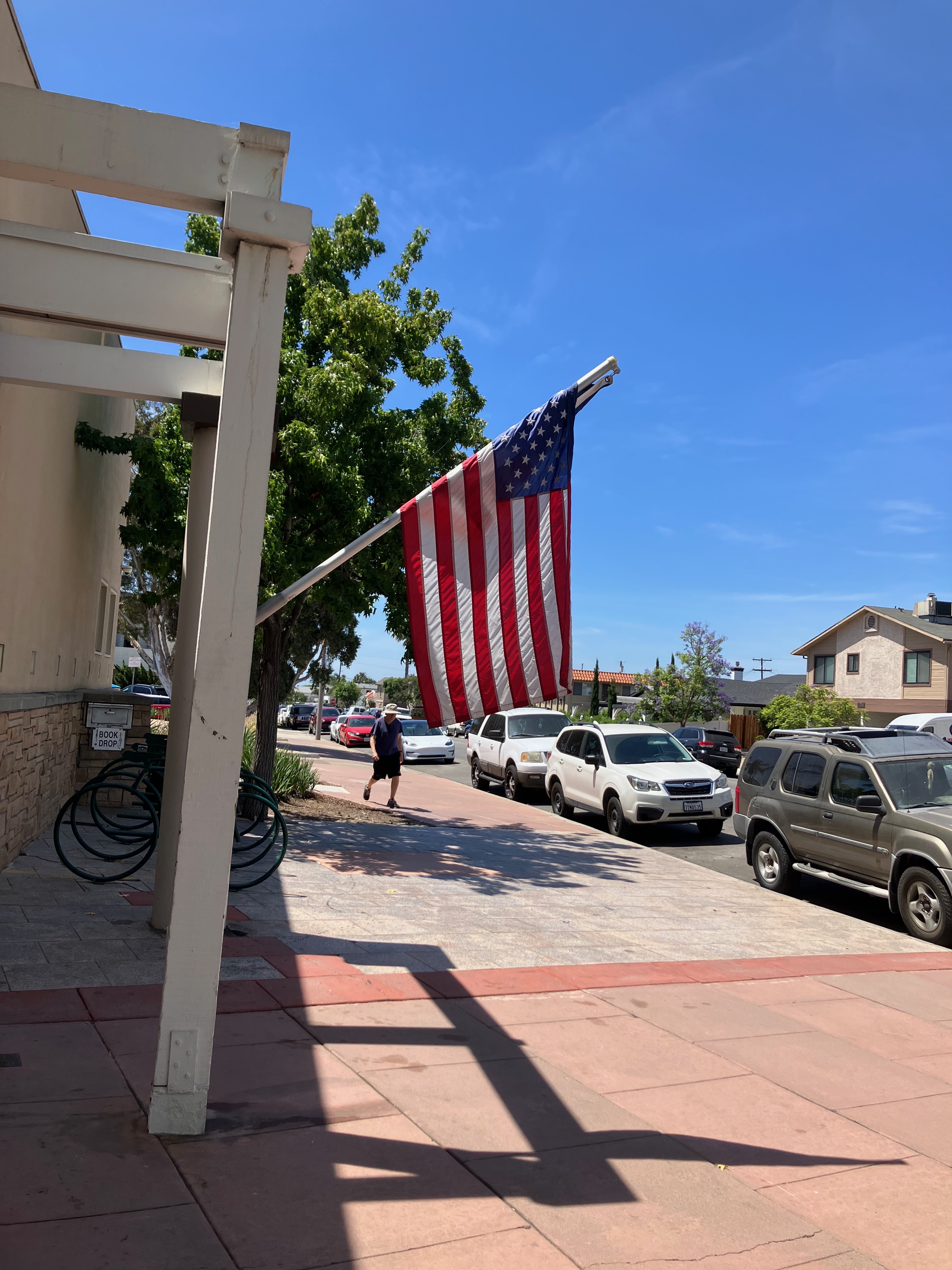
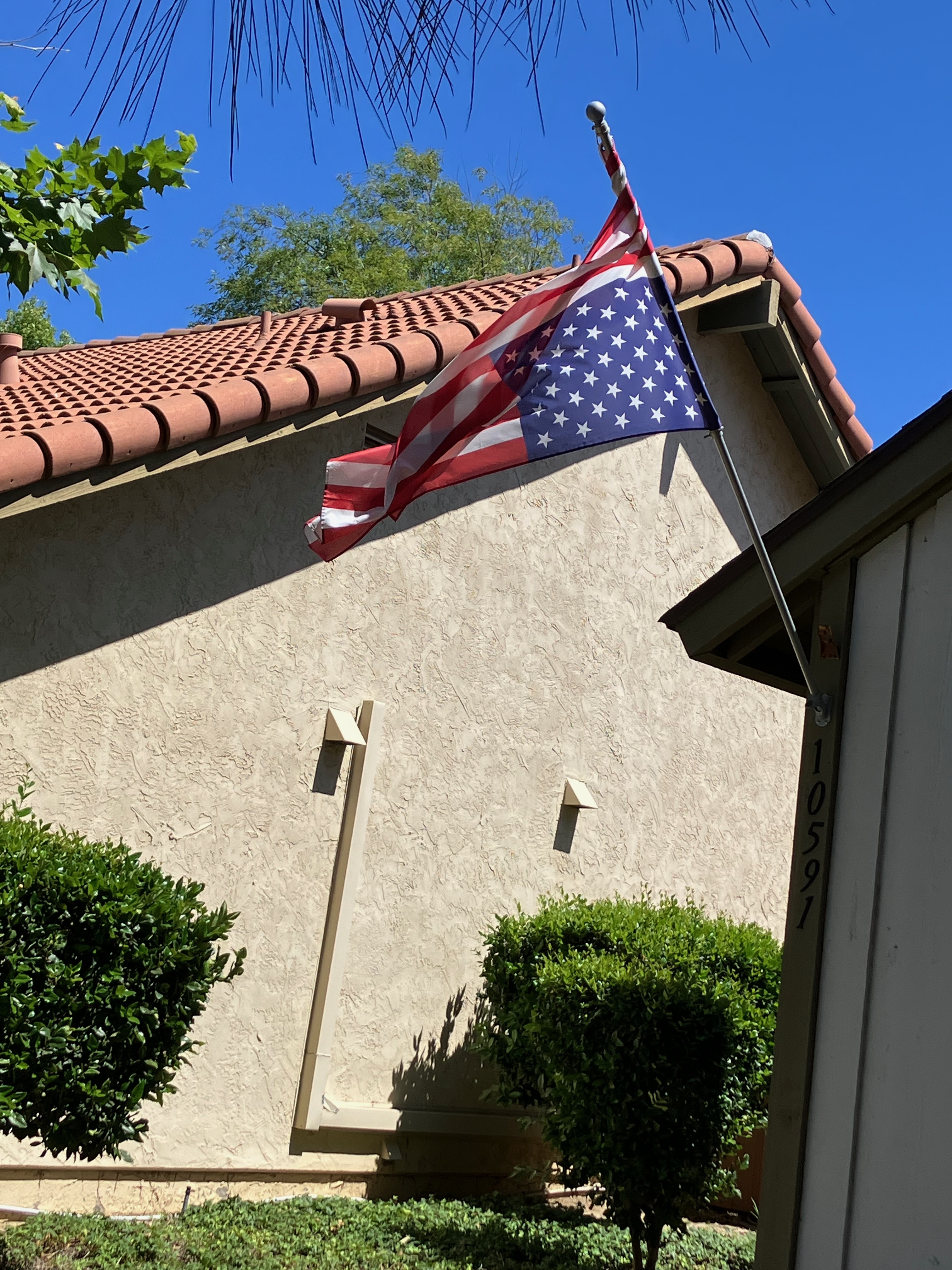
This year’s 4th of July celebrations did little for me.
Much flag waving seemed phony, some neighborhood camaraderie felt forced.
I ached as U.S. ICE raids continued, as civilian deaths mounted in too many armed conflicts.
I wanted to skulk away, to forego my allegiance to much of anything.
But I remain part of a wider whole. Whatever my pique at political or social shenanigans,
I do not have the option to resign from humanity.

So I briefly retreated to gardens that nourish me, some of whom I tend:
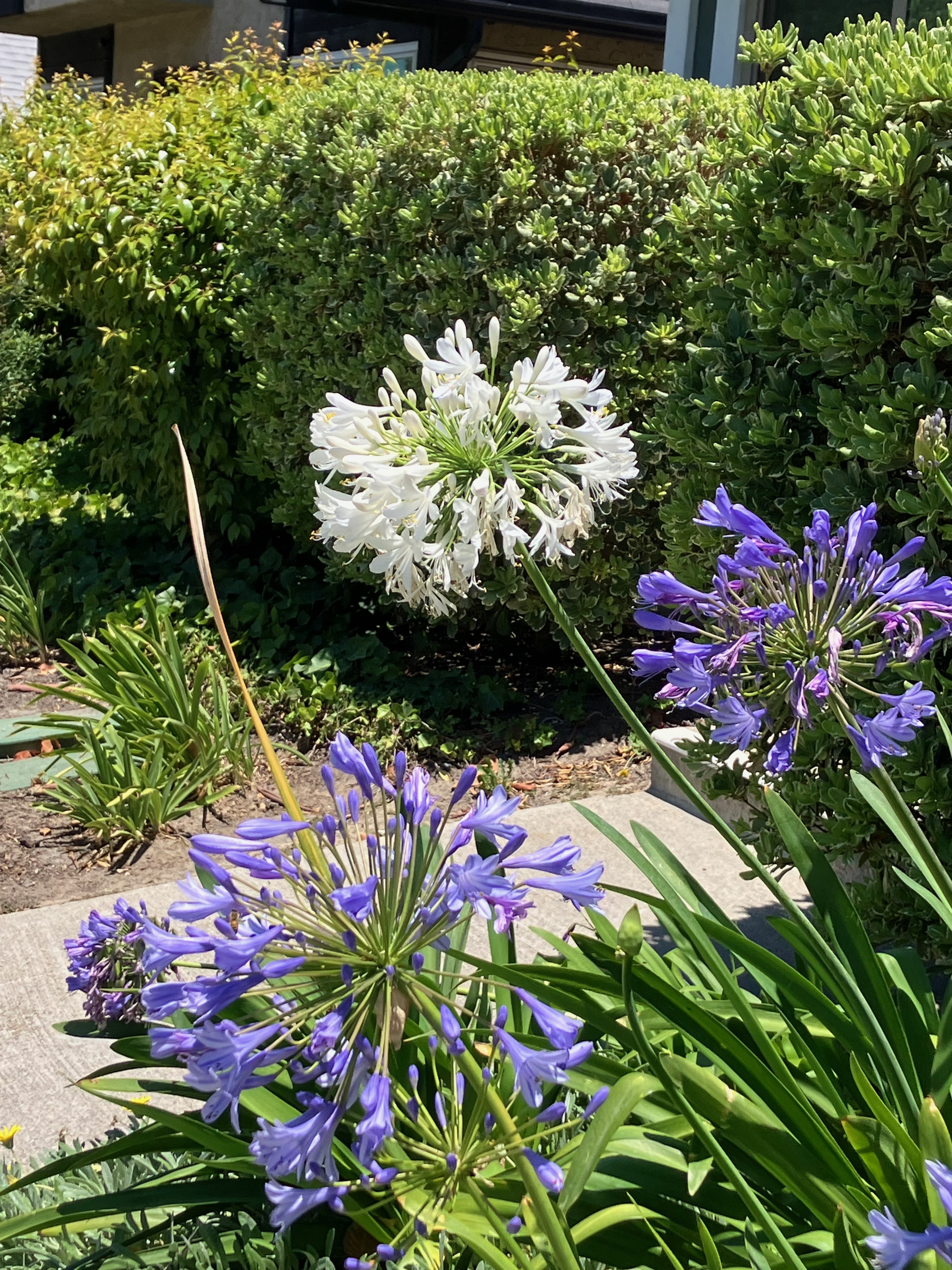
I admired walkway African lilies (agapanthus), most likely planted
When our 1970’s housing subdivision took shape over a decommissioned firing range.
This time of year, blue and white agapanthus blooms adorn our nearby streets,
Their starbursts quieter, more calming, less ephemeral than fireworks.

Within my own yard, I reveled in two sets of red blooms:
Along a sunny side fence, snapdragons from last year. They’d overwintered
In this mild climate where distinctions between “annual” and “perennial”
Get increasingly blurred.

overwintered snapdragons
shade-loving impatiens

Against the opposite fence, impatiens, cut-rate at the
Distressed rack of a local garden shop, now hold forth in most-of-day shade.

One day per year serves me as reminder of our nation’s independence. On other days,
I’d rather honor our interdependence with a natural world that graciously includes us.

May we continue to reconcile independence and interdependence, wherever we are.
Hurrah for the red, white, and blue, whether flags or flowers!

Trauma and Healing

Southern California at the start to 2025 has been the site of extensive trauma. Multiple wildfires are burning large areas around Los Angeles, abetted by fierce Santa Ana winds and a winter drought. Still not fully contained, the fires have killed dozens, forced mass evacuations, destroyed thousands of homes and businesses. 

People elsewhere haven’t been immune, either. Even if we’ve tried to shield ourselves from too much media exposure, we probably have heard about the New Year’s Day killing of New Orleans revelers by a disturbed military veteran who rammed his truck into a crowd. It’s hard to remain entirely oblivious to ongoing warfare and carnage in Ukraine, in Sudan, or in Gaza, where a limited ceasefire seems finally to be taking hold. 

As someone who came of age at the height of U.S. involvement in Vietnam in the late 1960’s, I’ve had long, indirect exposure to that war’s trauma. The Vietnam Veterans Memorial, dedicated in Washington, D.C. in 1982, is inscribed with the names of the over 58,000 American soldiers who lost their lives in that war. Estimates of the number of Vietnamese deaths in the period 1965-1975 range from about 750,000 to over 3 million, including both soldiers and civilians. Somewhere around a million Vietnamese survivors became “boat people,” making perilous sea journeys that eventually led many to settle in the U.S.  

The more people I get to know, the more history I learn, the more I become aware of traumas that have impacted millions of Americans. The past fifty years or so have uncovered more of the pain and dislocation of the chattel slavery practiced from about 1650 until the 1865 end of the American Civil War in the territory of the U.S. Even after the legal abolition of slavery, discriminatory practices and intimidation continued to severely circumscribe the lives of many former slaves. “Generational trauma” can persist, perpetuated by the lack of respect or opportunity accorded many African-Americans for centuries. 

Not all who are traumatized are black. More and more accounts are surfacing of gender-based violence, of violence in families, of mental illness or suicidal tendencies among those exposed to extended trauma. No amount of wealth, privilege, or fame seems sufficient to make one immune. 

Today we celebrate a holiday in honor of Martin Luther King, Jr., considered by many to be one of the most effective civil rights leaders during the 1950’s and 1960’s. King’s life began in racially segregated Atlanta, Georgia in January, 1929. Despite the constrictions of segregation, King excelled in his studies, attended Morehouse College, and later Boston University, where he completed his doctorate in 1955. Beginning in 1954, King also served as pastor of the Dexter Avenue Baptist Church in Montgomery, Alabama. In December, 1955, King was tapped to be the public face of the Montgomery Bus Boycott, started when Rosa Parks, a black woman, declined to give up her bus seat to a white passenger who boarded the bus at a later stop. King’s oratory and his negotiating skills were important in bringing the boycott to a successful conclusion after over a year.

King became known for his espousal of nonviolence, based partly on the practices of Indian independence pioneer Mahatma Gandhi. In some of his writings, King gave six principles of non-violence: 

1. Nonviolence is a way of life for courageous people.
2. Nonviolence seeks to win friendship and understanding.
3. Nonviolence seeks to defeat injustice, not people.
4. Nonviolence holds that suffering for a just cause can educate and transform.
5. Nonviolence chooses love instead of hate.
6. Nonviolence believes that the universe is on the side of justice.

King’s dedication to nonviolence was tested early during the bus boycott, when in January, 1956, his house was firebombed while he was away giving a speech at a nearby church. His wife and infant daughter were inside–fortunately they were not hurt. A mob of armed supporters later assembled bent on retribution, but King persuaded them to go home and lay down their weapons. Later, when on a book tour about the bus boycott in 1958, King was stabbed in the chest by a deranged woman. King was successfully operated on, recovered, and went on to lead further nonviolent protests. For years, he was hounded and wiretapped by J. Edgar Hoover’s FBI. He was jailed nearly thirty times, often on trumped up charges. If anyone should have become embittered or violent as a result of continued and multiple traumas, you’d think it might be MLK. 

Instead, as long as he was alive, he continued to work nonviolently for social change. He was not perfect, but his example of transcending trauma through the healing power of nonviolence is one we need to remember, especially now. 

Of Inflation and Inflatables

The calendar year 2024 will be over in a matter of hours. If I choose to watch or listen to this evening’s media, I’ll get a variety of summaries, explanations and interpretations of the year now ending. Whenever I’ve paid attention to pundits recently, I’ve gotten at least some commentary about inflation—the rising cost of most, if not all, consumer goods. 

Inflation hurts. So far, inflation has not hit me as hard as it has many others. Still, my prime earning years are long over. As time goes on, if inflation is not tamed, it will get harder for me to purchase extras. Eventually, even some things I consider basics may get priced beyond my capacity either to find less expensive substitutes or to switch some items I now buy ready-made to “make from scratch”.

So I’m thrilled that my neighbors have provided some holiday cheer at no cost to me. One of my joys this season has been walking around our neighborhood viewing the holiday decorations in nearby houses and yards. All that this viewing requires of me is a little exertion.

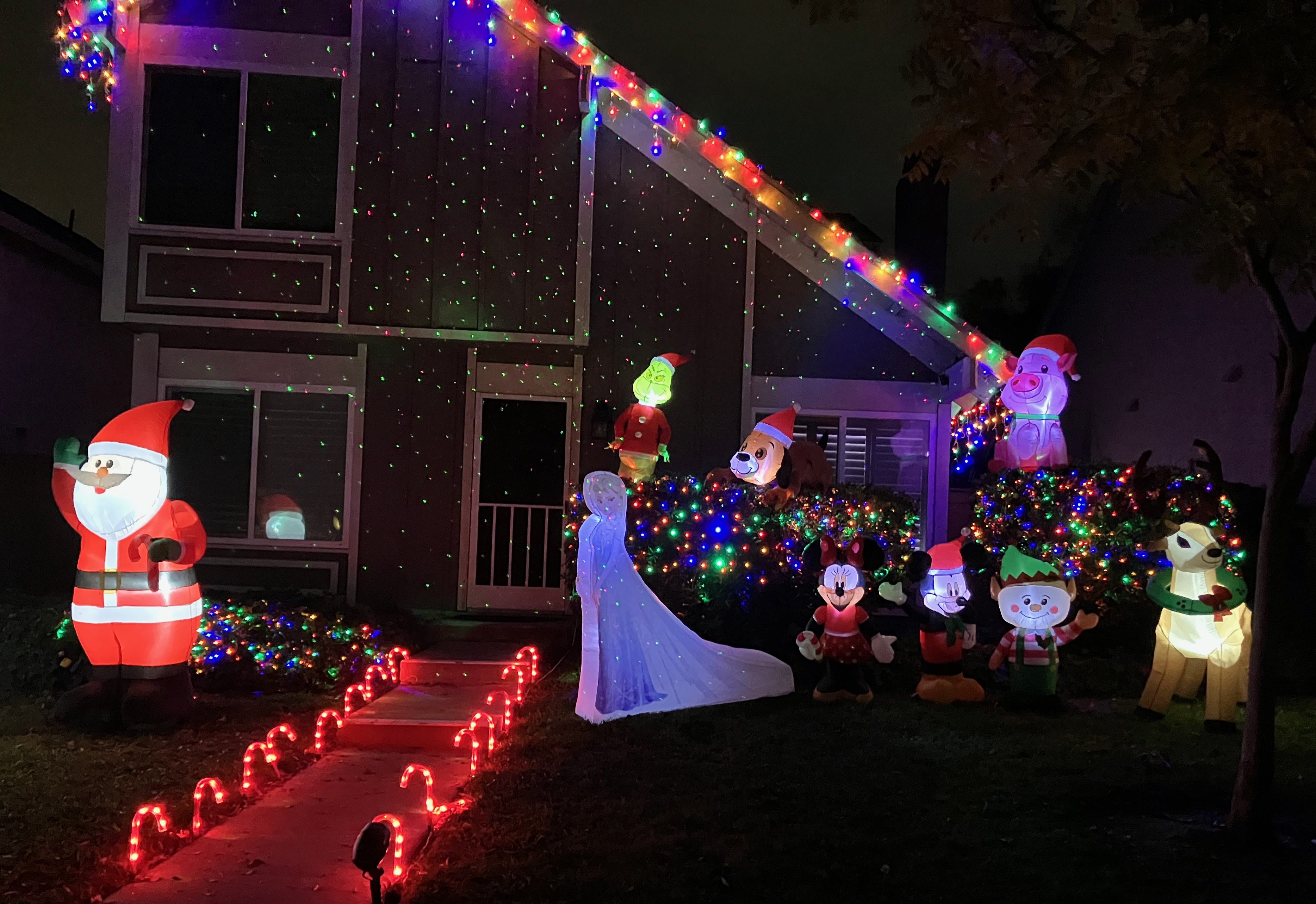
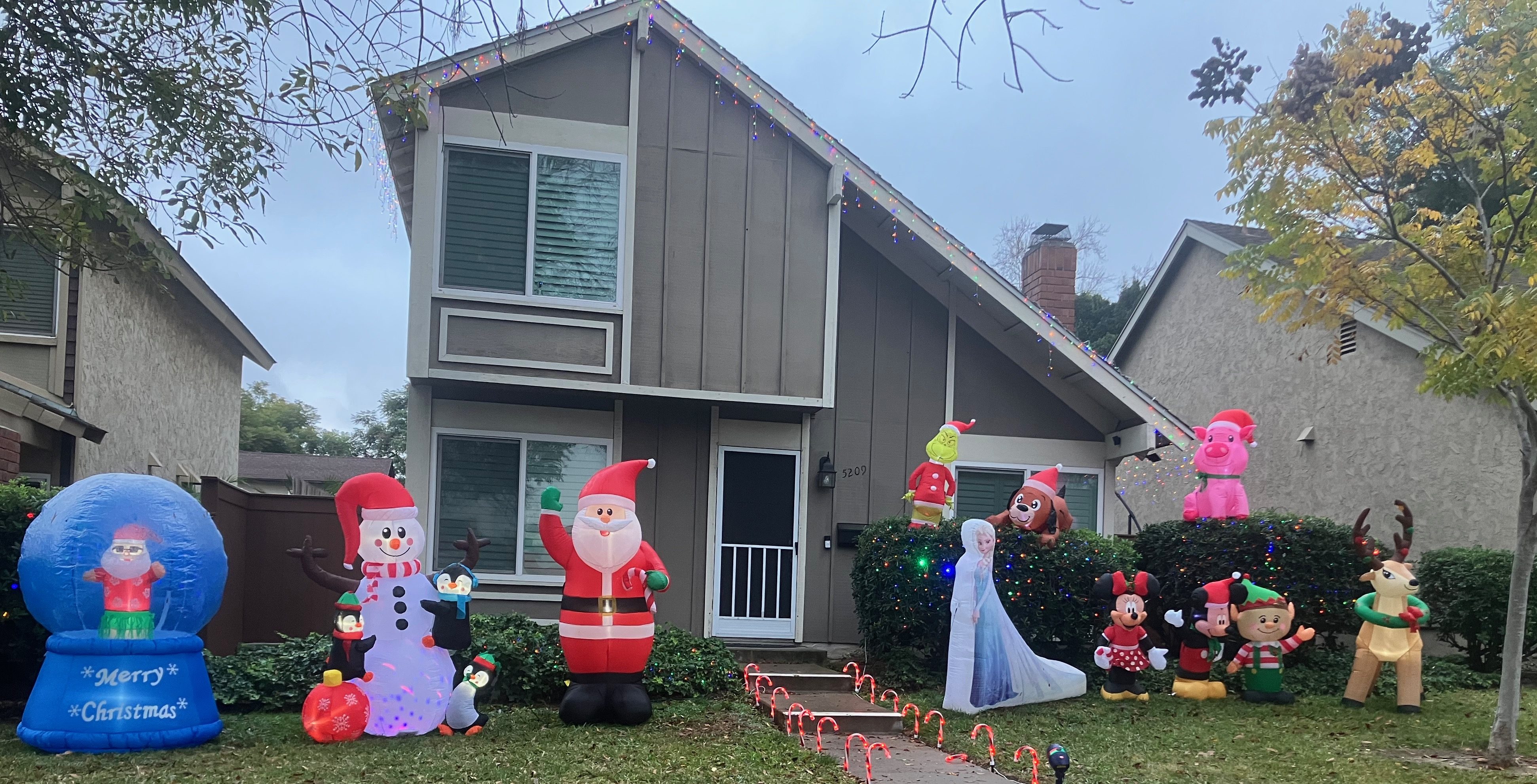
In this part of San Diego, it’s been a year of inflatables—replicas of holiday themed favorites such as Santas and elves, along with cartoon or animated film characters. Most of the figures rest in deflated sprawl during the day. As evening approaches, small electric motors kick in and the figures begin to rise, tethered and kept upright with ropes and/or anchors. It’s intriguing to see what neighbors have come up with. Because we’re in southern California’s “Disney country,” there are many Disney characters, along with Dr. Seuss Grinches. There’s been a rise in the number of “Bluey” likenesses, a recent Disney acquisition based on a children’s cartoon from Australia. Mixed in with the fantasy figures are figures of actual animals and plants. Often the displays are attached to real shrubs and trees that stay green in our mild climate in December.   

In a few days, this year’s inflatables will be more permanently deflated and stored away in attics, closets, or sheds. If electricity follows our inflationary trend, next year’s crop of inflatables may be slightly smaller. Perhaps we’ll substitute more natural materials.   

My wish for 2025 is that we will sooner or later succeed in reining in inflation. I think it will help if we remember that we are more stewards than owners of the natural world, that we are but one species among many. My hope is that more often than not, we’ll be able to avoid either an overinflated or an under inflated sense of our place in the grand scheme of things. Best wishes to all for a Happy New Year!   

Holiday Traffic

Another Thanksgiving weekend. 
This year no need to fight traffic
To and from the grandmothers’ houses,
No need to spend hours circling
The parking lot at the nearest mall.
No need to go anywhere at all.

Now we are the grandparents.
Our muted celebration took place
Around our kitchen table, with
The other set of grandparents,
A daughter-in-law, a teen granddaughter
In attendance. Mostly vegetarian,

The feast also featured a small ham for
The meat eaters of the oldest generation.
We talked in pleasantries, mostly
Avoiding politics. The weather was warm
And sunny, as southern California often
Is in late November. Tomorrow, a wintry mix may

Disrupt the other grandparents’ flights
Back to the Northeast. Been there,
Done that. Especially the two winters
When Vermont was my, then our home.
The Thanksgiving before we reconnected, a blizzard
Delayed and almost sidelined Jim as he came north.

The following year, sleet and snow complicated
Our southbound journey, delaying our arrival at our elders’
House in northeast Philadelphia until nearly 4 a.m.
From a later home in Richmond, VA, we’d set out by car to see
Grandmas and Grandpas in Maryland and New Jersey,
Two growing boys sporadically squabbling in the back seat.

I watch with sometimes spiteful glee as
News clips feature clogged airports, or huge
Temporary parking lots on I-95 in both
Directions. Yes, Virginia, it can take nearly an hour
To clear the Delaware Memorial Bridge.
Still, I need to remain grateful for holiday traffic.

Nearly sixty years ago, the bus ride from Baltimore to D.C.
That usually lasted 45 minutes stretched to almost
Three times that long, giving my college-bound seat mate
And me time to thread our awkward conversation toward a
Slow-budding romance. Holiday traffic helped introduce me
To a future husband, children, grandchildren. Thanks be!  

Stories from a Family with Long Generations

After another bruising electoral season, we are individually and collectively beginning to recover and move on. As an older voter, I do not expect to participate in many more presidential elections. Still, I’m concerned about the rancorous legacy our generation seems to be leaving for those who come after us. 

As a grandparent, I’ve lately become one of our family’s storytellers. It’s my hope that by sharing my own family story and then by deeply listening to others, I may be able to find more common ground. I hope that we may as a community be able to diminish the worst excesses of partisan bitterness. Every family has its own instances of disasters and triumphs. My family’s stories are unique but likely not uncommon. 

Some aspects of my biological family’s history remain a mystery. What has come down to me has been partially shaped by our clan’s tendency toward long generations. It’s also been shaped by a generally privileged trajectory and multiple generations of residency in what is now the United States of America. 

Both sets of my grandparents were well into their sixties or seventies, living in Maryland, when I was born there in 1947. For my first eleven years, I lived next door to my maternal grandparents. That grandfather began life in 1869, so his earliest memories are from a time over 150 years ago. My other three grandparents were born in 1879. All four grandparents had stories to tell. 

My maternal grandfather, the man I called Pop-Pop, was born in Mississippi just after the U.S. Civil War. He was the youngest child in a family of former slaveholders, with one older brother and five older sisters. Pop-Pop recounted being frightened of the Union troops billeted in his family home during Reconstruction. He was later able to get a good education. He spent time as a school teacher before switching to bookkeeping about the time his first child was born in 1906.  

My maternal grandmother, nicknamed “Ginx,” was a 3-pound “preemie” born in January, 1879 in rural Virginia, in the days before many hospitals or “modern medicine.” Her parents later told her that for her first few months they had kept her in a makeshift incubator constructed by lining a laundry basket with warm bricks and cast-off blankets. Her father was a school superintendent in one of the counties where Pop-Pop taught school. 

My paternal grandfather was the second son in a family of midwestern small-scale farmers. He met my other grandmother while both were students at a telegraphy school in Kentucky. This particular school was run by a conman whose main goal seems to have been lining his own pockets. The two lovers conducted a lengthy, partially long-distance courtship, complicated by economic struggles plus the lingering animosity between northern and southern states. Grandpa was “Yankee bred,” Grandma a Southerner. They eventually wed at my great-grandfather’s North Carolina farm at Christmas in 1907. 

Grandpa and Grandma briefly attempted to homestead in Nebraska, but found the dry conditions and near-constant wind too much of a challenge. Grandpa later worked various clerical and administrative jobs, first for railroads and then for a government agency regulating interstate commerce. Grandma managed the small Maryland farm where they eventually settled and continued raising their children. 

(Portraits of my grandparents that a friend of my parents painted; they hung for years in the family dining room)

My dad made his entry into the family saga in 1912. Born in Ohio, he moved with the family to Maryland in 1920. Through grade school, he attended a two-room rural schoolhouse. By the time he was ready for college, the Great Depression had set in and money for tuition was scarce. Dad and his two older siblings took turns at the University of Maryland nearby, each finding what work they could to supplement the family income. They pooled their funds, helping each other pay college costs. Dad and his older brother John sold chickens and eggs from the farm. Aunt Lucy did clerical work. 

My mom showed up in 1917 as a “bonus” daughter, eleven years younger than her sister Margaret, five years younger than her brother Stuart. Family life was hectic as the “war to end all wars” came to a close in late 1918. The armistice was bracketed by a global flu pandemic that spared Mom’s family, but killed an estimated 50 million people worldwide. 

Aunt Margaret and Uncle Stu attended high school in Baltimore City. Though city tuition was somewhat expensive, Baltimore’s schools at the time were considered vastly superior to the small high school in the next-county village where Mom’s family lived. Pop-Pop and Granny spent much of the 1920’s ponying up city school tuition to give their children the best educational start they could. Pop-Pop had a job as a Baltimore-based bookkeeper. Granny earned money teaching piano pupils at home or in local schools. Then, just as Mom was ready to enter high school, the Depression hit. It limited Mom’s high school choices and nearly preempted her chance to attend college.

Within seven months during 1929-1930, Mom’s family experienced a one-two punch of reversals. The stock market crash in late October, 1929 did not directly impact them—Pop-Pop and Granny owned no stocks. The family’s downward spiral started about a month later with an “upward spiral.” On an unusually cold day just after Thanksgiving, a chimney fire broke out in their recently renovated kitchen. By the time the local fire brigade arrived, the fire had started to spread. They were unable to contain the blaze. Water from their hoses froze before it could reach the house’s high roof. The entire structure burned to the ground. The family found rental lodging, hoping to rebuild later. The following June, Pop-Pop, then sixty years old, was laid off from his job. The company he had worked for replaced most of their human staff with early calculating machines to cut costs. 

Somehow, Mom’s family persevered. Aunt Margaret and Uncle Stu were able to find jobs. Granny took correspondence courses in hotel management. She then got work as a full-time housekeeping supervisor at a Baltimore luxury hotel. Though she frowned at some alcohol-lubricated political shenanigans during the waning days of Prohibition, she held her tongue. Pop-Pop got what temporary work he could, once surviving a major 1933 flood while working as a night guard at a railroad construction site. 

Mom finished at the top of her high school class. She scraped together earnings and loans to attend college. The Depression eventually ended. Mom and Dad eventually met and married. Their “greatest generation” was partially shaped by the eras they grew up in—one global war, then boom times, then economic depression, followed by another global war. During the post-WWII baby boom, they produced me, my sister and two brothers. We’ve so far confronted different challenges, including a recent global pandemic with its accompanying trauma and dislocations.

What have been your family’s triumphs and trials? How may they influence your experience of the world going forward?