Tag Archives: food insecurity

Serendipitous Synergy

Our city has lately had more bad news than we’d like. A hate crime at an area mosque on Monday took five lives, including those of the perpetrators, two teen gunmen. It could have been much worse. Police arrived on the scene and secured the area quickly. A mosque security guard and two congregation members gave their lives while helping prevent a wider tragedy. Nearly 150 children at the affiliated school were first hidden via a lockdown protocol, then safely evacuated. Still, the tragedy shook a community already somewhat on edge because of active and pending military deployments in our Navy and Marine heavy town. 

The mosque where the attack occurred is near a major freeway, so many of us know the location. An impromptu shrine has been set up to commemorate the victims. An online fundraiser has helped provide material aid for their families. A Tuesday evening vigil brought many in the community together to mourn and to call for a reduction in the hateful rhetoric that has helped provoke such events.  

Contributing to the fundraiser and watching coverage of the Tuesday vigil helped ground me a little, yet as this week has unfolded, I’ve needed something more positive to focus on. A fortuitous combination of circumstances has provided a boost. 

It starts with an area non-profit that works tirelessly to provide nutritious food to those in our area with unmet food needs. Since learning of its programs a couple of years ago, I’ve become a supporter and fan. I like their approach. Their small window sticker adorns our aging car:  “Feed People, Not Landfills.”  Using a whole combination of approaches and funding sources, Feeding San Diego is able to improve area nutrition while reducing area solid waste. They have a small staff and a whole army of regular or intermittent volunteers, including me.  
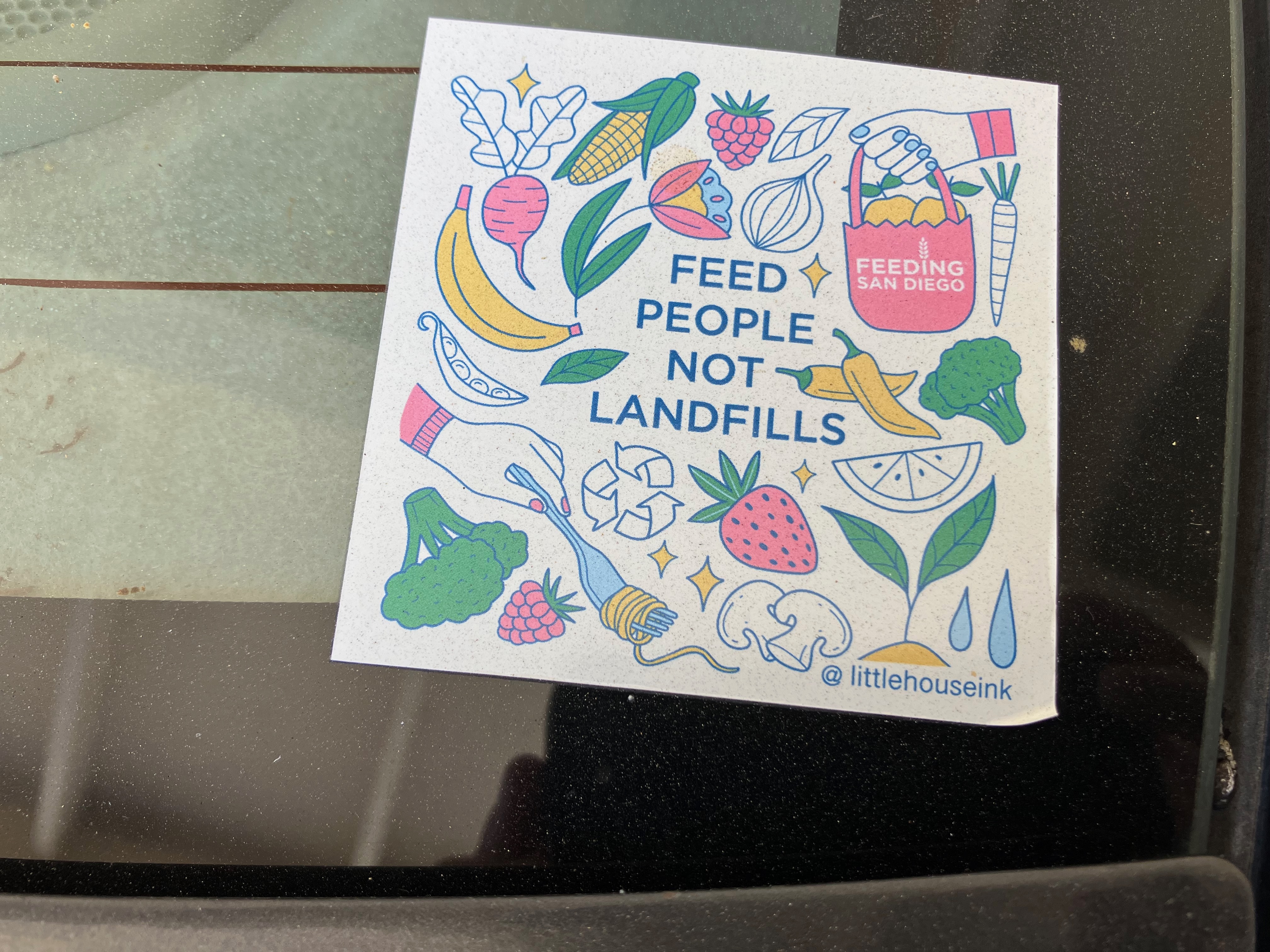
Feeding San Diego sticker

Next came a near neighbor, whose mature lemon tree outdid itself in fruit this year. Early Monday, I’d noticed a wheelbarrow and a beach umbrella across our alley, with a hand lettered sign that I had to get closer to to read: “Please take some; bags included.” I gathered a few lemons for our family to use, but barely made a dent. When the wheelbarrow was still nearly full on Monday evening, I lugged a couple of 5-gallon buckets across the alley and “harvested” about half the remaining lemons. I thought I might have an outlet for extra lemons, but needed to check before I took even more. 
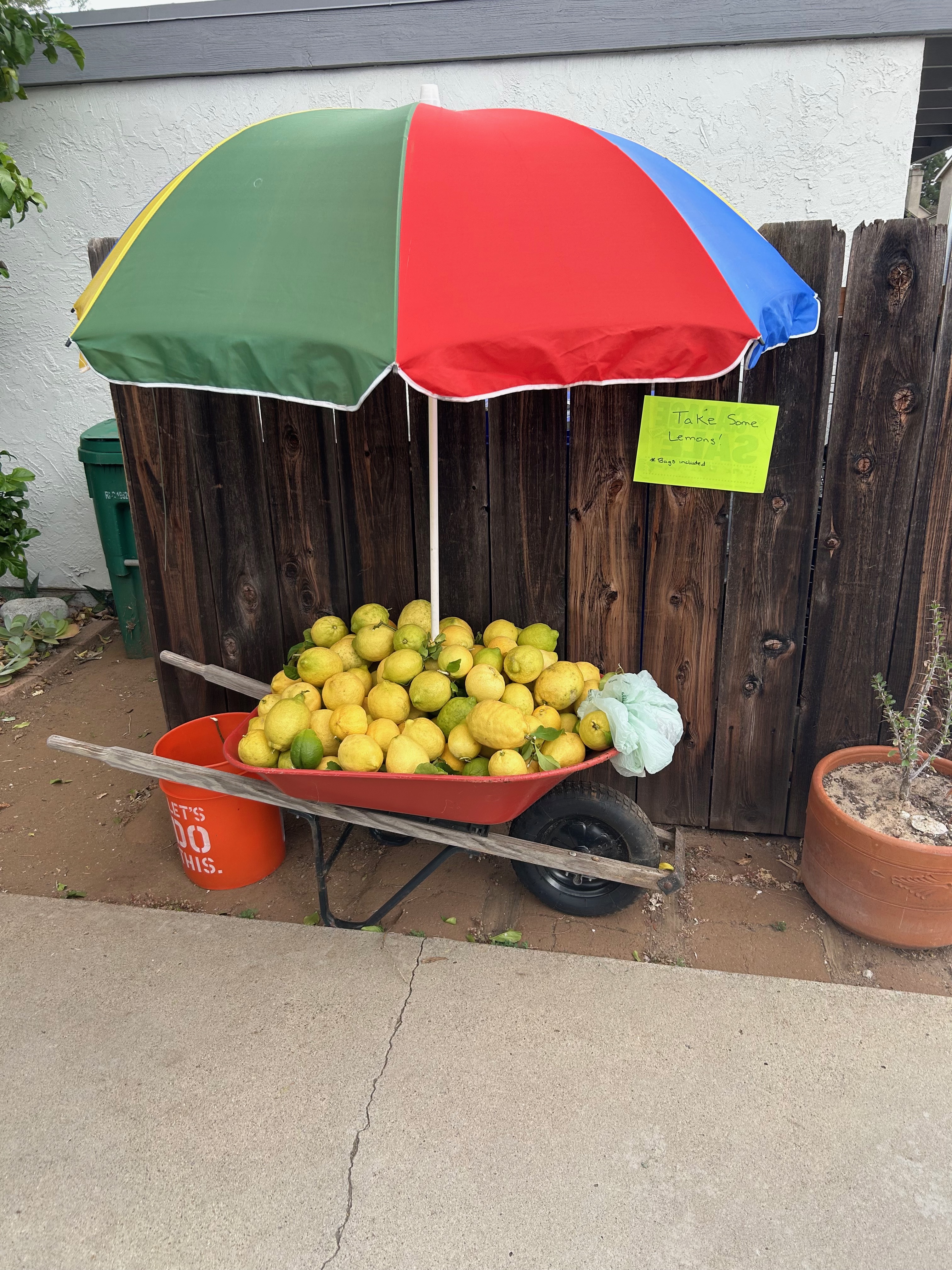
Our neighbor’s abundance of lemons

I’d signed up to attend a volunteer appreciation breakfast on Tuesday morning at a nearby elementary school where I sometimes assist with semi-monthly food distributions. The school serves mostly military families whose pay is not always enough to cover all their needs. I knew the school’s outreach coordinator slightly and could check with her at the breakfast about whether a set of organically grown lemons would be a useful addition to the school year’s final food distribution on Wednesday. She said yes!  

So, Tuesday evening I went back across the alley and filled multiple bags with nearly all the remaining lemons. This morning I checked with the volunteers who assemble food packets at the school—they’ll incorporate the lemons into this month’s produce, along with plums, pears, and avocados.  A nice variety.  
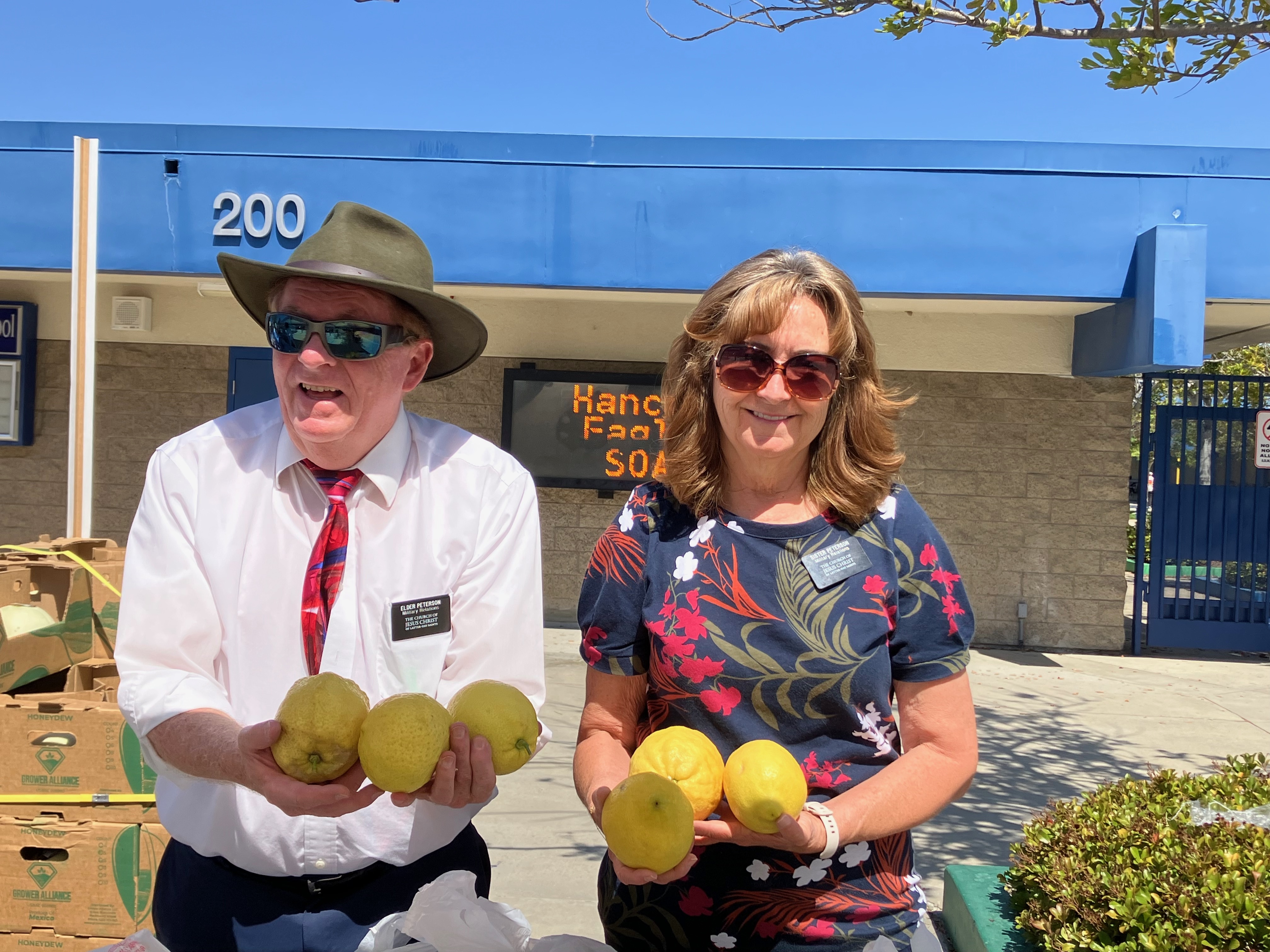
food pantry volunteers ready to re-package lemons

Our neighbor is thrilled that her lemons will not go to waste; I’m happy that I was able to connect a one-time source with appropriate recipients; the food distribution volunteers were happy to package the additional produce; some families will have extra fruit for the coming holiday weekend.  A win-win-win-win?  

Perhaps the old tag line needs revising:  When life hands you lemons, share!   

Taming the Urgency Instinct

This instinct, out of ten harmful perspectives mentioned in the 2018 book Factfulness, is the one the Roslings tackle last. It’s also one that gives me a lot of trouble. During the few days’ lull between this past Tuesday’s election and the crescendo of year-end fundraising appeals that begin to fill my postal and email in boxes this time of year, perhaps I can further tamp down my tendency to concentrate on “quick fixes.” Some problems have festered for decades, if not centuries. There may even be some whose contours are already getting less dire.  

Most of us have sometimes been lured by advertising and/or public pronouncements of “now or never.” When I was a teenager,  teen pregnancy was considered a big problem. Back then, one of the era’s most popular music idols recorded a new English lyric to an earlier Italian song. Elvis had me and many of my classmates swooning, though we might have been pretty hazy on what “be mine” meant: 

“It’s now or never, come hold me tight, 
Kiss me, my darling, be mine tonight–
Tomorrow will be too late,
It’s now or never, my love won’t wait.”

The testosterone-driven urgency of this 1961 lyric did not boost efforts to promote sexual responsibility among impressionable teens. However, Elvis was more echo than cause of an epidemic of post-World War II teen childbearing. The rate of teen pregnancies had peaked in 1957 at an estimated 96.3 births per 1,000 young women aged 15 through 19. It then began to decline. By 1986, it had fallen to 50.2.  (https://www.congress.gov/crs-product/R45184) The rate has since dropped even further, registering a historic low of 13.1 in 2023. Many successive studies confirm the negative impacts of teen births: “Adolescent childbearing is associated with significant social, health, and financial risks for teens, their families, and society more broadly.” 

Perhaps mothers (and fathers) of teenagers have over time come up with more effective ways to impress upon their daughters (and sons) the dangers of this particular “now or never” argument. Perhaps teens have gotten better at assessing risks.

Lately, most of the “now or never” appeals I’ve been getting involve either 

1) the need to reduce food insecurity or 
2) the dire consequences if we elect candidates of the “other” political party.  

1) It’s true that confusion and ongoing changes to SNAP benefits (also known as “food stamps”) for millions of low and moderate income Americans have temporarily increased food insecurity in many places. To compensate, food pantries, non-profits that provide meals, and food rescue organizations have all stepped up their fundraising and distribution efforts to mitigate negative impacts in the U.S.  It is also true that too many people throughout the world lack reliable access to healthy, nutritious food. Heartrending videos of ongoing hunger and starvation in Gaza and in Sudan can make us want to do something, anything, right away, to reduce the harm. 

What gets less attention are strides that continue to be made in producing sufficient food globally.  Per a recent report from the U.S. Department of Agriculture: “Over the past six decades, world production of crops, livestock, and aquaculture commodities grew from a gross value of $1.1 trillion to $4.3 trillion (2015 dollars). … As global agricultural productivity has risen, fewer natural and environmental resources per unit of agricultural production have been used.” (https://www.ers.usda.gov/amber-waves/2024/september/global-changes-in-agricultural-production-productivity-and-resource-use-over-six-decades

A decade or so after my Elvis phase, I listened to another singer, Harry Chapin, as he pitched the importance of helping solve the hunger crisis. Harry was convinced that world hunger was a solvable problem—more a distribution issue than overall scarcity. An organization he helped found, WhyHunger, still exists and is working in multiple countries to help reduce food insecurity. A similar group, The Hunger Project, works with a slightly different focus but similar goals. Related groups such as Drawdown, working to reduce the impacts of climate change, point to the current waste in our global food systems as a potential source of both increased food security and decreased greenhouse gas emissions. Reliable estimates put current global food waste at about 1/3 of all food produced.

2) Ever since the 2000 election cycle, I’ve gotten increasing numbers of urgent solicitations from political candidates and committees. Not all, but most requests want to persuade me that the opposing candidate or party is venal if not downright evil. They do little to explain how their candidate(s) might make conditions better, but concentrate on how their opponent(s) will make things worse. After several years of such solicitations from one party, I got so annoyed that I changed my voter registration to “no party affiliation.” Unfortunately, that just produced more requests—now from “both” sides. 

I don’t deny that much in our current political system cries out for reform. What I do question is whether replacing one set of naysayers with a different set of “nattering nabobs of negativism” would improve the situation. Per a recently edited Wikipedia article on “divided government in the United States”  (https://en.wikipedia.org/wiki/Divided_government_in_the_United_States), the U.S. has had roughly equal periods of divided and “unified” government since our current two political parties coalesced in 1857. There have been about 76 years when the Executive branch (the Presidency) was led by a different party than at least one house of the Legislative branch (the Congress). There were 74 years when a single party controlled both the executive and legislative branches. It’s not clear to me whether either set of periods was substantially better at governing the country.  

https://whyhunger.org http://thehungerproject.org http://drawdown.org

My “urgency instinct” is likely to kick in to some extent this giving season. I will likely make additional donations to food rescue organizations to reduce current food insecurity. Once the next election season ramps up, I may make small campaign contributions or volunteer for a local candidate.  However, I’ll continue to use whatever time is left to me to move away from “now OR never” toward “some now AND some later.” May you similarly use your material and spiritual resources. Happy Thanksgiving!