While waiting for the fever to break, I apply cold compresses and administer aspirin, trying to remember not to exceed the recommended dose. I pray, and pray, and pray some more. I tell others and myself “I love you,” over and over, fervently. I hum lullabies and songs of peace. I crave quiet. I shy away from news and opinion.
While waiting for the fever to break, I try to damp down feverish attempts to “make the world safe,” be they my own or others’. I search to find and support more measured changes toward whatever the world wants to become. I meander around the nearby detritus of prior conflicts, wondering at the residual scars. I gravitate toward the small patch of cleared ground where a group of us is learning organic gardening. Well before dawn, jarred awake by a buzzing phone, I ask the still-dark sky for wisdom. The stars shine an answer, one I’ve too often forgotten: “No one is an absolute owner; we are all, rather, temporary stewards.”
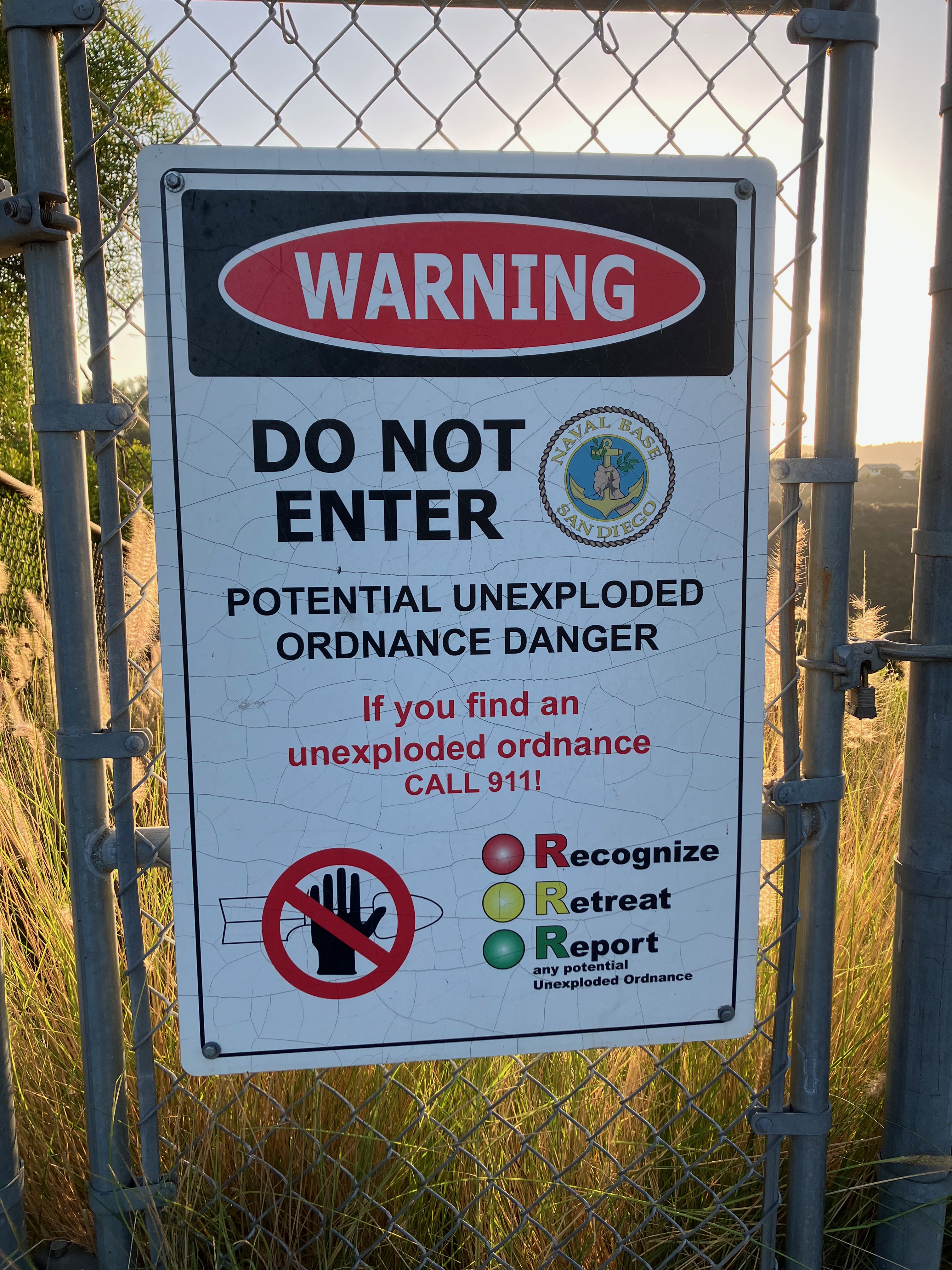
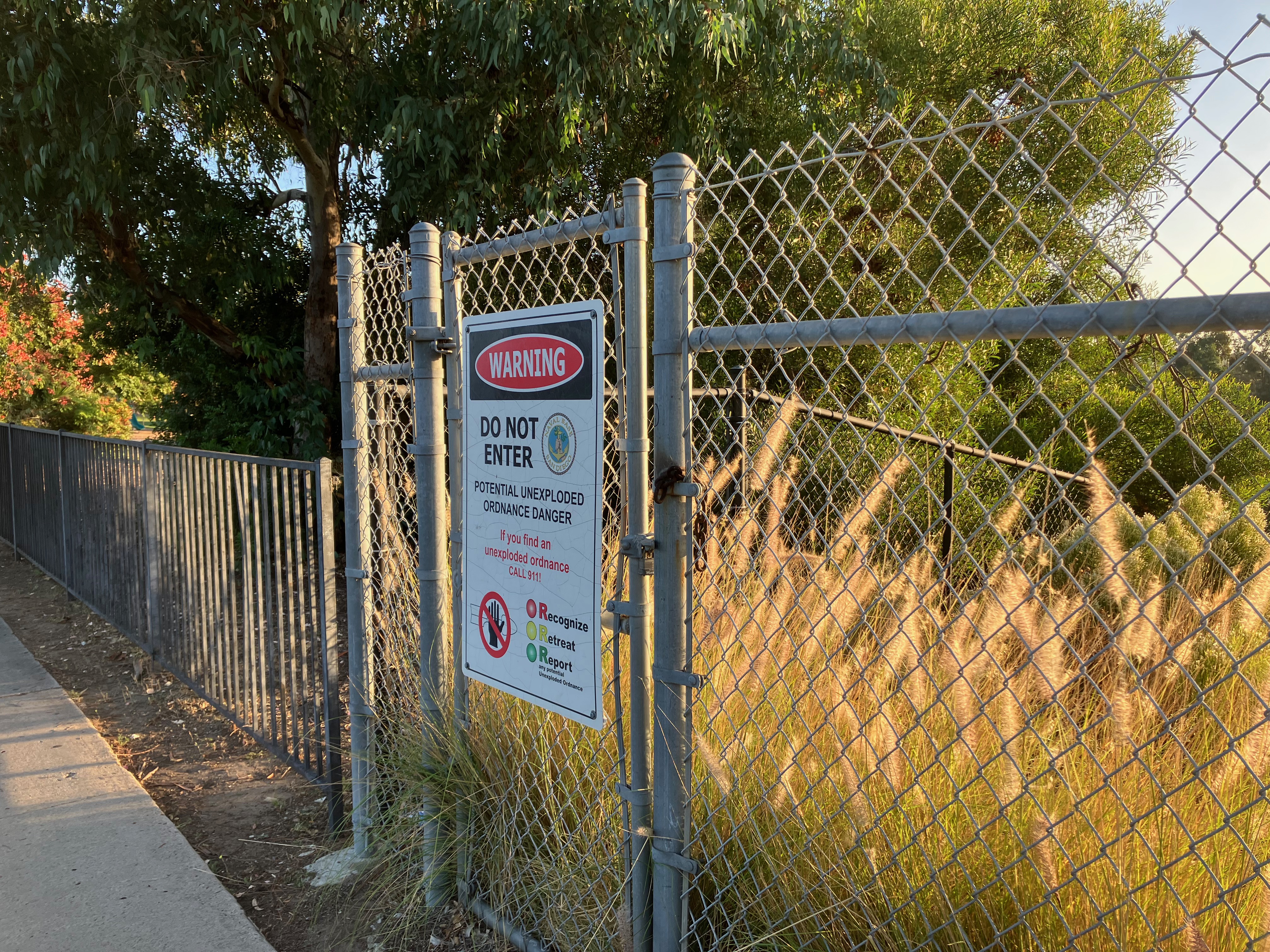
Lingering damage warning, Murphy Canyon, San DiegoWarning of unexploded ordnance near children’s playground, San DiegoEntrance to our “giving garden,” Tierrasanta, San Diego
Today, August 6, marks another anniversary of the dropping of an atomic bomb on the Japanese city of Hiroshima in 1945. This August 6, the war between Russia and Ukraine drags on, with periodic threats of deliberate use of nuclear weapons by the Russian military or of possible nuclear disaster at the vulnerable civilian nuclear power plant in Zaporizhzhia, Ukraine. In the U.S., summer release of the film “Oppenheimer,” about one of the physicists who helped develop the first nuclear weapons during World War II, has also reinforced our uneasiness about the possibility of nuclear catastrophe.
A number of years ago, I had a chance to meet and to listen to a “hibakusha,” a Japanese term for survivors of the nuclear attacks on Hiroshima or Nagasaki. The older woman I heard at a backyard barbecue in New Jersey was petite, exceptionally well-groomed, but nonetheless visibly scarred. She was passionate about the necessity of reducing the likelihood of further nuclear warfare.
She had been a young teenager in Hiroshima when the bomb was dropped. She and her schoolmates had been conscripted to work part-time folding parachutes at a war materials factory. As allied troops closed in on Japan in 1945, even young girls were recruited for the Japanese war effort. Whether this woman had been an “innocent victim” of the carnage may therefore be somewhat open to question. However, whether nuclear weapons should ever be used again should not be open for debate.
The woman I heard has probably died by now. The number of living hibakusha is dwindling. According to the most recent count in Hiroshima, taken in 2021, the average age of survivors was 84. During a spring 2023 summit of G7 industrial nations held in Japan, some of these survivors made the effort to present their stories.
For 84-year-old Toshiko Tanaka (six at the time of the blast), one of her most vivid memories from that time was the smell of burning corpses in the days after the explosion. The authorities had started cremating the bodies of those who died. “I was traumatized,” she says. “All my friends from school died and for a very long time I couldn’t speak about what happened.”
It can be too easy for those of us not directly exposed to the horrors of nuclear warfare to become complacent about the likelihood of a recurrence. It can be hard to figure out how best to articulate opposition to nuclear proliferation, to nuclear arms races, to the sheer inhumanity and indiscriminate slaughter wrought by this sort of weaponry.
May we continue to listen to the hibakusha; may we continue to develop more effective ways to reduce the chances of creating any more.
A little earlier this year, I read a book recommended by a friend: author Rachel Webster’s Benjamin Banneker and Us. Part biography, part genealogy, part memoir, Webster has crafted a heavily researched, deeply felt account of one extended American family’s efforts to come to terms with nearly a dozen generations of racism, sexism, and classism. My friend is a collateral descendant of Benjamin Banneker, an early American mathematician, intellectual, and author. Benjamin Banneker, born in 1731, was widely revered in his time. In the classifications of the day, he was considered a free colored man. During the 1790’s, Banneker helped survey the land that became Washington, D.C. He also published several widely read almanacs. He died in 1806, leaving no children, but multiple sisters, nieces, and nephews. Banneker owned a farm in the vicinity of Ellicott City, Maryland that has since become a park and memorial. Because Banneker was free and so widely known, researchers of his lineage can delve much further back than is possible for most African-Americans.
One set of Banneker’s grandparents met around 1680 in what later became the state of Maryland. Molly was a British woman serving a term as an indentured servant; Bana’ka was an African man of Wolof heritage who had been brought across the Atlantic to be sold into slavery. It’s not entirely clear how their relationship developed, but Molly and Bana’ka both obtained their freedom and had four daughters together in a tumultuous era when chattel slavery had not yet become fully fixed by law and marriage rules were confused. Their eldest daughter, Mary, fairly late in life became the free mother of Benjamin.
Rachel Webster had always been told she was “white,” until a chance conversation at a family wedding in 2016 opened up a Banneker connection. Webster and her cousins have done lots of genealogical research. They’ve used increasingly available DNA testing, public records, and oral traditions passed down mainly through the black-identifying cousins of the family to identify over 20,000 Banneker-Lett descendants, all but one of whom have at least some traceable European or “white” ancestry.
The book shifts back and forth between the historical facts and ambiguities of the Banneker-Lett lineage and the extended efforts Rachel makes to learn how and where she fits into this newly expanded version of her family. Some of her ancestors must have at some point decided to “pass” as white. Webster and many of her cousins on all sides of an increasingly blurry “color line” have mixed emotions about the complexities of the family’s story. Who constitutes “us” is rarely as simple as we think.
Those of us who’ve been told we are “white” still struggle with our heritage. Our cousinships are typically murkier and less well documented than Rachel Webster’s. We wonder how to go about celebrating Juneteenth, a recently established Federal holiday commemorating June 19, 1865, when U.S. Major General Gordon Granger, recently arrived with his troops in the area of Galveston, Texas, issued “General Order Number 3.” The order reads, in part:
“The people of Texas are informed that, in accordance with a proclamation from the Executive of the United States, all slaves are free. This involves an absolute equality of personal rights and rights of property between former masters and slaves…”
Somewhat less cause for celebration, the order goes on to say:
…and the connection heretofore existing between them becomes that between employer and hired labor. The freedmen are advised to remain quietly at their present homes and work for wages. They are informed that they will not be allowed to collect at military posts and that they will not be supported in idleness either there or elsewhere.”
It can take a very long time for the knowledge that none of us are free unless we all are free to enter our intellectual understanding. It can take even longer for this knowledge to move from head to heart. Some of our current debates surrounding race, sex, and class are not so different from those of Banneker’s day or from the mixed messages in General Order Number 3.
Still, as one of my brothers sometimes reminds me, “We are all human.” Please let’s expand our understanding, delving beyond labels, working for adequate wages, sharing in loving homes, enjoying full equality of personal rights while respecting those rights in others. Whatever our supposed racial identity, that will truly be cause for celebration!
Mothers are tired of outworn tropes proposing sheltered domesticity or cutthroat economic jostling as our only options.
We would much rather be acknowledged and appreciated for our often vibrant, adaptive balance, as we pivot through multiple changes, continually adding value.
Mothers are tired of having too many of our daughters derided, too many of our sons killed or injured in conflicts over illusory control.
We would much rather have all of our children valued, each for their unique style, limitations, perspectives, and gifts.
Mothers are tired of sappy greeting cards, purchased flowers, restaurant meals or burnt toast on our “special day.”
We would much rather have spontaneous, inclusive, carefree celebrations less linked to any calendar.
Mothers’ hands are tired of rocking cradles. Mothers do not want to rule the world.
We would much rather partner with others to help heal our own and our world’s brokenness.
We would much rather continue our strenuous, joyous lives, punctuated with occasional bawdy songs, with perhaps a few lascivious romps when we choose.
Easter morning, fog gradually dissipating. Soil gradually drying after a Cooler, wetter March than is Typical for this part of the world, I’m told.
My second gardening year here. Multiple seasonal harvests are possible When there’s enough moisture for irrigation.
Just ending, a Lent of voluntarily cutting back— No meat, more vegetable protein, More varied vegetables as well. Soups and stews that matched the Atypically chilly weather.
Now, a seasonal transition—more sun, Fewer storms, more widely spaced. Time to put in tomato seedlings, maybe. Time to consider what other warm season veggies Might put down roots in this nearly-new-to-me place.
After a cool season of media vitriol And exaggerated claims of victimhood And crisis, a relieved exhale at fuller reservoirs– Short-term apocalypse averted.
Whether we are transnational or transgender, Whether we’ve moved cross-country or across the street, Be we behaviorally inclined toward transactional, transitional, Or translational interactions, we each have seasons Of feeling transplanted, not quite fitting.
Then we remember, sometimes belatedly, the redemptive Character of this resurrectional season.
It’s been a while since I previously updated this blog. It’s been a busy, wet, cool season for me here in San Diego. For the first time since renting a community garden plot last spring, I’ve had chances to try my hand at cool season gardening. The cool, wetter than usual weather produced lettuce, carrots, chard, parsley, and kale—enough for salads that were a welcome addition to rainy day soups made with some homegrown leeks.
winter’s veggies
What people tell me is an unusual-for-here series of chilly, rainy days provided the impetus to go through my store of fabric scraps and to come up with a set that may provide some comfort and warmth for an area refugee family.
quilted squares for refugee family
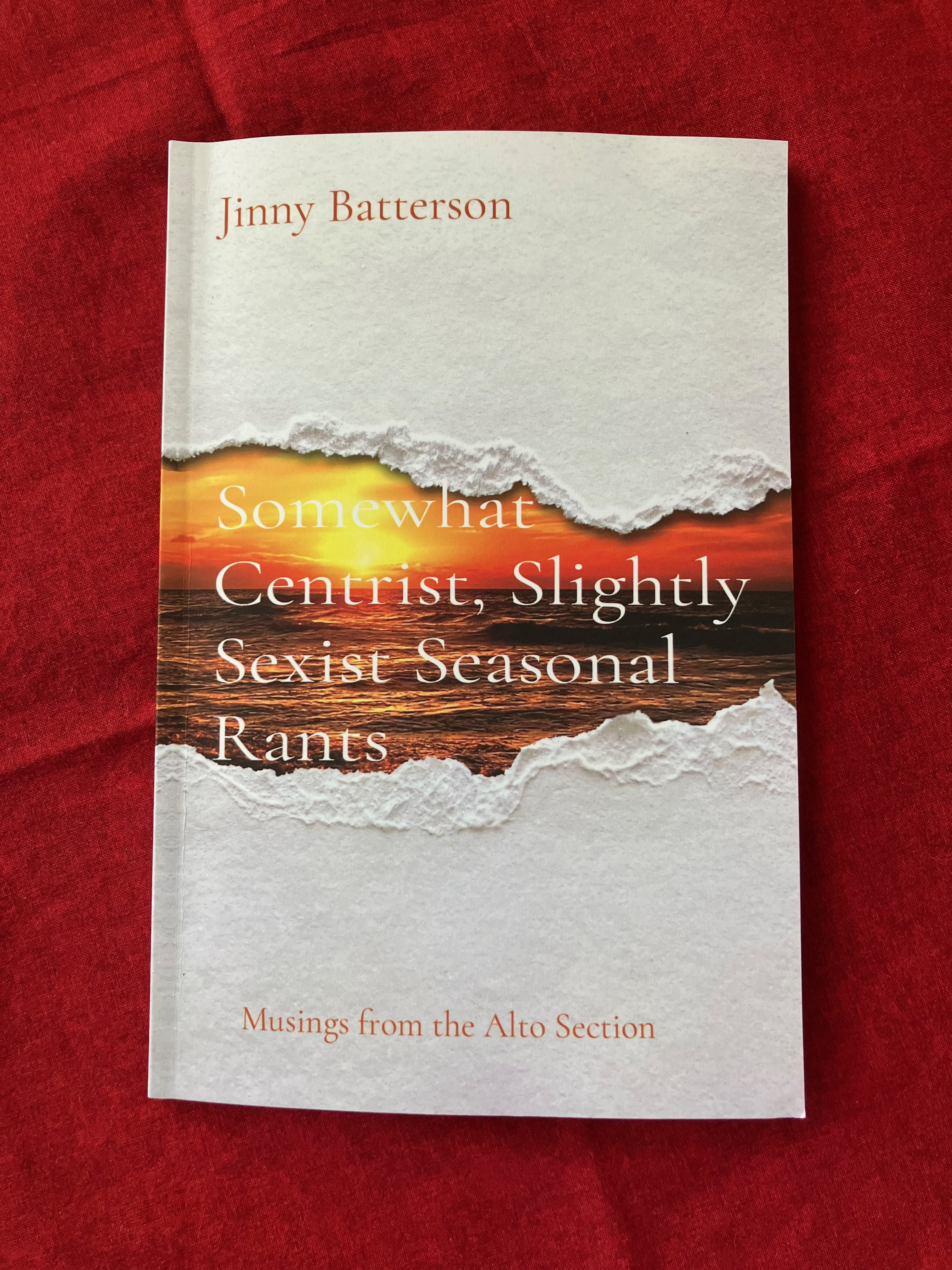
What’s taken up the bulk of my time the past couple of months has been adapting and updating some prior blog posts into a self-published book of essays with a long title “Somewhat Centrist, Slightly Sexist Seasonal Rants: Musings from the Alto Section.” The book, now in its final proofing process, is due out later this month. It chronicles parts of my particular woman’s history and relates my individual views of some current issues.
Today, March 8, is celebrated in many countries as “International Women’s Day.” Multiple relevant events in the San Diego area are listed for today or later during this Women’s History Month. Some highlight this year’s theme, “Embrace Equity.” Despite generations of effort, women do not yet enjoy pay equity in most environments. Sadly, in many places we seem to be going backward on one of the most important equity issues of all, the capacity to manage our own reproductive health, to control our own bodies.
Happy International Women’s Day to all as we continue the ongoing struggle for equity!
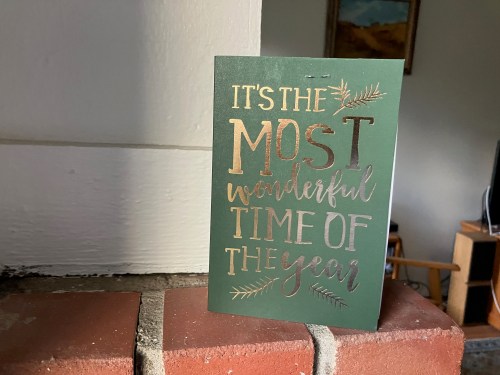
In the small Maryland town where I grew up in the 1950’s and 60’s, sending and receiving postal holiday cards was an important part of holiday tradition. Dad and Mom participated by taking an annual posed picture of us kids and then making numerous copies in Dad’s basic home photo lab, stinking up our house for days. They’d either include a holiday greeting in the photo itself or add a brief caption to each copy.
Then they’d stuff envelopes, write out addresses, and affix stamps by hand to send to family, neighbors, friends, and business contacts. Our parents’ lives back then were too busy for lengthy missives. However, we sometimes received cards with long enclosed letters from friends and family far away. In our house, one entire hallway was devoted to an arrangement of the most colorful cards, dozens and dozens of them, usually patterned into the shape of a stylized tree. After I started a family of my own, I continued the holiday card tradition.
By now, the postal holiday card and letter are fast becoming outmoded. Email can be a lot quicker and just as informative. All the same, I’m loathe to give up the older tradition. Stationery and gift shops still stock boxes of holiday cards. The U.S. Postal Service still collects and distributes mail.
Those of us who write holiday letters in whatever medium tend to brag a bit. We also tend to play down any difficult parts of the year just ended. I find pleasure in sitting down to compose a physical page (never more, rarely less) of highlights of the year just ending. It’s heavy on the celebrations and on the achievements of the younger generations.
This year I got a late start sending out holiday cards and letters because of holiday travel, visiting family members on the other coast whose pictures I hoped to include. Now I’m back home. Relevant trip pictures have been transferred from cell phone to computer. I’ve started my annual ritual of card and letter composition and distribution.
Tools for preparing and mailing holiday cards and letters have gotten somewhat more convenient since my parents’ days. My desktop printer will crank out appropriate adhesive mailing labels in sheets of thirty labels each. The printer can also produce multiple copies of letter text and interspersed images in either black and while or color. My word processing software, with some wrangling, will position pictures where I want them in the overall design. Most envelopes have peel off adhesive strips so they no longer require licking. Most stamps are also self-adhesive.
The process of writing out each card and sticking labels on an appropriate envelope helps me bring to mind each recipient in turn. I remember how they are special to me. I briefly reweave some of the tapestry of our friendships. It’s disappointing when a card gets returned with “no forwarding address”—I’ve lost track of yet another tie to my past. Even worse are the cards returned with regretful notes letting me know the intended recipient has died. Each year, the prior year’s card mailing list gets winnowed by at least a few names. As best I can, I focus on the good of the lives that have ended. In this era when age segregation has increased, I try to include younger friends and to broaden the age range of new friends beyond just my own cohort. Otherwise, my holiday card list would gradually dwindle to nothingness.
Our current house has little hall space. The number of postal cards we receive has diminished. The ones we still get will fit easily on our mantelpiece and along the top shelf of the smallest bookcase. I cherish them, fewer though they may be. In these shortest days of the year, they remind me both of the longer span of lives well lived and of the beauty of lives newly started. They reconnect us, something most of us can use after much pandemic-related isolation.
Happy holidays to you and yours! A belated Happy Hanukah, Merry Christmas, Happy Kwanzaa, Happy (Solar) New Year! Happy Upcoming (Lunar) Year of the Rabbit! Whatever your media of choice, may you continue to send and receive holiday greetings!
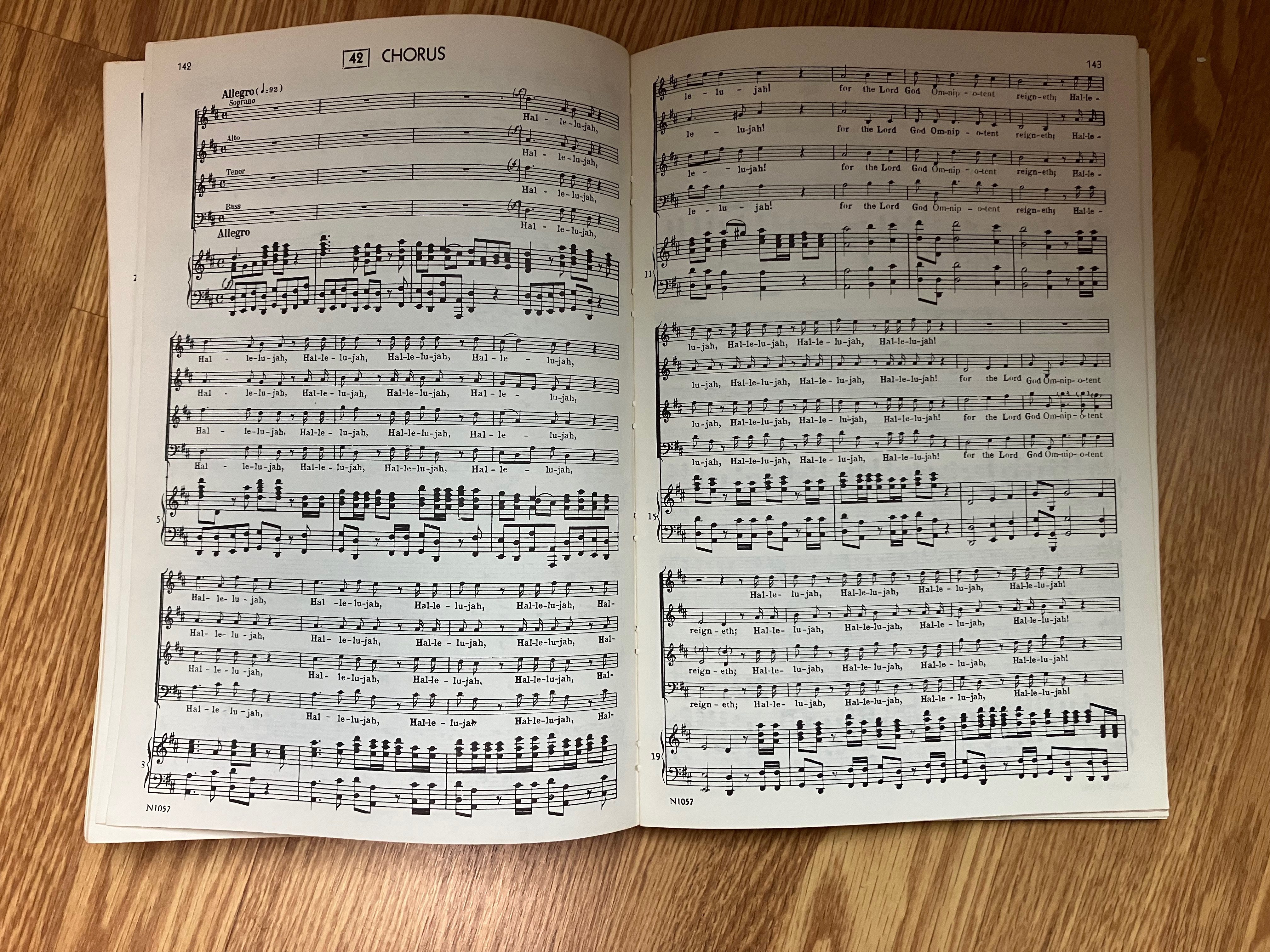
Handel’s oratorio “The Messiah,” and, in particular, its “Hallelujah Chorus,” figures largely in our family’s lore. Over the years, I’ve participated in several Handel Choirs, mostly as an alto. A vocal score of Messiah’s choruses has somehow made it through our various moves and sits, slightly musty, on a shelf in my office. Once covid concerns wane sufficiently, I hope to participate in future Messiah singalongs.
much-thumbed vocal Messiah scoreHallelujah Chorus from Handel’s Messiah
I’m not sure when I first heard this uplifting music. Because both my mother and her mother were practicing musicians, it was probably early in my life. The first time I remember being fully aware of the majesty of the piece was the Christmas season I was ten years old.
Our immediate family’s trajectory had been fairly typical of post-World War II small town America. My father came home from the Navy in early 1946, after serving the final years of that war on an aircraft carrier in the Pacific. He and my mom, who’d married during one of his home leaves in 1944, set up housekeeping in a one-bedroom cottage built by Mom’s parents next door to their own house. Mom’s parents wanted to keep their youngest close by, especially after their only other daughter and their one grandchild so far had moved cross-country to Seattle.
About a year later, I put in my appearance, followed in 1951 by a sister, then in 1953 by surprise twins—my youngest siblings, brothers to carry on the family name. Although Dad and some carpenter friends had added a second bedroom when my sister was born, it was tucked into an increasingly steep hillside. The slope precluded further expansion. Our small cottage was bursting at the seams. Dad and Mom paid a minimal monthly rent to my grandparents, more as a sop to Dad’s pride than anything approaching market rate.
Partly buoyed by this informal subsidy, by 1957 Dad and Mom had scrimped and saved enough to purchase a five acre piece of property in a wealthier part of town. Dad by then had become a small-scale residential construction contractor. He had the contacts and skills to be able to build his and Mom’s dream house on the newly purchased land at minimal cost. They would start construction in March, 1958, once the ground thawed.
For our final Christmas at the cottage, we’d shoehorned into one corner of the living room a small fir tree with presents underneath. While we went next door for breakfast at Granny and Pop-Pop’s, Santa (so the younger children believed) would leave an even bigger pile of gifts to be opened after our return.
On prior Christmas mornings, we’d been awakened by Dad’s best stentorian bellow: “Rise and shine, morning’s a’wasting!” he’d yell.
This year was different. From somewhere near the stairwell leading from the living room to our basement-level kitchen, there was music. Every bit as loud as Dad, it had a decidedly different pitch and rhythm: “Hallelujah, hallelujah, hallelujah, hallelujah, hallelujah!” As we stumbled out of our bunk beds and wiped the sleepy sand from our eyes, we wondered what was producing the music. It didn’t take us very long to locate the new walnut stereo cabinet with the record jacket to “The Messiah” placed carefully on top. Dad grinned at us, triumphant.
My father and my maternal grandmother had a respectful but sometimes strained relationship. Granny could be fussy about protocol and social niceties. Early in Dad’s and Mom’s married lives, before the arrival of children, Dad had gone out of his way one Christmas season to impress Granny. At considerable expense, he’d purchased three tickets to an evening performance of all three parts of Handel’s Messiah in downtown Baltimore. He’d arranged transportation to and from the concert hall and had put on his one good suit to escort the ladies to this holiday tradition.
As retold at subsequent holiday gatherings, Dad was so tired after a busy day of physical work that he nodded off early in part one. When the “Hallelujah Chorus” began (at the end of part two), Dad startled awake. Most in the audience were getting up, a tradition started supposedly when, at the premier London performance in 1743, King George II had stood for the “king of kings.” Other audience members had followed suit. Standing for the Hallelujah Chorus became customary whenever and wherever the oratorio was performed. Dad wrongly assumed it was the end of the performance. He went to get Granny’s and Mom’s coats, much to Granny’s chagrin.
Perhaps the 1957 hallelujahs were his way of celebrating the prospect of having a little more distance from his fussy mother-in-law. Perhaps he was just overjoyed at the prospect of a big-enough house.
After my dad’s multiple careers were over, he developed dementia. For much of his decline, he was lovingly tended by my mom, assisted by a fairly robust social safety net that included veterans’ benefits and a drop-in adult day care center. During his final few months, once the burden of his care threatened to debilitate my mother as well, he was confined to a nursing home. When my sister phoned to let me know that his body had finally died, she had the “Hallelujah Chorus” playing in the background. Somehow, it was a fitting testimony to Dad’s release from suffering.
The past couple of years have not been especially easy. Many of us have lost loved ones. The covid pandemic, in the U.S. and elsewhere, has brought into starker relief our disparities of wealth and of access to needed services. Rather than Handel, some of us may be more attuned to the darker lyrics of a recent “Hallelujah” version by singer-songwriter Leonard Cohen. Cohen continued revising the lyrics almost up until his death in 2016. After several despondent verses, he nonetheless asserts:
I’ll stand right here before the Lord of Song With nothing on my tongue but Hallelujah…
I like to think that both “Hallelujahs” are relevant. We have suffered. We will suffer again. We have known joy. We will know joy again. Hallelujah!
It’s a little past Hallowe’en. Images of “wicked witches” are fading from our consciousness for another year. Our recent understanding of witches has undergone something of a change, abetted by a modern Wiccan movement. Performances such as “Wicked,” a musical retelling of the Wizard of Oz story from the point of view of two witches, have also reminded us of the “good witch.” It’s been my good fortune to have become acquainted with three very good witches, three benign elders, since I moved to southern California in 2021.
The first good witch I encountered was Anne, a spritely octogenarian with a halo of blue-white curls. When I first met her, Anne was presiding over a large table of other elders at a summer neighborhood gathering of a “village,” a mutual help group for over-50’s who want to continue to live in their own homes for as long as possible, rather than moving to assisted living facilities. Anne was one of the original members of our local group a dozen years ago. Listening to some of Anne’s stories, I learned that she had spent time in China, a favorite travel destination earlier in my own life. I asked if I might meet with her one-on-one to trade stories and to learn more about her China experiences. She graciously acceded. As it turned out, Anne’s China stay had occurred mostly before I was born. She was a school girl in Shanghai and then in Chongqing from 1946 to 1948 while her naval officer father was an advisor to the Chinese military. Anne’s life experiences are quite different from mine—a Navy daughter, then a Navy wife to a commander who served during Vietnam, a conflict I had protested as a young woman. Anne raised a large family while moving from military post to post and adhering to her Roman Catholic faith. My guess is that her opinions on reproductive freedom are different from mine. However, she has never tried to proselytize or to foist her views on me. She has expressed that aspect of her faith mostly through work with charities and social service agencies in support of adoptive parents, support often badly needed.
My next good witch encounter was with Carolyn. As I oriented myself to our new environment by walking around, I was pleased that our “planned community” of about 700 houses had pleasant walkways and little traffic. A couple of small shopping strips bracketed the complex. A nearby public recreation area had both indoor and outdoor athletic facilities. Near the top of the closest hill was a cluster of churches. One morning as I explored the grounds of the local Lutheran church, I noticed a fenced garden behind the main building, with numbered raised plots and a small sign identifying it as a “nature friendly garden.” No one was around. I opened the garden gate and walked through the area. At one end were a small red shed and a small greenhouse. A couple of wrought iron lawn chairs were pulled up in front of the shed. The place looked well tended. I gradually made it a regular part of my walking routine. Several walks later, I came across Carolyn, who was tending some of the many plots she cares for. She’d opened the padlocked shed and was ferrying garden tools and containers back and forth as needed. She finished what she was doing, then took a break to chat.
“This garden has been my sanity refuge during covid,” she told me. “Outdoors, so less virus-prone, and still able to provide a service to the community.” She explained that most of “her” beds contained vegetables planted for use at T.A.C.O. (Third Avenue Charitable Organization), a downtown San Diego drop-in center for the area’s homeless and lower income residents. On Thursdays, Carolyn ferried fresh produce from the T.A.C.O. beds to the center to be included in the following day’s lunch. She’d been doing this since well before the pandemic. Given the disproportionate impact of the pandemic on those already struggling, she felt it was more needed during covid than ever.
“It’s amazing what the cooks can do with whatever I bring,” she said. “Sometimes we have mostly zucchini, other times it’s tomatoes, or carrots, or broccoli, or cabbage. Some of the other gardeners contribute their extra veggies as well.” Carolyn isn’t shy about her age—mid-80’s. She complains that she’s slowing down, but she can still heft a flat of squash or spade a garden plot with more energy than most of us, whatever our ages.
Ellen introduced herself to me by phone before I met her in person. She’s the doyenne of volunteers at our local public branch library. One of the restrictions of pandemic lockdowns that hit me hardest was the closure of area libraries. As soon as infection numbers waned enough so that libraries reopened, I visited our nearest branch, checked out as many books as I could carry, made a small donation, and signed up as a “Friend of the Tierrasanta Library.” Several months later, Ellen phoned to ask if I might be available to help cashier for a two-hour shift at the used book sale she and others arranged in the library’s conference room during the first weekend of every month.
“Sure,” I said. “Do I need to bring anything?”
“Just yourself. You’ll be working with an experienced volunteer who can show you what to do.” Ellen, too, complains that she is slowing down. Well into her 80’s, she’s had one hip replaced and is due to get the second one done next year. At the end of a day’s work, she has a noticeable limp. She doesn’t let it deter her much.
For over thirty years, it turns out, Ellen has been raising money for the library and spreading the love of books throughout the community. Over the years, she has refined a system that supplies extra children’s books at no charge to a nearby military housing complex.
Not long after arriving in California, I passed the midway point between 70 and 80. I’m slowing down a bit. Aging has brought different challenges than earlier life stages. One of the hardest for me is balancing self care with care for the wider community. Initially constrained by covid and by my general lack of knowledge of how this part of the country works, I’ve been inspired by the lives of my three good witches. Anne, Carolyn, and Ellen are not native Californians, either. They’ve all passed the 80 year milestone. Their adaptability and continuing active participation shine forth. Somewhere near here there are adoptive families with better coping skills thanks to Anne; someday a needy person is getting a more nutritious lunch thanks to Carolyn; in some child’s room someone is reading thanks to Ellen.
My skills are not exactly the same as theirs. Still, I can write about them, mimic them as much as I can, encourage others to follow their examples.
Until about a week ago, I had been looking forward to a fairly traditional Mother’s Day: I’d receive a card or two, perhaps a phone call from the grown child who lives out of town, maybe a home-cooked breakfast from a spouse who typically does little of the family cooking. I wondered what other mothers and expectant mothers would be doing to acknowledge the day. I thought that this Mother’s Day would be a low-key chance to reaffirm the importance of mothers in all our variations.
I believe that mothers are indispensable to a functioning society. A day’s worth of recognition can sometimes seem a small recompense for a generation or more of parenting labors. When our children are small, we may nurse them from our bodies. As they grow, we attempt to guide them into making life-affirming choices. We do our best to provide for them both financially and emotionally. Even if we’re exceptional parents, we sometimes need to rely on other adults, whether or not they have children of their own, to help us through the rough spots.
Amid all the other uncertainties of American life in 2022, I expected Mother’s Day to be more or less “normal.” Then, early last week, American media exploded with news of a leaked draft opinion by U.S. Supreme Court justice Samuel Alito. Alito urged that the landmark U.S. abortion decisions of Roe vs. Wade (1973) and Planned Parenthood vs. Casey (1992), permitting abortions in most instances prior to the viability of the fetus, should be completely overturned. Although efforts on multiple governmental levels to weaken abortion access had been going on ever since the Roe case was first decided, this was an unexpectedly harsh opinion at the national level.
I started losing sleep, wondering what more I could do to influence the ongoing abortion debate in an appropriate way. Earlier, I’d written letters and emails, phoned my elected representatives, posted blog entries, sometimes even attended demonstrations. So I blogged some more, sent more letters and emails, even submitted a brief letter to the editor pointing out the irony of expressing outrage over the breach of privacy suffered by Justice Alito while ignoring the subsequent breach of privacy he was advocating for millions of American women. (I figured brevity might count for something, although it’s not my typical style.)
Before dawn on Mother’s Day, I awoke and did a basic internet search on “Mother’s Day protests,” thinking it would be appropriate for me to attend one to express my support for motherhood that was voluntary rather than coerced. No events in my vicinity popped up, but there were severaI links about a nationwide “Mother’s Day Strike” during the next week or so, patterned after an October, 1975 women’s strike in Iceland to support women’s value and women’s choices.
So, to the extent that a retired grandmother can, I’m going “on strike.” I do not plan to do any housework for the next week. I’ve alerted my spouse to be on the hook for household chores. I plan to spend a good bit of my week at the public library, where I recently discovered a non-fiction book by Melinda French Gates, The Moment of Lift, about women’s empowerment, both globally and here in the U.S. Ms. French-Gates is a practicing Roman Catholic as well as a partner in the Bill and Melinda Gates Foundation, which widely supports family planning.
I encourage any of you who can to create your own strike on your own terms, letting those around you know what you are doing and why. Happy Mother’s Day, all!