Category Archives: Everyday Wonders

Benny the Auto Mechanic

Benny the auto mechanic is a major bulwark in my personal transportation system. A skilled, seasoned repairer of older (and newer) vehicles, Benny keeps my aging gas-powered sedan running smoothly and efficiently. After a 2021 move to California, I was fortunate to get our first annual “smog check” at the small nearby auto shop where Benny now works. I was even more fortunate when Benny returned to the shop after a while away. His coworkers put up a big banner, “Benny’s back.” Since his return, Benny has completed regular routine maintenance plus a couple of fairly major repair jobs on our car.  

In the area where I now live, the transition to electric vehicles and other transportation options is accelerating. Still, it will be a while before our family finances and electric capacity will accommodate a next-generation car. My guess is that this is the case for many other families. In the meantime, we need the Bennys of the world to tend our aging personal transportation. Whatever the newest automotive trends turn out to be, we will always need their skill and their wisdom. We need, too, the reminder that manual work skillfully done is just as important as “knowledge work.” Often, it requires just as much knowledge, anyway. 

Our family tradition includes maintaining cars, aided by skilled local mechanics, until they can’t be driven any more. My mother’s Plymouth Valiant became the stuff of legend. A 1963 or 1964 model, it was the little car I learned to drive on—manual transmission, three forward gears plus reverse, small enough to be easier than most to parallel park (a real boon during every teen’s nightmare back then: the road test to qualify for a driver’s license.)  

The Valiant survived two early accidents, repaired by our local small town mechanics, back in the days when insurance claims were much less formal, repair delays much less severe. As it reached middle age, the Valiant served in turn as my sister’s, then my brothers’ “learner” car. At some point, our family drove it on a vacation to New Hampshire, returning with the proud bumper sticker, “This Car Climbed Mount Washington.”  After that trip, my mom drove the car for nearly a dozen more years. As the original paint chipped or rusted in Maryland’s weather, she did a yeoman’s paint job with wall paint that nearly matched the car’s original color. Her brush strokes, she thought, just added a custom touch. Later, she decided that vinyl contact paper would better serve. 

The day finally came, though, when the salt and slush of successive Maryland winters proved too much for the little car. Mom took it to her local shop, Just Rite Motors, after she noticed yet another rust spot, this time a see-through area in the floor of the trunk. 

“Can you do one more weld for me?“ she inquired.

After a brief inspection, the mechanic reluctantly responded: “Sorry, ma’am, but there’s no longer anything to weld to.” The Valiant, its faded bumper sticker still intact, was sadly dispatched to the car graveyard.

My first car in adulthood proved incompatible with city living. Though I had access to good mechanics, courtesy of a friend’s father, living in Baltimore apartments required expensive and/or inconvenient parking options. After a frustrating year of rising pre-dawn to move the car from one side of the street to the other to accommodate city alternate-day parking restrictions, I sold my little Chevy II. For the next year or so, I relied on local public transportation, friends, walking, or an occasional train or long-distance bus. Then my husband and I moved to Vermont. We bought a true fixer-upper of a house at the edge of Montpelier, the state’s small town capital city. We found we needed a reliable vehicle with enough storage capacity for frequent trips to the local hardware store, the lumber yard, the town dump. 

We acquired “Fred,” a brand new cherry red Datsun pickup truck. Fred served us well through much home repair work, three moves, a long road trip, and then the arrival of children. With a second child imminent, we realized we’d require a bigger vehicle as a backup “family car,” but we were unwilling to relinquish Fred. He’d become almost a member of the family, with his own personality. Once they were vocal, our kids would argue over who got to ride on local errands in Fred. 

By a dozen years and over 100 thousand miles after purchase, Fred, too, had rusted pretty badly. The passenger side door would no longer open from inside—whoever sat in the passenger seat had to wait for the driver to walk around the truck to let him/her out. The original clutch had been replaced, twice. When the third started to slip, we acknowledged it was finally time to let Fred go. It took a while for our kids to forgive us. 

It’s getting more and more practical to manufacture cars and trucks that are less reliant on fossil fuels and friendlier for the environment. Eventually their prices will come down. Someday I hope to own (or lease) an all-electric vehicle of some kind. In the meantime, I’m so very grateful for auto mechanics like Benny and the crucial, important work they do to keep our existing pre-electric vehicles functioning as smoothly and efficiently as possible. 

Women’s Day Winter Harvest

It’s been a while since I previously updated this blog. It’s been a busy, wet, cool season for me here in San Diego. For the first time since renting a community garden plot last spring, I’ve had chances to try my hand at cool season gardening. The cool, wetter than usual weather produced lettuce, carrots, chard, parsley, and kale—enough for salads that were a welcome addition to rainy day soups made with some homegrown leeks.

winter’s veggies

What people tell me is an unusual-for-here series of chilly, rainy days provided the impetus to go through my store of fabric scraps and to come up with a set that may provide some comfort and warmth for an area refugee family. 

quilted squares for refugee family

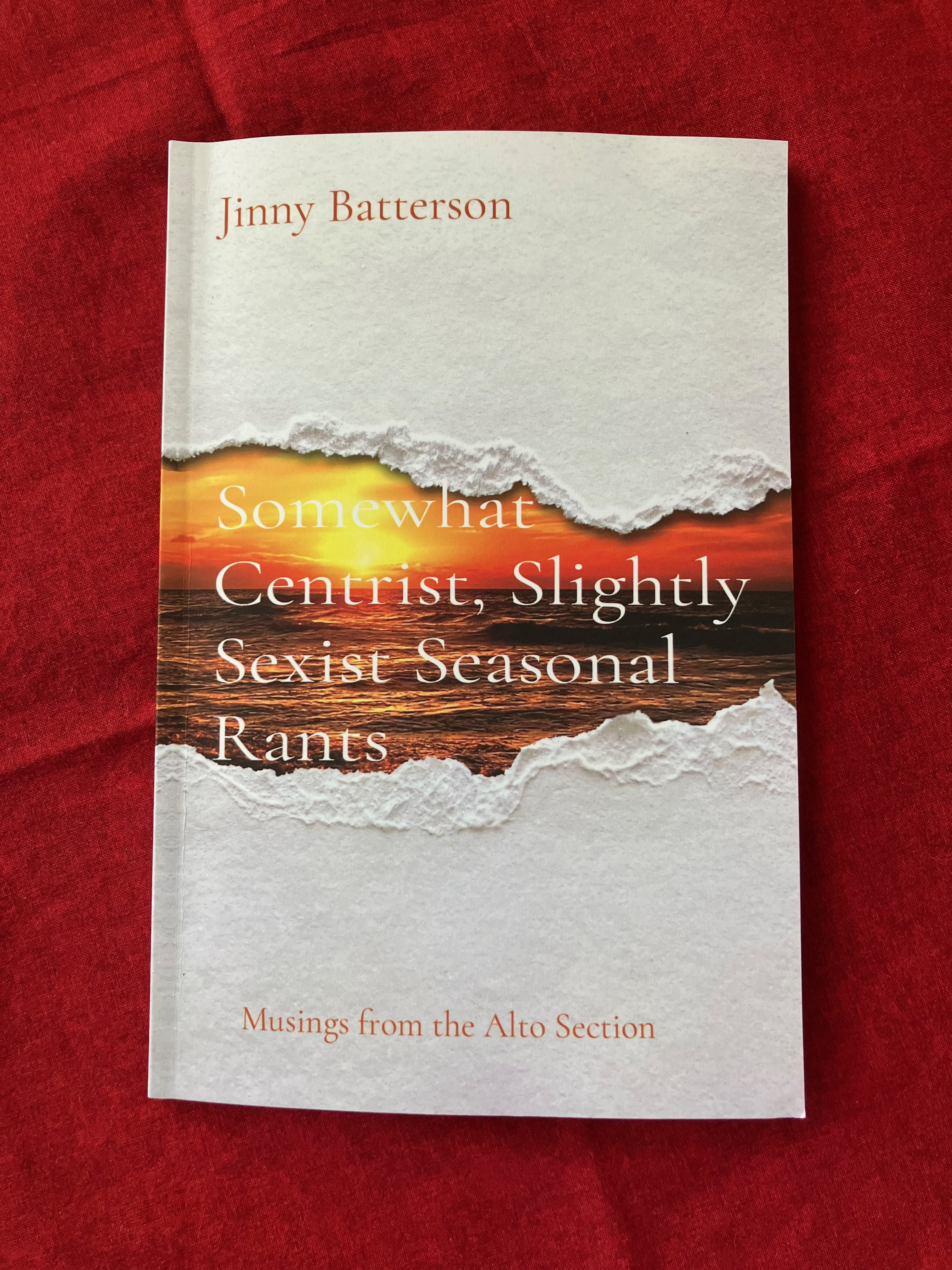
What’s taken up the bulk of my time the past couple of months has been adapting and updating some prior blog posts into a self-published book of essays with a long title  “Somewhat Centrist, Slightly Sexist Seasonal Rants: Musings from the Alto Section.” The book, now in its final proofing process, is due out later this month. It chronicles parts of my particular woman’s history and relates my individual views of some current issues. 

Today, March 8, is celebrated in many countries as “International Women’s Day.”  Multiple relevant events in the San Diego area are listed for today or later during this Women’s History Month. Some highlight this year’s theme, “Embrace Equity.” Despite generations of effort, women do not yet enjoy pay equity in most environments. Sadly, in many places we seem to be going backward on one of the most important equity issues of all, the capacity to manage our own reproductive health, to control our own bodies. 

Happy International Women’s Day to all as we continue the ongoing struggle for equity!  

On Sending (and Receiving) Holiday Cards and Letters

In the small Maryland town where I grew up in the 1950’s and 60’s, sending and receiving postal holiday cards was an important part of holiday tradition. Dad and Mom participated by taking an annual posed picture of us kids and then making numerous copies in Dad’s basic home photo lab, stinking up our house for days. They’d either include a holiday greeting in the photo itself or add a brief caption to each copy.

Then they’d stuff envelopes, write out addresses, and affix stamps by hand to send to family, neighbors, friends, and business contacts. Our parents’ lives back then were too busy for lengthy missives. However, we sometimes received cards with long enclosed letters from friends and family far away. In our house, one entire hallway was devoted to an arrangement of the most colorful cards, dozens and dozens of them, usually patterned into the shape of a stylized tree. After I started a family of my own, I continued the holiday card tradition. 

By now, the postal holiday card and letter are fast becoming outmoded. Email can be a lot quicker and just as informative. All the same, I’m loathe to give up the older tradition. Stationery and gift shops still stock boxes of holiday cards. The U.S. Postal Service still collects and distributes mail. 

Those of us who write holiday letters in whatever medium tend to brag a bit. We also tend to play down any difficult parts of the year just ended. I find pleasure in sitting down to compose a physical page (never more, rarely less) of highlights of the year just ending. It’s heavy on the celebrations and on the achievements of the younger generations.

This year I got a late start sending out holiday cards and letters because of holiday travel, visiting family members on the other coast whose pictures I hoped to include. Now I’m back home. Relevant trip pictures have been transferred from cell phone to computer. I’ve started my annual ritual of card and letter composition and distribution. 

Tools for preparing and mailing holiday cards and letters have gotten somewhat more convenient since my parents’ days. My desktop printer will crank out appropriate adhesive mailing labels in sheets of thirty labels each. The printer can also produce multiple copies of letter text and interspersed images in either black and while or color. My word processing software, with some wrangling, will position pictures where I want them in the overall design. Most envelopes have peel off adhesive strips so they no longer require licking. Most stamps are also self-adhesive.   

The process of writing out each card and sticking labels on an appropriate envelope helps me bring to mind each recipient in turn. I remember how they are special to me. I briefly reweave some of the tapestry of our friendships. It’s disappointing when a card gets returned with “no forwarding address”—I’ve lost track of yet another tie to my past. Even worse are the cards returned with regretful notes letting me know the intended recipient has died. Each year, the prior year’s card mailing list gets winnowed by at least a few names. As best I can, I focus on the good of the lives that have ended. In this era when age segregation has increased, I try to include younger friends and to broaden the age range of new friends beyond just my own cohort. Otherwise, my holiday card list would gradually dwindle to nothingness. 

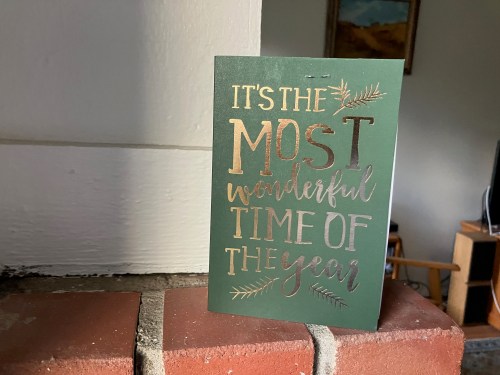
Our current house has little hall space. The number of postal cards we receive has diminished. The ones we still get will fit easily on our mantelpiece and along the top shelf of the smallest bookcase. I cherish them, fewer though they may be. In these shortest days of the year, they remind me both of the longer span of lives well lived and of the beauty of lives newly started. They reconnect us, something most of us can use after much pandemic-related isolation. 

Happy holidays to you and yours! A belated Happy Hanukah, Merry Christmas, Happy Kwanzaa, Happy (Solar) New Year! Happy Upcoming (Lunar) Year of the Rabbit! Whatever your media of choice, may you continue to send and receive holiday greetings!   

Liquid Amber

Back where I lived before,
They were called sweetgum trees,
Though what was sweet about them
Was beyond me. The huge one at our
Neighbor’s dropped prickly seed balls
Over three backyards, not to mention
The desiccated leaves and stray twigs.

The balls took forever to decay, in
The meantime punishing bare feet
And serving to twist ankles when
Those with shoes on stepped on the
Outliers on area sidewalks and pavement.

One year someone figured out that
You could spray gum balls with silver
Paint and tuck them into holiday wreaths.
A large expense of time and money for
A rather shabby looking result, I thought.

It took a while before I got the spelling
Correct in this locale–a single word,
With two ‘a’s in the second half.

In the right light, though, when nothing
Else in this near-desert landscape is
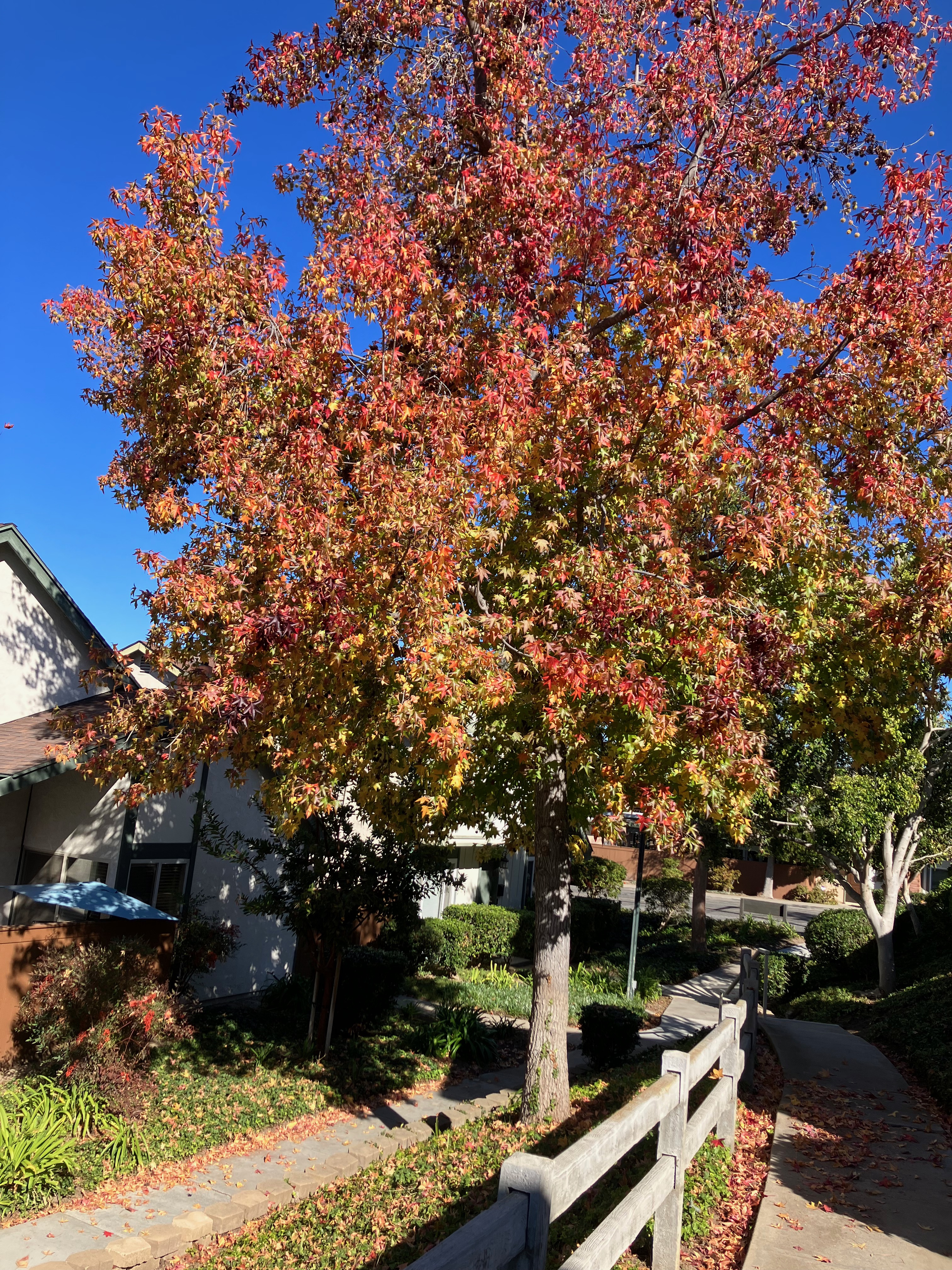
Colorful, the leaves can live up to their name.

On Being Granted Three Witches…

It’s a little past Hallowe’en. Images of “wicked witches” are fading from our consciousness for another year. Our recent understanding of witches has undergone something of a change, abetted by a modern Wiccan movement. Performances such as “Wicked,” a musical retelling of the Wizard of Oz story from the point of view of two witches, have also reminded us of the “good witch.” It’s been my good fortune to have become acquainted with three very good witches, three benign elders, since I moved to southern California in 2021. 

The first good witch I encountered was Anne, a spritely octogenarian with a halo of blue-white curls. When I first met her, Anne was presiding over a large table of other elders at a summer neighborhood gathering of a “village,” a mutual help group for over-50’s who want to continue to live in their own homes for as long as possible, rather than moving to assisted living facilities. Anne was one of the original members of our local group a dozen years ago. Listening to some of Anne’s stories, I learned that she had spent time in China, a favorite travel destination earlier in my own life. I asked if I might meet with her one-on-one to trade stories and to learn more about her China experiences. She graciously acceded. As it turned out, Anne’s China stay had occurred mostly before I was born. She was a school girl in Shanghai and then in Chongqing from 1946 to 1948 while her naval officer father was an advisor to the Chinese military. Anne’s life experiences are quite different from mine—a Navy daughter, then a Navy wife to a commander who served during Vietnam, a conflict I had protested as a young woman. Anne raised a large family while moving from military post to post and adhering to her Roman Catholic faith. My guess is that her opinions on reproductive freedom are different from mine. However, she has never tried to proselytize or to foist her views on me. She has expressed that aspect of her faith mostly through work with charities and social service agencies in support of adoptive parents, support often badly needed.   

My next good witch encounter was with Carolyn. As I oriented myself to our new environment by walking around, I was pleased that our “planned community” of about 700 houses had pleasant walkways and little traffic. A couple of small shopping strips bracketed the complex. A nearby public recreation area had both indoor and outdoor athletic facilities. Near the top of the closest hill was a cluster of churches. One morning as I explored the grounds of the local Lutheran church, I noticed a fenced garden behind the main building, with numbered raised plots and a small sign identifying it as a “nature friendly garden.” No one was around. I opened the garden gate and walked through the area. At one end were a small red shed and a small greenhouse. A couple of wrought iron lawn chairs were pulled up in front of the shed. The place looked well tended. I gradually made it a regular part of my walking routine. Several walks later, I came across Carolyn, who was tending some of the many plots she cares for. She’d opened the padlocked shed and was ferrying garden tools and containers back and forth as needed. She finished what she was doing, then took a break to chat. 

“This garden has been my sanity refuge during covid,” she told me. “Outdoors, so less virus-prone, and still able to provide a service to the community.” She explained that most of “her” beds contained vegetables planted for use at T.A.C.O. (Third Avenue Charitable Organization), a downtown San Diego drop-in center for the area’s homeless and lower income residents. On Thursdays, Carolyn ferried fresh produce from the T.A.C.O. beds to the center to be included in the following day’s lunch. She’d been doing this since well before the pandemic. Given the disproportionate impact of the pandemic on those already struggling, she felt it was more needed during covid than ever. 

“It’s amazing what the cooks can do with whatever I bring,” she said. “Sometimes we have mostly zucchini, other times it’s tomatoes, or carrots, or broccoli, or cabbage. Some of the other gardeners contribute their extra veggies as well.” Carolyn isn’t shy about her age—mid-80’s. She complains that she’s slowing down, but she can still heft a flat of squash or spade a garden plot with more energy than most of us, whatever our ages.

Ellen introduced herself to me by phone before I met her in person. She’s the doyenne of volunteers at our local public branch library. One of the restrictions of pandemic lockdowns that hit me hardest was the closure of area libraries. As soon as infection numbers waned enough so that libraries reopened, I visited our nearest branch, checked out as many books as I could carry, made a small donation, and signed up as a “Friend of the Tierrasanta Library.”  Several months later, Ellen phoned to ask if I might be available to help cashier for a two-hour shift at the used book sale she and others arranged in the library’s conference room during the first weekend of every month. 

“Sure,” I said. “Do I need to bring anything?” 

“Just yourself. You’ll be working with an experienced volunteer who can show you what to do.” Ellen, too, complains that she is slowing down. Well into her 80’s, she’s had one hip replaced and is due to get the second one done next year. At the end of a day’s work, she has a noticeable limp. She doesn’t let it deter her much. 

For over thirty years, it turns out, Ellen has been raising money for the library and spreading the love of books throughout the community. Over the years, she has refined a system that supplies extra children’s books at no charge to a nearby military housing complex.

Not long after arriving in California, I passed the midway point between 70 and 80. I’m slowing down a bit. Aging has brought different challenges than earlier life stages. One of the hardest for me is balancing self care with care for the wider community. Initially constrained by covid and by my general lack of knowledge of how this part of the country works, I’ve been inspired by the lives of my three good witches. Anne, Carolyn, and Ellen are not native Californians, either. They’ve all passed the 80 year milestone. Their adaptability and continuing active participation shine forth. Somewhere near here there are adoptive families with better coping skills thanks to Anne; someday a needy person is getting a more nutritious lunch thanks to Carolyn; in some child’s room someone is reading thanks to Ellen. 

My skills are not exactly the same as theirs. Still, I can write about them, mimic them as much as I can, encourage others to follow their examples.

. Who are the good witches in your life?  

Last Day of Summer, Southern California


It’s been a summer with periods of brutal heat,
Mostly, it’s been brutally dry.
Futurists bandy about terms like “aridification,”
Though sudden downpours have carved
More gashes into wounded hillside landscapes.

This morning I awoke at first light to a thin film 
Of condensation on our bedroom’s window glass.
After a clear, cool sunrise, a gentle ocean-scented breeze.
I meandered uphill to our local community garden,
Where I spent a calming hour trimming back succulents.

Temporarily insulated from political punditry, 
I relished the quiet, the hummingbirds and
Butterflies and late-season blooms.
On a day like today, it does not seem entirely
Unrealistic to hope for more moderate media.

It does not seem unrealistic to hope and pray for drizzles 
Of autumn rain, nourishing the liquidambar trees
Whose colors have again come early and muted.
It is enough to concentrate on soil and a pleasant sun,
To consider instances of compassion here and there.

Of course there are wars and famines, 
A pandemic that wanes but is not entirely gone.
Of course there are hurricanes, floods, wildfires,
Erratic weather, ruined crops, but today,
The prospect of a peaceful harvest peeps through.

Punctuated Devolution

(Purloined and/or penned in memory of my doggerel-writing mother;
posted on what would have been her 105th birthday, August 22, 2022.)

Long ago, when I was a child
My parents said to memorize
A set of poems, some tame, some wild,
About the way time often flies.

I’ve never mastered, ’til today
The longest verse that they suggested–
About the “deacon’s one-hoss shay,”
In days when roads were less congested.

Per Wendell Holmes, the deacon tried
To craft a carriage with strengths so even
It never would just lose a side,
For years could remain fit for driving.

The shay survived through heat and storm,
Through varied owners, steeds, it roamed,
Providing rides in stellar form
‘Til at the last, per Mr. Holmes:

“There are traces of age in the one-hoss-shay, 

A general flavor of mild decay,

But nothing local, as one may say.

There couldn’t be,—for the Deacon’s art

Had made it so like in every part

That there wasn’t a chance for one to start.

For the wheels were just as strong as the thills—

And the floor was just as strong as the sills,

And the panels just as strong as the floor,

And the whippletree neither less nor more.

And the back-crossbar as strong as the fore,

And spring and axle and hub encore.

And yet, as a whole, it is past a doubt

In another hour it will be worn out!

. . . . . 

You see, of course, if you’re not a dunce,

How it went to pieces all at once,—

All at once, and nothing first,—

Just as bubbles do when they burst.

End of the wonderful one-hoss shay.  

Logic is logic. That’s all I say.” 

Some days my bones ache,
Other days they feel brittle.
Some days my head hurts,
Other days it’s my middle.

Some days I feel fine,
Other days I wither,
Some days I’ve a clear mind,
Other days I dither.

May specific ailments give punctuation
To my inevitable disintegration.
As age advances, I hope and pray
I won’t go like the one-hoss-shay.

I’m not sure which of my parts will break
I hope some may be left to harvest.
May no internist unbeckoned make
Repairs to keep me from my last rest.


Learned Helpfulness

Most of our recent news is bad: warfare in Ukraine, mass shootings in the U.S., wildfires, floods, tornados, hurricanes, the list seems endless. It helps me to remember that most news has always been bad. We tend to take for granted the generosity, kindness, humor, and loving that people bestow on each other much of the time. Pleasant weather is considered unremarkable. We rarely get headlines or breaking news about the nice people or the nice weather. It’s the bad examples, the exceptions, that get the bulk of the publicity. Through our increasingly interconnected global communications, we can more readily and extensively broadcast the negative aspects of reality. They are not the whole picture.  

Last week, after an overload of news about wars and mass shootings and refugees and climate crises and teen anxiety and so on, I was tempted to lapse into “learned helplessness, ” a psychological condition often linked with depression. Problems can seem just too overwhelming to deal with. 

Instead, I made a conscious attempt to find some good news. I started with a basic internet search on altruism, broadly defined as actions taken on behalf of others that provide little or no benefit to the altruist. I sat down with my husband to watch a “Kindness 101” segment created by CBS reporter Steve Hartman in 2020, early in the covid pandemic, when he and his children were stuck at home due to school closures and lockdowns. I marveled at the story of Eugene Youn, a 28-year-old adventurer who quit his job and embarked on a long-distance hike to fundraise the $80,000 needed for a set of prosthetic devices to help paraplegic Arthur Renawinsky, a man Youn had yet to meet, walk again.

Later, I honed in on experiments done with very young children to try to find out how altruism develops. Research at the University of Washington showed that toddlers as young as about a year and a half will help an experimenter they believe needs their assistance (https://www.washington.edu/news/2020/02/04/altruistic-babies-study-shows-infants-are-willing-to-give-up-food-help-others/). 

Much earlier in my own life, a son who was then studying psychology in college urged me to check out the relatively new field of “positive psychology,” focussing on what’s right with us, rather than just diagnosing and treating what’s wrong. At son Scott’s suggestion, I read a pioneering volume, Learned Optimism, by Martin Seligman. Later I studied some of the work of the Hungarian-American psychologist with the difficult name, Mihaly Csikszentmihalyi. I read one of his seminal works, Flow. One of my go-to internet sites, TED, has a subset of 15 positive psychology talks featuring experts in the field: https://positivepsychology.com/positive-psychology-ted-talks/. I recommend them.  

Even earlier in my life, one summer at a family church camp I enrolled Scott as my assistant in the infant nursery. As the “baby of the family,” our younger son had rarely gotten to care for children even younger than he was. His chance at about age 3 to be a “caring older brother” for a week was one of the highlights of his camp that year. It gave him a sense of power to be able to help care for the infants in the nursery. He was very caring, very careful.  

It’s important to me that the war in Ukraine end soon, with as little additional carnage and displacement as possible. It’s important to me that those whose lives and livelihoods were ruined by the war receive humanitarian assistance. It’s important to me that those responsible for conducting the war be held accountable. It’s important to me that we Americans find ways to reduce our epidemic of gun violence. It’s important to me that we take more individual and coilective actions to reduce the future impacts of ongoing climate change and resulting catastrophic weather events. However, if I attempt to “fix” any of these issues by myself, I’m likely to get discouraged. All are big problems. 

Instead of the “learned helplessness” of throwing up my hands or getting angry at slow-to-move officialdom or deciding that all these are somebody else’s problems, I can practice learned helpfulness. I can pick and choose where my individual skills and actions would most likely make a positive difference and then use my skills, do the actions. 

Like my three-year-old nursery assistant, I can engage in the “learned helpfulness” of altruism. I can make small but positive differences in the lives of those I interact with. I can continue to learn from my mistakes and improve. Learned helpfulness will glean better results than its opposite, I’m sure of it. 

Dragonfruit


A welcoming presence in this new locale—
A community garden an easy walk away.
Most mornings, a garden elder greets me,
Shares stories of other gardeners and of
The plants growing under her watchful eye.

Along a trellis just outside the garden
Gate sprawls a droopy set of greenery—
Half cactus, half vine, it shades the
Garden’s tool shed behind it.

droopy cactus?


“What’s that?” I ask the first time
I see this mystery plant, splaying pale
Cream-colored blossoms along
Its width. “A dragonfruit,”
Explains the elder. “It’s not officially
Part of the garden, but one of
Our gardeners asked to put it there.”

Most of the time, the blossoms are
Already spent by morning. The plant,
I learn online, usually blooms at night.
Bats and nocturnal insects pollinate it.

On subsequent visits, I find that spent
Blooms have fallen off, replaced by growing
Orbs, at first pale green, then pinkish,
Then red. As they get bigger, they
Sprout what look a bit like scales—
Hence the popular name.

My most recent trip reveals a new sign—
“Large fruit, $3; small $1; proceeds to
Help buy supplies for next spring’s planting.”
I remember having eaten some once in a fruit salad:
White inside, with black seeds and a mild flavor.

I think I’ll buy some and try to find creative
Uses for them. If nothing else, they can remind
Me, in this pivotal time, when so many
Preconceptions have been turned
Inside out, to nudge my inner dragons
Away from seedy black and white,
Toward a more scaled and colorful reality.

halved dragon fruit

pink-red dragon fruit

Senior Crafting

some senior crafts old and new


more senior crafts

One Christmas when I was in elementary school, I was among many girls my age to get a potholder loom kit as a gift, probably from a non-resident aunt.  I spent part of that winter crafting multi-colored potholders from the loops provided with the square-shaped miniature loom. My mother graciously consented to use the somewhat lumpy things in her kitchen. (Mom was not especially fussy about equipment and accessories.) As I recall, the potholders were washable. They shrank only marginally once run through our wringer washing machine. Though the one I had in childhood has long since made it to the dump, such looms are still available for purchase. The next generations of potholder-makers may be getting some as holiday gifts.  

As I grew older, I learned to sew.  As a teen, I made some of my own outfits, stretching my limited clothing allowance. My grandmother taught me to knit, though I don’t remember knitting much except for an impatiently completed sweater for my then-boyfriend-now-husband that came only partway down his midriff. 

This holiday season, hubby and I are retired, locked down, with too much time on our hands and little social life. We’ve each discovered a craft outlet that fulfills some of our need to feel connected and useful: Jim decorates sets of garden pebbles, distributing them in area tree wells and along park paths; I make small “quilt-lets” and decorative fabric face masks. 

Previous generations of our families had different craft outlets. While doing this year’s minimal straightening and decorating for Christmas, I uncovered a few “potholders” from our elders—a crocheted afghan, some wooden candlesticks that my post-retirement dad turned on a lathe in his backyard wood shop, decorative tissue holders and toilet paper holders that my mother-in-law produced as part of a yarn crafts class. Perhaps “craftiness” is a skill set that lies dormant during the busiest parts of our lives, resurfacing once we have more leisure (certainly abundant in 2020!)

We may eventually need to downsize further, discarding or recycling yesteryear’s  “potholders.” For now, their quirks provoke curiosity: the uneven dimensions of the candle holders, the “squiggly thing” atop one of the toilet paper holders. I wonder if Dad got tired, after raising twins, of “matched sets” of anything, or if it was just difficult to get his raw materials to lathe into uniform shapes.  I wonder if Mom B., somewhat bored as she completed yet another tubular shape, decided to include on the top of a bird-sided holder, a sinuous brown and orange shape that doesn’t look part of the original pattern of concentric rings—maybe the worm that got away? 

The coldest days of the year lie ahead. We’re in for a few more challenging months while we await widespread vaccinations and the end to this pandemic. Perhaps our elders were wiser and craftier than we realized at the time—when times got tough, they got creative. Whimsy matters!