Category Archives: Everyday Wonders

Punctuated Devolution

(Purloined and/or penned in memory of my doggerel-writing mother;
posted on what would have been her 105th birthday, August 22, 2022.)

Long ago, when I was a child
My parents said to memorize
A set of poems, some tame, some wild,
About the way time often flies.

I’ve never mastered, ’til today
The longest verse that they suggested–
About the “deacon’s one-hoss shay,”
In days when roads were less congested.

Per Wendell Holmes, the deacon tried
To craft a carriage with strengths so even
It never would just lose a side,
For years could remain fit for driving.

The shay survived through heat and storm,
Through varied owners, steeds, it roamed,
Providing rides in stellar form
‘Til at the last, per Mr. Holmes:

“There are traces of age in the one-hoss-shay, 

A general flavor of mild decay,

But nothing local, as one may say.

There couldn’t be,—for the Deacon’s art

Had made it so like in every part

That there wasn’t a chance for one to start.

For the wheels were just as strong as the thills—

And the floor was just as strong as the sills,

And the panels just as strong as the floor,

And the whippletree neither less nor more.

And the back-crossbar as strong as the fore,

And spring and axle and hub encore.

And yet, as a whole, it is past a doubt

In another hour it will be worn out!

. . . . . 

You see, of course, if you’re not a dunce,

How it went to pieces all at once,—

All at once, and nothing first,—

Just as bubbles do when they burst.

End of the wonderful one-hoss shay.  

Logic is logic. That’s all I say.” 

Some days my bones ache,
Other days they feel brittle.
Some days my head hurts,
Other days it’s my middle.

Some days I feel fine,
Other days I wither,
Some days I’ve a clear mind,
Other days I dither.

May specific ailments give punctuation
To my inevitable disintegration.
As age advances, I hope and pray
I won’t go like the one-hoss-shay.

I’m not sure which of my parts will break
I hope some may be left to harvest.
May no internist unbeckoned make
Repairs to keep me from my last rest.


Learned Helpfulness

Most of our recent news is bad: warfare in Ukraine, mass shootings in the U.S., wildfires, floods, tornados, hurricanes, the list seems endless. It helps me to remember that most news has always been bad. We tend to take for granted the generosity, kindness, humor, and loving that people bestow on each other much of the time. Pleasant weather is considered unremarkable. We rarely get headlines or breaking news about the nice people or the nice weather. It’s the bad examples, the exceptions, that get the bulk of the publicity. Through our increasingly interconnected global communications, we can more readily and extensively broadcast the negative aspects of reality. They are not the whole picture.  

Last week, after an overload of news about wars and mass shootings and refugees and climate crises and teen anxiety and so on, I was tempted to lapse into “learned helplessness, ” a psychological condition often linked with depression. Problems can seem just too overwhelming to deal with. 

Instead, I made a conscious attempt to find some good news. I started with a basic internet search on altruism, broadly defined as actions taken on behalf of others that provide little or no benefit to the altruist. I sat down with my husband to watch a “Kindness 101” segment created by CBS reporter Steve Hartman in 2020, early in the covid pandemic, when he and his children were stuck at home due to school closures and lockdowns. I marveled at the story of Eugene Youn, a 28-year-old adventurer who quit his job and embarked on a long-distance hike to fundraise the $80,000 needed for a set of prosthetic devices to help paraplegic Arthur Renawinsky, a man Youn had yet to meet, walk again.

Later, I honed in on experiments done with very young children to try to find out how altruism develops. Research at the University of Washington showed that toddlers as young as about a year and a half will help an experimenter they believe needs their assistance (https://www.washington.edu/news/2020/02/04/altruistic-babies-study-shows-infants-are-willing-to-give-up-food-help-others/). 

Much earlier in my own life, a son who was then studying psychology in college urged me to check out the relatively new field of “positive psychology,” focussing on what’s right with us, rather than just diagnosing and treating what’s wrong. At son Scott’s suggestion, I read a pioneering volume, Learned Optimism, by Martin Seligman. Later I studied some of the work of the Hungarian-American psychologist with the difficult name, Mihaly Csikszentmihalyi. I read one of his seminal works, Flow. One of my go-to internet sites, TED, has a subset of 15 positive psychology talks featuring experts in the field: https://positivepsychology.com/positive-psychology-ted-talks/. I recommend them.  

Even earlier in my life, one summer at a family church camp I enrolled Scott as my assistant in the infant nursery. As the “baby of the family,” our younger son had rarely gotten to care for children even younger than he was. His chance at about age 3 to be a “caring older brother” for a week was one of the highlights of his camp that year. It gave him a sense of power to be able to help care for the infants in the nursery. He was very caring, very careful.  

It’s important to me that the war in Ukraine end soon, with as little additional carnage and displacement as possible. It’s important to me that those whose lives and livelihoods were ruined by the war receive humanitarian assistance. It’s important to me that those responsible for conducting the war be held accountable. It’s important to me that we Americans find ways to reduce our epidemic of gun violence. It’s important to me that we take more individual and coilective actions to reduce the future impacts of ongoing climate change and resulting catastrophic weather events. However, if I attempt to “fix” any of these issues by myself, I’m likely to get discouraged. All are big problems. 

Instead of the “learned helplessness” of throwing up my hands or getting angry at slow-to-move officialdom or deciding that all these are somebody else’s problems, I can practice learned helpfulness. I can pick and choose where my individual skills and actions would most likely make a positive difference and then use my skills, do the actions. 

Like my three-year-old nursery assistant, I can engage in the “learned helpfulness” of altruism. I can make small but positive differences in the lives of those I interact with. I can continue to learn from my mistakes and improve. Learned helpfulness will glean better results than its opposite, I’m sure of it. 

Dragonfruit


A welcoming presence in this new locale—
A community garden an easy walk away.
Most mornings, a garden elder greets me,
Shares stories of other gardeners and of
The plants growing under her watchful eye.

Along a trellis just outside the garden
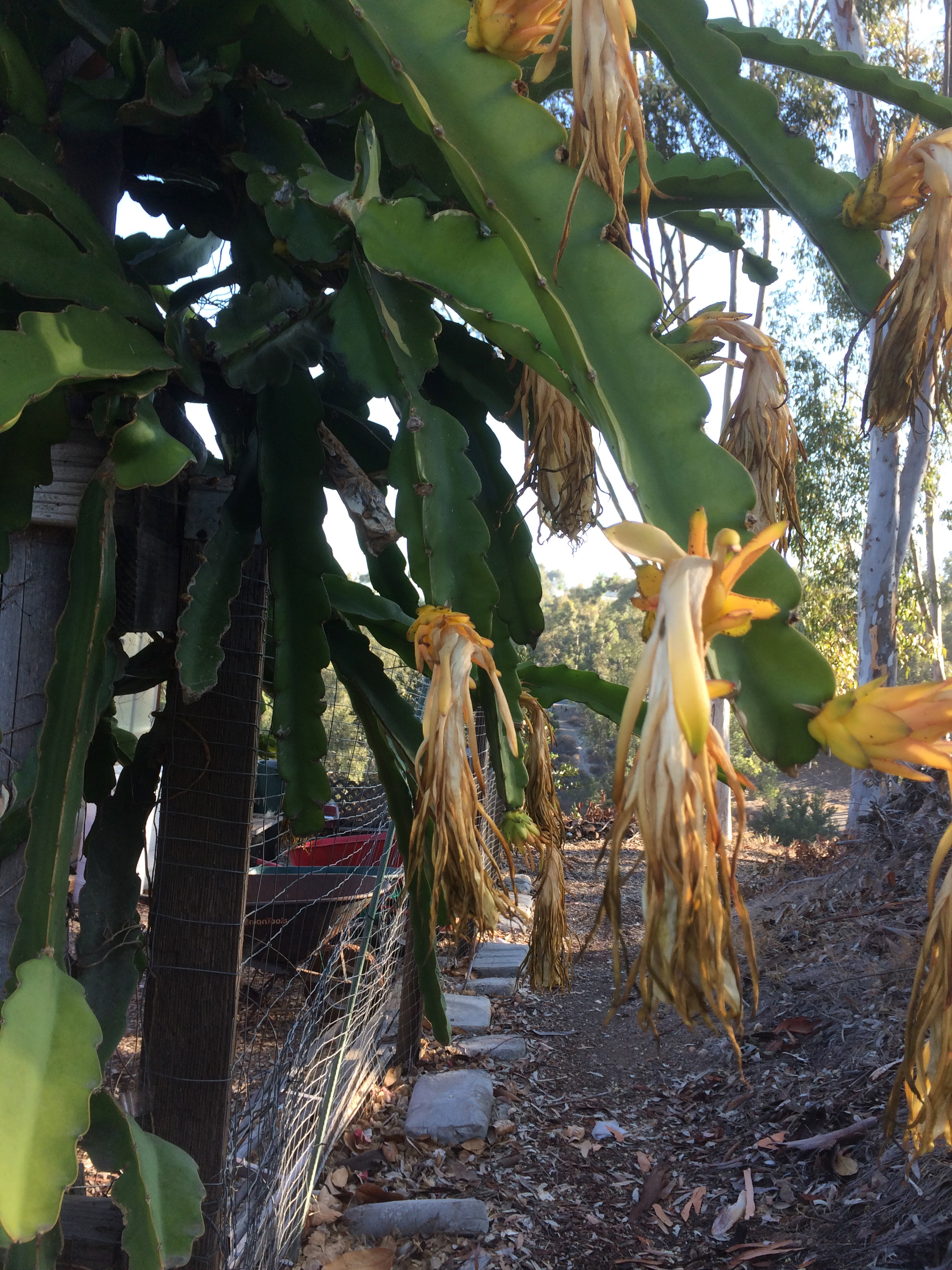
Gate sprawls a droopy set of greenery—
Half cactus, half vine, it shades the
Garden’s tool shed behind it.

droopy cactus?


“What’s that?” I ask the first time
I see this mystery plant, splaying pale
Cream-colored blossoms along
Its width. “A dragonfruit,”
Explains the elder. “It’s not officially
Part of the garden, but one of
Our gardeners asked to put it there.”

Most of the time, the blossoms are
Already spent by morning. The plant,
I learn online, usually blooms at night.
Bats and nocturnal insects pollinate it.

On subsequent visits, I find that spent
Blooms have fallen off, replaced by growing
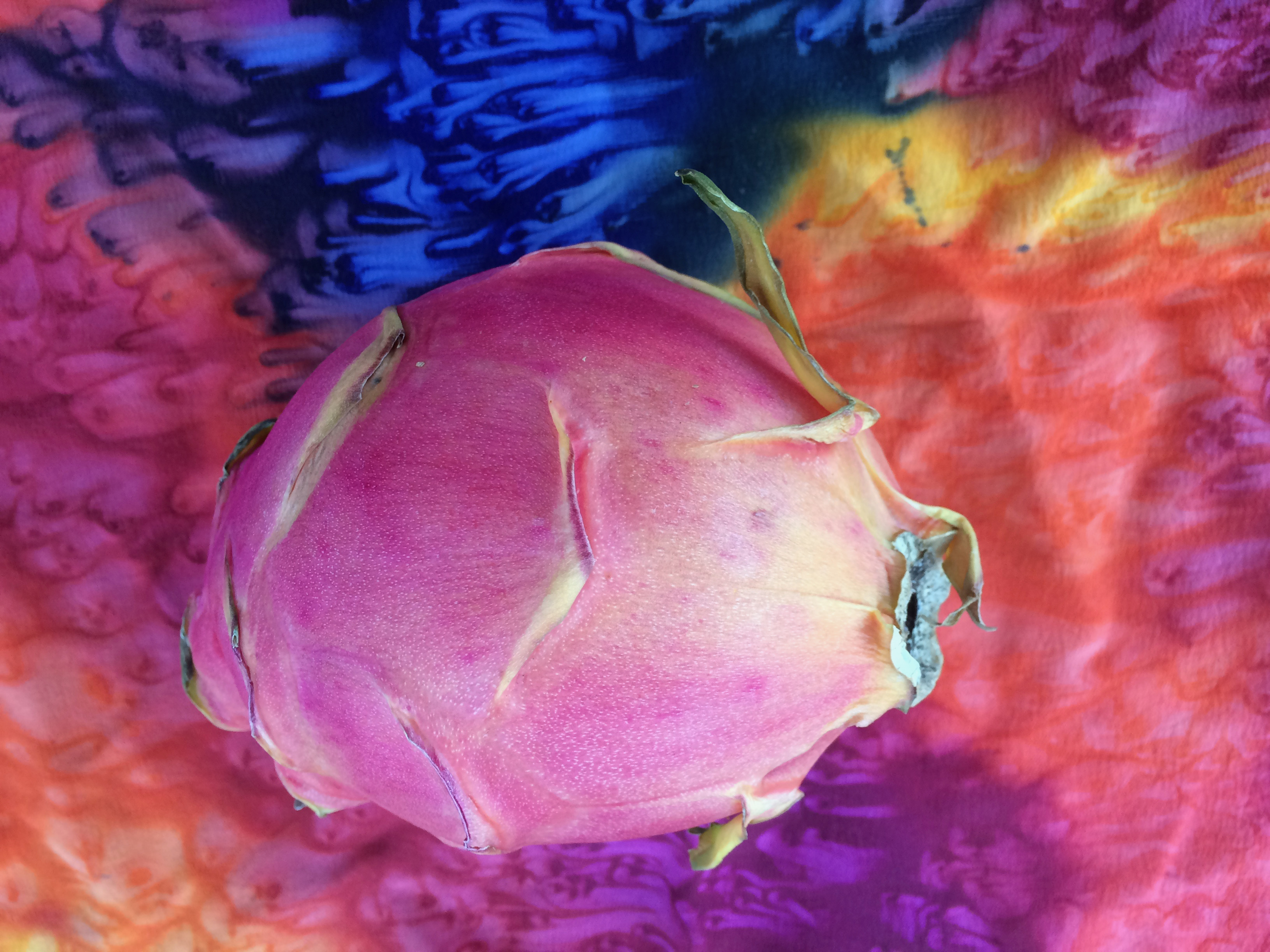
Orbs, at first pale green, then pinkish,
Then red. As they get bigger, they
Sprout what look a bit like scales—
Hence the popular name.

My most recent trip reveals a new sign—
“Large fruit, $3; small $1; proceeds to
Help buy supplies for next spring’s planting.”
I remember having eaten some once in a fruit salad:
White inside, with black seeds and a mild flavor.

I think I’ll buy some and try to find creative
Uses for them. If nothing else, they can remind
Me, in this pivotal time, when so many
Preconceptions have been turned
Inside out, to nudge my inner dragons
Away from seedy black and white,
Toward a more scaled and colorful reality.

halved dragon fruit

pink-red dragon fruit

Gratitude for Late-Life Friendships

My heart goes out to the many families who will be missing a member at this year’s holiday celebrations because of a covid-induced death. I have yet to lose a family member or very close friend directly from the pandemic, though the final year of our late-life friend Phyllis was impacted. She had to journey through end-stage cancer with limits on visits from loved ones, limits to her travels beyond what her illness proscribed. 

We’d known Phyllis for about a decade. She was among the first non-family members to welcome us to North Carolina. Just before her diagnosis, she and her husband had relocated to their “retirement haven” in rural Virginia. We were very lucky that there was a summer lull in the pandemic while Phyllis was still ambulatory enough to visit friends in North Carolina one more time, a chance to say good-bye.  

As I grieve Phyllis’s absence, I’m comforted by the example she set of dying well and leaving a nourishing legacy. She spent as much of her final months as her energy allowed painting nature scenes, a gift she had put on hold for much of an active life. Phyllis bequeathed any unused paints and drawing supplies to an underfunded school.  

At this Thanksgiving, made virtual for so many by the pandemic’s continuing spikes, I need to be especially grateful for late-life friendships like ours with Phyllis and her family. Many of our friends from earlier life stages were work colleagues, or family members of our children’s friends, or affiliates in non-profit groups. Though genuine, these somewhat opportunistic friendships sometimes withered as our locations and life stages changed. By now, we’ve retired, our children are grown, establishing their own friendship networks. More and more non-profits are conducted virtually even when there’s not a pandemic. 

This year’s limitations on in-person holiday gatherings have highlighted what connections we still can have. Not long after we’d gotten up this morning, we got a surprise phone call from a different late-life friend, a former next-door neighbor, recently retired and living across town. A confirmed “foodie,” Greg wished us a happy holiday and shared his story of a memorable Thanksgiving feast when he was living in Germany and tasked with contributing a pumpkin pie to a community celebration with graduate student colleagues. Turns out, fresh or canned pumpkin were rarities in the part of Germany where he studied. The only variant he was able to find were jars of pickled pumpkin. Numerous iterations of rinsing the jars’ contents before cooking didn’t entirely restore the taste of a traditional pumpkin pie. 

Another set of late-life friends that I cherish are members of a pre-covid walking group, now on temporary hiatus. All of us are retired. Many of us have lost spouses. Most of us have health conditions that slow our steps and make uphills more challenging than earlier. Still, whenever I go for a walk outdoors, either with my husband or alone, I mentally have the “Tuesday morning walkers” with me. 

Even once the covid pandemic subsides, through vaccination and/or better public health preventative measures, I will remain at the stage of life when more of my contemporaries will die off. It’s important, then, to cherish them while we still can. As my husband explained on a down day for both of us, “We’re likely to spend an increasing proportion of our time mourning deaths of friends and loved ones, until it’s our turn to be mourned.”  

So let us give thanks for life, thanks for the capacity to share our stories, whatever the medium, thanks for friendships, especially those late-life friends who can help make this trying time more bearable. Happy Thanksgiving and a big set of virtual hugs!      

Fallow

Fallow   –by Jinny Batterson

Farmhouse in November snow, 2018

My sister’s farm lies fallow,
After an unseasonable frost
Killed off much of the late-
Season garden.

My sister’s body lies fallow
Beneath the rose bushes
She planted when she gave
The farm its name–
“White Rose”–in memory of
The father whose memory fogged
Before he could return to farming.

A fallow North Carolina morning. Foggy.
A looming work assignment
Helped chase me outdoors to unfog
My thoughts before confinement.

As the fog lifted, it gently coaxed out
Memories of a sister
Who tirelessly worked to
Improve the soil and to create
A community that, in due season,
Will birth something new.

Goodwill

Goodwill    —by Jinny Batterson

In business dealings,
Intangible assets in excess of
The value of bricks and mortar,
In Christmas carols,
What the angels sing of
At the birth of Jesus.

In this conflicted age,
An improbable hope that
Something good will emerge
From this global pandemic:
Our acknowledgment that
Human life is uncertain
And that all life is connected.


What Difference Can a Letter Make?

What Difference Can a Letter Make?   —by Jinny Batterson

Of late the future of the United States Postal Service seems in doubt. Congressional hearings are being held. The recently appointed Postmaster General, Louis DeJoy, has defended his changes in service levels as attempts to streamline the post office’s business practices. Others have questioned whether the changes he is implementing undermine vital services, including a crucial pandemic-era method for casting ballots—by mail. 

I’m a fan of the postal service. It’s provided a lifeline, especially during periods when I’ve resided outside the United States. Then, the postal service provided the surest way for me to interact with family and friends back home. Internet access might be spotty or absent, phone lines might go down in earthquakes or other natural disasters, but the mail nearly always got through. 

Today, August 26, many in the U.S. celebrate Women’s Equality Day. This year marks the 100th anniversary of the 19th Amendment to the U.S. constitution for women’s suffrage:  “The right of citizens of the United States to vote shall not be denied or abridged by the United States or by any State on account of sex.”

Many of us know the story of the letter that made a difference in the suffrage fight—a six-page handwritten missive from a widowed mother to her son, Harry T. Burn, a young 24 year-old Republican lawmaker from McMinn County, Tennessee. After hearing a scathing denunciation of the amendment by one of her son’s legislative mentors, Febb Burn was moved to include a gentle rebuttal in her letter, nestled among descriptions of doings on the family farm. She closed with a suggestion, “Don’t forget to be a good boy and help Mrs. Catt…(a longtime suffragist).” When Burn broke a previous tie in the Tennessee legislature to support suffrage, others at first thought he’d made a mistake. He had not. He’d opted for conscience and the advice of his mother over political expedience in his heavily conservative district.  (For a lengthier account, see https://www.washingtonpost.com/graphics/2020/local/history/tennessee-19-amendment-letter-harry-burn-mother-febb/ ).  

My family has a different letter that made a difference. It was written by an Army corporal serving in Germany. My uncle, John Voris, loved learning. He described in his letter that he’d sent a big batch of books home, and hoped for a new shipment soon. “About the books, … I try to keep one or two about me all the time. You see that four years in the army represents a big hole in your life. I try to keep studying and reading so that I can salvage some of these years, in part at least.”  

Much of the November, 1944 letter describes his prior campaigns and the bronze star he’d just been awarded. What made and makes the letter special is that it was received by his family at about the same time as the telegram informing them that he had been killed in action. While the letter couldn’t bring John back, it helped assuage their grief. His younger sister, a printer, had the letter typeset and distributed. It has been passed down from generation to generation. Along with a few pictures, it’s all we have to remind us of an idealistic young soldier who didn’t live to see the next peacetime. 

The Febb Burn letter is now displayed in a museum. Most family mementoes have a less illustrious place, but they are still special. Our emails, tweets and instagram posts are not likely to replace them. So take the time to write a postal letter to someone you care about. Maybe write to the Postmaster General, too. Letters make a difference.    


Using Tools Wisely

My parents, long dead, got most of their early schooling in sparse classrooms. My dad attended grades one through seven in a two-room schoolhouse that was still standing, if derelict, when I was a child. On one of our Sunday afternoon rambles in the family station wagon, we stopped to see it. The wooden structure, built on raised posts, was set in a grove of trees at the edge of a small country road. Its door had a padlock, but, with a boost from Dad, we could look in through a couple of windows whose glass had long been missing. Only a few benches remained inside. Gone was the blackboard where Dad said students had practiced their sums and letters. Near the center of the structure on the floor was a metal platform. Dad explained that the platform had partially protected the rest of the structure from the potbellied stove (now also gone) that had provided the school’s only heat. Feeding wood into the stove had been a job reserved for the teacher or for responsible older students, since errors could result in either too little heat or a bad fire.

Much of what our parents shared with us from their early schooling were poems or essays they remembered having read in their texts all those years ago. The memorization tasks they set for us may have been a partial 1950’s equivalent to some of today’s at home “virtual learning.” They’d ask us to memorize, then recite, some of their favorite poems, like Ernest Thayer’s “Casey at the Bat,” about Mudville’s baseball team and its famed but ill-fated slugger. They introduced us to the Klondike gold rush via Robert W. Service’s “The Cremation of Sam McGee.”

The old schoolhouse selection that has come back to me most often lately, though, is an adaption of Charles Lamb’s “A Dissertation on Roast Pig.” The adapted essay was likely an entry in one of the “graded readers” that both my dad and my mom learned from.  (A Gutenberg project link to Charles Lamb’s entire essay can be found at https://www.gutenberg.org/files/43566/43566-h/43566-h.htm. )

According to Lamb’s account, likely neither true nor fact checked, roast pig first arose as a result of a house fire. A Chinese peasant had left his careless son in charge of the family homestead while he ran some errands. The son accidentally spread some sparks onto a bale of straw that then set the whole house ablaze. The building, a relatively insubstantial hut, burned completely to the ground. Poking around amid the rubble, the son noticed a delicious aroma, and eventually determined that it was coming from the skin and flesh of a piglet, one of several who had been unfortunate collateral damage in the fire. After he tasted it, the son wolfed down the rest of the scorched creature. By the time his father arrived back on the scene, he’d started to devour a second piglet. The son avoided punishment by introducing his father to the roast delicacy—a huge improvement on the raw meat, grains, and vegetables that had previously made up the peasants’ diet. It took a while before the peasantry adjusted their practices so that roast pigs could be obtained without pyromania. Taming fire, using it wisely, was and is an ongoing effort.  

You can likely see where I’m going with this. Our burgeoning online environment has spawned some of the same excesses as the pyromania that, per Lamb’s essay, originally attended roast pigs. We hear almost daily about “tweet storms” and various distortions, half-truths, conspiracy theories and blatant lies circulating on the internet. The “world wide web” has proved to be a hugely important adjunct to many of our former ways of communicating, but it is susceptible to abuses that, unchecked, can burn down more than houses. Can we in time figure out ways to enjoy our virtual “roast pigs” more safely and wisely?    

Noticing a Tailwind

Noticing a Tailwind   —by Jinny Batterson

As discussions and protests continue around issues of police brutality, systemic racism, and possible ways forward, I’m reminded of a long-ago vacation when I viscerally experienced the difference between the presence and the absence of a tailwind.

Back when my husband and I were younger and fitter than we are now, we sometimes planned bicycling vacations. An especially memorable one was a two-week jaunt during the 1990’s to some then-isolated regions of eastern Canada. We were able to reserve ten days’ lodgings in the Canadian province of Prince Edward Island, with a side trip to an even smaller, more remote set of islands further east—disjointed parts of the province of Quebec in the midst of the Gulf of St. Lawrence. Our initial setting out point was Charlottetown, PEI’s capital and largest city. In those days, Charlottetown was a frequent honeymoon destination for Japanese brides who’d read the popular novel series about Anne of Green Gables, an orphaned girl raised in an idyllic rural setting by her potato farmer aunt and uncle. The novels had been part of their high schools’ curricula in Japan. We wandered the town for a little while, getting oriented and marveling at the trilingual street signs (English, French, and Japanese). In the afternoon, we got a taxi to the site of a bike rental agency where we’d reserved two appropriately sized rental bikes. 

We then pedaled off to our first night’s lodging, a rental cabin at a campground not far from town. For most succeeding nights, our overnight accommodations would be at small inns and B&B’s about 30 miles apart, an easy day’s ride in the generally flat or gently rolling terrain.

Once we reached an eastern edge of PEI, we took a ferry from the smallish town of Souris to the even less populous Magdalens, or îles de la Madeleine.  We’d reserved four nights’ lodging on these islands—three on the island with the ferry terminus and one on an island further north.

Our first night we stayed near the ferry terminal in a family home with multiple generations in attendance. After a plentiful breakfast the following morning, we pedaled off northward, cruising easily along, spotting herons and other shore birds as we went. We traveled along a sandy causeway little more than the roadway wide and reached our destination mid-afternoon. Our northern island host was a dedicated birder. He gave us hints about when and where to get the best views of shore birds. Accommodations were simple but ample. The sunset and star views were unsurpassed. The following morning, after another plentiful breakfast, it was time to return southward. 

Pedaling along the causeway this time felt as if we were trying to propel our bikes through a slick of molasses. On our way northward, we had been totally oblivious to a substantial tailwind. The wind had not shifted overnight, so our return trip was straight into a significant headwind. It was well into evening when we reached our third night’s stay. 

I cannot know what it is like to be a black person in the United States of America in the year 2020. Though I’ve studied some about the traumas of slavery, Jim Crow, and mass incarceration, though I’ve had friends of color who were willing to share a few of their individual stories with me, being non-white is not part of my lived experience. The one minimal experience I’ve had on a bicycle riding into a headwind may be a small example of what it frequently feels like to be “living while black” in today’s America. 

So I need to ask myself, repeatedly, what additional actions I can take to make that headwind a little less severe.   


The Flowers Have Not (Yet) Gone

The Flowers Have Not (Yet) Gone   —by Jinny Batterson

It’s been a rough week to be an American. The death toll in the United States from the covid-19 pandemic crossed the 100,000 mark, while multiple U.S. cities experienced repeated, sometimes violent demonstrations in the wake of Monday’s death of yet another unarmed black man, George Floyd, at the hands of a white police officer in Minneapolis, Minnesota.  

Our economy has sputtered to a halt. Partly as a result of virus-related lockdowns, nearly a quarter of the U.S. labor force is unemployed. Our president sporadically spreads hatred and gibberish through his favored media platform, becoming so blatant in his misrepresentations and lies that Twitter has recently put “fact check” warnings on some of his posts.  

As various U.S. states attempt to restart their economies in the midst of a highly contagious novel corona virus with no known treatment or vaccine, cases have started to spike again in multiple hot spots. No one seems to know a good solution to the multiple crises besetting us.  

I sometimes get a “deja vu” feeling about our current problems and unrest, as someone who in 1968 was a young adult with much idealism and little experience. Then, an escalating and increasingly stalemated war in Vietnam was killing a disproportionate number of young black American men. Most American men between the ages of 19 and 26 (though less so the wealthiest or best connected) were susceptible to being conscripted into the military. In early April, Martin Luther King, Jr., an outstanding proponent of non-violent civil disobedience and a leader in the fight for legal equality for African-Americans, had been assassinated by a sniper while helping organize a peaceful protest for sanitation workers in Memphis, Tennessee. In the wake of his death, over a hundred American cities had erupted in protests that often turned violent and destructive.  

Conditions in many U.S. cities in 1968 were unequal, with housing projects and decaying urban neighborhoods receiving little in the way of substantive government assistance, while billions were being spent to advance presumed U.S. political interests overseas. Other government programs either intentionally or collaterally favored “white flight” to the suburbs, which were largely off limits to non-whites. Sound vaguely familiar?

Many collegians of the 1960’s had become enamored of a folk song revival, one of its signature songs being “Where Have All the Flowers Gone?”  penned by Pete Seeger in 1955. Joe Hickerson had later added more verses, turning the song into a circular questioning of the premise of warfare. The folk/rock trio of Peter, Paul and Mary popularized the expanded version, which remains a touchstone for many of us who lived through that era. (You can view their 25th anniversary rendering of the song at https://www.youtube.com/watch?v=ZgXNVA9ngx8.) 

In 2020, I’m somewhat creaky in the knees and a bit too virus-averse to participate in large gatherings, so I admire from a distance the courage and forbearance of many of the protesters (and many of the police officers who work to deescalate tensions, both short-term and longer-term). Meanwhile, I continue to send emails and postal letters to elected officials at all levels. I support voter registration and voting rights initiatives. I sew and give away protective face masks. I tend gardens. I plant flowers. I want to remind myself and others that the flowers have not yet gone. 

lilies and black-eyed susans near our central NC condo

Flowers near our central NC condo