Tag Archives: libraries

Sally Letter 0: Beltane/May Day 2020

Introduction:  Starting in 2005, my sister Sally took over a small farm in northern Maryland, part of an inheritance from our parents. Sally had never farmed full-time before. Her lifelong interest in gardening was scant preparation for this late-middle-age career transition. Especially at first, Sally struggled. She wanted to run the farm as a biodynamic one, building up the soil and paying special attention to the cycles of seasons, sun, and moon. Gradually, she got an acre or two into biodynamic production, renting much of the remaining acreage to nearby more conventional farmers.

For a biodynamic farmer, “cross-quarter days” are especially important in deciding harvest and planting schedules: Groundhog Day (Imbolc) in early February; May Day (Beltane) at the start of May; midsummer, in early August (Lammas); and Halloween (Samhain) in late October. Sally’s farm work was more than full-time, with scant occasions for the travel she had enjoyed earlier in her varied careers. Over time, she built up a cadre of part-time volunteer assistants. Before covid upended all of our lives, I’d visited the farm several times at different seasons of the year, assisting in a very short-term, minor way.

The covid pandemic impacted nearly everyone. For those of us who survived, our lives “after covid” are different from before. By the time the pandemic took hold in the U.S. in March, 2020, both my sister Sally and I were past 65—Sally in her late 60’s, I in my early 70’s. We were facing aging and mortality from quite different vantage points. I then lived with my husband Jim in a liberal-leaning, rather posh suburb in central North Carolina. Information technology was the prevailing “industry.” The population was awash in Ph.D.’s. My retirement nest egg provided a comfortable living. Sally was still actively working, as sole proprietor of a small Maryland farm and hospitality business in the heart of “Trump country,” where most struggled just to get by.   The technical tools I took for granted where I lived in North Carolina were missing, erratic, and/or prohibitively expensive in Sally’s locale. Her internet access was spotty at best. She and I kept in touch mainly through phone calls and letters.

This narrative chronicles the pandemic, its trajectory, and its early aftermath as a series of 27 “cross-quarter day” letters to my sister, corresponding to these harbingers of seasonal change from mid-2020 through late 2026. Prior to covid, we’d both been actively engaged in the civic life of our communities. Covid either terminated or redirected much of this civic activity. Travel, both regionally and internationally, had been an important part of Sally’s pre-farm and my pre-covid life. Covid constricted travel for a time and made most travel modes more risky.

I was concerned for my younger sister—increasingly isolated, farm-bound, and economically stressed. Letters and phone calls did not make up for being unable to visit, but they were the best we could do. I’ve written a good bit about gardening, which I’ve done, on a smaller scale than Sally’s farm, for most of my life. Our mutual connection to the earth also served to connect us to each other.

In one way or another, we are all gardeners. Whether we tend a windowsill plant, thousands of acres, or just “plant” encouraging words, we each do our part to enrich the soil of this resilient but fragile planet.


Friday, May 1, 2020 (Beltane/May Day); from Jinny in Cary, NC to Sally in Taneytown, MD

Dear Sal,

This year’s “May Day” is as much about international distress signals as any international labor celebrations, it seems to me. Covid so far seems be outstripping any of our efforts to contain it. Glad you seemed to be doing better in this week’s Sunday evening phone call. I’m glad you got my check, and hope a larger government check will reach you soon if it hasn’t already. Covid hasn’t been easy on anybody. I’m sorry you’re pretty much stuck at the farm for a while. I admire the way you’re pivoting to try to provide additional food during this growing season. 

The general lack of U.S. political leadership concerning the virus has been galling, though it has seemed to me that the governors of our respective states—Cooper in  North Carolina and Hogan in Maryland—are being somewhat more level-headed and effective than most. Many state governors of both political parties are doing their best to coordinate responses to the pandemic, sharing information and resources. Some have grandstanded more than others. Nobody seems to me to coordinate less or grandstand more than our sitting president. His pronouncements bother me. On March 13, 2020, some (perhaps hostile?) news outlets quoted our President as saying “I don’t take responsibility at all.” In late March, U.S. case numbers surpassed those of any other country. So much for our stellar health care system. We don’t have enough tests, enough protective equipment, enough knowledge of how the virus spreads or how to protect ourselves. I’m probably preaching to the choir. Sorry. 

Just before our library system closed up tight, this bookworm had a chance to check out one more set of books. During the next weeks, schools closed. Grocery stores posted reductions in opening hours. When I went to our local garden shop to get spring planting supplies, all the checkout clerks were wearing gloves to avoid contact with either patrons or cash register keyboards. Cash was no longer welcome most places—touch-free credit cards were much preferred. Our county officially went on lockdown as of March 27.

Supplies of wood and of plexiglass have dwindled as banks, groceries, hardware stores, and most other small businesses jury-rig barriers and enclosures to try to protect their employees from contagion. For a while, neighbors and friends disinfected incoming mail and waited several days before touching it. Same with groceries. Restaurants struggled to adapt—how can one mask and eat at the same time? Most are now “take out only.” 

Searching out what covid humor I could online, I came across this dirge for the millennial generation, which includes your son Alex and most of the cousins:

“Millennials have had it rough—a terrorist attack ushered in our teen years; as we became adults there was a global financial meltdown; when we started parenthood there was a global pandemic. We’re pretty worried about middle age.” Perhaps more truth than poetry, though I’m not sure that the challenges of millennials outstrip those of our grandparents’ cohort or of other earlier generations during unsettled times.

News has become even scarcer and more biased—many reporters are in quarantine or are self-isolating. I’ve been learning more about video conferencing platforms like Zoom, and having virtual conversations with others working on increasing voter turnout in this fall’s elections. We’re sending out thousands of postcards to intermittent voters.

I can now attend “virtual” church, and have been sampling services at both of the churches I previously attended in person. I’ve borrowed a neighbor’s sewing machine and am learning how to make cloth face masks. Somehow we’ll get through this. Please take good care. Talk with you again on Sunday. Lots of virtual hugs! 

Love, Jin
Wapakoneta Hometown Heroes

During a recent extended visit to a part of Ohio where a grown son and his family live, I spent a few days of non-family time in the town of Wapakoneta. Created in 1833 from former Indian lands after the forced removal of remnants of the Shawnee tribe, Wapakoneta prospered in the 19th century as a railroad transit point for farm goods. Over time, it developed a range of local industries as well. “Wapak” still functions as a market hub along the I-75 corridor south of Toledo. As county seat of Auglaize County, it also conducts the business of local government. In addition, the town attracts tourism because of its most famous former resident, “first on the Moon” astronaut Neil Armstrong. At one edge of town, there’s a substantial museum to the U.S. space effort that culminated in Armstrong’s walk on the moon. Wapakoneta is justly proud of this hometown hero, who returned to Ohio after his NASA career. Armstrong lived out most of his forty-three post-walk-on-the-moon years in the state. On an earlier occasion, I’d visited the Armstrong Air and Space Museum and was impressed with its scope.

On this year’s Wapakoneta visit, though, I mainly wanted to spend some quiet time enjoying a slower pace of life and exploring other parts of town. I checked out the vintage downtown with its imposing 19th century buildings that now housed a variety of small shops and restaurants. Early in my stay, I had coffee and chocolate on one building’s back terrace overlooking the Auglaize River. Then I set out to explore. 

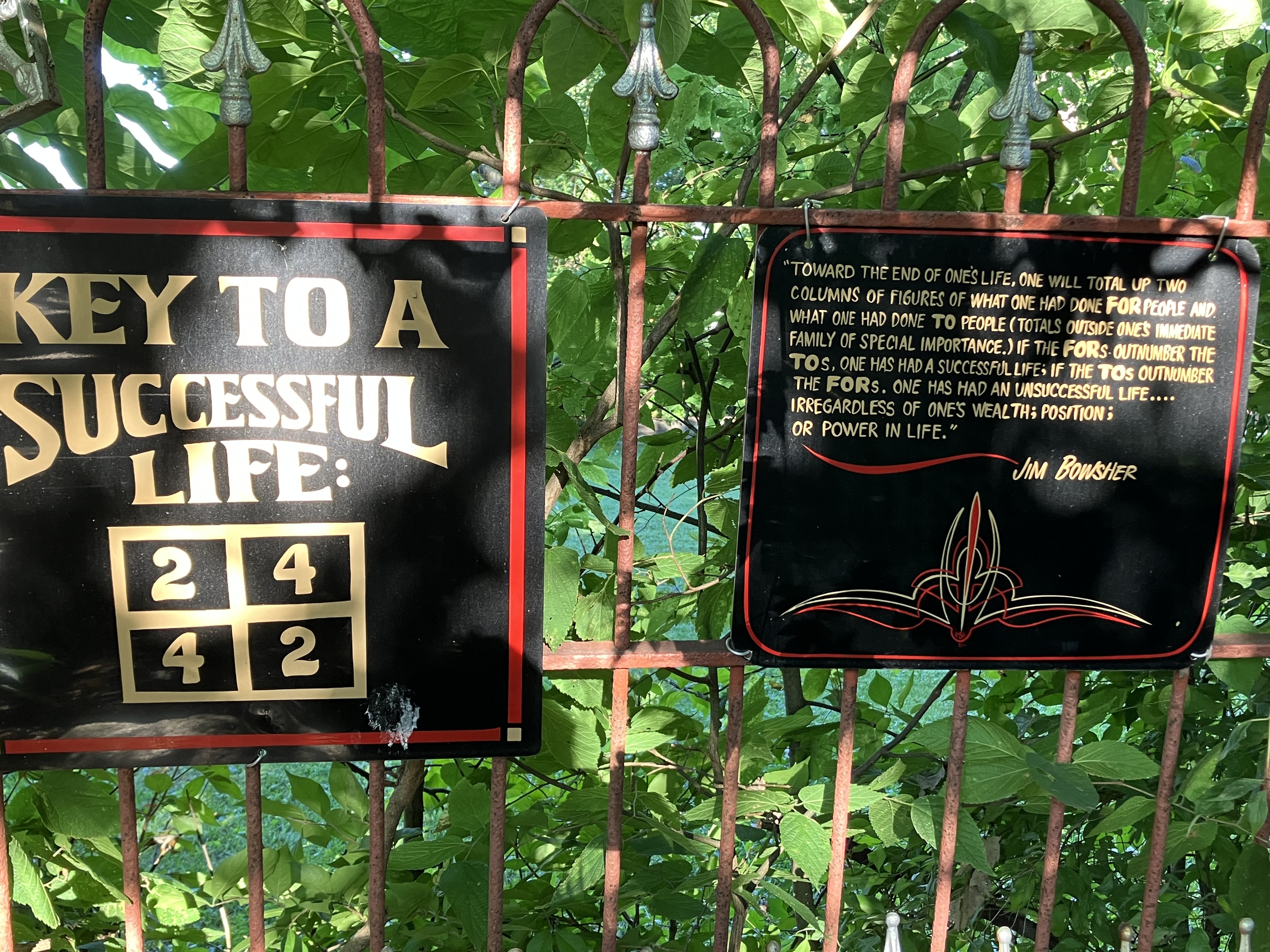
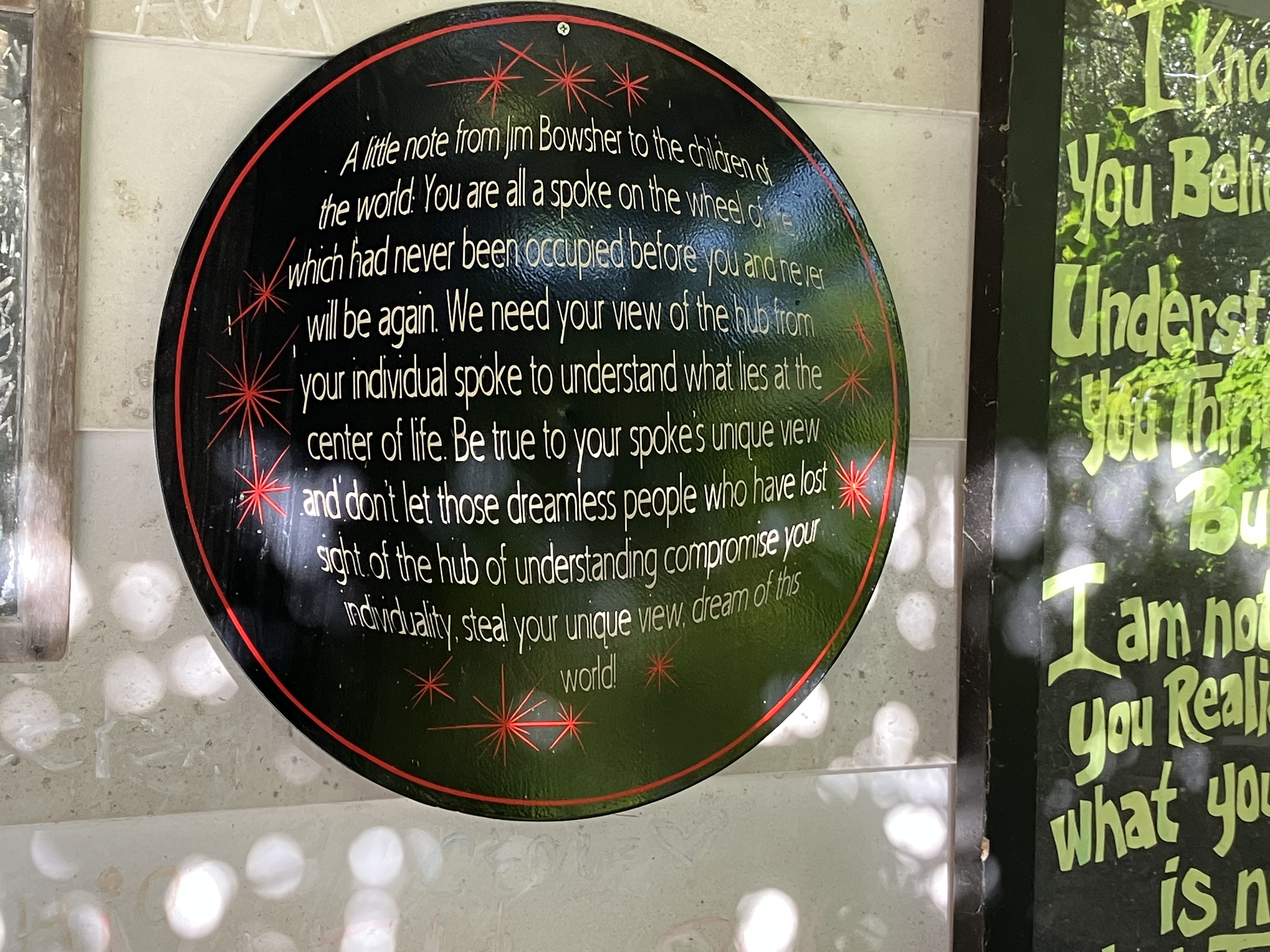
Not long before this Wapak visit, I’d come across a description of “The Temple of Tolerance,” an outdoor art installation created over a period of about twenty years, spearheaded by local historian and storyteller Jim Bowsher (see jimbowsher.com for overall photos). It took me a little while to locate the place, tucked behind a house on a quiet residential street. Bowsher’s “temple,” completed in 1999, has an international reputation but has fallen into partial disrepair following Bowsher’s 2024 death. The site is still open to the public, with a small donation box to help with upkeep. When I visited, a record-breaking rainy August had made some of the pathways through the elaborate site rather soggy. The weeds had sprouted faster than efforts could contain them. Still, the nearly 2-acre site had a reverent feel to it. There was ample evidence the place had not been totally abandoned. The site contains more than 100,000 pounds of massive cataloged field rocks, glacial boulders, and historical artifacts. How anyone could have had the stamina and vision to assemble some of the massive stone constructions was a wonder. Still, I was most impressed by a few placards that looked hand lettered, describing Bowsher’s attitude toward life. 

Jim Bowsher’s advice to children everywhere…
Jim Bowsher’s summary of 2/4 life

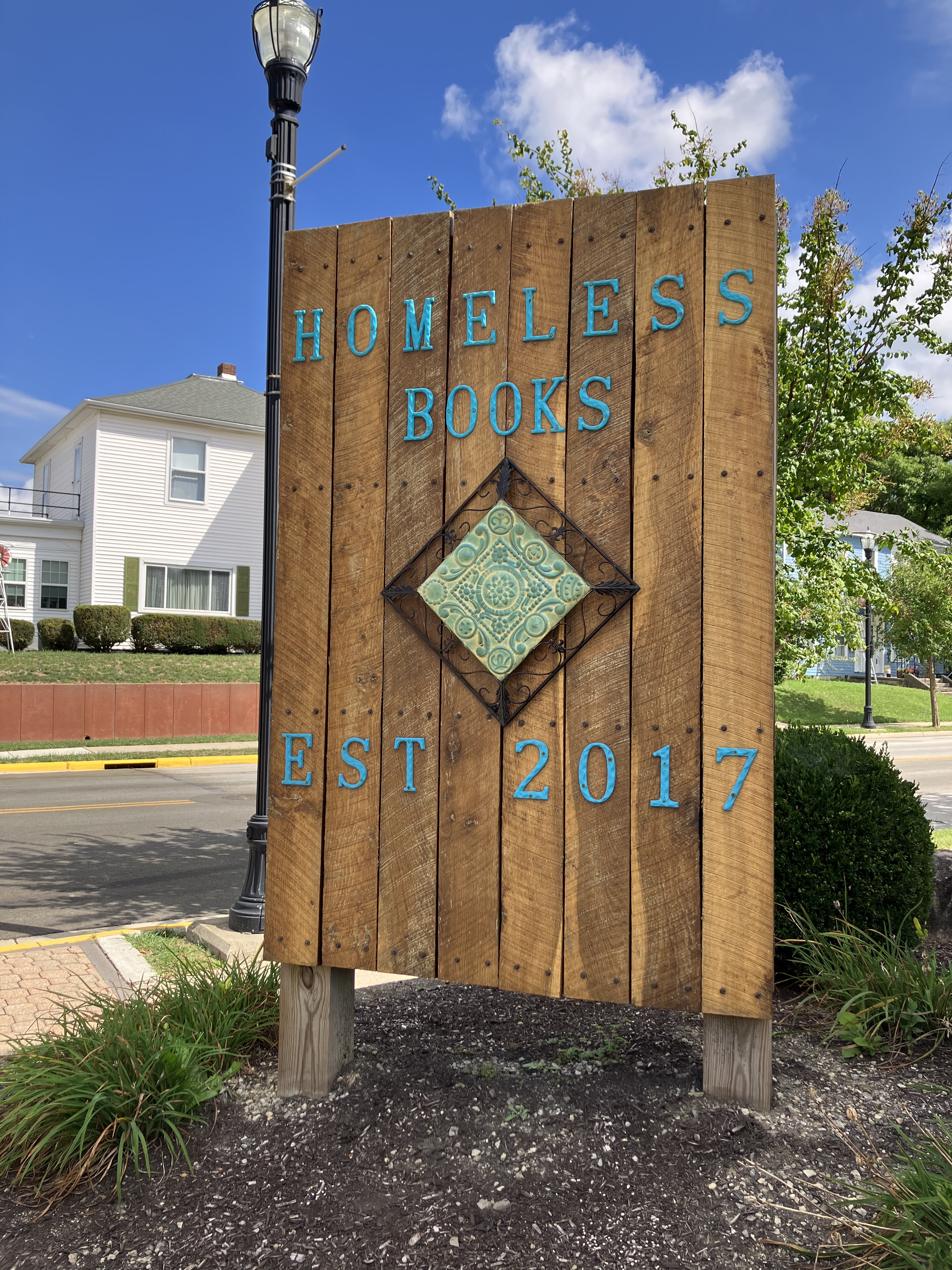
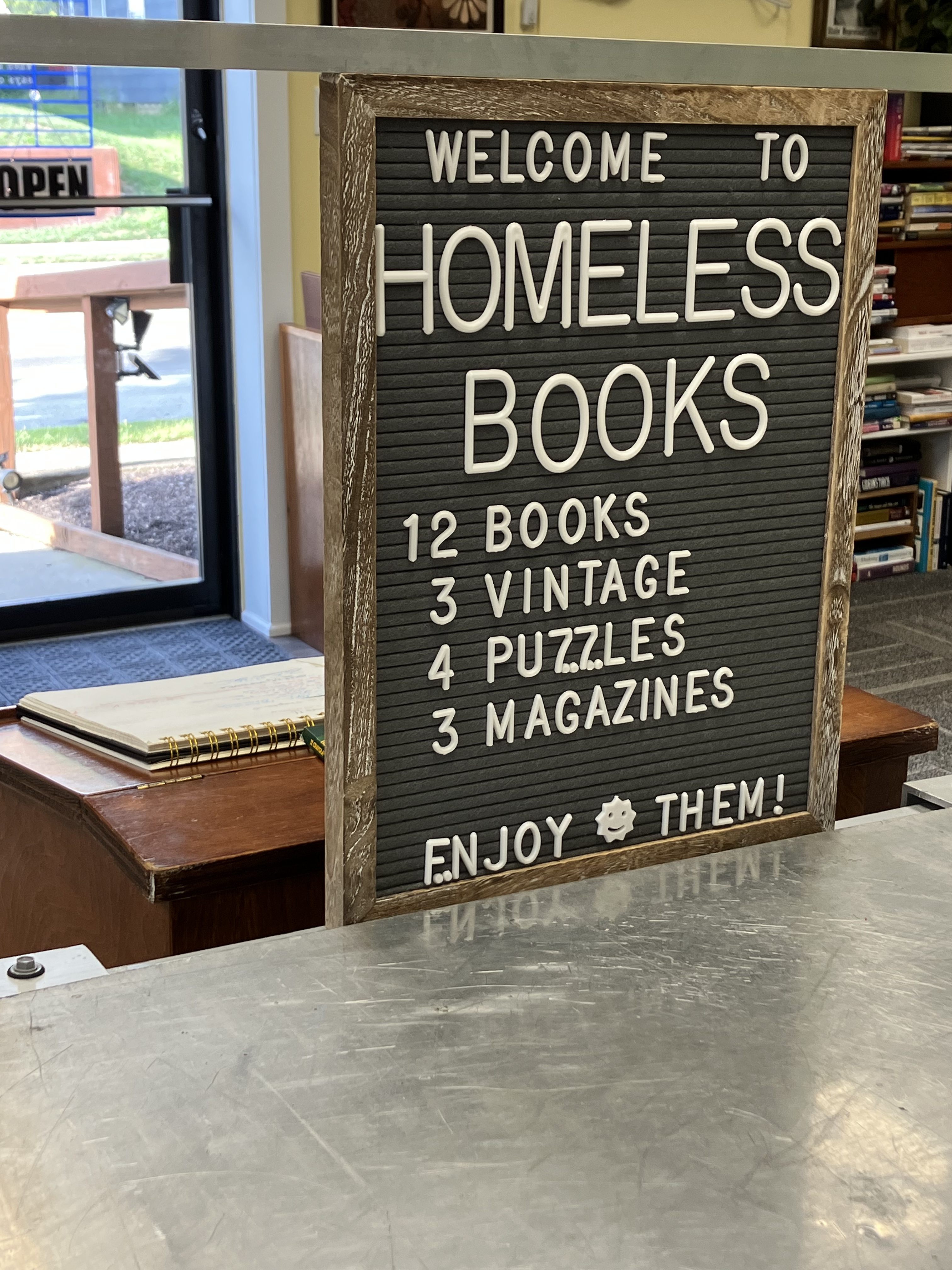
Another day as I walked through an area near downtown, I passed a modern single story building with an outdoor rustic sign announcing “Homeless Books, established 2017.” I’m a part-time writer and an avid reader, a big fan of book stores, large or small. Intrigued by the sign, I checked for its opening hours—only Sunday afternoons or “when the open sign is up.”  I was there on a Tuesday, with no prospect of being around until the following Sunday. It seemed possible the shop would remain a mystery. However, I figured there might be ways to find out more. The next day, I was able to locate a contact phone number for the store. The owner picked up and gave me time to state my purpose in calling. Once I’d given my name and identified myself as a fellow book lover from outside the area, she seemed willing to talk further. 

Unfortunately, the owner told me, I’d missed the Sunday afternoon time slot, the only time during the week when the store was now regularly open. However, she’d be at the site later that afternoon to do some work on the building. She’d be glad to give me a quick tour. 

I wondered, what kind of book store can possibly make a profit if it’s only open one afternoon a week? Turns out, the “profit” Frances Springer was interested in wasn’t expressed in money, but rather in encouraging reading, literacy, and curiosity among the people in this largely rural county. I only learned a small part of the Homeless Books story in my brief visit, and hope I have represented it accurately here: 

Frances had grown up in the area and was always interested in books. However, as a somewhat slow reader, she couldn’t always finish the books she got out of her local library before their due dates. As she grew up, she nourished the dream of later creating an environment where other readers, whether fast or slow, would have access to books without having to worry about a due date. What started in 2017 as a small, mobile operation serving rural readers later found an additional home in the building I’d happened upon in Wapakoneta. 

Frances stressed that what she was running was not a traditional book store, nor was it a traditional library. “You do not have to turn books back in,” she told me. “You do not have to be quiet.”

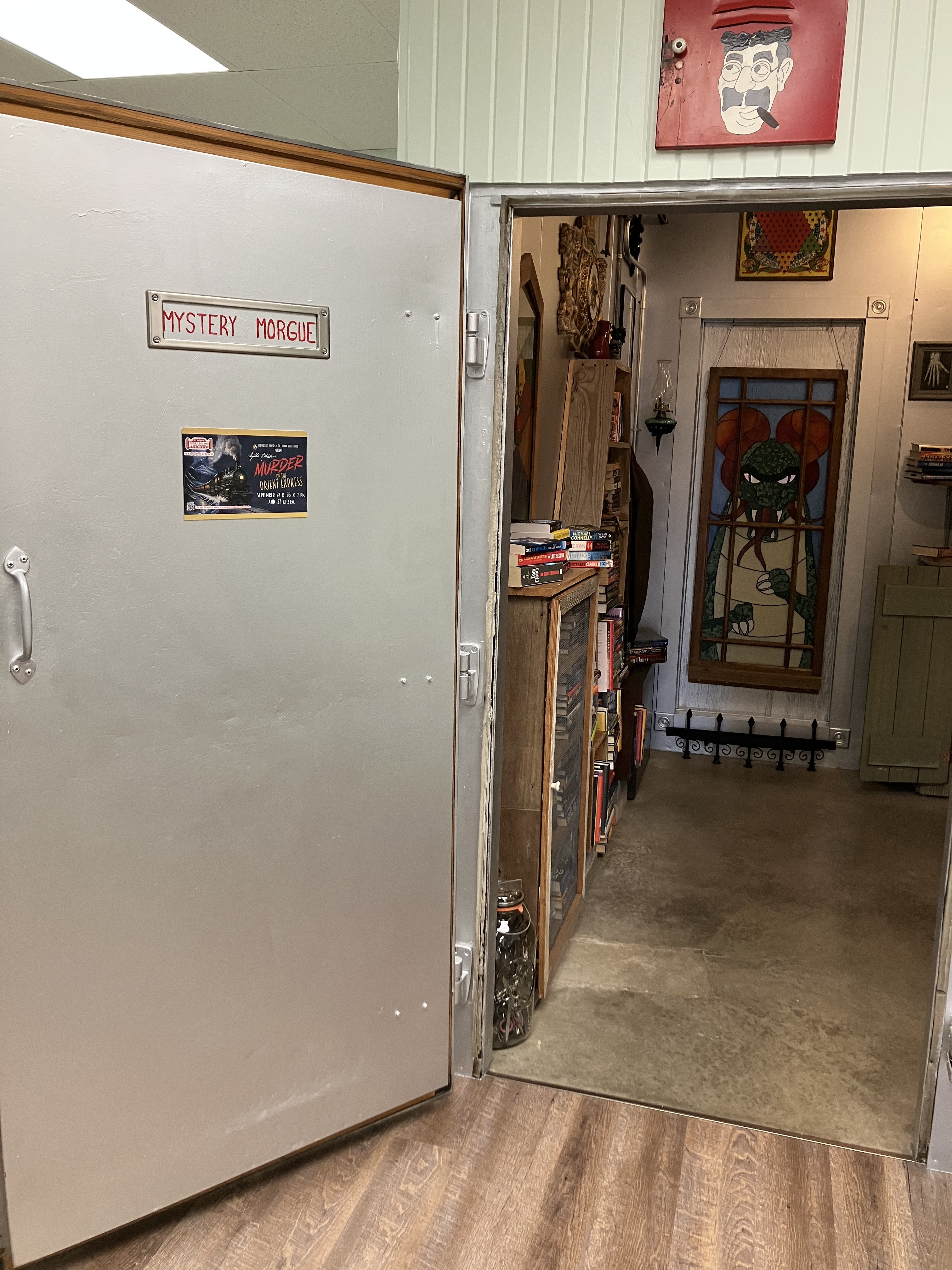
She runs the small, local operation using donations of books, furnishings, and volunteer time from area residents. Sometimes she also gets small infusions of cash. She puts in multiple hours each week collecting, preparing, and organizing the books and keeping the shop’s space welcoming and accessible. There are areas for certain kinds of books—the mystery section is in what used to be the “cooler” when the building was a flower shop—but there’s no strict organization. You might find two seemingly unrelated items right next to each other on a shelf or table. 

Frances told me that news of the existence of her shop and her educational mission gets spread mainly by word of mouth, though she has a small online Facebook presence. On a recent Sunday, she had over a hundred visitors at the Wapakoneta store during the four hours the shop was open. Frances does what she can to discourage commercial use of her inventory. She has a hand-printed flyer describing the purpose and limits of her operation. The quantity of books, puzzles, vintage books, and magazines available for the taking varies depending on the store’s inventory. When I visited, there was an abundance of material, so limits were accordingly higher. 

Homeless Books was certainly a place I’d enjoy spending part of a Sunday afternoon. I came away with six books, a puzzle, and a magazine, most to be redistributed to family or Little Free Library locations before I crammed my suitcase for the plane ride home. 

outdoor sign for Homeless Books near downtown Wapakoneta
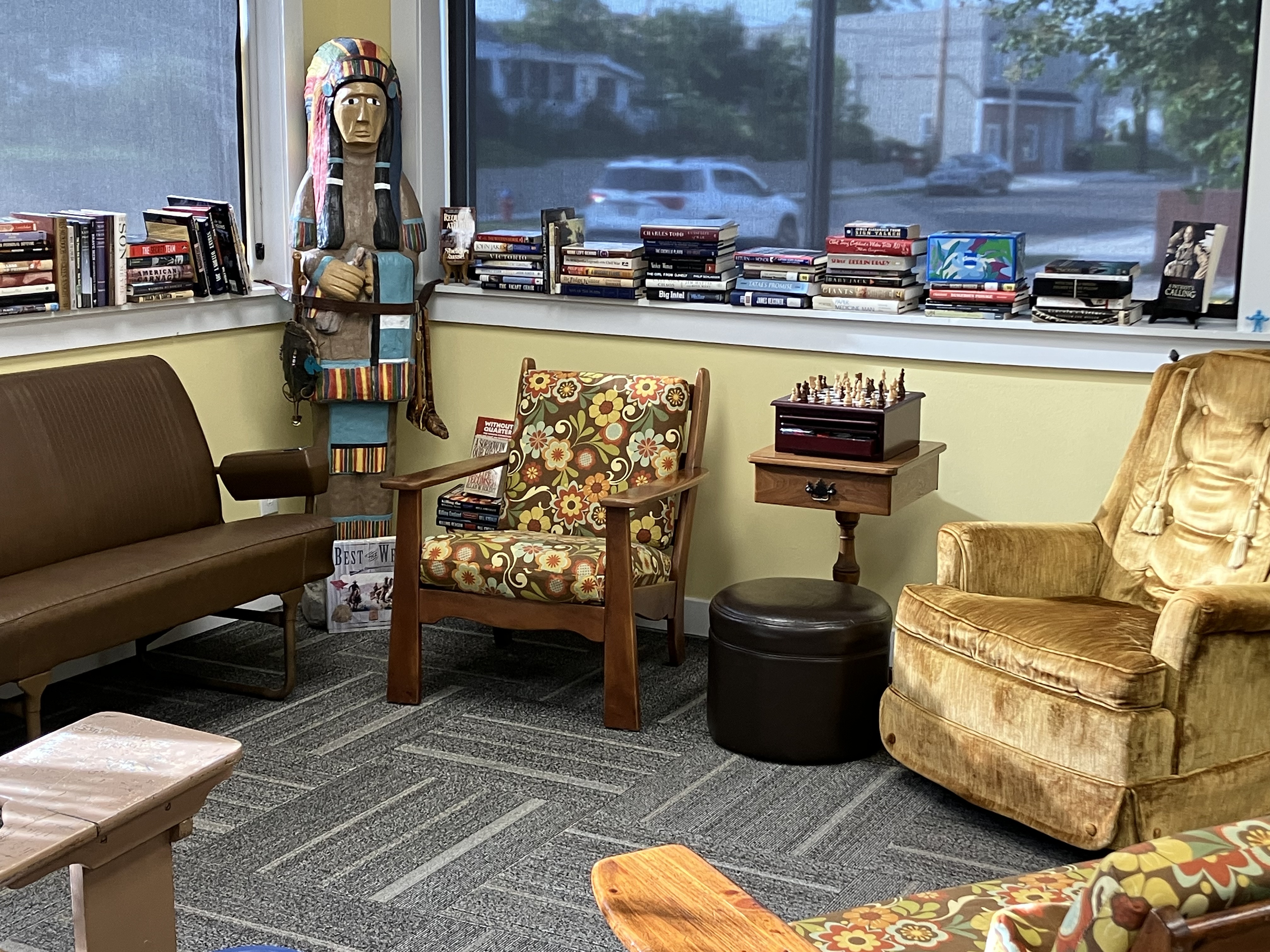
main reading area at Homeless Books
mystery “vault” at Homeless Books
quantities available for patron take out, as of September 9, 2026

I was very glad to have had a glimpse of Frances’s unique “business model.” I hope to convey some of its magic now that I’ve returned to the more urban environment where I usually live. 

= = = = = = = = = = = = = = = = = = = = = = = = = = = = = = = = = = = = = = = =

When I’d opted to spend a few days in Wapakoneta, I expected to find plaudits to Neil Armstrong, along with memorials and tributes to the numerous Wapakoneta residents who’ve served honorably in our nation’s military. What I didn’t expect was my exposure to two other “hometown heroes,” people whose mission was neither outer space nor the battlefield, people who wanted simply to nurture our shared humanity. Bowsher and Springer, each in their own way, have tried to make their hometown a more welcoming, more inclusive place. I’m much the richer for their efforts.   

In Praise of Libraries

To me, libraries are among the unsung heroes of our societal institutions. They typically get taken for granted until something goes wrong, or the budget goes short. I depend on our public libraries for much more than books. When I visit a library branch, I often get to observe all different ages and economic levels, from toddlers to dowagers with pearls to homeless folks in well worn jeans. I get to check out both nourishing fiction and varied non-fiction. Nearly every subject imaginable is covered, along with the entire spectrum of political views. I can browse the latest newspapers and magazines. I can do Internet research on one of the computer terminals typically available for patron use. Most library buildings provide community meeting spaces, often making community rooms available to civic and non-profit groups for free or at minimal cost. Public libraries are among our most vital “third spaces,” neutral zones, neither work nor home, for getting recharged. 

As one librarian recently told me, “Libraries are among the few remaining spaces where you can hang out without being expected to buy anything.” Libraries help combat the loneliness that can worsen the mental and physical health of seniors.  

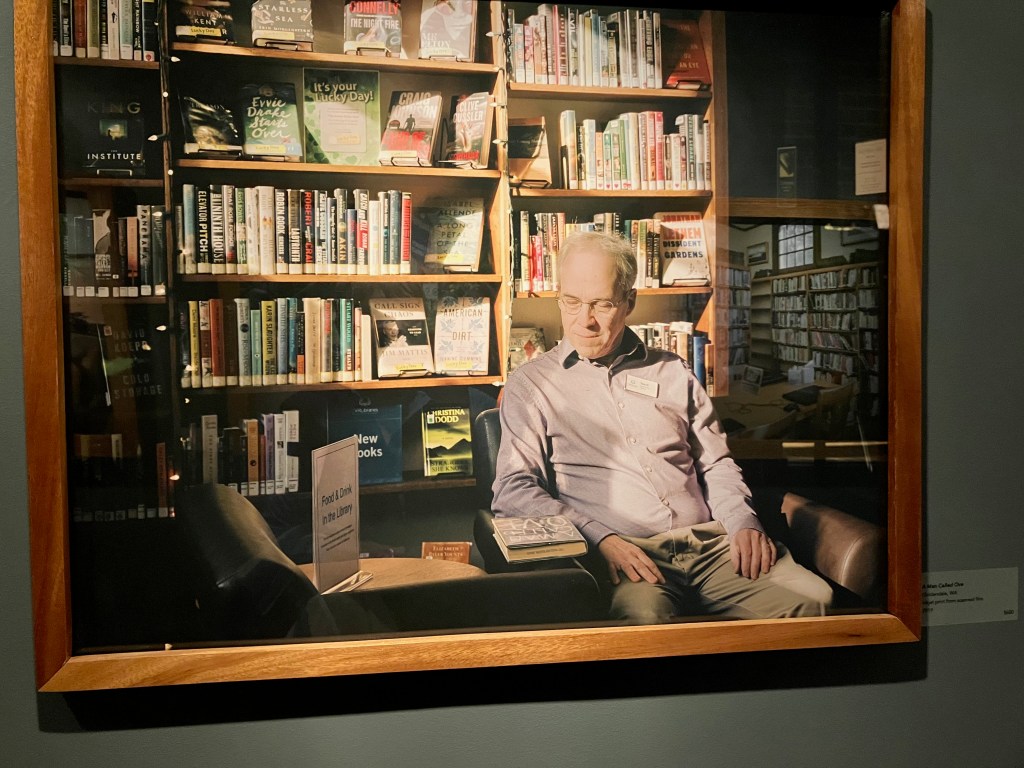
Photo of a Carnegie-Endowed Public Library

When in 2021 I arrived at my current home town as part of a cross-country move, libraries were still closed due to covid restrictions.  A library-related quote from a lean time in my young adulthood came back to me: “Libraries will get you through times of no money better than money will get you through times of no libraries.” Now, no longer cash-strapped, I was bereft of a major source of information and entertainment without library access. I very much missed the peaceable, low-stress interactions these venues had provided pre-pandemic. I appreciated the many creative ways libraries had adapted to provide what services they safely could during pandemic lockdowns. Once our central library reopened, I hurried to get a library card and to begin visiting and checking out materials. 

A while later, once our local branch reopened, I signed up as a library volunteer. Through volunteer hours and small-scale donations, I do my bit to support library programming. Nearly all our library branches have volunteers. We assist with day-to-day functioning and sometimes provide fundraising help through book sales and craft fairs. The more I volunteer, the more I appreciate the work, both paid and unpaid, that’s required to help keep our community well balanced and well informed, with access to the reliable information that helps citizenship flourish.

For over seventy years, ever since my grandmother first began taking me to story hours at our nearest library, public libraries have been a lifeline for me. The monthly library jaunts Granny and I took enriched me both intellectually and emotionally. Later, libraries helped me navigate term papers and college research assignments. During stressful times, they provided resource materials and outlets for harmlessly venting some of my frustrations. (My husband once joked that he’d know to start worrying if he saw me reading a murder mystery with an on-call computer programmer as the victim.)

In 2025, budget constraints are again threatening the health of many library systems, both urban and rural. Our city’s initial budget proposal for the next fiscal year projected cuts of about ten percent to the library system’s current allocation. It called for systemwide closures two days a week, regardless of branch patronage levels. It didn’t distinguish, among its thirty-seven branches, those in lower income areas where libraries are most crucial as a community resource.

Libraries can and often do provide the “ounce of prevention” that helps reduce the “pound of cure” required via police patrols, court costs, and emergency services. Those of us who are library partisans need to become better at touting the benefits of public libraries, intellectual, emotional, and societal. (Hence this blog post and multiple letters and emails to my local public officials.) 

When I walk past our local library branch the first weekend of each month and notice the temporary flag announcing “Used Book Sale Today,” I feel a small glow. Long may such flags wave! Long may public libraries flourish!