Category Archives: Everyday Wonders

The Flowers Have Not (Yet) Gone

The Flowers Have Not (Yet) Gone   —by Jinny Batterson

It’s been a rough week to be an American. The death toll in the United States from the covid-19 pandemic crossed the 100,000 mark, while multiple U.S. cities experienced repeated, sometimes violent demonstrations in the wake of Monday’s death of yet another unarmed black man, George Floyd, at the hands of a white police officer in Minneapolis, Minnesota.  

Our economy has sputtered to a halt. Partly as a result of virus-related lockdowns, nearly a quarter of the U.S. labor force is unemployed. Our president sporadically spreads hatred and gibberish through his favored media platform, becoming so blatant in his misrepresentations and lies that Twitter has recently put “fact check” warnings on some of his posts.  

As various U.S. states attempt to restart their economies in the midst of a highly contagious novel corona virus with no known treatment or vaccine, cases have started to spike again in multiple hot spots. No one seems to know a good solution to the multiple crises besetting us.  

I sometimes get a “deja vu” feeling about our current problems and unrest, as someone who in 1968 was a young adult with much idealism and little experience. Then, an escalating and increasingly stalemated war in Vietnam was killing a disproportionate number of young black American men. Most American men between the ages of 19 and 26 (though less so the wealthiest or best connected) were susceptible to being conscripted into the military. In early April, Martin Luther King, Jr., an outstanding proponent of non-violent civil disobedience and a leader in the fight for legal equality for African-Americans, had been assassinated by a sniper while helping organize a peaceful protest for sanitation workers in Memphis, Tennessee. In the wake of his death, over a hundred American cities had erupted in protests that often turned violent and destructive.  

Conditions in many U.S. cities in 1968 were unequal, with housing projects and decaying urban neighborhoods receiving little in the way of substantive government assistance, while billions were being spent to advance presumed U.S. political interests overseas. Other government programs either intentionally or collaterally favored “white flight” to the suburbs, which were largely off limits to non-whites. Sound vaguely familiar?

Many collegians of the 1960’s had become enamored of a folk song revival, one of its signature songs being “Where Have All the Flowers Gone?”  penned by Pete Seeger in 1955. Joe Hickerson had later added more verses, turning the song into a circular questioning of the premise of warfare. The folk/rock trio of Peter, Paul and Mary popularized the expanded version, which remains a touchstone for many of us who lived through that era. (You can view their 25th anniversary rendering of the song at https://www.youtube.com/watch?v=ZgXNVA9ngx8.) 

In 2020, I’m somewhat creaky in the knees and a bit too virus-averse to participate in large gatherings, so I admire from a distance the courage and forbearance of many of the protesters (and many of the police officers who work to deescalate tensions, both short-term and longer-term). Meanwhile, I continue to send emails and postal letters to elected officials at all levels. I support voter registration and voting rights initiatives. I sew and give away protective face masks. I tend gardens. I plant flowers. I want to remind myself and others that the flowers have not yet gone. 
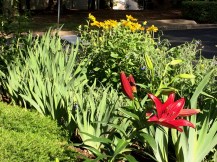
lilies and black-eyed susans near our central NC condo
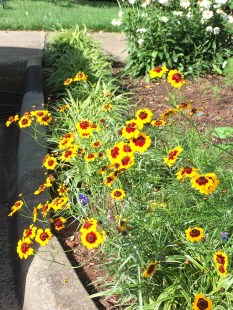
Flowers near our central NC condo
Earth Has Its Day

Earth Has Its Day   —by Jinny Batterson

Had this been a “normal” year, there would have been big crowds today commemorating the 50th annual Earth Day. There would have been lots of in-person speeches. There would have been live exhibits from corporations and non-profits with a mixture of important initiatives and “greenwashing,” spotlighting small impacts for mainly public relations value. There would have been more exhortations to “reduce, reuse, recycle.” 

This is not a normal year. A small pathogen whose exact origin is still unclear began spreading a respiratory ailment among the global human population in late 2019. As of today, covid-19 had caused nearly 2.5 million known infections and nearly 170,000 deaths. Much of the globe’s human population is on “lockdown.” Public gatherings are few. 

In parts of the world, other variations in nature are wreaking havoc in different ways: a plague of locusts in east Africa is destroying food crops, threatening the food supply of tens of millions; forest fires in Ukraine near the defunct Chernobyl nuclear power plant have recently caused the Ukrainian capital, Kiev, to have the worst air pollution of any place in the world; widespread bush fires during Australia’s 2019-2020 summer have blackened millions of acres and killed roughly a billion animals, endangering such unique species as kangaroos and koalas and putting Australia’s agricultural sector at risk; Greenland and Antarctica have ice sheets that are melting at increasing rates. 

Perhaps earth is reminding us, in increasingly urgent terms, that we are not the masters of the planet, but its guests and its (temporary) stewards. 

For much of my adult life, I’ve accumulated a clipping file of quotations and short pieces of prose that seem meaningful to me. During a personal or societal crisis, I reread them for wisdom. A while ago, I came across the World War II era diaries of Anne Morrow Lindbergh, War Without and Within, edited and first published long after that war was over, in 1980. Anne and her husband, aviator Charles Lindbergh, had spent part of the 1930’s living in Europe to regain some privacy after the highly publicized U.S. kidnapping and murder of their first child.  A pacifist often identified with her isolationist husband, Anne was deeply affected by the 1939 onset of war in Europe and the entry of the U.S. into a globalized conflict in late 1941. A diary entry from Easter Monday during the spring of 1942 expresses both sorrow and hope: 

“Today is the real Easter morning. Yesterday was overcast and chilly. This morning is still, warm, newly awakened. One walks out into it like a flower just opened. …
When I was young, I always felt a morning like this meant a promise of something wonderful … love in someone’s heart far away from me, or the success of some venture of my own. I thought–quite literally–it was a sign from heaven. The person who was ill would get well. … Or maybe something wonderful was happening for the world–some new spirit blooming. … the morning was a ‘sign.’
I still believe it is a ‘sign,’ but not for anything good happening to me or the world, anything specific. The love is not blooming in someone’s heart. The ventures fail. The one who is sick, dies, and the one who is lost is never found. Hate and cruelty and evil are still rampant, war goes on.
And yet it is a sign. It is a sign that in spite of these things beauty still exists and goes on side by side with horror. That there is love and goodness and beauty and spirit in the world–always. This is only one of the times when it is clothed in flesh–in the flesh of a spring morning.”

Amid the global concern about the covid-19 pandemic and the seemingly unending series of recriminations about whose “fault” the pandemic is, there have been occasional notes of clearer air in unexpected places, of a resurgence of birdsong alongside nearly empty highways. 

This morning where I live dawned crisp, cool, bright, with almost jewel-like clarity. May it be a sign. Happy Earth Day!   

The Tulips Don’t Care about Pandemics…

Tulips and Pandemics –by Jinny Batterson

Doing a bit of “nature therapy” yesterday during a brief shower, and took a couple of pictures in our smallish condo complex. This morning got a link from a more media-literate friend, an opinion piece that long-term astronaut Scott Kelly had penned about coping with isolation. Very grateful that many of us have the technology to stay closer in touch via phone and internet. Glad there are parts of nature that seem little affected/afflicted by our current human pandemic. Please take care, all!

tulips in our condo complex

more tulips, oblivious to human worries

Gardener’s Song

Gardener’s Song   —by Jinny Batterson

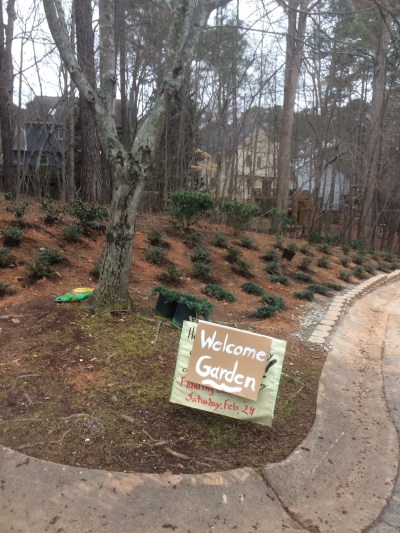
(In memory of Nancy Small Van Dijk on what would have been her 72nd birthday; Nancy served for several years as HOA chair of our condo complex. During her term, she spearheaded an effort to get a “Welcome Garden” of flowering shrubs at our previously clay-slope entry drive.)

This garden is overgrown, the weeds are practically choking it.
I come here and sit alone, and wonder what will become of it.
Yet we started out as gardeners, as workers in the soil,
And we reaped a bounteous harvest from our ever-loving toil.

Some cities are overgrown, with drugs and crime and pollution.
We sit in barred rooms alone, each writing a rational solution.
Yet we’ve cities full of gardeners, of players in the soil,
And the plants and herbs and flowers reward our ever-loving toil.

Our planet is overgrown, wars, strife, disease, aggravation,
We stumble our lone ways home, uncertain of continuation.
If our world should blow to pieces, not survive its own turmoil,
Would we all come back as gardeners, blessed to ever-loving toil?

"Welcome garden" planted February, 2018

“Welcome garden” with Nancy’s sign soon after planting in 2018

Poinsettia Day

Poinsettia Day    —by Jinny Batterson

December 12 has been proclaimed “Poinsettia Day” in the United States. The designation honors a plant brought to the U.S. by  Joel Roberts Poinsett, the first United States Ambassador to Mexico (1825-1829). Poinsett’s love of botany persisted while he trained as a physician. His career mostly went a different direction. While serving in Mexico, Poinsett continued to maintain hothouses on his Greenville, South Carolina plantations. In about 1828, he sent some poinsettias back from Mexico to be propagated. He later gave cuttings to John Bartram of Philadelphia, who introduced the plant to other nurserymen. Over time, the poinsettia in many variations has become a top selling Christmas plant,  with about 33 million poinsettias sold each year. 

Our 2019 experiments with “forcing” the two poinsettias given us by a neighbor after last year’s holidays were not entirely successful. Although the plants survived two successive transplantings—from pot to ground once frost was finished in spring, from ground back to pot before autumn’s first frost—they didn’t produce the same beautiful red bracts as store-bought plants.  I’m not sorry we tried. Even though our “home growns” were spindly and mostly stayed green, we learned from our efforts. Any plants we carry over until next year will be treated with an enhanced regimen, though likely not quite as standardized as hothouse plants. This year, as a side benefit, the exercise of taking the plants from basement to light and back twice a day has helped keep off some of this year’s holiday flab. 

Below are pictures of the two types of poinsettias gracing our hearth this holiday season. May light and life grace your home as well!  

full store-bought poinsettias, leggy home-grown from last year

A Small White Button

A Small White Button  —by Jinny Batterson

A year or so ago, someone at an anti-racism workshop gave me a small white button: BLACK LIVES MATTER, it said in black typeface on a white background, with a small circle of red edging around the whole button. Maybe an inch across, it’s not an “in your face” kind of button, although the lettering is not what you’d typically wear to a Rotary meeting. For much of the time since the workshop, the button has sat on my bedside table. When I look at it morning or evening, it reminds me of commitments I’ve made to work harder to reduce my own and American society’s racist tendencies. Most of the time the button just sits there while I go about my business elsewhere.

As a white person in Trump-era America, I can too easily let myself be cowed by mentally replaying images of gatherings like the angry mob of white supremacists that invaded Charlottesville during the summer of 2017. I can be timid, hesitant, even cowardly. “Will I put myself in jeopardy by publicly wearing a button for a cause many may misunderstand or disagree with?”   

What is the Black Lives Matter movement, anyway? Some black friends plus a bit of remedial internet sleuthing reconfirmed that the Black Lives Matter movement was started by three black women in 2013 after the shooter who killed unarmed black teen Trayvon Martin was acquitted of all charges. Trayvon Martin’s death was just one in a long series of deaths and injuries of unarmed blacks at the hands of police or armed civilians. It followed, too, a longstanding pattern of racially or gender motivated shootings, profiling, discrimination, arrests, and jail terms for those perceived as “other.” Someone needed to protest, to promote a more just approach. The women went on social media, where much BLM activism is still promoted. It’s also where much disinformation about the group gets spread. Not all black activists agree with some of BLM’s tactics; many of all races do not understand its inclusive emphasis.  

About the time of the Trayvon Martin shooting, a white librarian friend in rural South Carolina told me she’d learned to avoid any hint of condescension or derision with white colleagues and acquaintances in her economically challenged part of the Low Country. “Of course it doesn’t help to call someone a cracker or a redneck,”  she chided. “If someone talked to you that way, wouldn’t it just make your neck go redder?”  Her remarks echo when I try to remind myself of the humanity of the angry white men who converged on Charlottesville. Some of the men may have resented the continuing winnowing out of traditional middle class jobs due to outsourcing and automation. Some may have been facing financial challenges. Many may have been taught a distorted version of maleness. Trying to identify with what motivated them, I realize that when I feel insecure, I can be tempted to blame “others.” Skin color remains one of the most visible ways to “other” someone.  

Lately I’ve started wearing my small white button occasionally, rather than leaving it in solitary confinement at home. Over time, I’m adjusting when and where I put it on—showing it off to my progressive friends is not especially useful, I’ve concluded. At the other extreme, pushing it into the notice of hard-core BLM opponents is unlikely to change any minds or hearts.  

Mostly I put it on while running the everyday errands that are part of a retiree’s life this holiday season—banking, eating out, shopping, buying stamps, sending packages. Black lives DO matter. That they matter does not make my life matter any less. Once in a while, a black postal worker, a fast food restaurant worker, a lunch companion or a store clerk will smile after noticing my button. It affirms their dignity at the same time it reminds both of us of our common humanity. 

Wisely wearing my small white button is a very small risk. Experiencing the smiles it sometimes calls forth is a reward for which I’m thankful. 

The Ripple Effects of Gratitude

The Ripple Effects of Gratitude  —by Jinny Batterson

Lately I’ve been more aware than usual of how much I enjoy being on the receiving end of a “thank you.”  Having been raised partly by an old-fashioned Southern grandmother, I got childhood exposure to the notion that you should do stealthy good deeds for which thanks were a surprise you could then disarmingly dismiss. 

“Oh, it was nothing,” you could say with a shy smile, inwardly puffed up but too “refined” to openly accept the thanks offered.   

Most of my current friends and acquaintances are wise to this blushing maiden/aw-shucks approach, so I’ve gradually gotten better at replying with a simple “you’re welcome.”  

Perhaps it’s the somewhat brusque and derogatory tone of much of our public discourse these days, or the proliferation of mechanistic responses (the “press 1” phenomenon is often just the tip of the iceberg). Perhaps it’s a feature of aging. Whatever, I really thrill to a simple “thank you” after I’ve attempted to do something nice for someone.  

I’ve also tried to get better at thanking others who do nice things for me, from the shop clerk who spends a little extra time explaining the features of the new gadget I’m not very good at using, to the husband who takes out the trash without being asked, to the bus driver who lets me know the closest stop to my downtown Raleigh appointment. The most recent time I rode the bus, I noticed that passengers who got off before me often thanked the driver, so I did, too. It felt nearly as good as being on the receiving end of gratitude.  

Where I’ve noticed others’ gratitude the most is at a mostly African-American church I’ve attended intermittently for the past several years, trying to be inoffensive as a paler pew-sitter than the other church goers.  One of the older men often starts the service with a litany of all the ways the Lord has blessed him, starting with awakening him that morning. Usually I’m not part of the “thank you, Jesus” crowd, but I know this guy’s material circumstances and medical conditions are likely a lot more difficult than mine. If he can start his day with a “thank you,” then maybe I can, too.      

Caramel-colored Children and Labor Day

Caramel-colored Children and Labor Day    —by Jinny Batterson

In a conversation with a good friend whose tendency to wax cynical has been reinforced by some of our recent political and media trends, I heard her lament: “Maybe we’ll finally stop dissing or shooting each other when all of us are caramel-colored.”

I admit to a good bit of prejudice not supported by reality, so I did a little research on interethnic marriages and relationships, which have become increasingly common in the U.S. over the past several generations. Since the U.S. Supreme Court ruling legalizing interracial marriage (in the 1967 case Loving vs. Virginia), the proportion of reported interracial/interethnic marriages in the U.S. has risen dramatically. As of 2017, over one in six new marriages in the U.S. were registered between spouses of different “racial” backgrounds, while about 10% of all married couples were “mixed race.” Statistical evidence for non-marriage relationships is harder to come by, though my anecdotal experiences tell me that these are also becoming more diverse.

The 2000 census marked the first time that Americans were given an option to choose multiple racial identities, not just one. By the 2010 census, people who reported multiple races had risen substantially: 9 million census respondents chose to check two or more racial groups, a 32 percent increase from 2000. (Those who reported a single race rose by 9.2 percent over the same interval.)

My extended family has at least one multi-ethnic marriage and two young adults who could choose to check more than one “race” on a census form. I’ve not delved very far into how my nephews choose to identify themselves and how this has impacted their lives; my hope is that any prejudices against them are waning as “mixed race” children become more and more common.

Intellectually I know that the whole notion of “race” is more cultural than biological. Differences in skin pigmentation bear little relationship to variations in DNA and to other supposedly ingrained characteristics. Still, like many, I’ve been socialized to view a person’s skin color as somehow indicative of their other characteristics. Not until I’d lived next to an elegant “black” neighbor for a decade did she explain to me that she did not much like to dance and had little sense of rhythm. 

Labor Day is a day set aside to honor the contributions of laborers to the overall good of American society. Those of us who are “white” (and generally privileged to do most of our labor with heads rather than hands or backs) are beginning, reluctantly, awkwardly, to enter into conversations about the labor of “non-whites” forced or coerced into doing much of the work of building this country and society. Too often we continue to dishonor their and our heritage through sentimentalizing versions of U.S. history and society that leave out or minimize the injustices and cruelty that helped and help “make America great.” 

There is much work still to be done. Let’s remember, this Labor Day, to keep laboring toward a more equitable America where all labor is valued, whatever the skin color of the laborer.

The Durability of Sisterhood

The Durability of Sisterhood   —by Jinny Batterson

Over the past several weeks, I’ve attended three “women mostly” events—an NAACP breakfast fundraiser and celebration of that group’s NC mother/woman of the year, the annual meeting of our local chapter of the League of Women Voters, and the 50th reunion of my class from then-women’s-college Randolph College. At each event, there were a few men, as official escorts, unofficial companions, or male affiliates, but the focus was mainly on us women. I’d forgotten how good it can feel to be surrounded by other females.

The NC NAACP celebration was the first formal NAACP event I’d attended. Not knowing anyone to tag along with, I went alone. I expected to be a minority at the event—this proved true. The few other white women, none of whom I knew, seemed more connected and more engaged than I felt. The venue was local to Raleigh, but contestants and their supporters came from nearly twenty NAACP chapters throughout the state. Not realizing the flexibility of the event’s scheduling, I’d accepted an invitation to a lunch meeting in a different part of town, so missed the slightly delayed keynote talk by recently named Chief Justice of the North Carolina Supreme Court, Cheri Beasley. Over the part of the event I did attend, I learned that the NAACP has been holding such annual celebrations since the 1950’s.

The LWV Wake County annual meeting had a generally paler audience and was held on a weeknight. Food was higher priced. There was a cash bar. I knew some of the “old stalwarts,” but was pleased to notice younger faces new to me. One older male member I knew, attending without his equally activist spouse, spent a good bit of time talking with me. I wondered if he felt something of an outsider, like my reaction at the NAACP breakfast. The event was tightly scheduled. The business at hand—election of new officers, committee reports, financial updates—was quickly dispatched, assisted by paper agendas. Dinner conversations were pleasant, non-confrontational, and generally apolitical in this non-partisan organization. The Wake county LWV had been founded in 1920, the same year women got the right to vote in national elections. After a rocky period during the late 1930’s and 1940’s, the chapter reconstituted itself in 1950 and has been active ever since.

Then there was the Randolph reunion. I arrived near the beginning of the three-day weekend’s festivities to find a familiar, still beautiful, mostly empty campus. A good student when I’d attended what was then Randolph-Macon Woman’s College in the late 1960’s, I’d nevertheless been anything but a social standout. A foreign language major, I didn’t contribute to campus publications. I wasn’t a horsewoman or an athlete in any sport. I did sing in the glee club, but held no campus leadership positions and rarely attended campus-wide events. I’d felt at graduation that I’d made it through, but would likely not maintain much connection with the school. I wondered how fish-out-of-water I’d feel at a reunion of this institution that had been founded in 1891 exclusively to promote the education of young women, but evolved a lot over its recent existence. About a decade ago, faced with declining enrollment and difficulties attracting highly qualified women to a small, single-sex liberal arts school in the U.S. south, the trustees made a wrenching decision to become a coeducational institution. Alums of the most recent reunion class (those who graduated in 2014) are a rainbow mix of genders and backgrounds, though both the school’s student body and faculty are majority female.

As more and more members of my former class gradually filtered in, I was surprised at how many women I recognized and felt connected with: still-active, still-engaged, still-vibrant septuagenarians whose energy was palpable. This was a tribe I could feel part of! Of course we engaged in some mutual bragging—about further educational achievements, children, life partners, careers, travels, awards, humanitarian endeavors, whatever. Mostly, though, we shared stories based on the values we’d developed during a special time and place together in a supportive environment, values that continue to illuminate our choices and preferences fifty years after graduation. 

With so much travel in my recent past and near future, I’m temporarily traveled out. I’ll miss this Sunday afternoon’s Charlotte-area reunion of a part of my biological family that I’ve become better acquainted with since I moved to North Carolina: the Rea clan. I’ll especially miss the possibility of spending time together with three sisters of my dad’s generation, related to me through my grandmother’s baby brother Zeb. As far as I know, none of the Rea sisters are famous, but they’ve each lived long, fruitful lives, handling multiple challenges with quiet grace. I hope to have later chances to reconnect with Virginia, Betsy, and Judy. Now in their 80’s and 90’s, they have maintained a durable sisterhood through thick and thin.

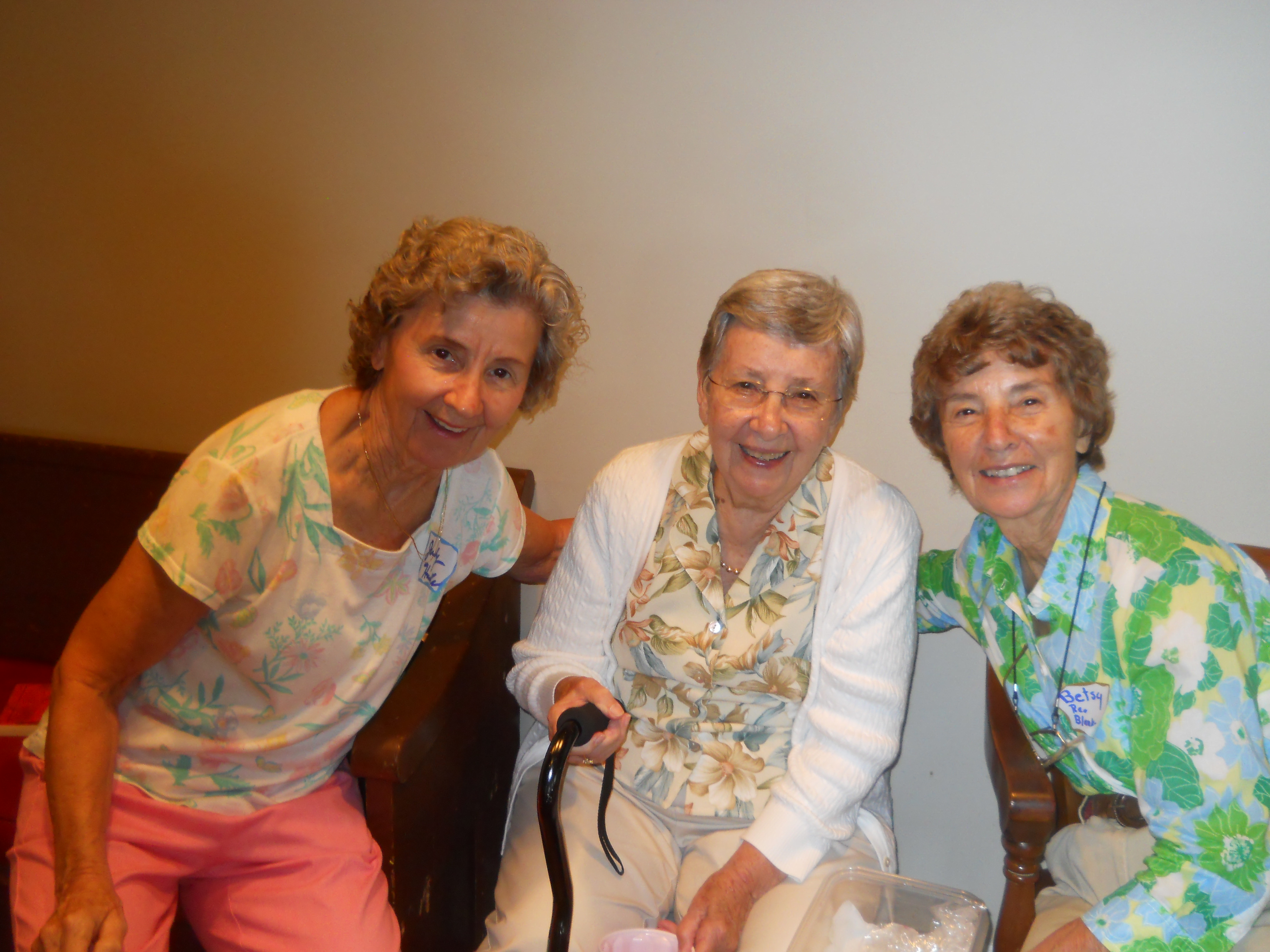
Rea sisters Judy, Virginia, and Betsy at 2014 reunion

So to sisters everywhere—stay active, stay engaged, stay vibrant. Avoid excluding anyone if you possibly can. And most of all, stay connected!   


The Shapes of our Scars

The Shapes of Our Scars  —by Jinny Batterson

This Mother’s Day brought cards and good wishes from the next generations. Although I once in a while miss the annual homemade breakfasts I used to get years ago, having grown-up children is much less hectic. I’m very glad I’ve had chances to be a biological mom. I’m grateful that the generations after mine are coming into their own, establishing their own patterns of family and civic life.

Mother’s Day observances for me can bring comparisons with other mammalian mothers. Someone has recently started a “dog moms’ day” (celebrating the women who care for their pet dogs) on the Saturday just before (human) Mother’s Day. Lots of internet images these days feature women mothering their pet dogs, or cute dog mothers with their pups, or cat moms with their kittens. What intrigues me most, though, are humpback whale moms. 

Many members of my age cohort were introduced to the songs of humpback whales during the 1970’s, when popular singer Judy Collins produced a duet of human and whale songs based partly on humpback whale recordings captured at sea. The whale songs were haunting. The songs of the humpbacks added impetus to a movement to curtail whale hunting internationally. Humpback populations have since rebounded, though still only at about a third of their estimated 1940 levels.

Marine biologists are learning more about the migration patterns and behavior of all whale species, including humpbacks, one of the larger whale species. Mature humpbacks are about the size of a school bus, weighing 30-40 tons.  Humpbacks migrate huge distances between feeding and breeding grounds each year. Scientists are not sure all the reasons that the whales vocalize—sometimes to find a mate, perhaps to share news, perhaps at times just for fun.  Humpback whale mothers can produce a calf every 2-3 years, and nurse their new calves for up to a year. It takes about a decade for whale calves to reach adult size. A normal humpback lifespan is about 50 years, with ocean pollution, boat collisions, and fishing gear entanglements having replaced whale hunting as main sources of premature death. 

Identifying individual humpbacks can involve studying the patterns of light and dark colorations on the underside of their tail fin, or “fluke.”  Sometimes these patterns are interrupted by scars, which can also help with identification. Recent studies have indicated that many of the scars on mature whales are the result of accidents or attacks when they were calves—often during their first migration.

In a way, such news is reassuring to this fellow mammal. Regardless of my best attempts, sometimes I may have exposed my human children to harm. Sometimes that harm may even have come from me, passed down from the generations that preceded me. I’m grateful that whatever the scars I carry or have inflicted, both I and my children have survived to adulthood. With wisdom, I may be able to use the shape of my individual scars to help heal myself and others.  With wisdom (and perhaps with song), we may be able to heal ourselves and other species from the scars we have inflicted on the planet.   

For more about humpbacks, check the internet—one fairly good introduction has been posted by National Geographic: https://www.nationalgeographic.com/animals/mammals/h/humpback-whale/