Category Archives: Everyday Wonders

Who Did You Expect?

Who Did You Expect?     —by Jinny Batterson

My life so far has been fortunate—no privation, little discrimination, generally good health, many chances for love and adventure.  Much of the time, though not always, people I’ve met have lived up to (or beyond) my expectations. On those rare occasions when someone’s behavior has disappointed me, more cynical or world-weary friends have shrugged at what they regard as my naiveté. 

“Of course so-and-so let you down,” they’ve announced. “What did you expect?”  

Increasingly for me,  the appropriate question is rather “Who (or, for the grammar police, “Whom”) did you expect?”  As I mature (a work in progress), I become more aware of instances when I’ve pre-judged people and turned out to be fairly far off the mark.

The first occasion that stands out is my initial in-person meeting with the leader of our 1980 group tour to China. In those pre-internet days, I’d exchanged postal letters and paperwork with Ms. Baum and talked with her on the phone. Until we both arrived in San Francisco’s airport departure lounge for our trans-Pacific group flight to Hong Kong, I had not actually met this native New Yorker. I’d assumed from her accent and phone demeanor that she was of Jewish background. She seemed somewhat pushy and no-nonsense, ready to take on the world. I was surprised to see that she was African-American, not ethnically Jewish. She could be somewhat pushy and no-nonsense. Her prior experiences as both social worker and travel agent had prepared her well to take on whatever bureaucracy attempted to get in her way, regardless of ethnic origin or nationality. She turned out to be both different from and similar to the “who” I’d expected.

Earlier this fall, I signed up to work the polls in the 2018 mid-terms. After on-site training, I exchanged emails with the woman who’d be my site supervisor for early voting. Her written English was good, clear and simple. Her family name was a common one, her given name, ending in “a,” suggested to me she might be African-American, or maybe Hispanic-American. When we met, I could detect no skin coloring or hair texture to suggest ancestral links with Africa, no hint of foreign origin in her accent. She seemed at first a very “vanilla,” somewhat conservative American. During our work, she showed her passion for ensuring that anyone who wanted to vote was given maximum opportunities to do so. She’d sit patiently with someone lacking appropriate credentials, or with an address not yet entered into the electoral system database of rapidly growing Wake County. She knew the rules well. She could suggest pulling up an electronic copy of a utility bill on a portable phone. She might advise going home to retrieve a needed ID and then returning later in the day. In rare cases, she’d have the potential voter fill out a provisional ballot, explaining how and when to check whether their vote had been counted. The workforce she’d helped assemble to follow her lead was the most visibly diverse I’ve ever participated in. She was both different from and similar to the “who” I’d expected.    

I’ve just spent Thanksgiving with parts of my extended family that I barely knew growing up in Maryland in the 1950’s and 60’s. Only once had I had a chance to visit these North Carolina farmer cousins from a rural area near Charlotte. What little I remember from that farm stay involves ponies tame enough so even I was persuaded to take a short ride. I got to see my grandmother’s sister-in-law make glorious biscuits using milk straight from the cows. The cousins closest to my age teased me good-naturedly about my lack of country skills.

After moving to North Carolina a decade ago, I became reacquainted with some of the cousins who’d left the farm to settle in Raleigh. They’d tell me enticing stories of an extended family Thanksgiving gathering at “the shed.” I pictured the locale in my mind: an expanse of gently rolling hills, empty except for a few horses or cows grazing in pastures. “The shed” would be a slightly cleaned-up farm outbuilding. Twenty or so aging cousins of Scots-Irish ancestry would assemble for our midday meal, then say interminable grace before we could eat. Someone would have cooked a turkey and brought it still warm to the feast. We’d eat plentifully, exchange pleasantries, carefully avoid politics, and then everyone would go home.

This year as we drove into the neighborhood nearest our destination, I had trouble reconciling my mental image with current reality. The surrounding area may once have been farmland, but the vicinity had long since become part of suburban Charlotte. A mid-rise apartment complex dominated the nearest street corner. The “shed ” had been expanded and modernized from an earlier role as storage space for some cousins’ plumbing business. It was now a comfortable, well-appointed venue with adjustable seating for up to a couple hundred people. Nearly that many cousins of all ages were in attendance, along with baby equipment, pet dogs and a few footballs.

We did have a short sung grace before the long, snaking buffet line formed. We did generally steer clear of contentious political topics. People caught up on family news since the previous get-together. One 20-something cousin had recently returned from an extended Peace Corps stint in South America; in the next generation up, a househusband described his four years of helping school their daughters while his family was on assignment in southern Europe. One attendee I didn’t get a chance to talk with directly had a skin tone and accent that implied ancestry or origin in India. The Reas still cherished their rural roots and pioneering ancestors, but the clan had gotten more diverse and widely traveled—both different from and similar to the “who’s” I’d expected.

The remaining holidays of late autumn and early winter are likely to have more extended family gatherings and chance meetings. May I remember not to pre-judge those I encounter, to be more careful not to let “who I expect” get in the way of meeting current reality with an open mind and heart. 
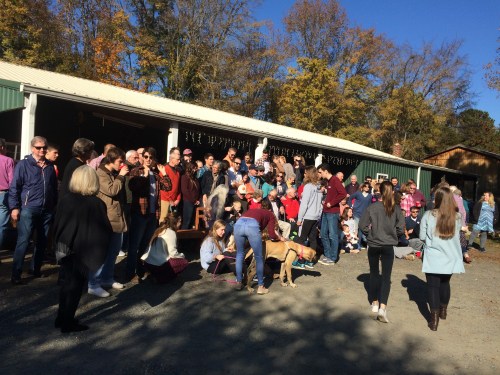
Rea Thanksgiving at “the shed”
Aubrac’s Fields of Wild Jonquils

In late May, as I was walking across a sparsely settled upland French plateau along a stretch of one pilgrimage route of the Camino de Santiago de Compostela, I encountered a delicious fragrance—delicate, sweet, lingering. I wasn’t sure where it was coming from. Despite, or perhaps because of, a fair amount of rainy weather, the meadows and woodlands abounded in spring blooms, many of them unfamiliar.  That evening at the small guest house where we had booked a room, I noticed a vase of flowers with the same delicate fragrance. I asked the proprietress what these small white blooms were called. “Jonquils des poètes,” she told me in French.

I’m not sure what the English equivalent is. The internet pictures I’ve found of “Poet’s jonquils” look similar, but not identical to the flowers I remember from my trip. A few days further into my journey, I arrived midmorning at the tiny town of Aubrac, after spending a couple of hours crossing several miles of minimally fenced upland pastures dotted with jonquils des poètes, some being contentedly munched by local cattle. The weather was cool and misty.

At the near edge of town was a forbidding-looking Romanesque structure. A guide was explaining to a group of tourists in strange-to-me language the wonders and historic significance of this church. According to the French signpost I could partly understand, this former Benedictine monastery was at least a thousand years old, likely built on the foundations of an even earlier structure.

Most of the other buildings along the road and edging the upland pastures were hotels, hostels, or small inns. I noticed one small cafe/guest house that seemed to be open. Several of us stopped and picked out an outdoor table under a protective awning. A warm drink seemed a good idea. It took a while for anyone to come to take our orders—after a bit, an elegant young woman showed up, apologizing somewhat for the delay, explaining that she and the other town residents were all still stressed out from the previous weekend’s “transhumance” festival that annually draws thousands to the area. I’d seen pictures and postcards of this celebration of the opening of common upland pastures for the area’s prized cattle. A nearby town square was still littered with floral garlands and signs from the festival. (Find a set of pictures of this annual festival here: http://hotel-lion-or.com/aveyron/fete-transhumance-aubrac/

When our hostess finally brought our coffees and hot chocolates, she stopped to take a smoke break. We began to ask her questions. All of us were curious about the town, whose year-round population has dwindled markedly from a peak over a century ago. Until the late 19th century, our hostess told us, Aubrac had been a traditional farming village, but the harshness of the climate and the difficulty of earning an adequate living caused many farm families to leave the area and seek better lives in French cities. Lots of the adults became small shopkeepers or restaurateurs in and around Paris. However, they retained cottages in Aubrac and continued to bring their families for summer vacations in their former hometown. At about the same time, some area doctors discovered that the clean, cool air in the Aubrac highlands helped tubercular patients. Several tuberculosis sanatoria were opened over the next decades—some have since become hotels or hostels. Most of the local economy now revolves around tourism, compressed into the three or four months of warmer weather. The local cattle, a special hardy breed, supply photo opportunities as well as milk or meat. 

Our hostess explained between puffs that she was even busier than she’d expected post-festival: her five rooms were all rented for the week—a group of businessmen from New York City had come to explore the option of buying quantities of jonquils des poètes to use in a new upscale perfume fragrance. She said that this particular type of jonquil only grew in the wild and had not yet been successfully cultivated.  Some of each year’s blooms already were collected by locals to supply French perfumeries in the southern city of Grasse, a noted perfume center.

I never got to meet the businessmen, who most probably were jet-lagged and perhaps also technology-deprived in this isolated small town. My current exposure to a former-NYC-businessman-turned-politician has temporarily soured me on the ethics and business practices of some.  My hope is that if a deal is struck, the good people of Aubrac will be fairly compensated for their labor and their wild-growing fragrant white blossoms.  I also hope that enough flowers will be left in the fields so that cattle, pilgrims, and residents can continue to enjoy their essence in their native habitat.    

Dragon Kites on Tiananmen Square

A growing number of locations world-wide sponsor kite festivals. In the town where I now live, March winds bring out people of all ages, eager to enjoy the outdoors as winter ebbs, to search for just the right spot and orientation to launch their creations skyward. The basic homemade wrapping-paper-and-balsa-strut diamond shaped kites I flew as a child pale in comparison with the elaborate heirloom and contemporary kites that participate in some of these festivals. A quick internet search turned up an American-based kite flyers association with members in 25 countries, with at least one U.S.-based festival in every month of the year.  (http://kite.org/activities/events/event-calendar/)

One blustery spring day in 2000 on Tiananmen Square in Beijing, China, I got to see a few of the world’s most cherished, most elaborate kites. My husband and I, partway through a tourist stay in Beijing, had spent our firs two days on organized guided tours: the Forbidden City, a nearby section of the Great Wall, the Summer Palace, some of the subterranean tunnels built under the modern city during the 1960’s and 1970’s to shelter residents in the event of a bombing attack by “the Soviets or another country.” Now we had a free day to explore on our own. We decided to return to the vicinity of Tiananmen Square.

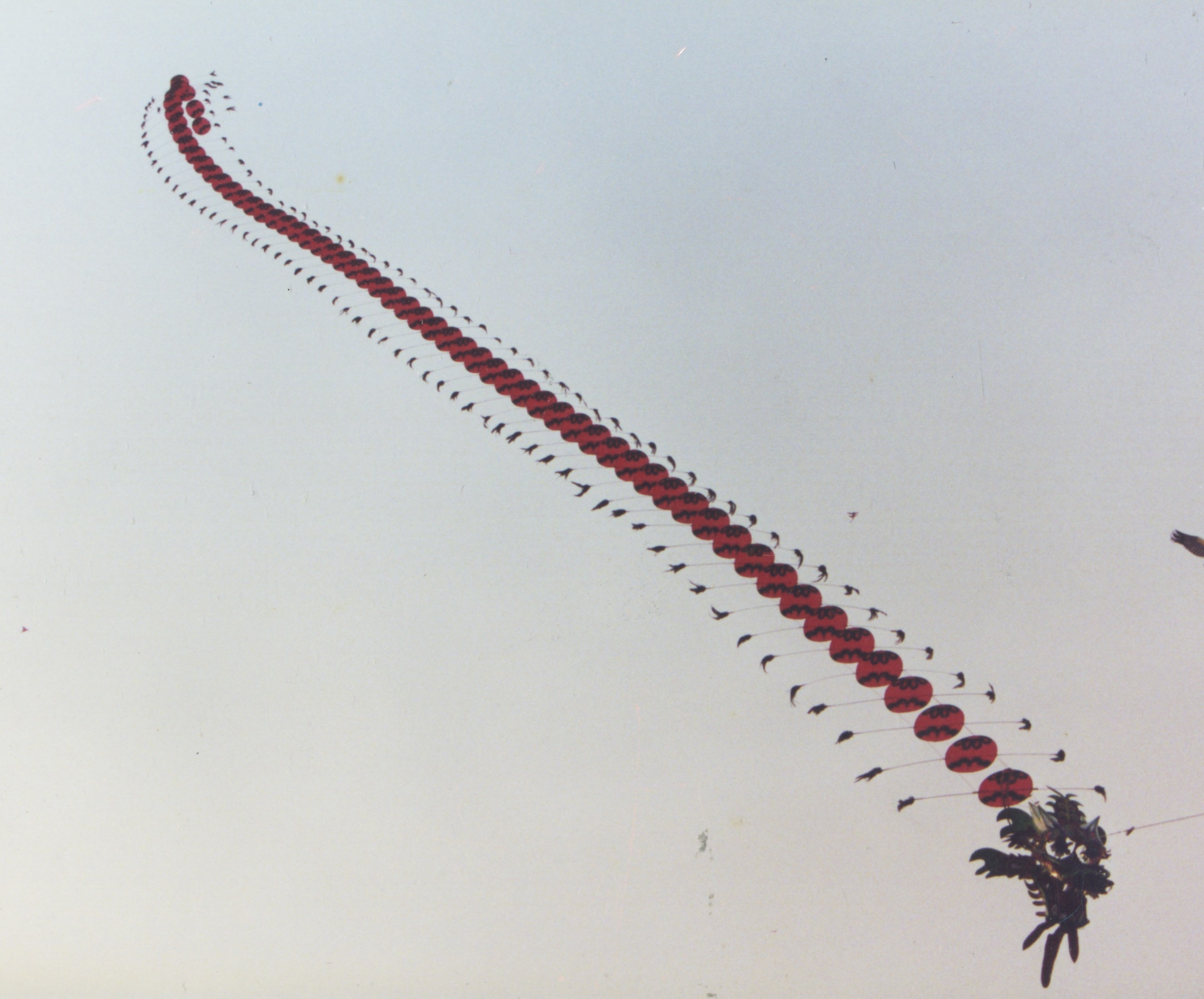
As we approached, we noticed several box kites bobbing and weaving in the sky above.  Once on the square itself, we found several older men preparing their heirloom dragon kites for flight. The kites, nearly fifty feet long, had extensive tails made of circles of paper glued to lightweight wooden rings, all linked together by three parallel strings that ran the kites’ entire length and could be used for steering. The rings were decorated with sturdy feathers for stability. Only when the tail was almost fully aloft was the dragon-shaped head of the kite attached and quickly pulled skyward. We watched until our necks cramped from craning upward. We had little language to express our amazement. Perhaps our rapt attention was language enough.

Groundhog

Harbinger of spring, furry cousin of a squirrel,
We celebrate your special day
By snatching you from burrow and sleep
To blink at the light–strong sun means longer winter.

Midway between poinsettia and forsythia,
We want a fellow creature to provide some assurance
That winter will end–a prognostication from one
Who also dislikes freezing cold and biting storms.

You don’t much care about the splendor of the overcoats,
Scarves, or top hats of those who briefly torment you.
Their race, religion, creed, or politics also matter little.

What’s more important Is that they make their
Ceremony short, so that you can return to needed
Rest before the frenzy of spring.

Plump marmot, I salute you; I beg for
Your wisdom to forebear when poked and prodded
And made to squint in uncomfortable directions.

And, yes, I want to believe that spring is on its way,
Whatever its speed.

Why I’m Glad Our Granddaughter is a Girl Scout

I recently spent a week of after-Christmas visit with parts of the next generations of our family on the U.S. West Coast. As visiting grandma, I got to attend some of the children’s after school activities, including a meeting of our granddaughter’s “Daisies and Brownies” troop. Before the meeting, I was curious about how this branch of Girl Scouting had evolved in the generations since I started Brownies in the 1950’s. At first, lacking everyday exposure to younger children, I found this recent meeting’s hubbub a little daunting, though it’s likely that little girls are no more or less squirmy and giggly than my friends and I were so many years ago. For starters, girls now can become “Daisies” a year or two younger than the Brownie program I entered in second grade.  Still, I recognized parts of the program: an opening circle and a check-in when each girl could relate any important events or concerns, lots of singing, lots of running around, a craft activity, time outdoors, a pledge to honor oneself and others, a short-term service project, plus an introduction to this year’s annual cookie sales campaign for the scouts, parents, and grandparents present.

Since the meeting, I’ve ruminated a bit about why I’m glad our granddaughter is in Girl Scouting. Some American girls recently gained admission to Boy Scout troops. The “#metoo” social media movement has gained wide publicity for its attempts to reduce the incidence of sexual assault and sexual harassment (something the Girl Scouts have been doing with less fanfare for decades). Why continue to be a Girl Scout in these changing times?

Based on my previous exposure and my brief reconnection through my granddaughter, these are several aspects that still seem important to me:

—revolving skills-based leadership within a basic structure. No one person has all the skills needed for the many different situations life will throw at us. In Scouting, some will excel at crafts, while others can organize; some are adept song leaders; some have sports skills; some are tech-savvy; still others are gifted at laying campfires. In the troop where I was a member, one girl, Cheryl, was somewhat less athletic than most, not good at crafts, a reluctant camper, quiet and shy. The rest of us knew, though, that she was very important to our troop. She had a family asset missing to the rest of us: her mom worked at a large nearby military base. At cookie sales time, it was Cheryl’s turn to be a star. Though the rest of us were a little jealous as she loaded the family station wagon full of cartons of cookies for distribution, we knew her work was vital to reaching our sales goals each year.

—an international focus in addition to the local, state, and national civic engagement of each Girl Scout. For me, this was best exemplified by the first international Scouting center, a chalet in the Swiss Alps that opened in 1932. Many Scouts know the “Chalet song” with its aspirational closing: “And this its dedication shall never fail nor be undone, each race, each creed, each nation beneath its roof are one.”  The Chalet is now the oldest of five operating international centers, including a recently organized rotating event space among Girl Scouts in Africa. 

—An affirmation of the worth of each individual, along with the importance of working together toward common goals. Like Cheryl in our troop long ago, some Scouts will have less readily visible skills, but Girl Scouting teaches that each of us has an important role to play. No one is inconsequential. When we get overly invested in a “great leader” model, it can be all too easy to forget this basic truth.   

  About this time last year, I was a local participant in one of many “Women’s Marches” that occurred globally on the third weekend of January. At this year’s anniversary weekend, I’ll have to track hometown activities from afar. Yet after having observed our granddaughter’s Girl Scout troop, I’m heartened that, if and when we forget to value all the world’s citizens, she and others like her will continue to show up to remind us:  all of us matter, including women and girls.   

Quilted Dreams

Quilted Dreams    —by Jinny Batterson

There’ve been times, since I outgrew visions of sugarplums,
When I’ve dreaded the coming of winter. Short days, short tempers, cold,
Damp, sniffles, indoor confinement. Winter’s had little to recommend it.

This year’s cold weather was late arriving. Days shortened, but it was
Nearly Thanksgiving before there was frost on the pumpkins. Our schedules
Got disrupted: when to test the furnace, bring houseplants indoors?

Finally, the evening arrived when a blanket was insufficient warmth.
The quilt could be brought out from the linen closet, shaken vigorously,
Then inserted between a fresh sheet and the all-season bedspread.

As my life has grown less hectic, I’ve come to relish the longer
Darkness of late autumn: a chance to sip cocoa before snuggling down
Early, perhaps to drift into episodes of remembered dreams.

I cannot guarantee that the quilt is the cause, but cold weather
Seems to bring more comforting visions: brilliant landscapes visited
Earlier in person or in imagination, peopled with friends and warm welcomes. 

Often I visit cities new to me, revel in explorations and travel that
Can be more pleasant in dreams than in reality–no crowded
Rail cars, no plugged toilets, no mewling youngsters in the seat behind.

The details no longer matter as much. It’s the comfort that counts.
Even when my mind and body are saddest, my waking
Anxieties will sometimes give way to quilted dreams.

Mr. Whirligig

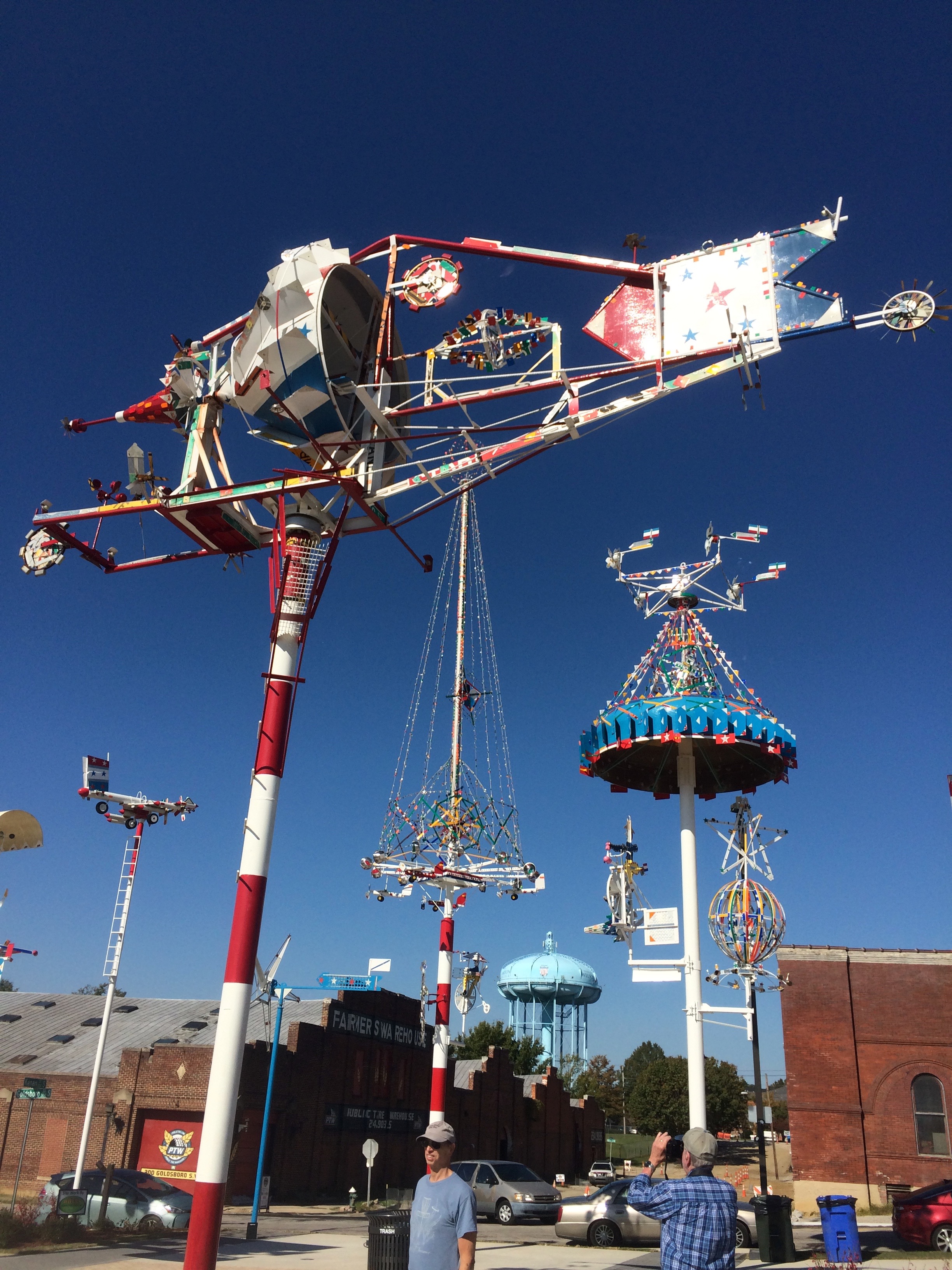
Vollis Simpson Whirligig Park in Wilson, NC

Recently, on my way to a weekend conference along North Carolina’s coast, I made a slight detour to stop in the former tobacco auction center of Wilson, North Carolina.  It was my third visit to this once-thriving, then derelict bastion of the tobacco industry, struggling to be reborn in a post-industrial, post-tobacco-auction age. 

Brick mansions with Greek-revival columns testify to Wilson’s former wealth. Vacant warehouses and storefronts bear witness to its doldrums. The town is about fifty miles east of Raleigh, at the far edge of commuting distance, but near major interstates. Its status as the county seat of a county by the same name brings some enduring activity—court cases, law offices, merchants of bail bonds. Population has stabilized at about 50,000 people, by far the largest town in this county named for a childless military man whose 1840’s exploits in a war with Mexico were ended by a fatal bout of yellow fever.

    What I came to see was a new park near the center of Wilson’s downtown: the Vollis Simpson Whirligig Park. Mr. Simpson, who died in 2013 at the age of 94, had for much of his life made fanciful sculptures out of scrap metal and pieces left over from the heavy equipment repair business that he ran from a small shop a few miles out of Wilson. After he closed his repair business, he turned his attention more fully to the sculptures he began to call windmills. Although his efforts sometimes drew the derision of his neighbors, Simpson continued to fashion larger and larger windmills with more and more moving parts, installing many of them around a small lake on his family’s property.

I first became aware of them when an acquaintance with ties to Wilson led a small group of us to view Simpson’s pond and the windmills planted along its edges. Mr. Simpson, then in his late 80’s, was working in his open-air shop at the far side of the pond. We saw him in profile at a distance, but an abundance of no trespassing signs made it clear that he did not welcome casual visitors.

Over time, Simpson’s “whirligigs” became a local, then regional tourist attraction. His variety of folk art drew the attention of art collectors and museums. A Whirligig graces the grounds of the North Carolina Museum of Art in Raleigh. Others have been purchased by museums and private collectors in many parts of the U.S.

Before Mr. Simpson died, local movers and shakers approached him about making his sculptures into an outdoor exhibition. According to Simpson’s obituary in the New York Times, Simpson relished the thought that some of his artworks would be preserved. He helped consult on the beginnings of removal and refurbishment of the pieces that eventually became the park. Vollis Simpson died before the park became a reality. Vagaries of weather, funding, and politics delayed the park’s opening for several years. The 2017 autumn day when I got to visit was gloriously clear and crisp, with just enough breeze to set most of the whirligigs to whirling.  Though I’d missed the park’s grand opening by a day, the vision I got of Mr. Simpson’s legacy brightened my outlook. It also lit up the faces of other visitors of all ages who viewed the park in person or via modern internet links.

It’s much too easy these days to get caught up in the political crises and name-calling of the moment. I like to think that Vollis Simpson’s spirit would be gratified at the way his creations beckon us toward less bluster and more whimsy. Thank you, Mr. Whirligig!    

Falling into Grace

Falling into Grace    —by Jinny Batterson

Grace Church, the church of my childhood,
Smelled of furniture polish, dust, and old masonry.
It sat squat, tucked into a hillside above a graveyard
Where my mother, at twelve, had sledded into a
Headstone, chipping both front teeth.

From behind the altar, stained-glass-filtered light
Shone on the choir stall where I sat, searching in the
Back of the Book of Common Prayer for my springtime
Birth date in the schedule for each year’s Easter.

My cousin, Grace, came for a week’s visit
As we both teetered at the edge of adolescence.
She had an athletic build, a mane of blond hair.
Not self-conscious about her body like I was,
She shed her day clothes before bed, revealing
The beginnings of breasts and pubes where
I was still flat and hairless.

During college jaunts to the small Shenandoah
Valley town where my boyfriend studied, I walked
Past a different church. Early in the 20th century, it
Was renamed to honor a fallen general with a mixed
Legacy that has become increasingly problematic
In our post-Charlottesville polarizations. 
.

My childhood church is still there, if little used.
My cousin Grace died after a horse riding accident.
Reverting to its original name, Grace Episcopal
In Lexington, Virginia struggles for reconciliation.
Nostalgia renders all more graceful.

It’s the season of falling—leaves blush, then let go.
We notice lengthening darkness, tremble at dark events.
When we pay attention, though, we still have access to
Qualities of bearing, blessing, benediction:
There’s still the possibility of falling into grace.


Chinese Girls in Frilly Dresses

little girls in frilly dresses, Qingdao, China

Last fall, one of our favorite former students in China emailed us exciting news—she was about to get married.  A few weeks later, our former student, “Mona,”  sent a second message with an attachment: a picture of her and her new husband in their wedding clothes.  Mona looked fetching, dressier than the Mona I was used to—seated on a high stool, in an elegant flower-print dress with a brimmed hat to match. Her husband, decked out in a casual summer suit, looked over her shoulder.

For much of June this year, I had a chance to travel in mainland China and to reconnect with some former students and colleagues. Especially wonderful was a chance to visit Mona, whose new husband had been a high school classmate I didn’t yet know. They’d chosen each other after a long, sometimes long-distance courtship. While I was visiting, Mona explained the logistics of arranging her wedding pictures, an increasingly common part of Chinese wedding preparations:

Few people actually buy clothes for their wedding pictures or have pictures taken on the wedding day itself, she explained. Rather, they rent dressy attire from specialized businesses. Then they pick out a place and time to have professional still pictures taken, sometimes adding a brief video. The most popular sites have historic significance or are natural beauty spots. Most photo shoots occur on a weekend day when both partners are off work.

Because Mona is short for a woman of her generation in China, preparations for her wedding pictures were somewhat complicated. One weekend, she and her groom-to-be visited a rental agency and picked out clothes they liked in close to the proper size. The following weekend, they went back to the agency to pick up the clothes, which had been altered slightly for better fit.  On still a third weekend, she and her fiancé dressed in their rented finery and met a hired wedding photographer at the agreed upon site and time. Scheduling was tight, with no allowances for weather. The day Mona’s pictures were taken, it poured down rain. The search for a “perfect shot” took most of a very long day and left both photographer and subjects tired and bedraggled. It took a fourth week to get the rental clothes dried, cleaned, and returned to the rental agency.   

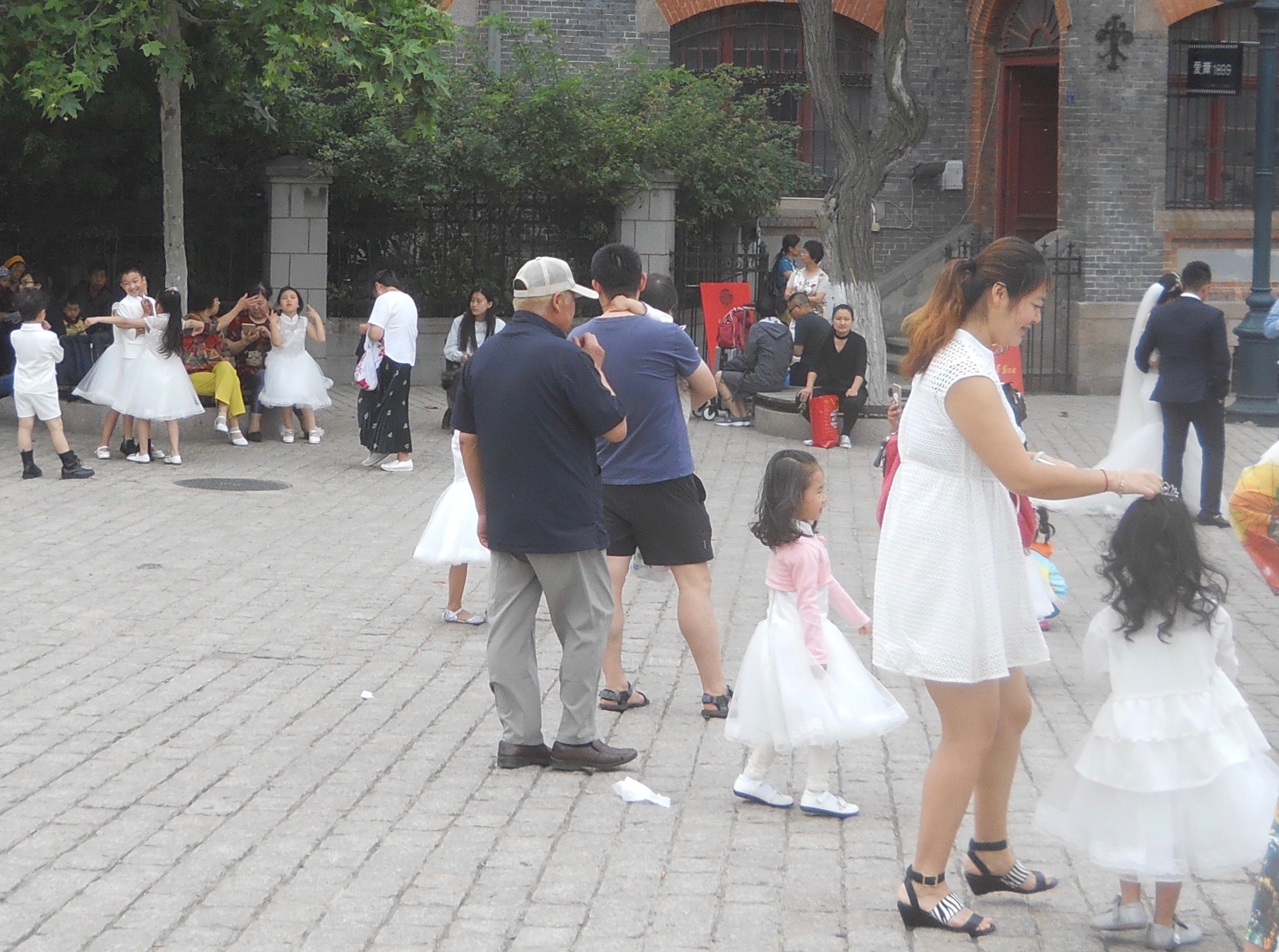
After my visit with Mona and her new spouse, I ventured without benefit of guide to parts of central and northern China where I’d never been before. In the northern seaside town of Qingdao, I came across a cobblestone plaza more filled than usual with elaborately dressed Chinese.  Primed by Mona’s descriptions of her wedding picture adventures, I realized that what I was viewing were a whole series of wedding photo shoots. June is a prime wedding month in China, just as in the U.S.  I counted eighteen different couples having their wedding pictures taken. The weather was windy and blustery—gowns and photo accessories were hard to keep steady. A dozen of the brides were wearing western-style dresses in white, while others had flowing formals in red, considered a lucky color in China. For one set of pictures, an entire wedding party was assembled, including five or six young girls in frilly white dresses. 

Over the course of this China visit, I noticed more and more young girls, not always in wedding groups, dressed in frills and bows. I’d see them on public busses, on trains and subways, in public parks. All were with at least one parent or grandparent. Often, a family group would be taking selfies, the grandparents somewhat subdued in both manner and dress, the dads fairly casual, the moms dressier, anchored with the latest shoe fashions. The daughters often wore white or pastel lacy dresses not much less formal than bridal finery. I crossed my fingers that the attention these girls were getting was a sign that the traditional stigma of having a daughter in China was lessening. None of the girls I saw looked neglected or abused. Most seemed valued family members, confident without being arrogant.

A few times, I saw girls and young women in less frilly outfits—on one park walk, the mom and dad in front of me strolled along at a normal pace, while their two daughters in trainers, shorts and tank tops raced ahead running sprints. At another public square, I noticed a young woman in jeans and a t-shirt with an English-language slogan: “Women are the Future.”

My re-entry into the U.S. was through Alaska, where few women are shrinking violets. I got to visit the kennels run by the family of Susan Butcher, who’d earlier won the long-distance Iditarod sled dog race four times.  I got to meet her elder daughter, now actively involved in training new generations of sled dogs for new challenges. Perhaps China’s daughters, and America’s, will, one day soon, be ready to take their places in a rapidly changing world that needs and welcomes their skills.   

Didace’s Garden

It’s a magical time of year here in central North Carolina. The trees have leaves of that vibrant green that’s unique to early spring, before they gradually darken and fade in the heat and dust of later seasons. Shrubs and flowers bloom in profusion, both in cultivated spaces and in parks and woodlands where they’ve either originated or escaped. Recently I spent a couple of hours “tidying up” parts of a traveling friend’s back yard. Mostly, I wanted an excuse to revel in the colors and blooms of the nearly solid wall of azaleas along one side of her property.   

As I raked and pruned, I remembered a different garden, a different season, a different part of the world. For a couple of years in the 1980’s, I had a temporary assignment in the small central African country of Burundi. Most weekdays, I worked in a rural development office in the country’s capital city of Bujumbura, participating in a project to strengthen and diversify a network of consumer/producer cooperatives throughout the country. Burundi then had a few business people and high government officials with great material wealth, a local and expatriate community of civil servants and shop owners who lived modestly, and over 90% of its populace who ground out a bare living as subsistence farmers. It is somewhat ironic that this Peace-Corps-like assignment was the only time in my life when I had human household help. Modern appliances were few; electricity was expensive and intermittent; having an employee to tend the yard was a godsend. My duplex neighbor and I shared a gardener/night watchman, Didace.

Any lasting impact I had in the country was more likely a result of my interactions with Didace than of any tasks I accomplished at the office. Though he had little formal education, Didace was proud of his skills as a small-hold farmer. While he scoffed at my feeble attempts to grow temperate-climate vegetables in the tropics, he faithfully dug small plots for me in September and January, at the beginnings of each of the country’s two rainy seasons. Later, he tracked down supports for the pea and bean vines that straggled upward. The income he got from maintaining foreigners’ gardens supplemented what he could grow on his farm to eat or sell, helping provide a better life for his family.

Before the first Christmas season of my assignment (which occurred during a lull between the shorter and longer of the two rainy seasons), I mentioned to Didace that I would be traveling to Greece to see family over the holiday. Was there anything I could bring back for him and his family as a small gift?  He thought for a while, then explained that what he’d really enjoy were some pictures of his family and his small farm. Didace had noticed the snapshots of family and travels that I kept on the room divider in our open-plan bungalow. Would I be willing to visit his home, take pictures with my (traditional) camera, then get the film developed on my trip and bring back several of the best photos?

We made plans for me to borrow a project vehicle one weekend in early December and to drive, then walk, to his family’s home in the hills above town. The paved road quickly became dirt, which gradually got more potholed and rutted. Didace met me at the intersection of the road and a person-wide path that led further into the hills. Once we arrived at his house, he pointed with pride to the tin roof he’d recently installed with a loan/advance on his monthly wages. He introduced me to his wife and two young sons, and then showed me around the small plots where they grew beans, corn, and cassava, a root vegetable whose tubers provided most of the carbohydrates of the Burundian diet. At one edge of the house was a small banana grove. A few chickens scratched in the dirt.

Then, in a small fenced area, I saw a flower garden. If memory serves, it had a mixture of gladiolas, dahlias, and other showy flowers I didn’t recognize. They were beautiful. I asked why his family chose to grow flowers on some of their limited acreage. Partly, he said, so they could sell the best blooms at the Bujumbura central market for additional income. But mainly, just because they were pretty. I wish I had made and kept copies of the pictures of Didace and his garden. Beauty knows no boundaries.