Category Archives: Everyday Wonders

Eating Out in Twenty-Nine Palms: Honoring National Service

During part of our most recent political transition, in late 2016, I spent several days in the desert interior of southern California, exploring the area around Joshua Tree National Park. From a small vacation rental home in the town of Twenty-Nine Palms, my husband and I could drive several miles uphill to a park entrance. We could explore the park’s trails and marvel at its unique geological formations. We could view the large members of the yucca family that gave the park its name. We experienced the variety of its altitudes and desert landscapes. Toward the end of our stay, a heavy wind kicked up, making hiking less appealing, so we spent some time indoors in town. At the Chamber of Commerce, we watched a film about the town’s history and viewed displays and pamphlets. We learned that the town’s first growth spurt had come in the wake of World War I. Then, a sympathetic veteran physician specializing in lung ailments had begun to recommend the climate around Twenty-Nine Palms to fellow veterans suffering from mustard gas exposure or tuberculosis. The dry air and moderate altitude provided an ideal setting for recovery. Several hundred veterans filed homestead claims in the area.

We also learned that a large modern U.S. Marine base existed nearby, in the opposite direction from the park. Soldiers could be stationed there for periods ranging from a few months to several years, with over 50,000 military personnel having received training at the base the preceding year. We drove as far as the base gate to the Marine Corps Air Ground Combat Center/Marine Air Ground Task Force Training Command, but were unable to enter without an approved escort.

That evening, we ate in town at a small local restaurant that catered to a burgers-and-milkshakes clientele.  When we first arrived, the restaurant’s central area was completely filled by a set of pushed-together tables where a dozen slightly disheveled young people, five men and seven women, were chatting and ordering food. They looked fit and tired, primed to enjoy a simple evening meal. Several were wearing matching sweatshirts with the initials “NCCC” on the back.  I guessed they might be members of some rock climbing club, since the park was a mecca for climbers. While I waited for our waitress, my curiosity got the better of me. I walked over to one end of their table.

“What does ‘NCCC’ stand for?”  I asked. “Are you a rock climbing group?”

“No ma’am,” responded one of the young men. “We’re a team from the National Civilian Community Corps. We’re on our way back to our base in Sacramento after an eight-week assignment helping repair homes in Baton Rouge, Louisiana that were damaged by last summer’s floods.”

As my husband and I ordered our food and waited while it was prepared, half a dozen young men with short haircuts arrived and settled into two booths nearby. They were in civilian clothes, but I guessed they might be on leave from the marine base: several barber shops in town advertised “Marine haircuts,” and these fit the bill. The men talked quietly among themselves as they too ordered and waited for their suppers. 

Both the Marines and NCCC volunteers I saw at dinner in Twenty-Nine Palms were training and practicing to meet whatever threats and emergencies might require a military response, civilian action, or some combination of the two. I was grateful for their service. I remembered previous generations of Americans who had participated in larger numbers in either civilian or military service—the Civilian Conservation Corps of the 1930’s depression years, or the military draftees of the 1940’s World War II era and beyond.  Surveying these young service men and women at supper in 2016, I also imagined what it might look like for similar service again to become a bigger part of our American society.

Various bills introduced in Congress since 2003 have attempted to create a framework for some sort of mandatory service component for young people, including a modest monetary stipend and educational funding assistance. Our nation’s physical and educational infrastructures are aging. Elements of our natural environment are threatened. The needs are great; the potential even greater. On this Presidents’ Day, let’s renew the value of public service as part of our heritage and responsibility as Americans. From the loftiest tasks to the most humble, each of us has something worthwhile to contribute. When a service ethic is lacking, we are all impoverished, not just monetarily.        

White Privilege, the Capacity to Leave, and the World’s Changing Games

As our nation veers closer and closer to fascism, I’m dismayed and unbalanced. How did we come to this point, I ask myself? How was I complicit? How can we as a society rebalance? 

As a “leading edge boomer white female,” I’ve followed a similar trajectory to that of many liberal-leaning members of my cohort: protesting the Vietnam war; attending Earth Days; joining various consciousness-raising groups; experimenting briefly with consciousness-altering substances; absorbing uplifting books, films and workshops about human possibilities; doing a Peace Corps stint in sub-Saharan Africa; later, in semi-retirement, doing shorter volunteer or low-paid assignments teaching English in rural China.

Where I may have diverged from classmates who moved to the suburbs, raised families, and enrolled their children in “superior” school systems, is that for over twenty years, I lived in America’s core cities. The neighborhoods where I settled were “marginal,” working class, multi-racial. At first, this was an economic necessity—my twenty-somethings were littered with lots of employment mis-steps and accidents. Rents and mortgage payments were lower in areas that had been written off by most of the real estate establishment. But I stayed. Partly this was a semi-conscious effort to atone for some slaveholding ancestors who conferred on me an undeserved inherited advantage. Later, it was partly to help prepare our children for a global society with no single dominant group. As I got to know my neighbors better, my staying got to be more and more about their kind and forgiving natures, and their partial immunity to the materialism I saw so much of elsewhere. I chose to be a visible “minority” presence. And there’s the rub.

The neighbors who surrounded me in inner city Baltimore or inner city Richmond had fewer options for leaving than I did. Legal discrimination, or, increasingly, lack of income or of inherited wealth, made it difficult or impossible for them to afford housing in “better” areas. When I lived in Burundi and visited with peasant families in Burundi and Rwanda, most had little chance for schooling beyond the most elementary levels, in crowded, under-equipped classrooms. Few could travel, either in their own countries or abroad. Their prospects for improving their lot in life were terribly limited. In high schools or agricultural colleges where I taught English in China, students were not likely to be able to use their skills—after graduation, most would work long hours at soul-destroying jobs in big cities. They might at best be able to show off for their parents or grandparents on holiday visits back home.

By contrast, I could take time away from Baltimore or Richmond to recharge at a summer cabin by a pristine lake in Vermont. When sub-Saharan Africa got too depressing, I could join my family on extended holiday in Europe. In China, I spent a winter break at a posh beach resort, a summer interval being escorted by a high-ranking official around the historic sights of Beijing.

The world I grew up in is changing at ever-increasing speed. Within the U.S., we are becoming more immigrant, more “non-white,” more interethnic than ever. Globally, we’ve expanded travel and communications by orders of magnitude. However, we’re also changing our earth’s atmosphere and oceans in ways that will make life less predictable and probably more difficult for all living creatures. Movie fantasies aside, precious few of us have the wealth and/or training to be able to leave the planet and survive. This changes the game, even for those of us with privilege.

The new game requires me and others with privileges conferred by birth, inheritance, skill and/or luck to practice “not leaving.” Of course, I will still need to protest injustices, to improve my environmental stewardship, to raise my awareness, to celebrate human possibilities. But I will need to do more. Even in situations that make me uncomfortable or defensive, I will need to remain fully present, and then to listen, deeply. I will need to practice staying, and staying, and staying. I can no longer afford not to.

Winter Beach Respite

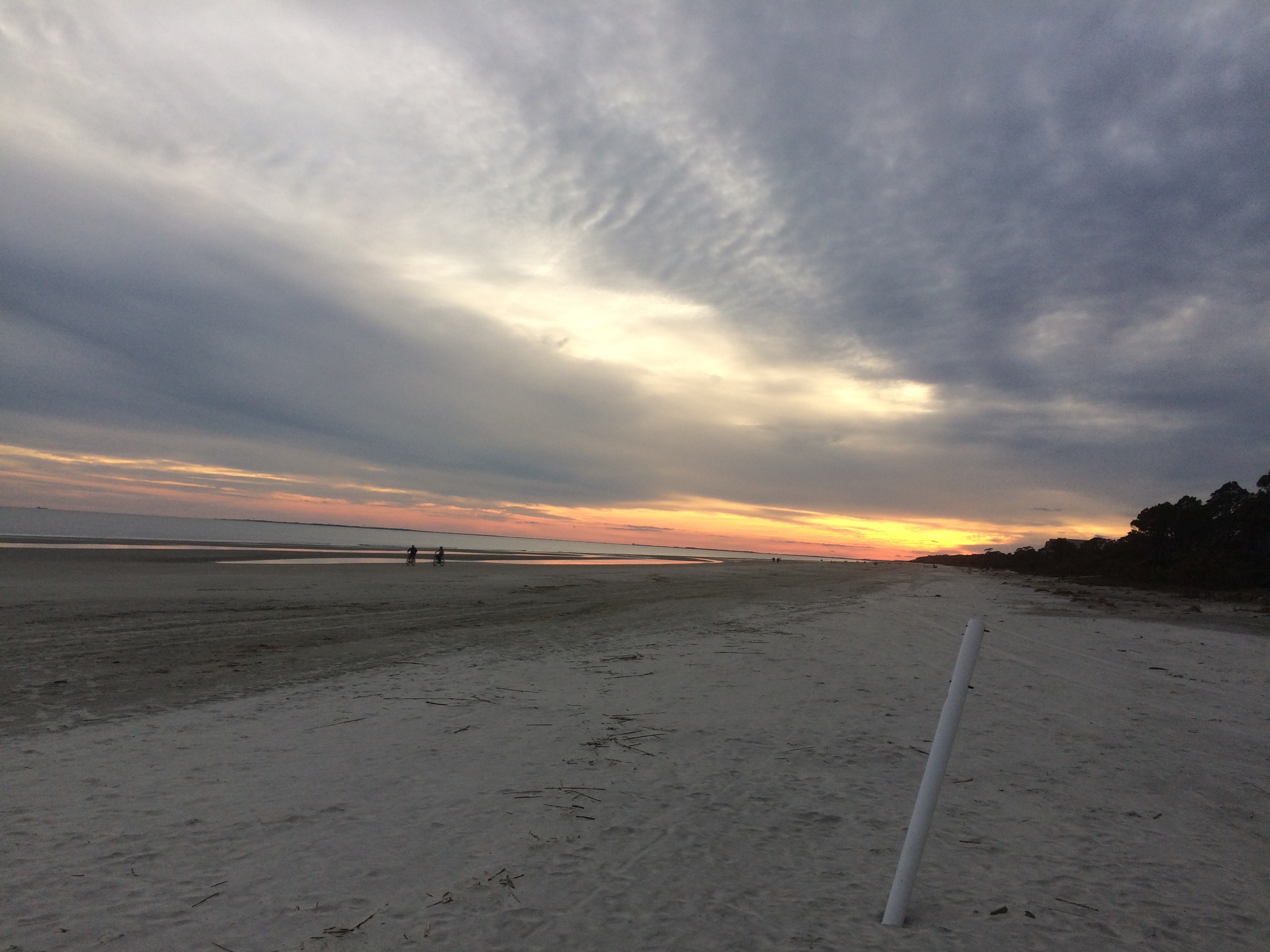
Barrier island beach at sunset

Just after New Year, we packed the car: layers and layers
Of casual clothes, plus assorted toys and games.
We headed for one of the barrier islands that
Dot the Atlantic from the Carolinas to Florida.

We’d spend a few days at the beachside condo
Of old friends, a final annual chance to reconnect
Before tax season swallowed them
And potential citizen activism swallowed us.

We arrived to balmy weather, with time for a brief
Beach stroll before sunset. Little view yet of the miles
Of downed vegetation and splintered piers and decks,
Remnants of Hurricane Matthew’s October impact.

It was after dark before our friends arrived, having
Battled urban traffic on their different trajectory east.
A brief political discussion gave way to reminiscences:
The guys had known each other since youth. 

One afternoon proved too chilly and windy for outdoor activity,
But often we walked–carrying binoculars to hone in on shore birds,
Or exclaiming as our more experienced friends pointed out the
Dolphins that sometimes trolled for fish in the breakers at low tide.

A morning guided excursion took us through parts of this island
Once owned by Gullah families descended from slaves.
Before resorts and tourism took over, they earned decent livings
Farming or fishing or ferrying neighbors to and from the mainland.

Predictions of an approaching winter storm cut our idyll short.
Several days of shivering and stabbing at recalcitrant ice have
Partially diminished our relish for January in the Southeast,
But not entirely. Our beach respite memories remain.

Tribute to Leonard Cohen

Tribute to Leonard Cohen (1934-2016)    —by Jinny Batterson

(Leonard Cohen, peripatetic Canadian poet and singer-songwriter, died in Los Angeles on November 7, 2016, a bit too early to absorb the results of the latest U.S. election.  I’m convinced, though, that his spirit still prowls. This short tribute incorporates snippets of several of Cohen’s best-known lyrics: Anthem, You Want it Darker, Suzanne, The Story of Isaac, and Democracy)  For a picture of Cohen near the end of his long life, see:

http://www.billboard.com/files/styles/article_main_image/public/media/leonard-cohen-2013-billboard-650×430.jpg

The bells that still will ring
These post-election days are ringing darker.
Though some the victor’s fulsome praises sing,
For others, the rifts are getting starker.

I saw him only once, we both were young.
In an Expo coffeehouse near Suzanne’s river,
He curled his raspy voice, lips, teeth and tongue
Around the credo that we lean toward love forever.

Bombastic tweets of blunt and bloodied hammering
May make hate and fear here for a time hold sway.
Yet, through the crack in everything
Democracy’s still coming to the U.S.A.

Practicing Gestational Politics

Now that we have apparently elected
a prime verbal ejaculator
to be our putative leader,
it will not do to turn our
hurt and anger inward,
nor will it suffice to cry
out in rage and disgust.

What we must do
instead is to take a short respite,
then to return with renewed dedication
to building bridges across the chasms of race,
class, gender, urban/rural, national origin, affection
that this retrograde campaign has opened up.
We must nurture ourselves, along with
the next generations of humans
and of other creatures
on this lovely planet.

My Father’s Afghan

A friend asked a group of us last fall to write a poem or lyric about a favorite memento. Before his memory was badly damaged by Alzheimer’s, my father in retirement took up knitting and crocheting, making scarves and blankets and afghans, giving at least one to each of his children. He also used his carpentry skills to make furniture out of pieces of wood he’d found on beaches and in woodland walks. Dad’s spirit persists, and we cherish the mementos he left us.

My father’s afghan’s worn, a loop pulled here and there,
But when I shrug beneath it, it envelopes me like prayer.
Dad’s gnarled hands were large, his knitting needles clicked–
They timed his slowing rhythms in a world obsessed with quick.

My father’s lamp burns bright, its bulb and shade are new,
Its base a set of gifts from autumn forests he walked through–
A branch entwined with vines, an interesting grain,
Within the lamplight’s glow I see those autumn woods again.

As his memory gradually died,
Confusion mocked Dad’s earlier pride–
His steps grew halting, his eyes grew dim;
By the time his body quit, there was little left of him.

My father’s spirit rests, his good and bad days done,
His ashes fondly buried near the house he last called home.
His legacy lives on, in loving songs like mine,
In crafts, and in concerns he shared with those he’s left behind.

DSCN3842


China Musings: Views from a Different Well

In September, 2014, I set out to post a weekly blog entry during the school year about some of my experiences and impressions of China. Now the school year is winding down. In a few weeks, I’ll stop posting about China as regularly. I’ve tried to stay true to my own experience of China and Chinese culture(s). After the year’s posts are complete, I’ll occasionally revisit some entries to update them or clarify them. I may expand some or delete others as my experiences and knowledge change. Near the end of a year of exploring China and its many facets, I’m almost as puzzled by its vastness as I was at the year’s start, and just as intrigued as ever. Early in my attempts to set some impressions on paper, I remembered a Chinese folk tale that some of my Chinese students had told me, about a frog and a turtle:

The frog lives at the bottom of a well. The well supplies all the nourishment and beauty she needs.  From her vantage point, it’s possible to see a small disk of sky. This is what she knows of the world above. One day, a large turtle happens to hear the frog croaking as he passes by the top of the well. He stops to chat.  The frog invites the turtle to climb down the well to share in the bounty she has found there, but the opening is too small for the turtle’s shell.

The turtle then tries to describe to the frog some of what he has seen—wide expanses of sky stretching to far horizons, a sea so broad and deep that it maintains its level despite the most massive floods or droughts. The turtle invites the frog to climb out and travel with him to view this wider world. The frog considers, then decides to remain in the security of the well, enjoying a more predictable life, viewing the sky from the well’s bottom.

I like to think that, like the turtle, I’ve seen a bit of ocean during a fairly long life so far. However, I’m aware that, like the frog, I can still see only parts of a larger sky—my views have been colored by my culture, my “American well,” and the times during which I’ve lived.

Most Americans and Chinese I know tend to view the world from different wells, shaped by our respective cultures, our personal and cultural histories. My aim with this year’s set of “China W(a/o)nderings” has been to show the small disk of sky that I can see, perhaps to broaden its edges a little, and to nourish conversations that may over time broaden the edges of other wells, too.

Simple Gifts

“Ruby” is a Chinese economic success story. Ruby grew up in poverty in a mountainous rural county about 5 hours’ drive across the mountains from the regional hospital in Ya’an, Sichuan, where she is now a doctor, a kidney disease specialist. Since her youth, she’s completed high school, university, and advanced training. She has earned enough to purchase an in-town apartment, one she shared with her aging parents when she wasn’t either on duty or catching a few hours’ sleep at the staff dormitory at the hospital between work shifts. She dresses well and enjoys travel, but has been somewhat limited in her leisure time because of work and family obligations. 

I first met Ruby at an autumn evening’s “English corner” session, open to students, staff, and town residents in Ya’an where my husband and I were spending the 2008-2009 academic year as foreign teachers at a local university. For much of the year, when she could get time off, Ruby practiced her English with us while she showed us around many of the tourist sites and natural areas closest to our university town.

Over the course of the years when I’ve traveled in China, living standards have improved tremendously.  The “three most wanteds” list that in the 1950’s included such basics as a bicycle, a radio, and leather shoes, more recently moved up to washing machine, mobile phone, television, computer, air conditioner, and even car for China’s burgeoning urban middle class.  The poverty rate throughout China, measured as those surviving on less than $1.25 per day,  decreased from 81% in 1981 to only a third as high, 27%, by 2012. In many urban areas, the rate is even lower. Still, there are pockets in the countryside that the new affluence seems largely to have passed by. Ruby’s hometown was one of these. It was inaccessible via major road. We never had a chance to see it during our year in Ya’an. Its isolation, we heard, reinforced the largely agrarian, hardscrabble existence of its inhabitants, who grew subsistence food crops plus fruit for regional markets.

After our teaching year was over, we kept up with Ruby intermittently by email.  On a later China visit, we reconnected. We were excited when she was able to arrange a weekend in the area where she’d grown up.  During Ruby’s childhood, settlements in Hanyuan County were mostly located in a fertile alluvial plain, tucked between successive ranges of the mountains of western Sichuan. Then came the double whammy of the 2008 Sichuan earthquake plus the impending relocation of all low-lying settlements to make way for an impoundment lake that would soon flood the valley, backed up behind a hydroelectric dam being built downstream.

By the time we got to Hanyuan, most low-lying areas were abandoned. A steep, raw new city was taking shape higher along the mountain slopes. We had a hot pot dinner at one of the few remaining lowland restaurants, then went to visit one of Ruby’s friends in her new apartment block in the new city.  Not many foreigners came to this part of the country, so we were a novelty.  On Sunday, before starting the long trek back to Ya’an, Ruby took us for a walk along one of the major streets. Locals came up to her and asked her who we were and why we were in Hanyuan—she replied that we were her friends, and that she’d brought us from Ya’an on a short visit to her hometown.

We were headed back uphill to the apartment block where her friend lived when still another group of locals approached us from behind.  Three little girls, dressed in warm colorful jackets against the chill, were out walking with their grandfather. The grandfather checked with Ruby to see who we were, then explained in local dialect to his granddaughters. After a block or so, the eldest girl walked up to Jim and took hold of his hand. A little later, the two younger girls, emboldened by their cousin’s example, came up beside me and each took one of my hands. Ruby used her cell phone to snap a low-resolution picture of the group of us—two foreigners, several local adults, and three adventuresome young Chinese girls, enjoying the simple gift of a weekend walk together.

A Good Failure

(Generations run long in our family. My older grandfather was born in rural Mississippi in September, 1869. He lived until 1961, through immense changes in the political and social landscape which he puzzled to make sense of.  I hope this remembrance does him justice.)

“You can learn a lot from a good failure,” my grandpa used to say,
Whenever he could get anyone to listen, which was not that often.
He probably spoke from experience, as someone who went bust
During the Texas oil boom at the turn of the last century.

Undaunted, he moved furniture and family further north,
Though he never lost some of the regionalisms of his upbringing.
For the next 20 years or so, he plodded along as a Baltimore bookkeeper,
Counting other people’s money, until the Depression dried up even that.
He got odd jobs when he could, but mainly lived out the rest of a long life
Supported by the earnings of his wife, and later his children.

If that hurt his Southern male pride, he got over it.
He raised berries, which flourished, and pecan trees, which
Grew spindly and refused to bear fruit
In the Maryland climate. During the summer,
He sat in their shade in a rakish straw hat, waving a straw fan,
Telling his granddaughter stories of triumphs and failures.