Category Archives: Uncategorized

Gardener’s Song

Gardener’s Song   —by Jinny Batterson

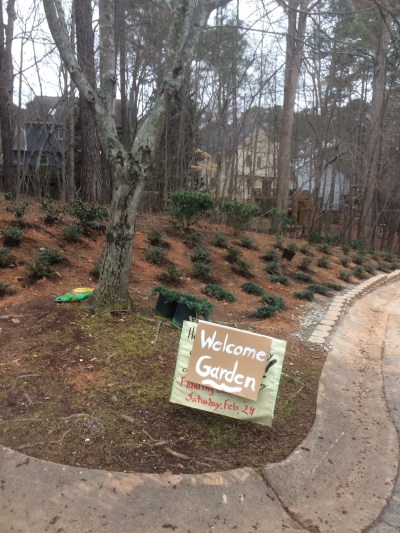
(In memory of Nancy Small Van Dijk on what would have been her 72nd birthday; Nancy served for several years as HOA chair of our condo complex. During her term, she spearheaded an effort to get a “Welcome Garden” of flowering shrubs at our previously clay-slope entry drive.)

This garden is overgrown, the weeds are practically choking it.
I come here and sit alone, and wonder what will become of it.
Yet we started out as gardeners, as workers in the soil,
And we reaped a bounteous harvest from our ever-loving toil.

Some cities are overgrown, with drugs and crime and pollution.
We sit in barred rooms alone, each writing a rational solution.
Yet we’ve cities full of gardeners, of players in the soil,
And the plants and herbs and flowers reward our ever-loving toil.

Our planet is overgrown, wars, strife, disease, aggravation,
We stumble our lone ways home, uncertain of continuation.
If our world should blow to pieces, not survive its own turmoil,
Would we all come back as gardeners, blessed to ever-loving toil?

"Welcome garden" planted February, 2018

“Welcome garden” with Nancy’s sign soon after planting in 2018

While We Were Away

While We Were Away    —by Jinny Batterson

While we were away, heartened by or hiding from
The tropical sun, walking the sandy beaches at dawn
Or swimming in warm waters midmorning,
While we were away, the early daffodils began
Blooming, but the tulips lured by a mild January
Got chomped to the base by browsing deer.

While we were away, the birdbath I’d emptied
To avoid having it cracked by winter ice
Was instead picked up and overturned by
March-like winds, though the bird feeders
Continued their cooler weather work of
Helping prospective parents bulk up for spring.

While we were away, a new-to-humans virus spread from
An initial center at the Chinese city of Wuhan
To most regions of the globe, engendering worry,
Research, and sales of face masks and hand sanitizer,
While the U.S. legislature continued its descent into more
And more abstruse angels-on-the-head-of-a-pin debate.

While we were away, the British government,
Having at length realized it no longer ruled the world,
Completed another step in its bid to ignore that world,
To hoard what remained of its material wealth,
Announcing to erstwhile partners that it had chosen
Instead to take its marbles and go home. 

While we were away, we played old and new games,
Each winning some, losing others. We purchased
Travel mementos from some of the tropical peoples who’d
Made both British and American empires possible.
Returning either tanned or more freckled,
We’ve brought back some adjusted mental context
That may prove useful while we are at home.

Virtual Reality, Deepfakes, 1000 Hours Outside…

Virtual Reality, Deepfakes, 1000 Hours Outside…   —by Jinny Batterson

As a boomer, I notice that my faculties are slowly declining. Also, habits younger folks now have are different from the ones I grew up with. Back in the 1950’s, parents and other adults fretted that we children and teens might turn into zombies from drinking too much unhealthy milk (contaminated by radiation from atmospheric nuclear tests) and watching too much television. Most nuclear testing has by now gone underground. The media landscape has evolved considerably. 

Now we have virtual reality. According to a recent article in Forbes Magazine (https://www.forbes.com/sites/solrogers/2019/06/21/2019-the-year-virtual-reality-gets-real/#3338ad6e6ba9), this technology is rapidly gaining adherents: “Worldwide, VR market volume is expected to reach 98.4 million sales by 2023, generating an installed base of 168 million units with a worldwide population penetration of 2%. Growth is forecast across all regions and countries, with China leading the way.”  Will all of us eventually be festooned with virtual reality headsets that enable us to sense ourselves anywhere, anytime we want?  

A somewhat different concern is the use of artificial intelligence capabilities to produce digitally altered “deepfakes,” seemingly genuine online videos of fictitious scenarios.  Bloomberg News recently raised an alarm:  https://www.bloomberg.com/news/articles/2020-01-06/how-deepfakes-make-disinformation-more-real-than-ever-quicktake. (It may be relevant to note, in this political season, that Bloomberg’s chair, Michael Bloomberg, is a U.S. presidential candidate.) The same day, Facebook announced that it planned to ban deepfakes from its platforms, though without a lot of detail about how it intended to accomplish this. 

My reaction to the ongoing media onslaught has been to avoid too much media exposure. A generally mild January has aided my effort, kicked off by a “First Day Hike” in a nearby state park. Such hikes started a number of years ago, and last year enticed over 55,000 individuals to take January 1 hikes in parks in all 50 states (https://www.stateparks.org/initiatives-special-programs/first-day-hikes/ ).  

The family walking behind me as I hiked were carrying on a lively conversation about a program for their school-age children called “1000 hours outside.”  Started among home schooling parents, the program is an attempt to counteract the tremendous number of hours most youngsters spend in “screen time.” According to the effort’s website blog (https://1000hoursoutside.com/index.html/), “1,000 hours outside, though daunting, is doable over the course of a calendar year… If kids can consume media through screens 1200 hours a year on average then the time is there and at least some of it can and should be shifted towards a more productive and healthy outcome.”

My childhood eons ago was not as scheduled as that of current-day youngsters, but my recollections are that we spent most of our non-school, non-chore time outside, and had to be called indoors to supper, sometimes protesting vehemently. 

As a former computer professional, I’ve spent many hours of “screen time.” I’ve also benefited from advances in transportation technology to travel widely to natural areas around the globe. Through thousands of hours outdoors in many different weathers and climates, I’ve developed a perspective shared by many farmers, fishers, and foresters: We humans are a small part of creation. 

Though we’ve developed technologies with hugely destructive potential, we’d have a much harder time surviving without the rest of nature than the rest of nature would have surviving without the human race. No advances in virtual reality or deepfakes can change that.

Playing for a Tie

Playing for a Tie…   —by Jinny Batterson

Most of the formal games I play are board games. Competitive athletics were pretty much out of the question for this lifelong klutz. Growing up, my brothers, sister and I got lots of gift games at Christmas to carry us through the cold weather months—classics like Monopoly, Clue, Stratego, plus other “big hits” of the time that haven’t aged as well. Once we got a little older, we were given word games like Scrabble. As my vocabulary grew, I got to be a pretty good Scrabble player in my first language, English. In high school, I played a few casual games in French, but English tile values for letters like “q” and “z” were inappropriate and we never got a French-based set, so the Scrabble fad in French club quickly died out. 

In my twenties, I started playing two-person Scrabble games with my husband, the super-competitor. It rarely mattered if I got better letters. He was much better at word placement, racking up double words and triple letters all over the place. Eventually, he’d beaten me so consistently that I decided I didn’t want to play him any more. Much later, we arranged a truce of sorts—we would still play each other, just not keep score. 

Several years ago, a mutual friend introduced us to the word game Quiddler, which can be played more quickly than Scrabble and requires less space, using playing card sized letters rather than tiles and a board. Hubby still beats me the majority of the time, but not by the lopsided proportions he used to tally up in Scrabble. I occasionally have a long enough winning streak so I’m willing to keep trying. We’ve adapted the original rules slightly: we play eight rounds per game, starting with a hand of four cards each, adding one card with each successive hand. The close games are more fun than the really lopsided ones—a hand with no vowels or no consonants, especially in a later round, can put you behind so far it’s almost impossible to catch up. 

Winning is fun, losing less so, but the contests I cherish most are the rarest—about once in a hundred games, we wind up with a tie score. Jim doesn’t get as much satisfaction as I do from the ties, but he humors me. 

On a whim, I decided to see if I could get an internet read on what popular physical sports allow tie games. I found the resulting gem via Wikipedia: 

“Ties or draws are possible in some, but not all, sports and games. Such an outcome, sometimes referred to as deadlock, can (also) occur in politics, business, and wherever there are different factions regarding an issue.”

“Tie” and “draw” appeal to me a great deal more than “deadlock,” which sounds unduly negative. All of us will eventually wind up dead. All of us at some point experienced birth.  While we’re in between, we’ll likely experience some wonderfully positive times (weddings, children’s births, signature achievements, reunions with long-absent friends). Other times may make us wish temporarily for death: serious illnesses or accidents, natural disasters, financial reversals, tragedies for loved ones, divorces.  

In these fraught times, when so much of our media environment can seem intent on making our circumstances feel even more fraught, I want to put in a plug for ties. If we live in the northern hemisphere, we’re approaching the winter solstice, the time of year when daylight is minimal and dark is “winning.” Starting on December 22, though, our 24-hour day/dark cycle will tend again toward balance, toward a “tie” at the equinox. Nature provides two such ties per year. 

Ties have a different connotation than deadlocks; ties can be enjoyable, special.  Let’s learn or relearn how to savor them.   


Poinsettia Day

Poinsettia Day    —by Jinny Batterson

December 12 has been proclaimed “Poinsettia Day” in the United States. The designation honors a plant brought to the U.S. by  Joel Roberts Poinsett, the first United States Ambassador to Mexico (1825-1829). Poinsett’s love of botany persisted while he trained as a physician. His career mostly went a different direction. While serving in Mexico, Poinsett continued to maintain hothouses on his Greenville, South Carolina plantations. In about 1828, he sent some poinsettias back from Mexico to be propagated. He later gave cuttings to John Bartram of Philadelphia, who introduced the plant to other nurserymen. Over time, the poinsettia in many variations has become a top selling Christmas plant,  with about 33 million poinsettias sold each year. 

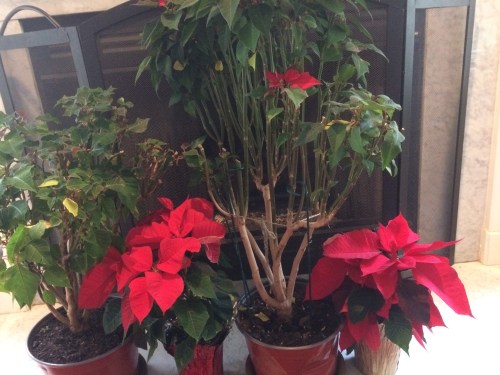
Our 2019 experiments with “forcing” the two poinsettias given us by a neighbor after last year’s holidays were not entirely successful. Although the plants survived two successive transplantings—from pot to ground once frost was finished in spring, from ground back to pot before autumn’s first frost—they didn’t produce the same beautiful red bracts as store-bought plants.  I’m not sorry we tried. Even though our “home growns” were spindly and mostly stayed green, we learned from our efforts. Any plants we carry over until next year will be treated with an enhanced regimen, though likely not quite as standardized as hothouse plants. This year, as a side benefit, the exercise of taking the plants from basement to light and back twice a day has helped keep off some of this year’s holiday flab. 

Below are pictures of the two types of poinsettias gracing our hearth this holiday season. May light and life grace your home as well!  

full store-bought poinsettias, leggy home-grown from last year

The Doors of the Church are Open

The Doors of the Church are Open  —by Jinny Batterson

During my childhood and adolescence, I attended Sunday school. As a young adult, I took a multi-year sabbatical from organized religion, then resumed attending a small congregation—a chance to sing in the choir, I told myself. I liked being an alto. For the past several years, I’ve attended two different congregations. One is mostly white, generally affluent, with a mix of children and adults, trending toward the older end of the age continuum. The other is mostly black, less affluent, with a similar age distribution. The Unitarian-Universalist congregation has slightly more college professors than the African Methodist Episcopal congregation; A.M.E. worshippers include slightly more former college football players and basketball stars. Both groups have several hundred members on their rolls, some of whom show up most Sundays. As older members die off, our numbers dwindle.

The fastest growing religious segment of the overall American population are the “unchurched.” A 2014 Pew Research Center survey of more than 35,000 Americans found that the percentage of adults (ages 18 and older) who describe themselves as Christians had dropped from 78.4% in 2007 to 70.6% just seven years later. Over the same period, the percentage of Americans who are religiously unaffiliated – describing themselves as atheist, agnostic or “nothing in particular” – jumped from 16.1% to 22.8%. 

Many younger adults have little use for Sunday worship. Partly, this is because Sunday morning can be the only unscheduled interval in their increasingly busy lives. Another partial answer may lie in incidents of mass violence, like a 2008 shooting at a UU worship service near Knoxville, Tennessee or the 2015 assault on an evening prayer service at an AME church in Charleston, South Carolina. These two horrendous incidents are part of a series of mass shootings in churches, synagogues, mosques, and temples that can badly damage our sense of safety. The congregations I attend have trained our ushers to be alert to potential violence, defusing it if at all possible, otherwise sounding the alarm and limiting the damage.

In both congregations I attend, we wrestle with questions of how to affirm each other’s dignity, how to forgive each other and ourselves, how to help each other grow spiritually. Both congregations also grapple with hateful rhetoric coming from the highest levels of our government. The U.S. constitution forbids church statements in support of or opposition to specific political figures or groups. However, we allow support of or opposition to specific policies and behaviors. Right now, churches are often centers of opposition to inhumane treatment of immigrants or “others.” 

Despite many similarities, both of the congregations I attend feel incomplete to me. I wonder if it’s partly because they continue to reflect a situation that Dr. Martin Luther King, Jr. noted in a 1960 speech: eleven o’clock on a Sunday morning is among the most segregated hours in Christian America. In a religion whose basic tenets include “love one another,” such segregation of “white” and “black” (or any other group identity) is hypocritical at best. Is how poorly we walk our talk one important explanation of formal Christianity’s dwindling numbers?

Given its recent decline, it’s tempting to conclude that Christianity, even religion more generally, may not survive in 21st century America. I think it can both survive and thrive, but rejuvenating our faiths will take a lot more than one older woman crossing a racial divide to attend two churches.

After both the Knoxville and the Charleston incidents, church leaders reassured and challenged us: whatever losses we’d suffered, “the doors of the church are still open.”  Often I imagine church doors as fully hinged swinging doors—capable of swinging out as well as in, like the doors sometimes found between restaurant kitchens and dining rooms, or fronting saloons in old cowboy movies. 

Many church activities have little doctrine associated with them. They can happen outside the confines of church buildings. They’re not limited to a single day per week. They are just something we can do as Christians, as humans—social outreach, social justice, social uplift. Our faith encourages us to feed the hungry, shelter the homeless, visit the sick and those in prison, comfort the bereaved.

From what I know of church history, the earliest Christians had no special buildings, very little liturgy, no delineated creeds. They just wanted to share the love of God with their fellow humans and with the rest of creation. Such sharing is not limited to Sunday mornings. It recognizes no artificial boundaries. The “doors of the church” in each one of us need to swing both ways. Maybe then the doors of our various denominations will be easier to keep open.      

A Small White Button

A Small White Button  —by Jinny Batterson

A year or so ago, someone at an anti-racism workshop gave me a small white button: BLACK LIVES MATTER, it said in black typeface on a white background, with a small circle of red edging around the whole button. Maybe an inch across, it’s not an “in your face” kind of button, although the lettering is not what you’d typically wear to a Rotary meeting. For much of the time since the workshop, the button has sat on my bedside table. When I look at it morning or evening, it reminds me of commitments I’ve made to work harder to reduce my own and American society’s racist tendencies. Most of the time the button just sits there while I go about my business elsewhere.

As a white person in Trump-era America, I can too easily let myself be cowed by mentally replaying images of gatherings like the angry mob of white supremacists that invaded Charlottesville during the summer of 2017. I can be timid, hesitant, even cowardly. “Will I put myself in jeopardy by publicly wearing a button for a cause many may misunderstand or disagree with?”   

What is the Black Lives Matter movement, anyway? Some black friends plus a bit of remedial internet sleuthing reconfirmed that the Black Lives Matter movement was started by three black women in 2013 after the shooter who killed unarmed black teen Trayvon Martin was acquitted of all charges. Trayvon Martin’s death was just one in a long series of deaths and injuries of unarmed blacks at the hands of police or armed civilians. It followed, too, a longstanding pattern of racially or gender motivated shootings, profiling, discrimination, arrests, and jail terms for those perceived as “other.” Someone needed to protest, to promote a more just approach. The women went on social media, where much BLM activism is still promoted. It’s also where much disinformation about the group gets spread. Not all black activists agree with some of BLM’s tactics; many of all races do not understand its inclusive emphasis.  

About the time of the Trayvon Martin shooting, a white librarian friend in rural South Carolina told me she’d learned to avoid any hint of condescension or derision with white colleagues and acquaintances in her economically challenged part of the Low Country. “Of course it doesn’t help to call someone a cracker or a redneck,”  she chided. “If someone talked to you that way, wouldn’t it just make your neck go redder?”  Her remarks echo when I try to remind myself of the humanity of the angry white men who converged on Charlottesville. Some of the men may have resented the continuing winnowing out of traditional middle class jobs due to outsourcing and automation. Some may have been facing financial challenges. Many may have been taught a distorted version of maleness. Trying to identify with what motivated them, I realize that when I feel insecure, I can be tempted to blame “others.” Skin color remains one of the most visible ways to “other” someone.  

Lately I’ve started wearing my small white button occasionally, rather than leaving it in solitary confinement at home. Over time, I’m adjusting when and where I put it on—showing it off to my progressive friends is not especially useful, I’ve concluded. At the other extreme, pushing it into the notice of hard-core BLM opponents is unlikely to change any minds or hearts.  

Mostly I put it on while running the everyday errands that are part of a retiree’s life this holiday season—banking, eating out, shopping, buying stamps, sending packages. Black lives DO matter. That they matter does not make my life matter any less. Once in a while, a black postal worker, a fast food restaurant worker, a lunch companion or a store clerk will smile after noticing my button. It affirms their dignity at the same time it reminds both of us of our common humanity. 

Wisely wearing my small white button is a very small risk. Experiencing the smiles it sometimes calls forth is a reward for which I’m thankful. 

Selective Memory and Finishing the Work We are In

Selective Memory and Finishing the Work We Are In  —by Jinny Batterson

I can remember parts of events that happened when I was much younger. On Friday, November 22, 1963, I was a Maryland high school student. I remember hearing our school principal start an announcement over the school intercom that day at an unusual time for announcements. I remember coming down the stairwell between the two floors of our building along with many other students changing classes. 

I don’t remember whether the announcement I heard while going downstairs was the first—that President Kennedy had been shot—or the second—that he had shortly afterward been pronounced dead at a Dallas hospital. I don’t remember whether school that day was dismissed early or whether school was canceled the following Monday for his funeral. I don’t remember much about that year’s Thanksgiving the following Thursday. 

Earlier in 1963, there had been a tense standoff between the nuclear-armed U.S.A. under Kennedy’s leadership, and the nuclear-armed U.S.S.R. under Nikita Khrushchev about the positioning of nuclear missiles on the island of Cuba, then led by Communist revolutionary Fidel Castro. I don’t remember whether my dad built a nuclear fallout shelter in our front yard before or after Kennedy was shot.  

Parts of our education when I was a student involved memorizing famous poems and speeches. I can recite most of a short Abraham Lincoln speech from a century earlier, first spoken in November, 1863 at a dedication ceremony for a military cemetery at the site of one of the U.S. Civil War’s deadliest battles:

Four score and seven years ago our fathers brought forth on this continent, a new nation, conceived in Liberty, and dedicated to the proposition that all men are created equal. Now we are …testing whether that nation, or any nation so conceived and dedicated, can long endure.…The world will little note, nor long remember what we say here, but it can never forget what they did here. It is for us the living, rather, to be dedicated here to the unfinished work which they who fought here have thus far so nobly advanced. …It is rather for us to be here dedicated to the great task remaining before us … that we here highly resolve that these dead shall not have died in vain — that this nation, under God, shall have a new birth of freedom — and that government of the people, by the people, for the people, shall not perish from the earth.

In the tragic days after Lincoln’s 1865 assassination, his Gettysburg speech was nearly forgotten. Later, the contents of the speech took on more importance. When the current Lincoln Memorial was dedicated in Washington, D.C. in 1922, the Gettysburg Address was inscribed on one of the monument’s inside walls.  

We are now experiencing another test of the viability of our democratic institutions. Each of us brings different memories to an ongoing impeachment inquiry. Witnesses and questioners interpret incidents differently, partly based on their training and point of view. Our current President ran for office touting the belief that our nation could return to a time when the U.S. was preeminent in global affairs. As an astute businessman, he could “fix things.” Some seem to think his position grants him nearly unlimited license to promote his own interests. Attempts to remove him from office are “character assassination.” Others less charitable to the President point out that our political system is based on checks and balances designed to restrict any one person or political entity from rigging the system to his own benefit, from “fixing things.” 

Absent from the immediate debates and questioning are considerations of the impacts of global over-dependence on fossil fuels to human and planetary health. Scientists tell us that both the United States of America and the rest of the world’s nations have only a decade or so to drastically curb our output of the climate-warming gasses produced by burning fossil fuels if we are to maintain a planet capable of supporting human life as we know it.

On another wall of the Lincoln Memorial is his second inaugural, delivered in March, 1865, just over a month before his assassination. We might be wise to remember its conclusion:  

With malice toward none, with charity for all, with firmness in the right as God gives us to see the right, let us strive on to finish the work we are in, to bind up the nation’s wounds, to care for him who shall have borne the battle… to do all which may achieve and cherish a just and lasting peace among ourselves and with all nations. 

Regardless of the outcome of our immediate political crises, climate change requires all of us to strive on, using whatever tools of intellect, wealth, compassion, and ingenuity are at our disposal, to finish the work we are in.     

Choosing Your Starfish

Choosing Your Starfish  —by Jinny Batterson

One of the years when I taught English in China, my students were fascinated by a story about an old man, a young boy, and a beach filled with stranded starfish. Many variants of the story have appeared. The one my students were most familiar with went something like this: 

  One morning after a storm, an older man went out for his customary walk along a gently curving stretch of beach. The weather had cleared. As he looked ahead, the man could see in the distance a small figure, also walking along, sometimes bending down, then throwing something into the waves. As the older man got closer, he saw that the other person was a young boy, perhaps twelve years old. The stretch of beach nearest them was littered with stranded starfish. Once in a while, the boy leaned over, picked up a starfish, and tossed it back into the sea.

“You’ll never succeed in making a difference for every living starfish,” the old man cautioned. “There are too many of them, and they can’t live very long on the beach.”

“That’s not the point,” replied the boy as he tossed another starfish back into the waves. “I made a difference for that one.”  

I didn’t remember having heard the story before. When I recently checked online for the story’s origin, I found it had appeared in slightly different form in 1969 as part of an essay titled “Star Thrower” by philosopher Loren Eiseley. A number of charitable organizations have since taken up the image of a rescued starfish as part of their name or marketing—groups for ex-offenders, for poverty-stricken children, for survivors of childhood abuse, for injured veterans, and so on. A variation of the story’s theme has been made into a children’s film, “Sara and the Starfish.”

The fable is both challenging and reassuring to me in these unsettled times. As someone with a tendency to obsess about all the actual and potential “starfish” I may encounter, I find the story helps me maintain or regain perspective. Of course I can never save all possible starfish. It’s important, though, that I pay attention to the starfish who get stranded on “my” beach with problems that match my resources and the solution skills I’ve developed. 

Who/what is your starfish?  

Building Lop-Sided Bridges

Building Lop-Sided Bridges    —by Jinny Batterson

About this time of year in 1997, I got a nasty shock. I was diagnosed with breast cancer. A set of cells had gone malignant and might soon invade the rest of my body. Several months earlier, I’d had my annual mammogram and was told it was normal. So at first, I wrote off the lump that showed up around Hallowe’en as just another annoying symptom of menopause. I was a healthy, middle-aged white woman. I ate well, exercised regularly, had gotten all my prescribed screenings. I made a comfortable living as a consultant, had two college-age sons, a husband who loved me, and no family history of breast cancer. The lump would go away on its own. It didn’t. Further tests showed an aggressive tumor. By early December, I’d had a modified radical mastectomy without reconstruction. I was pretty shaky both physically and mentally. 

As I began to heal, I tried to use my experiences as a teaching tool. Our Unitarian-Universalist congregation in Richmond, Virginia had long engaged in efforts to help promote racial healing. Each year about the time of the MLK holiday, we had a special service with a racial justice theme. This particular year, I’d been working for several months before my diagnosis on the planning committee for the service. As I began to regain strength after surgery, I asked if I could do a short talk about my “lop-sidedness,” using my body as a metaphor for the way our entire society was lop-sided and hampered by our history of individual prejudice and systemic racism. We all needed healing. I composed and rehearsed my talk. By early January I was confident that I’d have the physical stamina and the psychological strength to deliver a 10-minute talk, even with the prospect of six months of chemotherapy looming. 

Then I went to choir rehearsal. Our young choir director wanted to use spirituals to accompany the service. He’d chosen “Soon I will be done with the troubles of this world, goin’ home to live with God…” as the meditation hymn. I flinched. Jamie was a wonderful musician, but I really didn’t want to identify with that particular song at that particular time in my life. Privately, I asked if we could substitute something more upbeat. I got a reprieve. We wound up singing “I’m so busy servin’ my Master, ain’t got time to die…”  Both the congregation and I survived to continue our work. 

A decade later, I learned that my favorite college roommate had developed breast cancer. Beth had grown up near Richmond, graduated from our small liberal arts school, then gotten an advanced degree in library science. She’d moved to different parts of the country. She spent much of her career administering college libraries—first in Ohio, then South Dakota, then Florida. We kept up via holiday cards and occasional phone calls. In her 50’s, Beth had changed focus slightly and taken a post as director of a set of public libraries in an economically depressed part of lowland South Carolina. Beth had been in her new job only a year or so when the cancer hit. Her family and friends rallied to her support. Once her most intensive treatments were over, I went down for a weekend visit. We traded survivor stories. When she passed the five year mark without a recurrence, I sent hearty congratulations. Then, a couple of years later, a non-cancerous illness destroyed her kidneys and took her life with little warning. That April, I drove south through timber plantations, palmetto swamps, and railroad cuts festooned with blooming wisteria vines to get to South Carolina for Beth’s memorial service. I didn’t know much about her town, but suspected it would be as highly segregated racially as much of the South I’d previously been exposed to.

The small Methodist church was nearly full. Some of the mourners were family members I recognized, but I was surprised to see half a dozen older black women among the mostly white worshippers. I guessed at first that perhaps the women were maintenance workers at some of the libraries Beth supervised, then chided myself for stereotyping. At the reception after the service, I had a chance to talk with one of the women.

“How did you know Beth?” I asked.

“We were part of a local support group called ‘Bosom Buddies’,” the woman explained, pointing to the discrete pink lapel pin she wore. 

I never learned much about the group. Beth may have had a hand in creating this cross-racial sisters-beneath-the-skin effort in the area she’d made her home. Whatever her role, she’d reached out across any racial divide, creating enough of a bond so that six women had taken the time to attend her memorial service.

Our country remains in need of healing. Pundits of many political leanings expound on all the ways we are polarized— economically, racially, politically, spiritually. Income disparities persist; wealth gaps have gotten worse. Gun violence takes too many lives; “stop and frisk” procedures and mass incarceration further divide us. Health outcomes vary tremendously, based partly on income and ethnicity. We’re still lop-sided. We all need healing. Perhaps those of us who are physically lop-sided can continue to build lop-sided bridges.