Category Archives: Uncategorized

Of Loaves, Fishes, and Miracles

Of Loaves, Fishes, and Miracles   —by Jinny Batterson

One of the earliest Bible stories ever read to me was an account of the miracle of the loaves and fishes. I remember thinking how special it was that thousands of people could be fed from only a few loaves of bread and a few fish. My knowledge of Biblical lore is not as deep as I’d like, but I’ve recently revisited Biblical loaves and fishes stories, of which there are at least six (Matthew 14, Matthew 15, Mark 6, Mark 8, Luke 9, John 6). Online sources explain that the miracle of loaves and fishes is one of few mentioned in all four Gospels. In all the stories’ variations, Jesus interacts with his disciples, with a spiritual force to whom he gives thanks, and with large crowds. Literalist interpretations stress how many baskets of leftovers were collected at the end of the meal. More metaphorical explanations of the miracles concentrate on the possibility that it was not Jesus’ direct intervention that multiplied the available food, but his unleashing the generosity of members of the crowds who had enough food to share. 

Lately I’ve been thinking a lot about loaves and fishes stories, as the global covid-19 pandemic spotlights and sometimes worsens inequities in our access to material resources.  I’ve been reading the words of former Congressman John Lewis, a champion of principled action and societal equity. I’ve been marveling at the life of this man who was so often told that there was not enough, that HE was not enough, but persevered to blaze a path of non-violent protest and public service. I’ve been thinking, too, about a woman colleague from a couple of generations ago and the lessons she imparted to her daughter.

I’ll call my former colleague Susan. Susan was a single mother. She’d struggled hard to provide a decent living for herself and her daughter. Susan never talked about the child’s father. I never asked. They lived in a very conservative neighborhood. Despite disapproving looks and hurtful comments, Susan insisted on taking her daughter to church and to Sunday school. Over time, Susan saved up enough to provide a summer trip to Disney World, every young princess’s dream. Planning the trip was almost as fun as the actual event. Once Susan returned to work, she was full of stories about the marvelous rides, about the great service at the hotel where they’d stayed, about how thrilled her daughter had been to meet Mickey Mouse.  

“Do you have any special memory that stands out?” I asked her one day. 

After a pause, she told me, “Actually, it wasn’t a ride itself, but something that happened while we were waiting to get into one of the most popular attractions. It was a hot day, and I decided to spend a little extra money to get my daughter a popsicle—nothing fancy, just one of those water ice contraptions with two sticks. When I next looked at my daughter, she’d broken the popsicle in half and given a piece to the little boy in front of us. I didn’t want to make a scene, so I didn’t say anything. The line moved fast, and we all enjoyed the ride. That night at the hotel, I asked my daughter why she’d done what she did—didn’t she like the popsicle?” 

“It’s not that,” she told me, “but I could see that the little boy was just as hot as I was. I remembered my Bible school lesson—‘Jesus wants us to share.’” 

Amen!    

Taking a Media Sabbath

Taking a Media Sabbath  —by Jinny Batterson

In Judeo-Christian traditions, we are taught to “honor the Sabbath, and keep it holy.” According to the strictest interpretations, that means on every seventh day abstaining from all sorts of work and some of our usual daily activities, taking time instead to focus on spiritual growth. The term is related to a longer interval, a “sabbatical,” a seventh year widely observed in academic settings when professors and researchers take an extended break from their standard duties to pursue alternate studies and to recharge.   

The use of a day of prayer is not limited to Christian or Jewish traditions, though, and can have political overtones. In British-controlled India in 1919, a set of repressive new laws were passed giving the British government authority to arrest anyone suspected of “terrorist activity” and to detain them for up to two years without trial. Other laws simultaneously broadened police powers to conduct searches without warrants and curbed press freedoms. When the most egregious law, commonly called the Rowlatt Act, went into effect, opposition figure Mohandas Gandhi proposed that the entire country observe a hartal, a day of fasting, prayer, and abstention from physical labor, in protest. The response was overwhelming–on April 6, 1919, millions of Indians simply did not go to work, and for twenty-four hours (agonizing hours for the British) India simply ground to a halt. (https://www.sparknotes.com/biography/gandhi/section7/)  After continuing protests, the Rowlatt Act was repealed in 1922. 

As internet use has spread globally, much of the world’s population spends at least some time online. Back in 2017, scientists writing in a journal of neuropsychiatry estimated that perhaps 2% of the adult population suffered from “internet addiction,” compulsively spending more and more online time. (abstract from 10.4172/Neuropsychiatry.1000171,  2017) An article from 2019 (https://www.psycom.net/iadcriteria.html) gave a range of estimated internet addiction from below 1% to nearly 38% of adults. Since the onset of the current global covid-19 pandemic, internet use has spiked further as more of us turn to online communications while confined close to home and admonished to maintain social distancing. 

The internet can be a source of valuable new information, publicizing trends and histories that many of us had been unaware of. For example, as someone with no known enslaved ancestors, I’d been less aware of “Juneteenth” than those whose ancestry was less fortunate. (The holiday initially celebrated the anniversary of June 19, 1865, when formerly enslaved people in Galveston, Texas first got official word that they were now free.) Juneteenth is becoming more widely celebrated throughout the United States, and was recently cited as a reason for the postponement of a political rally by our current President. 

However, the internet can also be used to spread spurious information and to inflame tensions. It provides instantaneous feedback as “algorithms” select more and more of the content they believe we might want to be exposed to. We become “products” who are encouraged to buy more and more goods and services. These days, I know that my use and misuse of the internet can drift close to addictive behavior as I search for clues on how to stay well, relatively safe and somewhat sane in this confusing and highly politicized time. 

So I will use this Sunday, July 19, as my individual “Julyteenth,” my media sabbath, a brief freedom from the endless click bait of internet content providers. I’ll disengage as much as possible from internet browsing or virtual meetings. I’ll also try to cut back on television, streaming services, and the like. I’ll try to focus instead on spiritual growth, with perhaps some limited, more direct, but safe offline methods of reconnecting with neighbors and loved ones. I’ll adapt some advice of poet and writer Maya Angelou, who counseled a generation ago:  

“Every person needs to take one day away.  A day in which one consciously separates the past from the future.  …  Each person deserves a day away in which no problems are confronted, no solutions searched for.  Each of us needs to withdraw from the cares which will not withdraw from us.” (Maya Angelou, from Wouldn’t Take Nothing for My Journey Now, 1993) 

If my media sabbath refreshes me, I may make it at least a monthly ritual, if not yet every seventh day. My hope is that the spiritual nourishment of a sabbath will better equip me to confront the complex issues of my community, nation, and world. Good Sabbath, friends.    

Checking Our Sources, Knowing Our Contexts

Checking Our Sources, Knowing Our Contexts   —by Jinny Batterson

As the pandemic caused by the corona virus drags on, amid increasing conjectures about how to respond, increasing finger pointing about whose “fault” it might be, I can feel emotionally overloaded. So far, no one close to me has died of the infection, though several friends and relatives have had cases of varying degrees of severity. The small enclave where I live stays mainly quiet, those of us retired or furloughed staying pretty close to home, those still in the paid workforce adjusting work routines to stay as safe as practical.  

More of us live more of our lives in virtual spaces—emails, virtual meetings, social media posts. It can be tempting to get all of our input filtered through some electronic medium or other. My biological and intentional families are politically diverse. In these fraught times, we sometimes avoid discussing politics, but it can be nearly impossible not to be influenced by what we see, hear, and read. When discussions get especially heated, I try to remember some of my history teachers, including my part-time historian mother. 

“Check your sources,” they would repeatedly caution. “Everyone has an angle. Why did this particular source frame this particular event in this way? What advantage did they gain from telling their story from this viewpoint?”  

It’s disturbing to me that a fair amount of “information” these days is murkily sourced, if sourced at all. Lots of groups with high-sounding names have turned out to be unreliable at best, malicious at worst. Conspiracy theories abound.

It’s unclear where the virus causing covid-19 originated. It’s unclear exactly when it first spread among humans. It’s unclear all the ways the virus may be transmitted. It’s unclear why some people have few or mild symptoms, while others with similar backgrounds can be severely affected.  Given these uncertainties, it’s natural for us to form theories about what’s happening. What’s not natural is for so many of us to be so adamantly certain of “answers.”

I try to vary the sources of information I review, to filter out the obviously bogus. I know, too, that I respond to content in part from the contexts in which my life has unfolded so far. During my childhood, polio was a crippling pandemic that tended to reappear each summer, impacting both children and adults in seemingly random fashion. In some years in the early 20th century, as many as 6,000 Americans had died. Most Americans knew that president Franklin Roosevelt had contracted polio as an adult during the 1920’s and never fully regained the use of his legs. At its maximum in the U.S., in the early 1950’s, there were nearly 58,000 U.S. cases annually, with nearly 3,000 deaths. Swimming pools closed. Parents restricted their children’s friendships. 

Eventually, medical researchers tracked down the source of the illness and developed successive vaccines. I remember when I was in elementary school being part of a large-scale medical trial in which many of us got doses of an oral vaccine. In 2020, polio infections exist in just three countries globally, with fewer than 200 annual cases. Global health workers do their best to detect and isolate pockets of infection, often in war-torn areas, and to make sure at-risk children get vaccinated against the disease. 

At some future point, this novel corona virus that is spreading illness and death will yield to research and to more effective responses. Until that happens, it behooves us humans, whatever our political leanings or backgrounds, to check our sources and to be as aware as we can of our contexts.   


Democracy Is Not an “Ism”

Democracy Is Not an “Ism”  —by Jinny Batterson

We’re living in a strange season, locally, nationally, globally. First came a novel corona virus to which few humans have immunity. It has spread fear, illness, disruption, and death to nearly every country. So far efforts to contain, cure, or prevent it have met with uneven success. In many parts of the United States of America, the outbreak seems to be worsening.

As people everywhere began to cope with the pandemic, it quickly became evident that self-isolation and social distancing were the best ways to slow the virus’s human spread. In the U.S., those at the “bottom” of society were least likely to be able to self-isolate. Most lived in crowded conditions. Those who were employed mostly worked in low-wage service jobs necessary to society’s functioning—“essential workers,” they were suddenly called, as if a dignified label could make up for generations of poor pay and poor living conditions. Others chose not to isolate or distance because these practices seemed an impingement on their liberty.  

To add to the trauma of the pandemic, we’ve recently been confronted with other examples of our inequitable society. Video footage went viral of a white police officer in Minneapolis squeezing the life out of a prone, handcuffed black man by kneeling on his neck for nearly nine minutes while other officers looked on and bystanders yelled for him to stop. It became less and less possible to talk about “resisting arrest” or “a few bad apples.” The systemic corruption of America’s criminal justice system was broadcast worldwide for all to see. 

And we have an American election coming up, one that’s poised to be expensive, divisive, and prone to distortions at many levels. Is it any wonder many of us are disturbed?  Whatever happened to the “shining city on a hill,” a beacon of hope for oppressed people everywhere? Whatever happened to our democracy?  

I’m not exactly sure, but I think part of the difficulty is that we’ve confused democracy with ideology. Many of us self-identify at least partly using a series of “isms”: conservatism, liberalism, progressivism, socialism, libertarianism, federalism, communitarianism, environmentalism. Every week seems to bring a new label.  

Democracy is not supposed to be easy. It is always a work in progress. Some guidelines our U.S. founders laid out have generally held, but there were huge blind spots in our original framework of laws. Some of those blind spots have persisted, as the George Floyds and “essential workers” of our country have recently reminded us. 

Democracy requires that each human has some say in decisions that impact him/her/them, regardless of circumstances. In small settings, that say may be direct. As groups get larger and more diverse, it becomes necessary to have “representative democracy,” where officials are elected to represent a neighborhood, town, city, county, state, or nation and to champion the interests of their constituents. 

Democracy requires that each human be willing to listen to perspectives that differ from his/her/their own, to acknowledge the humanity of others, to be humble about the limits to any individual’s knowledge or judgment. Whatever “isms” we subscribe to, we all breathe air, we all drink water, we all eat food. While we’ve been busy discounting and insulting each other, our air and water are getting dirtier, parts of our food supply are at risk, and more of us are becoming sickened by the corona virus. 

A few of our political leaders have stressed our connections across our divisions: “We’re all in this together. We’ll get through this together.”  Too many of us may not get through at all unless we start acting as if we believe that, meeting each other beyond our “isms.”  Happy In(ter)dependence Day!  


Wild Berries

Wild Berries  –by Jinny Batterson

Summer is taking over,
Turning days warm and muggy,
Even just past dawn.

Going outside gets less
Appealing, while still a
Healthier alternative to
The viral burden of
Indoor spaces.

One more morning walk.

Meandering along a greenway,
Hugging the shade,
I nonetheless come
To a sunny stretch
Where the first of the
Season’s wild blackberries
Winks at me from the verge.

It’s only a little tart,
So warm and juicy.

A welcome reminder
That not everything
Beyond my control in
This season of covid
Is malevolent.

Noticing a Tailwind

Noticing a Tailwind   —by Jinny Batterson

As discussions and protests continue around issues of police brutality, systemic racism, and possible ways forward, I’m reminded of a long-ago vacation when I viscerally experienced the difference between the presence and the absence of a tailwind.

Back when my husband and I were younger and fitter than we are now, we sometimes planned bicycling vacations. An especially memorable one was a two-week jaunt during the 1990’s to some then-isolated regions of eastern Canada. We were able to reserve ten days’ lodgings in the Canadian province of Prince Edward Island, with a side trip to an even smaller, more remote set of islands further east—disjointed parts of the province of Quebec in the midst of the Gulf of St. Lawrence. Our initial setting out point was Charlottetown, PEI’s capital and largest city. In those days, Charlottetown was a frequent honeymoon destination for Japanese brides who’d read the popular novel series about Anne of Green Gables, an orphaned girl raised in an idyllic rural setting by her potato farmer aunt and uncle. The novels had been part of their high schools’ curricula in Japan. We wandered the town for a little while, getting oriented and marveling at the trilingual street signs (English, French, and Japanese). In the afternoon, we got a taxi to the site of a bike rental agency where we’d reserved two appropriately sized rental bikes. 

We then pedaled off to our first night’s lodging, a rental cabin at a campground not far from town. For most succeeding nights, our overnight accommodations would be at small inns and B&B’s about 30 miles apart, an easy day’s ride in the generally flat or gently rolling terrain.

Once we reached an eastern edge of PEI, we took a ferry from the smallish town of Souris to the even less populous Magdalens, or îles de la Madeleine.  We’d reserved four nights’ lodging on these islands—three on the island with the ferry terminus and one on an island further north.

Our first night we stayed near the ferry terminal in a family home with multiple generations in attendance. After a plentiful breakfast the following morning, we pedaled off northward, cruising easily along, spotting herons and other shore birds as we went. We traveled along a sandy causeway little more than the roadway wide and reached our destination mid-afternoon. Our northern island host was a dedicated birder. He gave us hints about when and where to get the best views of shore birds. Accommodations were simple but ample. The sunset and star views were unsurpassed. The following morning, after another plentiful breakfast, it was time to return southward. 

Pedaling along the causeway this time felt as if we were trying to propel our bikes through a slick of molasses. On our way northward, we had been totally oblivious to a substantial tailwind. The wind had not shifted overnight, so our return trip was straight into a significant headwind. It was well into evening when we reached our third night’s stay. 

I cannot know what it is like to be a black person in the United States of America in the year 2020. Though I’ve studied some about the traumas of slavery, Jim Crow, and mass incarceration, though I’ve had friends of color who were willing to share a few of their individual stories with me, being non-white is not part of my lived experience. The one minimal experience I’ve had on a bicycle riding into a headwind may be a small example of what it frequently feels like to be “living while black” in today’s America. 

So I need to ask myself, repeatedly, what additional actions I can take to make that headwind a little less severe.   


Complicity

Complicity    —by Jinny Batterson

Never once have I used the “n” word.
I’ve supported worthy causes,
Occasionally even put my personal
Safety at risk. I’m not like those bigots
Who can’t seem to understand
That, deep down, we are all one.

Yet I live where sirens are rare, where
Police are rarely present or summoned.
The officer who came last Sunday to
Investigate the fawn lying prone
On our sidewalk was friendly,
Bemused, not overbearing.
No verbal threats. No tasers.
No weapons drawn.

The economic system that nurtured me
Valued brain over brawn, and
Whiteness over everything else.
It diminished the dignity of manual
Work, replaced those with fewest
Connections with robots, or with
Off-shore call centers, while
A privileged few profited, assuming
They merited special consideration.

“Who you knew” became nearly
As important as what, and
Everyone cheated, if only a little.
Getting ahead became a mantra,
Though it was never clear what
Exactly we were getting ahead of.

This house of cards is collapsing.
Will I be buried under it, or
Will I help find a way to make explicit a
Rebuilt society that shelters and
Protects a multifarious polyglot of
Worthies, whatever our skin color,
Skills or connections?

A Protest Lullaby Project

A Protest Lullaby Project   —by Jinny Batterson

My hope is that many of you can remember a time in your childhood when your mother or a special adult sang you a soothing lullaby.  One of my favorites is “All Through the Night,” originally a Welsh song. (https://www.youtube.com/watch?v=KzFqirIGVB4) 

The past couple of months, especially the past couple of weeks, have been unsettling for me. As I write, the annual June anniversary of the use of repressive force in China in 1989 has nearly arrived. Many of us living in the United States of America are witnessing the use of repressive force on our own streets. In the wake of another senseless murder of an unarmed black man, demonstrations have begun and persisted in many American cities.  

At the same time, a global viral pandemic has hit our country hard, uncovering many inequities and rifts that those of us in comfortable circumstances have tried for too long to cover over. Concerns over the spread of the virus have dampened the public activism of many older Americans, those of us most vulnerable to serious illness or death from covid-19.

Many who are wiser than me have counseled prayer. Spending time on our knees is one good way to acknowledge both our pain and our solidarity. Another may be songs, both energetic and uplifting, and, at the close of the day, soothing.

My hope is that younger people in areas under curfew will continue peaceful in-person protests, wearing face coverings and observing as much social distancing as possible. Airing long-festering grievances and concerns, both in public protests and in virtual spaces, is crucial to beginning to address them.  

I suggest that we add to other protest rituals, a few minutes before curfews take effect, a lullaby. Let’s sing to each other, to ourselves, to our President and political leaders of all persuasions. Let’s choose whatever language and idiom most suits. Let’s mouth the words, silently or aloud. If we are not under curfew, let’s practice a lullaby a few minutes before sunset. 

Singing and praying to and for each other will not by themselves solve our problems. Nothing but sustained, concerted actions at many levels will. But a lullaby can offer a brief respite, perhaps open a greater possibility for healing our too-fractured world.   

Hush, my worldmates, peace attend thee, all through the night…

The Flowers Have Not (Yet) Gone

The Flowers Have Not (Yet) Gone   —by Jinny Batterson

It’s been a rough week to be an American. The death toll in the United States from the covid-19 pandemic crossed the 100,000 mark, while multiple U.S. cities experienced repeated, sometimes violent demonstrations in the wake of Monday’s death of yet another unarmed black man, George Floyd, at the hands of a white police officer in Minneapolis, Minnesota.  

Our economy has sputtered to a halt. Partly as a result of virus-related lockdowns, nearly a quarter of the U.S. labor force is unemployed. Our president sporadically spreads hatred and gibberish through his favored media platform, becoming so blatant in his misrepresentations and lies that Twitter has recently put “fact check” warnings on some of his posts.  

As various U.S. states attempt to restart their economies in the midst of a highly contagious novel corona virus with no known treatment or vaccine, cases have started to spike again in multiple hot spots. No one seems to know a good solution to the multiple crises besetting us.  

I sometimes get a “deja vu” feeling about our current problems and unrest, as someone who in 1968 was a young adult with much idealism and little experience. Then, an escalating and increasingly stalemated war in Vietnam was killing a disproportionate number of young black American men. Most American men between the ages of 19 and 26 (though less so the wealthiest or best connected) were susceptible to being conscripted into the military. In early April, Martin Luther King, Jr., an outstanding proponent of non-violent civil disobedience and a leader in the fight for legal equality for African-Americans, had been assassinated by a sniper while helping organize a peaceful protest for sanitation workers in Memphis, Tennessee. In the wake of his death, over a hundred American cities had erupted in protests that often turned violent and destructive.  

Conditions in many U.S. cities in 1968 were unequal, with housing projects and decaying urban neighborhoods receiving little in the way of substantive government assistance, while billions were being spent to advance presumed U.S. political interests overseas. Other government programs either intentionally or collaterally favored “white flight” to the suburbs, which were largely off limits to non-whites. Sound vaguely familiar?

Many collegians of the 1960’s had become enamored of a folk song revival, one of its signature songs being “Where Have All the Flowers Gone?”  penned by Pete Seeger in 1955. Joe Hickerson had later added more verses, turning the song into a circular questioning of the premise of warfare. The folk/rock trio of Peter, Paul and Mary popularized the expanded version, which remains a touchstone for many of us who lived through that era. (You can view their 25th anniversary rendering of the song at https://www.youtube.com/watch?v=ZgXNVA9ngx8.) 

In 2020, I’m somewhat creaky in the knees and a bit too virus-averse to participate in large gatherings, so I admire from a distance the courage and forbearance of many of the protesters (and many of the police officers who work to deescalate tensions, both short-term and longer-term). Meanwhile, I continue to send emails and postal letters to elected officials at all levels. I support voter registration and voting rights initiatives. I sew and give away protective face masks. I tend gardens. I plant flowers. I want to remind myself and others that the flowers have not yet gone. 

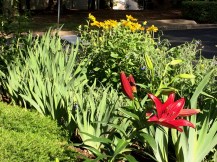
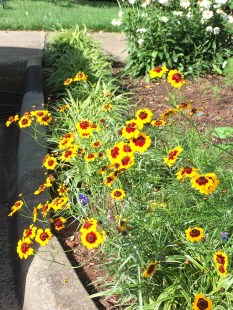
lilies and black-eyed susans near our central NC condo

Flowers near our central NC condo

Wandering in the Wilderness of COVID-19

Wandering in the Wilderness of Covid-19 —by Jinny Batterson

When as a child I read Bible stories about the forty years the Hebrews spent wandering in the wilderness after they fled Egypt and before they entered the promised land, I could partly identify, as someone who easily becomes lost. However, even as a child, I thought forty years seemed a very long time. I guess they probably didn’t have an app back then for directions on their cell phones, but couldn’t they ask someone for directions?  Didn’t anybody have a map?

As we humans try to navigate our way through the covid-19 pandemic, I’ve become more appreciative of the Hebrews’ difficulties. It wasn’t just physical distance the Hebrews needed to traverse. Turns out, the space between one “normal” and the next was just as much psychological as physical. The Biblical Book of Numbers tells of the challenges of life in the wilderness. At first, some Hebrews wanted to return to Egypt. There, though enslaved, they at least had plenty of varied food:  “We remember the fish we ate in Egypt for nothing, the cucumbers… and the garlic; but now our strength is dried up, and there is nothing at all but this manna to look at.” (Revised Standard Version, Chapter 11, verses 5-6). 

As they neared what they expected to be the promised land, overall leader Moses sent twelve tribal chieftains to assess the area: “Go up into the Negeb yonder, and go up into the hill country, and see what the land is, and whether the people who dwell in it are strong or weak … and whether the land that they dwell in is good or bad… Be of good courage, and bring some of the fruit of the land.” (Chapter 13, verses 17-20). The majority report, ten of the twelve, recommended giving up—the people already in the promised land were too strong. This majority even discounted the land’s good points, saying, in essence, that it was not worth fighting for. A minority of two believed the land was indeed worth trying to possess. They thought the challenges were not insurmountable, given spiritual assistance. It took an entire generation, plus lots of disease and death, before the rest of the Hebrews were persuaded.  

Another example, from the medical field, is closer to modern America in distance and time. It concerns the spread of the use of antiseptics to prevent post-surgical infections. In the nineteenth century, surgical advances made more complex operations possible, but deaths following surgery soared, sometimes taking half of all patients. One British professor of medicine then observed: “A man laid on the operating table in one or our surgical hospitals is exposed to more chance of death than was the English soldier on the field of Waterloo.” 

British surgeon Joseph Lister in 1865 read the results of experiments by French scientist Louis Pasteur, who connected microscopic bacteria with fermentation in foods and wine. Lister wondered whether what caused fermentation in food might also cause infections in wounds. In the late 1860’s, he began experimenting with different procedures and chemicals to reduce the chances of infection. He published the results of his cases in medical journals. Over time, he refined his approaches. Still, it took nearly a generation before antiseptic practices were widely used in hospital surgery wards. 

The wilderness of covid-19 response is disconcerting. Recommendations of currently available best practices can be confusing. As my home state of North Carolina begins the second phase of cautiously reopening its economy, the NC Department of Health and Human Services advises that I’ll still be “safer at home,” but that I’ll have an expanded range of businesses and non-profit groups I may visit. When getting my hair cut at a reduced-occupancy salon or dining in a reduced-occupancy restaurant, I’m advised to “wear, wait, wash”—wear a face covering (except, presumably, while eating), wait at least six feet from other customers, and wash my hands frequently (https://covid19.ncdhhs.gov/materials-resources/know-your-ws-wear-wait-wash). 

My guess is that it will be a good while before we’ll reach a post-covid “normal,” though I hope it will take less than forty years. Those of us who survive this pandemic will mourn our losses. In hindsight, we’ll realize that some preventive measures we tried were more effective than others. Some people will remain unenthusiastic about the longer-term changes we will need to make to reduce the threat of future pandemics. 

Still, we may take heart from the experiences of those venturing toward a promised land or safer surgery. The wilderness, however disorienting or longlasting, is neither uniform nor useless. It provides the venue and the time to develop and practice new skills we need. We cannot go back; with good guidance and courage, we can go forward. Please stay as safe and sane as possible, all, while we venture toward our post-covid world!