Category Archives: Quandaries and Rants

Democracy Is Not an “Ism”

Democracy Is Not an “Ism”  —by Jinny Batterson

We’re living in a strange season, locally, nationally, globally. First came a novel corona virus to which few humans have immunity. It has spread fear, illness, disruption, and death to nearly every country. So far efforts to contain, cure, or prevent it have met with uneven success. In many parts of the United States of America, the outbreak seems to be worsening.

As people everywhere began to cope with the pandemic, it quickly became evident that self-isolation and social distancing were the best ways to slow the virus’s human spread. In the U.S., those at the “bottom” of society were least likely to be able to self-isolate. Most lived in crowded conditions. Those who were employed mostly worked in low-wage service jobs necessary to society’s functioning—“essential workers,” they were suddenly called, as if a dignified label could make up for generations of poor pay and poor living conditions. Others chose not to isolate or distance because these practices seemed an impingement on their liberty.  

To add to the trauma of the pandemic, we’ve recently been confronted with other examples of our inequitable society. Video footage went viral of a white police officer in Minneapolis squeezing the life out of a prone, handcuffed black man by kneeling on his neck for nearly nine minutes while other officers looked on and bystanders yelled for him to stop. It became less and less possible to talk about “resisting arrest” or “a few bad apples.” The systemic corruption of America’s criminal justice system was broadcast worldwide for all to see. 

And we have an American election coming up, one that’s poised to be expensive, divisive, and prone to distortions at many levels. Is it any wonder many of us are disturbed?  Whatever happened to the “shining city on a hill,” a beacon of hope for oppressed people everywhere? Whatever happened to our democracy?  

I’m not exactly sure, but I think part of the difficulty is that we’ve confused democracy with ideology. Many of us self-identify at least partly using a series of “isms”: conservatism, liberalism, progressivism, socialism, libertarianism, federalism, communitarianism, environmentalism. Every week seems to bring a new label.  

Democracy is not supposed to be easy. It is always a work in progress. Some guidelines our U.S. founders laid out have generally held, but there were huge blind spots in our original framework of laws. Some of those blind spots have persisted, as the George Floyds and “essential workers” of our country have recently reminded us. 

Democracy requires that each human has some say in decisions that impact him/her/them, regardless of circumstances. In small settings, that say may be direct. As groups get larger and more diverse, it becomes necessary to have “representative democracy,” where officials are elected to represent a neighborhood, town, city, county, state, or nation and to champion the interests of their constituents. 

Democracy requires that each human be willing to listen to perspectives that differ from his/her/their own, to acknowledge the humanity of others, to be humble about the limits to any individual’s knowledge or judgment. Whatever “isms” we subscribe to, we all breathe air, we all drink water, we all eat food. While we’ve been busy discounting and insulting each other, our air and water are getting dirtier, parts of our food supply are at risk, and more of us are becoming sickened by the corona virus. 

A few of our political leaders have stressed our connections across our divisions: “We’re all in this together. We’ll get through this together.”  Too many of us may not get through at all unless we start acting as if we believe that, meeting each other beyond our “isms.”  Happy In(ter)dependence Day!  


Complicity

Complicity    —by Jinny Batterson

Never once have I used the “n” word.
I’ve supported worthy causes,
Occasionally even put my personal
Safety at risk. I’m not like those bigots
Who can’t seem to understand
That, deep down, we are all one.

Yet I live where sirens are rare, where
Police are rarely present or summoned.
The officer who came last Sunday to
Investigate the fawn lying prone
On our sidewalk was friendly,
Bemused, not overbearing.
No verbal threats. No tasers.
No weapons drawn.

The economic system that nurtured me
Valued brain over brawn, and
Whiteness over everything else.
It diminished the dignity of manual
Work, replaced those with fewest
Connections with robots, or with
Off-shore call centers, while
A privileged few profited, assuming
They merited special consideration.

“Who you knew” became nearly
As important as what, and
Everyone cheated, if only a little.
Getting ahead became a mantra,
Though it was never clear what
Exactly we were getting ahead of.

This house of cards is collapsing.
Will I be buried under it, or
Will I help find a way to make explicit a
Rebuilt society that shelters and
Protects a multifarious polyglot of
Worthies, whatever our skin color,
Skills or connections?

The Flowers Have Not (Yet) Gone

The Flowers Have Not (Yet) Gone   —by Jinny Batterson

It’s been a rough week to be an American. The death toll in the United States from the covid-19 pandemic crossed the 100,000 mark, while multiple U.S. cities experienced repeated, sometimes violent demonstrations in the wake of Monday’s death of yet another unarmed black man, George Floyd, at the hands of a white police officer in Minneapolis, Minnesota.  

Our economy has sputtered to a halt. Partly as a result of virus-related lockdowns, nearly a quarter of the U.S. labor force is unemployed. Our president sporadically spreads hatred and gibberish through his favored media platform, becoming so blatant in his misrepresentations and lies that Twitter has recently put “fact check” warnings on some of his posts.  

As various U.S. states attempt to restart their economies in the midst of a highly contagious novel corona virus with no known treatment or vaccine, cases have started to spike again in multiple hot spots. No one seems to know a good solution to the multiple crises besetting us.  

I sometimes get a “deja vu” feeling about our current problems and unrest, as someone who in 1968 was a young adult with much idealism and little experience. Then, an escalating and increasingly stalemated war in Vietnam was killing a disproportionate number of young black American men. Most American men between the ages of 19 and 26 (though less so the wealthiest or best connected) were susceptible to being conscripted into the military. In early April, Martin Luther King, Jr., an outstanding proponent of non-violent civil disobedience and a leader in the fight for legal equality for African-Americans, had been assassinated by a sniper while helping organize a peaceful protest for sanitation workers in Memphis, Tennessee. In the wake of his death, over a hundred American cities had erupted in protests that often turned violent and destructive.  

Conditions in many U.S. cities in 1968 were unequal, with housing projects and decaying urban neighborhoods receiving little in the way of substantive government assistance, while billions were being spent to advance presumed U.S. political interests overseas. Other government programs either intentionally or collaterally favored “white flight” to the suburbs, which were largely off limits to non-whites. Sound vaguely familiar?

Many collegians of the 1960’s had become enamored of a folk song revival, one of its signature songs being “Where Have All the Flowers Gone?”  penned by Pete Seeger in 1955. Joe Hickerson had later added more verses, turning the song into a circular questioning of the premise of warfare. The folk/rock trio of Peter, Paul and Mary popularized the expanded version, which remains a touchstone for many of us who lived through that era. (You can view their 25th anniversary rendering of the song at https://www.youtube.com/watch?v=ZgXNVA9ngx8.) 

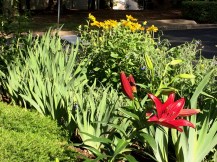
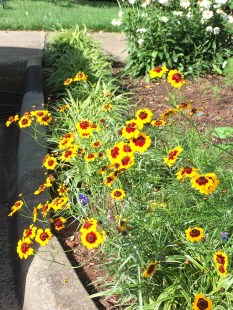
In 2020, I’m somewhat creaky in the knees and a bit too virus-averse to participate in large gatherings, so I admire from a distance the courage and forbearance of many of the protesters (and many of the police officers who work to deescalate tensions, both short-term and longer-term). Meanwhile, I continue to send emails and postal letters to elected officials at all levels. I support voter registration and voting rights initiatives. I sew and give away protective face masks. I tend gardens. I plant flowers. I want to remind myself and others that the flowers have not yet gone. 

lilies and black-eyed susans near our central NC condo

Flowers near our central NC condo

Efficiency and Resilience–Mutually Exclusive?

Efficiency and Resilience—Mutually Exclusive?  —by Jinny Batterson

The stay-at-home phase of the covid-19 pandemic has given me more time to wonder about human futures, along with ready access to the internet and a husband who’s keen to curate podcasts and videos he thinks I would benefit from hearing and seeing.  Last week, he sat me down to watch an hour-long talk and Q&A featuring Dan Ariely, a working-from-home internationally acclaimed psychology professor at nearby Duke University. Ariely contrasted our tendencies toward efficiency and resilience. (https://today.duke.edu/2020/04/using-social-science-aid-fight-against-covid-19).  In a shorter interview printed in an India-based magazine, Ariely explained: 

 “This virus demonstrated that we are ill-prepared for a catastrophe … hospitals are equipped to deal with the standard inflow and outflow. Almost all normal hospitals don’t have extra capacity. Our economic systems are basically designed to work efficiently, as efficiently as possible. But they are not designed for a day of emergency. Very few governments would say let’s put money aside for a rainy day. There are very few companies that do it.” (https://openthemagazine.com/features/pandemic-related-behavioural-changes-wont-last-long-dan-ariely/) 

The notion that we humans too often opt for efficiency over resilience, emphasizing short term gain rather than long term viability, has been around nearly as long as humans have thought and written. It gains traction during times of chaos or rapid change. Books exploring two variations of this idea came out when I was a young adult beginning a career in the rapidly expanding, then relatively new field of computer-mediated commercial data processing. One was Alvin Toffler’s 1970 treatise Future Shock, which theorized that the increasingly rapid pace of change was disorienting to humans being required to adapt on many levels in a short time period. The other, The Limits to Growth, was a 1972 volume co-authored by Donella Meadows, an outgrowth of an early computer modeling exercise to study interlocking factors that might limit the future viability of human societies on planet earth: population increase, agricultural production, nonrenewable resource depletion, industrial output, and pollution generation. 

My attempts to sidestep the shock and stay within the limits have so far been partially successful: I’ve been able to create a wide network of family, friends, and colleagues who’ve helped buffer the impact of multiple life changes by sharing support and humor; partly out of choice and partly through necessity, I’ve been more limited than many in reproduction, food habits, resource use, material output, and pollution generation.  However, these earlier habits have not helped much to inform my response to the novel corona virus. So I wondered, what might Toffler and Meadows have to say about our current dilemmas?  

Both Toffler and Meadows have died. Both left change-studying institutions as parts of their legacy. Toffler Associates (https://www.tofflerassociates.com) presents itself as a “future focused strategic advisory firm.”  Meadows co-founded a predecessor to the non-profit Academy for Systems Change (https://www.academyforchange.org), whose mission is “to advance the field of awareness-based systemic change in order to accelerate ecological, social, and economic well-being,” a tall order in these uncertain times. I’d encourage those of you with time and internet access to explore Ariely’s insights, along with both these groups’ online presence. 

In the Academy’s archives is an article written by Meadows in the late 1990’s, still somewhat applicable: “Leverage Points: Places to Intervene in a System” (http://donellameadows.org/archives/leverage-points-places-to-intervene-in-a-system/) In her article, Meadows argues that many of the interventions we espouse to “fix”  a system are either immaterial or counterproductive. Midway through her exposition of twelve increasingly influential leverage points are “negative feedback loops”: 

“Nature evolves them and humans invent them as controls to keep important system states within safe bounds. A thermostat loop is the classic example. Its purpose is to keep the system state called ‘room temperature’ fairly constant at a desired level. … A complex system usually has numerous negative feedback loops it can bring into play, so it can self-correct. … One of the big mistakes we make is to strip away these ‘emergency’ response mechanisms because they aren’t often used and they appear to be costly.”   

Part of our flat-footedness in responding to a novel corona virus has been the creakiness or absence of emergency human health response mechanisms on a global scale. It’s my hope that we may muddle through this crisis without catastrophic human damage, but with enough impact to prod us toward becoming more resilient, both in our personal choices and in our institutions.

The “Club of Rome,” which underwrote the study on which The Limits to Growth is based, still exists. It still provides cautions about its perceptions of humans’ misappropriations of global resources. But its pronouncements are not entirely doomsday. It continues to embrace, too, the hopefulness of Limits’ conclusion: 

The book contains a message of hope, as well: Man can create a society in which he can live indefinitely on earth if he imposes limits on himself and his production of material goods to achieve a state of global equilibrium with population and production in carefully selected balance.

Earth Has Its Day

Earth Has Its Day   —by Jinny Batterson

Had this been a “normal” year, there would have been big crowds today commemorating the 50th annual Earth Day. There would have been lots of in-person speeches. There would have been live exhibits from corporations and non-profits with a mixture of important initiatives and “greenwashing,” spotlighting small impacts for mainly public relations value. There would have been more exhortations to “reduce, reuse, recycle.” 

This is not a normal year. A small pathogen whose exact origin is still unclear began spreading a respiratory ailment among the global human population in late 2019. As of today, covid-19 had caused nearly 2.5 million known infections and nearly 170,000 deaths. Much of the globe’s human population is on “lockdown.” Public gatherings are few. 

In parts of the world, other variations in nature are wreaking havoc in different ways: a plague of locusts in east Africa is destroying food crops, threatening the food supply of tens of millions; forest fires in Ukraine near the defunct Chernobyl nuclear power plant have recently caused the Ukrainian capital, Kiev, to have the worst air pollution of any place in the world; widespread bush fires during Australia’s 2019-2020 summer have blackened millions of acres and killed roughly a billion animals, endangering such unique species as kangaroos and koalas and putting Australia’s agricultural sector at risk; Greenland and Antarctica have ice sheets that are melting at increasing rates. 

Perhaps earth is reminding us, in increasingly urgent terms, that we are not the masters of the planet, but its guests and its (temporary) stewards. 

For much of my adult life, I’ve accumulated a clipping file of quotations and short pieces of prose that seem meaningful to me. During a personal or societal crisis, I reread them for wisdom. A while ago, I came across the World War II era diaries of Anne Morrow Lindbergh, War Without and Within, edited and first published long after that war was over, in 1980. Anne and her husband, aviator Charles Lindbergh, had spent part of the 1930’s living in Europe to regain some privacy after the highly publicized U.S. kidnapping and murder of their first child.  A pacifist often identified with her isolationist husband, Anne was deeply affected by the 1939 onset of war in Europe and the entry of the U.S. into a globalized conflict in late 1941. A diary entry from Easter Monday during the spring of 1942 expresses both sorrow and hope: 

“Today is the real Easter morning. Yesterday was overcast and chilly. This morning is still, warm, newly awakened. One walks out into it like a flower just opened. …
When I was young, I always felt a morning like this meant a promise of something wonderful … love in someone’s heart far away from me, or the success of some venture of my own. I thought–quite literally–it was a sign from heaven. The person who was ill would get well. … Or maybe something wonderful was happening for the world–some new spirit blooming. … the morning was a ‘sign.’
I still believe it is a ‘sign,’ but not for anything good happening to me or the world, anything specific. The love is not blooming in someone’s heart. The ventures fail. The one who is sick, dies, and the one who is lost is never found. Hate and cruelty and evil are still rampant, war goes on.
And yet it is a sign. It is a sign that in spite of these things beauty still exists and goes on side by side with horror. That there is love and goodness and beauty and spirit in the world–always. This is only one of the times when it is clothed in flesh–in the flesh of a spring morning.”

Amid the global concern about the covid-19 pandemic and the seemingly unending series of recriminations about whose “fault” the pandemic is, there have been occasional notes of clearer air in unexpected places, of a resurgence of birdsong alongside nearly empty highways. 

This morning where I live dawned crisp, cool, bright, with almost jewel-like clarity. May it be a sign. Happy Earth Day!   

To Our Macho Valentines

To Our Macho Valentines 

Dearest Valentines,

We need to talk. 

When a disturbed young man sprays death on twenty first-graders with an assault rifle, when an aging oligarch bases a political campaign on insult, intrigue, and innuendo, when an ex-student defames Valentine’s Day by gun-murdering former schoolmates, when inconclusive wars kill thousands, displace millions, cost trillions, drag on and on,
we are overdue for some serious readjustments.

Our over-reliance on competition, violence, vengeance and
warfare needs to be scaled way back.

Ages ago, marauding bands with the best available clubs and spears made sense. Settlements were sparse, beasts huge, weather harsh. Outward threats were plentiful.
Now billions of us live in cities, where we vainly pretend to manicure and
manage nature, ignoring our dependence. Most threats are manmade, but our fears and habits of protections have yet to catch up with our
changed circumstances.

Human violence has thrust out everywhere: world wars, holocausts, genocides, civil wars, mass rapes, terrorism, alongside more intimate horrors.
We may mouth misleading terms–“collateral damage”–but it doesn’t help.
Our knowledge of the desolation we inflict on each other still sticks in our throats. 

So for a few moments,
drop your swagger,
your snigger, your armor,
your weapons.
Come join our quiet circle.
Don’t bring us presents–
no flowers, no chocolates,
no well-intentioned but futile
promises to keep us safe.

Just sit. Breathe.
No words, no gestures.
Open your senses.
Experience life’s 
interweavings.

Soon we’ll finish.
Then you can go back to media sports.
But first we’ll say our piece plainly:
though we may have admired your youthful feats
of physical or mental prowess, we won’t stop loving you
when injury, illness, or old age waylays you. 

Actually, when you’re not too loud, we love you best of all when you
lie snoring peacefully beside us, just as human and vulnerable as we are,.

With deepest affection,  

Your Partners

While We Were Away

While We Were Away    —by Jinny Batterson

While we were away, heartened by or hiding from
The tropical sun, walking the sandy beaches at dawn
Or swimming in warm waters midmorning,
While we were away, the early daffodils began
Blooming, but the tulips lured by a mild January
Got chomped to the base by browsing deer.

While we were away, the birdbath I’d emptied
To avoid having it cracked by winter ice
Was instead picked up and overturned by
March-like winds, though the bird feeders
Continued their cooler weather work of
Helping prospective parents bulk up for spring.

While we were away, a new-to-humans virus spread from
An initial center at the Chinese city of Wuhan
To most regions of the globe, engendering worry,
Research, and sales of face masks and hand sanitizer,
While the U.S. legislature continued its descent into more
And more abstruse angels-on-the-head-of-a-pin debate.

While we were away, the British government,
Having at length realized it no longer ruled the world,
Completed another step in its bid to ignore that world,
To hoard what remained of its material wealth,
Announcing to erstwhile partners that it had chosen
Instead to take its marbles and go home. 

While we were away, we played old and new games,
Each winning some, losing others. We purchased
Travel mementos from some of the tropical peoples who’d
Made both British and American empires possible.
Returning either tanned or more freckled,
We’ve brought back some adjusted mental context
That may prove useful while we are at home.

Virtual Reality, Deepfakes, 1000 Hours Outside…

Virtual Reality, Deepfakes, 1000 Hours Outside…   —by Jinny Batterson

As a boomer, I notice that my faculties are slowly declining. Also, habits younger folks now have are different from the ones I grew up with. Back in the 1950’s, parents and other adults fretted that we children and teens might turn into zombies from drinking too much unhealthy milk (contaminated by radiation from atmospheric nuclear tests) and watching too much television. Most nuclear testing has by now gone underground. The media landscape has evolved considerably. 

Now we have virtual reality. According to a recent article in Forbes Magazine (https://www.forbes.com/sites/solrogers/2019/06/21/2019-the-year-virtual-reality-gets-real/#3338ad6e6ba9), this technology is rapidly gaining adherents: “Worldwide, VR market volume is expected to reach 98.4 million sales by 2023, generating an installed base of 168 million units with a worldwide population penetration of 2%. Growth is forecast across all regions and countries, with China leading the way.”  Will all of us eventually be festooned with virtual reality headsets that enable us to sense ourselves anywhere, anytime we want?  

A somewhat different concern is the use of artificial intelligence capabilities to produce digitally altered “deepfakes,” seemingly genuine online videos of fictitious scenarios.  Bloomberg News recently raised an alarm:  https://www.bloomberg.com/news/articles/2020-01-06/how-deepfakes-make-disinformation-more-real-than-ever-quicktake. (It may be relevant to note, in this political season, that Bloomberg’s chair, Michael Bloomberg, is a U.S. presidential candidate.) The same day, Facebook announced that it planned to ban deepfakes from its platforms, though without a lot of detail about how it intended to accomplish this. 

My reaction to the ongoing media onslaught has been to avoid too much media exposure. A generally mild January has aided my effort, kicked off by a “First Day Hike” in a nearby state park. Such hikes started a number of years ago, and last year enticed over 55,000 individuals to take January 1 hikes in parks in all 50 states (https://www.stateparks.org/initiatives-special-programs/first-day-hikes/ ).  

The family walking behind me as I hiked were carrying on a lively conversation about a program for their school-age children called “1000 hours outside.”  Started among home schooling parents, the program is an attempt to counteract the tremendous number of hours most youngsters spend in “screen time.” According to the effort’s website blog (https://1000hoursoutside.com/index.html/), “1,000 hours outside, though daunting, is doable over the course of a calendar year… If kids can consume media through screens 1200 hours a year on average then the time is there and at least some of it can and should be shifted towards a more productive and healthy outcome.”

My childhood eons ago was not as scheduled as that of current-day youngsters, but my recollections are that we spent most of our non-school, non-chore time outside, and had to be called indoors to supper, sometimes protesting vehemently. 

As a former computer professional, I’ve spent many hours of “screen time.” I’ve also benefited from advances in transportation technology to travel widely to natural areas around the globe. Through thousands of hours outdoors in many different weathers and climates, I’ve developed a perspective shared by many farmers, fishers, and foresters: We humans are a small part of creation. 

Though we’ve developed technologies with hugely destructive potential, we’d have a much harder time surviving without the rest of nature than the rest of nature would have surviving without the human race. No advances in virtual reality or deepfakes can change that.

Playing for a Tie

Playing for a Tie…   —by Jinny Batterson

Most of the formal games I play are board games. Competitive athletics were pretty much out of the question for this lifelong klutz. Growing up, my brothers, sister and I got lots of gift games at Christmas to carry us through the cold weather months—classics like Monopoly, Clue, Stratego, plus other “big hits” of the time that haven’t aged as well. Once we got a little older, we were given word games like Scrabble. As my vocabulary grew, I got to be a pretty good Scrabble player in my first language, English. In high school, I played a few casual games in French, but English tile values for letters like “q” and “z” were inappropriate and we never got a French-based set, so the Scrabble fad in French club quickly died out. 

In my twenties, I started playing two-person Scrabble games with my husband, the super-competitor. It rarely mattered if I got better letters. He was much better at word placement, racking up double words and triple letters all over the place. Eventually, he’d beaten me so consistently that I decided I didn’t want to play him any more. Much later, we arranged a truce of sorts—we would still play each other, just not keep score. 

Several years ago, a mutual friend introduced us to the word game Quiddler, which can be played more quickly than Scrabble and requires less space, using playing card sized letters rather than tiles and a board. Hubby still beats me the majority of the time, but not by the lopsided proportions he used to tally up in Scrabble. I occasionally have a long enough winning streak so I’m willing to keep trying. We’ve adapted the original rules slightly: we play eight rounds per game, starting with a hand of four cards each, adding one card with each successive hand. The close games are more fun than the really lopsided ones—a hand with no vowels or no consonants, especially in a later round, can put you behind so far it’s almost impossible to catch up. 

Winning is fun, losing less so, but the contests I cherish most are the rarest—about once in a hundred games, we wind up with a tie score. Jim doesn’t get as much satisfaction as I do from the ties, but he humors me. 

On a whim, I decided to see if I could get an internet read on what popular physical sports allow tie games. I found the resulting gem via Wikipedia: 

“Ties or draws are possible in some, but not all, sports and games. Such an outcome, sometimes referred to as deadlock, can (also) occur in politics, business, and wherever there are different factions regarding an issue.”

“Tie” and “draw” appeal to me a great deal more than “deadlock,” which sounds unduly negative. All of us will eventually wind up dead. All of us at some point experienced birth.  While we’re in between, we’ll likely experience some wonderfully positive times (weddings, children’s births, signature achievements, reunions with long-absent friends). Other times may make us wish temporarily for death: serious illnesses or accidents, natural disasters, financial reversals, tragedies for loved ones, divorces.  

In these fraught times, when so much of our media environment can seem intent on making our circumstances feel even more fraught, I want to put in a plug for ties. If we live in the northern hemisphere, we’re approaching the winter solstice, the time of year when daylight is minimal and dark is “winning.” Starting on December 22, though, our 24-hour day/dark cycle will tend again toward balance, toward a “tie” at the equinox. Nature provides two such ties per year. 

Ties have a different connotation than deadlocks; ties can be enjoyable, special.  Let’s learn or relearn how to savor them.   


Selective Memory and Finishing the Work We are In

Selective Memory and Finishing the Work We Are In  —by Jinny Batterson

I can remember parts of events that happened when I was much younger. On Friday, November 22, 1963, I was a Maryland high school student. I remember hearing our school principal start an announcement over the school intercom that day at an unusual time for announcements. I remember coming down the stairwell between the two floors of our building along with many other students changing classes. 

I don’t remember whether the announcement I heard while going downstairs was the first—that President Kennedy had been shot—or the second—that he had shortly afterward been pronounced dead at a Dallas hospital. I don’t remember whether school that day was dismissed early or whether school was canceled the following Monday for his funeral. I don’t remember much about that year’s Thanksgiving the following Thursday. 

Earlier in 1963, there had been a tense standoff between the nuclear-armed U.S.A. under Kennedy’s leadership, and the nuclear-armed U.S.S.R. under Nikita Khrushchev about the positioning of nuclear missiles on the island of Cuba, then led by Communist revolutionary Fidel Castro. I don’t remember whether my dad built a nuclear fallout shelter in our front yard before or after Kennedy was shot.  

Parts of our education when I was a student involved memorizing famous poems and speeches. I can recite most of a short Abraham Lincoln speech from a century earlier, first spoken in November, 1863 at a dedication ceremony for a military cemetery at the site of one of the U.S. Civil War’s deadliest battles:

Four score and seven years ago our fathers brought forth on this continent, a new nation, conceived in Liberty, and dedicated to the proposition that all men are created equal. Now we are …testing whether that nation, or any nation so conceived and dedicated, can long endure.…The world will little note, nor long remember what we say here, but it can never forget what they did here. It is for us the living, rather, to be dedicated here to the unfinished work which they who fought here have thus far so nobly advanced. …It is rather for us to be here dedicated to the great task remaining before us … that we here highly resolve that these dead shall not have died in vain — that this nation, under God, shall have a new birth of freedom — and that government of the people, by the people, for the people, shall not perish from the earth.

In the tragic days after Lincoln’s 1865 assassination, his Gettysburg speech was nearly forgotten. Later, the contents of the speech took on more importance. When the current Lincoln Memorial was dedicated in Washington, D.C. in 1922, the Gettysburg Address was inscribed on one of the monument’s inside walls.  

We are now experiencing another test of the viability of our democratic institutions. Each of us brings different memories to an ongoing impeachment inquiry. Witnesses and questioners interpret incidents differently, partly based on their training and point of view. Our current President ran for office touting the belief that our nation could return to a time when the U.S. was preeminent in global affairs. As an astute businessman, he could “fix things.” Some seem to think his position grants him nearly unlimited license to promote his own interests. Attempts to remove him from office are “character assassination.” Others less charitable to the President point out that our political system is based on checks and balances designed to restrict any one person or political entity from rigging the system to his own benefit, from “fixing things.” 

Absent from the immediate debates and questioning are considerations of the impacts of global over-dependence on fossil fuels to human and planetary health. Scientists tell us that both the United States of America and the rest of the world’s nations have only a decade or so to drastically curb our output of the climate-warming gasses produced by burning fossil fuels if we are to maintain a planet capable of supporting human life as we know it.

On another wall of the Lincoln Memorial is his second inaugural, delivered in March, 1865, just over a month before his assassination. We might be wise to remember its conclusion:  

With malice toward none, with charity for all, with firmness in the right as God gives us to see the right, let us strive on to finish the work we are in, to bind up the nation’s wounds, to care for him who shall have borne the battle… to do all which may achieve and cherish a just and lasting peace among ourselves and with all nations. 

Regardless of the outcome of our immediate political crises, climate change requires all of us to strive on, using whatever tools of intellect, wealth, compassion, and ingenuity are at our disposal, to finish the work we are in.