Category Archives: Quandaries and Rants

Layered Reality

Layered Reality   —by Jinny Batterson

Sometimes, despite fairly consistent efforts to broaden my circle of friends and acquaintances, it seems as if I’m stuck in an ever-shrinking bubble, quarantined in my own little “liberal-urban-retiree” silo. Recently I had a chance to spend a week with our out-of-town grandchildren, exploring a couple of stunning U.S. national parks via outdoor hikes. My guess is that our son and daughter-in-law had carefully coached the kids to humor grandma and grandpa by not overusing their “screens.” We watched a fair number of breakfast-time morning cartoons, but mostly we wandered outside, free from earbuds, television, or other screens. Cell phone coverage was minimal or nonexistent.

Much of our political and cultural life these days, including mine when not hiking with the grandkids, gets mediated by screens. Screen life can often seem tasteless, colorless, instantaneous, disconnected. I realize I’m getting old and slow, but I doubt this is the only cause for our disconnectedness.

I remember a story my rural sister told me. Typically apolitical, Sal had gotten sufficiently exercised in our recent hyper-charged society that she decided to become more politically active. In 2018, she campaigned for a candidate for U.S. congress in the Maryland district where she lives. She and I live in mirrored political entities—both North Carolina, where I live, and Maryland, where Sal resides, are “poster child states” for extreme political gerrymandering. I live in one of a few districts carved out to the benefit of NC’s minority party (in this case, the Democrats). Sal lives in the one district in Maryland that has been allocated to its minority party (in this case, the Republicans). Though our NC polling sites during early voting and on election day fairly consistently have longish lines, the precinct where Sal stood with her candidate’s literature wasn’t busy. Dribbles of voters came by the area where campaigners were allowed, leaving lots of down time. My sister is nothing if not gregarious, so before long she was talking with the two campaigners for the majority party candidate. Carefully sidestepping the merits of their respective candidates, Sal probed for possible common ground. Pretty soon, the three of them were discussing the uncertainty of sale prices for soybeans; the availability of rental drones for quicker, more thorough analysis of field conditions; the best area bulls for improving dairy herds; the impact of changes in agricultural regulations on small-scale farmers. Although there were certainly political opinions where the three of them likely disagreed, they found a good many areas where their interests overlapped and they could be both civil and informative. Their reality was layered with interspersed agreement and disagreement.

Last year about this time, I was in an area of rural France where human habitation goes back hundreds of thousands of years. I got a tour of an archeological site with over a dozen layers of excavation, ranging from about 40,000 to about 15,000 years ago. Now inactive, the site had been carefully dug during a human generation or so, some layers yielding little in the way of artifacts or information, others rich with both. I believe we need to remember that our social and political realities are rarely either/or, much more often layered with both conflict and agreement. Likewise, we are both independent and interdependent.  Please let’s take a bit more effort toward excavating beyond the tweets and the sound bites—our neighbors may be more layered than we know.

Coercion

Coercion   –by Jinny Batterson

You
may be
able
to coerce
my
obedience

even
to bully me
into a forced
smile

but

you
cannot
coerce
my
enthusiasm.


Different Angels from Montgomery

Different Angels from Montgomery   —by Jinny Batterson

Growing up, I wasn’t a huge country music fan. However, like a lot of folks, I developed an infatuation with the John Prine song “Angel from Montgomery” and its signature refrain: “Make me an angel that flies from Montgomery.” Who/what is the angel? There’s some dispute.  One of John’s friends insists it was an angel atop the Montgomery Ward building in Chicago, near where John was raised. Another theory is that “angel that flies” refers to a prison pardon communicated from the office of Alabama’s governor at Montgomery. Such pardons for prisoners were/are much hoped for but seldom granted, especially for those on death row. To my knowledge, Prine himself hasn’t identified the angel.

The song stayed in the back of my mind as I planned a “southern swing” in late winter. I had friends in Atlanta, relatives in southern Georgia and northern Florida. Montgomery, where I’d never before visited, was not that far out of the way.

This initial capital of the Confederacy and nexus of civil rights activism a century later had some museums I wanted to see. Near my downtown Montgomery hotel was a small museum to early country music star Hank Williams, who first rose to fame in Montgomery in the late 1930’s. Though I read the historical marker to his memory and looked at the window displays, this was not one of the museums I came for. Rather, I wanted to spend time learning more about Montgomery’s role during the civil rights era—about Rosa Parks, Martin Luther King, Jr., and the bus boycott that helped usher in a decade of civil rights activism.

In a downtown Montgomery branch of Troy University, a Rosa Parks exhibit reconstructed the events surrounding Ms. Parks’ 1955 arrest and the ensuing bus boycott, complete with a vintage bus. Having a chance to see the actual venue that had produced her and then the year-long boycott brought home her fortitude and resolve, along with the solidarity and resolve of Montgomery’s African-American community.

I’d made advance reservations for another pair of museums and memorials, recently opened by the Equal Justice Initiative. The Legacy Museum and its companion, the National Memorial for Peace and Justice (also known as the Lynching Memorial) show the enduring legacy of racial terror that continues to haunt our nation. The Legacy Museum, a block from Hank Williams’ shrine, documents the horrors of the slavery and Jim Crow eras plus some brutal variants that continue to this day.  One of the museum’s most graphic exhibits is a set of large jars of soil collected from sites of terror lynchings that occurred from the 1870’s up through 1950, peaking in the 1890’s and early 1900’s.

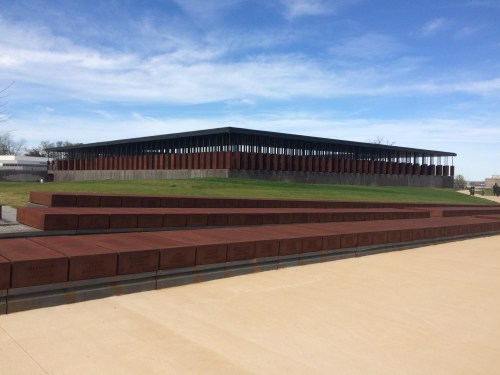
On a six acre site overlooking Montgomery’s downtown, a companion memorial contains two sets of over 800 steel columns, one for each county in the United States where documented racial terror lynchings took place. One set of columns is shielded by a roof. Viewers of the sloping site are led from an initial area where the columns are at ground level toward a section where they hang suspended, like many of the lynching victims they represent.  

Hanging columns at National Memorial for Peace and Justice in Montgomery, Alabama

Words or photos cannot convey the full impact of experiencing a walk among them. The county where I now live in North Carolina had one lynching memorialized; the county in Maryland where I was raised had two. In all, over 4,000 racial terror lynchings have been documented and verified in 20 states.

A second set of columns lies flat on the ground. Rust-colored, it reminded me of the corrosive myths many of us have told ourselves and each other for years, helping perpetuate race-based fears and hatred, going all the way back to the myth of the “happy darky.” There’s the myth of the predatory black man, with its corresponding myth of helpless womanhood. Especially pernicious and pervasive is the myth of white superiority, abetted by the myth of entirely benign police presence aimed solely at preserving “law and order.”

. The duplicate columns are designed to be brought home to the counties where lynchings occurred, as a way to help acknowledge past injustices and then help heal our enduring racial divides. The columns are way too heavy to fly, but these angels represented in Montgomery need to go home. It’s way past time.

Duplicate columns, Montgomery's memorial

duplicate columns lying outside at Montgomery memorial

By now, I’ve become an old woman. Not unlike the wife in Prine’s song, I’m named after one of my grandmothers. I may be old, but I can continue to bear witness. Again paraphrasing Prine’s lyrics—to believe in (and work toward) reconciliation is a good way to go.    

This Year’s February 14

This Year’s February 14     —by Jinny Batterson

This morning the sun rose here earlier than the day before;
The poinsettias a neighbor gave me to nursemaid
After the Christmas holidays droop a bit, but still
Lavish red and pink accents on our late-winter
Condo. My husband sneaks a colorful set of earrings
Onto my place at the breakfast table. Happy Valentine’s Day!

Only this year we add a differently sanguine tradition:
Marjory Stoneman Douglas High School Remembrance Day.
Last year, this morning in Florida started out routine,
Even joyous, until lives were shattered by gunfire.
Does it matter whether the gunman was mentally ill?
Does it matter that he had access to a military-style weapon,
Designed and sold for no other purpose than killing humans?

At 10:17 a.m., schools and workplaces will observe a moment
Of silence, remembering slain students Alyssa, Martin, Nicholas,
Jaime, Luke, Cara, Gina, Joaquin, Alaina, Meadow,
Helena, Alex, Carmen and Peter. We’ll ponder whether
Any of us have the bravery or protective instincts of staff
Members Chris, Aaron, or Scott. We’ll continue to mourn, to
Question what we can do to reduce the chances that
Future holidays will also come to hold dual meanings.
Thoughts, prayers, silent vigils help. They’re not enough.

Additional steps are required. To honor their memories,  go a little
Beyond: Send a pointed Valentine message to your legislator.
Follow up with emails, maybe even visits. Make a donation.
Register and vote. Talk with those of different views.
Find the unique, universal core deep within you,
Then share it. Some holidays exist for us to reclaim.


MLK, Jr. Reweaving the Dreams

MLK, Jr.: Reweaving the Dreams   —by Jinny Batterson

While he was alive, I knew little about him.
The mainstream press in Baltimore barely mentioned
This Negro preacher who’d helped marshal a yearlong bus
Boycott and in the mid-1960’s won a Nobel Peace Prize.
There were rumors he might be a Communist.

I was in high school, with other concerns—
Who could I get to take me to the prom?
Would my SAT scores help me get into a good college?
Would my parents take away my driving privileges
After an accident that I at least partially caused?

By the time I got to college, his star was waning,
Eclipsed by rising black militancy and a war in Southeast Asia
That dragged on and on. His tactics and pronouncements were
Less influential, less obviously successful in northern cities than in
Earlier Southern-based campaigns. Non-violence and preaching peace
Didn’t appear to work against big-city political machines and war contractors.

At first it seemed his dreams had come unraveled when his life ended.
As riots broke out in many American cities following his assassination,
I sat distracted in a secluded dating parlor on a small college campus,
My boyfriend’s bent-kneed proposal and diamond ring a pale foreground
To a muted television backdrop of Baltimore and Washington, D.C.,
Two bookends of my youth, engulfed in flames, sirens, and riot police. 

By the time his birthday was declared a national holiday
In November, 1983, I was attempting to learn and implement
Parts of his dream in rural central Africa. My efforts met with
Little success in a country whose few rich and many poor lived in vastly
Different worlds, with a minuscule middle partly made up of expatriates
Like me. I had lots of time to read the contents of a USAID library.

Martin Luther King, Jr., I learned, was a middle child, born just before
The Great Depression. His family lived in a relatively prosperous black enclave
In segregated Atlanta. During his early studies, he drifted, but partway through
High school he was inspired toward the ministry. He went north and completed
An impressive formal education, earning a doctorate by age twenty-five.

The parts we now recite in school start in Montgomery, Alabama,
Where he was nominated, as a young, little-known preacher, to give voice to the
Aspirations of people who had for too long been shunted to the back of the bus.
After the successful conclusion of the bus boycott, sixty civil rights leaders met
In Atlanta, founded the Southern Christian Leadership Conference, and elected
MLK as its first president.  Then came sit-ins, Freedom Summer, Albany,
Birmingham, Selma, Chicago, a Poor People’s Campaign, a sniper’s bullet.

Those of us who call ourselves progressives winced at subsequent American
Foreign and domestic policy, wrote letters, attended rallies and marches,
Wondered what else we might do to stop, or at least reduce, the madness.
For a while, we thought we had found an answer in another young,
Eloquent brown-skinned man. Twice we elected him national president,
Allowing complacency to creep into our ongoing efforts.

Our current national administration is more nightmare than dream.
It wants us to forget that our deepest dreams are inclusive rather
Than exclusionary, spiritual as well as material. MLK knew this.
He tried to tell us, over and over again, but we rarely listened.

We know MLK had flaws—infidelity, sometimes neglecting his family,
Carrying too much of the movement’s burden by himself.
We do not need another plaster saint, of whatever skin hue,
But Coretta was right to insist that we honor MLK with a holiday.
Though not free from sin or error, he was also a prophet
Who recalled us to our best selves. May we remember
His efforts as we redouble ours, reweaving stronger dreams.

What We Pay Attention To Matters:2018 Mid-Term Voting

Here in North Carolina, we have the option of voting early—this election cycle, nearly three weeks early.  On the very first day of the eighteen days set aside for early voting in the county where I live, I cast my ballot.  I’d earlier signed up to work as a non-partisan election official at one of the early voting sites in our county.  Because of this temporary job (and because I need to spend at least some of my time sleeping), I’ve been sheltered from widespread exposure to news events and negative campaign advertising. This has proved to be a blessing. 

Once I finish my early shift at about 2 in the afternoon, I come home, take a nap, take a walk, share an evening meal with my husband, then bed down early so I can repeat the cycle, starting at 4:30 a.m. the following day.  I’ve been vaguely aware of hateful tweets and sporadic violence, but mostly I’ve spent my after-dark hours sleeping and my before-dark hours either working or enjoying autumn weather outdoors. 

On the job, we’re forbidden to talk politics, a wise decision, I believe. Still, from some of the partial stories other workers have shared with me, I get the impression that we represent a pretty wide range of backgrounds and political persuasions. We have younger workers, some coping with student debt, others concerned about underemployment—mismatches between the skills they’ve trained for and the jobs they’ve found so far. We have middle aged workers who worry about aging parents and/or the fluctuations in their 401Ks in a volatile stock market.

The long and short of voting at a central NC early voting site

We come in all colors, shapes, and sizes, from a petite ballot handler to a former basketball center. Some older “temps” are retirees like me; others still work part-time, sandwiching in scant time for personal lives amid hectic work schedules. One of my 60ish white coworkers has a vocabulary that suggests he may not have had the same chances for formal education that I did. His line of patter can sometimes border on bigotry, yet he spent some of his off-hours last week comforting a black colleague whose wife had a terminal illness. 

Our range of voters also is wide—from the just-turned-18 to a frail elderly woman whose grandson wheeled her into the voting area to cast her ballot one more time. She was born in 1920, the year that women in the U.S. first obtained the right to vote in national elections.  We see office workers on their lunch hours, professors eager to encourage their students to vote, students puzzled about voting procedures, custodians, construction workers, and others whose dress and demeanor defy easy labeling. 

It would be unrealistic to believe that our democracy is in great shape. Being subjected to predictably inflammatory tweets, predictably bloody lead news stories, and predictably negative campaign advertising can be discouraging. Whatever the outcome of this current voting cycle, we will have lots of work to do to help heal some of the breaches in our social fabric, whether we are citizens or elected officials. Yet I’m encouraged by the civility of the voters and polling officials in the small corner of the electorate where I work. Many people DO show up to vote, over a million so far in North Carolina. They wait in line, sometimes chatting with each other. They’re glad to get their ballots and to make their opinions known.  Perhaps if we pay more attention to what’s going well, we may be in a better position to help alleviate what’s not. 

Softening Hearts, Hardening Infrastructure, Widening Perspectives

Softening Hearts, Hardening Infrastructure, Widening Perspectives

                                            —by Jinny Batterson

It’s been a rough couple of months here in North Carolina: two hurricanes (Florence, then Michael), a polarized government, widespread agricultural losses, increasing poverty, damaged schools and infrastructure. 

Yet there’s been heartening news as well. Many established charities such as the American Red Cross have sent disaster recovery teams to the worst impacted areas. Local citizens in areas less damaged by the storms have created both short-term and long-term relief efforts. A neighbor who specializes in local fundraising set up a Sunday-afternoon event at a nearby shopping center and raised over $10,000 in cash plus thousands of dollars worth of non-perishable food and household goods for hurricane relief. Because of the extent of the damage, both in the Carolinas and elsewhere, it will take continued efforts by private donors, non-profits, government agencies, and financial institutions to help promote recovery.  The natural environment will never be the same; repairs, rebuilding, and/or relocation of homes and businesses will take months if not years. 

After hurricane Florence decimated the coastal Carolinas, major roads and interstates were flooded and impassable for over a week, making cities such as Wilmington, North Carolina effectively islands.  Residents who’d evacuated were asked not even to try to return home as soon as the first few roads were reopened—what limited road travel was possible needed to be reserved for emergency and supply crews.  Now that the immediate crises are over, people are starting to grapple with longer-term problems: should rebuilding be limited in areas that seem more and more prone to drastic weather?  Should building codes be changed? How do we adapt our infrastructure to be more resilient? Do we need to pursue alternatives to a predominately road-based transportation network?

Simple solutions seem elusive and likely counterproductive. Perhaps we need to rethink some of the implicit assumptions we’ve made about how the world works.  Rather than considering ourselves outside nature, it may be time to widen our perspectives and acknowledge that we humans are just one piece in a complex, evolving whole.  Among the groups that have challenged some of my existing perceptions are:

Transition networks (https://transitionnetwork.org/), a set of local-global initiatives to work toward more resilient local economies in the face of escalating global challenges

Bioneers (https://bioneers.org/), harnessing scientific knowledge toward solving human problems

Biomimicry 3.8 (https://biomimicry.net/), which looks at other life forms (some with over 3.8 billion years of experience on earth) for innovative ways to re-engineer human-made systems

What partial solutions have you discovered?  What “small/local” actions are you taking to make our future more livable?  Please share some of your thoughts. 

Is Anyone Really Stealing American Jobs?

Recently, a friend forwarded to me an email of guidelines for “buying USA,” comparing some everyday items, from greeting cards to toothpaste, that are marketed in the U.S. but now are often made in other countries. I have no objection to buying more of the goods I use from hardworking Americans, but I do object to thinly veiled inferences that workers in China (or Mexico, or some other lower-wage country) are stealing American jobs. Wording of the message forwarded to me matches one posted by a real estate developer from near Charlotte, NC in March, 2016, as that year’s election cycle was heating up (see https://www.linkedin.com/pulse/ace-hardware-made-usa-very-encouraging-david-e-johnson-pe). My initial reaction was: Oh, rats! Here we go again, blaming job losses on low-wage workers in other parts of the world. Actually, those workers play a small and diminishing role in American job losses. I’m concerned at both recycled and more recent posts and tweets that try to persuade Americans to support tariffs and trade wars in order to save American jobs. 

Over the past forty years, I’ve been able to spend a fair amount of time visiting with workers in China. They don’t want to steal anyone’s job. Like workers everywhere, they want to improve their lives and the lives of their families. In the 1940’s,1950’s and 1960’s, many Americans left grinding rural poverty for better manufacturing jobs in cities. In the 1980’s and 1990’s, many Chinese similarly left the countryside in search of better paying urban jobs. By now, Chinese wages have risen. After trying to ignore pollution for too long, the Chinese government is tightening regulations to rein in unfettered industrialization that has significantly shortened Chinese lives. Some jobs are leaving China for other countries with even lower wages and/or laxer environmental rules.

After I sent a semi-coherent reply to my friend, I took some time to simmer down and reflect at my good luck in retirement. So far, my retirement income is comfortable enough so I can afford to be selective in my buying habits. As much as possible, I patronize local sources. First in Vermont, then later in Virginia and now in North Carolina, I shop local farmers’ markets; when eating out, I seek out restaurants that source locally grown food. For less-localized items, I check labels along with prices to see where a product originated and how it was produced. Even if they’re somewhat more expensive,  I sometimes buy U.S.-made goods to help support American workers. At holidays or when buying specialty items, I often purchase “fair trade” products so that some of my coffee, chocolate, and gift purchases will help support those with the lowest wages. Overall, I try to be an informed, careful, caring consumer.

Despite all sorts of “buy from nearby” campaigns, despite what we may want to believe about fair and unfair trade, for at least a generation the biggest cause of job losses worldwide has been the quickening pace of replacing human workers using automation. According to a Financial Times article published in late 2016 (https://www.ft.com/content/dec677c0-b7e6-11e6-ba85-95d1533d9a62, December 2, 2016), about 85% of U.S. manufacturing job losses between 2000 and 2010 were due to automation. The same article compared the average hourly wage for a human American welder ($25) with the operating cost to have a robot do the same work ($8). If you include the installation and maintenance costs for the robot, the gap narrows slightly. However, the cost difference is substantial and likely to grow. 

Some trade agreements can damage the interests of workers and/or put at risk the natural environment that supports human life as we know it. Global trade has rarely been without its distortions and inequities. (For example, ask almost any Chinese about the British 19th century practice of exporting opium raised in British colonial India into China to offset the costs of British imports of tea and porcelain. Consider the trans-Atlantic slave trade.) Negotiating worthwhile trade deals can be both time-consuming and extremely difficult—blogs or tweets inevitably oversimplify. 

One of my grandfathers lost his job in 1930 when the company he was working for at the time replaced their human bookkeepers with calculating machines as a cost-cutting measure. On President Herbert Hoover’s final full day in office, March 3, 1933, he signed the “Buy America Act” that had recently passed the U.S. Congress. The Great Depression of the 1930’s was not solved.

Americans suffering from job losses need assistance and encouragement rather than attempts to divert the problem onto others. Automation, used wisely, can help improve lives; used foolishly, it can devastate human workers, even entire communities. Global competition, used wisely and fairly, can help spur innovation and growth. Used foolishly, it can pit groups that have many common interests against each other.

Blaming does not solve anything. Please let’s take time together to consider the deeper issues. 

Testing the Alarm System

Testing the Alarm System   —by Jinny Batterson

Wisps of smoke color our East Coast sky
As across our media screens dance
Sheets of flame from West Coast wildfires.

In Miami Beach, tourists get wet feet
Nearly every high tide. In Alaska, melting
Permafrost leaves larger and larger sinkholes.

From time to time, our mid-Atlantic region
Gets buffeted by hurricanes. Summers veer
Between drench and drought. Just now, neither.

I set out on an early morning walk to outpace
The heat and humidity that will settle all too soon,
Once the sun is well up and shade recedes.

Already, morning traffic is picking up along
The commuter artery where my walk begins.
I stay to the shady edge of the sidewalk.

My immediate goal is an off-road greenway;
Its entrance takes off just shy of a big new
Apartment complex.  Almost there–relief!

When I’d first started this walking loop several
Years ago, there were no apartments, only acres of
Second-growth woodland with a greenway in the middle.

I’d watched with dismay as the woods to the path’s left were reduced
To a mere comb-over, the rest cleared, gouged, then built over,
Paved or mulched, adorned with small shrubs and spindly saplings.

Just as I turn onto the path, a racket like the quacking
Of the Aflac duck, but amplified to ear-splitting intensity,
Erupts from somewhere within the apartment complex.

Three short blasts, short silence, three more, on and on.
No place to hide from the noise. No sirens, though.
No evidence of smoke or flame.  What gives?

Wandering the parking lot in search of an answer,
I eventually find a fellow in a hard hat getting
Out of a pickup.  “Is there an emergency?” 

“No, ma’am. They’re just testing out the alarm
System to make sure it works, before the next
Phase of the complex is opened for occupancy.” 

Radio Mille Collines and the Limits to Free Speech

Radio Mille Collines and the Limits to Free Speech   —by Jinny Batterson

Each of us beyond infancy is, I believe, a product of both nature and nurture. Genetic traits and predispositions we’re born with get adjusted over time by our experiences and our successive re-interpretations of those experiences. I seem to have been born with a predisposition toward nervousness, so it’s probable that the name-calling and mud-slinging that too often inhabit media and political spaces in current-day America feel more threatening and more repugnant to me than they might to someone with a less nervous temperament.

Still, my “nurture” plays a role as well. During the 1980s, I spent two years in the economically impoverished central African country of Burundi working on rural development. Before I went, I did as much research as I could in those pre-internet days about the country I’d be living in for a time: Burundi was for most of its history a sparsely populated, geographically isolated mountainous kingdom with a preponderance of rural herders and farmers. Then, starting in the late 19th century, Burundi became first a German, then a Belgian colony, administered along with neighboring Rwanda. Neither colonial power provided much development support. During their four-plus decades of rule, Belgian administrators often used “divide and conquer” tactics, exacerbating tensions between the area’s two main ethnic groups: the Tutsis, most of whom owned and herded cattle, and the Hutus, who tended instead to farm multiple small plots owned communally by extended families in the Burundian and Rwandan hillsides, or “collines.” Since its early 1960s independence, Burundi’s trajectory has included political assassinations plus a massive ethnic conflict in the early 1970s that killed an estimated 300,000 Burundians. 

When I first arrived, I spoke none of the local language, Kirundi. I had little notion of which of my coworkers and neighbors were Tutsi and which were Hutu. Physically similar, with the same language and skin tone, Tutsis and Hutus were sometimes characterized as “talls” and “shorts” in an exaggeration of one trait that distinguishes them at the extremes. Because of intermarriage, a fair number of Burundians were and are a mixture of both groups. During my stay, I gradually built up a very basic Kirundi vocabulary. Though fluency remained beyond my grasp, I understood enough so that when I attended a local soccer game about halfway through my assignment, I recognized the derogatory use of a word meaning “short,” yelled at the opposing team by some nearby spectators. Not quite as offensive as the “n” word in American speech, the epithet was still intended to be disrespectful. 

During the 1980s, Burundi and neighboring Rwanda were relatively calm, but starting in 1993 both countries again descended into wholesale bloodletting, with the widely publicized Rwandan genocide of 1994 and a less-media-covered simmering civil war in Burundi.  Part of the build-up to the Rwandan genocide consisted of incitements by a privately owned radio station, Radio Mille Collines (Radio of a Thousand Hillsides), against ethnic Tutsis and moderates of all groups. According to a summary by the Montreal Institute for Genocide and Human Rights Studies:

“From October 1993 to late 1994, Radio-Television-des-Mille-Collines (RTLM) was used by Hutu leaders to advance an extremist Hutu message and anti-Tutsi disinformation, spreading fear of a Tutsi genocide against Hutu, identifying specific Tutsi targets or areas where they could be found, and encouraging the progress of the genocide. In April 1994, Radio Rwanda (the official government station) began to advance a similar message, speaking for the national authorities, issuing directives on how and where to kill Tutsis, and congratulating those who had already taken part.”  The Institute has published detailed transcripts of many of these station broadcasts in English, French, or Kinyarwanda, the Rwandan local language.

After the genocide and a change of government in Rwanda, international criminal proceedings brought to trial some of the political leaders of genocide-era Rwanda, along with some of the media leaders who had helped foment hatred with their increasingly strident broadcasts. Not all ringleaders could be located and brought to justice, but 92  high-ranking defendants were indicted for their roles in a 100-day rampage that killed an estimated 800,000 Rwandans.

As we approach the 50th anniversary of the assassination of Dr. Martin Luther King, Jr., I sometimes fear for my own country and for our planet. Derogatory speech is again on the rise globally, whether from politicians, media pundits, or just disgruntled citizens and residents. Americans belonging to groups who have in the past been targets of repression and/or genocide—African-Americans, Jews, immigrants, LGBTQ persons, among others—feel the impact most deeply, but it affects us all.  As one European Jewish leader put it, “While hate speech and incitement is far too often dismissed as bigoted ranting or merely painful words, it can also serve as an important warning sign for much more severe consequences. Almost every genocide, ethnic cleansing or inter-ethnic conflict in modern history was preceded by violent words. We witnessed inflammatory public speech rise steadily before outbreaks of mass violence, whether in Nazi Germany, Rwanda or in the former Yugoslavia.”   

Of course we need to be able to express opposing views, but we need to be able to express them civilly, rather than by using name-calling, blaming, or personal attacks. Free speech is not the same as hate speech or incitement—please let us learn and teach the difference before it’s too late.