Category Archives: Everyday Wonders

Wedding Dress Trees: Of Bradford Pears (and Gnarled Old Oaks)

Wedding Dress Trees: Of Bradford Pears (and Gnarled Old Oaks)    —by Jinny Batterson

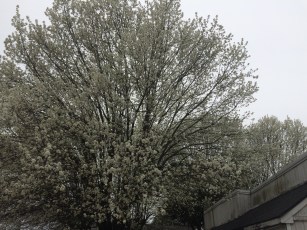
A Bradford pear in bloom

Yesterday was a dreary day, made more dreary for me because it contained a memorial service for an elderly former congregation-mate.  We’d had a wetter than usual winter. It seemed the rain would never go away.  Precipitation since the first of December was running about 40% above average.  A late-winter jaunt that my husband and I had recently taken to cities further south had been largely unsuccessful at getting away from the wet. A few sunny days, but mostly just more rain. 

After the memorial service, I drove back toward our condo. The weather alternately showered, drizzled and misted, continuing its uninviting pattern. The white roadside blooms of our area’s Bradford pears and their naturalized cousins temporarily brightened the landscape. A few of the trees reminded me of inverted wedding dresses—puffy, full, virginally white.

I knew a little about this species of tree. Near my former home in Richmond, Virginia, rows of them had been planted as street trees during the 1970’s or 80’s. There, they’d provided ethereal beauty for a couple of weeks each spring. When young, the trees were a welcome addition to the landscape. However, as they aged, they produced mostly headaches. Few lived past twenty, not very old for a tree. Their brittle wood had a tendency to split any time there was a wind stronger than a gentle breeze. During thunderstorm season, city maintenance trucks performed branch clearing chores so regularly they might as well have parked for the summer along the pear-lined street.

Curious for more information about the history of both our departed elder and the Bradford pear, I clicked a few online keys.

According to the obituary that I belatedly read, “Old Jim Quinn,” a long-term member of the UU Fellowship of Raleigh, had served in the military in post-war Europe, but otherwise spent nearly all his 87-plus-year life in North Carolina. He’d married Sonnya, his “Super Chick,” in 1955. During the 1970’s, he’d served two terms on the Raleigh City Council. Later, he and Sonnya became regulars at civil rights marches and demonstrations. Along the way Jim had sired and helped raise several children, designed buildings, helped promote affordable housing before it became a buzzword, and served in numerous other civic capacities. He was known far and wide for his barbecue skills. By the time I knew him slightly, he was gray and a little stooped, if still quick with a smile and a witty remark. 

According to a somewhat critical article (https://www.greenvilleonline.com/story/life/2016/03/21/curse-bradford-pear/82070210/), the Bradford pear was introduced as a landscape tree by the U.S. Department of Agriculture in 1964, imported from its native China and presumed to be sterile. Before long, it was an urban landscape fixture in cities throughout the Southeast. As the first trees aged, problems with their brittle wood became more apparent. Later, problems with cross-pollination with other pear varieties showed up, along with the invasive nature of some hybrid offspring. By now, most towns have stopped planting new Bradford pear cultivars. Some jurisdictions and homeowners have even begun active attempts to rein in Bradford pears and the offspring that can form dense thorny hedges and crowd out native flowering trees.

Bradford pear blossoms

Raleigh, long-time home to Jim Quinn, bills itself as the “city of oaks.” There’s a gnarled old specimen behind our condo, not unlike the gnarled older version of Jim I used to see at church. If Sonnya once in a while looks at her long-ago wedding dress or passes it on to a granddaughter or great-niece for reuse, she must constantly miss the gnarled old oak her life mate grew to become. Here’s to you, Old Jim Quinn.    

Experiments in Car-Less Living

Experiments in Car-less Living    —by Jinny Batterson

My body periodically tells me it’s no longer young or limber—creaky knees, back twinges, huffing up hills, diminished stamina, hearing difficulties, memory lapses.

The biggest problem is my eyes. Most of my life I’ve been nearsighted, my vision corrected with either glasses or contact lenses. Unfortunately, my aging orbs have recently developed both glaucoma (probably an inherited trait) and cataracts. The glaucoma, caught early, has done minimal harm, with further damage slowed or stopped by medication. The cataracts will sooner or later require corrective surgery. In the meantime, my night vision is declining. I try to avoid driving after dark. For those evening events I really don’t want to miss, I do my best to catch rides.

Last weekend I traveled out of town to my previous hometown of Richmond, VA. During this midwinter solo getaway, I’d visit with former classmates and friends, touch base with my financial advisor, attend a couple of public events. The trip could be a more extended experiment in getting along without a car. I’d made a provisional plan:

1) Get my accommodating husband to drive me and my luggage to the train station, then take the Friday morning train north from Raleigh, NC.

2) Get a former college suite mate to pick me up at the Richmond station and shepherd me around to that day’s activities, then drop me at the suburban hotel I’d booked near my other weekend events.

3) Line up two other friends who lived near the hotel to be my companion/chauffeur, one each for the two other weekend days, with my “Sunday driver” depositing me back at the Richmond train station in time for the mid-afternoon southbound train.

4) Phone hubby and have him pick me and my luggage back up in Raleigh.

The start of the plan worked well—hubby complained only slightly about getting up early enough to drive me to the train station; the train, though slightly late, was very comfortable; my classmate met me promptly at the Richmond station; we shared a leisurely restaurant lunch nearby and began catching up on our respective lives. She then drove me to my Friday afternoon appointment downtown. I wasn’t sure how long it would last. My friend assured me she’d be available for further ferrying duties—just phone her once I was done. After she deposited me at the appropriate high-rise office building, she drove off westward to share babysitting chores with her husband, spending some quality time with their most recent grand baby.

The meeting was briefer than I’d expected, so I decided to experiment with the new high-speed bus that ran from the downtown area west to a shopping center near where my friend and her husband were babysitting. That way, I figured, I’d save her from coping with downtown traffic plus have my own little adventure with public transportation.

The infrastructure of the new bus line was impressive: a dedicated bus lane, ramps to raised bus stops imbedded in the median of a major east-west street, automated ticket kiosks. The first kiosk I came to was out of order. I asked a woman waiting for the next bus where I could get a ticket headed west.

“Maybe the machine at the next stop is working,” she told me, “but it’s quite a ways.”   

Turns out one of the design changes for the new line increased the distance between stops. I walked about half a mile, got a ticket, then waited fifteen minutes for the next bus. Overall, the five mile trek to the shopping center took me more than an hour. Not a huge problem for me. Potentially hard on someone with a tighter schedule and/or mobility problems.

After my “Friday chauffeur” had picked me up at the shopping center, we’d caught up more over coffee, and she’d deposited me at my hotel, I got a plaintive phone call from Saturday’s ride. She’d broken a bone. She was in pain, with her arm in a sling. She was temporarily in no shape to drive.

Due to my friend’s injury, my Saturday logistics would be more complicated. Luckily, I’d installed an app on my phone for one of the ride-sharing services that’s recently sprung up in some American cities. An exploratory check for potential rides turned up multiple possibilities. My scaled back Saturday itinerary could be satisfied using a combination of public bus, walking, and Lyft. On Saturday morning, the hotel front desk directed me to a nearby bus stop; my first errand was just over a mile away along the bus line; a return walk to the hotel was doable, though there were gaps in the sidewalk on a busy street. In the afternoon, Lyft rides to and from my event were less expensive than I’d feared. I found a supper restaurant an easy walk from the hotel. My Sunday ride was healthy and punctual. Needing her chauffeuring was a good excuse to catch up. Hubby picked me and my luggage up with minimal griping.   

My aging eyes have got me thinking about our society’s over-dependence on private automobiles. If I’d previously listened to the frustrations of car-less friends and acquaintances with a mixture of pity and amusement, my turn for similar frustrations might arrive sooner than expected. I’m still lucky—I can afford and access alternatives. People with limited economic means can rarely afford a car, for-fee ride-sharing, or extensive public transit. In rural areas, suitable transit isn’t often available. This morning I awoke to a cold snap that had made outdoor temperatures so frigid that in some northern areas, schools and offices were closed, and even the U.S. postal service had temporarily halted deliveries.

An aging population, income disparities, geographic sprawl,  and climate change will severely stress a society accustomed to hopping in the car for every errand and need. Public transportation in the area where I live is spotty, but I’m going to learn more about riding the bus (https://gotriangle.org/how-ride-bus), using ride sharing services, and occasionally engaging a customized pick-up service our town provides. What are your options? 

Who Did You Expect?

Who Did You Expect?     —by Jinny Batterson

My life so far has been fortunate—no privation, little discrimination, generally good health, many chances for love and adventure.  Much of the time, though not always, people I’ve met have lived up to (or beyond) my expectations. On those rare occasions when someone’s behavior has disappointed me, more cynical or world-weary friends have shrugged at what they regard as my naiveté. 

“Of course so-and-so let you down,” they’ve announced. “What did you expect?”  

Increasingly for me,  the appropriate question is rather “Who (or, for the grammar police, “Whom”) did you expect?”  As I mature (a work in progress), I become more aware of instances when I’ve pre-judged people and turned out to be fairly far off the mark.

The first occasion that stands out is my initial in-person meeting with the leader of our 1980 group tour to China. In those pre-internet days, I’d exchanged postal letters and paperwork with Ms. Baum and talked with her on the phone. Until we both arrived in San Francisco’s airport departure lounge for our trans-Pacific group flight to Hong Kong, I had not actually met this native New Yorker. I’d assumed from her accent and phone demeanor that she was of Jewish background. She seemed somewhat pushy and no-nonsense, ready to take on the world. I was surprised to see that she was African-American, not ethnically Jewish. She could be somewhat pushy and no-nonsense. Her prior experiences as both social worker and travel agent had prepared her well to take on whatever bureaucracy attempted to get in her way, regardless of ethnic origin or nationality. She turned out to be both different from and similar to the “who” I’d expected.

Earlier this fall, I signed up to work the polls in the 2018 mid-terms. After on-site training, I exchanged emails with the woman who’d be my site supervisor for early voting. Her written English was good, clear and simple. Her family name was a common one, her given name, ending in “a,” suggested to me she might be African-American, or maybe Hispanic-American. When we met, I could detect no skin coloring or hair texture to suggest ancestral links with Africa, no hint of foreign origin in her accent. She seemed at first a very “vanilla,” somewhat conservative American. During our work, she showed her passion for ensuring that anyone who wanted to vote was given maximum opportunities to do so. She’d sit patiently with someone lacking appropriate credentials, or with an address not yet entered into the electoral system database of rapidly growing Wake County. She knew the rules well. She could suggest pulling up an electronic copy of a utility bill on a portable phone. She might advise going home to retrieve a needed ID and then returning later in the day. In rare cases, she’d have the potential voter fill out a provisional ballot, explaining how and when to check whether their vote had been counted. The workforce she’d helped assemble to follow her lead was the most visibly diverse I’ve ever participated in. She was both different from and similar to the “who” I’d expected.    

I’ve just spent Thanksgiving with parts of my extended family that I barely knew growing up in Maryland in the 1950’s and 60’s. Only once had I had a chance to visit these North Carolina farmer cousins from a rural area near Charlotte. What little I remember from that farm stay involves ponies tame enough so even I was persuaded to take a short ride. I got to see my grandmother’s sister-in-law make glorious biscuits using milk straight from the cows. The cousins closest to my age teased me good-naturedly about my lack of country skills.

After moving to North Carolina a decade ago, I became reacquainted with some of the cousins who’d left the farm to settle in Raleigh. They’d tell me enticing stories of an extended family Thanksgiving gathering at “the shed.” I pictured the locale in my mind: an expanse of gently rolling hills, empty except for a few horses or cows grazing in pastures. “The shed” would be a slightly cleaned-up farm outbuilding. Twenty or so aging cousins of Scots-Irish ancestry would assemble for our midday meal, then say interminable grace before we could eat. Someone would have cooked a turkey and brought it still warm to the feast. We’d eat plentifully, exchange pleasantries, carefully avoid politics, and then everyone would go home.

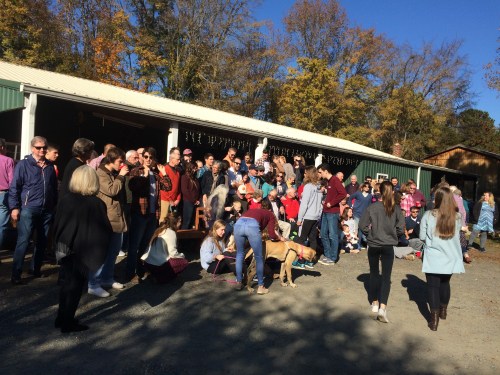
This year as we drove into the neighborhood nearest our destination, I had trouble reconciling my mental image with current reality. The surrounding area may once have been farmland, but the vicinity had long since become part of suburban Charlotte. A mid-rise apartment complex dominated the nearest street corner. The “shed ” had been expanded and modernized from an earlier role as storage space for some cousins’ plumbing business. It was now a comfortable, well-appointed venue with adjustable seating for up to a couple hundred people. Nearly that many cousins of all ages were in attendance, along with baby equipment, pet dogs and a few footballs.

We did have a short sung grace before the long, snaking buffet line formed. We did generally steer clear of contentious political topics. People caught up on family news since the previous get-together. One 20-something cousin had recently returned from an extended Peace Corps stint in South America; in the next generation up, a househusband described his four years of helping school their daughters while his family was on assignment in southern Europe. One attendee I didn’t get a chance to talk with directly had a skin tone and accent that implied ancestry or origin in India. The Reas still cherished their rural roots and pioneering ancestors, but the clan had gotten more diverse and widely traveled—both different from and similar to the “who’s” I’d expected.

The remaining holidays of late autumn and early winter are likely to have more extended family gatherings and chance meetings. May I remember not to pre-judge those I encounter, to be more careful not to let “who I expect” get in the way of meeting current reality with an open mind and heart. 

Rea Thanksgiving at “the shed”

Aubrac’s Fields of Wild Jonquils

Aubrac’s Flelds of Wild Jonquils    —by Jinny Batterson

In late May, as I was walking across a sparsely settled upland French plateau along a stretch of one pilgrimage route of the Camino de Santiago de Compostela, I encountered a delicious fragrance—delicate and sweet and lingering. I wasn’t sure where it was coming from. Despite, or perhaps because of, a fair amount of rainy weather, the meadows and woodlands abounded in spring blooms, many of them unfamiliar to me.  That evening at the small guest house where we had booked a room, I noticed a vase of flowers with the same delicate fragrance. I asked the proprietress what these small white blooms were called. “Jonquils des poètes,” she told me in French.

I’m not sure what the English equivalent is. The internet pictures I’ve found of “Poet’s jonquils” look similar, but not identical to the flowers I remember from my trip. A few days further into my journey, I arrived midmorning at the tiny town of Aubrac, after spending a couple of hours crossing several miles of minimally fenced upland pastures dotted with jonquils des poètes, some being contentedly munched by local cattle. The weather was cool and misty.

At the near edge of town was a forbidding-looking Romanesque structure. A guide was explaining to a group of tourists in a language I could not understand the wonders and historic significance of this church. According to the French signpost I could partly understand, this former Benedictine monastery was at least a thousand years old and likely built on the foundations of an even earlier structure.

Most of the other buildings along the road and edging the upland pastures were hotels, hostels, or small inns. I noticed one small cafe/guest house that seemed to be open. Several of us stopped and picked out an outdoor table under a protective awning. A warm drink seemed a good idea. It took a while for anyone to come to take our orders—after a bit, an elegant young woman showed up, apologizing somewhat for the delay, explaining that she and the other town residents were all still stressed out from the previous weekend’s “transhumance” festival that annually draws thousands to the area. I’d seen pictures and postcards of this celebration of the opening of common upland pastures for the area’s prized cattle. A nearby town square was still littered with floral garlands and signs from the festival. (Find a set of commercial pictures of the 2018 festival here: http://hotel-lion-or.com/aveyron/fete-transhumance-aubrac/

When our hostess finally brought our coffees and hot chocolates, she stopped to take a smoke break and we began to ask her questions. All of us were curious about the town, whose year-round population has dwindled markedly from a peak over a century ago. Until the late 19th century, our hostess told us, Aubrac had been a traditional farming village, but the harshness of the climate and the difficulty of earning an adequate living caused many farm families to leave the area and seek better lives in French cities. Lots of the adults became small shopkeepers or restaurateurs in and around Paris. However, they retained cottages in Aubrac and continued to bring their families for summer vacations in their former hometown. At about the same time, some area doctors discovered that the clean, cool air in the Aubrac highlands helped tubercular patients. Several tuberculosis sanatoria were opened over the next decades—some have since become hotels or hostels. Most of the local economy now revolves around tourism, compressed into the three or four months of warmer weather. The local cattle, a special hardy breed, supply photo opportunities as well as milk or meat. 

Our hostess explained between puffs that she was even busier than she’d expected post-festival: her five rooms were all rented for the week—a group of businessmen from New York City had come to explore the option of buying quantities of jonquils des poètes to use in a new upscale perfume fragrance. She said that this particular type of jonquil only grew in the wild and had not yet been successfully cultivated.  Some of each year’s blooms already were collected by locals to supply French perfumeries in the southern city of Grasse, a noted perfume center.

I never got to meet the businessmen, who most probably were jet-lagged and perhaps also technology-deprived in this isolated small town. My current exposure to a former-NYC-businessman-turned-politician has temporarily soured me on the ethics and business practices of some.  My hope is that if a deal is struck, the good people of Aubrac will be fairly compensated for their labor and their wild-growing fragrant white blossoms.  I also hope that enough flowers will be left in the fields so that cattle, pilgrims, and residents can continue to enjoy their essence in their native habitat.    

Dragon Kites on Tiananmen Square

Dragon Kites on Tiananmen Square    —by Jinny Batterson

(Portions of this post have been adapted from my upcoming book, Where the Great Wall Ends: A China Memoir, due out later this year.)

A growing number of locations world-wide are sponsoring kite festivals. In the town where I now live, March winds bring out people of all ages, eager to enjoy the outdoors as winter ebbs, to search for just the right spot and orientation to launch their creations skyward. The basic homemade wrapping-paper-and-balsa-strut diamond shaped kites I flew as a child pale in comparison with the elaborate heirloom and contemporary kites that participate in some of these festivals. A quick internet search turned up an American-based kite flyers association with members in 25 countries, with at least one U.S.-based festival in every month of the year.  (http://kite.org/activities/events/event-calendar/)

One blustery spring day in 2000 on Tiananmen Square in Beijing, China, I got to see a few of the world’s most cherished, most elaborate kites. My husband and I were partway through a tourist stay in Beijing. Our first two days had been filled with organized guided tours: the Forbidden City, a nearby section of the Great Wall, the Summer Palace, some of the subterranean tunnels built under the modern city during the 1960’s and 1970’s to shelter residents in the event of a bombing attack by “the Soviets or another country,” as our tour guide put it. Now we had a free day to explore on our own. We decided to return to the vicinity of Tiananmen Square.

As we approached, we noticed several box kites bobbing and weaving in the sky above.  Once on the square itself, we found several older men preparing their heirloom dragon kites for flight. The kites, nearly fifty feet long, had extensive tails made of circles of paper glued to lightweight wooden rings, all linked together by three parallel strings that ran the kites’ entire length and could be used for steering. The rings were decorated with sturdy feathers for stability. Only when the tail was almost fully aloft was the dragon-shaped head of the kite attached and quickly pulled skyward. We watched until our necks cramped from craning upward. We had little language to express our amazement—Jim gave a thumbs up sign. Perhaps our rapt attention was language enough.

Groundhog

Groundhog  —by Jinny Batterson

Harbinger of spring, furry cousin of a squirrel,
We celebrate your special day
By snatching you from burrow and sleep
To blink at the light–strong sun means longer winter.

Midway between poinsettia and forsythia,
We want a fellow creature to provide some assurance
That winter will end–a prognostication from one
Who also dislikes freezing cold and biting storms.

You don’t much care about the splendor of the overcoats,
Scarves, or top hats of those who briefly torment you.
Their race, religion, creed, or politics also matter little.

What’s more important Is that they make their
Ceremony short, so that you can return to needed
Rest before the frenzy of spring.

Plump marmot, I salute you; I beg for
Your wisdom to forebear when poked and prodded
And made to squint in uncomfortable directions.

And, yes, I want to believe that spring is on its way,
Whatever its speed.

Why I’m Glad Our Granddaughter is a Girl Scout

Why I’m Glad Our Granddaughter is a Girl Scout    —by Jinny Batterson

I recently spent a week of after-Christmas visit with parts of the next generations of our family on the U.S. West Coast. As visiting grandma, I got to attend some of the children’s after school activities, including a meeting of our granddaughter’s “Daisies and Brownies” troop. Before the meeting, I was curious about how this branch of Girl Scouting had evolved in the generations since I started Brownies in the 1950’s. At first, lacking everyday exposure to younger children, I found this recent meeting’s hubbub a little daunting, though it’s likely that little girls are no more or less squirmy and giggly than my friends and I were so many years ago. For starters, girls now can become “Daisies” a year or two younger than the Brownie program I entered in second grade.  Still, I recognized parts of the program: an opening circle and a check-in when each girl could relate any important events or concerns, lots of singing, lots of running around, a craft activity, time outdoors, a pledge to honor oneself and others, a short-term service project, plus an introduction to this year’s annual cookie sales campaign for the scouts, parents, and grandparents present.

Since the meeting, I’ve ruminated a bit about why I’m glad our granddaughter is in Girl Scouting. Some American girls recently gained admission to Boy Scout troops. The “#metoo” social media movement has gained wide publicity for its attempts to reduce the incidence of sexual assault and sexual harassment (something the Girl Scouts have been doing with less fanfare for decades). Why continue to be a Girl Scout in these changing times?

Based on my previous exposure and my brief reconnection through my granddaughter, these are several aspects that still seem important to me:

—revolving skills-based leadership within a basic structure. No one person has all the skills needed for the many different situations life will throw at us. In Scouting, some will excel at crafts, while others can organize; some are adept song leaders; some have sports skills; some are tech-savvy; still others are gifted at laying campfires. In the troop where I was a member, one girl, Cheryl, was somewhat less athletic than most, not good at crafts, a reluctant camper, quiet and shy. The rest of us knew, though, that she was very important to our troop. She had a family asset missing to the rest of us: her mom worked at a large nearby military base. At cookie sales time, it was Cheryl’s turn to be a star. Though the rest of us were a little jealous as she loaded the family station wagon full of cartons of cookies for distribution, we knew her work was vital to reaching our sales goals each year.

—an international focus in addition to the local, state, and national civic engagement of each Girl Scout. For me, this was best exemplified by the first international Scouting center, a chalet in the Swiss Alps that opened in 1932. Many Scouts know the “Chalet song” with its aspirational closing: “And this its dedication shall never fail nor be undone, each race, each creed, each nation beneath its roof are one.”  The Chalet is now the oldest of five operating international centers, including a recently organized rotating event space among Girl Scouts in Africa. 

—An affirmation of the worth of each individual, along with the importance of working together toward common goals. Like Cheryl in our troop long ago, some Scouts will have less readily visible skills, but Girl Scouting teaches that each of us has an important role to play. No one is inconsequential. When we get overly invested in a “great leader” model, it can be all too easy to forget this basic truth.   

  About this time last year, I was a local participant in one of many “Women’s Marches” that occurred globally on the third weekend of January. At this year’s anniversary weekend, I’ll have to track hometown activities from afar. Yet after having observed our granddaughter’s Girl Scout troop, I’m heartened that, if and when we forget to value all the world’s citizens, she and others like her will continue to show up to remind us:  all of us matter, including women and girls.   

Quilted Dreams

Quilted Dreams    —by Jinny Batterson

There’ve been times, since I outgrew visions of sugarplums,
When I’ve dreaded the coming of winter. Short days, short tempers, cold,
Damp, sniffles, indoor confinement. Winter’s had little to recommend it.

This year’s cold weather was late arriving. Days shortened, but it was
Nearly Thanksgiving before there was frost on the pumpkins. Our schedules
Got disrupted: when to test the furnace, bring houseplants indoors?

Finally, the evening arrived when a blanket was insufficient warmth.
The quilt could be brought out from the linen closet, shaken vigorously,
Then inserted between a fresh sheet and the all-season bedspread.

As my life has grown less hectic, I’ve come to relish the longer
Darkness of late autumn: a chance to sip cocoa before snuggling down
Early, perhaps to drift into episodes of remembered dreams.

I cannot guarantee that the quilt is the cause, but cold weather
Seems to bring more comforting visions: brilliant landscapes visited
Earlier in person or in imagination, peopled with friends and warm welcomes. 

Often I visit cities new to me, revel in explorations and travel that
Can be more pleasant in dreams than in reality–no crowded
Rail cars, no plugged toilets, no mewling youngsters in the seat behind.

The details no longer matter as much. It’s the comfort that counts.
Even when my mind and body are saddest, my waking
Anxieties will sometimes give way to quilted dreams.

Mr. Whirligig

Vollis Simpson Whirligig Park in Wilson, NC

Mister Whirligig     —by Jinny Batterson

Recently, on my way to a weekend conference along North Carolina’s coast, I made a slight detour to stop in the former tobacco auction center of Wilson, North Carolina.  It was my third visit to this once-thriving, then derelict bastion of the tobacco industry, struggling to be reborn in a post-industrial, post-tobacco-auction age. 

Brick mansions with Greek-revival columns testify to Wilson’s former wealth. Vacant warehouses and storefronts bear witness to its doldrums. The town is about fifty miles east of Raleigh, at the far edge of commuting distance, but near major interstates. Its status as the county seat of a county by the same name brings some enduring activity—court cases, law offices, merchants of bail bonds. Population has stabilized at about 50,000 people, by far the largest town in this county named for a childless military man whose 1840’s exploits in a war with Mexico were ended by a fatal bout of yellow fever.

    What I came to see was a new park near the center of Wilson’s downtown: the Vollis Simpson Whirligig Park. Mr. Simpson, who died in 2013 at the age of 94, had for much of his life made fanciful sculptures out of scrap metal and pieces left over from the heavy equipment repair business that he ran from a small shop a few miles out of Wilson. After he closed his repair business, he turned his attention more fully to the sculptures he began to call windmills. Although his efforts sometimes drew the derision of his neighbors, Simpson continued to fashion larger and larger windmills with more and more moving parts, installing many of them around a small lake on his family’s property.

I first became aware of them when an acquaintance with ties to Wilson led a small group of us to view Simpson’s pond and the windmills planted along its edges. Mr. Simpson, then in his late 80’s, was working in his open-air shop at the far side of the pond. We saw him in profile at a distance, but an abundance of no trespassing signs made it clear that he did not welcome casual visitors.

Over time, Simpson’s “whirligigs” became a local, then regional tourist attraction. His variety of folk art drew the attention of art collectors and museums. A Whirligig graces the grounds of the North Carolina Museum of Art in Raleigh. Others have been purchased by museums and private collectors in many parts of the U.S.

Before Mr. Simpson died, local movers and shakers approached him about making his sculptures into an outdoor exhibition. According to Simpson’s obituary in the New York Times, Simpson relished the thought that some of his artworks would be preserved. He helped consult on the beginnings of removal and refurbishment of the pieces that eventually became the park. Vollis Simpson died before the park became a reality. Vagaries of weather, funding, and politics delayed the park’s opening for several years. The 2017 autumn day when I got to visit was gloriously clear and crisp, with just enough breeze to set most of the whirligigs to whirling.  Though I’d missed the park’s grand opening by a day, the vision I got of Mr. Simpson’s legacy brightened my outlook. It also lit up the faces of other visitors of all ages who viewed the park in person or via modern internet links.

It’s much too easy these days to get caught up in the political crises and name-calling of the moment. I like to think that Vollis Simpson’s spirit would be gratified at the way his creations beckon us toward less bluster and more whimsy. Thank you, Mr. Whirligig!    

Falling into Grace

Falling into Grace    —by Jinny Batterson

Grace Church, the church of my childhood,
Smelled of furniture polish, dust, and old masonry.
It sat squat, tucked into a hillside above a graveyard
Where my mother, at twelve, had sledded into a
Headstone, chipping both front teeth.

From behind the altar, stained-glass-filtered light
Shone on the choir stall where I sat, searching in the
Back of the Book of Common Prayer for my springtime
Birth date in the schedule for each year’s Easter.

My cousin, Grace, came for a week’s visit
As we both teetered at the edge of adolescence.
She had an athletic build, a mane of blond hair.
Not self-conscious about her body like I was,
She shed her day clothes before bed, revealing
The beginnings of breasts and pubes where
I was still flat and hairless.

During college jaunts to the small Shenandoah
Valley town where my boyfriend studied, I walked
Past a different church. Early in the 20th century, it
Was renamed to honor a fallen general with a mixed
Legacy that has become increasingly problematic
In our post-Charlottesville polarizations. 
.

My childhood church is still there, if little used.
My cousin Grace died after a horse riding accident.
Reverting to its original name, Grace Episcopal
In Lexington, Virginia struggles for reconciliation.
Nostalgia renders all more graceful.

It’s the season of falling—leaves blush, then let go.
We notice lengthening darkness, tremble at dark events.
When we pay attention, though, we still have access to
Qualities of bearing, blessing, benediction:
There’s still the possibility of falling into grace.