Category Archives: Uncategorized

Birthing a Book

Birthing a Book    —by Jinny Batterson

As I near the May 1, 2018 official launch date of my first-ever published book, Where the Great Wall Ends: A China Memoir, I’ve been pondering the similarities and differences between creating a child and creating a book.  Both are exciting; both can be scary at times; both involve some pain and expense; both require time and energy. 

The specifics, however, can vary. The gestation period for a baby falls within a somewhat predictable range, typically 7-9 months. For a book, the period from first inkling to publication can be as short as a few months or as long as most of a lifetime. The process of going from initial cells/initial words to baby or book nearly always involves a certain amount of risk and uncertainty. There are times in both processes when I’ve been uncomfortable, when I’ve questioned why I ever decided to embark on this adventure in the first place, when what I’ve wanted most of all is for the “pregnancy” to reach completion.

In both types of birthing, I’ve benefited immensely from the help and advice of those with broader, deeper experience than mine. It is only half jokingly that I’ve complimented one of my editors on her midwifing skills. Again, some differences: the labor pains for a book are less physical, but can still be intense—for a couple of weeks now, I’ve often awakened in the middle of the night with a stray thought about one more person I’d like to alert to the book’s impending arrival. I’ve had pangs of regret for not completing the publication process sooner, so some of those who’ve already left the planet might have had a chance to view the finished product.

So now, as my mom used to say once she’d completed the dress rehearsal for a musical or theater production, it’s all over but the shouting. What sort of world will greet my China memoir?  What changes in global politics and natural environment will Where the Great Wall Ends experience as it “grows up”?  These are factors beyond my control.

I can only hope that I’ve written as true an account as I can of my experiences, and that some of what I’ve lived through will help generate greater understanding in the lives of my readers. Happy birthday, book!   

Radio Mille Collines and the Limits to Free Speech

Radio Mille Collines and the Limits to Free Speech   —by Jinny Batterson

Each of us beyond infancy is, I believe, a product of both nature and nurture. Genetic traits and predispositions we’re born with get adjusted over time by our experiences and our successive re-interpretations of those experiences. I seem to have been born with a predisposition toward nervousness, so it’s probable that the name-calling and mud-slinging that too often inhabit media and political spaces in current-day America feel more threatening and more repugnant to me than they might to someone with a less nervous temperament.

Still, my “nurture” plays a role as well. During the 1980s, I spent two years in the economically impoverished central African country of Burundi working on rural development. Before I went, I did as much research as I could in those pre-internet days about the country I’d be living in for a time: Burundi was for most of its history a sparsely populated, geographically isolated mountainous kingdom with a preponderance of rural herders and farmers. Then, starting in the late 19th century, Burundi became first a German, then a Belgian colony, administered along with neighboring Rwanda. Neither colonial power provided much development support. During their four-plus decades of rule, Belgian administrators often used “divide and conquer” tactics, exacerbating tensions between the area’s two main ethnic groups: the Tutsis, most of whom owned and herded cattle, and the Hutus, who tended instead to farm multiple small plots owned communally by extended families in the Burundian and Rwandan hillsides, or “collines.” Since its early 1960s independence, Burundi’s trajectory has included political assassinations plus a massive ethnic conflict in the early 1970s that killed an estimated 300,000 Burundians. 

When I first arrived, I spoke none of the local language, Kirundi. I had little notion of which of my coworkers and neighbors were Tutsi and which were Hutu. Physically similar, with the same language and skin tone, Tutsis and Hutus were sometimes characterized as “talls” and “shorts” in an exaggeration of one trait that distinguishes them at the extremes. Because of intermarriage, a fair number of Burundians were and are a mixture of both groups. During my stay, I gradually built up a very basic Kirundi vocabulary. Though fluency remained beyond my grasp, I understood enough so that when I attended a local soccer game about halfway through my assignment, I recognized the derogatory use of a word meaning “short,” yelled at the opposing team by some nearby spectators. Not quite as offensive as the “n” word in American speech, the epithet was still intended to be disrespectful. 

During the 1980s, Burundi and neighboring Rwanda were relatively calm, but starting in 1993 both countries again descended into wholesale bloodletting, with the widely publicized Rwandan genocide of 1994 and a less-media-covered simmering civil war in Burundi.  Part of the build-up to the Rwandan genocide consisted of incitements by a privately owned radio station, Radio Mille Collines (Radio of a Thousand Hillsides), against ethnic Tutsis and moderates of all groups. According to a summary by the Montreal Institute for Genocide and Human Rights Studies:

“From October 1993 to late 1994, Radio-Television-des-Mille-Collines (RTLM) was used by Hutu leaders to advance an extremist Hutu message and anti-Tutsi disinformation, spreading fear of a Tutsi genocide against Hutu, identifying specific Tutsi targets or areas where they could be found, and encouraging the progress of the genocide. In April 1994, Radio Rwanda (the official government station) began to advance a similar message, speaking for the national authorities, issuing directives on how and where to kill Tutsis, and congratulating those who had already taken part.”  The Institute has published detailed transcripts of many of these station broadcasts in English, French, or Kinyarwanda, the Rwandan local language.

After the genocide and a change of government in Rwanda, international criminal proceedings brought to trial some of the political leaders of genocide-era Rwanda, along with some of the media leaders who had helped foment hatred with their increasingly strident broadcasts. Not all ringleaders could be located and brought to justice, but 92  high-ranking defendants were indicted for their roles in a 100-day rampage that killed an estimated 800,000 Rwandans.

As we approach the 50th anniversary of the assassination of Dr. Martin Luther King, Jr., I sometimes fear for my own country and for our planet. Derogatory speech is again on the rise globally, whether from politicians, media pundits, or just disgruntled citizens and residents. Americans belonging to groups who have in the past been targets of repression and/or genocide—African-Americans, Jews, immigrants, LGBTQ persons, among others—feel the impact most deeply, but it affects us all.  As one European Jewish leader put it, “While hate speech and incitement is far too often dismissed as bigoted ranting or merely painful words, it can also serve as an important warning sign for much more severe consequences. Almost every genocide, ethnic cleansing or inter-ethnic conflict in modern history was preceded by violent words. We witnessed inflammatory public speech rise steadily before outbreaks of mass violence, whether in Nazi Germany, Rwanda or in the former Yugoslavia.”   

Of course we need to be able to express opposing views, but we need to be able to express them civilly, rather than by using name-calling, blaming, or personal attacks. Free speech is not the same as hate speech or incitement—please let us learn and teach the difference before it’s too late. 


Dragon Kites on Tiananmen Square

Dragon Kites on Tiananmen Square    —by Jinny Batterson

(Portions of this post have been adapted from my upcoming book, Where the Great Wall Ends: A China Memoir, due out later this year.)

A growing number of locations world-wide are sponsoring kite festivals. In the town where I now live, March winds bring out people of all ages, eager to enjoy the outdoors as winter ebbs, to search for just the right spot and orientation to launch their creations skyward. The basic homemade wrapping-paper-and-balsa-strut diamond shaped kites I flew as a child pale in comparison with the elaborate heirloom and contemporary kites that participate in some of these festivals. A quick internet search turned up an American-based kite flyers association with members in 25 countries, with at least one U.S.-based festival in every month of the year.  (http://kite.org/activities/events/event-calendar/)

One blustery spring day in 2000 on Tiananmen Square in Beijing, China, I got to see a few of the world’s most cherished, most elaborate kites. My husband and I were partway through a tourist stay in Beijing. Our first two days had been filled with organized guided tours: the Forbidden City, a nearby section of the Great Wall, the Summer Palace, some of the subterranean tunnels built under the modern city during the 1960’s and 1970’s to shelter residents in the event of a bombing attack by “the Soviets or another country,” as our tour guide put it. Now we had a free day to explore on our own. We decided to return to the vicinity of Tiananmen Square.

As we approached, we noticed several box kites bobbing and weaving in the sky above.  Once on the square itself, we found several older men preparing their heirloom dragon kites for flight. The kites, nearly fifty feet long, had extensive tails made of circles of paper glued to lightweight wooden rings, all linked together by three parallel strings that ran the kites’ entire length and could be used for steering. The rings were decorated with sturdy feathers for stability. Only when the tail was almost fully aloft was the dragon-shaped head of the kite attached and quickly pulled skyward. We watched until our necks cramped from craning upward. We had little language to express our amazement—Jim gave a thumbs up sign. Perhaps our rapt attention was language enough.

Where the Great Wall Meets the Desert

Where the Great Wall Meets the Desert   —by Jinny Batterson

(This entry is adapted from excerpts of Where the Great Wall Ends: A China Memoir, due out later this year.)

In August 2006, I got to see the western end of the Great Wall, near Jaiyuguan, a small city in Gansu province. Many years earlier, I’d first seen part of the wall near Beijing on a guided group tour. On this 2006 visit, my husband Jim and I were headed in stages by train to our first year-long China teaching assignment, in far western Xinjiang. We hadn’t originally planned to view the western terminus of the Great Wall, but fate (and some poor planning on our part) had landed us in Jaiyuguan for an overnight stay.   

We’d been able to get from our initial arrival city of Beijing as far as Jaiyuguan with the assistance of English-speaking Chinese friends and helpful travel agents. The further we got from Beijing, the fewer local people we knew.  Also, the less likely we were to encounter English-capable travel agents. Once we arrived in Jaiyuguan, we knew no one. We’d met no one on the train we could ask for help. We got ourselves and our luggage off onto the station platform. Then I approached the station clerk to buy tickets that evening for the next stage of our westward journey. I got stonewalled. Pulling out my phrase book, trying different dates, I got repeated exposure to a Chinese expression that’s become one of my least favorites: “Mei you,” (pronounced like the abbreviated version of mayonnaise), meaning roughly, “Don’t have.”

Stymied as far as immediate train travel was concerned, we located a helpful taxi driver who guided us to a comfortable tourist hotel near Jaiyuguan’s city center. Luckily we were able to arrange at least one night’s stay there. After we’d settled into our hotel room, we explored a nearby city park, ate dinner at a local restaurant, checked out some small shops, then spent a quiet night’s sleep away from a clanking, crowded train.

The following morning, we decided to do a little local touring. Using sign language, a bilingual tourist map of the area, and some basic Mandarin, we engaged a taxi to take us to the fort at the “First and Greatest Pass under Heaven,” the westernmost outpost of the Great Wall. Our driver, a middle-aged woman, would wait for about an hour while we toured, then return us to our hotel in town.

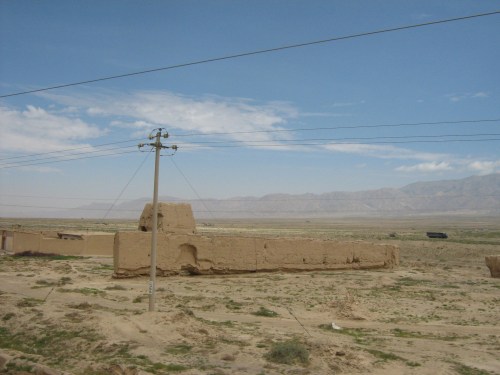
The fort was several miles west, straddling the narrowest portion of a corridor between two high hills. Our map’s brief commentary explained that it had been built to guard against barbarian invaders who could descend toward China through the pass.  Much of the fort had recently been reconstructed. It was tall, square, thick, appropriately forbidding, with concentric sets of walls and gates to keep invaders out and soldiers in. It had its own water supply. A holding pond to one side supported a luxuriant growth of shoreline willows. From the fort’s highest walls, I could see nearby wall remnants that were little more than crumbling mounds of packed earth in a parched landscape.

I saw few other foreigners. There was little English-language signage to explain the construction and history of this portion of the wall. Then a Chinese dad who sported a T-shirt advertising a Charlottesville, Virginia, pizza shop engaged me in conversation and provided some additional information:

“The fort is built mainly of rammed earth. Its initial construction occurred during the Ming Dynasty, starting in the 14th century. In addition to being a military fort, it was also a trading post along the Silk Road between China and the West,” he told me.

When I asked how he’d come by his excellent English and his American-themed shirt, the man told me he was a cardiologist who’d done part of his training at the University of Virginia’s Medical Center. Before I could ask many more questions, he politely bid me good-bye, rounded up his family, and departed the scene in an air-conditioned minivan that looked a great deal more comfortable than our taxi.     

Remnants of the Great Wall near Jaiyuguan, Gansu in northwest China

Who Was Marjory Stoneman Douglas, and Why Does It Matter?

Who Was Marjory Stoneman Douglas, and Why Does It Matter?                                                              —by Jinny Batterson

After the Valentine’s Day mass shooting at a high school in south Florida, I listened to some of the early news reports. Of course, there was outrage at the taking of seventeen lives, fourteen of them students at the school. There was the customary soul-searching and hand-wringing over supposed reasons for the violence that once again had erupted in our midst.

Then I partially tuned out. I wrote yet another set of letters and messages to my NRA-indebted U.S. Senators. I commiserated with family and friends. I tried to focus mainly on small, more localized projects where I could make a positive difference.

While I tried to process this latest affront to human dignity, somewhere in the back of my mind, the name Marjory Stoneman Douglas rang a bell. Most high schools are named either geographically, or for some local educator or political figure. Why, then, did this woman’s name seem somehow familiar?  After a while, I checked the internet for a biography of Ms. Stoneman Douglas. First I noticed a picture of an aged woman in a brimmed hat, holding a cat on her lap. Skimming the accompanying text, I found that Marjory had been born in 1890, an only child of a marriage that unraveled when she was six. She spent much of her childhood under the stern tutelage of her mother’s parents in Taunton, Massachusetts. As she grew up, her mother’s mental and physical health deteriorated, leading to several institutionalizations, then a death due to metastatic breast cancer shortly after Marjory graduated from college. 

Always an avid reader, Marjory began writing for publication in her teens. After a brief tumultuous marriage, Marjory moved to Florida in 1915 and worked for several years at her father’s newspaper, which eventually became the Miami Herald. Over time, she established a career as a free-lance writer, penning over 100 articles and short stories, several novels, as well as the non-faction account The Everglades: River of Grass, first published in 1947.

Now the connection clicked—I’d spent a couple of vacations exploring parts of Everglades National Park, including the Marjorie Stoneman Douglas Wilderness Area. I read further into her biography. In later life, Douglas became a tireless advocate for preservation of the Everglades, earning several awards, plus the enmity of some agricultural and real estate developers. She turned 100 the year Marjorie Stoneman Douglas High School opened, and lived for eight more years, continuing to write and speak about the need for good environmental stewardship. According to a local journalist who’d interviewed Stoneman Douglas several times, “She had a tongue like a switchblade and the moral authority to embarrass bureaucrats and politicians and make things happen.”

I applaud the ongoing efforts by student survivors at the school named in her honor to reimagine our national obsession with guns. I’ve heard that some of their fundraising appeals contain variations of this Stoneman Douglas quote: “Be a nuisance where it counts; Do your part to inform and stimulate the public to join your action. Be depressed, discouraged, and disappointed at failure and the disheartening effects of ignorance, greed, corruption and bad politics—but never give up.”  She didn’t give up. Neither can we. 


Groundhog

Groundhog  —by Jinny Batterson

Harbinger of spring, furry cousin of a squirrel,
We celebrate your special day
By snatching you from burrow and sleep
To blink at the light–strong sun means longer winter.

Midway between poinsettia and forsythia,
We want a fellow creature to provide some assurance
That winter will end–a prognostication from one
Who also dislikes freezing cold and biting storms.

You don’t much care about the splendor of the overcoats,
Scarves, or top hats of those who briefly torment you.
Their race, religion, creed, or politics also matter little.

What’s more important Is that they make their
Ceremony short, so that you can return to needed
Rest before the frenzy of spring.

Plump marmot, I salute you; I beg for
Your wisdom to forebear when poked and prodded
And made to squint in uncomfortable directions.

And, yes, I want to believe that spring is on its way,
Whatever its speed.

Why I’m Glad Our Granddaughter is a Girl Scout

Why I’m Glad Our Granddaughter is a Girl Scout    —by Jinny Batterson

I recently spent a week of after-Christmas visit with parts of the next generations of our family on the U.S. West Coast. As visiting grandma, I got to attend some of the children’s after school activities, including a meeting of our granddaughter’s “Daisies and Brownies” troop. Before the meeting, I was curious about how this branch of Girl Scouting had evolved in the generations since I started Brownies in the 1950’s. At first, lacking everyday exposure to younger children, I found this recent meeting’s hubbub a little daunting, though it’s likely that little girls are no more or less squirmy and giggly than my friends and I were so many years ago. For starters, girls now can become “Daisies” a year or two younger than the Brownie program I entered in second grade.  Still, I recognized parts of the program: an opening circle and a check-in when each girl could relate any important events or concerns, lots of singing, lots of running around, a craft activity, time outdoors, a pledge to honor oneself and others, a short-term service project, plus an introduction to this year’s annual cookie sales campaign for the scouts, parents, and grandparents present.

Since the meeting, I’ve ruminated a bit about why I’m glad our granddaughter is in Girl Scouting. Some American girls recently gained admission to Boy Scout troops. The “#metoo” social media movement has gained wide publicity for its attempts to reduce the incidence of sexual assault and sexual harassment (something the Girl Scouts have been doing with less fanfare for decades). Why continue to be a Girl Scout in these changing times?

Based on my previous exposure and my brief reconnection through my granddaughter, these are several aspects that still seem important to me:

—revolving skills-based leadership within a basic structure. No one person has all the skills needed for the many different situations life will throw at us. In Scouting, some will excel at crafts, while others can organize; some are adept song leaders; some have sports skills; some are tech-savvy; still others are gifted at laying campfires. In the troop where I was a member, one girl, Cheryl, was somewhat less athletic than most, not good at crafts, a reluctant camper, quiet and shy. The rest of us knew, though, that she was very important to our troop. She had a family asset missing to the rest of us: her mom worked at a large nearby military base. At cookie sales time, it was Cheryl’s turn to be a star. Though the rest of us were a little jealous as she loaded the family station wagon full of cartons of cookies for distribution, we knew her work was vital to reaching our sales goals each year.

—an international focus in addition to the local, state, and national civic engagement of each Girl Scout. For me, this was best exemplified by the first international Scouting center, a chalet in the Swiss Alps that opened in 1932. Many Scouts know the “Chalet song” with its aspirational closing: “And this its dedication shall never fail nor be undone, each race, each creed, each nation beneath its roof are one.”  The Chalet is now the oldest of five operating international centers, including a recently organized rotating event space among Girl Scouts in Africa. 

—An affirmation of the worth of each individual, along with the importance of working together toward common goals. Like Cheryl in our troop long ago, some Scouts will have less readily visible skills, but Girl Scouting teaches that each of us has an important role to play. No one is inconsequential. When we get overly invested in a “great leader” model, it can be all too easy to forget this basic truth.   

  About this time last year, I was a local participant in one of many “Women’s Marches” that occurred globally on the third weekend of January. At this year’s anniversary weekend, I’ll have to track hometown activities from afar. Yet after having observed our granddaughter’s Girl Scout troop, I’m heartened that, if and when we forget to value all the world’s citizens, she and others like her will continue to show up to remind us:  all of us matter, including women and girls.   

Quilted Dreams

Quilted Dreams    —by Jinny Batterson

There’ve been times, since I outgrew visions of sugarplums,
When I’ve dreaded the coming of winter. Short days, short tempers, cold,
Damp, sniffles, indoor confinement. Winter’s had little to recommend it.

This year’s cold weather was late arriving. Days shortened, but it was
Nearly Thanksgiving before there was frost on the pumpkins. Our schedules
Got disrupted: when to test the furnace, bring houseplants indoors?

Finally, the evening arrived when a blanket was insufficient warmth.
The quilt could be brought out from the linen closet, shaken vigorously,
Then inserted between a fresh sheet and the all-season bedspread.

As my life has grown less hectic, I’ve come to relish the longer
Darkness of late autumn: a chance to sip cocoa before snuggling down
Early, perhaps to drift into episodes of remembered dreams.

I cannot guarantee that the quilt is the cause, but cold weather
Seems to bring more comforting visions: brilliant landscapes visited
Earlier in person or in imagination, peopled with friends and warm welcomes. 

Often I visit cities new to me, revel in explorations and travel that
Can be more pleasant in dreams than in reality–no crowded
Rail cars, no plugged toilets, no mewling youngsters in the seat behind.

The details no longer matter as much. It’s the comfort that counts.
Even when my mind and body are saddest, my waking
Anxieties will sometimes give way to quilted dreams.

Mr. Whirligig

Vollis Simpson Whirligig Park in Wilson, NC

Mister Whirligig     —by Jinny Batterson

Recently, on my way to a weekend conference along North Carolina’s coast, I made a slight detour to stop in the former tobacco auction center of Wilson, North Carolina.  It was my third visit to this once-thriving, then derelict bastion of the tobacco industry, struggling to be reborn in a post-industrial, post-tobacco-auction age. 

Brick mansions with Greek-revival columns testify to Wilson’s former wealth. Vacant warehouses and storefronts bear witness to its doldrums. The town is about fifty miles east of Raleigh, at the far edge of commuting distance, but near major interstates. Its status as the county seat of a county by the same name brings some enduring activity—court cases, law offices, merchants of bail bonds. Population has stabilized at about 50,000 people, by far the largest town in this county named for a childless military man whose 1840’s exploits in a war with Mexico were ended by a fatal bout of yellow fever.

    What I came to see was a new park near the center of Wilson’s downtown: the Vollis Simpson Whirligig Park. Mr. Simpson, who died in 2013 at the age of 94, had for much of his life made fanciful sculptures out of scrap metal and pieces left over from the heavy equipment repair business that he ran from a small shop a few miles out of Wilson. After he closed his repair business, he turned his attention more fully to the sculptures he began to call windmills. Although his efforts sometimes drew the derision of his neighbors, Simpson continued to fashion larger and larger windmills with more and more moving parts, installing many of them around a small lake on his family’s property.

I first became aware of them when an acquaintance with ties to Wilson led a small group of us to view Simpson’s pond and the windmills planted along its edges. Mr. Simpson, then in his late 80’s, was working in his open-air shop at the far side of the pond. We saw him in profile at a distance, but an abundance of no trespassing signs made it clear that he did not welcome casual visitors.

Over time, Simpson’s “whirligigs” became a local, then regional tourist attraction. His variety of folk art drew the attention of art collectors and museums. A Whirligig graces the grounds of the North Carolina Museum of Art in Raleigh. Others have been purchased by museums and private collectors in many parts of the U.S.

Before Mr. Simpson died, local movers and shakers approached him about making his sculptures into an outdoor exhibition. According to Simpson’s obituary in the New York Times, Simpson relished the thought that some of his artworks would be preserved. He helped consult on the beginnings of removal and refurbishment of the pieces that eventually became the park. Vollis Simpson died before the park became a reality. Vagaries of weather, funding, and politics delayed the park’s opening for several years. The 2017 autumn day when I got to visit was gloriously clear and crisp, with just enough breeze to set most of the whirligigs to whirling.  Though I’d missed the park’s grand opening by a day, the vision I got of Mr. Simpson’s legacy brightened my outlook. It also lit up the faces of other visitors of all ages who viewed the park in person or via modern internet links.

It’s much too easy these days to get caught up in the political crises and name-calling of the moment. I like to think that Vollis Simpson’s spirit would be gratified at the way his creations beckon us toward less bluster and more whimsy. Thank you, Mr. Whirligig!    

Falling into Grace

Falling into Grace    —by Jinny Batterson

Grace Church, the church of my childhood,
Smelled of furniture polish, dust, and old masonry.
It sat squat, tucked into a hillside above a graveyard
Where my mother, at twelve, had sledded into a
Headstone, chipping both front teeth.

From behind the altar, stained-glass-filtered light
Shone on the choir stall where I sat, searching in the
Back of the Book of Common Prayer for my springtime
Birth date in the schedule for each year’s Easter.

My cousin, Grace, came for a week’s visit
As we both teetered at the edge of adolescence.
She had an athletic build, a mane of blond hair.
Not self-conscious about her body like I was,
She shed her day clothes before bed, revealing
The beginnings of breasts and pubes where
I was still flat and hairless.

During college jaunts to the small Shenandoah
Valley town where my boyfriend studied, I walked
Past a different church. Early in the 20th century, it
Was renamed to honor a fallen general with a mixed
Legacy that has become increasingly problematic
In our post-Charlottesville polarizations. 
.

My childhood church is still there, if little used.
My cousin Grace died after a horse riding accident.
Reverting to its original name, Grace Episcopal
In Lexington, Virginia struggles for reconciliation.
Nostalgia renders all more graceful.

It’s the season of falling—leaves blush, then let go.
We notice lengthening darkness, tremble at dark events.
When we pay attention, though, we still have access to
Qualities of bearing, blessing, benediction:
There’s still the possibility of falling into grace.