Category Archives: Uncategorized

Old Years’ Resolutions

Old Years’ Resolutions    —by Jinny Batterson

For many years, I’ve avoided making discrete New Years’ resolutions. I have a tendency to backslide. Eliminating harsh words, taking off five pounds, following an exercise plan—most years such resolutions would get broken by late January if not sooner.  Instead, I’ve tried just setting general directions, somewhat more gently: I’ll bite my tongue a bit more often, eat a little less, exercise a tad more. I’m not sure if those around me even notice. Still, I reason, how can I expect to improve either myself or the world if I spend lots of my time blaming myself and/or making up excuses for broken promises?

Looking forward and setting goals are important, with New Year a frequent milestone for doing so. As I get older, occasionally looking backward seems appropriate, too.  What has gone well in the year just ending? What has gone poorly?

This past year has been good for me. I realized a long-term goal of publishing a travel memoir. I enjoyed generally good health. My husband and I shared several adventurous and rewarding trips. Meanwhile, the world at large has caromed along with perhaps more disasters and more vitriol than in some years. Headlines and blogosphere trend negative.

On the personal front, I think I’ve done a fair job at maintaining a civil tone in interactions with relatives, friends, acquaintances and elected officials across the political spectrum. However, I did send a somewhat snippy letter about varying leadership styles to our congregation’s new minister; I used some harsh words in a couple of the postcards I mailed to our current national leader. Weight control? Not so good—after a December trip that included lots of holiday feasting, any implicit goals about weight loss have fallen short.

What about exercise? There I think I’ve shone. Partway through 2018, after an extended hiking trip in rural France upped my average step count well above 10,000 steps per day, I set a short-term personal goal: Could I keep my annual average above 12,000 daily?  With just a few days to go, I’m tantalizingly close. Today the weather where I live has been pleasant, so getting in steps outdoors (roughly between four and five miles) was easy. Tomorrow and the next day are predicted to be rainy, making outdoor walks less appealing. New Year’s Eve may find me trudging on the treadmill at the gym, or pedaling the second-hand exercise bike at home, or even doing late-evening laps around our small condo as the TV counts down the final hours until midnight. If I’m able to meet this “old year’s resolution,” set not in January but in August, I’ll be pleased. The world at large may still be somewhat dicey, but I’m in better shape.   

Concentrating too hard on “new year” milestones may cause us to miss chances for learnings and goals later in the year or later in life. Looking back through much earlier personal journals, I found a year-end thought from 1982, a year in which unrest in Poland and the continuing cold war between the U.S. and the Soviet Union had been much in the news. The U.S. economy was in recession. Britain and Argentina had gone to war over the Falklands, a set of small islands in the South Atlantic. Nevertheless, I wrote then:  “All in all, 1982 has not been a bad year. The world is still teetering on the brink of disaster, as usual, but there’s been a lot of love and beauty, too.”   

May 2019 turn out to be a year in which many personal and broader issues move toward better resolutions, whether made early or later. Happy New Year! 


Who Did You Expect?

Who Did You Expect?     —by Jinny Batterson

My life so far has been fortunate—no privation, little discrimination, generally good health, many chances for love and adventure.  Much of the time, though not always, people I’ve met have lived up to (or beyond) my expectations. On those rare occasions when someone’s behavior has disappointed me, more cynical or world-weary friends have shrugged at what they regard as my naiveté. 

“Of course so-and-so let you down,” they’ve announced. “What did you expect?”  

Increasingly for me,  the appropriate question is rather “Who (or, for the grammar police, “Whom”) did you expect?”  As I mature (a work in progress), I become more aware of instances when I’ve pre-judged people and turned out to be fairly far off the mark.

The first occasion that stands out is my initial in-person meeting with the leader of our 1980 group tour to China. In those pre-internet days, I’d exchanged postal letters and paperwork with Ms. Baum and talked with her on the phone. Until we both arrived in San Francisco’s airport departure lounge for our trans-Pacific group flight to Hong Kong, I had not actually met this native New Yorker. I’d assumed from her accent and phone demeanor that she was of Jewish background. She seemed somewhat pushy and no-nonsense, ready to take on the world. I was surprised to see that she was African-American, not ethnically Jewish. She could be somewhat pushy and no-nonsense. Her prior experiences as both social worker and travel agent had prepared her well to take on whatever bureaucracy attempted to get in her way, regardless of ethnic origin or nationality. She turned out to be both different from and similar to the “who” I’d expected.

Earlier this fall, I signed up to work the polls in the 2018 mid-terms. After on-site training, I exchanged emails with the woman who’d be my site supervisor for early voting. Her written English was good, clear and simple. Her family name was a common one, her given name, ending in “a,” suggested to me she might be African-American, or maybe Hispanic-American. When we met, I could detect no skin coloring or hair texture to suggest ancestral links with Africa, no hint of foreign origin in her accent. She seemed at first a very “vanilla,” somewhat conservative American. During our work, she showed her passion for ensuring that anyone who wanted to vote was given maximum opportunities to do so. She’d sit patiently with someone lacking appropriate credentials, or with an address not yet entered into the electoral system database of rapidly growing Wake County. She knew the rules well. She could suggest pulling up an electronic copy of a utility bill on a portable phone. She might advise going home to retrieve a needed ID and then returning later in the day. In rare cases, she’d have the potential voter fill out a provisional ballot, explaining how and when to check whether their vote had been counted. The workforce she’d helped assemble to follow her lead was the most visibly diverse I’ve ever participated in. She was both different from and similar to the “who” I’d expected.    

I’ve just spent Thanksgiving with parts of my extended family that I barely knew growing up in Maryland in the 1950’s and 60’s. Only once had I had a chance to visit these North Carolina farmer cousins from a rural area near Charlotte. What little I remember from that farm stay involves ponies tame enough so even I was persuaded to take a short ride. I got to see my grandmother’s sister-in-law make glorious biscuits using milk straight from the cows. The cousins closest to my age teased me good-naturedly about my lack of country skills.

After moving to North Carolina a decade ago, I became reacquainted with some of the cousins who’d left the farm to settle in Raleigh. They’d tell me enticing stories of an extended family Thanksgiving gathering at “the shed.” I pictured the locale in my mind: an expanse of gently rolling hills, empty except for a few horses or cows grazing in pastures. “The shed” would be a slightly cleaned-up farm outbuilding. Twenty or so aging cousins of Scots-Irish ancestry would assemble for our midday meal, then say interminable grace before we could eat. Someone would have cooked a turkey and brought it still warm to the feast. We’d eat plentifully, exchange pleasantries, carefully avoid politics, and then everyone would go home.

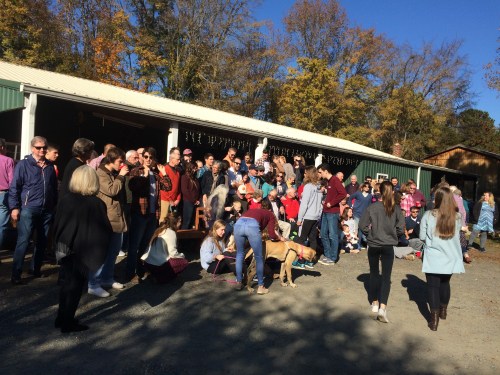
This year as we drove into the neighborhood nearest our destination, I had trouble reconciling my mental image with current reality. The surrounding area may once have been farmland, but the vicinity had long since become part of suburban Charlotte. A mid-rise apartment complex dominated the nearest street corner. The “shed ” had been expanded and modernized from an earlier role as storage space for some cousins’ plumbing business. It was now a comfortable, well-appointed venue with adjustable seating for up to a couple hundred people. Nearly that many cousins of all ages were in attendance, along with baby equipment, pet dogs and a few footballs.

We did have a short sung grace before the long, snaking buffet line formed. We did generally steer clear of contentious political topics. People caught up on family news since the previous get-together. One 20-something cousin had recently returned from an extended Peace Corps stint in South America; in the next generation up, a househusband described his four years of helping school their daughters while his family was on assignment in southern Europe. One attendee I didn’t get a chance to talk with directly had a skin tone and accent that implied ancestry or origin in India. The Reas still cherished their rural roots and pioneering ancestors, but the clan had gotten more diverse and widely traveled—both different from and similar to the “who’s” I’d expected.

The remaining holidays of late autumn and early winter are likely to have more extended family gatherings and chance meetings. May I remember not to pre-judge those I encounter, to be more careful not to let “who I expect” get in the way of meeting current reality with an open mind and heart. 

Rea Thanksgiving at “the shed”

What We Pay Attention To Matters

What We Pay Attention To Matters     —by Jinny Batterson

Here in North Carolina, we have the option of voting early—this election cycle, nearly three weeks early.  On the very first day of the eighteen days set aside for early voting in the county where I live, I cast my ballot.  I’d earlier signed up to work as a non-partisan election official at one of the early voting sites in our county.  Mostly because of this temporary job (and because I need to spend at least some of my time sleeping), I’ve been sheltered from widespread exposure to news events and negative campaign advertising. This has proved to be a real blessing. 

Once I finish my early shift at about 2 in the afternoon, I come home, take a nap, take a walk, share an evening meal with my husband, then bed down early so I can repeat the cycle, starting at about 4:30 a.m. the following day.  I’ve been vaguely aware of hateful tweets and sporadic violence, but mostly I’ve spent my after-dark hours sleeping and my before-dark hours either working or enjoying the autumn weather outdoors. 

On the job, we’re forbidden to talk politics, a wise decision, I believe. Still, from some of the partial stories other workers have shared with me, I get the impression that we represent a pretty wide range of backgrounds and political persuasions. We have younger workers, some coping with student debt, others concerned about underemployment—mismatches between the skills they’ve trained for and the jobs they’ve found so far. We have middle aged workers who worry about aging parents and/or the fluctuations in their 401Ks in a volatile stock market.

The long and short of voting at a central NC early voting site

We come in all colors, shapes, and sizes, from a petite ballot handler to a former basketball center. Some older “temps” are retirees like me; others still work part-time, sandwiching in scant time for personal lives amid hectic work schedules. One of my 60ish coworkers has a vocabulary that suggests he may not have had the same chances for formal education that I did. His line of patter can sometimes border on bigotry, yet he spent some of his off-hours last week comforting a colleague whose wife had a terminal illness. 

Our range of voters also is wide—from the just-turned-18 to a frail elderly woman whose grandson wheeled her up the elevator and into the voting area to cast her ballot one more time. She was born in 1920, the year that women in the U.S. first obtained the right to vote in national elections.  We see office workers on their lunch hours, professors eager to encourage their students to vote, students puzzled about voting procedures, custodians, construction workers, and others whose dress and demeanor defy easy labeling. 

It would be unrealistic to believe that our democracy is in great shape. Being subjected to predictably inflammatory tweets, predictably bloody lead news stories, and predictably negative campaign advertising can be discouraging. Whatever the outcome of this current voting cycle, we will have lots of work to do to help heal some of the breaches in our social fabric, whether we are citizens or elected officials. Yet I’m encouraged by the civility of the voters and polling officials in the small corner of the electorate where I work. Many people DO show up to vote, over a million so far in North Carolina. They wait in line, sometimes chatting with each other. They’re glad to get their ballots and to make their opinions known.  Perhaps if we pay more attention to what’s going well, we may be in a better position to help alleviate what’s not. 

Softening Hearts, Hardening Infrastructure, Widening Perspectives

Softening Hearts, Hardening Infrastructure, Widening Perspectives

                                            —by Jinny Batterson

It’s been a rough couple of months here in North Carolina: two hurricanes (Florence, then Michael), a polarized government, widespread agricultural losses, increasing poverty, damaged schools and infrastructure. 

Yet there’s been heartening news as well. Many established charities such as the American Red Cross have sent disaster recovery teams to the worst impacted areas. Local citizens in areas less damaged by the storms have created both short-term and long-term relief efforts. A neighbor who specializes in local fundraising set up a Sunday-afternoon event at a nearby shopping center and raised over $10,000 in cash plus thousands of dollars worth of non-perishable food and household goods for hurricane relief. Because of the extent of the damage, both in the Carolinas and elsewhere, it will take continued efforts by private donors, non-profits, government agencies, and financial institutions to help promote recovery.  The natural environment will never be the same; repairs, rebuilding, and/or relocation of homes and businesses will take months if not years. 

After hurricane Florence decimated the coastal Carolinas, major roads and interstates were flooded and impassable for over a week, making cities such as Wilmington, North Carolina effectively islands.  Residents who’d evacuated were asked not even to try to return home as soon as the first few roads were reopened—what limited road travel was possible needed to be reserved for emergency and supply crews.  Now that the immediate crises are over, people are starting to grapple with longer-term problems: should rebuilding be limited in areas that seem more and more prone to drastic weather?  Should building codes be changed? How do we adapt our infrastructure to be more resilient? Do we need to pursue alternatives to a predominately road-based transportation network?

Simple solutions seem elusive and likely counterproductive. Perhaps we need to rethink some of the implicit assumptions we’ve made about how the world works.  Rather than considering ourselves outside nature, it may be time to widen our perspectives and acknowledge that we humans are just one piece in a complex, evolving whole.  Among the groups that have challenged some of my existing perceptions are:

Transition networks (https://transitionnetwork.org/), a set of local-global initiatives to work toward more resilient local economies in the face of escalating global challenges

Bioneers (https://bioneers.org/), harnessing scientific knowledge toward solving human problems

Biomimicry 3.8 (https://biomimicry.net/), which looks at other life forms (some with over 3.8 billion years of experience on earth) for innovative ways to re-engineer human-made systems

What partial solutions have you discovered?  What “small/local” actions are you taking to make our future more livable?  Please share some of your thoughts. 

Is Anyone Really Stealing American Jobs?

Is Anyone Really Stealing American Jobs?  —by Jinny Batterson

Recently, a friend forwarded to me an email of guidelines for “buying USA,” comparing some everyday items, from greeting cards to toothpaste, that are marketed in the U.S. but now often made in other countries. I have no objection to buying more of the goods I use from hardworking Americans, but I do object to the thinly veiled inference that workers in China (or Mexico, or some other lower-wage country) are stealing American jobs. Wording of the message forwarded to me matches one posted by a real estate developer from near Charlotte, NC in March, 2016, as that year’s election cycle was heating up (see https://www.linkedin.com/pulse/ace-hardware-made-usa-very-encouraging-david-e-johnson-pe). My initial reaction to the message: Oh, rats! Here we go again, blaming job losses on low-wage workers in other parts of the world, when those workers actually play only a small part in American job losses. This mid-term election cycle, I’m concerned that both recycled and more recent posts and tweets are trying to persuade American voters that a broad trade war with China will help save American jobs. 

Over the past forty years, I’ve been able to spend a fair amount of time visiting with workers in China. They don’t want to steal anyone’s job. They are just trying to improve their lives, like workers everywhere. In the 1940’s,1950’s and 1960’s, many Americans left grinding rural poverty for better manufacturing jobs in cities. In the 1980’s and 1990’s, many Chinese also left the countryside in search of better paying urban jobs. By now, Chinese wages have risen. The Chinese government is starting to tighten regulations to rein in the pollution that significantly shortens Chinese lives. Some jobs are leaving China for other countries with lower wages and/or laxer environmental rules.

After I sent a semi-coherent reply to my friend, I let a later draft sit. I needed more time to simmer down and reflect. I realized that I’m very lucky.  So far, my retirement income is comfortable. I do not have to pinch pennies. I can afford to be selective in my buying habits. As much as possible, I patronize local sources. When we lived in Vermont, I made a special effort to buy cheese from our area farmers’ co-op; in Virginia, I bought a lot of local apples; here in North Carolina, I shop the local farmers’ markets; I eat ribs and barbecue at local restaurants. For less-localized items, I check labels along with prices to see where a product originated and how it was produced. Even if they’re somewhat more expensive,  I will sometimes buy U.S.-made goods to help support American workers. At holidays or when buying specialty items, I often purchase “fair trade” products so that some of my coffee, chocolate, and gift purchases will help support those with the lowest wages. Overall, I try to be an informed, careful, caring consumer.

Despite all sorts of “buy from nearby” campaigns, and despite what we may want to believe about fair and unfair trade, for at least a generation the biggest cause of job losses worldwide has been the quickening pace of replacing human workers using automation. According to a Financial Times article published just after Mr. Trump’s election (https://www.ft.com/content/dec677c0-b7e6-11e6-ba85-95d1533d9a62, December 2, 2016), about 85% of U.S. manufacturing job losses between 2000 and 2010 were due to automation rather than to moving jobs overseas. The same article compared the average hourly wage for a human American welder ($25) with the operating cost to have a robot do the same work ($8). If you include the installation and maintenance costs for the robot, the gap narrows slightly. However, the cost difference is likely to continue growing. 

Some trade agreements can damage the interests of workers and/or put at risk the natural environment that supports human life as we know it. Global trade has rarely been without its distortions and inequities. (For example, ask almost any Chinese about the British practice during the 19th century of exporting opium raised in the British colony of India into China to offset the costs of British imports of tea and porcelain, or consider the trans-Atlantic slave trade.) Negotiating worthwhile trade deals can be both time-consuming and extremely difficult—blogs or tweets alone don’t cut it. 

One of my grandfathers lost his job in 1930 when the company he was working for at the time replaced their human bookkeepers with calculating machines as a cost-cutting measure. On President Herbert Hoover’s final full day in office, March 3, 1933, he signed the “Buy America Act” that had recently passed the U.S. Congress. The Great Depression of the 1930’s was not solved.

Americans suffering from job losses need assistance and encouragement rather than attempts to divert the problem onto others. Automation, used wisely, can help improve lives; used foolishly, it can devastate human workers, even entire communities. Global competition, used wisely and fairly, can help spur innovation and growth. Used foolishly, it can pit groups that have many common interests against each other.

Blaming will not solve anything. Please let’s take time together to consider the deeper issues. 

The Rich Man and Lazarus Revisited

The Rich Man and Lazarus Revisited   —by Jinny Batterson

During my childhood, my most formally religious aunt used to give me books of Bible stories, adapted for children. One of the most difficult stories for me was Jesus’ parable of the rich man and Lazarus. It concerned death, not totally unknown even to small-town American children in the 1950’s, plus a kind of cosmic reckoning:

In a gated estate there lived a rich man, who (revised standard translation, part of Luke’s gospel, chapter 16) “was clothed in purple and fine linen and who feasted sumptuously every day.”  Outside the rich man’s gate was a poor, diseased man named Lazarus, “who desired to be fed with what fell from the rich man’s table.”  Sharing was apparently not part of the rich man’s ethos, so Lazarus languished in distress.

After a time, both Lazarus and the rich man died. Lazarus was carried by angels to heaven, “Abraham’s bosom,” a welcome change. The rich man, by contrast, went to Hades, a realm of fire and brimstone, just near enough to heaven so the rich man could see Lazarus there, hanging out with Abraham in comfort. The rich man cried out: “Father Abraham, have mercy upon me, and send Lazarus to dip the end of his finger in water and cool my tongue; for I am in anguish in this flame.” Nothing doing, Abraham explained. The rich man had had his chance at comfort while alive. Now the chasm between his current locale and Lazarus was deep and impenetrable, allowing for no crossovers.

During the 1990’s, I was briefly exposed to a widening gap in perspectives between rich and not-so-rich. I had a short-term subcontract with a major accounting firm at their downtown office. At the time, I was living in an inner city neighborhood that suffered the side-effects of a worsening epidemic of crack cocaine: robberies, arrests, lengthy prison sentences, even murders. It was a scary time. Occasionally I went out to lunch with my accounting firm colleagues. Once, I asked my supervisor whether the city’s worsening poverty and crime bothered him.

“I don’t have to notice poverty or crime,” he responded. “After work, I ride the elevator down to the guarded basement garage to retrieve my car. Then I drive out the expressway to my home in a gated community in the suburbs. No poor people interact with me at all. It’s not my problem.”  For most of the years since that encounter, I’ve lived in relative comfort, while trying with mixed success to learn and practice the discipline of sharing.

Though some quote an incident near the end of Jesus’ ministry as a justification for ignoring those in poverty, saying, without the surrounding context, “you always have the poor with you,” the vast majority of Jesus’ sayings and actions support the view that caring for “the least of these” is a sacred duty. 

The year 2018 so far has been filled with more than a little fire and brimstone—volcanic eruptions on Hawaii’s big island, huge wildfires in much of the U.S. West. In the part of the country where I live, the major problem has been floods. So far, they have yet to approach Biblical proportions, but the aftermath of Hurricane Florence in eastern North Carolina has been severe enough so that our current equivalent of Noah’s Ark has deployed, in the form of government rescue boats and the “Cajun navy,” a set of volunteers with small boats who previously plied their crafts in last year’s major flooding in Houston, Texas.  Florence drenched already struggling regions with over two feet of rain. Among the hardest hit were the region’s poor. Relieved to have been spared the worst of the storm, I watched media coverage of a flooded housing project where building maintenance had long been ignored or postponed. Videos showed some of the problems: peeling paint, exposed pipes, stained ceilings. Residents complained of asbestos-laced insulation. The electricity had gone out, and no one knew when it might be restored.

Beyond temporary aid, what could be done to help?  Should we as a society put more emphasis on affordable housing, less on high-end real estate? Would rebuilding and/or relocating require higher taxes? Could we somehow craft a renewed ethic of sharing? 

As I struggled to make sense of our society, seemingly rather badly out of kilter, I went out for a walk. The days were getting shorter. It occurred to me that our earth was in the period around an equinox—one of two occasions each year when the sun’s rays hit our tilted planet directly over the equator. Around the vernal and autumnal equinoxes, all creatures everywhere on earth experience days and nights of roughly equal length.

Instead of a chasm between wealth and poverty that gets harder and harder to cross, maybe we need something approaching a human “equinox.” Maybe we can head toward a narrower “wealth gap,” with adequate basic provisions for all living beings. Getting to a more equitable distribution and use of earth’s resources will take skill, political will, and good character. It IS possible, though. Nature creates equinoxes twice each year. Can we learn from her before flood, fire and brimstone get worse?  Happy fall, y’all!             

Happy Interdependence Day!

Happy Interdependence Day!    —by Jinny Batterson

For a good many years now, I’ve bracketed an insertion into my July 4 Independence Day greetings to friends in the American expatriate community:

“Happy In(ter)dependence Day!” I extol them.  It has seemed to me increasingly evident that in an era of global communication and commerce, celebrating “independence” needs a counterweight. We have become more and more dependent on one another across all sorts of boundaries. So I was pleased to find that others more widely known than I am have come up with similar themes. Perhaps the most widely publicized is a September 12 holiday proposed in the years just following the World Trade Center terrorist attacks.  In 2003, a group met to create a day to celebrate our global interconnectedness, and settled on September 12, the day after the terrorist assault, as a day for an annual celebration. According to Parag Khanna, one of its founders:

     “For the event’s organizers (the Democracy Collaborative at the University of Maryland), Interdependence Day is intended to be crucially different from 4 July. Where Americans alone celebrate the latter, the idea of interdependence unites all peoples across national boundaries in a common human destiny. At the same time, there is an element of deep continuity: for Americans in particular will have to struggle as hard to realize the promise of interdependence as they did for independence.”  (For a fuller explanation, please check out the following link: https://www.paragkhanna.com/home/americas-interdependence-day.) 

     I’ve just returned from a cross-country U.S. trip, benefiting from collaborative practices among airline personnel, colleagues, other passengers, and airport employees to adjust schedules and seating to get as many of us as practical back to our homes on the U.S. Atlantic coast in advance of a strong hurricane. My guess is that our skills at interdependence will soon get a good bit of practice, courtesy of Florence and/or other storms later in the season. My best wishes to all for adequate shelter from the storm—Happy Interdependence Day!     

Entitled, Endowed, Enabled

Entitled, Endowed, Enabled    —by Jinny Batterson

At this year’s Labor Day, I’m likely to be engaged in intense mental labor with friends and former colleagues, trying to make some sense of the somewhat shaky state of civil society in the United States of America in 2018. As the holiday approaches, my sense is that our uneasiness arises partly from confusion about being entitled, endowed, or enabled. Below are some as-yet-unfinished thoughts about how the three might be interrelated:  

A decade or so ago, a leader at an educational institution I value complained that students there had “a sense of entitlement.”  I wasn’t sure what he meant, and I wasn’t in a position to either validate or refuse his claim. Just now I looked up the definition of the phrase, and this is what a search engine produced:

“If someone has a sense of entitlement, that means the person believes he deserves certain privileges — and he’s arrogant about it. The term “culture of entitlement” suggests that many people now have highly unreasonable expectations about what they are entitled to.”  (from www.vocabulary.com)  

         I suppose the term “entitlement” derives from the honorific and/or hereditary titles that certain members of European nobility were given. Over time, such entitlement does not need to have anything to do with the person’s character or accomplishments. It cannot be revoked. 

The most famous phrase about “endowed” comes from one of our founding documents, the U.S. Declaration of Independence:  “We hold these Truths to be self-evident, that all Men are created equal, that they are endowed by their Creator with certain unalienable Rights, that among these are Life, Liberty, and the Pursuit of Happiness.”  

A more recent application of “endowment” is the endowment effect (also known as divestiture aversion), the hypothesis that people ascribe more value to things merely because they own them. Someone who has been “endowed” with say, a house, or a job, may feel that this endowment is permanent and react strongly when there is a perceived threat to his/her ownership. Institutions can also be “endowed” materially—we periodically hear figures about the size of Harvard’s endowment, not  often paying attention to the variability of such funds over time. In a different sense, we may talk of Dolly Parton’s “endowment,” likewise a not-entirely-permanent trait.  

What appeals to me more than either of the previous terms is “enabled.” To me, this term infers more active engagement by the person who’s enabled.  Some stories of enablement based on events at Special Olympics competitions and other sporting events give examples of teamwork, in which someone who may fall behind in the traditional sense is enabled by teammates to finish his/her race, enabling all to succeed together. The term is also used for the process of retraining someone who has lost previously available skills due to illness, accident, or other impediment.  

Reverting to endowment, though, I quote from the lead article of the constitution of my adoptive state of North Carolina. Borrowing from the U.S. Declaration of Independence, the framers of this post-Civil-War constitution added a fourth endowment: the enjoyment of the fruits of their own labor.  

  May we all find ways to better balance entitlement, endowment, enablement as we move forward.    


Testing the Alarm System

Testing the Alarm System   —by Jinny Batterson

Wisps of smoke color our East Coast sky
As across our media screens dance
Sheets of flame from West Coast wildfires.

In Miami Beach, tourists get wet feet
Nearly every high tide. In Alaska, melting
Permafrost leaves larger and larger sinkholes.

From time to time, our mid-Atlantic region
Gets buffeted by hurricanes. Summers veer
Between drench and drought. Just now, neither.

I set out on an early morning walk to outpace
The heat and humidity that will settle all too soon,
Once the sun is well up and shade recedes.

Already, morning traffic is picking up along
The commuter artery where my walk begins.
I stay to the shady edge of the sidewalk.

My immediate goal is an off-road greenway;
Its entrance takes off just shy of a big new
Apartment complex.  Almost there–relief!

When I’d first started this walking loop several
Years ago, there were no apartments, only acres of
Second-growth woodland with a greenway in the middle.

I’d watched with dismay as the woods to the path’s left were reduced
To a mere comb-over, the rest cleared, gouged, then built over,
Paved or mulched, adorned with small shrubs and spindly saplings.

Just as I turn onto the path, a racket like the quacking
Of the Aflac duck, but amplified to ear-splitting intensity,
Erupts from somewhere within the apartment complex.

Three short blasts, short silence, three more, on and on.
No place to hide from the noise. No sirens, though.
No evidence of smoke or flame.  What gives?

Wandering the parking lot in search of an answer,
I eventually find a fellow in a hard hat getting
Out of a pickup.  “Is there an emergency?” 

“No, ma’am. They’re just testing out the alarm
System to make sure it works, before the next
Phase of the complex is opened for occupancy.” 

Aubrac’s Fields of Wild Jonquils

Aubrac’s Flelds of Wild Jonquils    —by Jinny Batterson

In late May, as I was walking across a sparsely settled upland French plateau along a stretch of one pilgrimage route of the Camino de Santiago de Compostela, I encountered a delicious fragrance—delicate and sweet and lingering. I wasn’t sure where it was coming from. Despite, or perhaps because of, a fair amount of rainy weather, the meadows and woodlands abounded in spring blooms, many of them unfamiliar to me.  That evening at the small guest house where we had booked a room, I noticed a vase of flowers with the same delicate fragrance. I asked the proprietress what these small white blooms were called. “Jonquils des poètes,” she told me in French.

I’m not sure what the English equivalent is. The internet pictures I’ve found of “Poet’s jonquils” look similar, but not identical to the flowers I remember from my trip. A few days further into my journey, I arrived midmorning at the tiny town of Aubrac, after spending a couple of hours crossing several miles of minimally fenced upland pastures dotted with jonquils des poètes, some being contentedly munched by local cattle. The weather was cool and misty.

At the near edge of town was a forbidding-looking Romanesque structure. A guide was explaining to a group of tourists in a language I could not understand the wonders and historic significance of this church. According to the French signpost I could partly understand, this former Benedictine monastery was at least a thousand years old and likely built on the foundations of an even earlier structure.

Most of the other buildings along the road and edging the upland pastures were hotels, hostels, or small inns. I noticed one small cafe/guest house that seemed to be open. Several of us stopped and picked out an outdoor table under a protective awning. A warm drink seemed a good idea. It took a while for anyone to come to take our orders—after a bit, an elegant young woman showed up, apologizing somewhat for the delay, explaining that she and the other town residents were all still stressed out from the previous weekend’s “transhumance” festival that annually draws thousands to the area. I’d seen pictures and postcards of this celebration of the opening of common upland pastures for the area’s prized cattle. A nearby town square was still littered with floral garlands and signs from the festival. (Find a set of commercial pictures of the 2018 festival here: http://hotel-lion-or.com/aveyron/fete-transhumance-aubrac/

When our hostess finally brought our coffees and hot chocolates, she stopped to take a smoke break and we began to ask her questions. All of us were curious about the town, whose year-round population has dwindled markedly from a peak over a century ago. Until the late 19th century, our hostess told us, Aubrac had been a traditional farming village, but the harshness of the climate and the difficulty of earning an adequate living caused many farm families to leave the area and seek better lives in French cities. Lots of the adults became small shopkeepers or restaurateurs in and around Paris. However, they retained cottages in Aubrac and continued to bring their families for summer vacations in their former hometown. At about the same time, some area doctors discovered that the clean, cool air in the Aubrac highlands helped tubercular patients. Several tuberculosis sanatoria were opened over the next decades—some have since become hotels or hostels. Most of the local economy now revolves around tourism, compressed into the three or four months of warmer weather. The local cattle, a special hardy breed, supply photo opportunities as well as milk or meat. 

Our hostess explained between puffs that she was even busier than she’d expected post-festival: her five rooms were all rented for the week—a group of businessmen from New York City had come to explore the option of buying quantities of jonquils des poètes to use in a new upscale perfume fragrance. She said that this particular type of jonquil only grew in the wild and had not yet been successfully cultivated.  Some of each year’s blooms already were collected by locals to supply French perfumeries in the southern city of Grasse, a noted perfume center.

I never got to meet the businessmen, who most probably were jet-lagged and perhaps also technology-deprived in this isolated small town. My current exposure to a former-NYC-businessman-turned-politician has temporarily soured me on the ethics and business practices of some.  My hope is that if a deal is struck, the good people of Aubrac will be fairly compensated for their labor and their wild-growing fragrant white blossoms.  I also hope that enough flowers will be left in the fields so that cattle, pilgrims, and residents can continue to enjoy their essence in their native habitat.