Category Archives: Uncategorized

The Mixed Legacies of 9/11

The Mixed Legacies of 9/11  —by Jinny Batterson

Recently I had a chance to host a set of international guests—three generations whose eldest member had grown up in newly-independent India as a disciple of Mahatma Gandhi.  As she was about to leave our house, Ms. Mehta gave me a small booklet entitled “Hope or Terror: Gandhi and the other 9/11.” According to the booklet, on an earlier September 11, in 1906, Gandhi had launched the “satyagraha” movement that eventually helped lead to India’s independence in 1947. 

The booklet’s author, long term American peace activist Michael Nagler, spends most of the pamphlet giving examples of non-violent movements that have achieved worthwhile social aims with a minimum of bloodshed. His pamphlet was published in 2006, just five years after the 2001 terrorist airplane hijackings, destruction and loss of life that have created lingering unhealed physical and psychic wounds in so many Americans, both military and civilian. Nagler points to traits needed to participate more fully in satyagraha-like efforts, to use “integrative power” rather than “threat power.” So what can we learn from previous satyagraha struggles that may be relevant in 2019?

First, we can become familiar with the term “satyagraha,” which has several English translations—it can be rendered as “soul force,” as “love in action,” as “clinging to truth.” Many of us who have heard the term associate it primarily with Gandhi and his “salt march,” a long-distance 1930 walk to publicize and challenge the unfairness of British taxes on salt, a necessary nutrient that washes up freely on some of India’s beaches. Americans may be more familiar with the life and work of Martin Luther King, Jr., whose commitment to the related concept of non-violence was partially inspired by his study of Gandhi’s life and methods.

Nagler points out that there are two prongs to satyagraha efforts—one a resistance to coercion, the other a creation of alternative forms of organization that are freer and less coercive.  Most of us are likely to be more attuned to one prong than the other, so we need to partner with individuals and groups that are more highly skilled in the other prong. Otherwise, we can too often confuse tactics and methods with strategies and longer-term goals.

The passage in Nagler’s booklet that I found most heartening and persuasive concerns the way that satyagraha/nonviolence works:  “Nonviolence sometimes ‘works’ and always works, while by contrast, violence sometimes ‘works’ and never works.”

He explains his use of terminology this way: an action succeeds, or “works” based on its short-term, obvious effects, while it works (without quotes) in how it impacts situations and participants under the surface, producing longer-term effects that are not always obvious at the time.

I’m not sure what commemorations will occur on September 11, 2019. The lingering war in Afghanistan seems no closer to resolution; gun violence in the U.S. claims or maims too many lives; organized violence in many parts of the world dominate our headlines and media reports. Climate change can pose global challenges we often seem powerless to respond to. However, there are other actions going on, other factors at play. One was a last-minute decision to open our home for a night to a family of strangers who are strangers no longer, with an aging Indian matriarch who replanted a seed of hope.     


Caramel-colored Children and Labor Day

Caramel-colored Children and Labor Day    —by Jinny Batterson

In a conversation with a good friend whose tendency to wax cynical has been reinforced by some of our recent political and media trends, I heard her lament: “Maybe we’ll finally stop dissing or shooting each other when all of us are caramel-colored.”

I admit to a good bit of prejudice not supported by reality, so I did a little research on interethnic marriages and relationships, which have become increasingly common in the U.S. over the past several generations. Since the U.S. Supreme Court ruling legalizing interracial marriage (in the 1967 case Loving vs. Virginia), the proportion of reported interracial/interethnic marriages in the U.S. has risen dramatically. As of 2017, over one in six new marriages in the U.S. were registered between spouses of different “racial” backgrounds, while about 10% of all married couples were “mixed race.” Statistical evidence for non-marriage relationships is harder to come by, though my anecdotal experiences tell me that these are also becoming more diverse.

The 2000 census marked the first time that Americans were given an option to choose multiple racial identities, not just one. By the 2010 census, people who reported multiple races had risen substantially: 9 million census respondents chose to check two or more racial groups, a 32 percent increase from 2000. (Those who reported a single race rose by 9.2 percent over the same interval.)

My extended family has at least one multi-ethnic marriage and two young adults who could choose to check more than one “race” on a census form. I’ve not delved very far into how my nephews choose to identify themselves and how this has impacted their lives; my hope is that any prejudices against them are waning as “mixed race” children become more and more common.

Intellectually I know that the whole notion of “race” is more cultural than biological. Differences in skin pigmentation bear little relationship to variations in DNA and to other supposedly ingrained characteristics. Still, like many, I’ve been socialized to view a person’s skin color as somehow indicative of their other characteristics. Not until I’d lived next to an elegant “black” neighbor for a decade did she explain to me that she did not much like to dance and had little sense of rhythm. 

Labor Day is a day set aside to honor the contributions of laborers to the overall good of American society. Those of us who are “white” (and generally privileged to do most of our labor with heads rather than hands or backs) are beginning, reluctantly, awkwardly, to enter into conversations about the labor of “non-whites” forced or coerced into doing much of the work of building this country and society. Too often we continue to dishonor their and our heritage through sentimentalizing versions of U.S. history and society that leave out or minimize the injustices and cruelty that helped and help “make America great.” 

There is much work still to be done. Let’s remember, this Labor Day, to keep laboring toward a more equitable America where all labor is valued, whatever the skin color of the laborer.

Climate Change Hope

Climate Change Hope  —by Jinny Batterson

It’s been over a generation since I first became concerned that human activity might irreversibly change our planet’s climate. I’ve gradually been revising my lifestyle to reduce my input to the problem. Even now, though, if I pull up an online “carbon footprint” app to measure how many earths would be required to support all humanity in the style to which I’m currently accustomed, my number is a good bit over one. I can feel anxious sometimes.

Over my lifetime so far, I’ve had chances to visit many different world regions, and to notice adaptations in other cultures that help reduce waste and emissions without causing privation. So I continue to adapt, plus I do my best to encourage others to make lifestyle adjustments that are planet-friendly without feeling like deprivation. Some I talk with are enthusiastic; others either ignore me or offer a variety of negative responses, the most common being: 

—It’s not really a problem; see this snowball? (denial)

—It’s somebody else’s problem, I didn’t cause much of it so why should I have to fix it? (projection)

—If governments and corporations won’t fix it, what can one person do? (defeatism)

Like anyone with an opinion, I have what psychologists call “confirmation bias.” Once I’m convinced of a view, I tend to pay more attention to information that supports it and to ignore or discount contradictory information. My current view is that anyone who tries to persuade you that climate change is a simple phenomenon with a single solution has likely not done much research and/or has discounted lived experience.  Do Hurricane Katrina, Superstorm Sandy, and/or major increases in the number and severity of wildfires signal global warming? Does a severe winter signal the opposite? I doubt we can ever know for sure. Given the impossibility of certainty, I think it makes sense to err on the side of conserving as much of the planet’s existing climate and species as we can. I try to listen respectfully to those with different views, and to revise my opinions when reliable new information becomes available. Most of the time I’m a “glass half full” sort of person, so I try to pay attention to efforts toward reducing or adapting to climate impacts, to applaud them and, where practical, to follow suit.

London’s transportation mix, from what I saw of it on a recent visit, encouraged me. I was amazed at the number of riders of its extensive subway (“underground”) system, plus the volume of bicycle commuters and the widespread availability of dedicated bicycle lanes and monitored bicycle parking areas. Near the rental apartment complex where I was staying was a two-tiered parking lot, for bikes.  Each weekday morning, extensive stands of standardized rental bikes near the major intersections and bridges emptied out, refilling in the evening. During some of my pedestrian sightseeing, I noticed “ULEZ zone” signs posted on major thoroughfares. Via later research, I learned that this acronym is for “ultra-low emission zone,” an area covering much of central London where vehicle traffic is restricted. Only cars, trucks, and buses which meet stringent emissions standard are allowed. The zone was activated on April 8, 2019; drivers who violate it face hefty fines.

In other reading and internet exposure, I’ve come across additional worthwhile suggestions. Given my gender, I was drawn to the recommendation in the collection Drawdown, published in 2017, about the importance of educating and empowering women as a component in reducing or adapting to climate change impacts (ranking 6th best of the 100 partial solutions suggested). Recently, I came across the results of a 2019 study of the possible impact of a massive global tree-planting effort on climate. Thomas Crowther, a climate change ecologist at the Swiss Federal Institute of Technology in Zurich, coauthored an examination of global land use and found enough suitable unused land so that a trillion trees could be planted, reforesting an area equivalent to the size of the U.S. and potentially reducing atmospheric carbon substantially. Another source of encouragement is a talk given by climate scientist Katharine Hayhoe, a Canadian who now teaches at Texas Tech in Lubbock, Texas, about productive ways of talking about climate reality: “The most important thing we can do about climate change is talk about it,” posted on the TED website in December, 2018. Please let’s keep talking!    

The Double Seventh Festival

The Double Seventh Festival (Qixi)    —by Jinny Batterson

The “Double Seventh” festival is celebrated in China on the seventh day of the seventh lunar month each year. Because the lunar calendar varies compared to the solar calendar used in most Western countries, the occurrence of the Double Seventh festival can come anywhere between late July and late August. In 2019, the festival falls on August 7. It has been called the Chinese “Valentine’s Day,” and is based on a famous legendary Chinese love tale:

Niu Lang (the Cowherd) was an orphan with a gift for nursing cattle back to health. After a god coaxed him into caring for cows in the heavens, Niu fell in love with the fairy Zhi Nu (the Weaver Girl) and the two started a family. However, the queen of heaven became jealous and caused a great river (the Milky Way) to come between them. The two were heartbroken. Their copious tears caused the queen to relent just a little—one day each year, on the seventh day of the seventh month, the two were temporarily reunited.

The star Vega is often cited as representing the Weaver Girl, and the star Altair represents the Cowherd. On double seventh evening, Chinese in areas with clear skies can gaze up to see Vega and Altair shining in the Milky Way, with the star Deneb forming a symbolic bridge between them.

Similar celebrations are held throughout other countries in Asia, with variations of the legend told in Korea, Japan, and Vietnam. 

In more urban areas of China, the Double Seventh festival has become less important, overshadowed by Valentine’s Day in February. In the countryside, celebrations are more likely to continue to exist, with young women exhibiting their skills in sewing and embroidery, and lovers exchanging gifts of flowers, chocolate, or decorative clothing.    

Layered Reality

Layered Reality   —by Jinny Batterson

Sometimes, despite fairly consistent efforts to broaden my circle of friends and acquaintances, it seems as if I’m stuck in an ever-shrinking bubble, quarantined in my own little “liberal-urban-retiree” silo. Recently I had a chance to spend a week with our out-of-town grandchildren, exploring a couple of stunning U.S. national parks via outdoor hikes. My guess is that our son and daughter-in-law had carefully coached the kids to humor grandma and grandpa by not overusing their “screens.” We watched a fair number of breakfast-time morning cartoons, but mostly we wandered outside, free from earbuds, television, or other screens. Cell phone coverage was minimal or nonexistent.

Much of our political and cultural life these days, including mine when not hiking with the grandkids, gets mediated by screens. Screen life can often seem tasteless, colorless, instantaneous, disconnected. I realize I’m getting old and slow, but I doubt this is the only cause for our disconnectedness.

I remember a story my rural sister told me. Typically apolitical, Sal had gotten sufficiently exercised in our recent hyper-charged society that she decided to become more politically active. In 2018, she campaigned for a candidate for U.S. congress in the Maryland district where she lives. She and I live in mirrored political entities—both North Carolina, where I live, and Maryland, where Sal resides, are “poster child states” for extreme political gerrymandering. I live in one of a few districts carved out to the benefit of NC’s minority party (in this case, the Democrats). Sal lives in the one district in Maryland that has been allocated to its minority party (in this case, the Republicans). Though our NC polling sites during early voting and on election day fairly consistently have longish lines, the precinct where Sal stood with her candidate’s literature wasn’t busy. Dribbles of voters came by the area where campaigners were allowed, leaving lots of down time. My sister is nothing if not gregarious, so before long she was talking with the two campaigners for the majority party candidate. Carefully sidestepping the merits of their respective candidates, Sal probed for possible common ground. Pretty soon, the three of them were discussing the uncertainty of sale prices for soybeans; the availability of rental drones for quicker, more thorough analysis of field conditions; the best area bulls for improving dairy herds; the impact of changes in agricultural regulations on small-scale farmers. Although there were certainly political opinions where the three of them likely disagreed, they found a good many areas where their interests overlapped and they could be both civil and informative. Their reality was layered with interspersed agreement and disagreement.

Last year about this time, I was in an area of rural France where human habitation goes back hundreds of thousands of years. I got a tour of an archeological site with over a dozen layers of excavation, ranging from about 40,000 to about 15,000 years ago. Now inactive, the site had been carefully dug during a human generation or so, some layers yielding little in the way of artifacts or information, others rich with both. I believe we need to remember that our social and political realities are rarely either/or, much more often layered with both conflict and agreement. Likewise, we are both independent and interdependent.  Please let’s take a bit more effort toward excavating beyond the tweets and the sound bites—our neighbors may be more layered than we know.

The Durability of Sisterhood

The Durability of Sisterhood   —by Jinny Batterson

Over the past several weeks, I’ve attended three “women mostly” events—an NAACP breakfast fundraiser and celebration of that group’s NC mother/woman of the year, the annual meeting of our local chapter of the League of Women Voters, and the 50th reunion of my class from then-women’s-college Randolph College. At each event, there were a few men, as official escorts, unofficial companions, or male affiliates, but the focus was mainly on us women. I’d forgotten how good it can feel to be surrounded by other females.

The NC NAACP celebration was the first formal NAACP event I’d attended. Not knowing anyone to tag along with, I went alone. I expected to be a minority at the event—this proved true. The few other white women, none of whom I knew, seemed more connected and more engaged than I felt. The venue was local to Raleigh, but contestants and their supporters came from nearly twenty NAACP chapters throughout the state. Not realizing the flexibility of the event’s scheduling, I’d accepted an invitation to a lunch meeting in a different part of town, so missed the slightly delayed keynote talk by recently named Chief Justice of the North Carolina Supreme Court, Cheri Beasley. Over the part of the event I did attend, I learned that the NAACP has been holding such annual celebrations since the 1950’s.

The LWV Wake County annual meeting had a generally paler audience and was held on a weeknight. Food was higher priced. There was a cash bar. I knew some of the “old stalwarts,” but was pleased to notice younger faces new to me. One older male member I knew, attending without his equally activist spouse, spent a good bit of time talking with me. I wondered if he felt something of an outsider, like my reaction at the NAACP breakfast. The event was tightly scheduled. The business at hand—election of new officers, committee reports, financial updates—was quickly dispatched, assisted by paper agendas. Dinner conversations were pleasant, non-confrontational, and generally apolitical in this non-partisan organization. The Wake county LWV had been founded in 1920, the same year women got the right to vote in national elections. After a rocky period during the late 1930’s and 1940’s, the chapter reconstituted itself in 1950 and has been active ever since.

Then there was the Randolph reunion. I arrived near the beginning of the three-day weekend’s festivities to find a familiar, still beautiful, mostly empty campus. A good student when I’d attended what was then Randolph-Macon Woman’s College in the late 1960’s, I’d nevertheless been anything but a social standout. A foreign language major, I didn’t contribute to campus publications. I wasn’t a horsewoman or an athlete in any sport. I did sing in the glee club, but held no campus leadership positions and rarely attended campus-wide events. I’d felt at graduation that I’d made it through, but would likely not maintain much connection with the school. I wondered how fish-out-of-water I’d feel at a reunion of this institution that had been founded in 1891 exclusively to promote the education of young women, but evolved a lot over its recent existence. About a decade ago, faced with declining enrollment and difficulties attracting highly qualified women to a small, single-sex liberal arts school in the U.S. south, the trustees made a wrenching decision to become a coeducational institution. Alums of the most recent reunion class (those who graduated in 2014) are a rainbow mix of genders and backgrounds, though both the school’s student body and faculty are majority female.

As more and more members of my former class gradually filtered in, I was surprised at how many women I recognized and felt connected with: still-active, still-engaged, still-vibrant septuagenarians whose energy was palpable. This was a tribe I could feel part of! Of course we engaged in some mutual bragging—about further educational achievements, children, life partners, careers, travels, awards, humanitarian endeavors, whatever. Mostly, though, we shared stories based on the values we’d developed during a special time and place together in a supportive environment, values that continue to illuminate our choices and preferences fifty years after graduation. 

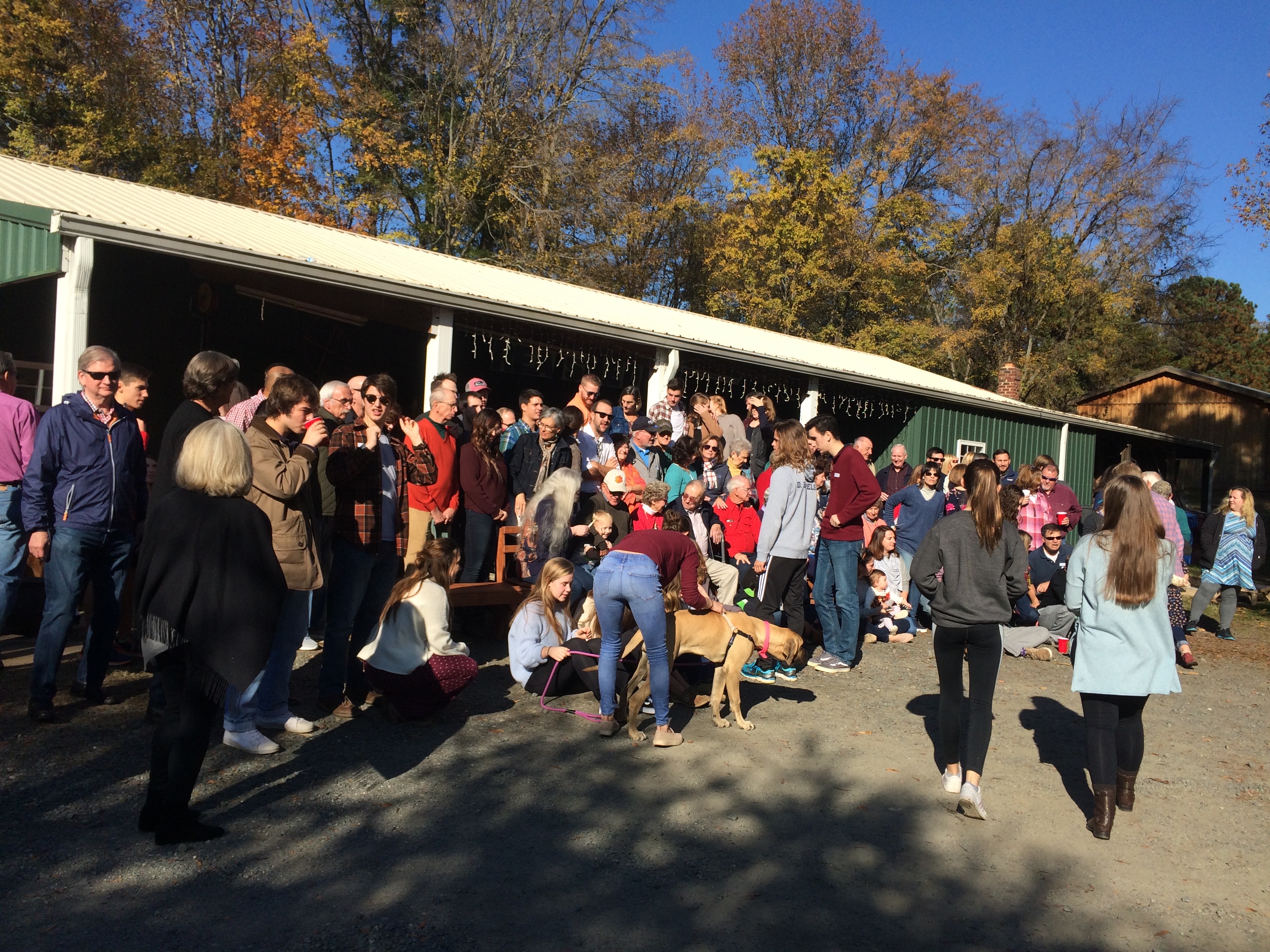
With so much travel in my recent past and near future, I’m temporarily traveled out. I’ll miss this Sunday afternoon’s Charlotte-area reunion of a part of my biological family that I’ve become better acquainted with since I moved to North Carolina: the Rea clan. I’ll especially miss the possibility of spending time together with three sisters of my dad’s generation, related to me through my grandmother’s baby brother Zeb. As far as I know, none of the Rea sisters are famous, but they’ve each lived long, fruitful lives, handling multiple challenges with quiet grace. I hope to have later chances to reconnect with Virginia, Betsy, and Judy. Now in their 80’s and 90’s, they have maintained a durable sisterhood through thick and thin.

Rea sisters Judy, Virginia, and Betsy at 2014 reunion

So to sisters everywhere—stay active, stay engaged, stay vibrant. Avoid excluding anyone if you possibly can. And most of all, stay connected!   


Uncle John

Uncle John   –by Jinny Batterson

Uncle John in military uniform, 1941

It’s been so long ago now that I barely remember
The annual childhood visits to Arlington’s cemetery,
To put flowers on the gravesite where your family
Eventually had you re-interred after you’d fallen
In Germany near the end of World War II.

Once I’d grown older, I asked for pictures of
What you’d looked like in life–you were blond, like
The stern dad whose name is included in yours.
You’d volunteered early for the military, convinced
That the Third Reich posed a grave danger to
Global civilization, though equally so, you thought,
Did rampant nationalism and materialism. In one of the
Pamphlets that your middle sister had printed in your
Honor and memory, you opined, “Would you die for
Your bathtub?” Perhaps somewhat germane, as I sit
In air-conditioned comfort while soldiers in distant deserts
Sweat out yet another year of armed conflict.

You were an inveterate scribbler, like this niece
You never met in life. An eldest son, one of just two
To survive to adulthood, you died in Europe a month
Shy of your thirty-fourth birthday, at about the same
Time your younger brother was among those not killed
When a kamikaze pilot damaged the aircraft carrier
Where he served in the Pacific. Dad came home and
Rarely talked about his service. He sired four children of the
Family’s next generation. In life, the two of you had argued
Passionately about politics, about human nature, but had
Worked and traveled together before war sent you to opposite
Ends of the earth. Dad had the longer physical life, and
He passed along some of your ideals along with the family genes.

You loved the outdoors, spent time on the family farm,
Went camping with friends–an heirloom snapshot shows you
Holding a coffee pot, with an improvised clothes line
Tied to a tent in the background. It’s somewhat fitting
That what physically remains of you lies among many others
On a grassy incline, partially shaded by trees, in a large area
Of “section 12” between Grant and Eisenhower Drives.

This year I won’t make it physically to your gravesite.
My worsening eyesight cannot totally decipher the
Inscription on the virtual image of your headstone
That I now can pull up thanks to a website and the
Volunteers who maintain it. Our country and others
Still engage far too often in “shooting wars,” both foreign
And domestic. Our technology now allows us to engage also
In vicious foreign and domestic cyber wars, equally dangerous.
Please rest well, Uncle John. Know that your survivors
Are doing our best to continue your legacy of service.

The Shapes of our Scars

The Shapes of Our Scars  —by Jinny Batterson

This Mother’s Day brought cards and good wishes from the next generations. Although I once in a while miss the annual homemade breakfasts I used to get years ago, having grown-up children is much less hectic. I’m very glad I’ve had chances to be a biological mom. I’m grateful that the generations after mine are coming into their own, establishing their own patterns of family and civic life.

Mother’s Day observances for me can bring comparisons with other mammalian mothers. Someone has recently started a “dog moms’ day” (celebrating the women who care for their pet dogs) on the Saturday just before (human) Mother’s Day. Lots of internet images these days feature women mothering their pet dogs, or cute dog mothers with their pups, or cat moms with their kittens. What intrigues me most, though, are humpback whale moms. 

Many members of my age cohort were introduced to the songs of humpback whales during the 1970’s, when popular singer Judy Collins produced a duet of human and whale songs based partly on humpback whale recordings captured at sea. The whale songs were haunting. The songs of the humpbacks added impetus to a movement to curtail whale hunting internationally. Humpback populations have since rebounded, though still only at about a third of their estimated 1940 levels.

Marine biologists are learning more about the migration patterns and behavior of all whale species, including humpbacks, one of the larger whale species. Mature humpbacks are about the size of a school bus, weighing 30-40 tons.  Humpbacks migrate huge distances between feeding and breeding grounds each year. Scientists are not sure all the reasons that the whales vocalize—sometimes to find a mate, perhaps to share news, perhaps at times just for fun.  Humpback whale mothers can produce a calf every 2-3 years, and nurse their new calves for up to a year. It takes about a decade for whale calves to reach adult size. A normal humpback lifespan is about 50 years, with ocean pollution, boat collisions, and fishing gear entanglements having replaced whale hunting as main sources of premature death. 

Identifying individual humpbacks can involve studying the patterns of light and dark colorations on the underside of their tail fin, or “fluke.”  Sometimes these patterns are interrupted by scars, which can also help with identification. Recent studies have indicated that many of the scars on mature whales are the result of accidents or attacks when they were calves—often during their first migration.

In a way, such news is reassuring to this fellow mammal. Regardless of my best attempts, sometimes I may have exposed my human children to harm. Sometimes that harm may even have come from me, passed down from the generations that preceded me. I’m grateful that whatever the scars I carry or have inflicted, both I and my children have survived to adulthood. With wisdom, I may be able to use the shape of my individual scars to help heal myself and others.  With wisdom (and perhaps with song), we may be able to heal ourselves and other species from the scars we have inflicted on the planet.   

For more about humpbacks, check the internet—one fairly good introduction has been posted by National Geographic: https://www.nationalgeographic.com/animals/mammals/h/humpback-whale/     

Coercion

Coercion   –by Jinny Batterson

You
may be
able
to coerce
my
obedience

even
to bully me
into a forced
smile

but

you
cannot
coerce
my
enthusiasm.


Labor

Labor     —by Jinny Batterson

Not to belabor the point,
But for many of us, labor has gotten
Pretty thoroughly detached from bodily work. 

The fruits of our labors these days
May often involve spreadsheets rather
Than hand-washed sheets spread in the sun
To dry, or fruitful virtual deals rather
Than fruit freshly picked from actual trees.

Fuels laid down in prior geological
Time substitute for much manual labor these days.
Gas, oil, coal, electricity can help make our lives
Comfortable, if not especially productive or fulfilling.
We yearn for connection, but rarely find it.

We may experience nature at a distance,
Or not at all. Sweat, strain, exertion, groans
Happen at the fitness center, washed away
When we shower and change into “street clothes.” 

Physical labor, when done well, has its own inherent dignity.
Might this day, established in the nineteenth century
To honor laborers, remind us in the twenty-first
To take a break from the gym? Instead,
To go outside, to find a patch of earth, however small,
To heft a trowel, hoe, or shovel, then to burrow
Into a bit of the foundational soil that has for
Eons fed both our bodies and our souls.