Category Archives: Uncategorized

Uncle John

Uncle John   –by Jinny Batterson

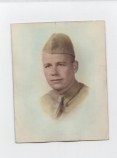
Uncle John in military uniform, 1941

It’s been so long ago now that I barely remember
The annual childhood visits to Arlington’s cemetery,
To put flowers on the gravesite where your family
Eventually had you re-interred after you’d fallen
In Germany near the end of World War II.

Once I’d grown older, I asked for pictures of
What you’d looked like in life–you were blond, like
The stern dad whose name is included in yours.
You’d volunteered early for the military, convinced
That the Third Reich posed a grave danger to
Global civilization, though equally so, you thought,
Did rampant nationalism and materialism. In one of the
Pamphlets that your middle sister had printed in your
Honor and memory, you opined, “Would you die for
Your bathtub?” Perhaps somewhat germane, as I sit
In air-conditioned comfort while soldiers in distant deserts
Sweat out yet another year of armed conflict.

You were an inveterate scribbler, like this niece
You never met in life. An eldest son, one of just two
To survive to adulthood, you died in Europe a month
Shy of your thirty-fourth birthday, at about the same
Time your younger brother was among those not killed
When a kamikaze pilot damaged the aircraft carrier
Where he served in the Pacific. Dad came home and
Rarely talked about his service. He sired four children of the
Family’s next generation. In life, the two of you had argued
Passionately about politics, about human nature, but had
Worked and traveled together before war sent you to opposite
Ends of the earth. Dad had the longer physical life, and
He passed along some of your ideals along with the family genes.

You loved the outdoors, spent time on the family farm,
Went camping with friends–an heirloom snapshot shows you
Holding a coffee pot, with an improvised clothes line
Tied to a tent in the background. It’s somewhat fitting
That what physically remains of you lies among many others
On a grassy incline, partially shaded by trees, in a large area
Of “section 12” between Grant and Eisenhower Drives.

This year I won’t make it physically to your gravesite.
My worsening eyesight cannot totally decipher the
Inscription on the virtual image of your headstone
That I now can pull up thanks to a website and the
Volunteers who maintain it. Our country and others
Still engage far too often in “shooting wars,” both foreign
And domestic. Our technology now allows us to engage also
In vicious foreign and domestic cyber wars, equally dangerous.
Please rest well, Uncle John. Know that your survivors
Are doing our best to continue your legacy of service.

The Shapes of our Scars

The Shapes of Our Scars  —by Jinny Batterson

This Mother’s Day brought cards and good wishes from the next generations. Although I once in a while miss the annual homemade breakfasts I used to get years ago, having grown-up children is much less hectic. I’m very glad I’ve had chances to be a biological mom. I’m grateful that the generations after mine are coming into their own, establishing their own patterns of family and civic life.

Mother’s Day observances for me can bring comparisons with other mammalian mothers. Someone has recently started a “dog moms’ day” (celebrating the women who care for their pet dogs) on the Saturday just before (human) Mother’s Day. Lots of internet images these days feature women mothering their pet dogs, or cute dog mothers with their pups, or cat moms with their kittens. What intrigues me most, though, are humpback whale moms. 

Many members of my age cohort were introduced to the songs of humpback whales during the 1970’s, when popular singer Judy Collins produced a duet of human and whale songs based partly on humpback whale recordings captured at sea. The whale songs were haunting. The songs of the humpbacks added impetus to a movement to curtail whale hunting internationally. Humpback populations have since rebounded, though still only at about a third of their estimated 1940 levels.

Marine biologists are learning more about the migration patterns and behavior of all whale species, including humpbacks, one of the larger whale species. Mature humpbacks are about the size of a school bus, weighing 30-40 tons.  Humpbacks migrate huge distances between feeding and breeding grounds each year. Scientists are not sure all the reasons that the whales vocalize—sometimes to find a mate, perhaps to share news, perhaps at times just for fun.  Humpback whale mothers can produce a calf every 2-3 years, and nurse their new calves for up to a year. It takes about a decade for whale calves to reach adult size. A normal humpback lifespan is about 50 years, with ocean pollution, boat collisions, and fishing gear entanglements having replaced whale hunting as main sources of premature death. 

Identifying individual humpbacks can involve studying the patterns of light and dark colorations on the underside of their tail fin, or “fluke.”  Sometimes these patterns are interrupted by scars, which can also help with identification. Recent studies have indicated that many of the scars on mature whales are the result of accidents or attacks when they were calves—often during their first migration.

In a way, such news is reassuring to this fellow mammal. Regardless of my best attempts, sometimes I may have exposed my human children to harm. Sometimes that harm may even have come from me, passed down from the generations that preceded me. I’m grateful that whatever the scars I carry or have inflicted, both I and my children have survived to adulthood. With wisdom, I may be able to use the shape of my individual scars to help heal myself and others.  With wisdom (and perhaps with song), we may be able to heal ourselves and other species from the scars we have inflicted on the planet.   

For more about humpbacks, check the internet—one fairly good introduction has been posted by National Geographic: https://www.nationalgeographic.com/animals/mammals/h/humpback-whale/     

Coercion

Coercion   –by Jinny Batterson

You
may be
able
to coerce
my
obedience

even
to bully me
into a forced
smile

but

you
cannot
coerce
my
enthusiasm.


Labor

Labor     —by Jinny Batterson

Not to belabor the point,
But for many of us, labor has gotten
Pretty thoroughly detached from bodily work. 

The fruits of our labors these days
May often involve spreadsheets rather
Than hand-washed sheets spread in the sun
To dry, or fruitful virtual deals rather
Than fruit freshly picked from actual trees.

Fuels laid down in prior geological
Time substitute for much manual labor these days.
Gas, oil, coal, electricity can help make our lives
Comfortable, if not especially productive or fulfilling.
We yearn for connection, but rarely find it.

We may experience nature at a distance,
Or not at all. Sweat, strain, exertion, groans
Happen at the fitness center, washed away
When we shower and change into “street clothes.” 

Physical labor, when done well, has its own inherent dignity.
Might this day, established in the nineteenth century
To honor laborers, remind us in the twenty-first
To take a break from the gym? Instead,
To go outside, to find a patch of earth, however small,
To heft a trowel, hoe, or shovel, then to burrow
Into a bit of the foundational soil that has for
Eons fed both our bodies and our souls. 

Different Angels from Montgomery

Different Angels from Montgomery   —by Jinny Batterson

Growing up, I wasn’t a huge country music fan. However, like a lot of folks, I developed an infatuation with the John Prine song “Angel from Montgomery” and its signature refrain: “Make me an angel that flies from Montgomery.” Who/what is the angel? There’s some dispute.  One of John’s friends insists it was an angel atop the Montgomery Ward building in Chicago, near where John was raised. Another theory is that “angel that flies” refers to a prison pardon communicated from the office of Alabama’s governor at Montgomery. Such pardons for prisoners were/are much hoped for but seldom granted, especially for those on death row. To my knowledge, Prine himself hasn’t identified the angel.

The song stayed in the back of my mind as I planned a “southern swing” in late winter. I had friends in Atlanta, relatives in southern Georgia and northern Florida. Montgomery, where I’d never before visited, was not that far out of the way.

This initial capital of the Confederacy and nexus of civil rights activism a century later had some museums I wanted to see. Near my downtown Montgomery hotel was a small museum to early country music star Hank Williams, who first rose to fame in Montgomery in the late 1930’s. Though I read the historical marker to his memory and looked at the window displays, this was not one of the museums I came for. Rather, I wanted to spend time learning more about Montgomery’s role during the civil rights era—about Rosa Parks, Martin Luther King, Jr., and the bus boycott that helped usher in a decade of civil rights activism.

In a downtown Montgomery branch of Troy University, a Rosa Parks exhibit reconstructed the events surrounding Ms. Parks’ 1955 arrest and the ensuing bus boycott, complete with a vintage bus. Having a chance to see the actual venue that had produced her and then the year-long boycott brought home her fortitude and resolve, along with the solidarity and resolve of Montgomery’s African-American community.

I’d made advance reservations for another pair of museums and memorials, recently opened by the Equal Justice Initiative. The Legacy Museum and its companion, the National Memorial for Peace and Justice (also known as the Lynching Memorial) show the enduring legacy of racial terror that continues to haunt our nation. The Legacy Museum, a block from Hank Williams’ shrine, documents the horrors of the slavery and Jim Crow eras plus some brutal variants that continue to this day.  One of the museum’s most graphic exhibits is a set of large jars of soil collected from sites of terror lynchings that occurred from the 1870’s up through 1950, peaking in the 1890’s and early 1900’s.

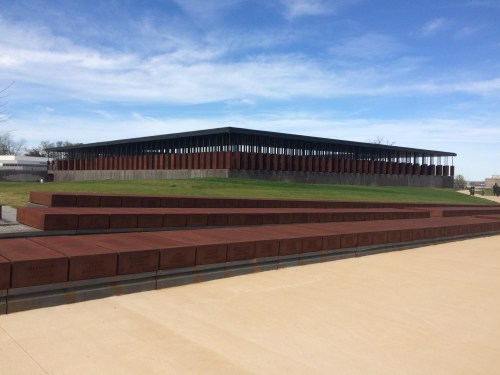
On a six acre site overlooking Montgomery’s downtown, a companion memorial contains two sets of over 800 steel columns, one for each county in the United States where documented racial terror lynchings took place. One set of columns is shielded by a roof. Viewers of the sloping site are led from an initial area where the columns are at ground level toward a section where they hang suspended, like many of the lynching victims they represent.  

Hanging columns at National Memorial for Peace and Justice in Montgomery, Alabama

Words or photos cannot convey the full impact of experiencing a walk among them. The county where I now live in North Carolina had one lynching memorialized; the county in Maryland where I was raised had two. In all, over 4,000 racial terror lynchings have been documented and verified in 20 states.

A second set of columns lies flat on the ground. Rust-colored, it reminded me of the corrosive myths many of us have told ourselves and each other for years, helping perpetuate race-based fears and hatred, going all the way back to the myth of the “happy darky.” There’s the myth of the predatory black man, with its corresponding myth of helpless womanhood. Especially pernicious and pervasive is the myth of white superiority, abetted by the myth of entirely benign police presence aimed solely at preserving “law and order.”

. The duplicate columns are designed to be brought home to the counties where lynchings occurred, as a way to help acknowledge past injustices and then help heal our enduring racial divides. The columns are way too heavy to fly, but these angels represented in Montgomery need to go home. It’s way past time.

Duplicate columns, Montgomery's memorial

duplicate columns lying outside at Montgomery memorial

By now, I’ve become an old woman. Not unlike the wife in Prine’s song, I’m named after one of my grandmothers. I may be old, but I can continue to bear witness. Again paraphrasing Prine’s lyrics—to believe in (and work toward) reconciliation is a good way to go.    

Wedding Dress Trees: Of Bradford Pears (and Gnarled Old Oaks)

Wedding Dress Trees: Of Bradford Pears (and Gnarled Old Oaks)    —by Jinny Batterson

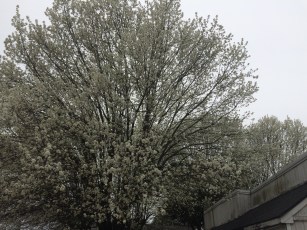
A Bradford pear in bloom

Yesterday was a dreary day, made more dreary for me because it contained a memorial service for an elderly former congregation-mate.  We’d had a wetter than usual winter. It seemed the rain would never go away.  Precipitation since the first of December was running about 40% above average.  A late-winter jaunt that my husband and I had recently taken to cities further south had been largely unsuccessful at getting away from the wet. A few sunny days, but mostly just more rain. 

After the memorial service, I drove back toward our condo. The weather alternately showered, drizzled and misted, continuing its uninviting pattern. The white roadside blooms of our area’s Bradford pears and their naturalized cousins temporarily brightened the landscape. A few of the trees reminded me of inverted wedding dresses—puffy, full, virginally white.

I knew a little about this species of tree. Near my former home in Richmond, Virginia, rows of them had been planted as street trees during the 1970’s or 80’s. There, they’d provided ethereal beauty for a couple of weeks each spring. When young, the trees were a welcome addition to the landscape. However, as they aged, they produced mostly headaches. Few lived past twenty, not very old for a tree. Their brittle wood had a tendency to split any time there was a wind stronger than a gentle breeze. During thunderstorm season, city maintenance trucks performed branch clearing chores so regularly they might as well have parked for the summer along the pear-lined street.

Curious for more information about the history of both our departed elder and the Bradford pear, I clicked a few online keys.

According to the obituary that I belatedly read, “Old Jim Quinn,” a long-term member of the UU Fellowship of Raleigh, had served in the military in post-war Europe, but otherwise spent nearly all his 87-plus-year life in North Carolina. He’d married Sonnya, his “Super Chick,” in 1955. During the 1970’s, he’d served two terms on the Raleigh City Council. Later, he and Sonnya became regulars at civil rights marches and demonstrations. Along the way Jim had sired and helped raise several children, designed buildings, helped promote affordable housing before it became a buzzword, and served in numerous other civic capacities. He was known far and wide for his barbecue skills. By the time I knew him slightly, he was gray and a little stooped, if still quick with a smile and a witty remark. 

According to a somewhat critical article (https://www.greenvilleonline.com/story/life/2016/03/21/curse-bradford-pear/82070210/), the Bradford pear was introduced as a landscape tree by the U.S. Department of Agriculture in 1964, imported from its native China and presumed to be sterile. Before long, it was an urban landscape fixture in cities throughout the Southeast. As the first trees aged, problems with their brittle wood became more apparent. Later, problems with cross-pollination with other pear varieties showed up, along with the invasive nature of some hybrid offspring. By now, most towns have stopped planting new Bradford pear cultivars. Some jurisdictions and homeowners have even begun active attempts to rein in Bradford pears and the offspring that can form dense thorny hedges and crowd out native flowering trees.

Bradford pear blossoms

Raleigh, long-time home to Jim Quinn, bills itself as the “city of oaks.” There’s a gnarled old specimen behind our condo, not unlike the gnarled older version of Jim I used to see at church. If Sonnya once in a while looks at her long-ago wedding dress or passes it on to a granddaughter or great-niece for reuse, she must constantly miss the gnarled old oak her life mate grew to become. Here’s to you, Old Jim Quinn.    

This Year’s February 14

This Year’s February 14     —by Jinny Batterson

This morning the sun rose here earlier than the day before;
The poinsettias a neighbor gave me to nursemaid
After the Christmas holidays droop a bit, but still
Lavish red and pink accents on our late-winter
Condo. My husband sneaks a colorful set of earrings
Onto my place at the breakfast table. Happy Valentine’s Day!

Only this year we add a differently sanguine tradition:
Marjory Stoneman Douglas High School Remembrance Day.
Last year, this morning in Florida started out routine,
Even joyous, until lives were shattered by gunfire.
Does it matter whether the gunman was mentally ill?
Does it matter that he had access to a military-style weapon,
Designed and sold for no other purpose than killing humans?

At 10:17 a.m., schools and workplaces will observe a moment
Of silence, remembering slain students Alyssa, Martin, Nicholas,
Jaime, Luke, Cara, Gina, Joaquin, Alaina, Meadow,
Helena, Alex, Carmen and Peter. We’ll ponder whether
Any of us have the bravery or protective instincts of staff
Members Chris, Aaron, or Scott. We’ll continue to mourn, to
Question what we can do to reduce the chances that
Future holidays will also come to hold dual meanings.
Thoughts, prayers, silent vigils help. They’re not enough.

Additional steps are required. To honor their memories,  go a little
Beyond: Send a pointed Valentine message to your legislator.
Follow up with emails, maybe even visits. Make a donation.
Register and vote. Talk with those of different views.
Find the unique, universal core deep within you,
Then share it. Some holidays exist for us to reclaim.


Experiments in Car-Less Living

Experiments in Car-less Living    —by Jinny Batterson

My body periodically tells me it’s no longer young or limber—creaky knees, back twinges, huffing up hills, diminished stamina, hearing difficulties, memory lapses.

The biggest problem is my eyes. Most of my life I’ve been nearsighted, my vision corrected with either glasses or contact lenses. Unfortunately, my aging orbs have recently developed both glaucoma (probably an inherited trait) and cataracts. The glaucoma, caught early, has done minimal harm, with further damage slowed or stopped by medication. The cataracts will sooner or later require corrective surgery. In the meantime, my night vision is declining. I try to avoid driving after dark. For those evening events I really don’t want to miss, I do my best to catch rides.

Last weekend I traveled out of town to my previous hometown of Richmond, VA. During this midwinter solo getaway, I’d visit with former classmates and friends, touch base with my financial advisor, attend a couple of public events. The trip could be a more extended experiment in getting along without a car. I’d made a provisional plan:

1) Get my accommodating husband to drive me and my luggage to the train station, then take the Friday morning train north from Raleigh, NC.

2) Get a former college suite mate to pick me up at the Richmond station and shepherd me around to that day’s activities, then drop me at the suburban hotel I’d booked near my other weekend events.

3) Line up two other friends who lived near the hotel to be my companion/chauffeur, one each for the two other weekend days, with my “Sunday driver” depositing me back at the Richmond train station in time for the mid-afternoon southbound train.

4) Phone hubby and have him pick me and my luggage back up in Raleigh.

The start of the plan worked well—hubby complained only slightly about getting up early enough to drive me to the train station; the train, though slightly late, was very comfortable; my classmate met me promptly at the Richmond station; we shared a leisurely restaurant lunch nearby and began catching up on our respective lives. She then drove me to my Friday afternoon appointment downtown. I wasn’t sure how long it would last. My friend assured me she’d be available for further ferrying duties—just phone her once I was done. After she deposited me at the appropriate high-rise office building, she drove off westward to share babysitting chores with her husband, spending some quality time with their most recent grand baby.

The meeting was briefer than I’d expected, so I decided to experiment with the new high-speed bus that ran from the downtown area west to a shopping center near where my friend and her husband were babysitting. That way, I figured, I’d save her from coping with downtown traffic plus have my own little adventure with public transportation.

The infrastructure of the new bus line was impressive: a dedicated bus lane, ramps to raised bus stops imbedded in the median of a major east-west street, automated ticket kiosks. The first kiosk I came to was out of order. I asked a woman waiting for the next bus where I could get a ticket headed west.

“Maybe the machine at the next stop is working,” she told me, “but it’s quite a ways.”   

Turns out one of the design changes for the new line increased the distance between stops. I walked about half a mile, got a ticket, then waited fifteen minutes for the next bus. Overall, the five mile trek to the shopping center took me more than an hour. Not a huge problem for me. Potentially hard on someone with a tighter schedule and/or mobility problems.

After my “Friday chauffeur” had picked me up at the shopping center, we’d caught up more over coffee, and she’d deposited me at my hotel, I got a plaintive phone call from Saturday’s ride. She’d broken a bone. She was in pain, with her arm in a sling. She was temporarily in no shape to drive.

Due to my friend’s injury, my Saturday logistics would be more complicated. Luckily, I’d installed an app on my phone for one of the ride-sharing services that’s recently sprung up in some American cities. An exploratory check for potential rides turned up multiple possibilities. My scaled back Saturday itinerary could be satisfied using a combination of public bus, walking, and Lyft. On Saturday morning, the hotel front desk directed me to a nearby bus stop; my first errand was just over a mile away along the bus line; a return walk to the hotel was doable, though there were gaps in the sidewalk on a busy street. In the afternoon, Lyft rides to and from my event were less expensive than I’d feared. I found a supper restaurant an easy walk from the hotel. My Sunday ride was healthy and punctual. Needing her chauffeuring was a good excuse to catch up. Hubby picked me and my luggage up with minimal griping.   

My aging eyes have got me thinking about our society’s over-dependence on private automobiles. If I’d previously listened to the frustrations of car-less friends and acquaintances with a mixture of pity and amusement, my turn for similar frustrations might arrive sooner than expected. I’m still lucky—I can afford and access alternatives. People with limited economic means can rarely afford a car, for-fee ride-sharing, or extensive public transit. In rural areas, suitable transit isn’t often available. This morning I awoke to a cold snap that had made outdoor temperatures so frigid that in some northern areas, schools and offices were closed, and even the U.S. postal service had temporarily halted deliveries.

An aging population, income disparities, geographic sprawl,  and climate change will severely stress a society accustomed to hopping in the car for every errand and need. Public transportation in the area where I live is spotty, but I’m going to learn more about riding the bus (https://gotriangle.org/how-ride-bus), using ride sharing services, and occasionally engaging a customized pick-up service our town provides. What are your options? 

MLK, Jr. Reweaving the Dreams

MLK, Jr.: Reweaving the Dreams   —by Jinny Batterson

While he was alive, I knew little about him.
The mainstream press in Baltimore barely mentioned
This Negro preacher who’d helped marshal a yearlong bus
Boycott and in the mid-1960’s won a Nobel Peace Prize.
There were rumors he might be a Communist.

I was in high school, with other concerns—
Who could I get to take me to the prom?
Would my SAT scores help me get into a good college?
Would my parents take away my driving privileges
After an accident that I at least partially caused?

By the time I got to college, his star was waning,
Eclipsed by rising black militancy and a war in Southeast Asia
That dragged on and on. His tactics and pronouncements were
Less influential, less obviously successful in northern cities than in
Earlier Southern-based campaigns. Non-violence and preaching peace
Didn’t appear to work against big-city political machines and war contractors.

At first it seemed his dreams had come unraveled when his life ended.
As riots broke out in many American cities following his assassination,
I sat distracted in a secluded dating parlor on a small college campus,
My boyfriend’s bent-kneed proposal and diamond ring a pale foreground
To a muted television backdrop of Baltimore and Washington, D.C.,
Two bookends of my youth, engulfed in flames, sirens, and riot police. 

By the time his birthday was declared a national holiday
In November, 1983, I was attempting to learn and implement
Parts of his dream in rural central Africa. My efforts met with
Little success in a country whose few rich and many poor lived in vastly
Different worlds, with a minuscule middle partly made up of expatriates
Like me. I had lots of time to read the contents of a USAID library.

Martin Luther King, Jr., I learned, was a middle child, born just before
The Great Depression. His family lived in a relatively prosperous black enclave
In segregated Atlanta. During his early studies, he drifted, but partway through
High school he was inspired toward the ministry. He went north and completed
An impressive formal education, earning a doctorate by age twenty-five.

The parts we now recite in school start in Montgomery, Alabama,
Where he was nominated, as a young, little-known preacher, to give voice to the
Aspirations of people who had for too long been shunted to the back of the bus.
After the successful conclusion of the bus boycott, sixty civil rights leaders met
In Atlanta, founded the Southern Christian Leadership Conference, and elected
MLK as its first president.  Then came sit-ins, Freedom Summer, Albany,
Birmingham, Selma, Chicago, a Poor People’s Campaign, a sniper’s bullet.

Those of us who call ourselves progressives winced at subsequent American
Foreign and domestic policy, wrote letters, attended rallies and marches,
Wondered what else we might do to stop, or at least reduce, the madness.
For a while, we thought we had found an answer in another young,
Eloquent brown-skinned man. Twice we elected him national president,
Allowing complacency to creep into our ongoing efforts.

Our current national administration is more nightmare than dream.
It wants us to forget that our deepest dreams are inclusive rather
Than exclusionary, spiritual as well as material. MLK knew this.
He tried to tell us, over and over again, but we rarely listened.

We know MLK had flaws—infidelity, sometimes neglecting his family,
Carrying too much of the movement’s burden by himself.
We do not need another plaster saint, of whatever skin hue,
But Coretta was right to insist that we honor MLK with a holiday.
Though not free from sin or error, he was also a prophet
Who recalled us to our best selves. May we remember
His efforts as we redouble ours, reweaving stronger dreams.

Pandas Playing Mahjongg–Enjoying the Cary Chinese Lantern Festival

Pandas Playing Mahjongg, Enjoying the Cary Chinese Lantern Festival 

                                                        —by Jinny Batterson

Cary Chinese Lantern Festival Panda Land 2019

For the past several years, a traveling exhibit of LED-lit silk-skinned “lanterns” has come to our North Carolina town during the darkest period of winter. Last year on the night I attended the festival, the air was bitingly cold. Crowds were sparse. This year, on a clear weekend evening a good bit warmer than typical for early January, I ate an early supper, then put on a hoodie, drove to the festival site, parked in a free adjacent lot, and walked to the box office to get a ticket. I arrived a little after the festival’s 6 p.m. opening—once the sky was dark enough to provide a good backdrop for the thousands of lanterns and fanciful lit shapes.

I’d assumed that by arriving early, I’d “beat the crowds” and minimize my wait time to purchase tickets (cheaper at the gate than by internet) and then gain entry to the exhibit space. The wait wasn’t too long—maybe twenty minutes in all–but it turned out I’d arrived at the height of that evening’s viewing hours for multi-generational families. Rather than come later in the evening, they were enjoying the spectacle before youngsters’ bedtimes, at the same time taking advantage of reduced or free entry for young children.

The star of the show, a huge brightly lit dragon, again stretched along the shallows of Symphony Lake for a couple hundred feet. It was even larger and more intricate than last year’s dragon.  A few of the other exhibits were similar to what I’d seen previously, but arranged differently and with different emphasis.  New features had been added, too, including a set of large lantern “drums” near the entrance, with a real drum that kids could pound on to make the lights glow brighter.

Cary Chinese Lantern Festival Drums

My favorite set of lanterns was “panda land.” I’d previously spent time in China in the region where pandas are native. This exhibit featured stylized panda figures in human poses—riding a bicycle or, my absolute top pick, playing the Chinese tiled game of mahjongg, a sort of cross between dominoes and the card game spades.  Periodically, performers on the festival stage did acrobatics or Chinese dances—I watched briefly, then went back to the pandas. This year’s lantern festival is nearly over. The weather for remaining evenings is predicted to be less pleasant than the evening I went.

If you live locally, I’d encourage you to go if you can. Too often these days our airwaves are full of insults, ricocheting threats, and fear mongering. Against this background, an outdoor stroll alongside others speaking many languages, all of us watching the whimsical uses we can make of our technologies when we’re not busy fussing with each other, is, dare I say it, priceless.