Category Archives: travel

Happy Interdependence Day!

Happy Interdependence Day!    —by Jinny Batterson

For a good many years now, I’ve bracketed an insertion into my July 4 Independence Day greetings to friends in the American expatriate community:

“Happy In(ter)dependence Day!” I extol them.  It has seemed to me increasingly evident that in an era of global communication and commerce, celebrating “independence” needs a counterweight. We have become more and more dependent on one another across all sorts of boundaries. So I was pleased to find that others more widely known than I am have come up with similar themes. Perhaps the most widely publicized is a September 12 holiday proposed in the years just following the World Trade Center terrorist attacks.  In 2003, a group met to create a day to celebrate our global interconnectedness, and settled on September 12, the day after the terrorist assault, as a day for an annual celebration. According to Parag Khanna, one of its founders:

     “For the event’s organizers (the Democracy Collaborative at the University of Maryland), Interdependence Day is intended to be crucially different from 4 July. Where Americans alone celebrate the latter, the idea of interdependence unites all peoples across national boundaries in a common human destiny. At the same time, there is an element of deep continuity: for Americans in particular will have to struggle as hard to realize the promise of interdependence as they did for independence.”  (For a fuller explanation, please check out the following link: https://www.paragkhanna.com/home/americas-interdependence-day.) 

     I’ve just returned from a cross-country U.S. trip, benefiting from collaborative practices among airline personnel, colleagues, other passengers, and airport employees to adjust schedules and seating to get as many of us as practical back to our homes on the U.S. Atlantic coast in advance of a strong hurricane. My guess is that our skills at interdependence will soon get a good bit of practice, courtesy of Florence and/or other storms later in the season. My best wishes to all for adequate shelter from the storm—Happy Interdependence Day!     

Aubrac’s Fields of Wild Jonquils

Aubrac’s Flelds of Wild Jonquils    —by Jinny Batterson

In late May, as I was walking across a sparsely settled upland French plateau along a stretch of one pilgrimage route of the Camino de Santiago de Compostela, I encountered a delicious fragrance—delicate and sweet and lingering. I wasn’t sure where it was coming from. Despite, or perhaps because of, a fair amount of rainy weather, the meadows and woodlands abounded in spring blooms, many of them unfamiliar to me.  That evening at the small guest house where we had booked a room, I noticed a vase of flowers with the same delicate fragrance. I asked the proprietress what these small white blooms were called. “Jonquils des poètes,” she told me in French.

I’m not sure what the English equivalent is. The internet pictures I’ve found of “Poet’s jonquils” look similar, but not identical to the flowers I remember from my trip. A few days further into my journey, I arrived midmorning at the tiny town of Aubrac, after spending a couple of hours crossing several miles of minimally fenced upland pastures dotted with jonquils des poètes, some being contentedly munched by local cattle. The weather was cool and misty.

At the near edge of town was a forbidding-looking Romanesque structure. A guide was explaining to a group of tourists in a language I could not understand the wonders and historic significance of this church. According to the French signpost I could partly understand, this former Benedictine monastery was at least a thousand years old and likely built on the foundations of an even earlier structure.

Most of the other buildings along the road and edging the upland pastures were hotels, hostels, or small inns. I noticed one small cafe/guest house that seemed to be open. Several of us stopped and picked out an outdoor table under a protective awning. A warm drink seemed a good idea. It took a while for anyone to come to take our orders—after a bit, an elegant young woman showed up, apologizing somewhat for the delay, explaining that she and the other town residents were all still stressed out from the previous weekend’s “transhumance” festival that annually draws thousands to the area. I’d seen pictures and postcards of this celebration of the opening of common upland pastures for the area’s prized cattle. A nearby town square was still littered with floral garlands and signs from the festival. (Find a set of commercial pictures of the 2018 festival here: http://hotel-lion-or.com/aveyron/fete-transhumance-aubrac/

When our hostess finally brought our coffees and hot chocolates, she stopped to take a smoke break and we began to ask her questions. All of us were curious about the town, whose year-round population has dwindled markedly from a peak over a century ago. Until the late 19th century, our hostess told us, Aubrac had been a traditional farming village, but the harshness of the climate and the difficulty of earning an adequate living caused many farm families to leave the area and seek better lives in French cities. Lots of the adults became small shopkeepers or restaurateurs in and around Paris. However, they retained cottages in Aubrac and continued to bring their families for summer vacations in their former hometown. At about the same time, some area doctors discovered that the clean, cool air in the Aubrac highlands helped tubercular patients. Several tuberculosis sanatoria were opened over the next decades—some have since become hotels or hostels. Most of the local economy now revolves around tourism, compressed into the three or four months of warmer weather. The local cattle, a special hardy breed, supply photo opportunities as well as milk or meat. 

Our hostess explained between puffs that she was even busier than she’d expected post-festival: her five rooms were all rented for the week—a group of businessmen from New York City had come to explore the option of buying quantities of jonquils des poètes to use in a new upscale perfume fragrance. She said that this particular type of jonquil only grew in the wild and had not yet been successfully cultivated.  Some of each year’s blooms already were collected by locals to supply French perfumeries in the southern city of Grasse, a noted perfume center.

I never got to meet the businessmen, who most probably were jet-lagged and perhaps also technology-deprived in this isolated small town. My current exposure to a former-NYC-businessman-turned-politician has temporarily soured me on the ethics and business practices of some.  My hope is that if a deal is struck, the good people of Aubrac will be fairly compensated for their labor and their wild-growing fragrant white blossoms.  I also hope that enough flowers will be left in the fields so that cattle, pilgrims, and residents can continue to enjoy their essence in their native habitat.    

Radio Mille Collines and the Limits to Free Speech

Radio Mille Collines and the Limits to Free Speech   —by Jinny Batterson

Each of us beyond infancy is, I believe, a product of both nature and nurture. Genetic traits and predispositions we’re born with get adjusted over time by our experiences and our successive re-interpretations of those experiences. I seem to have been born with a predisposition toward nervousness, so it’s probable that the name-calling and mud-slinging that too often inhabit media and political spaces in current-day America feel more threatening and more repugnant to me than they might to someone with a less nervous temperament.

Still, my “nurture” plays a role as well. During the 1980s, I spent two years in the economically impoverished central African country of Burundi working on rural development. Before I went, I did as much research as I could in those pre-internet days about the country I’d be living in for a time: Burundi was for most of its history a sparsely populated, geographically isolated mountainous kingdom with a preponderance of rural herders and farmers. Then, starting in the late 19th century, Burundi became first a German, then a Belgian colony, administered along with neighboring Rwanda. Neither colonial power provided much development support. During their four-plus decades of rule, Belgian administrators often used “divide and conquer” tactics, exacerbating tensions between the area’s two main ethnic groups: the Tutsis, most of whom owned and herded cattle, and the Hutus, who tended instead to farm multiple small plots owned communally by extended families in the Burundian and Rwandan hillsides, or “collines.” Since its early 1960s independence, Burundi’s trajectory has included political assassinations plus a massive ethnic conflict in the early 1970s that killed an estimated 300,000 Burundians. 

When I first arrived, I spoke none of the local language, Kirundi. I had little notion of which of my coworkers and neighbors were Tutsi and which were Hutu. Physically similar, with the same language and skin tone, Tutsis and Hutus were sometimes characterized as “talls” and “shorts” in an exaggeration of one trait that distinguishes them at the extremes. Because of intermarriage, a fair number of Burundians were and are a mixture of both groups. During my stay, I gradually built up a very basic Kirundi vocabulary. Though fluency remained beyond my grasp, I understood enough so that when I attended a local soccer game about halfway through my assignment, I recognized the derogatory use of a word meaning “short,” yelled at the opposing team by some nearby spectators. Not quite as offensive as the “n” word in American speech, the epithet was still intended to be disrespectful. 

During the 1980s, Burundi and neighboring Rwanda were relatively calm, but starting in 1993 both countries again descended into wholesale bloodletting, with the widely publicized Rwandan genocide of 1994 and a less-media-covered simmering civil war in Burundi.  Part of the build-up to the Rwandan genocide consisted of incitements by a privately owned radio station, Radio Mille Collines (Radio of a Thousand Hillsides), against ethnic Tutsis and moderates of all groups. According to a summary by the Montreal Institute for Genocide and Human Rights Studies:

“From October 1993 to late 1994, Radio-Television-des-Mille-Collines (RTLM) was used by Hutu leaders to advance an extremist Hutu message and anti-Tutsi disinformation, spreading fear of a Tutsi genocide against Hutu, identifying specific Tutsi targets or areas where they could be found, and encouraging the progress of the genocide. In April 1994, Radio Rwanda (the official government station) began to advance a similar message, speaking for the national authorities, issuing directives on how and where to kill Tutsis, and congratulating those who had already taken part.”  The Institute has published detailed transcripts of many of these station broadcasts in English, French, or Kinyarwanda, the Rwandan local language.

After the genocide and a change of government in Rwanda, international criminal proceedings brought to trial some of the political leaders of genocide-era Rwanda, along with some of the media leaders who had helped foment hatred with their increasingly strident broadcasts. Not all ringleaders could be located and brought to justice, but 92  high-ranking defendants were indicted for their roles in a 100-day rampage that killed an estimated 800,000 Rwandans.

As we approach the 50th anniversary of the assassination of Dr. Martin Luther King, Jr., I sometimes fear for my own country and for our planet. Derogatory speech is again on the rise globally, whether from politicians, media pundits, or just disgruntled citizens and residents. Americans belonging to groups who have in the past been targets of repression and/or genocide—African-Americans, Jews, immigrants, LGBTQ persons, among others—feel the impact most deeply, but it affects us all.  As one European Jewish leader put it, “While hate speech and incitement is far too often dismissed as bigoted ranting or merely painful words, it can also serve as an important warning sign for much more severe consequences. Almost every genocide, ethnic cleansing or inter-ethnic conflict in modern history was preceded by violent words. We witnessed inflammatory public speech rise steadily before outbreaks of mass violence, whether in Nazi Germany, Rwanda or in the former Yugoslavia.”   

Of course we need to be able to express opposing views, but we need to be able to express them civilly, rather than by using name-calling, blaming, or personal attacks. Free speech is not the same as hate speech or incitement—please let us learn and teach the difference before it’s too late. 


Dragon Kites on Tiananmen Square

Dragon Kites on Tiananmen Square    —by Jinny Batterson

(Portions of this post have been adapted from my upcoming book, Where the Great Wall Ends: A China Memoir, due out later this year.)

A growing number of locations world-wide are sponsoring kite festivals. In the town where I now live, March winds bring out people of all ages, eager to enjoy the outdoors as winter ebbs, to search for just the right spot and orientation to launch their creations skyward. The basic homemade wrapping-paper-and-balsa-strut diamond shaped kites I flew as a child pale in comparison with the elaborate heirloom and contemporary kites that participate in some of these festivals. A quick internet search turned up an American-based kite flyers association with members in 25 countries, with at least one U.S.-based festival in every month of the year.  (http://kite.org/activities/events/event-calendar/)

One blustery spring day in 2000 on Tiananmen Square in Beijing, China, I got to see a few of the world’s most cherished, most elaborate kites. My husband and I were partway through a tourist stay in Beijing. Our first two days had been filled with organized guided tours: the Forbidden City, a nearby section of the Great Wall, the Summer Palace, some of the subterranean tunnels built under the modern city during the 1960’s and 1970’s to shelter residents in the event of a bombing attack by “the Soviets or another country,” as our tour guide put it. Now we had a free day to explore on our own. We decided to return to the vicinity of Tiananmen Square.

As we approached, we noticed several box kites bobbing and weaving in the sky above.  Once on the square itself, we found several older men preparing their heirloom dragon kites for flight. The kites, nearly fifty feet long, had extensive tails made of circles of paper glued to lightweight wooden rings, all linked together by three parallel strings that ran the kites’ entire length and could be used for steering. The rings were decorated with sturdy feathers for stability. Only when the tail was almost fully aloft was the dragon-shaped head of the kite attached and quickly pulled skyward. We watched until our necks cramped from craning upward. We had little language to express our amazement—Jim gave a thumbs up sign. Perhaps our rapt attention was language enough.

Where the Great Wall Meets the Desert

Where the Great Wall Meets the Desert   —by Jinny Batterson

(This entry is adapted from excerpts of Where the Great Wall Ends: A China Memoir, due out later this year.)

In August 2006, I got to see the western end of the Great Wall, near Jaiyuguan, a small city in Gansu province. Many years earlier, I’d first seen part of the wall near Beijing on a guided group tour. On this 2006 visit, my husband Jim and I were headed in stages by train to our first year-long China teaching assignment, in far western Xinjiang. We hadn’t originally planned to view the western terminus of the Great Wall, but fate (and some poor planning on our part) had landed us in Jaiyuguan for an overnight stay.   

We’d been able to get from our initial arrival city of Beijing as far as Jaiyuguan with the assistance of English-speaking Chinese friends and helpful travel agents. The further we got from Beijing, the fewer local people we knew.  Also, the less likely we were to encounter English-capable travel agents. Once we arrived in Jaiyuguan, we knew no one. We’d met no one on the train we could ask for help. We got ourselves and our luggage off onto the station platform. Then I approached the station clerk to buy tickets that evening for the next stage of our westward journey. I got stonewalled. Pulling out my phrase book, trying different dates, I got repeated exposure to a Chinese expression that’s become one of my least favorites: “Mei you,” (pronounced like the abbreviated version of mayonnaise), meaning roughly, “Don’t have.”

Stymied as far as immediate train travel was concerned, we located a helpful taxi driver who guided us to a comfortable tourist hotel near Jaiyuguan’s city center. Luckily we were able to arrange at least one night’s stay there. After we’d settled into our hotel room, we explored a nearby city park, ate dinner at a local restaurant, checked out some small shops, then spent a quiet night’s sleep away from a clanking, crowded train.

The following morning, we decided to do a little local touring. Using sign language, a bilingual tourist map of the area, and some basic Mandarin, we engaged a taxi to take us to the fort at the “First and Greatest Pass under Heaven,” the westernmost outpost of the Great Wall. Our driver, a middle-aged woman, would wait for about an hour while we toured, then return us to our hotel in town.

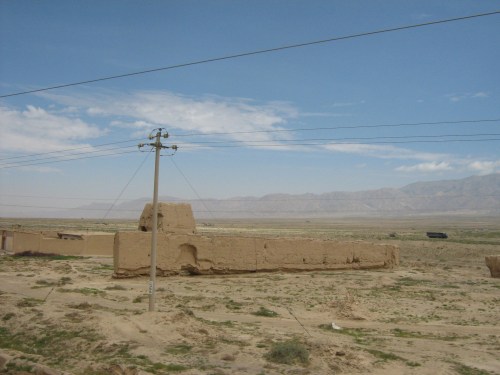
The fort was several miles west, straddling the narrowest portion of a corridor between two high hills. Our map’s brief commentary explained that it had been built to guard against barbarian invaders who could descend toward China through the pass.  Much of the fort had recently been reconstructed. It was tall, square, thick, appropriately forbidding, with concentric sets of walls and gates to keep invaders out and soldiers in. It had its own water supply. A holding pond to one side supported a luxuriant growth of shoreline willows. From the fort’s highest walls, I could see nearby wall remnants that were little more than crumbling mounds of packed earth in a parched landscape.

I saw few other foreigners. There was little English-language signage to explain the construction and history of this portion of the wall. Then a Chinese dad who sported a T-shirt advertising a Charlottesville, Virginia, pizza shop engaged me in conversation and provided some additional information:

“The fort is built mainly of rammed earth. Its initial construction occurred during the Ming Dynasty, starting in the 14th century. In addition to being a military fort, it was also a trading post along the Silk Road between China and the West,” he told me.

When I asked how he’d come by his excellent English and his American-themed shirt, the man told me he was a cardiologist who’d done part of his training at the University of Virginia’s Medical Center. Before I could ask many more questions, he politely bid me good-bye, rounded up his family, and departed the scene in an air-conditioned minivan that looked a great deal more comfortable than our taxi.     

Remnants of the Great Wall near Jaiyuguan, Gansu in northwest China

Why I’m Glad Our Granddaughter is a Girl Scout

Why I’m Glad Our Granddaughter is a Girl Scout    —by Jinny Batterson

I recently spent a week of after-Christmas visit with parts of the next generations of our family on the U.S. West Coast. As visiting grandma, I got to attend some of the children’s after school activities, including a meeting of our granddaughter’s “Daisies and Brownies” troop. Before the meeting, I was curious about how this branch of Girl Scouting had evolved in the generations since I started Brownies in the 1950’s. At first, lacking everyday exposure to younger children, I found this recent meeting’s hubbub a little daunting, though it’s likely that little girls are no more or less squirmy and giggly than my friends and I were so many years ago. For starters, girls now can become “Daisies” a year or two younger than the Brownie program I entered in second grade.  Still, I recognized parts of the program: an opening circle and a check-in when each girl could relate any important events or concerns, lots of singing, lots of running around, a craft activity, time outdoors, a pledge to honor oneself and others, a short-term service project, plus an introduction to this year’s annual cookie sales campaign for the scouts, parents, and grandparents present.

Since the meeting, I’ve ruminated a bit about why I’m glad our granddaughter is in Girl Scouting. Some American girls recently gained admission to Boy Scout troops. The “#metoo” social media movement has gained wide publicity for its attempts to reduce the incidence of sexual assault and sexual harassment (something the Girl Scouts have been doing with less fanfare for decades). Why continue to be a Girl Scout in these changing times?

Based on my previous exposure and my brief reconnection through my granddaughter, these are several aspects that still seem important to me:

—revolving skills-based leadership within a basic structure. No one person has all the skills needed for the many different situations life will throw at us. In Scouting, some will excel at crafts, while others can organize; some are adept song leaders; some have sports skills; some are tech-savvy; still others are gifted at laying campfires. In the troop where I was a member, one girl, Cheryl, was somewhat less athletic than most, not good at crafts, a reluctant camper, quiet and shy. The rest of us knew, though, that she was very important to our troop. She had a family asset missing to the rest of us: her mom worked at a large nearby military base. At cookie sales time, it was Cheryl’s turn to be a star. Though the rest of us were a little jealous as she loaded the family station wagon full of cartons of cookies for distribution, we knew her work was vital to reaching our sales goals each year.

—an international focus in addition to the local, state, and national civic engagement of each Girl Scout. For me, this was best exemplified by the first international Scouting center, a chalet in the Swiss Alps that opened in 1932. Many Scouts know the “Chalet song” with its aspirational closing: “And this its dedication shall never fail nor be undone, each race, each creed, each nation beneath its roof are one.”  The Chalet is now the oldest of five operating international centers, including a recently organized rotating event space among Girl Scouts in Africa. 

—An affirmation of the worth of each individual, along with the importance of working together toward common goals. Like Cheryl in our troop long ago, some Scouts will have less readily visible skills, but Girl Scouting teaches that each of us has an important role to play. No one is inconsequential. When we get overly invested in a “great leader” model, it can be all too easy to forget this basic truth.   

  About this time last year, I was a local participant in one of many “Women’s Marches” that occurred globally on the third weekend of January. At this year’s anniversary weekend, I’ll have to track hometown activities from afar. Yet after having observed our granddaughter’s Girl Scout troop, I’m heartened that, if and when we forget to value all the world’s citizens, she and others like her will continue to show up to remind us:  all of us matter, including women and girls.   

Quilted Dreams

Quilted Dreams    —by Jinny Batterson

There’ve been times, since I outgrew visions of sugarplums,
When I’ve dreaded the coming of winter. Short days, short tempers, cold,
Damp, sniffles, indoor confinement. Winter’s had little to recommend it.

This year’s cold weather was late arriving. Days shortened, but it was
Nearly Thanksgiving before there was frost on the pumpkins. Our schedules
Got disrupted: when to test the furnace, bring houseplants indoors?

Finally, the evening arrived when a blanket was insufficient warmth.
The quilt could be brought out from the linen closet, shaken vigorously,
Then inserted between a fresh sheet and the all-season bedspread.

As my life has grown less hectic, I’ve come to relish the longer
Darkness of late autumn: a chance to sip cocoa before snuggling down
Early, perhaps to drift into episodes of remembered dreams.

I cannot guarantee that the quilt is the cause, but cold weather
Seems to bring more comforting visions: brilliant landscapes visited
Earlier in person or in imagination, peopled with friends and warm welcomes. 

Often I visit cities new to me, revel in explorations and travel that
Can be more pleasant in dreams than in reality–no crowded
Rail cars, no plugged toilets, no mewling youngsters in the seat behind.

The details no longer matter as much. It’s the comfort that counts.
Even when my mind and body are saddest, my waking
Anxieties will sometimes give way to quilted dreams.

Mr. Whirligig

Vollis Simpson Whirligig Park in Wilson, NC

Mister Whirligig     —by Jinny Batterson

Recently, on my way to a weekend conference along North Carolina’s coast, I made a slight detour to stop in the former tobacco auction center of Wilson, North Carolina.  It was my third visit to this once-thriving, then derelict bastion of the tobacco industry, struggling to be reborn in a post-industrial, post-tobacco-auction age. 

Brick mansions with Greek-revival columns testify to Wilson’s former wealth. Vacant warehouses and storefronts bear witness to its doldrums. The town is about fifty miles east of Raleigh, at the far edge of commuting distance, but near major interstates. Its status as the county seat of a county by the same name brings some enduring activity—court cases, law offices, merchants of bail bonds. Population has stabilized at about 50,000 people, by far the largest town in this county named for a childless military man whose 1840’s exploits in a war with Mexico were ended by a fatal bout of yellow fever.

    What I came to see was a new park near the center of Wilson’s downtown: the Vollis Simpson Whirligig Park. Mr. Simpson, who died in 2013 at the age of 94, had for much of his life made fanciful sculptures out of scrap metal and pieces left over from the heavy equipment repair business that he ran from a small shop a few miles out of Wilson. After he closed his repair business, he turned his attention more fully to the sculptures he began to call windmills. Although his efforts sometimes drew the derision of his neighbors, Simpson continued to fashion larger and larger windmills with more and more moving parts, installing many of them around a small lake on his family’s property.

I first became aware of them when an acquaintance with ties to Wilson led a small group of us to view Simpson’s pond and the windmills planted along its edges. Mr. Simpson, then in his late 80’s, was working in his open-air shop at the far side of the pond. We saw him in profile at a distance, but an abundance of no trespassing signs made it clear that he did not welcome casual visitors.

Over time, Simpson’s “whirligigs” became a local, then regional tourist attraction. His variety of folk art drew the attention of art collectors and museums. A Whirligig graces the grounds of the North Carolina Museum of Art in Raleigh. Others have been purchased by museums and private collectors in many parts of the U.S.

Before Mr. Simpson died, local movers and shakers approached him about making his sculptures into an outdoor exhibition. According to Simpson’s obituary in the New York Times, Simpson relished the thought that some of his artworks would be preserved. He helped consult on the beginnings of removal and refurbishment of the pieces that eventually became the park. Vollis Simpson died before the park became a reality. Vagaries of weather, funding, and politics delayed the park’s opening for several years. The 2017 autumn day when I got to visit was gloriously clear and crisp, with just enough breeze to set most of the whirligigs to whirling.  Though I’d missed the park’s grand opening by a day, the vision I got of Mr. Simpson’s legacy brightened my outlook. It also lit up the faces of other visitors of all ages who viewed the park in person or via modern internet links.

It’s much too easy these days to get caught up in the political crises and name-calling of the moment. I like to think that Vollis Simpson’s spirit would be gratified at the way his creations beckon us toward less bluster and more whimsy. Thank you, Mr. Whirligig!    

The Other One Percent: Puerto Rico

The Other One Percent: Puerto Rico     —by Jinny Batterson

Like many mainland Americans, I’ve been watching a fair amount of television reporting these days about the unfolding humanitarian tragedy in Puerto Rico in the wake of hurricanes Irma and Maria. Nearly all the island’s electric, transportation, and communications infrastructure was decimated by the back-to-back hurricanes. Maria was the strongest hurricane to hit Puerto Rico in nearly a century, and pummeled the island only thirteen days after a lesser blow from Irma had disrupted power for up to a million residents. 

The news coverage sent me to the Internet to try to get some additional background on factors that contributed to this disaster impacting the estimated 3.4 million Puerto Ricans—about 1% of the total U.S. population.

Of course, the immediate causes are the hurricanes themselves—two of the most powerful storms ever seen over land. But there is also a backstory of decades of neglect, indifference, and discrimination that contributed. It seems somewhat cruel in the current circumstances to note that 2017 marks the centennial of Puerto Ricans’ American citizenship—on March 2, 1917, President Woodrow Wilson signed the Jones-Shafroth Act, establishing limited U.S. citizenship for all islanders born during or after 1898, when the island was acquired by the United States at the conclusion of the Spanish-American War.

At the time of the U.S. takeover, Puerto Rico was primarily an agricultural economy. Its principal exports were coffee and sugar. That began to change after World War II. In 1950, the U.S. initiated an “operation bootstrap” program to encourage industrialization and economic growth, and for a while the economy boomed.  Puerto Rico’s economy began a long-term decline in the late 1990’s after a change in the U.S. tax code phased out a provision that had allowed mainland-based companies to avoid corporate taxes on profits made in U.S. territories, including Puerto Rico. During the decade of 1996-2006, as the phase-out program took effect, manufacturing jobs declined from about 160,000 to about 110,000. More and more Puerto Ricans left for the mainland, where job prospects might be better. By 2016, over 4.6 million Puerto Ricans resided on the mainland, with the greatest concentrations in metropolitan New York City and in Florida.     

Politically, Puerto Rico chafed under near-colonial rule that seesawed between periods of development support by mainland politicians and periods of repression. Successive votes by islanders to change their status generally supported some variation of the status quo until 2012, when a majority of islanders voted to become a state. The referendum was controversial—opponents had tried to get people to abstain from voting altogether and later argued that the vote was invalid.

Once immediate crises ease and redevelopment plans begin to be developed, it might be wise to consult extensively with this “other 1%” to learn what Puerto Ricans, those with the most at stake, want their still-proud island to become.    

Where the Great Wall Meets the Sea

Final Great Wall tower juts into the Bohai Gulf

Where the Great Wall Meets the Sea  —by Jinny Batterson

Earlier this summer, I had a chance to check off a minor item on my “bucket list,” finally visiting an eastern terminus of China’s Great Wall. I’d first seen a section of the wall near Beijing nearly forty years ago. Much later, I’d visited the wall’s western terminus near Jaiyuguan along a portion of the Silk Road in Gansu Province. Now I wanted to see where this 5,500 mile plus engineering marvel met the sea. One balmy, pleasantly breezy mid-June morning, I got my chance.

This Great Wall excursion was part of a much longer China trip, first reconnecting with old friends, then checking out areas of northeastern China that were new to me. Internet access in China had improved tremendously. My husband, our family’s computer nerd, was able to find enough English-language variants of Chinese travel apps to help craft an unaccompanied land tour in China’s northeast. We benefited from great advances in China’s transportation and public transit infrastructures, including high-speed rail service between most major cities. As a retiree, traveling with my retired husband, I could create an itinerary that was more flexible and slower paced than a package tour. My Mandarin skills had advanced to the point where I could carry on very basic conversations: asking directions, purchasing train tickets, ordering in restaurants, swapping basic biographical information with people in more remote areas who were curious about two “big nose” visitors.

For the Great Wall portion of our adventure, we booked several nights’ stay at a luxury hotel in the nearby city of Qinhuangdao, along China’s fashionable “gold coast.” When we arrived, the area was basking in an interval of June weather when the skies were clear and temperatures were comfortable.  Our second morning, after a sumptuous breakfast buffet featuring both Chinese and Western dishes, we ordered a taxi and headed the dozen or so miles toward the coast to visit where the wall jutted into the sea, at “Old Dragon’s Head” (Laolongtou) along the Bohai Gulf, in northern Hebei province.

Substantial parks surrounded several sections of restored wall. For centuries, walls had been built in this area in attempts to keep marauding northern tribes from attacking Chinese settlements further south. The seaside sections of the wall had been reinforced and greatly expanded during the 16th century, near the end of the Ming dynasty. Close to the wall’s descent to the sea, a few Ming dynasty stones had been left bare to show layers of the original wall’s structure. Along most other accessible portions of the wall, modern stones had been added during restoration efforts in the 1980’s and 1990’s to provide a more uniform surface.

We spent parts of two days exploring several portions of the wall, getting to and from town sometimes by taxi, at others by inexpensive public bus.  The area was blanketed with signs in Chinese, Russian, and English. A major toll road, the Jingshen Expressway, runs from Beijing over 400 miles northeast to the city of Shenyang via Tianjin, Qinhuangdao and Beidaihe, a summer hangout for senior Chinese officials. As we skirted parts of the expressway, we saw familiar green and brown highway signs, signaling exits (green)  and sights of interest (brown), the same color scheme used along many U.S. interstate highways. Tourist services were abundantly available, including a KFC where we shared a chicken nuggets lunch, surrounded by conversations in Mandarin, Italian, French, and Russian.

Looking right from the final seaside tower at Laolongtou, I could see a wide sandy beach. A little further in the other direction was a major modern container port.  I was impressed with the scope and strength of the wall itself, but flummoxed by the notion that the wall could keep out anyone out who desperately, passionately wanted to get past it—a simple small boat under cover of night might suffice. Actually, forces of China’s final imperial dynasty, the Qing, had come from north of the wall and marched south through it at a strategic pass after the Ming Dynasty disintegrated due to corruption and infighting.

If, among its other craziness, our current national administration persists in plans to build a wall along the U.S.’s border, American officials might benefit from a visit to Old Dragon’s Head as a cautionary reminder.