Category Archives: travel

The Double Seventh Festival

The Double Seventh Festival (Qixi)    —by Jinny Batterson

The “Double Seventh” festival is celebrated in China on the seventh day of the seventh lunar month each year. Because the lunar calendar varies compared to the solar calendar used in most Western countries, the occurrence of the Double Seventh festival can come anywhere between late July and late August. In 2019, the festival falls on August 7. It has been called the Chinese “Valentine’s Day,” and is based on a famous legendary Chinese love tale:

Niu Lang (the Cowherd) was an orphan with a gift for nursing cattle back to health. After a god coaxed him into caring for cows in the heavens, Niu fell in love with the fairy Zhi Nu (the Weaver Girl) and the two started a family. However, the queen of heaven became jealous and caused a great river (the Milky Way) to come between them. The two were heartbroken. Their copious tears caused the queen to relent just a little—one day each year, on the seventh day of the seventh month, the two were temporarily reunited.

The star Vega is often cited as representing the Weaver Girl, and the star Altair represents the Cowherd. On double seventh evening, Chinese in areas with clear skies can gaze up to see Vega and Altair shining in the Milky Way, with the star Deneb forming a symbolic bridge between them.

Similar celebrations are held throughout other countries in Asia, with variations of the legend told in Korea, Japan, and Vietnam. 

In more urban areas of China, the Double Seventh festival has become less important, overshadowed by Valentine’s Day in February. In the countryside, celebrations are more likely to continue to exist, with young women exhibiting their skills in sewing and embroidery, and lovers exchanging gifts of flowers, chocolate, or decorative clothing.    

Layered Reality

Layered Reality   —by Jinny Batterson

Sometimes, despite fairly consistent efforts to broaden my circle of friends and acquaintances, it seems as if I’m stuck in an ever-shrinking bubble, quarantined in my own little “liberal-urban-retiree” silo. Recently I had a chance to spend a week with our out-of-town grandchildren, exploring a couple of stunning U.S. national parks via outdoor hikes. My guess is that our son and daughter-in-law had carefully coached the kids to humor grandma and grandpa by not overusing their “screens.” We watched a fair number of breakfast-time morning cartoons, but mostly we wandered outside, free from earbuds, television, or other screens. Cell phone coverage was minimal or nonexistent.

Much of our political and cultural life these days, including mine when not hiking with the grandkids, gets mediated by screens. Screen life can often seem tasteless, colorless, instantaneous, disconnected. I realize I’m getting old and slow, but I doubt this is the only cause for our disconnectedness.

I remember a story my rural sister told me. Typically apolitical, Sal had gotten sufficiently exercised in our recent hyper-charged society that she decided to become more politically active. In 2018, she campaigned for a candidate for U.S. congress in the Maryland district where she lives. She and I live in mirrored political entities—both North Carolina, where I live, and Maryland, where Sal resides, are “poster child states” for extreme political gerrymandering. I live in one of a few districts carved out to the benefit of NC’s minority party (in this case, the Democrats). Sal lives in the one district in Maryland that has been allocated to its minority party (in this case, the Republicans). Though our NC polling sites during early voting and on election day fairly consistently have longish lines, the precinct where Sal stood with her candidate’s literature wasn’t busy. Dribbles of voters came by the area where campaigners were allowed, leaving lots of down time. My sister is nothing if not gregarious, so before long she was talking with the two campaigners for the majority party candidate. Carefully sidestepping the merits of their respective candidates, Sal probed for possible common ground. Pretty soon, the three of them were discussing the uncertainty of sale prices for soybeans; the availability of rental drones for quicker, more thorough analysis of field conditions; the best area bulls for improving dairy herds; the impact of changes in agricultural regulations on small-scale farmers. Although there were certainly political opinions where the three of them likely disagreed, they found a good many areas where their interests overlapped and they could be both civil and informative. Their reality was layered with interspersed agreement and disagreement.

Last year about this time, I was in an area of rural France where human habitation goes back hundreds of thousands of years. I got a tour of an archeological site with over a dozen layers of excavation, ranging from about 40,000 to about 15,000 years ago. Now inactive, the site had been carefully dug during a human generation or so, some layers yielding little in the way of artifacts or information, others rich with both. I believe we need to remember that our social and political realities are rarely either/or, much more often layered with both conflict and agreement. Likewise, we are both independent and interdependent.  Please let’s take a bit more effort toward excavating beyond the tweets and the sound bites—our neighbors may be more layered than we know.

Different Angels from Montgomery

Different Angels from Montgomery   —by Jinny Batterson

Growing up, I wasn’t a huge country music fan. However, like a lot of folks, I developed an infatuation with the John Prine song “Angel from Montgomery” and its signature refrain: “Make me an angel that flies from Montgomery.” Who/what is the angel? There’s some dispute.  One of John’s friends insists it was an angel atop the Montgomery Ward building in Chicago, near where John was raised. Another theory is that “angel that flies” refers to a prison pardon communicated from the office of Alabama’s governor at Montgomery. Such pardons for prisoners were/are much hoped for but seldom granted, especially for those on death row. To my knowledge, Prine himself hasn’t identified the angel.

The song stayed in the back of my mind as I planned a “southern swing” in late winter. I had friends in Atlanta, relatives in southern Georgia and northern Florida. Montgomery, where I’d never before visited, was not that far out of the way.

This initial capital of the Confederacy and nexus of civil rights activism a century later had some museums I wanted to see. Near my downtown Montgomery hotel was a small museum to early country music star Hank Williams, who first rose to fame in Montgomery in the late 1930’s. Though I read the historical marker to his memory and looked at the window displays, this was not one of the museums I came for. Rather, I wanted to spend time learning more about Montgomery’s role during the civil rights era—about Rosa Parks, Martin Luther King, Jr., and the bus boycott that helped usher in a decade of civil rights activism.

In a downtown Montgomery branch of Troy University, a Rosa Parks exhibit reconstructed the events surrounding Ms. Parks’ 1955 arrest and the ensuing bus boycott, complete with a vintage bus. Having a chance to see the actual venue that had produced her and then the year-long boycott brought home her fortitude and resolve, along with the solidarity and resolve of Montgomery’s African-American community.

I’d made advance reservations for another pair of museums and memorials, recently opened by the Equal Justice Initiative. The Legacy Museum and its companion, the National Memorial for Peace and Justice (also known as the Lynching Memorial) show the enduring legacy of racial terror that continues to haunt our nation. The Legacy Museum, a block from Hank Williams’ shrine, documents the horrors of the slavery and Jim Crow eras plus some brutal variants that continue to this day.  One of the museum’s most graphic exhibits is a set of large jars of soil collected from sites of terror lynchings that occurred from the 1870’s up through 1950, peaking in the 1890’s and early 1900’s.

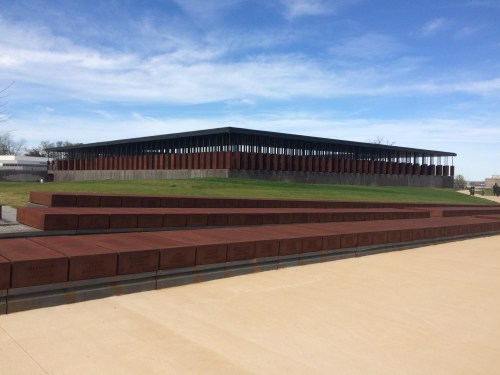
On a six acre site overlooking Montgomery’s downtown, a companion memorial contains two sets of over 800 steel columns, one for each county in the United States where documented racial terror lynchings took place. One set of columns is shielded by a roof. Viewers of the sloping site are led from an initial area where the columns are at ground level toward a section where they hang suspended, like many of the lynching victims they represent.  

Hanging columns at National Memorial for Peace and Justice in Montgomery, Alabama

Words or photos cannot convey the full impact of experiencing a walk among them. The county where I now live in North Carolina had one lynching memorialized; the county in Maryland where I was raised had two. In all, over 4,000 racial terror lynchings have been documented and verified in 20 states.

A second set of columns lies flat on the ground. Rust-colored, it reminded me of the corrosive myths many of us have told ourselves and each other for years, helping perpetuate race-based fears and hatred, going all the way back to the myth of the “happy darky.” There’s the myth of the predatory black man, with its corresponding myth of helpless womanhood. Especially pernicious and pervasive is the myth of white superiority, abetted by the myth of entirely benign police presence aimed solely at preserving “law and order.”

. The duplicate columns are designed to be brought home to the counties where lynchings occurred, as a way to help acknowledge past injustices and then help heal our enduring racial divides. The columns are way too heavy to fly, but these angels represented in Montgomery need to go home. It’s way past time.

Duplicate columns, Montgomery's memorial

duplicate columns lying outside at Montgomery memorial

By now, I’ve become an old woman. Not unlike the wife in Prine’s song, I’m named after one of my grandmothers. I may be old, but I can continue to bear witness. Again paraphrasing Prine’s lyrics—to believe in (and work toward) reconciliation is a good way to go.    

Experiments in Car-Less Living

Experiments in Car-less Living    —by Jinny Batterson

My body periodically tells me it’s no longer young or limber—creaky knees, back twinges, huffing up hills, diminished stamina, hearing difficulties, memory lapses.

The biggest problem is my eyes. Most of my life I’ve been nearsighted, my vision corrected with either glasses or contact lenses. Unfortunately, my aging orbs have recently developed both glaucoma (probably an inherited trait) and cataracts. The glaucoma, caught early, has done minimal harm, with further damage slowed or stopped by medication. The cataracts will sooner or later require corrective surgery. In the meantime, my night vision is declining. I try to avoid driving after dark. For those evening events I really don’t want to miss, I do my best to catch rides.

Last weekend I traveled out of town to my previous hometown of Richmond, VA. During this midwinter solo getaway, I’d visit with former classmates and friends, touch base with my financial advisor, attend a couple of public events. The trip could be a more extended experiment in getting along without a car. I’d made a provisional plan:

1) Get my accommodating husband to drive me and my luggage to the train station, then take the Friday morning train north from Raleigh, NC.

2) Get a former college suite mate to pick me up at the Richmond station and shepherd me around to that day’s activities, then drop me at the suburban hotel I’d booked near my other weekend events.

3) Line up two other friends who lived near the hotel to be my companion/chauffeur, one each for the two other weekend days, with my “Sunday driver” depositing me back at the Richmond train station in time for the mid-afternoon southbound train.

4) Phone hubby and have him pick me and my luggage back up in Raleigh.

The start of the plan worked well—hubby complained only slightly about getting up early enough to drive me to the train station; the train, though slightly late, was very comfortable; my classmate met me promptly at the Richmond station; we shared a leisurely restaurant lunch nearby and began catching up on our respective lives. She then drove me to my Friday afternoon appointment downtown. I wasn’t sure how long it would last. My friend assured me she’d be available for further ferrying duties—just phone her once I was done. After she deposited me at the appropriate high-rise office building, she drove off westward to share babysitting chores with her husband, spending some quality time with their most recent grand baby.

The meeting was briefer than I’d expected, so I decided to experiment with the new high-speed bus that ran from the downtown area west to a shopping center near where my friend and her husband were babysitting. That way, I figured, I’d save her from coping with downtown traffic plus have my own little adventure with public transportation.

The infrastructure of the new bus line was impressive: a dedicated bus lane, ramps to raised bus stops imbedded in the median of a major east-west street, automated ticket kiosks. The first kiosk I came to was out of order. I asked a woman waiting for the next bus where I could get a ticket headed west.

“Maybe the machine at the next stop is working,” she told me, “but it’s quite a ways.”   

Turns out one of the design changes for the new line increased the distance between stops. I walked about half a mile, got a ticket, then waited fifteen minutes for the next bus. Overall, the five mile trek to the shopping center took me more than an hour. Not a huge problem for me. Potentially hard on someone with a tighter schedule and/or mobility problems.

After my “Friday chauffeur” had picked me up at the shopping center, we’d caught up more over coffee, and she’d deposited me at my hotel, I got a plaintive phone call from Saturday’s ride. She’d broken a bone. She was in pain, with her arm in a sling. She was temporarily in no shape to drive.

Due to my friend’s injury, my Saturday logistics would be more complicated. Luckily, I’d installed an app on my phone for one of the ride-sharing services that’s recently sprung up in some American cities. An exploratory check for potential rides turned up multiple possibilities. My scaled back Saturday itinerary could be satisfied using a combination of public bus, walking, and Lyft. On Saturday morning, the hotel front desk directed me to a nearby bus stop; my first errand was just over a mile away along the bus line; a return walk to the hotel was doable, though there were gaps in the sidewalk on a busy street. In the afternoon, Lyft rides to and from my event were less expensive than I’d feared. I found a supper restaurant an easy walk from the hotel. My Sunday ride was healthy and punctual. Needing her chauffeuring was a good excuse to catch up. Hubby picked me and my luggage up with minimal griping.   

My aging eyes have got me thinking about our society’s over-dependence on private automobiles. If I’d previously listened to the frustrations of car-less friends and acquaintances with a mixture of pity and amusement, my turn for similar frustrations might arrive sooner than expected. I’m still lucky—I can afford and access alternatives. People with limited economic means can rarely afford a car, for-fee ride-sharing, or extensive public transit. In rural areas, suitable transit isn’t often available. This morning I awoke to a cold snap that had made outdoor temperatures so frigid that in some northern areas, schools and offices were closed, and even the U.S. postal service had temporarily halted deliveries.

An aging population, income disparities, geographic sprawl,  and climate change will severely stress a society accustomed to hopping in the car for every errand and need. Public transportation in the area where I live is spotty, but I’m going to learn more about riding the bus (https://gotriangle.org/how-ride-bus), using ride sharing services, and occasionally engaging a customized pick-up service our town provides. What are your options? 

Pandas Playing Mahjongg–Enjoying the Cary Chinese Lantern Festival

Pandas Playing Mahjongg, Enjoying the Cary Chinese Lantern Festival 

                                                        —by Jinny Batterson

Cary Chinese Lantern Festival Panda Land 2019

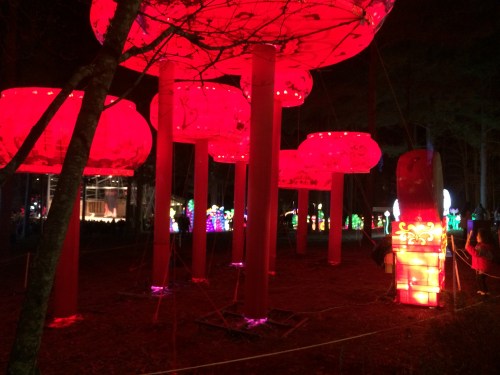
For the past several years, a traveling exhibit of LED-lit silk-skinned “lanterns” has come to our North Carolina town during the darkest period of winter. Last year on the night I attended the festival, the air was bitingly cold. Crowds were sparse. This year, on a clear weekend evening a good bit warmer than typical for early January, I ate an early supper, then put on a hoodie, drove to the festival site, parked in a free adjacent lot, and walked to the box office to get a ticket. I arrived a little after the festival’s 6 p.m. opening—once the sky was dark enough to provide a good backdrop for the thousands of lanterns and fanciful lit shapes.

I’d assumed that by arriving early, I’d “beat the crowds” and minimize my wait time to purchase tickets (cheaper at the gate than by internet) and then gain entry to the exhibit space. The wait wasn’t too long—maybe twenty minutes in all–but it turned out I’d arrived at the height of that evening’s viewing hours for multi-generational families. Rather than come later in the evening, they were enjoying the spectacle before youngsters’ bedtimes, at the same time taking advantage of reduced or free entry for young children.

The star of the show, a huge brightly lit dragon, again stretched along the shallows of Symphony Lake for a couple hundred feet. It was even larger and more intricate than last year’s dragon.  A few of the other exhibits were similar to what I’d seen previously, but arranged differently and with different emphasis.  New features had been added, too, including a set of large lantern “drums” near the entrance, with a real drum that kids could pound on to make the lights glow brighter.

Cary Chinese Lantern Festival Drums

My favorite set of lanterns was “panda land.” I’d previously spent time in China in the region where pandas are native. This exhibit featured stylized panda figures in human poses—riding a bicycle or, my absolute top pick, playing the Chinese tiled game of mahjongg, a sort of cross between dominoes and the card game spades.  Periodically, performers on the festival stage did acrobatics or Chinese dances—I watched briefly, then went back to the pandas. This year’s lantern festival is nearly over. The weather for remaining evenings is predicted to be less pleasant than the evening I went.

If you live locally, I’d encourage you to go if you can. Too often these days our airwaves are full of insults, ricocheting threats, and fear mongering. Against this background, an outdoor stroll alongside others speaking many languages, all of us watching the whimsical uses we can make of our technologies when we’re not busy fussing with each other, is, dare I say it, priceless.     

Old Years’ Resolutions

Old Years’ Resolutions    —by Jinny Batterson

For many years, I’ve avoided making discrete New Years’ resolutions. I have a tendency to backslide. Eliminating harsh words, taking off five pounds, following an exercise plan—most years such resolutions would get broken by late January if not sooner.  Instead, I’ve tried just setting general directions, somewhat more gently: I’ll bite my tongue a bit more often, eat a little less, exercise a tad more. I’m not sure if those around me even notice. Still, I reason, how can I expect to improve either myself or the world if I spend lots of my time blaming myself and/or making up excuses for broken promises?

Looking forward and setting goals are important, with New Year a frequent milestone for doing so. As I get older, occasionally looking backward seems appropriate, too.  What has gone well in the year just ending? What has gone poorly?

This past year has been good for me. I realized a long-term goal of publishing a travel memoir. I enjoyed generally good health. My husband and I shared several adventurous and rewarding trips. Meanwhile, the world at large has caromed along with perhaps more disasters and more vitriol than in some years. Headlines and blogosphere trend negative.

On the personal front, I think I’ve done a fair job at maintaining a civil tone in interactions with relatives, friends, acquaintances and elected officials across the political spectrum. However, I did send a somewhat snippy letter about varying leadership styles to our congregation’s new minister; I used some harsh words in a couple of the postcards I mailed to our current national leader. Weight control? Not so good—after a December trip that included lots of holiday feasting, any implicit goals about weight loss have fallen short.

What about exercise? There I think I’ve shone. Partway through 2018, after an extended hiking trip in rural France upped my average step count well above 10,000 steps per day, I set a short-term personal goal: Could I keep my annual average above 12,000 daily?  With just a few days to go, I’m tantalizingly close. Today the weather where I live has been pleasant, so getting in steps outdoors (roughly between four and five miles) was easy. Tomorrow and the next day are predicted to be rainy, making outdoor walks less appealing. New Year’s Eve may find me trudging on the treadmill at the gym, or pedaling the second-hand exercise bike at home, or even doing late-evening laps around our small condo as the TV counts down the final hours until midnight. If I’m able to meet this “old year’s resolution,” set not in January but in August, I’ll be pleased. The world at large may still be somewhat dicey, but I’m in better shape.   

Concentrating too hard on “new year” milestones may cause us to miss chances for learnings and goals later in the year or later in life. Looking back through much earlier personal journals, I found a year-end thought from 1982, a year in which unrest in Poland and the continuing cold war between the U.S. and the Soviet Union had been much in the news. The U.S. economy was in recession. Britain and Argentina had gone to war over the Falklands, a set of small islands in the South Atlantic. Nevertheless, I wrote then:  “All in all, 1982 has not been a bad year. The world is still teetering on the brink of disaster, as usual, but there’s been a lot of love and beauty, too.”   

May 2019 turn out to be a year in which many personal and broader issues move toward better resolutions, whether made early or later. Happy New Year! 


Who Did You Expect?

Who Did You Expect?     —by Jinny Batterson

My life so far has been fortunate—no privation, little discrimination, generally good health, many chances for love and adventure.  Much of the time, though not always, people I’ve met have lived up to (or beyond) my expectations. On those rare occasions when someone’s behavior has disappointed me, more cynical or world-weary friends have shrugged at what they regard as my naiveté. 

“Of course so-and-so let you down,” they’ve announced. “What did you expect?”  

Increasingly for me,  the appropriate question is rather “Who (or, for the grammar police, “Whom”) did you expect?”  As I mature (a work in progress), I become more aware of instances when I’ve pre-judged people and turned out to be fairly far off the mark.

The first occasion that stands out is my initial in-person meeting with the leader of our 1980 group tour to China. In those pre-internet days, I’d exchanged postal letters and paperwork with Ms. Baum and talked with her on the phone. Until we both arrived in San Francisco’s airport departure lounge for our trans-Pacific group flight to Hong Kong, I had not actually met this native New Yorker. I’d assumed from her accent and phone demeanor that she was of Jewish background. She seemed somewhat pushy and no-nonsense, ready to take on the world. I was surprised to see that she was African-American, not ethnically Jewish. She could be somewhat pushy and no-nonsense. Her prior experiences as both social worker and travel agent had prepared her well to take on whatever bureaucracy attempted to get in her way, regardless of ethnic origin or nationality. She turned out to be both different from and similar to the “who” I’d expected.

Earlier this fall, I signed up to work the polls in the 2018 mid-terms. After on-site training, I exchanged emails with the woman who’d be my site supervisor for early voting. Her written English was good, clear and simple. Her family name was a common one, her given name, ending in “a,” suggested to me she might be African-American, or maybe Hispanic-American. When we met, I could detect no skin coloring or hair texture to suggest ancestral links with Africa, no hint of foreign origin in her accent. She seemed at first a very “vanilla,” somewhat conservative American. During our work, she showed her passion for ensuring that anyone who wanted to vote was given maximum opportunities to do so. She’d sit patiently with someone lacking appropriate credentials, or with an address not yet entered into the electoral system database of rapidly growing Wake County. She knew the rules well. She could suggest pulling up an electronic copy of a utility bill on a portable phone. She might advise going home to retrieve a needed ID and then returning later in the day. In rare cases, she’d have the potential voter fill out a provisional ballot, explaining how and when to check whether their vote had been counted. The workforce she’d helped assemble to follow her lead was the most visibly diverse I’ve ever participated in. She was both different from and similar to the “who” I’d expected.    

I’ve just spent Thanksgiving with parts of my extended family that I barely knew growing up in Maryland in the 1950’s and 60’s. Only once had I had a chance to visit these North Carolina farmer cousins from a rural area near Charlotte. What little I remember from that farm stay involves ponies tame enough so even I was persuaded to take a short ride. I got to see my grandmother’s sister-in-law make glorious biscuits using milk straight from the cows. The cousins closest to my age teased me good-naturedly about my lack of country skills.

After moving to North Carolina a decade ago, I became reacquainted with some of the cousins who’d left the farm to settle in Raleigh. They’d tell me enticing stories of an extended family Thanksgiving gathering at “the shed.” I pictured the locale in my mind: an expanse of gently rolling hills, empty except for a few horses or cows grazing in pastures. “The shed” would be a slightly cleaned-up farm outbuilding. Twenty or so aging cousins of Scots-Irish ancestry would assemble for our midday meal, then say interminable grace before we could eat. Someone would have cooked a turkey and brought it still warm to the feast. We’d eat plentifully, exchange pleasantries, carefully avoid politics, and then everyone would go home.

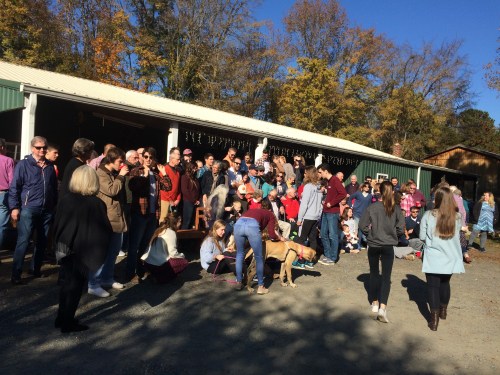
This year as we drove into the neighborhood nearest our destination, I had trouble reconciling my mental image with current reality. The surrounding area may once have been farmland, but the vicinity had long since become part of suburban Charlotte. A mid-rise apartment complex dominated the nearest street corner. The “shed ” had been expanded and modernized from an earlier role as storage space for some cousins’ plumbing business. It was now a comfortable, well-appointed venue with adjustable seating for up to a couple hundred people. Nearly that many cousins of all ages were in attendance, along with baby equipment, pet dogs and a few footballs.

We did have a short sung grace before the long, snaking buffet line formed. We did generally steer clear of contentious political topics. People caught up on family news since the previous get-together. One 20-something cousin had recently returned from an extended Peace Corps stint in South America; in the next generation up, a househusband described his four years of helping school their daughters while his family was on assignment in southern Europe. One attendee I didn’t get a chance to talk with directly had a skin tone and accent that implied ancestry or origin in India. The Reas still cherished their rural roots and pioneering ancestors, but the clan had gotten more diverse and widely traveled—both different from and similar to the “who’s” I’d expected.

The remaining holidays of late autumn and early winter are likely to have more extended family gatherings and chance meetings. May I remember not to pre-judge those I encounter, to be more careful not to let “who I expect” get in the way of meeting current reality with an open mind and heart. 

Rea Thanksgiving at “the shed”

Softening Hearts, Hardening Infrastructure, Widening Perspectives

Softening Hearts, Hardening Infrastructure, Widening Perspectives

                                            —by Jinny Batterson

It’s been a rough couple of months here in North Carolina: two hurricanes (Florence, then Michael), a polarized government, widespread agricultural losses, increasing poverty, damaged schools and infrastructure. 

Yet there’s been heartening news as well. Many established charities such as the American Red Cross have sent disaster recovery teams to the worst impacted areas. Local citizens in areas less damaged by the storms have created both short-term and long-term relief efforts. A neighbor who specializes in local fundraising set up a Sunday-afternoon event at a nearby shopping center and raised over $10,000 in cash plus thousands of dollars worth of non-perishable food and household goods for hurricane relief. Because of the extent of the damage, both in the Carolinas and elsewhere, it will take continued efforts by private donors, non-profits, government agencies, and financial institutions to help promote recovery.  The natural environment will never be the same; repairs, rebuilding, and/or relocation of homes and businesses will take months if not years. 

After hurricane Florence decimated the coastal Carolinas, major roads and interstates were flooded and impassable for over a week, making cities such as Wilmington, North Carolina effectively islands.  Residents who’d evacuated were asked not even to try to return home as soon as the first few roads were reopened—what limited road travel was possible needed to be reserved for emergency and supply crews.  Now that the immediate crises are over, people are starting to grapple with longer-term problems: should rebuilding be limited in areas that seem more and more prone to drastic weather?  Should building codes be changed? How do we adapt our infrastructure to be more resilient? Do we need to pursue alternatives to a predominately road-based transportation network?

Simple solutions seem elusive and likely counterproductive. Perhaps we need to rethink some of the implicit assumptions we’ve made about how the world works.  Rather than considering ourselves outside nature, it may be time to widen our perspectives and acknowledge that we humans are just one piece in a complex, evolving whole.  Among the groups that have challenged some of my existing perceptions are:

Transition networks (https://transitionnetwork.org/), a set of local-global initiatives to work toward more resilient local economies in the face of escalating global challenges

Bioneers (https://bioneers.org/), harnessing scientific knowledge toward solving human problems

Biomimicry 3.8 (https://biomimicry.net/), which looks at other life forms (some with over 3.8 billion years of experience on earth) for innovative ways to re-engineer human-made systems

What partial solutions have you discovered?  What “small/local” actions are you taking to make our future more livable?  Please share some of your thoughts. 

Is Anyone Really Stealing American Jobs?

Is Anyone Really Stealing American Jobs?  —by Jinny Batterson

Recently, a friend forwarded to me an email of guidelines for “buying USA,” comparing some everyday items, from greeting cards to toothpaste, that are marketed in the U.S. but now often made in other countries. I have no objection to buying more of the goods I use from hardworking Americans, but I do object to the thinly veiled inference that workers in China (or Mexico, or some other lower-wage country) are stealing American jobs. Wording of the message forwarded to me matches one posted by a real estate developer from near Charlotte, NC in March, 2016, as that year’s election cycle was heating up (see https://www.linkedin.com/pulse/ace-hardware-made-usa-very-encouraging-david-e-johnson-pe). My initial reaction to the message: Oh, rats! Here we go again, blaming job losses on low-wage workers in other parts of the world, when those workers actually play only a small part in American job losses. This mid-term election cycle, I’m concerned that both recycled and more recent posts and tweets are trying to persuade American voters that a broad trade war with China will help save American jobs. 

Over the past forty years, I’ve been able to spend a fair amount of time visiting with workers in China. They don’t want to steal anyone’s job. They are just trying to improve their lives, like workers everywhere. In the 1940’s,1950’s and 1960’s, many Americans left grinding rural poverty for better manufacturing jobs in cities. In the 1980’s and 1990’s, many Chinese also left the countryside in search of better paying urban jobs. By now, Chinese wages have risen. The Chinese government is starting to tighten regulations to rein in the pollution that significantly shortens Chinese lives. Some jobs are leaving China for other countries with lower wages and/or laxer environmental rules.

After I sent a semi-coherent reply to my friend, I let a later draft sit. I needed more time to simmer down and reflect. I realized that I’m very lucky.  So far, my retirement income is comfortable. I do not have to pinch pennies. I can afford to be selective in my buying habits. As much as possible, I patronize local sources. When we lived in Vermont, I made a special effort to buy cheese from our area farmers’ co-op; in Virginia, I bought a lot of local apples; here in North Carolina, I shop the local farmers’ markets; I eat ribs and barbecue at local restaurants. For less-localized items, I check labels along with prices to see where a product originated and how it was produced. Even if they’re somewhat more expensive,  I will sometimes buy U.S.-made goods to help support American workers. At holidays or when buying specialty items, I often purchase “fair trade” products so that some of my coffee, chocolate, and gift purchases will help support those with the lowest wages. Overall, I try to be an informed, careful, caring consumer.

Despite all sorts of “buy from nearby” campaigns, and despite what we may want to believe about fair and unfair trade, for at least a generation the biggest cause of job losses worldwide has been the quickening pace of replacing human workers using automation. According to a Financial Times article published just after Mr. Trump’s election (https://www.ft.com/content/dec677c0-b7e6-11e6-ba85-95d1533d9a62, December 2, 2016), about 85% of U.S. manufacturing job losses between 2000 and 2010 were due to automation rather than to moving jobs overseas. The same article compared the average hourly wage for a human American welder ($25) with the operating cost to have a robot do the same work ($8). If you include the installation and maintenance costs for the robot, the gap narrows slightly. However, the cost difference is likely to continue growing. 

Some trade agreements can damage the interests of workers and/or put at risk the natural environment that supports human life as we know it. Global trade has rarely been without its distortions and inequities. (For example, ask almost any Chinese about the British practice during the 19th century of exporting opium raised in the British colony of India into China to offset the costs of British imports of tea and porcelain, or consider the trans-Atlantic slave trade.) Negotiating worthwhile trade deals can be both time-consuming and extremely difficult—blogs or tweets alone don’t cut it. 

One of my grandfathers lost his job in 1930 when the company he was working for at the time replaced their human bookkeepers with calculating machines as a cost-cutting measure. On President Herbert Hoover’s final full day in office, March 3, 1933, he signed the “Buy America Act” that had recently passed the U.S. Congress. The Great Depression of the 1930’s was not solved.

Americans suffering from job losses need assistance and encouragement rather than attempts to divert the problem onto others. Automation, used wisely, can help improve lives; used foolishly, it can devastate human workers, even entire communities. Global competition, used wisely and fairly, can help spur innovation and growth. Used foolishly, it can pit groups that have many common interests against each other.

Blaming will not solve anything. Please let’s take time together to consider the deeper issues. 

The Rich Man and Lazarus Revisited

The Rich Man and Lazarus Revisited   —by Jinny Batterson

During my childhood, my most formally religious aunt used to give me books of Bible stories, adapted for children. One of the most difficult stories for me was Jesus’ parable of the rich man and Lazarus. It concerned death, not totally unknown even to small-town American children in the 1950’s, plus a kind of cosmic reckoning:

In a gated estate there lived a rich man, who (revised standard translation, part of Luke’s gospel, chapter 16) “was clothed in purple and fine linen and who feasted sumptuously every day.”  Outside the rich man’s gate was a poor, diseased man named Lazarus, “who desired to be fed with what fell from the rich man’s table.”  Sharing was apparently not part of the rich man’s ethos, so Lazarus languished in distress.

After a time, both Lazarus and the rich man died. Lazarus was carried by angels to heaven, “Abraham’s bosom,” a welcome change. The rich man, by contrast, went to Hades, a realm of fire and brimstone, just near enough to heaven so the rich man could see Lazarus there, hanging out with Abraham in comfort. The rich man cried out: “Father Abraham, have mercy upon me, and send Lazarus to dip the end of his finger in water and cool my tongue; for I am in anguish in this flame.” Nothing doing, Abraham explained. The rich man had had his chance at comfort while alive. Now the chasm between his current locale and Lazarus was deep and impenetrable, allowing for no crossovers.

During the 1990’s, I was briefly exposed to a widening gap in perspectives between rich and not-so-rich. I had a short-term subcontract with a major accounting firm at their downtown office. At the time, I was living in an inner city neighborhood that suffered the side-effects of a worsening epidemic of crack cocaine: robberies, arrests, lengthy prison sentences, even murders. It was a scary time. Occasionally I went out to lunch with my accounting firm colleagues. Once, I asked my supervisor whether the city’s worsening poverty and crime bothered him.

“I don’t have to notice poverty or crime,” he responded. “After work, I ride the elevator down to the guarded basement garage to retrieve my car. Then I drive out the expressway to my home in a gated community in the suburbs. No poor people interact with me at all. It’s not my problem.”  For most of the years since that encounter, I’ve lived in relative comfort, while trying with mixed success to learn and practice the discipline of sharing.

Though some quote an incident near the end of Jesus’ ministry as a justification for ignoring those in poverty, saying, without the surrounding context, “you always have the poor with you,” the vast majority of Jesus’ sayings and actions support the view that caring for “the least of these” is a sacred duty. 

The year 2018 so far has been filled with more than a little fire and brimstone—volcanic eruptions on Hawaii’s big island, huge wildfires in much of the U.S. West. In the part of the country where I live, the major problem has been floods. So far, they have yet to approach Biblical proportions, but the aftermath of Hurricane Florence in eastern North Carolina has been severe enough so that our current equivalent of Noah’s Ark has deployed, in the form of government rescue boats and the “Cajun navy,” a set of volunteers with small boats who previously plied their crafts in last year’s major flooding in Houston, Texas.  Florence drenched already struggling regions with over two feet of rain. Among the hardest hit were the region’s poor. Relieved to have been spared the worst of the storm, I watched media coverage of a flooded housing project where building maintenance had long been ignored or postponed. Videos showed some of the problems: peeling paint, exposed pipes, stained ceilings. Residents complained of asbestos-laced insulation. The electricity had gone out, and no one knew when it might be restored.

Beyond temporary aid, what could be done to help?  Should we as a society put more emphasis on affordable housing, less on high-end real estate? Would rebuilding and/or relocating require higher taxes? Could we somehow craft a renewed ethic of sharing? 

As I struggled to make sense of our society, seemingly rather badly out of kilter, I went out for a walk. The days were getting shorter. It occurred to me that our earth was in the period around an equinox—one of two occasions each year when the sun’s rays hit our tilted planet directly over the equator. Around the vernal and autumnal equinoxes, all creatures everywhere on earth experience days and nights of roughly equal length.

Instead of a chasm between wealth and poverty that gets harder and harder to cross, maybe we need something approaching a human “equinox.” Maybe we can head toward a narrower “wealth gap,” with adequate basic provisions for all living beings. Getting to a more equitable distribution and use of earth’s resources will take skill, political will, and good character. It IS possible, though. Nature creates equinoxes twice each year. Can we learn from her before flood, fire and brimstone get worse?  Happy fall, y’all!