My aging body performs better and heals faster if I walk a good bit every day. In recent weeks, some of my walks have had a dual purpose—maintaining fitness and also helping support the democratic institutions on which our government is built. Last Saturday, I was one of millions who took to the streets as part of “No Kings” protests throughout the U.S. The atmosphere at the event I attended was festive. It made the roughly 2 mile walk go quickly and lessened any tiredness on a fairly hot day. I was careful to stay hydrated. I enjoyed looking at hand-made signs that were a big part of the event. Though I wished some people’s protest signs, banners, and inflatable figures less closely mirrored the disdainful rhetoric we often hear from our current national executive, I could identify with some of their justifiable anger. Some of the younger generations in my family work in government. They have been repeatedly buffeted and challenged by the sometimes haphazard, sometimes vengeful demands, firings, and shutdowns that seem to be prominent tools of this administration.
Earlier this month, I spent time alternately sitting silently in courtrooms and walking the halls of the U.S. federal courthouse nearest me, bearing mute witness to increasingly harsh, sometimes arbitrary processing and deportation of asylum seekers who show up for their asylum hearings. I have few illusions that either of my protest walks will influence policy in the short term. Still, putting my body where my convictions are in non-violent, non-threatening ways seems appropriate.
Because I arrived early for “No Kings,” I had time to meander among booths set up by various environmental and civic groups near the starting point of the march. I signed a petition or two. I noticed what especially galling aspects of government mismanagement or overreach were being most prominently disputed. One new-to-me civic proponent was one I almost missed. A single person staffed a small table with a tented sign, “The Listening Project.” I walked up to him and asked what he was doing.
“I’m trying to provide an example of good listening. Listening is really important,” he told me. “Many of us are not very good listeners, but practicing good listening can become a habit, like brushing your teeth every day. If you think of listening as a muscle, it’s one that gets stronger with practice. “
Given this implicit permission, I proceeded to talk about how frustrated I felt at the current political stand-offs in our country. It sometimes has seemed to me, I explained, that all this talk of “polarization” tends to become a self-fulfilling prophecy. He neither agreed or disagreed explicitly, but did note that he’d had chances to listen to people from all along the political spectrum. Sometimes, he observed, listening to people whose opinions might be quite militant to begin with resulted in their softening their stances as they felt heard. Listening can be powerful, he reiterated.
Most of us live in places and spaces that have gotten noisier over the years—airplane engines, traffic, sirens, leaf blowers, not to mention beeps and chirps from our electronics. It can be harder and harder even to hear each other, let alone listen. Too often, we compound the problem by ramping up our own noise output. So we need a third power, the power of quiet.
In researching this essay, I ran an internet search on “rising ambient noise levels in the U.S.” I found a website for an annual event that I hadn’t known existed, “International Noise Awareness Day.” (Its 31st iteration will occur on April 29, 2026.) I clicked on a link to an interview with author Chris Berdik about his recently published Clamor. The author had submitted his book proposal before the pandemic, but wound up doing much of his research and writing during pandemic-related shutdowns. Alongside its tragedies, the pandemic measurably lowered ambient noise levels in the world’s noisiest places. Berdik argues forcefully that noise is one of the stressors we have not yet paid enough attention to, that hearing loss is only part of the damage caused by too much noise too often.
To walk, to listen, to be quiet—three powers often overlooked. May we choose more often to walk together, to listen better to each other, and to find peace in quiet, both within and without.
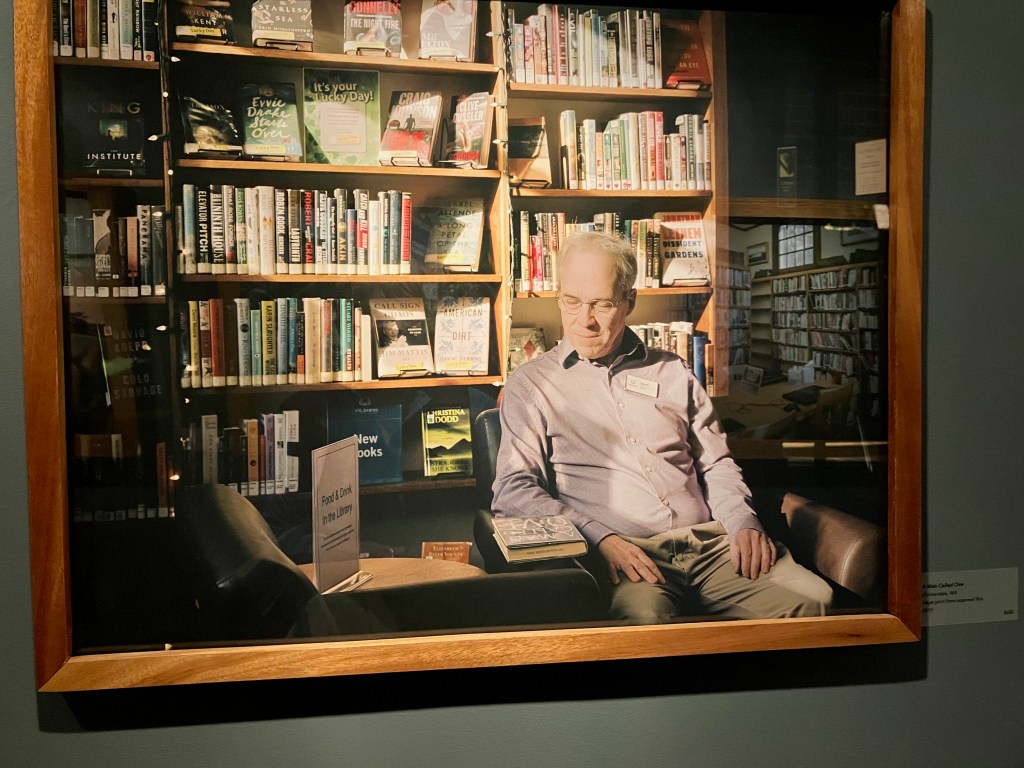
To me, libraries are among the unsung heroes of our societal institutions. They typically get taken for granted until something goes wrong, or the budget goes short. I depend on our public libraries for much more than books. When I visit a library branch, I often get to observe all different ages and economic levels, from toddlers to dowagers with pearls to homeless folks in well worn jeans. I get to check out both nourishing fiction and varied non-fiction. Nearly every subject imaginable is covered, along with the entire spectrum of political views. I can browse the latest newspapers and magazines. I can do Internet research on one of the computer terminals typically available for patron use. Most library buildings provide community meeting spaces, often making community rooms available to civic and non-profit groups for free or at minimal cost. Public libraries are among our most vital “third spaces,” neutral zones, neither work nor home, for getting recharged.
As one librarian recently told me, “Libraries are among the few remaining spaces where you can hang out without being expected to buy anything.” Libraries help combat the loneliness that can worsen the mental and physical health of seniors.
Photo of a Carnegie-Endowed Public Library
When in 2021 I arrived at my current home town as part of a cross-country move, libraries were still closed due to covid restrictions. A library-related quote from a lean time in my young adulthood came back to me: “Libraries will get you through times of no money better than money will get you through times of no libraries.” Now, no longer cash-strapped, I was bereft of a major source of information and entertainment without library access. I very much missed the peaceable, low-stress interactions these venues had provided pre-pandemic. I appreciated the many creative ways libraries had adapted to provide what services they safely could during pandemic lockdowns. Once our central library reopened, I hurried to get a library card and to begin visiting and checking out materials.
A while later, once our local branch reopened, I signed up as a library volunteer. Through volunteer hours and small-scale donations, I do my bit to support library programming. Nearly all our library branches have volunteers. We assist with day-to-day functioning and sometimes provide fundraising help through book sales and craft fairs. The more I volunteer, the more I appreciate the work, both paid and unpaid, that’s required to help keep our community well balanced and well informed, with access to the reliable information that helps citizenship flourish.
For over seventy years, ever since my grandmother first began taking me to story hours at our nearest library, public libraries have been a lifeline for me. The monthly library jaunts Granny and I took enriched me both intellectually and emotionally. Later, libraries helped me navigate term papers and college research assignments. During stressful times, they provided resource materials and outlets for harmlessly venting some of my frustrations. (My husband once joked that he’d know to start worrying if he saw me reading a murder mystery with an on-call computer programmer as the victim.)
In 2025, budget constraints are again threatening the health of many library systems, both urban and rural. Our city’s initial budget proposal for the next fiscal year projected cuts of about ten percent to the library system’s current allocation. It called for systemwide closures two days a week, regardless of branch patronage levels. It didn’t distinguish, among its thirty-seven branches, those in lower income areas where libraries are most crucial as a community resource.
Libraries can and often do provide the “ounce of prevention” that helps reduce the “pound of cure” required via police patrols, court costs, and emergency services. Those of us who are library partisans need to become better at touting the benefits of public libraries, intellectual, emotional, and societal. (Hence this blog post and multiple letters and emails to my local public officials.)
When I walk past our local library branch the first weekend of each month and notice the temporary flag announcing “Used Book Sale Today,” I feel a small glow. Long may such flags wave! Long may public libraries flourish!
As wealth and income gaps in the U.S. widen, complaints grow about “the top 1%” economically. We suspect the very wealthy of using tax loopholes, unfair competition, lobbying, abuse of public office, and various government policies to further enrich themselves while many of the rest of us languish.
A one percent figure is a somewhat arbitrary cutoff, but can be useful shorthand for “a small proportion” in any given field. Percentages for nearly everything also may change over time. Thinking about wealthy “one percenters” got me to wondering about other examples of contemporary low percentages. Below, then, are some other “one percents” in the U.S. and globally: farmers, legal (and illegal) immigrants, redheads, intersex persons, Icelanders.
Way back when the first U.S. census was taken in 1790, about 90% of the country’s roughly 4 million people were farmers. Over many decades, population increased and farms generally consolidated. Most became more highly mechanized. The number of farms dwindled over time, along with the proportion of farmers. At the latest U.S. agricultural census, in 2022, only 1.2% of the U.S. labor force were farmers, albeit very productive ones. (Domestic farmers produce over 85% of the food and beverages purchased in the United States. The U.S. is the world’s leading exporter of corn and rice by volume, and has generally been the world’s leading exporter of soybeans by value.)
Our “country of immigrants” has seen vast changes in its levels of immigration. One measure of legal immigration is the number of “green cards” issued for new Legal Permanent Residents. In 1820, the first year to register immigration status, only 8,400 new LPR’s were admitted. Then, our total population was about 9.6 million, so registered immigrants accounted for less than 0.1% of Americans. During the 19th century, immigration levels increased, reaching an initial peak in 1854. That year, 427,800 LPR’s were admitted to our country. Because since 1820, we’d added new states and increased our total population to over 23 million people, the 1854 LPR proportion was between 1 and 2% of the total population at the time. Still, that year’s number of LPR’s was an over 50-fold increase from the 1820 figure.
Twentieth century U.S. immigration reached an all-time low in 1933 during the Great Depression, with just 23,100 LPR’s among a total population of over 125 million, less than 0.02%. Until after the end of World War II, U.S. immigration rates stayed very low. An all-time high in legal immigration came in 1991, when over 1.8 million LPR’s were admitted, somewhat less than 1% of our then total population of about 250 million. (source for historic immigration figures: https://www.migrationpolicy.org/programs/data-hub/charts/Annual-Number-of-US-Legal-Permanent-Residents?width=850&height=850&iframe=true).
Most estimates of the number of “illegals” in the U.S., immigrants whose documentation is either missing or invalid, range between 10 and 15 million. Reliable numbers are hard to establish. However, even at the high end, this is less than 5% of the U.S. 2020 census population of over 331 million.
I was born a redhead, one among a roughly estimated 4% of the U.S. population. Until fairly recently, I was the only known auburn-haired child in our extended family. My grandparents sometimes recalled a distant cousin who maybe had red hair like me. Generally my family liked my red hair. However, once I started school, I got mild teasing from some blond or darker haired classmates.
As gender identity debates continue to roil our “culture wars,” I recently learned of a category new to me, the poorly understood phenomenon of “intersex.” Being intersex is definitely biological, not a choice. It begins in the womb. As fetuses, intersex individuals acquire some genital and sex-linked characteristics of both female and male. Young woman-with-balls Emily Quinn is among the best known intersex Americans. (Another well-known intersex person is South African Olympic athlete, runner Caster Semenya.) In her 2018 TED talk, Emily estimates that she/he is one among more than 150 million living humans with mixed female and male characteristics. (Without extensive biological testing, it can sometimes be hard to tell if someone is intersex.) If accurate, Emily’s figure represents between 1 and 2% of the global human population of over 8 billion.
Iceland is a small island nation in the northern Atlantic whose population is only about 0.1% of the U.S. total. Iceland has many unique characteristics, but the one that most buoys my sense of possibilities is that it has the smallest “gender pay gap” of any developed country. By 2024, U.S. women’s access to high-income professions had improved. A former gender pay gap of 60 cents on the dollar had been cut by over half. U.S. women now earn nearly 84 cents for every dollar paid to similarly qualified men. In Iceland, women earn nearly 92% of men’s compensation, not yet quite equal, but an inkling that gender pay parity is possible.
Some of the figures above give me hope; they also provide food for thought. However, my main concern as I continue to age isn’t any of them. It’s the small but increasing proportion of elders with their mental and physical faculties in decent shape. Even into their 80’s and 90’s, they continue to be alert, contributing members of their communities. They are a 1% I hope to be able to join!
April, thank heavens, is nearly over. It’s been a real seesaw ride, with on-again/off-again tariffs, roll backs of environmental safeguards, and wild gyrations in the U.S. and other global stock markets. Civil rights are under attack, amid detentions and deportations of highly questionable legality. Along with all this have come near constant doses of hyperbole, vitriol, and vacuousness from various U.S. national officials. Whoa!
Outside the U.S., wars in Gaza and Ukraine grind on, causing ever-deepening destruction and human misery. Despite our current President’s boast of ending the Ukrainian conflict even before his inauguration, what talks are occurring seem far from establishing even a temporary cease fire, let alone a resolution of the status of disputed territory plus security guarantees to prevent a recurrence. In Gaza, regardless of Israeli Defense Force claims to be hunting just Hamas terrorists, the density of the Gazan population means that more and more civilians are being killed, maimed, or starved to death. Globally, various other armed conflicts simmer or worsen, less noticed in America-based publicity.
To adjust my perspective a bit, I went back to an artistic work from the previous time the world seemed on the brink of falling apart, in the early 1940’s. I watched the classic Charlie Chaplin movie, “The Great Dictator,” originally released in October, 1940. At that time, the U.S. had not yet entered the rapidly spreading conflict we now know as World War II. However, German military forces had occupied Belgium, the Netherlands, Luxembourg, and much of France. Germany’s then-ally, the Soviet Union, had annexed the Baltic states of Latvia, Lithuania, and Estonia, while German ally Italy had invaded Greece. The German air force was conducting frequent bombing raids over Great Britain. Jews in Warsaw, Poland were being herded into an increasingly crowded and restrictive ghetto.
In the movie, Chaplin plays both anti-semitic dictator Adenoid Hynkel, ruler of the mythical country of Tomainia, and his look-alike, an anonymous Jewish barber who’d previously fought for Tomainia during the first World War and had suffered twenty years of amnesia stemming from his injuries. The barber, after returning to his former shop, regaining his memory, and being caught up in anti-semitic raids, flees with his former commander, both of them dressed in military uniforms. The barber is mistakenly presumed to be Hynkel and is pressured into giving a speech to the citizens of the neighboring country of Osterlich, recently invaded by Hynkel’s troops. Impersonating Hynkel, the barber, instead of more bombast, gives an impassioned speech about the need for peace and justice:
“I’m sorry, but I don’t want to be an emperor. That’s not my business. I don’t want to rule or conquer anyone. I should like to help everyone – if possible – Jew, Gentile – black man – white. We all want to help one another. Human beings are like that. We want to live by each other’s happiness – not by each other’s misery. … To those who can hear me, I say – do not despair. The misery that is now upon us is but the passing of greed – the bitterness of men who fear the way of human progress. The hate of men will pass, and dictators die, and the power they took from the people will return to the people. And so long as men die, liberty will never perish.”
Though release of “The Great Dictator” was initially limited in some U.S. cities with substantial German-American populations, over time it became Chaplin’s most successful film commercially. The film has also won critical acclaim as one of the greatest comedies ever produced. In 1997, it was selected by the Library of Congress for inclusion in the National Film Registry.
As we approach the final day of this tumultuous month, it may be just coincidence that April 30 marks a couple of other transitions in recent history: On April 30, 1945, Adolf Hitler committed suicide in his Berlin bunker, as opposing troops closed in from both west and east; on April 30, 1975, the final Americans left South Vietnam after a generation of American involvement, as troops from the north shelled the presidential palace in Saigon.
This April, we’re also marking a transition of leadership in one of the world’s major faiths. We’re partway through a nine day period of mourning for Pope Francis, who died earlier in April. For over a dozen years, Francis used his papacy to speak up for the world’s underserved—our natural environment, and those of our human citizens who have least benefited from the global economy.
While watching one bombastic leader hold forth in an Oval Office centered on a toy airplane, we can remember that his style is not the only possible option. Both Chaplin’s barber and the former leader whose simple casket was recently laid to rest provide viable counterexamples.
The news seems to come at us faster and faster these days. With so many channels and so many media, it can be hard to keep track. Hard, too, to keep away from the insistent, worrisome chatter. Might our job/investment portfolio/health care/retirement income go up in smoke if we don’t pay close enough attention? Might the next global conflict be just around the corner? Might the U.S. devolve into its next civil war during the current congressional or presidential term? Will we ever get to civil peace again?
Most mental health advice suggests that limiting our news consumption helps maintain our sanity. When we pay too much attention, we can easily succumb to the belief that everything is out of control, that things are bad and getting worse.
It helps me to take a step back. Being older in this instance can also be an asset. Having endured prior booms, busts, and disasters helps me put things into perspective.
As a lifelong bookworm, I’ve also developed during the past couple of decades some “go to” volumes for perspective adjustment. Two stand out, both for their global range, and for their hopefulness:
———–
Half the Sky, by Nicholas Kristof and Sheryl WuDunn, was published in 2009. Its title derives from the Chinese folk proverb, “Women hold up half the sky.” The book focusses on women’s situations in the developing world and how we might achieve women’s development goals globally. Kristof and WuDunn explore some of the gaps and practices that continue to disenfranchise women and girls. The authors stress adequate health care, education, and entrepreneurship as avenues for progress, benefitting both women and men. They present vivid examples, while being realistic about roadblocks. One is our human tendency to focus on individual stories over the “big picture.” For example, in discussing maternal mortality ratios, they touch briefly on overall statistics. Global data on such rates, from 2005, ranged from 1 death per 100,000 live births in Ireland to 2,100 in Sierra Leone. The authors then write: “…[W]e hesitate to pile on the data, since even when numbers are persuasive, they are not galvanizing. …[S]tatistics have a dulling effect, while it is individual stories that move people to act.” (p. 99)
Factfulness, by Hans Rosling with Ola Rosling and Anna Rosling Rönnlund, was published in 2018. The subtitle to the Roslings’ book is attitude adjusting all by itself: “Ten Reasons We’re Wrong About the World—and Why Things Are Better Than You Think.” Hans Rosling died while the book was in progress and was succeeded in authorship by his son and daughter-in-law. Hans gained wide recognition as a global health researcher who made statistics both more approachable and more relevant. He pioneered representing global datasets with proportionately sized bubbles for different countries or regions. He also showed bubbles in motion for longer term trends. (You may want to watch his TED talk from 2006 on late 20th century human fertility, health, wealth, and change titled “The Best Stats You’ve Ever Seen,” or a 4-minute BBC presentation of “200 years of health and wealth in 200 countries.”)
In Factfulness, the Roslings sum up Hans’ life’s work by pointing out the harmful “instincts” that can skew our assessments of overall conditions. One that I find especially prevalent in current news is the “size instinct.” As they explain:
“You tend to get things out of proportion. I do not mean to sound rude. Getting things out of proportion, or misjudging the size of things, is something that we humans do naturally. It is instinctive to look at a lonely number and misjudge its importance. …
The media is this instinct’s friend. …
The size instinct directs our limited attention and resources toward those individual instances or identifiable victims, those concrete things right in front of our eyes.” (pp. 128-129)
———-
Much of our current media, it seems to me, suffers greatly from overuse of the “size instinct.” Though huge numbers can get bandied about without much context, much of our media highlights whichever isolated facts promote their respective political agendas. Our size instinct is not new, but can get amplified in our media-saturated lives.
Several decades ago, I was exposed to the slogan “Think globally, act locally.” The Kristof/WuDunn and Rosling books remind me to pay attention to widespread, longer term trends, while at the same time concentrating my energies and skills toward making the locale where I live a little bit more humane, a little bit more equitable. Facts are mutable over time. Women do hold up half the sky. And if enough of us make small improvements wherever we are, over time we’ll become worthy of better news.
Current dismantling of “diversity, equity, and inclusion” efforts, in our national government and elsewhere, lead me to wonder whether any of us would be willing to be subject to their opposites: uniformity, inequity, and exclusion.
We too often can seem to be playing a cynical game of zero-sum, short-term “yo-yo” with efforts that have ebbed and flowed for generations, if not millennia. We need to remember that diversity is broader than a label–it includes all our many efforts to understand our differences. Let’s be careful lest, in a push to reform any excesses of DEI, we prematurely abandon valuable progress because of the discomfort that diversity, equity and inclusion work inevitably creates. Be we mainstream or marginalized (most of us can be either, depending on the situation), changing the habits we’ve developed in the ways we treat each other rarely comes naturally. Also, American impatience with the pace of change sometimes redounds to our detriment. For example, among lessons yet to be learned from the covid-19 pandemic is that recovery from a serious societal trauma takes both effort and time.
An advocate of inclusion I recently came across is author Ty Tashiro, whose 2017 book Awkward, includes a discussion of an increasingly diverse American social landscape and the nearly universal awkwardness this can engender:
“[I’m] one of those who strongly believes … [that] more inclusionary attitudes toward traditionally marginalized groups have been positive and long overdue. I think it’s important to make clear that I hold a supportive view of these changes because I would also suggest that these societal shifts have come with some societal growing pains. These significant shifts … have created a post-institutional social world where traditional expectations have faded away and new expectations have yet to be clearly defined. It’s all right to admit that social progress comes with a little confusion about what to do next.
Many people are also discovering how much work it takes to truly embrace diversity. It’s one thing for people to say that they support racial diversity, gender equality, or gay marriage, but being fully open to negotiating different attitudes and expectations takes a tremendous amount of social awareness and effort.”
I believe that some of the current vitriol of our politics and social lives comes from an intersection of burgeoning social media with correspondingly increased diversity in our population. We can too easily get “siloed” in our media diets and either not be exposed to differing views at all or start to view people with differing views as somehow less than human. Over the longer term, we cannot maintain whatever fragile status quo we imagine we’re protecting by building a wall, out-shouting our opponents, or using intimidation. The sooner we resume the slow, important work of promoting diversity, equity, and inclusion, the more likely we are to succeed in our ongoing experiments in democratic governance and civil society.
Again, we have selected an immigrant’s Grandchild, someone with complex business Dealings and a felony conviction on appeal, To be our official national leader.
Again, we have projected our individual And collective traumas–slavery, violence Internal, external, and systemic– Across time zones and borders.
Perhaps too few of us have yet realized that Pursuing greatness through vengeance Will, sooner or later, be revealed To be the basest form of pettiness.
Perhaps too few of us have yet relearned That nature, however harsh she may seem During pandemics, blizzards, floods, or fires, is Also healing when we show respect and pay attention.
Jimmy Carter served as our nation’s 39th president from January 20, 1977 to January 20, 1981. I voted for him in 1976 and again in 1980. During his presidency and for a number of years after that, when asked about my political affiliation, I identified myself as a “Carter Democrat.” Today, October 1, 2024, Carter turns 100. For many, his contributions to global health and progress since his presidency have been even more impressive than his accomplishments while in office. In 1982, Jimmy and his wife Rosalynn co-founded the non-profit Carter Center. In 2002, Carter was awarded the Nobel Peace Prize for his persistent efforts to promote global health and to encourage peaceful solutions to difficult problems worldwide. For over 30 years, Jimmy and Rosalynn spent at least a week each year helping build quality low-cost housing with non-profit Habitat for Humanity.
Since the beginning of the 21st century, my political trajectory has gradually diverged from official designation as a big-d “Democrat.” Turned off by increasingly shrill campaign entreaties and demonization of “the other side” from both major political parties, I now have “no political party affiliation.” However, I keep my voter registration up to date. I make it a point to vote in local, state, and national elections if at all possible, sometimes even voting absentee from places outside the U.S.
How I became a “Carter Democrat” and why I still consider myself one involves both timing and geography. In 1968, I cast my first vote in a presidential election for Richard Nixon. I believed his promises to help extricate the U.S. from involvement in the war in far-off Vietnam that his predecessor Lyndon Johnson had escalated. Partway through Nixon’s first term, in 1971, I moved from Baltimore to Vermont. I’d secured a job in its small capital city of Montpelier. The early 1970’s saw a lot of social ferment, along with burgeoning interest in caring for our natural environment. I was part of a trend of young, childless adults aiming to “go back to the land” after disenchantment with urban life.
Vermont was at the forefront of environmental legislation, including a 1970 comprehensive land use program, “Act 250,” designed to maintain Vermont’s rural flavor and natural beauty while allowing for economic growth. A different law passed at about the same time instituted graduated “pay to pollute” fees on companies who discharged waste into Vermont’s waterways. These legislative actions struck me as pragmatic efforts to deal with complex problems—rather than outright prohibitions, using financial incentives/disincentives to promote more environmentally sensitive behavior by both individuals and businesses.
As Nixon’s first term progressed, I lost confidence in his Vietnam policies. By 1972, I had become thoroughly discouraged about the lack of U.S. progress there. I also thought Nixon insensitive on environmental matters, though in 1970 he had signed into law the National Environmental Policy Act after it had overwhelmingly passed both houses of Congress.
So in 1972, I voted for Democrat George McGovern. President Nixon won reelection in a landslide, though, with over 60% of the popular vote and all but two jurisdictions’ electoral votes. Meanwhile, my idyll in Vermont proved short-lived due to unemployment and underemployment. Late 1973 found me and my husband spending our severance pay on a low-budget trip down the Mississippi River valley in our small pickup truck. We were trying to put our lives back together, to figure out what to do next.
Globally, in 1973-74 a group of oil exporting nations reduced their production levels and paused oil exports to the U.S. to retaliate for U.S. support of Israel in 1973’s Arab-Israeli war. This caused an “oil shock,” with the average price of gasoline rapidly rising over 30%. The crisis caught up with my husband and me when we were in a part of Louisiana with huge concentrations of refineries and oil transport facilities. Still, gasoline supplies were short. Tempers, too. Local gas stations sprouted long lines. Late autumn temperatures soared, threatening A/C-induced blackouts in an oil-dependent electricity grid. We were somewhat shaken by this evidence of American vulnerability to “oil blackmail.” Meanwhile, Nixon’s first vice president, former Maryland governor Spiro Agnew, was in December 1973 forced to resign after being charged with conspiracy, bribery, and tax evasion. Nixon quickly nominated Michigan Congressman Gerald Ford as Vice President. Ford was just as quickly confirmed by his Congressional colleagues.
Partway through 1974, my husband and I found good-paying jobs in the mid-sized American city of Richmond, Virginia, where my younger sister then lived and had provided us with temporary housing. We gradually put the trauma of our job reversals and subsequent relocations behind us. Then came the Watergate scandal and Nixon’s August resignation from the presidency. It flummoxed me why someone who’d won reelection so convincingly would turn out to have been a cheat who’d tried to undermine the other party’s campaign. During Congressional hearings, Nixon’s efforts to distance himself from a botched June, 1972 break-in at the Democratic National Committee in Washington, D.C. gradually collapsed. My faith in our electoral system took a hit. Gerald Ford became president.
By 1975, I was no longer paying much attention to national politics. I focussed instead on buying our first home, starting a family. I didn’t think Ford was a bad President, but I was troubled by his pardon of former President Nixon. When Jimmy Carter won the Democratic nomination for President in 1976, I was ready for a fresh face, a fresh approach. After all Nixon’s lies and evasions, Carter’s assertion that “I will never lie to you” sounded doubly refreshing. Our older son was born as Carter began his campaign; our younger son arrived partway through his term. I struggled to stay informed about local, state, and national issues while changing diapers and dreaming of some day reentering the paid work force.
When the winter of 1976-77 turned out to be more severe than most, Carter’s early “fireside chat” (February 2, 1977) calling for energy conservation and small, shared sacrifices resonated with me. My earlier experience of two Vermont winters had given me considerable respect for the vagaries of weather. Richmond, Virginia typically has mild winters, but I’d made sure to install multiple sources of heat in our house—gas, electricity, plus an efficient wood stove in our largest room. I supported Carter’s efforts to diversify the American energy supply.
In the late 1970’s I continued my efforts to become a more responsible energy user. I improved our house’s insulation, grew more of our own food, increased my use of public transportation. A second “oil shock” in the wake of the 1979 Iranian Revolution impacted me less than most. I hoped people would recognize our need to reduce our nation’s oil dependence and to become better environmental stewards. I did my best to follow Carter’s lead, even when it involved some material sacrifice. To my dismay, the combination of energy difficulties, high inflation and unemployment, plus a lengthy U.S. hostage crisis in Tehran destroyed Carter’s chances for a second term. In 1980, former California governor Ronald Reagan handily defeated Carter with just over 50% of the popular vote in a 3-way race.
If Carter was disappointed at his loss, he soon regrouped. Rather than stew over his defeat or attempt to persuade others that the 1980 election was “stolen,” he turned his considerable energies toward improving the lives of the world’s least fortunate. Over the years, the Carter Center has launched initiatives to reduce or eliminate six preventable diseases common in tropical climates. It is closing in on the elimination of guinea worm disease, having reduced the incidence of this debilitating parasitic infection from an estimated 3.5 million cases in 1986 to just 4 reported cases so far in 2024. Since 1989, the center also has monitored elections in 40 countries after having been invited in by the major political parties participating in those elections.
from a Carter Center brochure
The 2024 U.S. election will mark my 15th presidential election cycle. By now I have cast the majority of my presidential election votes. I’ve supported winning candidates about half the time. I have lived through several policy reverses that I wish had not happened. Through it all, I’ve maintained a sense of hope and a belief in the importance of sound, sensible environmental stewardship. It seems to me, as it did to Carter nearly fifty years ago, that a transition to more responsible energy use is needed. I believe that a transition to renewable energy sources will continue, regardless of the 2024 election outcome. Eventually, regardless of who occupies the White House or any other country’s leadership, the world’s oil and coal reserves will be depleted.
However, ingenuity and regard for our fellow humans and for the natural world that supports us are the ultimate renewable resource. Amidst all the hubbub and negativity, it’s important to avoid pointing fingers. It’s important to stay engaged. Democracy has always been an experiment, with some failures along with its successes.
Jimmy Carter’s faith is at the root of who he is as a person, regardless of any political position he might hold. I appreciate the bywords of this white evangelical, Naval Academy graduate, former nuclear submarine engineer, former peanut farmer, and former president from the rural U.S.: “My faith demands that I do whatever I can, wherever I am, whenever I can, for as long as I can with whatever I have to try to make a difference.”
I’m proud to have been a “Carter Democrat.” Mr. Carter, may your persistence and long-range vision continue to inspire those of us not yet to the century mark. Happy, Happy Birthday!
As we approach the shank of summer, I’ve been reminiscing about a long-ago summer I spent at a magical place, Montreal’s “Expo 67.” It was my first summer away from home and on my own. I was just out of my teens, in a serious relationship, not sure what to do about it. My boyfriend was hundreds of miles away, working at a summer camp in Pennsylvania. In those pre-internet days, we wrote postal letters back and forth, sometimes emboldened to share by mail what we’d shied away from in person.
The world was in turmoil, perhaps a bit more than usual. I was somewhat bewildered, but hopeful about prospects for a better society. Expo 67 was a perfect vantage point for viewing new possibilities.
Because I’d also fallen in love with the French language, at first I’d considered dropping out of college to spend the entire April-October interval of the fair as a participant-observer. I thought that a prolonged stay in French-speaking Québec province would improve my language skills beyond what I was getting in coursework at my small liberal arts college in Virginia. Our academic dean suggested an alternative—why not apply to work just for the length of my summer break, when visitors to the fair would be at their peak, the need for extra staff most urgent? That way I could get almost the same exposure to French language and culture without interrupting my college education.
Of the hundred or so application letters I sent out, only one produced a definite job offer—preparing and selling Belgian waffles at one of the fair’s many snack bars. I jumped at the chance. Once school let out, I boarded a bus headed north across the border. It took an intervention by my soon-to-be boss to prevent me from becoming an undocumented worker. There were many in Montreal that summer—American young men evading the military draft, or newcomers from elsewhere fleeing disasters, disorder, or worse in their countries of origin.
Over time I became one of Smitty’s Waffles best strawberry cappers. I earned a pittance, but was surrounded by others in the same situation. We shared low-cost housing tips. We traded end-of-shift free food among the half dozen or so snack bars in our cluster. Sometimes this included freshly whipped butter, made in our gigantic electric mixer by whipping the cream that topped our waffles for just a little too long (and substituting a little salt for the sugar).
Montreal had extended its public transportation system for the fair. A monthly pass for the Metro was affordable, even at minimum wage. Best of all, on my days off, I got free entry to the fair. An exhibit I sampled multiple times was sponsored by Canada’s telephone companies. It featured a trans-Canada travel film, the first in immersive Imax, a genre many of us have come to enjoy since. Though I haven’t located an online archive of the film, I can remember snatches of scenery, from the easternmost stretches of the Maritime Provinces along the Atlantic to British Columbia on the Pacific. However, it’s two scenes from Canada’s interior that linger most vividly in my mind.
The first is an aerial panorama of a huge steel mill complex near Sudbury, Ontario, belching smoke. Back in 1967, making steel was seen as a hallmark of industrial might, with smokestack pollution a bothersome but necessary byproduct.
The second snippet is slightly longer—several young people joyriding in an open jeep across a vast plain, with no other traffic in sight. Abruptly, the vehicle brakes to a stop, just as the celebrants reach the edge of a thousand foot drop. Even after several viewings, I still gasped at the sudden halt and the averted plunge to oblivion.
Since 1967, industrialized countries have reduced some of our smokestack pollution, viewing it as a health threat. Since 1967, we’ve also gotten increasingly concerned about a global “cliff” of climate change, caused by humanity’s net emissions of greenhouse gases. We humans have yet to master satisfying our needs and wants without endangering our long-term survival as a species. The 2015 Paris International Climate Agreement may be a small start toward solutions. It’s been signed by over 190 countries that produce 98% of the globe’s greenhouse gases. The U.S. is currently a signatory. We are reducing our greenhouse gas emissions, if not yet quite as fast as climate accords targets. I’m trying to play my part. I’m also rooting for those young joyriders. I want us to apply our collective human brakes fast enough and creatively enough to keep us from plunging over the edge of a climate cliff.
As a long-time consumer of murder mysteries and courtroom dramas, I’ve absorbed the notion that, when searching for a perpetrator Of some crime or aberration, it’s smart to ponder the question, “Who benefits?” or, in Latin legalese, “cui bono?”
Immersed too often in our vociferous media stream, I wonder, “Cui bono?” about pressing issues of the day.
Who benefits from spreading fear about immigrants? Maybe it’s not the migratory humans who benefit from a Much-touted “crisis at the U.S. border.” New arrivals Anywhere rarely fare well at first in their next environments, Whether having fled famines, or political or domestic violence. Instead, they are often harassed, crowded, derided, treated as pawns. Could it be that it’s the human predators–the “coyotes” with sky-high fees, The purveyors of sub-wage work, some opportunistic politicians– Who trade on everyone’s fears to their benefit? Perhaps they’re The ones who make a killing, sometimes literally. “Cui bono?”
Who benefits from restrictive reproductive health options? Maybe it’s not the human infants born into impoverished or dysfunctional Families. Maybe it’s not the mothers whose health is damaged, Sometimes beyond repair, through dangerous pregnancies. Maybe it’s not the badly deformed babies who die just after birth. Maybe it’s not the single mothers who struggle daily to provide, either. While I can respect those who believe that life before birth is sacred, What about life after birth? Could it be that regulating childbearing without due Consideration of the rights of mothers-to-be is, for some, a strategy for dividing us? Could it be that some would, for political or economic gain, Pit women against each other because of our nearly unique ability To carry life within us? Could it serve to absolve fathers-to-be of Nearly all responsibility? Perhaps we need to shift focus. “Cui bono?”
We live in an age when much attention is paid to quick results. Benefits may be measured in “likes” or “shares” according to Some arbitrary algorithm that changes rankings nearly instantaneously. Are there benefits that last longer–hours, perhaps, or months, or years, Or the length of a political term, a decade, even a lifetime? Could it be that The longer-term consequences of distortions, half-truths, and outright lies Are harmful to all life? Could it be that unselfish love Provides the only enduring benefit for all? “Cui bono?”