Category Archives: holidays

Labor

Labor     —by Jinny Batterson

Not to belabor the point,
But for many of us, labor has gotten
Pretty thoroughly detached from bodily work. 

The fruits of our labors these days
May often involve spreadsheets rather
Than hand-washed sheets spread in the sun
To dry, or fruitful virtual deals rather
Than fruit freshly picked from actual trees.

Fuels laid down in prior geological
Time substitute for much manual labor these days.
Gas, oil, coal, electricity can help make our lives
Comfortable, if not especially productive or fulfilling.
We yearn for connection, but rarely find it.

We may experience nature at a distance,
Or not at all. Sweat, strain, exertion, groans
Happen at the fitness center, washed away
When we shower and change into “street clothes.” 

Physical labor, when done well, has its own inherent dignity.
Might this day, established in the nineteenth century
To honor laborers, remind us in the twenty-first
To take a break from the gym? Instead,
To go outside, to find a patch of earth, however small,
To heft a trowel, hoe, or shovel, then to burrow
Into a bit of the foundational soil that has for
Eons fed both our bodies and our souls. 

Different Angels from Montgomery

Different Angels from Montgomery   —by Jinny Batterson

Growing up, I wasn’t a huge country music fan. However, like a lot of folks, I developed an infatuation with the John Prine song “Angel from Montgomery” and its signature refrain: “Make me an angel that flies from Montgomery.” Who/what is the angel? There’s some dispute.  One of John’s friends insists it was an angel atop the Montgomery Ward building in Chicago, near where John was raised. Another theory is that “angel that flies” refers to a prison pardon communicated from the office of Alabama’s governor at Montgomery. Such pardons for prisoners were/are much hoped for but seldom granted, especially for those on death row. To my knowledge, Prine himself hasn’t identified the angel.

The song stayed in the back of my mind as I planned a “southern swing” in late winter. I had friends in Atlanta, relatives in southern Georgia and northern Florida. Montgomery, where I’d never before visited, was not that far out of the way.

This initial capital of the Confederacy and nexus of civil rights activism a century later had some museums I wanted to see. Near my downtown Montgomery hotel was a small museum to early country music star Hank Williams, who first rose to fame in Montgomery in the late 1930’s. Though I read the historical marker to his memory and looked at the window displays, this was not one of the museums I came for. Rather, I wanted to spend time learning more about Montgomery’s role during the civil rights era—about Rosa Parks, Martin Luther King, Jr., and the bus boycott that helped usher in a decade of civil rights activism.

In a downtown Montgomery branch of Troy University, a Rosa Parks exhibit reconstructed the events surrounding Ms. Parks’ 1955 arrest and the ensuing bus boycott, complete with a vintage bus. Having a chance to see the actual venue that had produced her and then the year-long boycott brought home her fortitude and resolve, along with the solidarity and resolve of Montgomery’s African-American community.

I’d made advance reservations for another pair of museums and memorials, recently opened by the Equal Justice Initiative. The Legacy Museum and its companion, the National Memorial for Peace and Justice (also known as the Lynching Memorial) show the enduring legacy of racial terror that continues to haunt our nation. The Legacy Museum, a block from Hank Williams’ shrine, documents the horrors of the slavery and Jim Crow eras plus some brutal variants that continue to this day.  One of the museum’s most graphic exhibits is a set of large jars of soil collected from sites of terror lynchings that occurred from the 1870’s up through 1950, peaking in the 1890’s and early 1900’s.

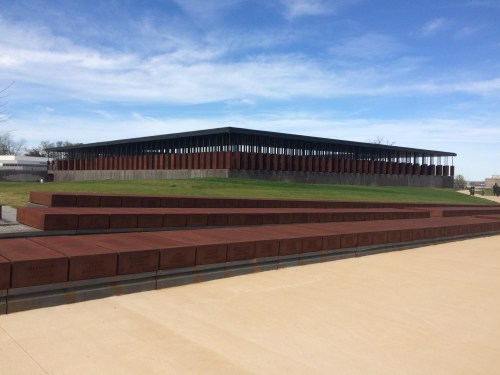
On a six acre site overlooking Montgomery’s downtown, a companion memorial contains two sets of over 800 steel columns, one for each county in the United States where documented racial terror lynchings took place. One set of columns is shielded by a roof. Viewers of the sloping site are led from an initial area where the columns are at ground level toward a section where they hang suspended, like many of the lynching victims they represent.  

Hanging columns at National Memorial for Peace and Justice in Montgomery, Alabama

Words or photos cannot convey the full impact of experiencing a walk among them. The county where I now live in North Carolina had one lynching memorialized; the county in Maryland where I was raised had two. In all, over 4,000 racial terror lynchings have been documented and verified in 20 states.

A second set of columns lies flat on the ground. Rust-colored, it reminded me of the corrosive myths many of us have told ourselves and each other for years, helping perpetuate race-based fears and hatred, going all the way back to the myth of the “happy darky.” There’s the myth of the predatory black man, with its corresponding myth of helpless womanhood. Especially pernicious and pervasive is the myth of white superiority, abetted by the myth of entirely benign police presence aimed solely at preserving “law and order.”

. The duplicate columns are designed to be brought home to the counties where lynchings occurred, as a way to help acknowledge past injustices and then help heal our enduring racial divides. The columns are way too heavy to fly, but these angels represented in Montgomery need to go home. It’s way past time.

Duplicate columns, Montgomery's memorial

duplicate columns lying outside at Montgomery memorial

By now, I’ve become an old woman. Not unlike the wife in Prine’s song, I’m named after one of my grandmothers. I may be old, but I can continue to bear witness. Again paraphrasing Prine’s lyrics—to believe in (and work toward) reconciliation is a good way to go.    

This Year’s February 14

This Year’s February 14     —by Jinny Batterson

This morning the sun rose here earlier than the day before;
The poinsettias a neighbor gave me to nursemaid
After the Christmas holidays droop a bit, but still
Lavish red and pink accents on our late-winter
Condo. My husband sneaks a colorful set of earrings
Onto my place at the breakfast table. Happy Valentine’s Day!

Only this year we add a differently sanguine tradition:
Marjory Stoneman Douglas High School Remembrance Day.
Last year, this morning in Florida started out routine,
Even joyous, until lives were shattered by gunfire.
Does it matter whether the gunman was mentally ill?
Does it matter that he had access to a military-style weapon,
Designed and sold for no other purpose than killing humans?

At 10:17 a.m., schools and workplaces will observe a moment
Of silence, remembering slain students Alyssa, Martin, Nicholas,
Jaime, Luke, Cara, Gina, Joaquin, Alaina, Meadow,
Helena, Alex, Carmen and Peter. We’ll ponder whether
Any of us have the bravery or protective instincts of staff
Members Chris, Aaron, or Scott. We’ll continue to mourn, to
Question what we can do to reduce the chances that
Future holidays will also come to hold dual meanings.
Thoughts, prayers, silent vigils help. They’re not enough.

Additional steps are required. To honor their memories,  go a little
Beyond: Send a pointed Valentine message to your legislator.
Follow up with emails, maybe even visits. Make a donation.
Register and vote. Talk with those of different views.
Find the unique, universal core deep within you,
Then share it. Some holidays exist for us to reclaim.


MLK, Jr. Reweaving the Dreams

MLK, Jr.: Reweaving the Dreams   —by Jinny Batterson

While he was alive, I knew little about him.
The mainstream press in Baltimore barely mentioned
This Negro preacher who’d helped marshal a yearlong bus
Boycott and in the mid-1960’s won a Nobel Peace Prize.
There were rumors he might be a Communist.

I was in high school, with other concerns—
Who could I get to take me to the prom?
Would my SAT scores help me get into a good college?
Would my parents take away my driving privileges
After an accident that I at least partially caused?

By the time I got to college, his star was waning,
Eclipsed by rising black militancy and a war in Southeast Asia
That dragged on and on. His tactics and pronouncements were
Less influential, less obviously successful in northern cities than in
Earlier Southern-based campaigns. Non-violence and preaching peace
Didn’t appear to work against big-city political machines and war contractors.

At first it seemed his dreams had come unraveled when his life ended.
As riots broke out in many American cities following his assassination,
I sat distracted in a secluded dating parlor on a small college campus,
My boyfriend’s bent-kneed proposal and diamond ring a pale foreground
To a muted television backdrop of Baltimore and Washington, D.C.,
Two bookends of my youth, engulfed in flames, sirens, and riot police. 

By the time his birthday was declared a national holiday
In November, 1983, I was attempting to learn and implement
Parts of his dream in rural central Africa. My efforts met with
Little success in a country whose few rich and many poor lived in vastly
Different worlds, with a minuscule middle partly made up of expatriates
Like me. I had lots of time to read the contents of a USAID library.

Martin Luther King, Jr., I learned, was a middle child, born just before
The Great Depression. His family lived in a relatively prosperous black enclave
In segregated Atlanta. During his early studies, he drifted, but partway through
High school he was inspired toward the ministry. He went north and completed
An impressive formal education, earning a doctorate by age twenty-five.

The parts we now recite in school start in Montgomery, Alabama,
Where he was nominated, as a young, little-known preacher, to give voice to the
Aspirations of people who had for too long been shunted to the back of the bus.
After the successful conclusion of the bus boycott, sixty civil rights leaders met
In Atlanta, founded the Southern Christian Leadership Conference, and elected
MLK as its first president.  Then came sit-ins, Freedom Summer, Albany,
Birmingham, Selma, Chicago, a Poor People’s Campaign, a sniper’s bullet.

Those of us who call ourselves progressives winced at subsequent American
Foreign and domestic policy, wrote letters, attended rallies and marches,
Wondered what else we might do to stop, or at least reduce, the madness.
For a while, we thought we had found an answer in another young,
Eloquent brown-skinned man. Twice we elected him national president,
Allowing complacency to creep into our ongoing efforts.

Our current national administration is more nightmare than dream.
It wants us to forget that our deepest dreams are inclusive rather
Than exclusionary, spiritual as well as material. MLK knew this.
He tried to tell us, over and over again, but we rarely listened.

We know MLK had flaws—infidelity, sometimes neglecting his family,
Carrying too much of the movement’s burden by himself.
We do not need another plaster saint, of whatever skin hue,
But Coretta was right to insist that we honor MLK with a holiday.
Though not free from sin or error, he was also a prophet
Who recalled us to our best selves. May we remember
His efforts as we redouble ours, reweaving stronger dreams.

Pandas Playing Mahjongg–Enjoying the Cary Chinese Lantern Festival

Pandas Playing Mahjongg, Enjoying the Cary Chinese Lantern Festival 

                                                        —by Jinny Batterson

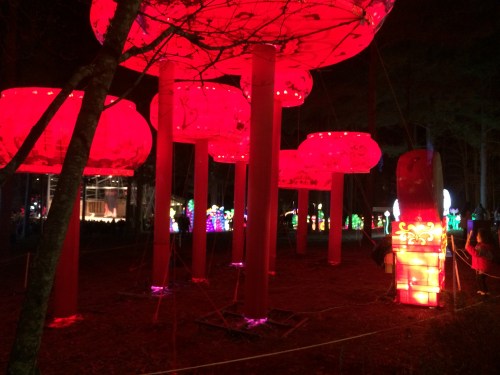
Cary Chinese Lantern Festival Panda Land 2019

For the past several years, a traveling exhibit of LED-lit silk-skinned “lanterns” has come to our North Carolina town during the darkest period of winter. Last year on the night I attended the festival, the air was bitingly cold. Crowds were sparse. This year, on a clear weekend evening a good bit warmer than typical for early January, I ate an early supper, then put on a hoodie, drove to the festival site, parked in a free adjacent lot, and walked to the box office to get a ticket. I arrived a little after the festival’s 6 p.m. opening—once the sky was dark enough to provide a good backdrop for the thousands of lanterns and fanciful lit shapes.

I’d assumed that by arriving early, I’d “beat the crowds” and minimize my wait time to purchase tickets (cheaper at the gate than by internet) and then gain entry to the exhibit space. The wait wasn’t too long—maybe twenty minutes in all–but it turned out I’d arrived at the height of that evening’s viewing hours for multi-generational families. Rather than come later in the evening, they were enjoying the spectacle before youngsters’ bedtimes, at the same time taking advantage of reduced or free entry for young children.

The star of the show, a huge brightly lit dragon, again stretched along the shallows of Symphony Lake for a couple hundred feet. It was even larger and more intricate than last year’s dragon.  A few of the other exhibits were similar to what I’d seen previously, but arranged differently and with different emphasis.  New features had been added, too, including a set of large lantern “drums” near the entrance, with a real drum that kids could pound on to make the lights glow brighter.

Cary Chinese Lantern Festival Drums

My favorite set of lanterns was “panda land.” I’d previously spent time in China in the region where pandas are native. This exhibit featured stylized panda figures in human poses—riding a bicycle or, my absolute top pick, playing the Chinese tiled game of mahjongg, a sort of cross between dominoes and the card game spades.  Periodically, performers on the festival stage did acrobatics or Chinese dances—I watched briefly, then went back to the pandas. This year’s lantern festival is nearly over. The weather for remaining evenings is predicted to be less pleasant than the evening I went.

If you live locally, I’d encourage you to go if you can. Too often these days our airwaves are full of insults, ricocheting threats, and fear mongering. Against this background, an outdoor stroll alongside others speaking many languages, all of us watching the whimsical uses we can make of our technologies when we’re not busy fussing with each other, is, dare I say it, priceless.     

Old Years’ Resolutions

Old Years’ Resolutions    —by Jinny Batterson

For many years, I’ve avoided making discrete New Years’ resolutions. I have a tendency to backslide. Eliminating harsh words, taking off five pounds, following an exercise plan—most years such resolutions would get broken by late January if not sooner.  Instead, I’ve tried just setting general directions, somewhat more gently: I’ll bite my tongue a bit more often, eat a little less, exercise a tad more. I’m not sure if those around me even notice. Still, I reason, how can I expect to improve either myself or the world if I spend lots of my time blaming myself and/or making up excuses for broken promises?

Looking forward and setting goals are important, with New Year a frequent milestone for doing so. As I get older, occasionally looking backward seems appropriate, too.  What has gone well in the year just ending? What has gone poorly?

This past year has been good for me. I realized a long-term goal of publishing a travel memoir. I enjoyed generally good health. My husband and I shared several adventurous and rewarding trips. Meanwhile, the world at large has caromed along with perhaps more disasters and more vitriol than in some years. Headlines and blogosphere trend negative.

On the personal front, I think I’ve done a fair job at maintaining a civil tone in interactions with relatives, friends, acquaintances and elected officials across the political spectrum. However, I did send a somewhat snippy letter about varying leadership styles to our congregation’s new minister; I used some harsh words in a couple of the postcards I mailed to our current national leader. Weight control? Not so good—after a December trip that included lots of holiday feasting, any implicit goals about weight loss have fallen short.

What about exercise? There I think I’ve shone. Partway through 2018, after an extended hiking trip in rural France upped my average step count well above 10,000 steps per day, I set a short-term personal goal: Could I keep my annual average above 12,000 daily?  With just a few days to go, I’m tantalizingly close. Today the weather where I live has been pleasant, so getting in steps outdoors (roughly between four and five miles) was easy. Tomorrow and the next day are predicted to be rainy, making outdoor walks less appealing. New Year’s Eve may find me trudging on the treadmill at the gym, or pedaling the second-hand exercise bike at home, or even doing late-evening laps around our small condo as the TV counts down the final hours until midnight. If I’m able to meet this “old year’s resolution,” set not in January but in August, I’ll be pleased. The world at large may still be somewhat dicey, but I’m in better shape.   

Concentrating too hard on “new year” milestones may cause us to miss chances for learnings and goals later in the year or later in life. Looking back through much earlier personal journals, I found a year-end thought from 1982, a year in which unrest in Poland and the continuing cold war between the U.S. and the Soviet Union had been much in the news. The U.S. economy was in recession. Britain and Argentina had gone to war over the Falklands, a set of small islands in the South Atlantic. Nevertheless, I wrote then:  “All in all, 1982 has not been a bad year. The world is still teetering on the brink of disaster, as usual, but there’s been a lot of love and beauty, too.”   

May 2019 turn out to be a year in which many personal and broader issues move toward better resolutions, whether made early or later. Happy New Year! 


Who Did You Expect?

Who Did You Expect?     —by Jinny Batterson

My life so far has been fortunate—no privation, little discrimination, generally good health, many chances for love and adventure.  Much of the time, though not always, people I’ve met have lived up to (or beyond) my expectations. On those rare occasions when someone’s behavior has disappointed me, more cynical or world-weary friends have shrugged at what they regard as my naiveté. 

“Of course so-and-so let you down,” they’ve announced. “What did you expect?”  

Increasingly for me,  the appropriate question is rather “Who (or, for the grammar police, “Whom”) did you expect?”  As I mature (a work in progress), I become more aware of instances when I’ve pre-judged people and turned out to be fairly far off the mark.

The first occasion that stands out is my initial in-person meeting with the leader of our 1980 group tour to China. In those pre-internet days, I’d exchanged postal letters and paperwork with Ms. Baum and talked with her on the phone. Until we both arrived in San Francisco’s airport departure lounge for our trans-Pacific group flight to Hong Kong, I had not actually met this native New Yorker. I’d assumed from her accent and phone demeanor that she was of Jewish background. She seemed somewhat pushy and no-nonsense, ready to take on the world. I was surprised to see that she was African-American, not ethnically Jewish. She could be somewhat pushy and no-nonsense. Her prior experiences as both social worker and travel agent had prepared her well to take on whatever bureaucracy attempted to get in her way, regardless of ethnic origin or nationality. She turned out to be both different from and similar to the “who” I’d expected.

Earlier this fall, I signed up to work the polls in the 2018 mid-terms. After on-site training, I exchanged emails with the woman who’d be my site supervisor for early voting. Her written English was good, clear and simple. Her family name was a common one, her given name, ending in “a,” suggested to me she might be African-American, or maybe Hispanic-American. When we met, I could detect no skin coloring or hair texture to suggest ancestral links with Africa, no hint of foreign origin in her accent. She seemed at first a very “vanilla,” somewhat conservative American. During our work, she showed her passion for ensuring that anyone who wanted to vote was given maximum opportunities to do so. She’d sit patiently with someone lacking appropriate credentials, or with an address not yet entered into the electoral system database of rapidly growing Wake County. She knew the rules well. She could suggest pulling up an electronic copy of a utility bill on a portable phone. She might advise going home to retrieve a needed ID and then returning later in the day. In rare cases, she’d have the potential voter fill out a provisional ballot, explaining how and when to check whether their vote had been counted. The workforce she’d helped assemble to follow her lead was the most visibly diverse I’ve ever participated in. She was both different from and similar to the “who” I’d expected.    

I’ve just spent Thanksgiving with parts of my extended family that I barely knew growing up in Maryland in the 1950’s and 60’s. Only once had I had a chance to visit these North Carolina farmer cousins from a rural area near Charlotte. What little I remember from that farm stay involves ponies tame enough so even I was persuaded to take a short ride. I got to see my grandmother’s sister-in-law make glorious biscuits using milk straight from the cows. The cousins closest to my age teased me good-naturedly about my lack of country skills.

After moving to North Carolina a decade ago, I became reacquainted with some of the cousins who’d left the farm to settle in Raleigh. They’d tell me enticing stories of an extended family Thanksgiving gathering at “the shed.” I pictured the locale in my mind: an expanse of gently rolling hills, empty except for a few horses or cows grazing in pastures. “The shed” would be a slightly cleaned-up farm outbuilding. Twenty or so aging cousins of Scots-Irish ancestry would assemble for our midday meal, then say interminable grace before we could eat. Someone would have cooked a turkey and brought it still warm to the feast. We’d eat plentifully, exchange pleasantries, carefully avoid politics, and then everyone would go home.

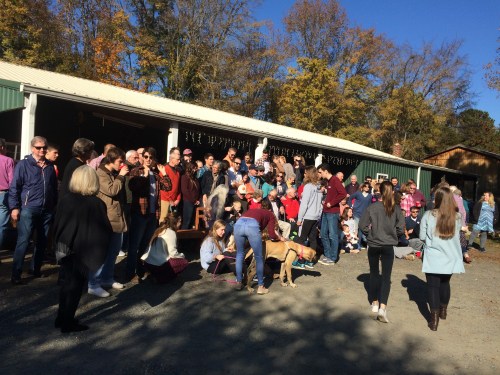
This year as we drove into the neighborhood nearest our destination, I had trouble reconciling my mental image with current reality. The surrounding area may once have been farmland, but the vicinity had long since become part of suburban Charlotte. A mid-rise apartment complex dominated the nearest street corner. The “shed ” had been expanded and modernized from an earlier role as storage space for some cousins’ plumbing business. It was now a comfortable, well-appointed venue with adjustable seating for up to a couple hundred people. Nearly that many cousins of all ages were in attendance, along with baby equipment, pet dogs and a few footballs.

We did have a short sung grace before the long, snaking buffet line formed. We did generally steer clear of contentious political topics. People caught up on family news since the previous get-together. One 20-something cousin had recently returned from an extended Peace Corps stint in South America; in the next generation up, a househusband described his four years of helping school their daughters while his family was on assignment in southern Europe. One attendee I didn’t get a chance to talk with directly had a skin tone and accent that implied ancestry or origin in India. The Reas still cherished their rural roots and pioneering ancestors, but the clan had gotten more diverse and widely traveled—both different from and similar to the “who’s” I’d expected.

The remaining holidays of late autumn and early winter are likely to have more extended family gatherings and chance meetings. May I remember not to pre-judge those I encounter, to be more careful not to let “who I expect” get in the way of meeting current reality with an open mind and heart. 

Rea Thanksgiving at “the shed”

Happy Interdependence Day!

Happy Interdependence Day!    —by Jinny Batterson

For a good many years now, I’ve bracketed an insertion into my July 4 Independence Day greetings to friends in the American expatriate community:

“Happy In(ter)dependence Day!” I extol them.  It has seemed to me increasingly evident that in an era of global communication and commerce, celebrating “independence” needs a counterweight. We have become more and more dependent on one another across all sorts of boundaries. So I was pleased to find that others more widely known than I am have come up with similar themes. Perhaps the most widely publicized is a September 12 holiday proposed in the years just following the World Trade Center terrorist attacks.  In 2003, a group met to create a day to celebrate our global interconnectedness, and settled on September 12, the day after the terrorist assault, as a day for an annual celebration. According to Parag Khanna, one of its founders:

     “For the event’s organizers (the Democracy Collaborative at the University of Maryland), Interdependence Day is intended to be crucially different from 4 July. Where Americans alone celebrate the latter, the idea of interdependence unites all peoples across national boundaries in a common human destiny. At the same time, there is an element of deep continuity: for Americans in particular will have to struggle as hard to realize the promise of interdependence as they did for independence.”  (For a fuller explanation, please check out the following link: https://www.paragkhanna.com/home/americas-interdependence-day.) 

     I’ve just returned from a cross-country U.S. trip, benefiting from collaborative practices among airline personnel, colleagues, other passengers, and airport employees to adjust schedules and seating to get as many of us as practical back to our homes on the U.S. Atlantic coast in advance of a strong hurricane. My guess is that our skills at interdependence will soon get a good bit of practice, courtesy of Florence and/or other storms later in the season. My best wishes to all for adequate shelter from the storm—Happy Interdependence Day!     

Entitled, Endowed, Enabled

Entitled, Endowed, Enabled    —by Jinny Batterson

At this year’s Labor Day, I’m likely to be engaged in intense mental labor with friends and former colleagues, trying to make some sense of the somewhat shaky state of civil society in the United States of America in 2018. As the holiday approaches, my sense is that our uneasiness arises partly from confusion about being entitled, endowed, or enabled. Below are some as-yet-unfinished thoughts about how the three might be interrelated:  

A decade or so ago, a leader at an educational institution I value complained that students there had “a sense of entitlement.”  I wasn’t sure what he meant, and I wasn’t in a position to either validate or refuse his claim. Just now I looked up the definition of the phrase, and this is what a search engine produced:

“If someone has a sense of entitlement, that means the person believes he deserves certain privileges — and he’s arrogant about it. The term “culture of entitlement” suggests that many people now have highly unreasonable expectations about what they are entitled to.”  (from www.vocabulary.com)  

         I suppose the term “entitlement” derives from the honorific and/or hereditary titles that certain members of European nobility were given. Over time, such entitlement does not need to have anything to do with the person’s character or accomplishments. It cannot be revoked. 

The most famous phrase about “endowed” comes from one of our founding documents, the U.S. Declaration of Independence:  “We hold these Truths to be self-evident, that all Men are created equal, that they are endowed by their Creator with certain unalienable Rights, that among these are Life, Liberty, and the Pursuit of Happiness.”  

A more recent application of “endowment” is the endowment effect (also known as divestiture aversion), the hypothesis that people ascribe more value to things merely because they own them. Someone who has been “endowed” with say, a house, or a job, may feel that this endowment is permanent and react strongly when there is a perceived threat to his/her ownership. Institutions can also be “endowed” materially—we periodically hear figures about the size of Harvard’s endowment, not  often paying attention to the variability of such funds over time. In a different sense, we may talk of Dolly Parton’s “endowment,” likewise a not-entirely-permanent trait.  

What appeals to me more than either of the previous terms is “enabled.” To me, this term infers more active engagement by the person who’s enabled.  Some stories of enablement based on events at Special Olympics competitions and other sporting events give examples of teamwork, in which someone who may fall behind in the traditional sense is enabled by teammates to finish his/her race, enabling all to succeed together. The term is also used for the process of retraining someone who has lost previously available skills due to illness, accident, or other impediment.  

Reverting to endowment, though, I quote from the lead article of the constitution of my adoptive state of North Carolina. Borrowing from the U.S. Declaration of Independence, the framers of this post-Civil-War constitution added a fourth endowment: the enjoyment of the fruits of their own labor.  

  May we all find ways to better balance entitlement, endowment, enablement as we move forward.    


Aubrac’s Fields of Wild Jonquils

Aubrac’s Flelds of Wild Jonquils    —by Jinny Batterson

In late May, as I was walking across a sparsely settled upland French plateau along a stretch of one pilgrimage route of the Camino de Santiago de Compostela, I encountered a delicious fragrance—delicate and sweet and lingering. I wasn’t sure where it was coming from. Despite, or perhaps because of, a fair amount of rainy weather, the meadows and woodlands abounded in spring blooms, many of them unfamiliar to me.  That evening at the small guest house where we had booked a room, I noticed a vase of flowers with the same delicate fragrance. I asked the proprietress what these small white blooms were called. “Jonquils des poètes,” she told me in French.

I’m not sure what the English equivalent is. The internet pictures I’ve found of “Poet’s jonquils” look similar, but not identical to the flowers I remember from my trip. A few days further into my journey, I arrived midmorning at the tiny town of Aubrac, after spending a couple of hours crossing several miles of minimally fenced upland pastures dotted with jonquils des poètes, some being contentedly munched by local cattle. The weather was cool and misty.

At the near edge of town was a forbidding-looking Romanesque structure. A guide was explaining to a group of tourists in a language I could not understand the wonders and historic significance of this church. According to the French signpost I could partly understand, this former Benedictine monastery was at least a thousand years old and likely built on the foundations of an even earlier structure.

Most of the other buildings along the road and edging the upland pastures were hotels, hostels, or small inns. I noticed one small cafe/guest house that seemed to be open. Several of us stopped and picked out an outdoor table under a protective awning. A warm drink seemed a good idea. It took a while for anyone to come to take our orders—after a bit, an elegant young woman showed up, apologizing somewhat for the delay, explaining that she and the other town residents were all still stressed out from the previous weekend’s “transhumance” festival that annually draws thousands to the area. I’d seen pictures and postcards of this celebration of the opening of common upland pastures for the area’s prized cattle. A nearby town square was still littered with floral garlands and signs from the festival. (Find a set of commercial pictures of the 2018 festival here: http://hotel-lion-or.com/aveyron/fete-transhumance-aubrac/

When our hostess finally brought our coffees and hot chocolates, she stopped to take a smoke break and we began to ask her questions. All of us were curious about the town, whose year-round population has dwindled markedly from a peak over a century ago. Until the late 19th century, our hostess told us, Aubrac had been a traditional farming village, but the harshness of the climate and the difficulty of earning an adequate living caused many farm families to leave the area and seek better lives in French cities. Lots of the adults became small shopkeepers or restaurateurs in and around Paris. However, they retained cottages in Aubrac and continued to bring their families for summer vacations in their former hometown. At about the same time, some area doctors discovered that the clean, cool air in the Aubrac highlands helped tubercular patients. Several tuberculosis sanatoria were opened over the next decades—some have since become hotels or hostels. Most of the local economy now revolves around tourism, compressed into the three or four months of warmer weather. The local cattle, a special hardy breed, supply photo opportunities as well as milk or meat. 

Our hostess explained between puffs that she was even busier than she’d expected post-festival: her five rooms were all rented for the week—a group of businessmen from New York City had come to explore the option of buying quantities of jonquils des poètes to use in a new upscale perfume fragrance. She said that this particular type of jonquil only grew in the wild and had not yet been successfully cultivated.  Some of each year’s blooms already were collected by locals to supply French perfumeries in the southern city of Grasse, a noted perfume center.

I never got to meet the businessmen, who most probably were jet-lagged and perhaps also technology-deprived in this isolated small town. My current exposure to a former-NYC-businessman-turned-politician has temporarily soured me on the ethics and business practices of some.  My hope is that if a deal is struck, the good people of Aubrac will be fairly compensated for their labor and their wild-growing fragrant white blossoms.  I also hope that enough flowers will be left in the fields so that cattle, pilgrims, and residents can continue to enjoy their essence in their native habitat.