Category Archives: Everyday Wonders

Up, Up, and Up: the Straight Line Instinct

My father-in-law was something of a cut-up. When he finished high school during the early 1920’s, he wasn’t the star scholar of his class, but he was good at telling a story. His classmates demanded that he be chosen to give the graduation address.  

From a few pictures of the time, I can see in my mind’s eye his slicked back hair with the cowlick that refused to lie down, the somewhat unevenly polished shoes his mother had persuaded him to wear with his best suit. His title was “The Iron Bedstead Menace.” 

He never shared the text of his remarks with us, but I can also picture his well-timed delivery, alternately amusing and frightening his audience. He had learned from a magazine article somewhere that the prevalence of iron bedsteads was widespread and continued to grow. 

Grandpa Batterson presented ample evidence of the rapid ascendancy of iron bedstead production and ownership. He projected the continuing growth of the trend, until the Chicago suburb where he and his family lived would be overwhelmed with bedsteads everywhere. These bulky, never-decaying items would over time leave little room for other furniture; discards would fill area dumps and backyards to overflowing. People should beware and take action to ban this creeping menace, before it was too late, he concluded. 

Per a contemporary article on a Home/Office/Garden website: “Owning an iron bed became a status symbol in the late 19th and early 20th centuries. As they were more expensive than the basic wooden beds, having an ornately designed iron bed indicated a family’s wealth and modernity. The intricate designs also reflected the artistic tastes and sophistication of the household. (https://hogfurniture.co/blogs/ideas-inspiration/the-importance-of-antique-iron-beds-historically-and-currently, accessed 11/22/2025)” (In hindsight, we’ve learned that the incidence of such beds actually declined as the 1920’s progressed, their overly ornate designs supplanted by more modest furniture.)

The Roslings use global human population growth as evidence of the straight line fallacy—over the centuries, pundits have repeatedly suggested that human population will continue to increase until limited by our finite planet. In its most recent incarnation, the expectation that population will continue its recent upward trajectory fooled lots of sustainability experts at conferences Rosling attended. As Rosling explains: “The number of future children is the most essential number for making global population forecasts. … The numbers [of children globally] are freely available online, from the U.N. website, but free access to data doesn’t turn into knowledge without effort. … U.N. experts expect that in the year 2100 there will be 2 billion children, the same number as today. … [Because] (a)fter 1965 the number [of babies per woman globally] started dropping like it never had done before. Over the last 50 years it dropped all the way to the amazingly low average of just below 2.5.” 

It’s natural for us to expect a certain stability in rates of change of a given phenomenon, but, as the Roslings point out, such stability is not universal. Straight line increases are no more  common than s-bends, slides, bumps, or doubling lines. We need to pay attention to the assumptions we are making about the shape of a line or curve, and adjust our expectations as conditions change. 

(Last time I checked, the Chicago area was not drowning in iron bedsteads.) 

Ten November Notions

A few months ago, I posted an entry mentioning a 2018 book I often refer to: Hans Rosling and family’s study of global conditions Factfulness (https://jinnyoccasionalpoems.com/2025/03/15/newsworthy/). 

We’re in the early days of “National Novel Writing November.” While any novel I may have inside me has yet to agitate for birth, I would like to make the effort to write somewhat more frequently during this month when writers of all genres are encouraged to put pen to paper (or hands to keyboards). 

The Roslings published their book, subtitled “Ten Reasons We’re Wrong About the World—and Why Things Are Better Than You Think,” before the Covid-19 pandemic and before some of our current political dysfunction in the U.S. and elsewhere. I believe that their “ten reasons,” also called “instincts,” are still relevant, perhaps even more so now than when they wrote. I plan to explore each one of the ten, not necessarily in order, every few days between now and the end of November. (Their non-profit information foundation, Sweden-based gapminder.org, subtitled “important stuff most people get wrong,” makes frequent updates to the information they study.)  

As an introduction, I’ve photocopied the page near the end of their book that lists their ten reasons, providing a catchy graphic for each one. In the text of the book, the Roslings mesh statistics with personal stories from Hans’ life. One early experience, his near-death from drowning as a 4-year-old, helped form Hans’ world view, as did successive brushes with mortality as he pursued a career as a global health researcher with a concentration on sub-Saharan Africa. 

My interpretations of the ten reasons are somewhat different from Hans’, based on my own life experiences and opinions. Your interpretations will likely be different from mine. Still, I hope that by focussing on each “instinct” in turn, we may all wind up with slightly different perspectives on the opportunities of the present moment, as well as its dangers. 

Next up, the “urgency” instinct.  

Getting Ready for the Rain

For the first time in about a month,
Our weather apps are showing a non-trivial
Chance of showers tonight or tomorrow–maybe
As much as half an inch. Oh, ecstasy!

I scurry around, getting our small yard
Ready for the rain: positioning buckets to catch
Run-off from the gutter-less part of the roof,
Moistening the soil around area
Trees and shrubs to improve absorption
If/when the rains do come, clearing out roof gutters,
Sweeping away detritus from street edges, replenishing pea
Gravel on our slightly sloping garden walkway.

For as long as I can remember, I’ve
Been a weather nerd. My Maryland childhood
Included watching the approach of summer thundershowers,
Sledding during winter’s rare snowfalls, learning to swim
Just well enough to make it across a neighbor’s pool,
Keeping cool-ish during August’s soggy heat.

Here in San Diego, our heat is more apt to
Arrive in September or October, sometimes
Bringing with it the Santa Ana winds that heighten
Wildfire danger. Rain this time of year can be
A blessing, especially when it falls gently.

Weather nerdiness also exposes me to the
Increasing number of places where weather events
Are getting less gentle–friends in North Carolina
Have been displaced by Hurricane Helene,
Folks I know further north in California were burned
Out this past January, while some San Diegans are still
Recovering from our January, 2024 floods.

It’s not yet clear to me what further changes I’ll
Need to make as our rains become even more
Hit or miss. Last week, I visited Yosemite for the
First time, learning from its guides about the extremes
Of past weather in its granite-encircled, glacier-scoured valleys.
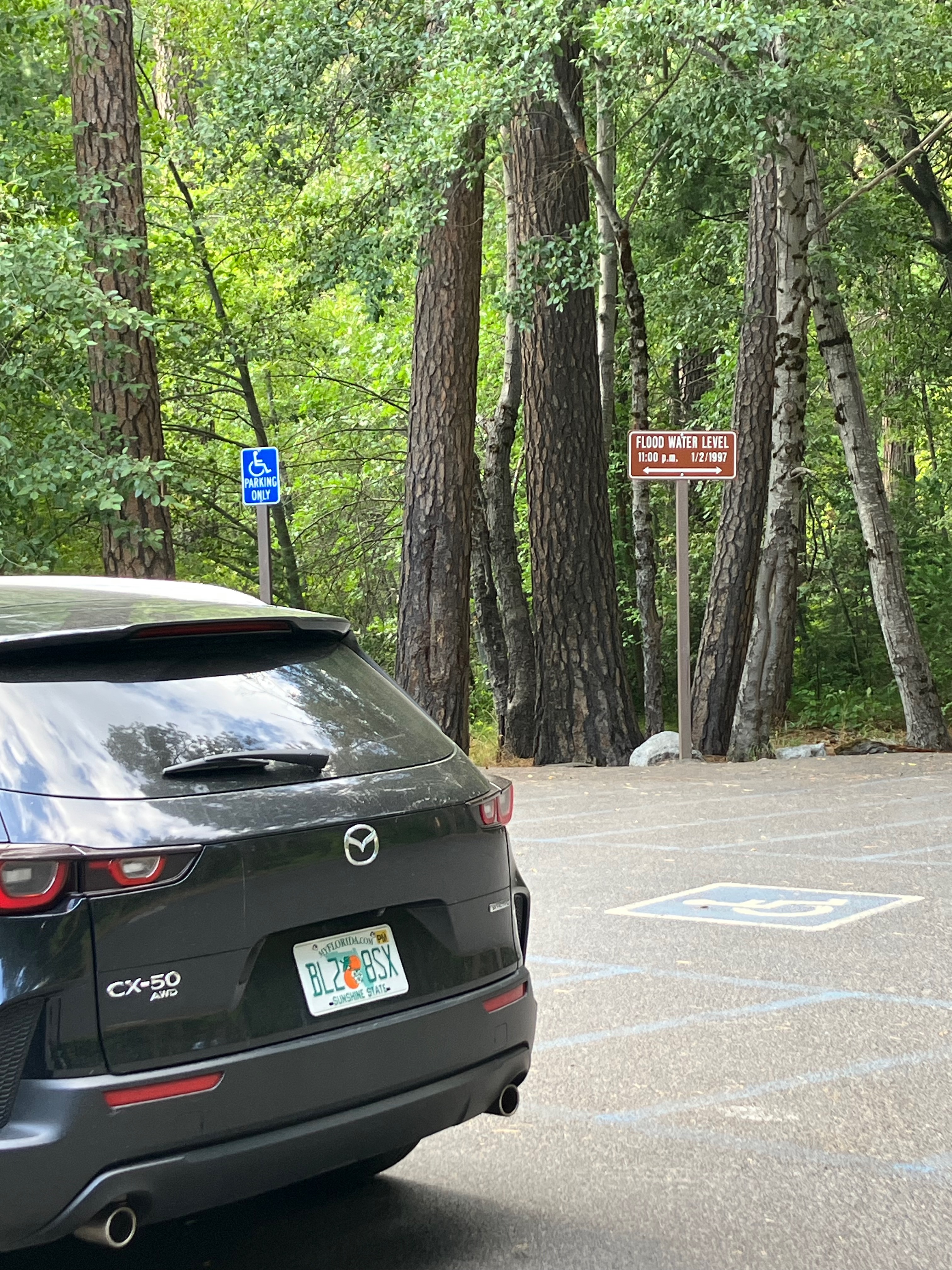
Its highest recent flood, noted at a parking area, would
Have drowned anyone not safely escaped to higher ground.

Regardless of our political outlook or economic status,
I believe we’d be wise to productively, concertedly
Get ready for the rain.

What Good Is August?

At first blush, it seems a mere blot on the calendar—
Wedged between the heroic hoopla of July 4 and
The start of another workaday year around September’s
Labor Day. People in their prime have disappeared from workplaces,
Taking their camping gear, their beach bags, their teenaged offspring
And their air-conditioned vans with them elsewhere.

Those of us left comfortably behind are only a little envious. 
We loll lazily on lounge chairs, or float face up in bathtub-warm
Backyard pools, while grills entice with odors of slowly broiling brats.
Vintage music plays at local festivals–Beach Boys, Beatles,
Sometimes even Sinatra. Bocce tournaments bring out the
Men in white. Parasols make a temporary comeback.

The furious scandals of pre-recess government seem less
Pressing for the moment, the final few tomatoes extra juicy.
August is not regal, not “august,” its aspect instead laid back.
Sharing vowels with its mood, August is languorous.
Before the rushed tumult of impending autumn,
Such languor is both welcome and sorely needed.

Interdependence Days

This year’s 4th of July celebrations did little for me.
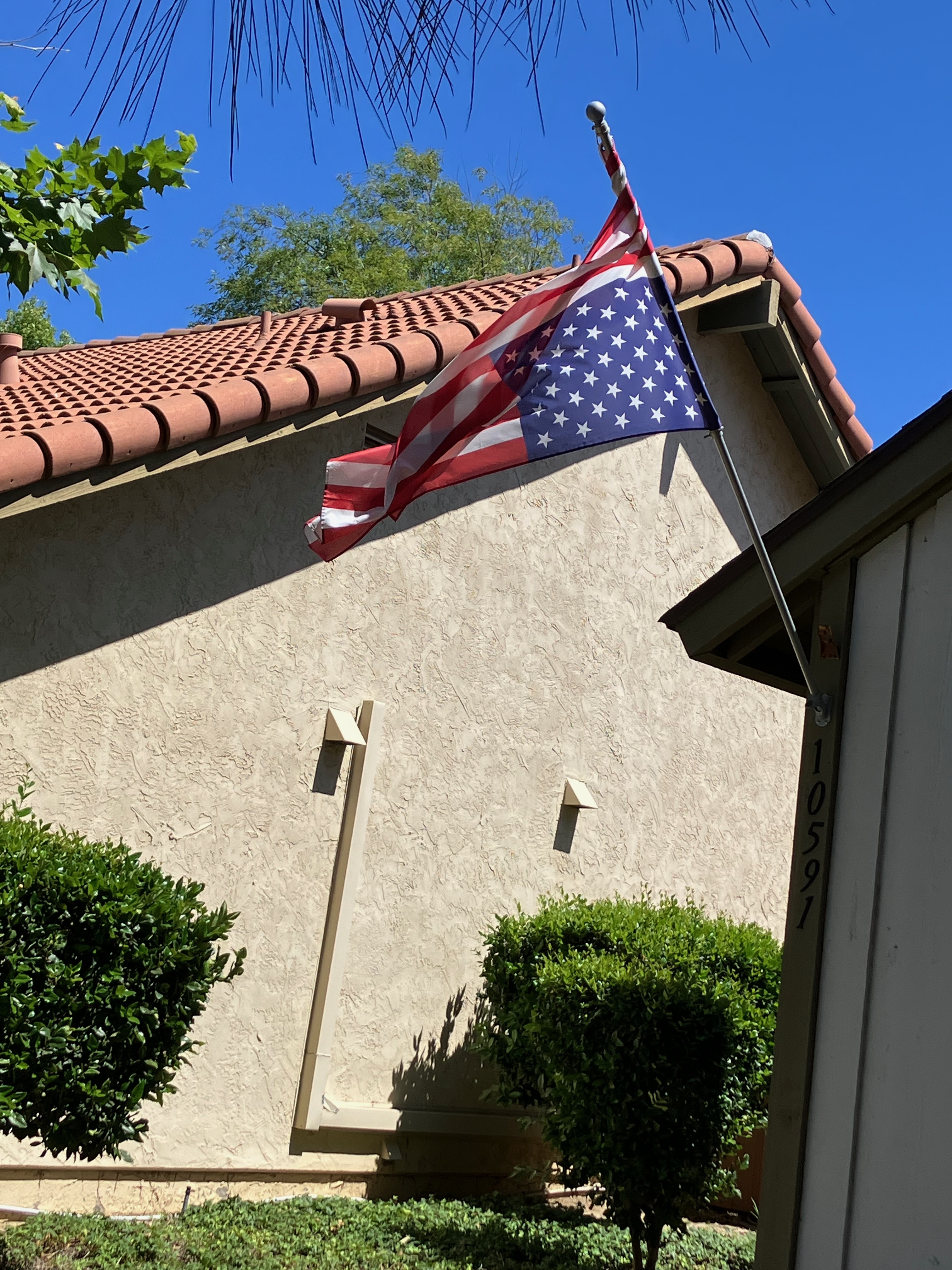
Much flag waving seemed phony, some neighborhood camaraderie felt forced.
I ached as U.S. ICE raids continued, as civilian deaths mounted in too many armed conflicts.
I wanted to skulk away, to forego my allegiance to much of anything.
But I remain part of a wider whole. Whatever my pique at political or social shenanigans,
I do not have the option to resign from humanity.

So I briefly retreated to gardens that nourish me, some of whom I tend:
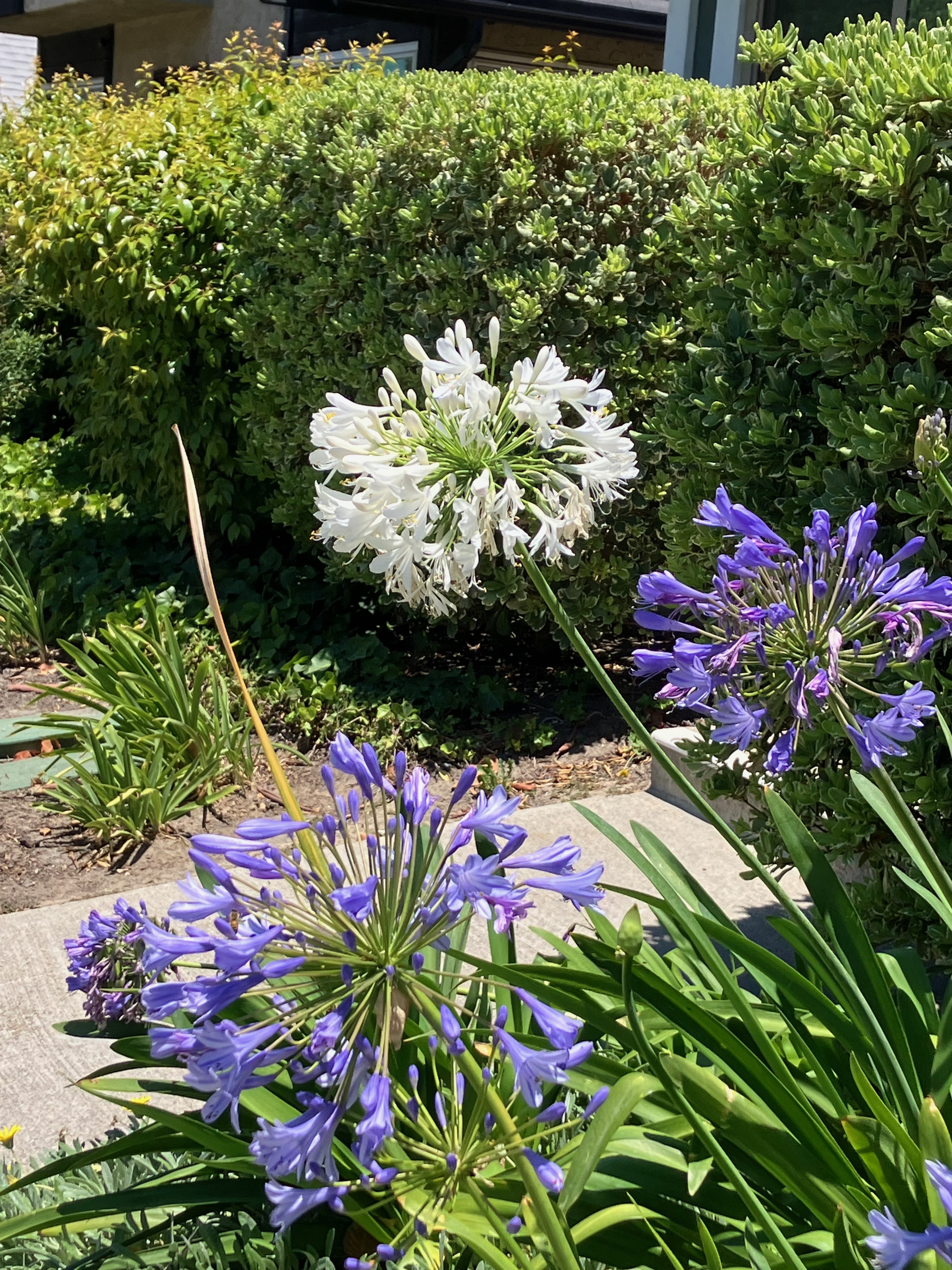
I admired walkway African lilies (agapanthus), most likely planted
When our 1970’s housing subdivision took shape over a decommissioned firing range.
This time of year, blue and white agapanthus blooms adorn our nearby streets,
Their starbursts quieter, more calming, less ephemeral than fireworks.

Within my own yard, I reveled in two sets of red blooms:
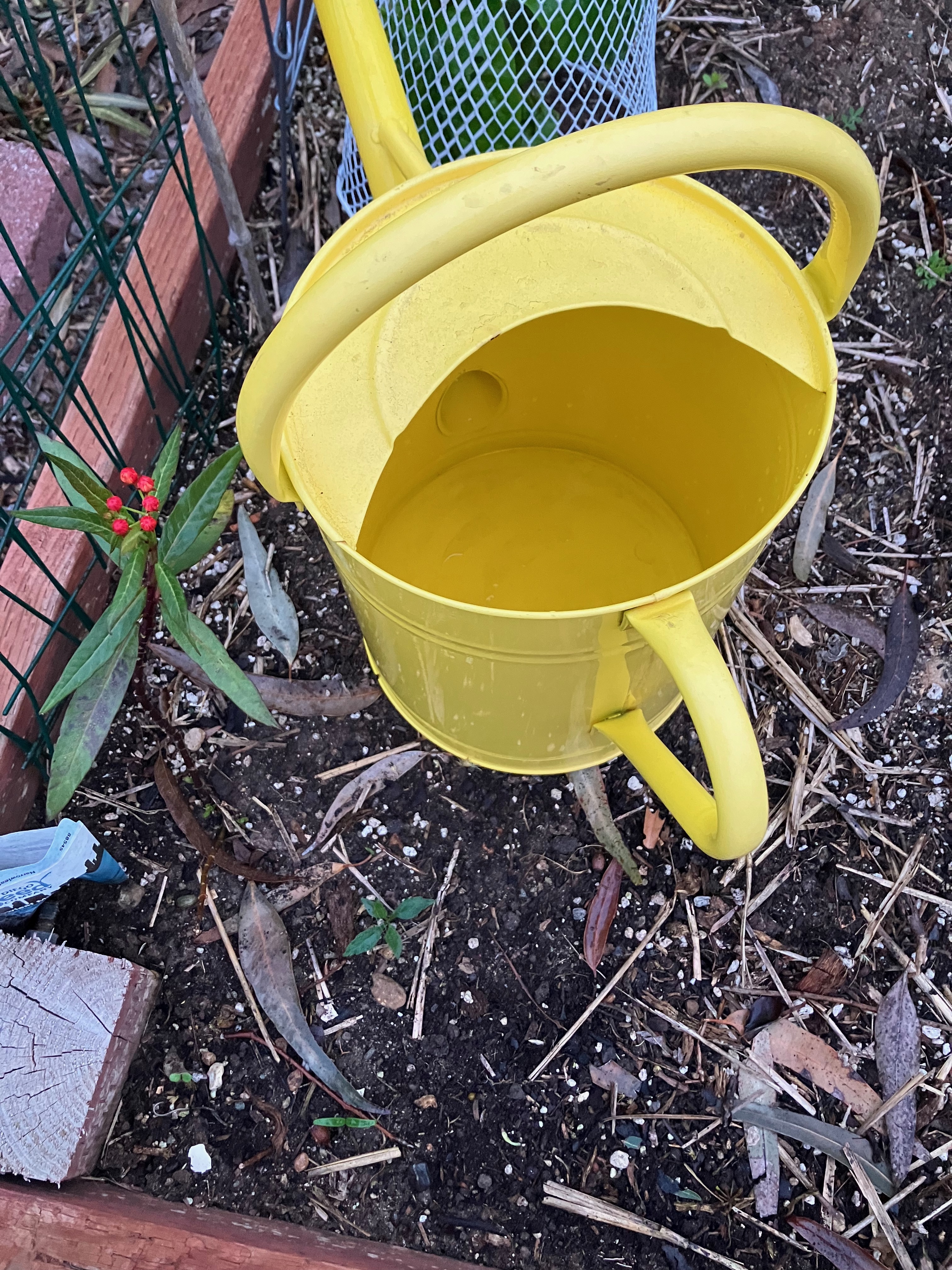
Along a sunny side fence, snapdragons from last year. They’d overwintered
In this mild climate where distinctions between “annual” and “perennial”
Get increasingly blurred.

overwintered snapdragons
shade-loving impatiens

Against the opposite fence, impatiens, cut-rate at the
Distressed rack of a local garden shop, now hold forth in most-of-day shade.

One day per year serves me as reminder of our nation’s independence. On other days,
I’d rather honor our interdependence with a natural world that graciously includes us.

May we continue to reconcile independence and interdependence, wherever we are.
Hurrah for the red, white, and blue, whether flags or flowers!

In Praise of Libraries

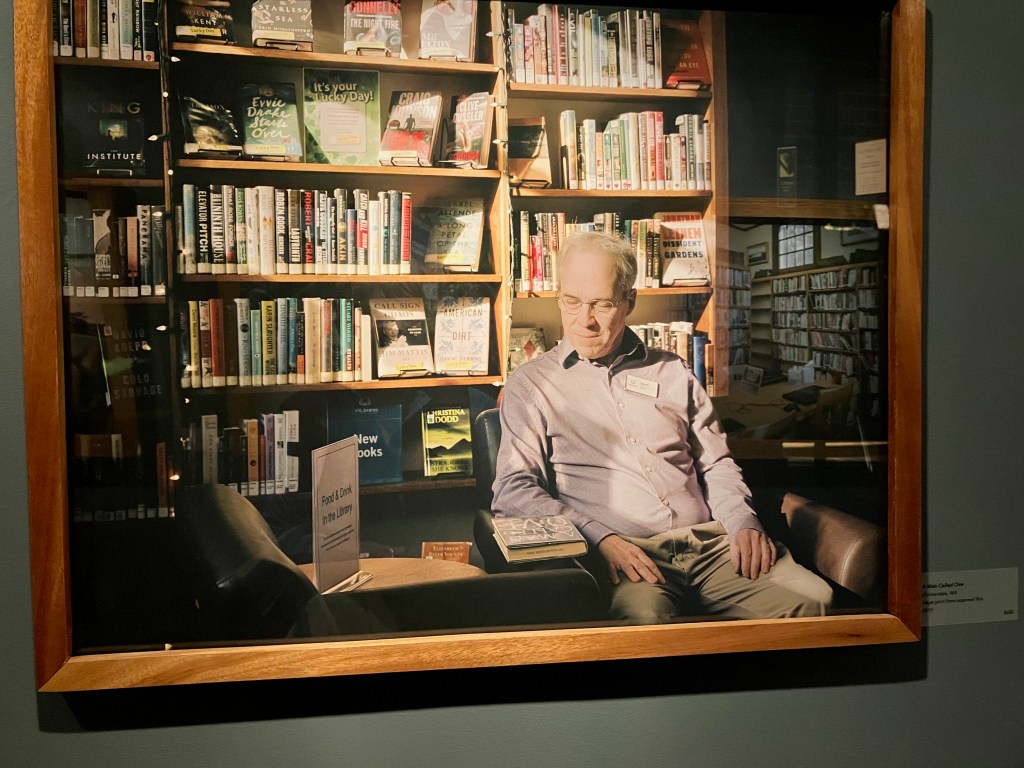
To me, libraries are among the unsung heroes of our societal institutions. They typically get taken for granted until something goes wrong, or the budget goes short. I depend on our public libraries for much more than books. When I visit a library branch, I often get to observe all different ages and economic levels, from toddlers to dowagers with pearls to homeless folks in well worn jeans. I get to check out both nourishing fiction and varied non-fiction. Nearly every subject imaginable is covered, along with the entire spectrum of political views. I can browse the latest newspapers and magazines. I can do Internet research on one of the computer terminals typically available for patron use. Most library buildings provide community meeting spaces, often making community rooms available to civic and non-profit groups for free or at minimal cost. Public libraries are among our most vital “third spaces,” neutral zones, neither work nor home, for getting recharged. 

As one librarian recently told me, “Libraries are among the few remaining spaces where you can hang out without being expected to buy anything.” Libraries help combat the loneliness that can worsen the mental and physical health of seniors.  

Photo of a Carnegie-Endowed Public Library

When in 2021 I arrived at my current home town as part of a cross-country move, libraries were still closed due to covid restrictions.  A library-related quote from a lean time in my young adulthood came back to me: “Libraries will get you through times of no money better than money will get you through times of no libraries.” Now, no longer cash-strapped, I was bereft of a major source of information and entertainment without library access. I very much missed the peaceable, low-stress interactions these venues had provided pre-pandemic. I appreciated the many creative ways libraries had adapted to provide what services they safely could during pandemic lockdowns. Once our central library reopened, I hurried to get a library card and to begin visiting and checking out materials. 

A while later, once our local branch reopened, I signed up as a library volunteer. Through volunteer hours and small-scale donations, I do my bit to support library programming. Nearly all our library branches have volunteers. We assist with day-to-day functioning and sometimes provide fundraising help through book sales and craft fairs. The more I volunteer, the more I appreciate the work, both paid and unpaid, that’s required to help keep our community well balanced and well informed, with access to the reliable information that helps citizenship flourish.

For over seventy years, ever since my grandmother first began taking me to story hours at our nearest library, public libraries have been a lifeline for me. The monthly library jaunts Granny and I took enriched me both intellectually and emotionally. Later, libraries helped me navigate term papers and college research assignments. During stressful times, they provided resource materials and outlets for harmlessly venting some of my frustrations. (My husband once joked that he’d know to start worrying if he saw me reading a murder mystery with an on-call computer programmer as the victim.)

In 2025, budget constraints are again threatening the health of many library systems, both urban and rural. Our city’s initial budget proposal for the next fiscal year projected cuts of about ten percent to the library system’s current allocation. It called for systemwide closures two days a week, regardless of branch patronage levels. It didn’t distinguish, among its thirty-seven branches, those in lower income areas where libraries are most crucial as a community resource.

Libraries can and often do provide the “ounce of prevention” that helps reduce the “pound of cure” required via police patrols, court costs, and emergency services. Those of us who are library partisans need to become better at touting the benefits of public libraries, intellectual, emotional, and societal. (Hence this blog post and multiple letters and emails to my local public officials.) 

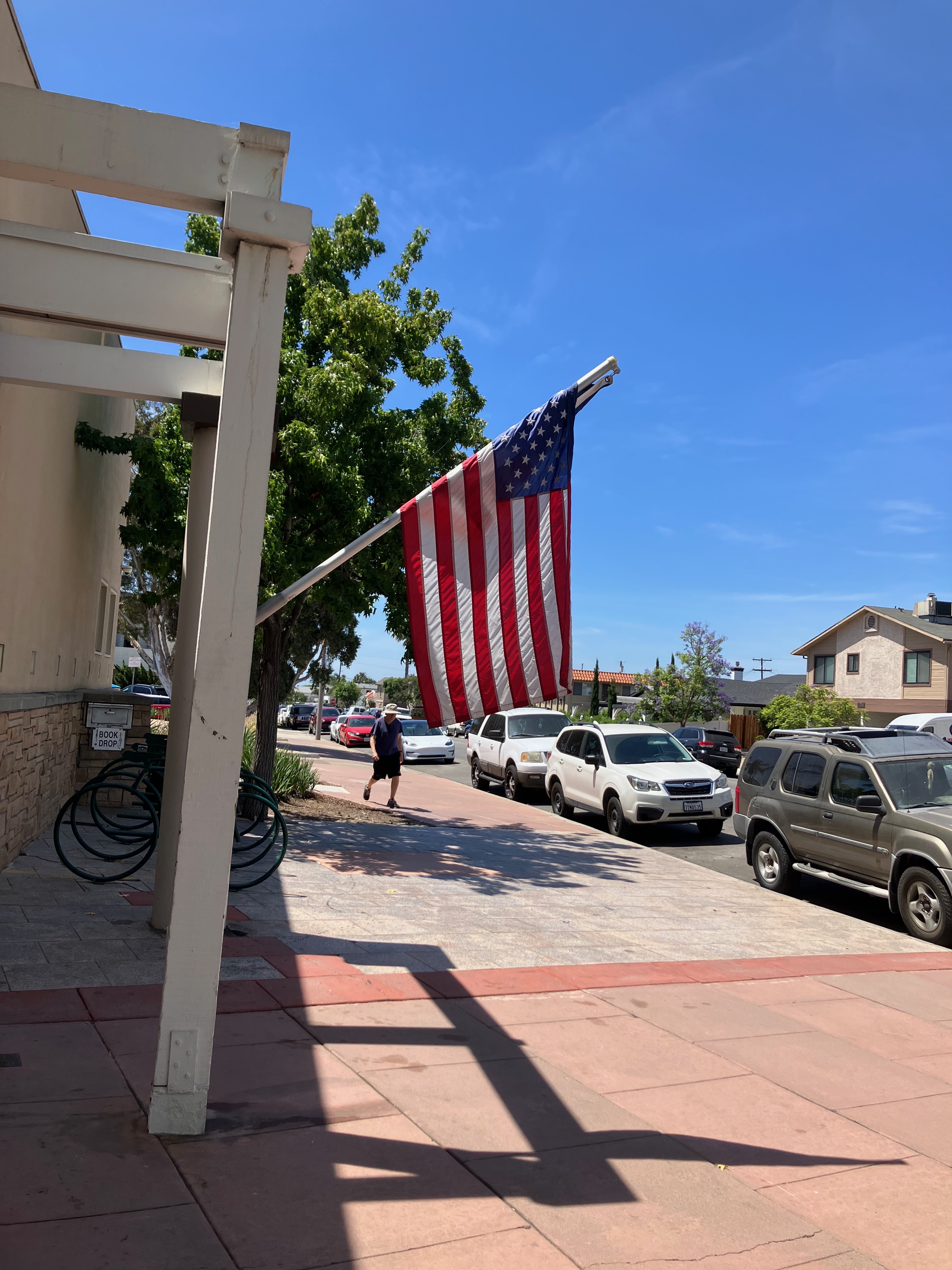
When I walk past our local library branch the first weekend of each month and notice the temporary flag announcing “Used Book Sale Today,” I feel a small glow. Long may such flags wave! Long may public libraries flourish!   

Five Finger Exercise

A few weeks before the 2024 U.S. election, I attended a local workshop about healing, mostly self healing. I hoped to learn some new skills, brush up on some older ones, to hone practices for remaining calmer and more focussed, as this national political campaign neared its quadrennial conclusion. 

I was reminded to practice paying attention to my breath—afterward I resumed early morning sessions of “yoga breathing” several days each week. The workshop provided refreshers about reframing difficult situations to try to understand and respect opposing viewpoints while not abandoning one’s own. I practiced mirroring what I thought I’d heard, pausing before giving my perspective, then keeping my voice even and speaking slowly. 

One practice that was new to me was a body-based sequence which I’ve attempted to adapt as a just-before-sleep ritual when a day has been especially stressful. It involves using the fingers of both hands to clasp successively, then release, five troubling emotional states: loss, fear, anger, worry, and self-doubt

To practice this five finger exercise, I begin by grasping the thumb of my left hand with all the fingers of my right hand, bringing to mind personal losses, either recent or still raw: death or illness of a family member or close friend, end of a cherished relationship, a natural disaster, violence that has diminished me directly or indirectly. I keep holding onto my left thumb until the anguish of such losses subsides to a more manageable level.  

Then I use my right hand to encircle my left index finger. I review any times during the day just ending when I’ve felt fear. I reflect on how severe the threat was, and how I can develop more effective coping techniques if a similar situation comes up later. Once I’ve gleaned as much wisdom as I can, I move on to the middle finger.

It seems fitting that this is the “anger” finger. Mostly when I start working with this finger, I’m angry at someone—either a personal friend or relative who I believe has slighted me, or a public figure whose abrasiveness I find off-putting. Before I finish with the middle finger, it often occurs to me that it’s the behavior, rather than the person, that I’m most angry at. Forgiveness may or may not come later, but distinguishing a person from his/her bad behavior is a start. 

Dealing with my fourth finger rehashes the worries of the day. This finger reminds me to distinguish between fear and worry. For me, fear is about “big picture” threats like nuclear annihilation, another global pandemic, an asteroid collision, or about being physically assaulted. Worry is instead about niggling little aspects of daily life: Why did our indoor air purifier stop functioning correctly? Why aren’t the spring seeds I planted germinating better? Why has my toothpaste started tasting sour to me? It typically doesn’t take very long to realize the trivial nature of my worries. 

My pinkie is the finger of self-doubt. For me, it’s totally appropriate that this is the final finger of the exercise. No next finger to hurry on to. As much time as I need to regain perspective on my place in the larger scheme of things. It can take a while (I don’t attempt to measure the time) for it to dawn on me that much of my sense of inadequacy comes from the fallacy that, as one of our national politicians likes to put it, “I alone can solve it.” Except for small problems, this is patently untrue. No one, alone, can solve the complex problems our society grapples with, though each of us can play our part. 

After a bit, I do a rewind of my day’s activities. I give myself credit for small acts of kindness and empathy. Sometimes it’s just a smile to a stranger. Other times it’s a small act of service or consideration. If over the course of the day I’ve acted out of malice or spite, I chide myself gently, see if there’s a way I can make amends tomorrow, and then let the episode go. 

Finally, I release my pinkie finger and drift off to sleep. As a well-known Southern belle movie heroine had as her mantra, “Tomorrow is another day.”     

Of Inflation and Inflatables

The calendar year 2024 will be over in a matter of hours. If I choose to watch or listen to this evening’s media, I’ll get a variety of summaries, explanations and interpretations of the year now ending. Whenever I’ve paid attention to pundits recently, I’ve gotten at least some commentary about inflation—the rising cost of most, if not all, consumer goods. 

Inflation hurts. So far, inflation has not hit me as hard as it has many others. Still, my prime earning years are long over. As time goes on, if inflation is not tamed, it will get harder for me to purchase extras. Eventually, even some things I consider basics may get priced beyond my capacity either to find less expensive substitutes or to switch some items I now buy ready-made to “make from scratch”.

So I’m thrilled that my neighbors have provided some holiday cheer at no cost to me. One of my joys this season has been walking around our neighborhood viewing the holiday decorations in nearby houses and yards. All that this viewing requires of me is a little exertion.

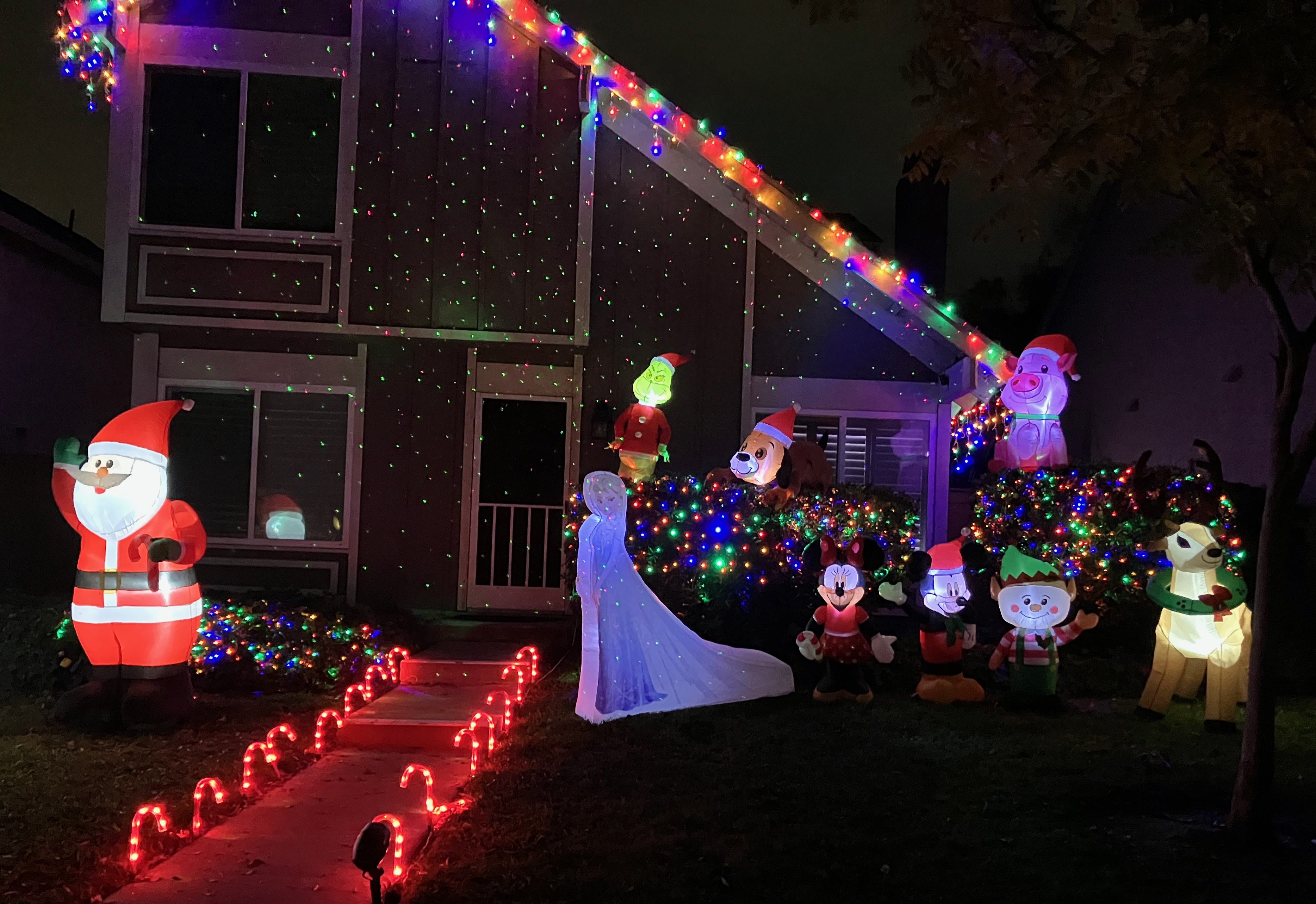
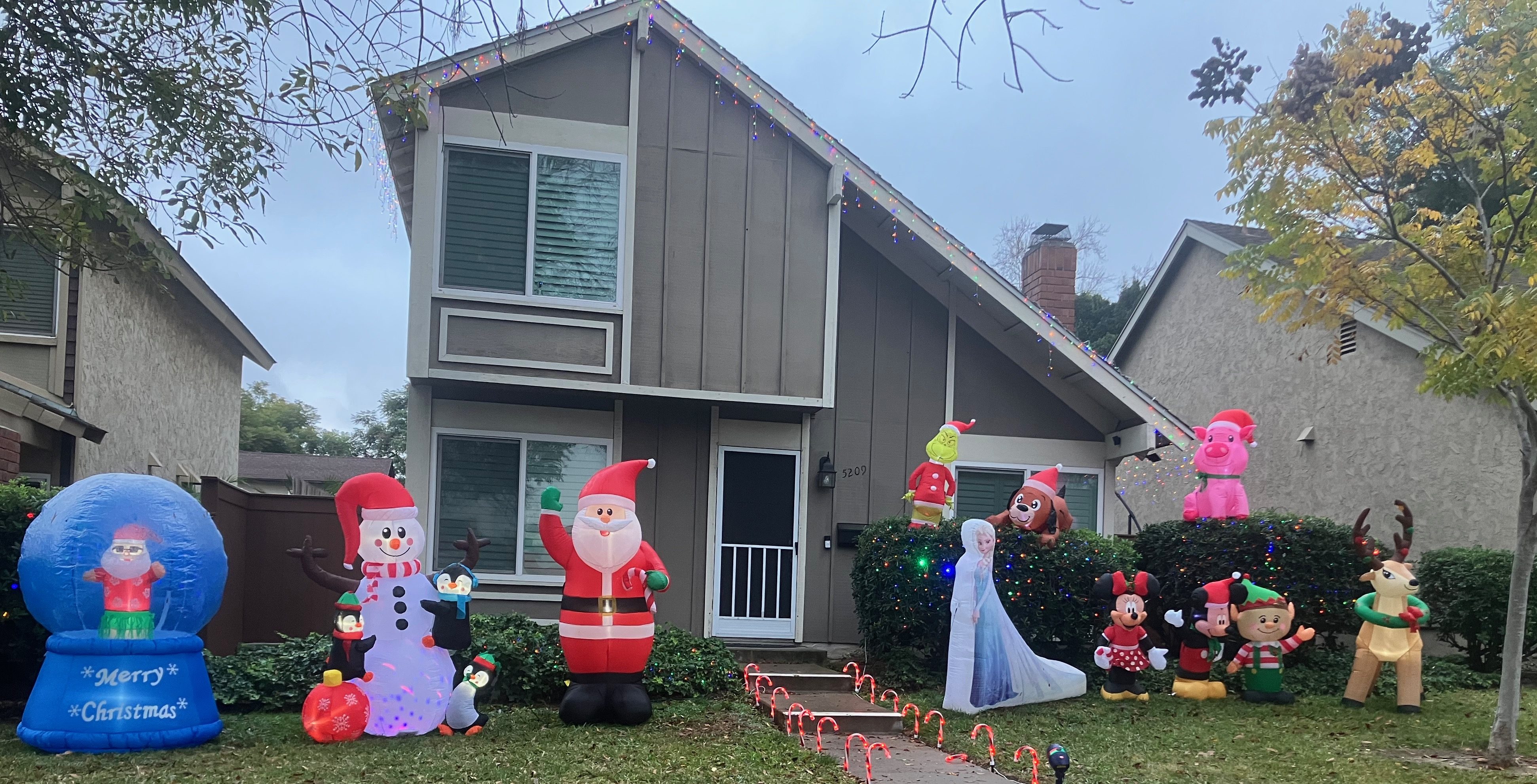
In this part of San Diego, it’s been a year of inflatables—replicas of holiday themed favorites such as Santas and elves, along with cartoon or animated film characters. Most of the figures rest in deflated sprawl during the day. As evening approaches, small electric motors kick in and the figures begin to rise, tethered and kept upright with ropes and/or anchors. It’s intriguing to see what neighbors have come up with. Because we’re in southern California’s “Disney country,” there are many Disney characters, along with Dr. Seuss Grinches. There’s been a rise in the number of “Bluey” likenesses, a recent Disney acquisition based on a children’s cartoon from Australia. Mixed in with the fantasy figures are figures of actual animals and plants. Often the displays are attached to real shrubs and trees that stay green in our mild climate in December.   

In a few days, this year’s inflatables will be more permanently deflated and stored away in attics, closets, or sheds. If electricity follows our inflationary trend, next year’s crop of inflatables may be slightly smaller. Perhaps we’ll substitute more natural materials.   

My wish for 2025 is that we will sooner or later succeed in reining in inflation. I think it will help if we remember that we are more stewards than owners of the natural world, that we are but one species among many. My hope is that more often than not, we’ll be able to avoid either an overinflated or an under inflated sense of our place in the grand scheme of things. Best wishes to all for a Happy New Year!   

Crow O’Clock

A few days ago, I had a morning commitment in downtown San Diego. To avoid the hassle of having to park downtown, I had driven from my suburban house to our nearest trolley stop, next to a local shopping center. After I’d parked, as I was approaching the stop, an outbound trolley disgorged its passengers. 

One, a middle aged woman, took a look at the pre-dawn sky just beginning to lighten and remarked to no one in particular, “Ah, crow o’clock, my favorite time to get off the trolley and be out in nature.” 

As I followed her gaze, I noticed over a hundred crows circling. Intrigued, I blurted out,  “Do they do this every morning?” 

“Yeah, it’s their time to get up after roosting in surrounding trees overnight.” 

Days are short this time of year. In our part of southern California, we get about 10 hours of daylight. As luck would have it, my downtown stint lasted most of the day, so I returned to my trolley stop just at dusk. The crows again were circling, this time preparing to roost. I’d gotten to see two “crow o’clocks” in a single day. 

My neighborhood doesn’t have as many crows as the valley where the trolley runs, but enough of the glossy black birds hang out here to provide near-constant background noise during daylight hours. I’d not paid too much attention, but after my encounter with the “crow o’clock” trolley rider, I decided to do a little online research. 

Among the tidbits I picked up: crows make a variety of vocalizations, up to 20 different sounds. Along with the “caw, caw” we typically associate with crows, I’ve started to notice a less loud sound our area birds sometimes make—sort of a cross between a chuckle and the noise of a can being opened with a manual can opener. 

Crows mate for life. Both partners participate in building a nest, a new one each breeding season. Once the baby birds hatch, both parents help feed them. Crows typically lay just one set of eggs per year. Out of a clutch of up to six eggs, three or four nestlings may make it to their first birthday. Older crow offspring sometimes stick around for a few years to help with younger nest mates. Crows that survive more than a year may live ten to fifteen years, with the oldest wild crow ever formally banded and studied surviving to nearly thirty. One captive bird in New York lived to be 59.  

There are over forty varieties of crows globally, one being the American crow, which ranges through much of the U.S. and parts of Canada. A variety of professionals and amateurs study crows, which have had legal protection since 1972, except when landowners believe the birds are damaging property or livestock (think scarecrows?).

If you are a glutton for crow knowledge, you can find a 90-minute presentation about crows, “To Know the Crow,” on the site of the Cornell Ornithology Lab, allaboutbirds.org. My favorite crow video is a much shorter snippet posted by author Kira Jane Buxton, about a female crow she’s named “Sharkey” who often accompanies her on daily walks.  

I’m not motivated to become a serious crow researcher, nor am I likely to develop a crow walking companion like Kira Buxton’s Sharkey. However, as the days slowly lengthen and also become chillier, I think I’ll arrange at least a few more trolley rides to correspond with “crow o’clock.”  

Holiday Traffic

Another Thanksgiving weekend. 
This year no need to fight traffic
To and from the grandmothers’ houses,
No need to spend hours circling
The parking lot at the nearest mall.
No need to go anywhere at all.

Now we are the grandparents.
Our muted celebration took place
Around our kitchen table, with
The other set of grandparents,
A daughter-in-law, a teen granddaughter
In attendance. Mostly vegetarian,

The feast also featured a small ham for
The meat eaters of the oldest generation.
We talked in pleasantries, mostly
Avoiding politics. The weather was warm
And sunny, as southern California often
Is in late November. Tomorrow, a wintry mix may

Disrupt the other grandparents’ flights
Back to the Northeast. Been there,
Done that. Especially the two winters
When Vermont was my, then our home.
The Thanksgiving before we reconnected, a blizzard
Delayed and almost sidelined Jim as he came north.

The following year, sleet and snow complicated
Our southbound journey, delaying our arrival at our elders’
House in northeast Philadelphia until nearly 4 a.m.
From a later home in Richmond, VA, we’d set out by car to see
Grandmas and Grandpas in Maryland and New Jersey,
Two growing boys sporadically squabbling in the back seat.

I watch with sometimes spiteful glee as
News clips feature clogged airports, or huge
Temporary parking lots on I-95 in both
Directions. Yes, Virginia, it can take nearly an hour
To clear the Delaware Memorial Bridge.
Still, I need to remain grateful for holiday traffic.

Nearly sixty years ago, the bus ride from Baltimore to D.C.
That usually lasted 45 minutes stretched to almost
Three times that long, giving my college-bound seat mate
And me time to thread our awkward conversation toward a
Slow-budding romance. Holiday traffic helped introduce me
To a future husband, children, grandchildren. Thanks be!