A sort of hybrid, really—less posh Than a luxury hotel stay or an all-inclusive cruise, Certainly less opulent (and less expensive) Than a crewed private yacht.
Still, less chore filled than everyday Living, clean linens typically supplied, Fairly often nearby restaurants or Delis to reduce meal prep tasks.
Because hosts may exaggerate online the allure And amenities of their properties, especially In popular holiday destinations, it pays To do some independent research before booking.
More often than not, guests Never get to meet their hosts In person, instead getting key Codes to open gates and doors.
The interpersonal graciousness of Localized hospitality is mostly gone. Interfaces among actual people In the “hospitality industry” get more Complex, contacts more attenuated.
Nevertheless, when all goes well—no weather foul-ups Or travel delays–a vacation rental can provide A much needed change of scene for a few days: A chance to recharge, maybe to renew Our flagging sense of vocation.
For the first time in about a month, Our weather apps are showing a non-trivial Chance of showers tonight or tomorrow–maybe As much as half an inch. Oh, ecstasy!
I scurry around, getting our small yard Ready for the rain: positioning buckets to catch Run-off from the gutter-less part of the roof, Moistening the soil around area Trees and shrubs to improve absorption If/when the rains do come, clearing out roof gutters, Sweeping away detritus from street edges, replenishing pea Gravel on our slightly sloping garden walkway.
For as long as I can remember, I’ve Been a weather nerd. My Maryland childhood Included watching the approach of summer thundershowers, Sledding during winter’s rare snowfalls, learning to swim Just well enough to make it across a neighbor’s pool, Keeping cool-ish during August’s soggy heat.
Here in San Diego, our heat is more apt to Arrive in September or October, sometimes Bringing with it the Santa Ana winds that heighten Wildfire danger. Rain this time of year can be A blessing, especially when it falls gently.
Weather nerdiness also exposes me to the Increasing number of places where weather events Are getting less gentle–friends in North Carolina Have been displaced by Hurricane Helene, Folks I know further north in California were burned Out this past January, while some San Diegans are still Recovering from our January, 2024 floods.
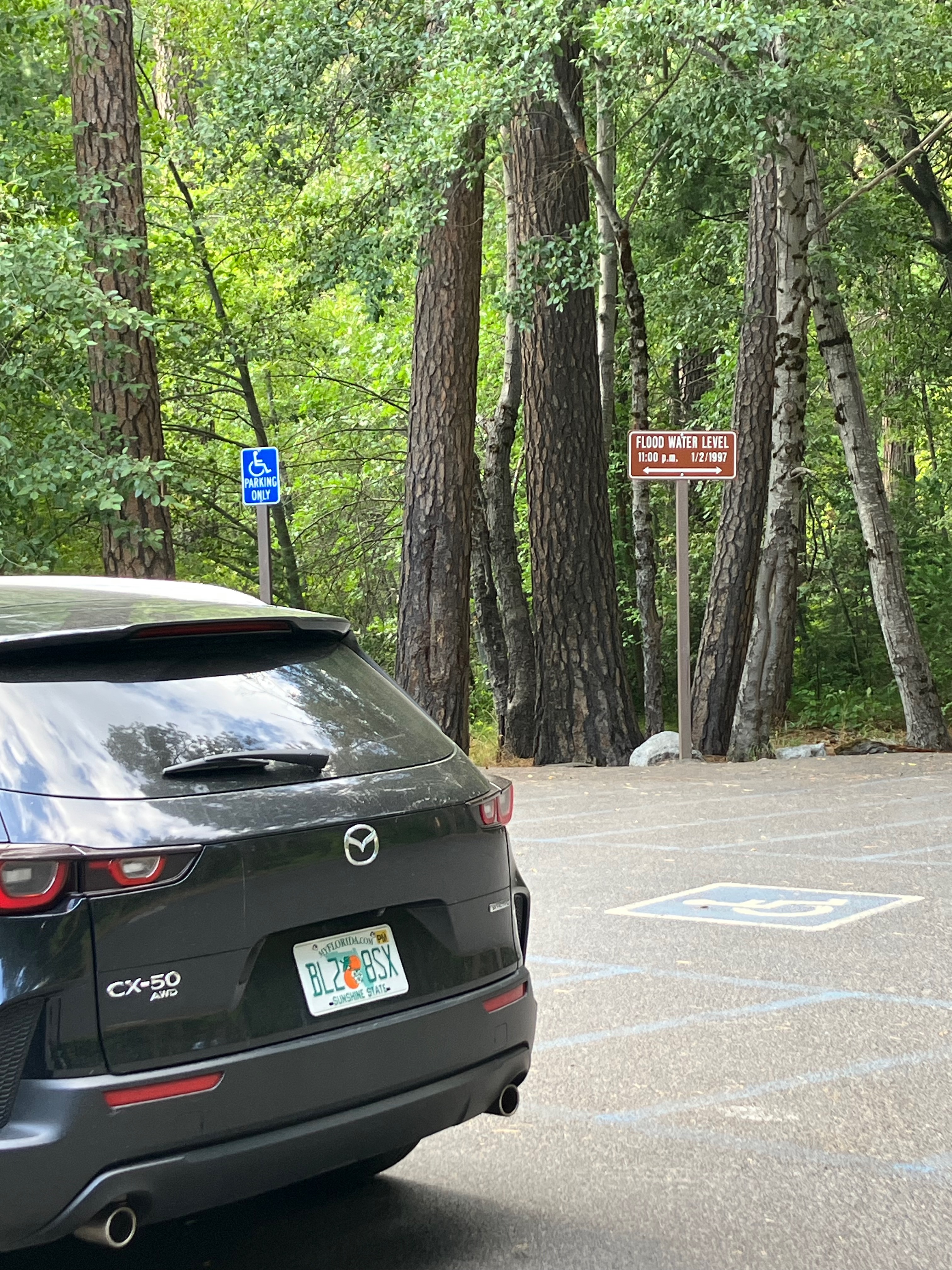
It’s not yet clear to me what further changes I’ll Need to make as our rains become even more Hit or miss. Last week, I visited Yosemite for the First time, learning from its guides about the extremes Of past weather in its granite-encircled, glacier-scoured valleys. Its highest recent flood, noted at a parking area, would Have drowned anyone not safely escaped to higher ground.
Regardless of our political outlook or economic status, I believe we’d be wise to productively, concertedly Get ready for the rain.
overview of Yosemite valleybrown flood level sign above car roof
This spring, I traveled with my husband to two European cities—our first international trip since the start of the covid pandemic. Judging by the crowds we encountered at prime tourist sites, we were far from the world’s only “post-covid tourists.” We were lucky enough to be able to afford about a month each at small rental apartments in Barcelona and then Paris—a wonderful chance to get some different perspectives about how a more resilient human world might work.
Both Barcelona and Paris get considerable income from tourism. According to official figures, almost 26 million visitors made an overnight stay in the Barcelona region in 2023, spending 12.75 billion euros ( or 13.8 billion dollars). About 100 million visitors come to France in non-covid years, making it the most visited country in the world, with Paris one of its most visited cities. In 2023, Parisian tourism generated revenues of 63 billion euros. Tourism in each city employs over ten percent of the work force—an important component of their overall economies.
The proprietors of our rental units were accommodating and helpful. Our lodgings contained useful tour guides with hints to optimize our access to both famous and lesser known sites. In both cities, there were many restaurants and food choices, including some at affordable prices. During our journey, we did not encounter any personal rudeness or threatening behavior. However, there were a few worrisome signs in our surroundings.
One day in Barcelona, we visited its museum of contemporary art, tucked away along a side street an easy walk from our apartment. The building itself is a work of art, filled with adaptable exhibit spaces and easy access ramps. Outside is an extensive plaza where we watched young men and women practicing their skateboard moves. As we left the area, I noticed a large mural on an adjacent wall. The overall wording was beyond my elementary Spanish or my even more limited Catalan, but the message was clear. The accompanying graphic, a “welcome mat” inscribed in English with “Not Welcome,” told me what I needed to know.
tourist caution in Barcelona
Recently, some locals expressed similar sentiments by going to prime tourist venues and squirting patrons with water pistols.
Protests in Barcelona are partly due to the way tourist lodging seems to distort available housing stocks. Though the rental income from our apartment helped sustain our proprietor’s family, it may also have helped drive up longer term rental prices for local residents. Not just in Europe, but in resort areas in the U.S. as well, we’ve heard laments by long-term residents about the hollowing out of local cultures and services when a town or region becomes too dependent on tourism.
A ski resort, a summer retreat, a place to go to view autumn colors, a city with an abundance of museums and historic sites—none of these by themselves support local transportation infrastructure, schools, or other public services. Tax revenue can fall short of providing the level of services wanted. If too many non-tourism-related locals leave, the networks of volunteer groups that help make a community thrive can wither and die. Similarly, becoming too dependent on tourism can exacerbate income and wealth inequalities. Service workers crucial to successful tourism can find it impossible to afford housing near where they work. Long-distance commutes, sub-standard housing, and exhausted workers then can blemish even the poshest resort.
Tourism-driven economies can also generate excess trash and pollution. The streets of old town Barcelona were sometimes cramped, loud, and dirty. Traffic jams all over the area were getting more frequent and disruptive. In Paris, tourist taxis sped by our building nearly 24/7, along with police cruisers, sometimes with sirens blaring. They made it more difficult for visitors and locals alike to get needed rest.
Finally, as covid so dramatically showed us, tourism is not a “core” industry. In a health crisis, millions of erstwhile tourists will stay home, leaving hotels and restaurants standing vacant, their staffs suddenly unemployed.
An appropriate level of tourism will vary from place to place. Paris, for centuries a tourist magnet, may be more robust than most in its efforts to be a “host city” that works. In a week or so, it will become the site of the 2024 Olympic games, estimated to bring in about half again as many as its already abundant annual influx of tourists.
While governments and economists continue to wrestle with how to “solve” the tourism conundrum, those of us who travel and/or host can help make tourism more mutually rewarding. As travelers, we can prepare with some basic education about the places we plan to visit, make responsible choices in itineraries and accommodations, use our best manners and be respectfully curious about habits and customs different from what we’re used to “back home.” As hosts, we can be more patient than we might be with fellow locals, do our best to assume positive intent by our visitors, and provide clear instructions about the use of available services.
Whatever our role of the moment, we can acknowledge both the value and the limitations of tourism.
I have a somewhat strained relationship with mobile phone directions apps. On the one hand, they can be helpful in navigating in unfamiliar locations. On the other hand, they can be infuriatingly obtuse at honoring my preferences for places I mostly know how to get to (limited or no freeway use, as few left turns as possible, a generally direct route toward my destination). The most aggravating circumstances of all are when I lack just a little knowledge at either end of the trip. I’ll be in dense traffic in the right lane when the annoying app voice tells me “in 800 feet, turn left.” Not going to happen.
Sometimes I’m able to adjust quickly enough to resume following the app’s instructions. Say, for example, there’s an almost miraculous break in traffic. At other times, there seems to be no way to adjust my driving to match the app. So I tootle along semi-lost, somewhat relieved that I’ve allowed extra time to reach any appointments with a set schedule. After a while, the app will display a message, “recentering,” then attempt to find me an alternate route to my destination based on where I currently am.
Given the present political and media climates, both in the U.S. and globally, I need to practice “recentering” often in other aspects of my life. This can involve insulating myself temporarily from most external distractions of our too often noisy lives. It can be hard to get away from the noises of airplanes overhead, leaf blowers nearby, or a neighbor’s next home improvement project. (I need to remember to be grateful that the noises surrounding me are generally benign—not bombs, not bullets, not blaring sirens.) It’s nearly always possible, though, with some effort, to find a time/place for quiet contemplation.
Both Christian and Buddhist faith traditions have evolved forms of centering. Christianity focuses on our communication with what we call God. Buddhism stresses non-attachment to external stimuli. I doubt that I’ll ever become totally adept at either practice. Still, I’ve found that taking a breather (sometimes literally focusing on my breath) can help me be less overwhelmed by what’s going on around me.
Perhaps the phone directions apps are onto something.
It’s been a rough couple of months here in North Carolina: two hurricanes (Florence, then Michael), a polarized government, widespread agricultural losses, increasing poverty, damaged schools and infrastructure.
Yet there’s been heartening news as well. Many established charities such as the American Red Cross have sent disaster recovery teams to the worst impacted areas. Local citizens in areas less damaged by the storms have created both short-term and long-term relief efforts. A neighbor who specializes in local fundraising set up a Sunday-afternoon event at a nearby shopping center and raised over $10,000 in cash plus thousands of dollars worth of non-perishable food and household goods for hurricane relief. Because of the extent of the damage, both in the Carolinas and elsewhere, it will take continued efforts by private donors, non-profits, government agencies, and financial institutions to help promote recovery. The natural environment will never be the same; repairs, rebuilding, and/or relocation of homes and businesses will take months if not years.
After hurricane Florence decimated the coastal Carolinas, major roads and interstates were flooded and impassable for over a week, making cities such as Wilmington, North Carolina effectively islands.Residents who’d evacuated were asked not even to try to return home as soon as the first few roads were reopened—what limited road travel was possible needed to be reserved for emergency and supply crews.Now that the immediate crises are over, people are starting to grapple with longer-term problems: should rebuilding be limited in areas that seem more and more prone to drastic weather? Should building codes be changed? How do we adapt our infrastructure to be more resilient? Do we need to pursue alternatives to a predominately road-based transportation network?
Simple solutions seem elusive and likely counterproductive. Perhaps we need to rethink some of the implicit assumptions we’ve made about how the world works.Rather than considering ourselves outside nature, it may be time to widen our perspectives and acknowledge that we humans are just one piece in a complex, evolving whole.Among the groups that have challenged some of my existing perceptions are:
Transition networks (https://transitionnetwork.org/), a set of local-global initiatives to work toward more resilient local economies in the face of escalating global challenges
Bioneers (https://bioneers.org/), harnessing scientific knowledge toward solving human problems
Biomimicry 3.8 (https://biomimicry.net/), which looks at other life forms (some with over 3.8 billion years of experience on earth) for innovative ways to re-engineer human-made systems
What partial solutions have you discovered?What “small/local” actions are you taking to make our future more livable?Please share some of your thoughts.
(Originally written in December, 2006, as we completed a first term as foreign English teachers at a smallish desert reclamation university in far western China.)
On bad days, the weakening sun blinks slowly over a bare landscape.
The students who bother to show up at all
drowse or exchange text messages on their cell phones.
Life seems brittle; our small attempts to make a difference, to enjoy ourselves
While doing it are dry as the dust that, folks tell us, will fill the air in April.
Uyghur, Han, Mongolian, American–
each of us wanders with little sense of direction
In this polyglot excuse for a university,
where misfits and refugees from “inland”
mingle but do not very much mix.
It is cold, and sometimes, even in December,
The wind blows.
Good days predominate.
An older student respectfully inquires
about differences among Western religions.
A few stalwart undergraduates continue to attend classes even
After their prescribed seven listening sessions are up.
An abundance of kitschy but sincere
holiday decorations festoon the shops,
Spreading a message of peace and goodwill that needs no language.
Wintering birds twitter.
Faraway friends send emails.
A little clean snow lingers in the shadows and on hedges from the dusting
That fell nearly a month ago.
Adults and children who do not know us say an English “hello,”
The children accompanying their greeting by giggles and running away.
Crews gather leaves and prune the dormant trees
to prepare for the next warm season.
The desert nearby covers us all with a sort of stillness,
Scouring away the unneeded cares of more “settled” life.
Our family and a not-quite-grandchild send pictures and greetings.
Life is resilient.



 Jinny's Occasional Poems