Tag Archives: Thanksgiving

Some Things Never Change: the Destiny Instinct

When I was a kid in 1950’s Maryland, Thanksgiving was all about the Pilgrims and the friendly Indians in Massachusetts. Before sitting down to turkey and stuffing at Grandma’s house, I’d probably participated in an earlier school Thanksgiving pageant, its prize roles going to the Indian Squanto and to Massachusetts governor William Bradford. We made paper cutouts of Pilgrim hats, or paper headdresses of fake feathers. It was pretty much the same every year. 

Much later, after I’d lived near Virginia’s coastal plains for decades, I went to watch a celebration of the Virginia version of the first Thanksgiving—held, locals bragged, before the Massachusetts pilgrims had even landed. At what later became Berkeley Plantation, according to its website (https://berkeleyplantation.com/first-thanksgiving), in late November, 1619, a newly arrived set of 50 additional Virginia settlers gave thanks, per instructions from their sponsors back in England: “We ordaine that this day of our ships arrival, at the place assigned for plantacon, in the land of Virginia, shall be yearly and perpetually kept holy as a day of Thanksgiving to Almighty God.” Little thought back then was given to the perspectives of the native peoples who were often being displaced, diseased, and/or disrespected by the growing numbers of European settlers coming to Virginia, Massachusetts, and other areas up and down the Eastern seaboard of North America. You have to read beyond the Thanksgiving chapter of the Berkeley website to learn that in 1622, local tribes rose up in a concerted attack against the British settlers, after which the Berkeley settlement disintegrated. The next Thanksgiving celebration at Berkeley was not until 1958.

I now live in California, where origin stories for Thanksgiving are multiple and murky. It’s possible that the earliest Spanish or Russian explorers had celebrations of thanksgiving after surviving especially difficult passages. Later specific dates for California’s initial celebrations are variously given as: December 10, 1774, when some of the Franciscan missionaries in the area celebrated a near-miraculous return to health of one of their brothers;  or November 29, 1849 in and around the goldfields; or November 30, 1850, based on a proclamation by Governor Peter Burnett in Sacramento in the newly established State of California. The safest date to recognize may be the 1863 proclamation by Abraham Lincoln of the first national day of Thanksgiving on the last Thursday of November.  

Wherever we live in the U.S., there seem to be a wealth of “first Thanksgivings” to choose from. Our views of what’s appropriate for Thanksgiving and “who got there first” will likely continue to change. 

The book Factfulness was written by three Swedes, so there are no examples of Thanksgivings and the way the feast has changed. However, the authors use multiple examples to show that many things do change, if sometimes slowly. One example I especially like is Hans Rosling’s analysis of the compounding impact of slow changes for Earth’s nature preserves and natural parks. Under the rubric “Slow Change Is Not No Change,” he begins with an initial set-aside of natural land nearly 2500 years ago: 

“In the third century BC, the world’s first nature reserve was created by King Devanampiya Tessa in Sri Lanka. … It took more than 2000 years for a European, in West Yorkshire, to get a similar idea, and another 50 years before Yellowstone National Park was established in the United States. By the year 1900, 0.03 percent of the Earth’s land surface as protected. …Slowly, slowly, decade by decade, one forest at a time, the numbers climbed. The annual increase was absolutely tiny, almost imperceptible. Today a stunning 15 percent of the Earth’s surface is protected, and the number is still climbing.” (One globally ambitions goal is to have 30% of the earth’s land and seas protected by 2030: https://www.campaignfornature.org/getting-to-30.) 

Of course, change can be multi-directional. There’s no guarantee all change will be positive. But the notion that things cannot change can prevent much of the experimentation that might help improve things.  

Among the prescriptions the Roslings suggest for countering the “destiny instinct” are exercises like the one I’ve tried to develop here about Thanksgiving—the way we now think about and celebrate Thanksgiving is not the same as when I was a child, nor need it be the way people will celebrate in the future. Per the Roslings, “Challenge the idea that today’s culture must also have been yesterday’s, and will also be tomorrow’s.” 

In a long life so far, among the things that have not changed for me are gratitude for life. I’m also grateful for new and renewed possibilities for continued learning. Happy Thanksgiving to all!   

Holiday Traffic

Another Thanksgiving weekend. 
This year no need to fight traffic
To and from the grandmothers’ houses,
No need to spend hours circling
The parking lot at the nearest mall.
No need to go anywhere at all.

Now we are the grandparents.
Our muted celebration took place
Around our kitchen table, with
The other set of grandparents,
A daughter-in-law, a teen granddaughter
In attendance. Mostly vegetarian,

The feast also featured a small ham for
The meat eaters of the oldest generation.
We talked in pleasantries, mostly
Avoiding politics. The weather was warm
And sunny, as southern California often
Is in late November. Tomorrow, a wintry mix may

Disrupt the other grandparents’ flights
Back to the Northeast. Been there,
Done that. Especially the two winters
When Vermont was my, then our home.
The Thanksgiving before we reconnected, a blizzard
Delayed and almost sidelined Jim as he came north.

The following year, sleet and snow complicated
Our southbound journey, delaying our arrival at our elders’
House in northeast Philadelphia until nearly 4 a.m.
From a later home in Richmond, VA, we’d set out by car to see
Grandmas and Grandpas in Maryland and New Jersey,
Two growing boys sporadically squabbling in the back seat.

I watch with sometimes spiteful glee as
News clips feature clogged airports, or huge
Temporary parking lots on I-95 in both
Directions. Yes, Virginia, it can take nearly an hour
To clear the Delaware Memorial Bridge.
Still, I need to remain grateful for holiday traffic.

Nearly sixty years ago, the bus ride from Baltimore to D.C.
That usually lasted 45 minutes stretched to almost
Three times that long, giving my college-bound seat mate
And me time to thread our awkward conversation toward a
Slow-budding romance. Holiday traffic helped introduce me
To a future husband, children, grandchildren. Thanks be!  

Gratitude over Resentment

Most days, I remember at some point to be grateful: 
—for life 
—for breathable air, for water that’s safe to drink 
—for access to food, clothing, and shelter 
—for health 
—for family and friends both near and far 
—for sunrises and sunsets, for clear days and for rainy ones.  

It seems totally appropriate to me that we celebrate an autumn holiday in honor of gratitude, “Thanksgiving.” 

Depending on what traditions we’ve been exposed to, we may think that the Thanksgiving holiday in the current territory of the U.S. originated in 1541 in Texas with Spanish explorer Coronado and the Teya Indians. We might suppose that Thanksgiving started in 1619 in eastern Virginia when some British colonists gave thanks for their safe arrival on American shores. Lots of us were taught as primary school students about the 1621 Massachusetts feast when Pilgrims and Wampanoag Indians celebrated together after the immigrants’ first successful harvest. In multiple places in the colonies and then in the U. S., Thanksgiving was celebrated locally or intermittently for a long time, but it only became fixed as a national holiday in 1863. That year, then-President Abraham Lincoln issued a proclamation making the last Thursday of November (later tweaked by Congress to the 4th Thursday) a national celebration of Thanksgiving.

November 2023 has so far often lacked for gratitude—wars and conflicts dominate our headlines; fiscal and military brinksmanship abounds; in many places there’s a general feeling of malaise and discouragement. Resentment often fills our airwaves and screens. It’s so pervasive that it can seem to poison the very air. Few of us will ever let go of our resentments entirely, be they of long-ago childhood slights or traumas, of former lovers who jilted us, or of perceived business or professional snubs. The rich and powerful are not immune, either. Some can seem resentful that they’ve not obtained even more wealth and/or power. So, especially in this fraught season, it’s important to make time for gratitude. 

Fortunately, it’s nearly impossible to be resentful and grateful at exactly the same time. Thanksgiving reminds us to rearrange our lives to expand our proportion of gratitude and to diminish our corresponding “resentment quotient.”  We need Thanksgivings, more than we usually admit.  

Coronado’s party and the long-ago Virginians and Pilgrims had lives filled with deprivation and danger. Back then, there might have seemed little reason to be grateful. At the first national November Thanksgiving in 1863, the American Civil War raged. Though the tide of battle seemed to have turned in favor of preserving the Union, the outcome was far from sure. Deaths and injuries had touched many families both North and South. In many places, basic goods were either in short supply or totally unavailable. The ill will and resentment that had helped spark the war lingered. Even now, it sometimes darkens our politics. 

Happily, for most of us in the U.S. in 2023, Thanksgiving does not equate with privation. It’s sobering, though, that over a tenth of our population fell below the official poverty line in calendar 2022. Moreover, during the period 2020-2022, there were about a million and a half excess deaths, either directly from the covid pandemic, or from other health complications. Many Thanksgiving tables this year are missing one or more previous guests.  

Still, it’s my hope that this Thanksgiving many of us will have things to be grateful for. I hope that most of us will resist temptations either to settle old scores or to prefigure the next election cycle. May we, for at least the better part of a day, let gratitude overtake any resentments.  

A previous Thanksgiving feast

Gratitude for Late-Life Friendships

My heart goes out to the many families who will be missing a member at this year’s holiday celebrations because of a covid-induced death. I have yet to lose a family member or very close friend directly from the pandemic, though the final year of our close late-life friend, Phyllis, was impacted. She had to journey through end-stage cancer with limits on visits from loved ones, limits to her travels beyond what her illness proscribed. 

We’d known Phyllis for about a decade before her death. She was among the first non-family members to welcome us to North Carolina when we arrived here. More recently, she and her husband had finalized plans to relocate to their “retirement haven” in rural Virginia just before her diagnosis. We were very lucky that there was a summer lull in the pandemic while Phyllis was still ambulatory. She and her family visited friends in North Carolina one more time, a sort of chance to say good-bye.  

As I grieve Phyllis’s absence, I’m comforted by the example she set of dying well and of leaving a nourishing legacy. She spent as much of her final months as her energy allowed painting nature scenes, a gift she had put on hold for much of an active life. Her son just posted an image of art created by a young artist at a school to which Phyllis had bequeathed her unused paints and drawing supplies.  

At this Thanksgiving, made virtual for so many by the pandemic’s continuing spikes, I need to be especially grateful for late-life friendships like ours with Phyllis and her family. Many of our friends from earlier life stages have been work colleagues, or family members of our children’s friends, or affiliates in non-profit groups. Though genuine, these friendships were somewhat opportunistic and sometimes withered as our locations and life stages changed. By now, we’ve retired, our children are grown and establishing their own friendship networks, and more and more non-profits are conducted virtually even when there’s not a pandemic. 

This year’s limitations on in-person holiday gatherings have highlighted what connections we still can have. Not long after we’d gotten up this morning, we got a surprise phone call from a different late-life friend, a former next-door neighbor, recently retired and living across town. A confirmed “foodie,” Greg wished us a happy holiday and shared a story of a memorable Thanksgiving feast when he was living in Germany and tasked with contributing a pumpkin pie to a community celebration with his graduate student colleagues. Turns out, fresh or canned pumpkin were rarities in the part of Germany where he studied. The only variant he was able to find were jars of pickled pumpkin. Numerous iterations of rinsing the jars’ contents before cooking didn’t entirely restore the taste of a traditional pumpkin pie. 

Another set of late-life friends that I cherish are members of a pre-covid walking group, now on temporary hiatus. All of us are retired. Many of us have lost spouses. Most of us have health conditions that slow our steps and make uphills more challenging than earlier. Still, whenever I go for a walk outdoors, either with my husband or alone, I mentally have the “Tuesday morning walkers” with me. 

Even once the covid pandemic subsides, through vaccination and/or better public health preventative measures, I will remain at the stage of life when more of my contemporaries will die off. It’s important, then, to cherish them while we still can. As my husband explained on a down day for both of us, “We’re likely to spend an increasing proportion of our time mourning deaths of friends and loved ones, until it’s our turn to be mourned.”  

So let us give thanks for life, thanks for the capacity to share our stories, whatever the medium, thanks for friendships, especially those late-life friends who can help make this trying time more bearable. Happy Thanksgiving and a big set of virtual hugs!      

Who Did You Expect?

Who Did You Expect?     —by Jinny Batterson

My life so far has been fortunate—no privation, little discrimination, generally good health, many chances for love and adventure.  Much of the time, though not always, people I’ve met have lived up to (or beyond) my expectations. On those rare occasions when someone’s behavior has disappointed me, more cynical or world-weary friends have shrugged at what they regard as my naiveté. 

“Of course so-and-so let you down,” they’ve announced. “What did you expect?”  

Increasingly for me,  the appropriate question is rather “Who (or, for the grammar police, “Whom”) did you expect?”  As I mature (a work in progress), I become more aware of instances when I’ve pre-judged people and turned out to be fairly far off the mark.

The first occasion that stands out is my initial in-person meeting with the leader of our 1980 group tour to China. In those pre-internet days, I’d exchanged postal letters and paperwork with Ms. Baum and talked with her on the phone. Until we both arrived in San Francisco’s airport departure lounge for our trans-Pacific group flight to Hong Kong, I had not actually met this native New Yorker. I’d assumed from her accent and phone demeanor that she was of Jewish background. She seemed somewhat pushy and no-nonsense, ready to take on the world. I was surprised to see that she was African-American, not ethnically Jewish. She could be somewhat pushy and no-nonsense. Her prior experiences as both social worker and travel agent had prepared her well to take on whatever bureaucracy attempted to get in her way, regardless of ethnic origin or nationality. She turned out to be both different from and similar to the “who” I’d expected.

Earlier this fall, I signed up to work the polls in the 2018 mid-terms. After on-site training, I exchanged emails with the woman who’d be my site supervisor for early voting. Her written English was good, clear and simple. Her family name was a common one, her given name, ending in “a,” suggested to me she might be African-American, or maybe Hispanic-American. When we met, I could detect no skin coloring or hair texture to suggest ancestral links with Africa, no hint of foreign origin in her accent. She seemed at first a very “vanilla,” somewhat conservative American. During our work, she showed her passion for ensuring that anyone who wanted to vote was given maximum opportunities to do so. She’d sit patiently with someone lacking appropriate credentials, or with an address not yet entered into the electoral system database of rapidly growing Wake County. She knew the rules well. She could suggest pulling up an electronic copy of a utility bill on a portable phone. She might advise going home to retrieve a needed ID and then returning later in the day. In rare cases, she’d have the potential voter fill out a provisional ballot, explaining how and when to check whether their vote had been counted. The workforce she’d helped assemble to follow her lead was the most visibly diverse I’ve ever participated in. She was both different from and similar to the “who” I’d expected.    

I’ve just spent Thanksgiving with parts of my extended family that I barely knew growing up in Maryland in the 1950’s and 60’s. Only once had I had a chance to visit these North Carolina farmer cousins from a rural area near Charlotte. What little I remember from that farm stay involves ponies tame enough so even I was persuaded to take a short ride. I got to see my grandmother’s sister-in-law make glorious biscuits using milk straight from the cows. The cousins closest to my age teased me good-naturedly about my lack of country skills.

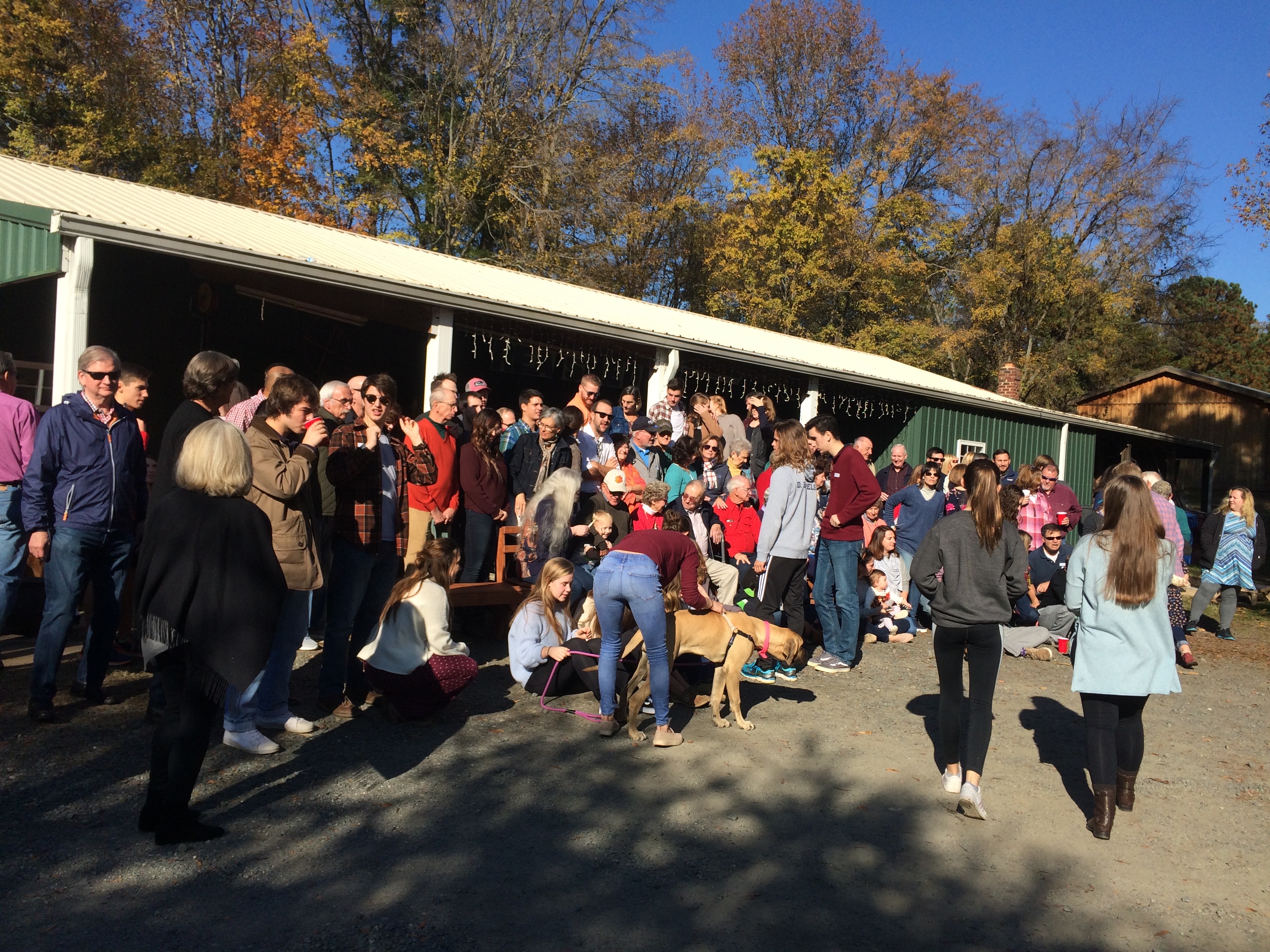
After moving to North Carolina a decade ago, I became reacquainted with some of the cousins who’d left the farm to settle in Raleigh. They’d tell me enticing stories of an extended family Thanksgiving gathering at “the shed.” I pictured the locale in my mind: an expanse of gently rolling hills, empty except for a few horses or cows grazing in pastures. “The shed” would be a slightly cleaned-up farm outbuilding. Twenty or so aging cousins of Scots-Irish ancestry would assemble for our midday meal, then say interminable grace before we could eat. Someone would have cooked a turkey and brought it still warm to the feast. We’d eat plentifully, exchange pleasantries, carefully avoid politics, and then everyone would go home.

This year as we drove into the neighborhood nearest our destination, I had trouble reconciling my mental image with current reality. The surrounding area may once have been farmland, but the vicinity had long since become part of suburban Charlotte. A mid-rise apartment complex dominated the nearest street corner. The “shed ” had been expanded and modernized from an earlier role as storage space for some cousins’ plumbing business. It was now a comfortable, well-appointed venue with adjustable seating for up to a couple hundred people. Nearly that many cousins of all ages were in attendance, along with baby equipment, pet dogs and a few footballs.

We did have a short sung grace before the long, snaking buffet line formed. We did generally steer clear of contentious political topics. People caught up on family news since the previous get-together. One 20-something cousin had recently returned from an extended Peace Corps stint in South America; in the next generation up, a househusband described his four years of helping school their daughters while his family was on assignment in southern Europe. One attendee I didn’t get a chance to talk with directly had a skin tone and accent that implied ancestry or origin in India. The Reas still cherished their rural roots and pioneering ancestors, but the clan had gotten more diverse and widely traveled—both different from and similar to the “who’s” I’d expected.

The remaining holidays of late autumn and early winter are likely to have more extended family gatherings and chance meetings. May I remember not to pre-judge those I encounter, to be more careful not to let “who I expect” get in the way of meeting current reality with an open mind and heart. 

Rea Thanksgiving at “the shed”