Tag Archives: pandemic

The Paradox of Independence Day

For many of us, especially those of us who are older, this is our first fully “post-pandemic” Independence Day. Although the pandemic in the U.S. was declared officially over in May, 2023, last July many were still somewhat nervous about indoor gatherings or large crowds. This year I still didn’t venture out into large crowds, but not because of covid concerns. The prospect of driving through heavy traffic to crowded beaches or our area’s evening fireworks venues was unappealing. I spent a fairly quiet, but nonetheless enjoyable 4th, no longer isolated by a nasty virus and the worldwide fear it had engendered. Later, as I drifted off to sleep, I could hear the muffled hisses and booms of the closer fireworks displays.

Early in the morning, I’d gone to my small plot at our neighborhood community garden. Our most consistent volunteer was already there, watering some shrubs and flowering plants that were stressed from our recent heat wave. I wished her a Happy 4th. I quickly drew some water from the communal water barrel to help coax the bean seeds I’d recently planted into sprouting. As I was leaving the garden, I ran across a group of local men who volunteer at holidays to place American flags in the medians of our major streets. At 7 in the morning, they had just finished their work, and were headed to a local donut shop to have breakfast together. 

Once home, I phoned my brothers, who both live on the East Coast, three time zones later than here. I wished each of them a Happy 4th. The brother who still lives in the neighborhood where we all grew up was getting ready to head to the potluck lunch that’s been a local tradition since long before we were born. He said attendance might be down some due to their latest heat wave—the historic community center, built in the 1870’s, has multiple fans but is not air conditioned. We reminisced about our childhood 4ths at “the hall”— the turtle race, the ample lunch with ice cream for the children, the parade featuring patriotic floats and decorated bicycles, the general fellowship and good feeling.

Later in the morning, before the sun got too high, I went for a walk with my husband through our suburban housing complex. Heading uphill to a favorite overlook, we met a stream of elementary-school-age children riding bicycles festooned with red, white, and blue streamers. They were accompanied by several adults, probably parents. All seemed headed toward festivities in our community park. Different neighborhood, different times, similar traditions. To some, it might seem a little contradictory to celebrate “independence” by having community gatherings, community gardens, community flag displays. Perhaps not.

I didn’t remember exactly what I’d done last Independence Day, so I checked a previous journal for July 4, 2023: my husband and son’s family were away; turns out I’d gone to a small outdoor barbecue at a next-door neighbor’s. More journals helped me recall prior 4ths during the pandemic:

At July 4, 2020, daily life was totally upended. In the neighborhood in North Carolina where we then lived, few were in a holiday mood. Infections, serious illness and deaths were climbing. There was not yet a vaccine or reliable treatment. Most of us were hunkered down, even disinfecting our postal mail before bringing it indoors. Libraries and other public venues were closed indefinitely. There was a dire shortage of protective gear of any kind. Social activities that still occurred were probably virtual. In-person activity had ground to a screeching halt. 

In 2021, we had relocated to be close to a grown son and his family in southern California–the prospect during a pandemic of continuing to make long-distance plane trips to visit the grandchildren seemed foolhardy. In early spring we’d gotten our vaccinations, further downsized, and driven cross-country to our lives’ next stage. I spent July 4 trimming hedges at our son’s house while he and his family took a much-needed vacation. 

On July 4, 2022, we were recovering from mild cases of covid. We’d most likely become infected while traveling by plane back and forth in June to visit a “bonus” grandchild born in Ohio in late May. 

This July 4th, I relished my encounters with those celebrating where I live now. It was fun, too, to share long-ago memories with family and friends. I hope we never have to go back to the isolation of the worst of covid times. I hope that we never forget the medical researchers who helped develop vaccines and treatments, the health care workers who sometimes risked their own health to care for the rest of us, all the “essential workers” who kept us fed, clothed, and provisioned during the pandemic’s darkest days. I hope we avoid conflating independence with isolation. 

On July 4th and on other days, let’s keep in mind the moving balance between our independence and our mutual dependence. A worthwhile paradox. Happy belated In(ter)dependence Day!   

Fearing Fear Itself

It sometimes seems to me that the media environment surrounding me is getting increasingly fear inducing. Should our American predilection for gun violence have me quaking in my shoes? Is another deadly pandemic inevitable? Should I be afraid of the overwhelming consequences of irreversible climate change? Is our political system broken beyond repair? To help provide context and retain some sense of balance, I look for historical parallels and trends rather than just following the headlines or lead story:  

—Colonial America had more endemic violence than we see now. Dueling with pistols was then considered a socially acceptable means of “settling” disputes. Unfortunately, firearm deaths remain among major causes of death in the U.S., with the majority of those deaths being suicides. Rates vary considerably by locality and over time. After a U.S. low of under 29,000 fatalities in 1999 and 2000, the death toll again began to climb. Starting in 2015, it increased significantly, by 2021 exceeding 48,000. However, because of population growth, the gun death rate of 14.6 gun deaths per 100,000 people in 2021 was still below the prior peak of 16.3 gun deaths per 100,000 people in 1974. 

—During the 2020-2023 covid pandemic, losses were immense, but the global death toll, estimated at 5 to 6 million, was just over 10% of the estimated toll of the prior 1918-1920 influenza pandemic. Both pandemics fell far short of the catastrophic losses from bubonic plague outbreaks that wiped out about a third of Europe’s human population during the 14th century. 

—Erratic weather events seem to have become more frequent, yet warning systems, preparation, and remediation resources have also improved. In 1900, a hurricane all but obliterated Galveston, Texas. The storm killed an estimated 10,000 people, primarily because there were inadequate weather warnings.

—We certainly have a current crop of crooked politicians and political shenanigans, but the respective eras of “Boss Tweed” of NYC’s Tammany Hall and later “Kingfish” Huey Long of Louisiana could run contemporary political machinations a close second. 

In our current round of political theater, have we allowed ourselves too often, though, to be frightened by our supposed differences, be they political party, ethnicity, gender, or any other category? It may now sadly be a somewhat realistic fear to fear those who for political gain try to incite us to fear each other.   

Our most famous U.S. political quote about the toxicity of fear comes from Franklin Delano Roosevelt’s first inaugural address in March, 1933. Then, the nation’s economy was reeling after a 1929 stock market crash and several years of deepening economic dysfunction. FDR was a seasoned politician and also someone who had made an arduous recovery from the paralyzing polio he’d contracted in 1921. Without downplaying the dire state of the economy, he spoke to rally our citizenry by beginning with the need to reduce fear: 

“So, first of all, let me assert my firm belief that the only thing we have to fear is fear itself—nameless, unreasoning, unjustified terror which paralyzes needed efforts to convert retreat into advance.”  

He then went on to outline actions for restoring trust (there’s a reason many banks have “trust” as part of their names) and for minimizing further panic (there’s also a reason that financial panics are called “panics.”)

A recent explanation of the importance of not succumbing to fear comes from a 2018 book that helped get me through covid isolation: Factfulness. Authored by former Sweden-based global health researcher, professor and statistician Hans Rosling, the book evaluates a whole set of instinctual responses that can distort our human reactions to situations and events. Fear is one of the most insidious. 

Anecdotally, Rosling describes his initial reaction while coping as a young emergency room physician with his first trauma event, a downed, incoherent pilot. Temporarily short of more seasoned backup, Rosling’s initial reaction was fear-driven: 

“…(M)y head quickly generated a worst-case scenario. … I saw what I was afraid of seeing [a Russian intruder signaling the start of World War III]. Critical thinking is always difficult, but it’s almost impossible when we are scared. There’s no room for facts when our minds are occupied by fear.”  

Fortunately for Rosling and for his patient, an experienced nurse soon returned from her lunch break and identified the real problem [a Swedish pilot whose training mission had ended with a ditched plane and resulted in hypothermia]. She reclaimed the situation before the young doctor’s fear response resulted in serious errors. 

Rosling also provides statistical evidence contrasting what we find frightening and what our actual risks may be: “This chapter has touched on terrifying events: natural disasters (0.1 percent of all deaths), plane crashes (0.001 percent), murders (0.7 percent), nuclear leaks (0 percent) and terrorism (0.05 percent). None of them kills more than 1 percent of the people who die each year, and still they get enormous media attention.”

Per Rosling, we all need to become better at distinguishing between what we find frightening and what is truly dangerous. He elaborates: “The world seems scarier than it is because what you hear about it has been selected—by your own attention filter or by the media—precisely because it is scary.” We need to evaluate situations based both on the actual danger and on our level of exposure to that danger. 

In conclusion, he offers this suggestion: “Get calm(er) before you carry on.”  Good advice for troubling times. 

The Rip Van Winkle Effect

Yesterday was the first time in many months when the people I saw at a local shopping center were mostly unmasked. Due to widespread vaccinations, many former restrictions had been lifted. Life seemed somewhat more “normal,” yet at the same time somewhat surreal. I thought maybe I’d fallen into a time warp. Who were all these strange people with exposed mouths? It reminded me of the Rip Van Winkle story I’d heard when I was a kid. I looked up a text of this Washington Irving tale from the early 19th century.

The basics: Rip Van Winkle was a middle-aged farmer in a small village in the Hudson River valley during the 1760’s or thereabouts. Though an amiable sort, he never made a go at farming. He spent a good bit of time away from home, a home that contained multiple children and a wife who often chided him about his lapses as a farmer. He sometimes frequented the local tavern, but even more often he took his gun and his dog and went hunting in the surrounding hills. 

On one of his woodland rambles, he encountered a strange man who was carrying a heavy keg uphill. Rip helped with the keg and later with its contents, which put him into a deep sleep. When he awoke, he was surprised to find that his beard had grown long and his joints had grown stiff. He was at a loss to figure out why. When he returned to town, some of the buildings had changed and he didn’t at first recognize anybody. He nearly got into trouble by offering his fealty to Good King George. The former colonies were now an independent country, he learned. After being vouched for by another local elder, Rip was given a welcome by his now-grown daughter. Gradually it dawned on him that he’d slept for a whole generation and was now an old widower, his wife having died a few years before. Once he adapted to life in his daughter’s house, he enjoyed an old age with the freedom to indulge his gift for stories and for entertaining the younger generations. 

Before the pandemic, I’d considered myself a spry retiree, an active participant in the community where I lived. My husband and I traveled widely, both in the U.S. and overseas. I thought we’d spend at least several more years traveling before we became frail enough to need to move near a grown child for support. Covid-19 changed our trajectory. For over a year, we were virtually housebound. Both over 70 with some underlying health conditions, we learned that according to the best available information, we’d be vulnerable to serious illness or even death should we be exposed to the virus. We coped partly by staying in contact via phone and internet. I sewed lots of decorative cloth face masks for family, friends, and local non-profits. Jim learned to paint river rocks and distributed them outdoors in nearby parks and trails. Early in 2021, we were fortunate to find an available vaccination site. 

By the time our immunity was at an acceptable level, our timetable for a move had compressed substantially. We began searching for a new home near  one of our grown children. We exchanged coasts, going almost as far as was possible within the contiguous U.S. Our new-to-us community is quite different from where we used to live. I’m learning Spanish. The quality and quantity of Mexican-themed restaurants are amazing. Automotive traffic is awful. 

My joints are stiffer than pre-pandemic. My hair is grayer, my middle more expansive. A little like post-nap Rip, I wonder what role I and other vaccinated seniors can play in dealing with the challenges that lie ahead. As a cohort, we are the most thoroughly vaccinated, with over 75% of us over 65 having received a full complement of vaccine.  

Like Rip, we may be able to share stories of past adversity and coping skills with the next generations. We will also need to adapt further to climate change (heat waves, droughts, floods, plagues of grasshoppers, wildfires, and so on) and social changes (demographic shifts, electoral reform, police reform, reducing violence, upgrading infrastructure, etc.). We may sometimes be as confused as Rip Van Winkle was when he awakened into the brand-new United States of America. 

Driving Across “Flyover Country”

The past year or so has been challenging. The covid-19 pandemic ended or upended many lives, causing us to question former habits, try out new ones, ponder whether life could ever return to “normal.” For my husband and me, the pandemic accelerated a move we’d originally planned to undertake several years into the future—from one U.S. coast to the other to be close to a grown son and his family. 

It took most of the winter and early spring of 2021 to make the needed arrangements: to find a buyer for our previous house, plus someone to sell us an “age in place” home close to where one of our sons lives in southern California. Then the more physical work began. Giving away, selling, or discarding half a lifetime’s worth of furniture, clothes, and knickknacks that would not fit into our downsized new home. Then packing, packing, and more packing. Renting a mobile storage unit and figuring out how to fit our remaining stuff into it, one piece of furniture or box at a time. Family and neighbors pitched in. 

Finally but also too soon, our departure date arrived. Before heading across the country, we made a couple of detours to visit family and friends, some of whom might not be around the next time we had a chance to visit “back east.” Then, from a suburb in central Maryland, westward ho! 

We stopped briefly in central Ohio to meet our other son’s current intentional family. Then we threaded our way across Indiana and Illinois on rain-slick, pot-holed roads to a Mississippi river town in Iowa, one-time home to a set of great-grandparents. The namesake store that Jim’s great-grandpa had founded was no longer doing business, but its building still stood, raised nameplate in place.  

In front of great-granddaddy’s store in Iowa

Iowa’s interstates provided a near continuous view of wind farms. As we passed, their blades were turning, producing renewable energy. Rest areas where we took pee breaks had shelters surrounding their picnic areas. Once we’d been blown around by the near-constant wind, we understood why. Historical markers at these areas mostly chronicled settlers’  stop-off points and routes westward. Here and there, some mentioned the original inhabitants. Place names memorialized them, too: Iowa, Sioux City, Keokuk, Wichita, Topeka, Pawnee, Kiowa, and many more.

The further west we got, the bigger and emptier the landscape seemed. Irrigation rigs gradually became more plentiful icons in the flat, windy landscape. In western Kansas, we swerved slightly to visit the small town of Greensburg. A while ago, I’d read articles about the resurrection of this town, nearly flattened by an F5 tornado on the night of May 4, 2007. In the wake of recent increases in severe weather events, the saga of Greensburg has again become newsworthy. 

When we arrived late afternoon, the Greensburg town museum was open. We took an hour or so to tour exhibits of the town’s origins, near-death, and reconstruction. Founded in 1886 with help from stagecoach entrepreneur D.R. Green, the town’s initial claim to fame was a large, stone-lined hand-dug well completed in 1888. The well descended over 100 feet to reach the Ogallala aquifer to provide the town with water. Though no longer functional, the “big well” is a centerpiece of the reconstructed museum. 

Along parts of the museum walls were pictures and videos of the tornado’s destruction. On the morning of May 5, 2007, little remained of the pre-tornado town. Thanks to warnings that were largely heeded, there were only a dozen fatalities, but only three of the town’s buildings remained standing. Everyone was rendered homeless. Government, non-profit disaster relief agencies, and individual volunteers from near and far responded quickly to help the town recover. It took a while for the idea of a “green Greensburg” to take shape. Other exhibits described the planning and reconstruction process, highlighting some of the rebuilt town’s environmental features.

I don’t have the technical expertise to fully appreciate the conservation and renewable energy components of the renovated town, which includes a wind farm, solar panels, and energy-efficient public buildings and private residences. Museum exhibits stressed that rebuilding and economic development efforts have not been without snags. Greensburg’s  post-tornado population, growing slowly, is a good bit smaller than before. Also, like many small towns on the Great Plains, Greensburg perennially struggles to provide good jobs and a good quality of life for its residents. Like most places, Greensburg has recently suffered economically and socially from the pandemic. Nevertheless, for me the town had a vibrant feel to it, personified by the 80-something museum docent who sold us our tickets. She explained that she’d spent her whole life in Greensburg. The 2007 tornado was the first and only one in her lifetime to hit this settlement smack dab in the middle of “tornado alley.” She very much expected to finish her life well before the next one hit. In the meantime, she was proud of the efforts the town had made to reinvent itself. For additional information about Greensburg and its rebirth, please search the internet for various Youtube videos and recent news articles.

After Greensburg, we caught bits of the U.S. Southwest—sections of the Oklahoma and Texas panhandles, New Mexico, Arizona, then southern California. Partly because of the pandemic, partly because we were just strangers traveling through, we had few extended interactions with locals. It seemed to me that masking and social distancing regulations varied a good bit from place to place, as did compliance with any restrictions. Reactions probably had less to do with governments at any level and more to do with peer pressure. People mainly imitated their neighbors. Many seemed to have a fierce independent streak that the prospect of a potentially lethal, readily spread virus did little to abate. Even in small towns, though, customs and ethnic mixes were changing.  

By the end of our car pilgrimage, I had a much greater respect for the gritty folks who make their living and maintain their communities in “flyover country.” For me, a car trip rather than a plane ride provided insights I might well have missed in non-covid times.  

Valuing Connections, Finding Joy

Valuing Connections, Finding Joy   —by Jinny Batterson

The corona virus pandemic has impacted every nation on earth, few more severely than the United States of America, which has rarely seemed less united. Many of us, especially if we are older, have mostly hunkered down in physical isolation at home (assuming we have a home), venturing out rarely, masked and sanitized, for shopping or medical appointments. It’s easy to feel disconnected.  

An American friend who’s widely traveled and now makes her home in France sent me a link to a lengthy article by Colombian-Canadian anthropologist Wade Davis. His early August 2020 commentary is titled “The Unraveling of America,” and includes this quotation: 

“In a dark season of pestilence, COVID has reduced to tatters the illusion of American exceptionalism. At the height of the crisis, with more than 2,000 dying each day, Americans found themselves members of a failed state, ruled by a dysfunctional and incompetent government largely responsible for death rates that added a tragic coda to America’s claim to supremacy in the world.”   (You can read the entire article at https://www.rollingstone.com/politics/political-commentary/covid-19-end-of-american-era-wade-davis-1038206/?fbclid=IwAR1STn3hp2VywUqvGxjPpSUqMItAGBnF7oEPorxsZ1OeUZERQbrTpSHEe78.) 

Some of us Americans are still involved in blaming each other for the mess we currently find ourselves in. Some are foolishly conflating “freedom” with the license to spread harm via a tiny airborne pathogen none of us can see. Some, though, are also remembering glimmers of our underlying interconnectedness, even while physical distancing remains an important tool for reducing the spread of illness, misery, and death. 

Earlier today, I attended this week’s “Friday Action Parking Lot” event at our mostly distanced congregation, a sort of modified “tailgate party.” Since March, Sunday services and most weekday meetings have gone virtual, but we’ve adapted some of our sharing practices to fit our changed circumstances. Before the pandemic, we participated, along with other religious groups and non-profits, in various feeding and affordable housing programs. Hosting an in-person group luncheon is no longer practical, but food still needs to be provided. Lengthy in-person visits to affordable housing complexes are not advisable, either, but families whose children may soon continue “virtual” schooling in apartments lacking air conditioning could really use donated portable fans. Each week a virtual call goes out via email for items especially needed—this week, in addition to fans, there was a premium on face masks and reusable grocery bags.

If few in our congregation are among the wealthiest, few are destitute, either.  It’s important to maintain connections with others who may be economically challenged at the moment, for a whole host of reasons. One of the strongest is that we are all inevitably interconnected, so generosity helps maintain health and brings joy. 

Recently I picked up some books ordered online from my favorite local bookshop, which now has “book take-out.” As I’d ordered a different book by a favorite author, another book he’d co-authored came up as a possible selection: The Book of Joy. The title was especially appealing. Once I got my treasures home, I found the book jacket cover of two famous octogenarians broadly smiling at each other worth the price of the book all by itself. Created from notes and insights garnered during an in-person 2015 meeting between Desmond Tutu, retired Archbishop of South Africa and  convener of that country’s Truth and Reconciliation Commission and Tensin Gyatso, His Holiness the Dalai Lama, The Book of Joy chronicles some of these two Nobel Peace Laureates struggles along the way to developing abiding senses of joy. It examines “eight pillars of joy:” perspective, humility, humor, acceptance, forgiveness, gratitude, compassion, and, finally, generosity. 

Tutu speaks from his religious tradition about the importance of generosity: “I’ve sometimes joked and said God doesn’t know very much math, because when you give to others, it should be that you are subtracting from yourself. But in this incredible kind of way … you give and it then seems in fact you are making space for more to be given to you.” 

“And there is a very physical example. The Dead Sea in the Middle East receives fresh water, but it has no outlet, so it doesn’t pass the water out. It receives beautiful water from the rivers, and the water goes dank. I mean, it just goes bad. And that’s why it is the Dead Sea. …And we are made much that way, too. I mean, we receive and we must give. In the end generosity is the best way of becoming more, more, and more joyful.”   

Checking Our Sources, Knowing Our Contexts

Checking Our Sources, Knowing Our Contexts   —by Jinny Batterson

As the pandemic caused by the corona virus drags on, amid increasing conjectures about how to respond, increasing finger pointing about whose “fault” it might be, I can feel emotionally overloaded. So far, no one close to me has died of the infection, though several friends and relatives have had cases of varying degrees of severity. The small enclave where I live stays mainly quiet, those of us retired or furloughed staying pretty close to home, those still in the paid workforce adjusting work routines to stay as safe as practical.  

More of us live more of our lives in virtual spaces—emails, virtual meetings, social media posts. It can be tempting to get all of our input filtered through some electronic medium or other. My biological and intentional families are politically diverse. In these fraught times, we sometimes avoid discussing politics, but it can be nearly impossible not to be influenced by what we see, hear, and read. When discussions get especially heated, I try to remember some of my history teachers, including my part-time historian mother. 

“Check your sources,” they would repeatedly caution. “Everyone has an angle. Why did this particular source frame this particular event in this way? What advantage did they gain from telling their story from this viewpoint?”  

It’s disturbing to me that a fair amount of “information” these days is murkily sourced, if sourced at all. Lots of groups with high-sounding names have turned out to be unreliable at best, malicious at worst. Conspiracy theories abound.

It’s unclear where the virus causing covid-19 originated. It’s unclear exactly when it first spread among humans. It’s unclear all the ways the virus may be transmitted. It’s unclear why some people have few or mild symptoms, while others with similar backgrounds can be severely affected.  Given these uncertainties, it’s natural for us to form theories about what’s happening. What’s not natural is for so many of us to be so adamantly certain of “answers.”

I try to vary the sources of information I review, to filter out the obviously bogus. I know, too, that I respond to content in part from the contexts in which my life has unfolded so far. During my childhood, polio was a crippling pandemic that tended to reappear each summer, impacting both children and adults in seemingly random fashion. In some years in the early 20th century, as many as 6,000 Americans had died. Most Americans knew that president Franklin Roosevelt had contracted polio as an adult during the 1920’s and never fully regained the use of his legs. At its maximum in the U.S., in the early 1950’s, there were nearly 58,000 U.S. cases annually, with nearly 3,000 deaths. Swimming pools closed. Parents restricted their children’s friendships. 

Eventually, medical researchers tracked down the source of the illness and developed successive vaccines. I remember when I was in elementary school being part of a large-scale medical trial in which many of us got doses of an oral vaccine. In 2020, polio infections exist in just three countries globally, with fewer than 200 annual cases. Global health workers do their best to detect and isolate pockets of infection, often in war-torn areas, and to make sure at-risk children get vaccinated against the disease. 

At some future point, this novel corona virus that is spreading illness and death will yield to research and to more effective responses. Until that happens, it behooves us humans, whatever our political leanings or backgrounds, to check our sources and to be as aware as we can of our contexts.   


The Tulips Don’t Care about Pandemics…

Tulips and Pandemics –by Jinny Batterson

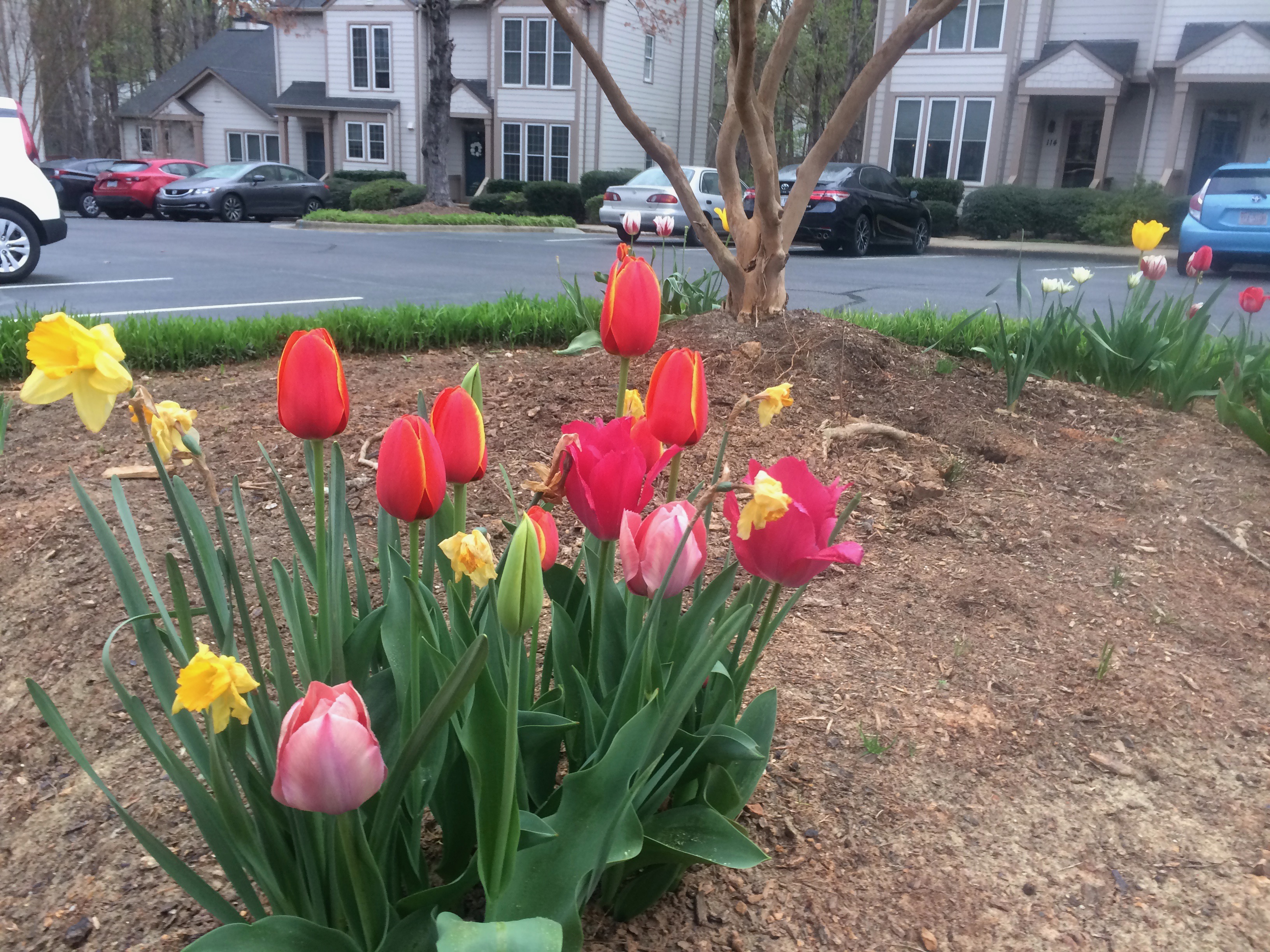
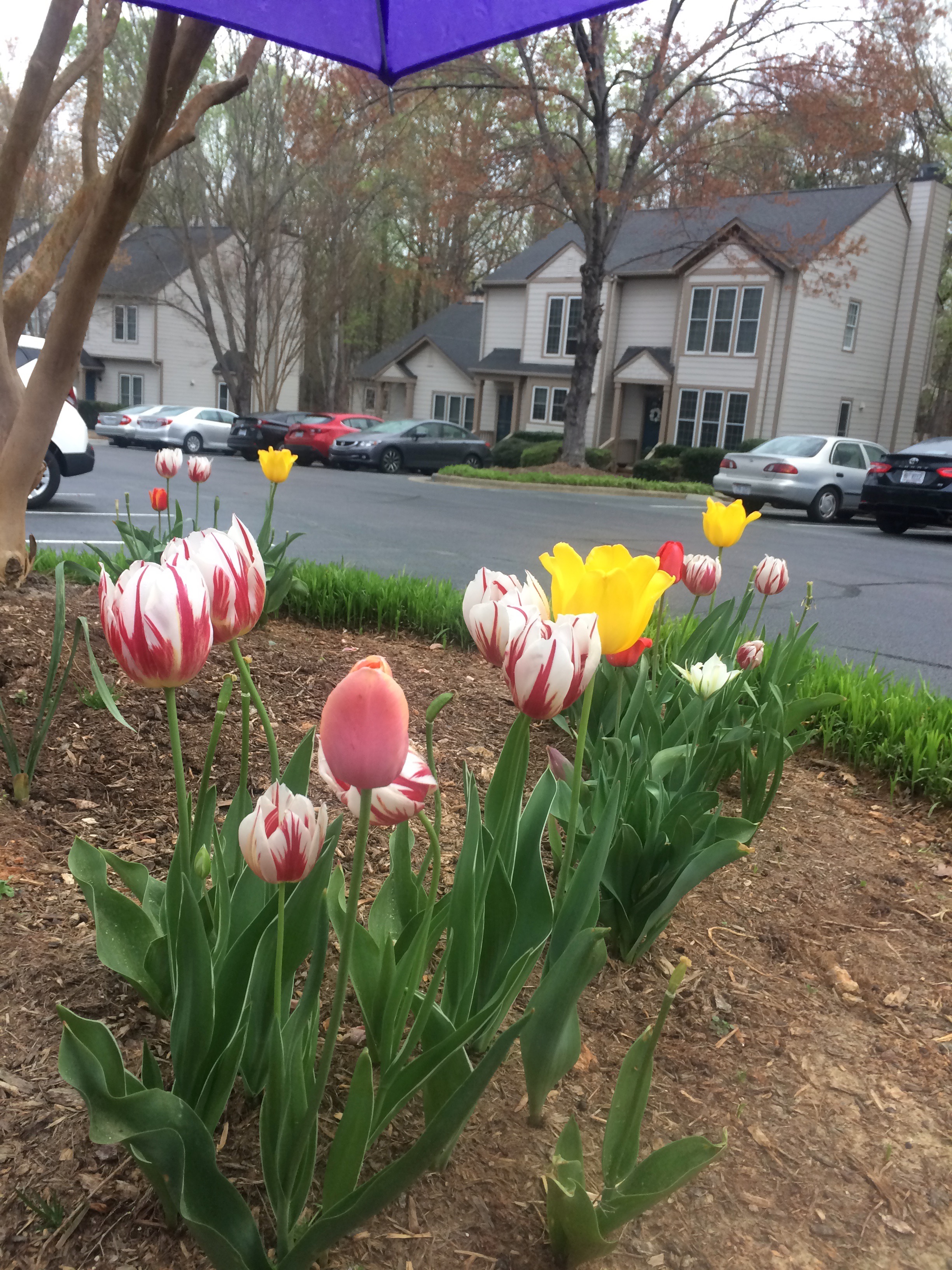
Doing a bit of “nature therapy” yesterday during a brief shower, and took a couple of pictures in our smallish condo complex. This morning got a link from a more media-literate friend, an opinion piece that long-term astronaut Scott Kelly had penned about coping with isolation. Very grateful that many of us have the technology to stay closer in touch via phone and internet. Glad there are parts of nature that seem little affected/afflicted by our current human pandemic. Please take care, all!

tulips in our condo complex

more tulips, oblivious to human worries