Tag Archives: MLK

Trauma and Healing

Southern California at the start to 2025 has been the site of extensive trauma. Multiple wildfires are burning large areas around Los Angeles, abetted by fierce Santa Ana winds and a winter drought. Still not fully contained, the fires have killed dozens, forced mass evacuations, destroyed thousands of homes and businesses. 

People elsewhere haven’t been immune, either. Even if we’ve tried to shield ourselves from too much media exposure, we probably have heard about the New Year’s Day killing of New Orleans revelers by a disturbed military veteran who rammed his truck into a crowd. It’s hard to remain entirely oblivious to ongoing warfare and carnage in Ukraine, in Sudan, or in Gaza, where a limited ceasefire seems finally to be taking hold. 

As someone who came of age at the height of U.S. involvement in Vietnam in the late 1960’s, I’ve had long, indirect exposure to that war’s trauma. The Vietnam Veterans Memorial, dedicated in Washington, D.C. in 1982, is inscribed with the names of the over 58,000 American soldiers who lost their lives in that war. Estimates of the number of Vietnamese deaths in the period 1965-1975 range from about 750,000 to over 3 million, including both soldiers and civilians. Somewhere around a million Vietnamese survivors became “boat people,” making perilous sea journeys that eventually led many to settle in the U.S.  

The more people I get to know, the more history I learn, the more I become aware of traumas that have impacted millions of Americans. The past fifty years or so have uncovered more of the pain and dislocation of the chattel slavery practiced from about 1650 until the 1865 end of the American Civil War in the territory of the U.S. Even after the legal abolition of slavery, discriminatory practices and intimidation continued to severely circumscribe the lives of many former slaves. “Generational trauma” can persist, perpetuated by the lack of respect or opportunity accorded many African-Americans for centuries. 

Not all who are traumatized are black. More and more accounts are surfacing of gender-based violence, of violence in families, of mental illness or suicidal tendencies among those exposed to extended trauma. No amount of wealth, privilege, or fame seems sufficient to make one immune. 

Today we celebrate a holiday in honor of Martin Luther King, Jr., considered by many to be one of the most effective civil rights leaders during the 1950’s and 1960’s. King’s life began in racially segregated Atlanta, Georgia in January, 1929. Despite the constrictions of segregation, King excelled in his studies, attended Morehouse College, and later Boston University, where he completed his doctorate in 1955. Beginning in 1954, King also served as pastor of the Dexter Avenue Baptist Church in Montgomery, Alabama. In December, 1955, King was tapped to be the public face of the Montgomery Bus Boycott, started when Rosa Parks, a black woman, declined to give up her bus seat to a white passenger who boarded the bus at a later stop. King’s oratory and his negotiating skills were important in bringing the boycott to a successful conclusion after over a year.

King became known for his espousal of nonviolence, based partly on the practices of Indian independence pioneer Mahatma Gandhi. In some of his writings, King gave six principles of non-violence: 

1. Nonviolence is a way of life for courageous people.
2. Nonviolence seeks to win friendship and understanding.
3. Nonviolence seeks to defeat injustice, not people.
4. Nonviolence holds that suffering for a just cause can educate and transform.
5. Nonviolence chooses love instead of hate.
6. Nonviolence believes that the universe is on the side of justice.

King’s dedication to nonviolence was tested early during the bus boycott, when in January, 1956, his house was firebombed while he was away giving a speech at a nearby church. His wife and infant daughter were inside–fortunately they were not hurt. A mob of armed supporters later assembled bent on retribution, but King persuaded them to go home and lay down their weapons. Later, when on a book tour about the bus boycott in 1958, King was stabbed in the chest by a deranged woman. King was successfully operated on, recovered, and went on to lead further nonviolent protests. For years, he was hounded and wiretapped by J. Edgar Hoover’s FBI. He was jailed nearly thirty times, often on trumped up charges. If anyone should have become embittered or violent as a result of continued and multiple traumas, you’d think it might be MLK. 

Instead, as long as he was alive, he continued to work nonviolently for social change. He was not perfect, but his example of transcending trauma through the healing power of nonviolence is one we need to remember, especially now. 
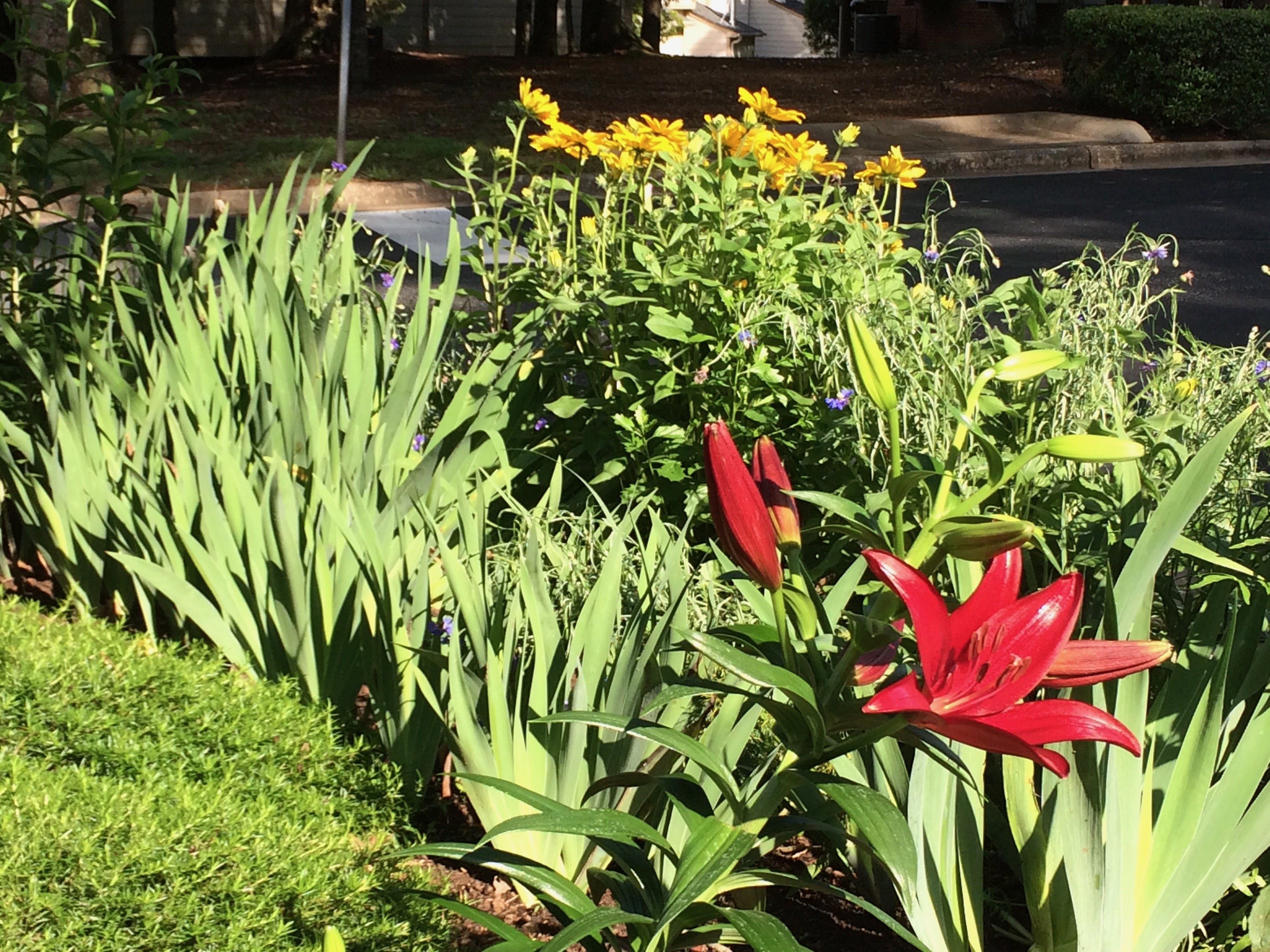
The Flowers Have Not (Yet) Gone

The Flowers Have Not (Yet) Gone   —by Jinny Batterson

It’s been a rough week to be an American. The death toll in the United States from the covid-19 pandemic crossed the 100,000 mark, while multiple U.S. cities experienced repeated, sometimes violent demonstrations in the wake of Monday’s death of yet another unarmed black man, George Floyd, at the hands of a white police officer in Minneapolis, Minnesota.  

Our economy has sputtered to a halt. Partly as a result of virus-related lockdowns, nearly a quarter of the U.S. labor force is unemployed. Our president sporadically spreads hatred and gibberish through his favored media platform, becoming so blatant in his misrepresentations and lies that Twitter has recently put “fact check” warnings on some of his posts.  

As various U.S. states attempt to restart their economies in the midst of a highly contagious novel corona virus with no known treatment or vaccine, cases have started to spike again in multiple hot spots. No one seems to know a good solution to the multiple crises besetting us.  

I sometimes get a “deja vu” feeling about our current problems and unrest, as someone who in 1968 was a young adult with much idealism and little experience. Then, an escalating and increasingly stalemated war in Vietnam was killing a disproportionate number of young black American men. Most American men between the ages of 19 and 26 (though less so the wealthiest or best connected) were susceptible to being conscripted into the military. In early April, Martin Luther King, Jr., an outstanding proponent of non-violent civil disobedience and a leader in the fight for legal equality for African-Americans, had been assassinated by a sniper while helping organize a peaceful protest for sanitation workers in Memphis, Tennessee. In the wake of his death, over a hundred American cities had erupted in protests that often turned violent and destructive.  

Conditions in many U.S. cities in 1968 were unequal, with housing projects and decaying urban neighborhoods receiving little in the way of substantive government assistance, while billions were being spent to advance presumed U.S. political interests overseas. Other government programs either intentionally or collaterally favored “white flight” to the suburbs, which were largely off limits to non-whites. Sound vaguely familiar?

Many collegians of the 1960’s had become enamored of a folk song revival, one of its signature songs being “Where Have All the Flowers Gone?”  penned by Pete Seeger in 1955. Joe Hickerson had later added more verses, turning the song into a circular questioning of the premise of warfare. The folk/rock trio of Peter, Paul and Mary popularized the expanded version, which remains a touchstone for many of us who lived through that era. (You can view their 25th anniversary rendering of the song at https://www.youtube.com/watch?v=ZgXNVA9ngx8.) 

In 2020, I’m somewhat creaky in the knees and a bit too virus-averse to participate in large gatherings, so I admire from a distance the courage and forbearance of many of the protesters (and many of the police officers who work to deescalate tensions, both short-term and longer-term). Meanwhile, I continue to send emails and postal letters to elected officials at all levels. I support voter registration and voting rights initiatives. I sew and give away protective face masks. I tend gardens. I plant flowers. I want to remind myself and others that the flowers have not yet gone. 

lilies and black-eyed susans near our central NC condo

Flowers near our central NC condo

Building Lop-Sided Bridges

Building Lop-Sided Bridges    —by Jinny Batterson

About this time of year in 1997, I got a nasty shock. I was diagnosed with breast cancer. A set of cells had gone malignant and might soon invade the rest of my body. Several months earlier, I’d had my annual mammogram and was told it was normal. So at first, I wrote off the lump that showed up around Hallowe’en as just another annoying symptom of menopause. I was a healthy, middle-aged white woman. I ate well, exercised regularly, had gotten all my prescribed screenings. I made a comfortable living as a consultant, had two college-age sons, a husband who loved me, and no family history of breast cancer. The lump would go away on its own. It didn’t. Further tests showed an aggressive tumor. By early December, I’d had a modified radical mastectomy without reconstruction. I was pretty shaky both physically and mentally. 

As I began to heal, I tried to use my experiences as a teaching tool. Our Unitarian-Universalist congregation in Richmond, Virginia had long engaged in efforts to help promote racial healing. Each year about the time of the MLK holiday, we had a special service with a racial justice theme. This particular year, I’d been working for several months before my diagnosis on the planning committee for the service. As I began to regain strength after surgery, I asked if I could do a short talk about my “lop-sidedness,” using my body as a metaphor for the way our entire society was lop-sided and hampered by our history of individual prejudice and systemic racism. We all needed healing. I composed and rehearsed my talk. By early January I was confident that I’d have the physical stamina and the psychological strength to deliver a 10-minute talk, even with the prospect of six months of chemotherapy looming. 

Then I went to choir rehearsal. Our young choir director wanted to use spirituals to accompany the service. He’d chosen “Soon I will be done with the troubles of this world, goin’ home to live with God…” as the meditation hymn. I flinched. Jamie was a wonderful musician, but I really didn’t want to identify with that particular song at that particular time in my life. Privately, I asked if we could substitute something more upbeat. I got a reprieve. We wound up singing “I’m so busy servin’ my Master, ain’t got time to die…”  Both the congregation and I survived to continue our work. 

A decade later, I learned that my favorite college roommate had developed breast cancer. Beth had grown up near Richmond, graduated from our small liberal arts school, then gotten an advanced degree in library science. She’d moved to different parts of the country. She spent much of her career administering college libraries—first in Ohio, then South Dakota, then Florida. We kept up via holiday cards and occasional phone calls. In her 50’s, Beth had changed focus slightly and taken a post as director of a set of public libraries in an economically depressed part of lowland South Carolina. Beth had been in her new job only a year or so when the cancer hit. Her family and friends rallied to her support. Once her most intensive treatments were over, I went down for a weekend visit. We traded survivor stories. When she passed the five year mark without a recurrence, I sent hearty congratulations. Then, a couple of years later, a non-cancerous illness destroyed her kidneys and took her life with little warning. That April, I drove south through timber plantations, palmetto swamps, and railroad cuts festooned with blooming wisteria vines to get to South Carolina for Beth’s memorial service. I didn’t know much about her town, but suspected it would be as highly segregated racially as much of the South I’d previously been exposed to.

The small Methodist church was nearly full. Some of the mourners were family members I recognized, but I was surprised to see half a dozen older black women among the mostly white worshippers. I guessed at first that perhaps the women were maintenance workers at some of the libraries Beth supervised, then chided myself for stereotyping. At the reception after the service, I had a chance to talk with one of the women.

“How did you know Beth?” I asked.

“We were part of a local support group called ‘Bosom Buddies’,” the woman explained, pointing to the discrete pink lapel pin she wore. 

I never learned much about the group. Beth may have had a hand in creating this cross-racial sisters-beneath-the-skin effort in the area she’d made her home. Whatever her role, she’d reached out across any racial divide, creating enough of a bond so that six women had taken the time to attend her memorial service.

Our country remains in need of healing. Pundits of many political leanings expound on all the ways we are polarized— economically, racially, politically, spiritually. Income disparities persist; wealth gaps have gotten worse. Gun violence takes too many lives; “stop and frisk” procedures and mass incarceration further divide us. Health outcomes vary tremendously, based partly on income and ethnicity. We’re still lop-sided. We all need healing. Perhaps those of us who are physically lop-sided can continue to build lop-sided bridges.


The Mixed Legacies of 9/11

The Mixed Legacies of 9/11  —by Jinny Batterson

Recently I had a chance to host a set of international guests—three generations whose eldest member had grown up in newly-independent India as a disciple of Mahatma Gandhi.  As she was about to leave our house, Ms. Mehta gave me a small booklet entitled “Hope or Terror: Gandhi and the other 9/11.” According to the booklet, on an earlier September 11, in 1906, Gandhi had launched the “satyagraha” movement that eventually helped lead to India’s independence in 1947. 

The booklet’s author, long term American peace activist Michael Nagler, spends most of the pamphlet giving examples of non-violent movements that have achieved worthwhile social aims with a minimum of bloodshed. His pamphlet was published in 2006, just five years after the 2001 terrorist airplane hijackings, destruction and loss of life that have created lingering unhealed physical and psychic wounds in so many Americans, both military and civilian. Nagler points to traits needed to participate more fully in satyagraha-like efforts, to use “integrative power” rather than “threat power.” So what can we learn from previous satyagraha struggles that may be relevant in 2019?

First, we can become familiar with the term “satyagraha,” which has several English translations—it can be rendered as “soul force,” as “love in action,” as “clinging to truth.” Many of us who have heard the term associate it primarily with Gandhi and his “salt march,” a long-distance 1930 walk to publicize and challenge the unfairness of British taxes on salt, a necessary nutrient that washes up freely on some of India’s beaches. Americans may be more familiar with the life and work of Martin Luther King, Jr., whose commitment to the related concept of non-violence was partially inspired by his study of Gandhi’s life and methods.

Nagler points out that there are two prongs to satyagraha efforts—one a resistance to coercion, the other a creation of alternative forms of organization that are freer and less coercive.  Most of us are likely to be more attuned to one prong than the other, so we need to partner with individuals and groups that are more highly skilled in the other prong. Otherwise, we can too often confuse tactics and methods with strategies and longer-term goals.

The passage in Nagler’s booklet that I found most heartening and persuasive concerns the way that satyagraha/nonviolence works:  “Nonviolence sometimes ‘works’ and always works, while by contrast, violence sometimes ‘works’ and never works.”

He explains his use of terminology this way: an action succeeds, or “works” based on its short-term, obvious effects, while it works (without quotes) in how it impacts situations and participants under the surface, producing longer-term effects that are not always obvious at the time.

I’m not sure what commemorations will occur on September 11, 2019. The lingering war in Afghanistan seems no closer to resolution; gun violence in the U.S. claims or maims too many lives; organized violence in many parts of the world dominate our headlines and media reports. Climate change can pose global challenges we often seem powerless to respond to. However, there are other actions going on, other factors at play. One was a last-minute decision to open our home for a night to a family of strangers who are strangers no longer, with an aging Indian matriarch who replanted a seed of hope.     


MLK, Jr. Reweaving the Dreams

MLK, Jr.: Reweaving the Dreams   —by Jinny Batterson

While he was alive, I knew little about him.
The mainstream press in Baltimore barely mentioned
This Negro preacher who’d helped marshal a yearlong bus
Boycott and in the mid-1960’s won a Nobel Peace Prize.
There were rumors he might be a Communist.

I was in high school, with other concerns—
Who could I get to take me to the prom?
Would my SAT scores help me get into a good college?
Would my parents take away my driving privileges
After an accident that I at least partially caused?

By the time I got to college, his star was waning,
Eclipsed by rising black militancy and a war in Southeast Asia
That dragged on and on. His tactics and pronouncements were
Less influential, less obviously successful in northern cities than in
Earlier Southern-based campaigns. Non-violence and preaching peace
Didn’t appear to work against big-city political machines and war contractors.

At first it seemed his dreams had come unraveled when his life ended.
As riots broke out in many American cities following his assassination,
I sat distracted in a secluded dating parlor on a small college campus,
My boyfriend’s bent-kneed proposal and diamond ring a pale foreground
To a muted television backdrop of Baltimore and Washington, D.C.,
Two bookends of my youth, engulfed in flames, sirens, and riot police. 

By the time his birthday was declared a national holiday
In November, 1983, I was attempting to learn and implement
Parts of his dream in rural central Africa. My efforts met with
Little success in a country whose few rich and many poor lived in vastly
Different worlds, with a minuscule middle partly made up of expatriates
Like me. I had lots of time to read the contents of a USAID library.

Martin Luther King, Jr., I learned, was a middle child, born just before
The Great Depression. His family lived in a relatively prosperous black enclave
In segregated Atlanta. During his early studies, he drifted, but partway through
High school he was inspired toward the ministry. He went north and completed
An impressive formal education, earning a doctorate by age twenty-five.

The parts we now recite in school start in Montgomery, Alabama,
Where he was nominated, as a young, little-known preacher, to give voice to the
Aspirations of people who had for too long been shunted to the back of the bus.
After the successful conclusion of the bus boycott, sixty civil rights leaders met
In Atlanta, founded the Southern Christian Leadership Conference, and elected
MLK as its first president.  Then came sit-ins, Freedom Summer, Albany,
Birmingham, Selma, Chicago, a Poor People’s Campaign, a sniper’s bullet.

Those of us who call ourselves progressives winced at subsequent American
Foreign and domestic policy, wrote letters, attended rallies and marches,
Wondered what else we might do to stop, or at least reduce, the madness.
For a while, we thought we had found an answer in another young,
Eloquent brown-skinned man. Twice we elected him national president,
Allowing complacency to creep into our ongoing efforts.

Our current national administration is more nightmare than dream.
It wants us to forget that our deepest dreams are inclusive rather
Than exclusionary, spiritual as well as material. MLK knew this.
He tried to tell us, over and over again, but we rarely listened.

We know MLK had flaws—infidelity, sometimes neglecting his family,
Carrying too much of the movement’s burden by himself.
We do not need another plaster saint, of whatever skin hue,
But Coretta was right to insist that we honor MLK with a holiday.
Though not free from sin or error, he was also a prophet
Who recalled us to our best selves. May we remember
His efforts as we redouble ours, reweaving stronger dreams.