Who Did You Expect? —by Jinny Batterson
My life so far has been fortunate—no privation, little discrimination, generally good health, many chances for love and adventure. Much of the time, though not always, people I’ve met have lived up to (or beyond) my expectations. On those rare occasions when someone’s behavior has disappointed me, more cynical or world-weary friends have shrugged at what they regard as my naiveté.
“Of course so-and-so let you down,” they’ve announced. “What did you expect?”
Increasingly for me, the appropriate question is rather “Who (or, for the grammar police, “Whom”) did you expect?” As I mature (a work in progress), I become more aware of instances when I’ve pre-judged people and turned out to be fairly far off the mark.
The first occasion that stands out is my initial in-person meeting with the leader of our 1980 group tour to China. In those pre-internet days, I’d exchanged postal letters and paperwork with Ms. Baum and talked with her on the phone. Until we both arrived in San Francisco’s airport departure lounge for our trans-Pacific group flight to Hong Kong, I had not actually met this native New Yorker. I’d assumed from her accent and phone demeanor that she was of Jewish background. She seemed somewhat pushy and no-nonsense, ready to take on the world. I was surprised to see that she was African-American, not ethnically Jewish. She could be somewhat pushy and no-nonsense. Her prior experiences as both social worker and travel agent had prepared her well to take on whatever bureaucracy attempted to get in her way, regardless of ethnic origin or nationality. She turned out to be both different from and similar to the “who” I’d expected.
Earlier this fall, I signed up to work the polls in the 2018 mid-terms. After on-site training, I exchanged emails with the woman who’d be my site supervisor for early voting. Her written English was good, clear and simple. Her family name was a common one, her given name, ending in “a,” suggested to me she might be African-American, or maybe Hispanic-American. When we met, I could detect no skin coloring or hair texture to suggest ancestral links with Africa, no hint of foreign origin in her accent. She seemed at first a very “vanilla,” somewhat conservative American. During our work, she showed her passion for ensuring that anyone who wanted to vote was given maximum opportunities to do so. She’d sit patiently with someone lacking appropriate credentials, or with an address not yet entered into the electoral system database of rapidly growing Wake County. She knew the rules well. She could suggest pulling up an electronic copy of a utility bill on a portable phone. She might advise going home to retrieve a needed ID and then returning later in the day. In rare cases, she’d have the potential voter fill out a provisional ballot, explaining how and when to check whether their vote had been counted. The workforce she’d helped assemble to follow her lead was the most visibly diverse I’ve ever participated in. She was both different from and similar to the “who” I’d expected.
I’ve just spent Thanksgiving with parts of my extended family that I barely knew growing up in Maryland in the 1950’s and 60’s. Only once had I had a chance to visit these North Carolina farmer cousins from a rural area near Charlotte. What little I remember from that farm stay involves ponies tame enough so even I was persuaded to take a short ride. I got to see my grandmother’s sister-in-law make glorious biscuits using milk straight from the cows. The cousins closest to my age teased me good-naturedly about my lack of country skills.
After moving to North Carolina a decade ago, I became reacquainted with some of the cousins who’d left the farm to settle in Raleigh. They’d tell me enticing stories of an extended family Thanksgiving gathering at “the shed.” I pictured the locale in my mind: an expanse of gently rolling hills, empty except for a few horses or cows grazing in pastures. “The shed” would be a slightly cleaned-up farm outbuilding. Twenty or so aging cousins of Scots-Irish ancestry would assemble for our midday meal, then say interminable grace before we could eat. Someone would have cooked a turkey and brought it still warm to the feast. We’d eat plentifully, exchange pleasantries, carefully avoid politics, and then everyone would go home.
This year as we drove into the neighborhood nearest our destination, I had trouble reconciling my mental image with current reality. The surrounding area may once have been farmland, but the vicinity had long since become part of suburban Charlotte. A mid-rise apartment complex dominated the nearest street corner. The “shed ” had been expanded and modernized from an earlier role as storage space for some cousins’ plumbing business. It was now a comfortable, well-appointed venue with adjustable seating for up to a couple hundred people. Nearly that many cousins of all ages were in attendance, along with baby equipment, pet dogs and a few footballs.
We did have a short sung grace before the long, snaking buffet line formed. We did generally steer clear of contentious political topics. People caught up on family news since the previous get-together. One 20-something cousin had recently returned from an extended Peace Corps stint in South America; in the next generation up, a househusband described his four years of helping school their daughters while his family was on assignment in southern Europe. One attendee I didn’t get a chance to talk with directly had a skin tone and accent that implied ancestry or origin in India. The Reas still cherished their rural roots and pioneering ancestors, but the clan had gotten more diverse and widely traveled—both different from and similar to the “who’s” I’d expected.
The remaining holidays of late autumn and early winter are likely to have more extended family gatherings and chance meetings. May I remember not to pre-judge those I encounter, to be more careful not to let “who I expect” get in the way of meeting current reality with an open mind and heart.
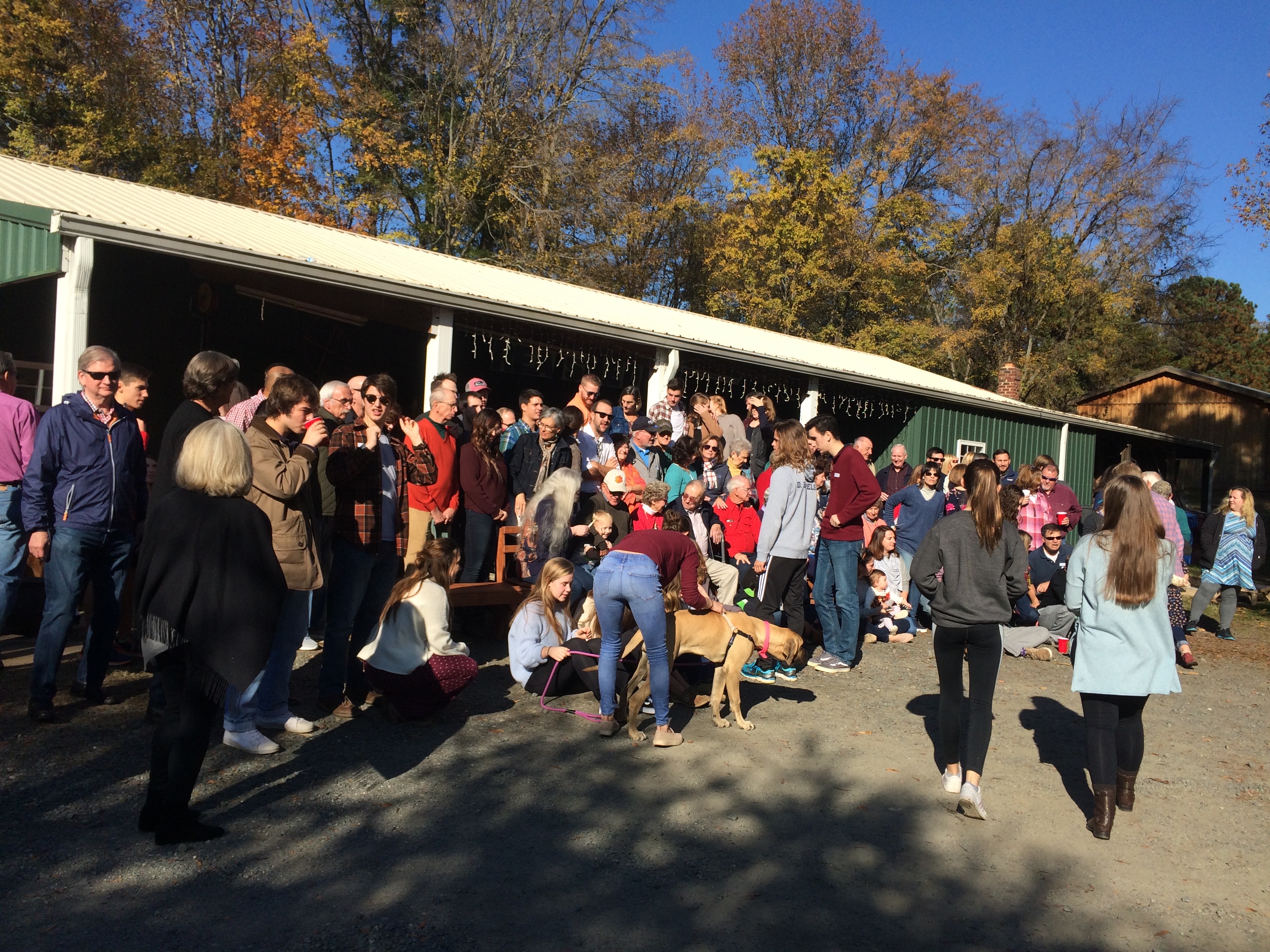
Rea Thanksgiving at “the shed”

 Jinny's Occasional Poems