Again, we have selected an immigrant’s Grandchild, someone with complex business Dealings and a felony conviction on appeal, To be our official national leader.
Again, we have projected our individual And collective traumas–slavery, violence Internal, external, and systemic– Across time zones and borders.
Perhaps too few of us have yet realized that Pursuing greatness through vengeance Will, sooner or later, be revealed To be the basest form of pettiness.
Perhaps too few of us have yet relearned That nature, however harsh she may seem During pandemics, blizzards, floods, or fires, is Also healing when we show respect and pay attention.
Southern California at the start to 2025 has been the site of extensive trauma. Multiple wildfires are burning large areas around Los Angeles, abetted by fierce Santa Ana winds and a winter drought. Still not fully contained, the fires have killed dozens, forced mass evacuations, destroyed thousands of homes and businesses.
People elsewhere haven’t been immune, either. Even if we’ve tried to shield ourselves from too much media exposure, we probably have heard about the New Year’s Day killing of New Orleans revelers by a disturbed military veteran who rammed his truck into a crowd. It’s hard to remain entirely oblivious to ongoing warfare and carnage in Ukraine, in Sudan, or in Gaza, where a limited ceasefire seems finally to be taking hold.
As someone who came of age at the height of U.S. involvement in Vietnam in the late 1960’s, I’ve had long, indirect exposure to that war’s trauma. The Vietnam Veterans Memorial, dedicated in Washington, D.C. in 1982, is inscribed with the names of the over 58,000 American soldiers who lost their lives in that war. Estimates of the number of Vietnamese deaths in the period 1965-1975 range from about 750,000 to over 3 million, including both soldiers and civilians. Somewhere around a million Vietnamese survivors became “boat people,” making perilous sea journeys that eventually led many to settle in the U.S.
The more people I get to know, the more history I learn, the more I become aware of traumas that have impacted millions of Americans. The past fifty years or so have uncovered more of the pain and dislocation of the chattel slavery practiced from about 1650 until the 1865 end of the American Civil War in the territory of the U.S. Even after the legal abolition of slavery, discriminatory practices and intimidation continued to severely circumscribe the lives of many former slaves. “Generational trauma” can persist, perpetuated by the lack of respect or opportunity accorded many African-Americans for centuries.
Not all who are traumatized are black. More and more accounts are surfacing of gender-based violence, of violence in families, of mental illness or suicidal tendencies among those exposed to extended trauma. No amount of wealth, privilege, or fame seems sufficient to make one immune.
Today we celebrate a holiday in honor of Martin Luther King, Jr., considered by many to be one of the most effective civil rights leaders during the 1950’s and 1960’s. King’s life began in racially segregated Atlanta, Georgia in January, 1929. Despite the constrictions of segregation, King excelled in his studies, attended Morehouse College, and later Boston University, where he completed his doctorate in 1955. Beginning in 1954, King also served as pastor of the Dexter Avenue Baptist Church in Montgomery, Alabama. In December, 1955, King was tapped to be the public face of the Montgomery Bus Boycott, started when Rosa Parks, a black woman, declined to give up her bus seat to a white passenger who boarded the bus at a later stop. King’s oratory and his negotiating skills were important in bringing the boycott to a successful conclusion after over a year.
King became known for his espousal of nonviolence, based partly on the practices of Indian independence pioneer Mahatma Gandhi. In some of his writings, King gave six principles of non-violence:
1. Nonviolence is a way of life for courageous people. 2. Nonviolence seeks to win friendship and understanding. 3. Nonviolence seeks to defeat injustice, not people. 4. Nonviolence holds that suffering for a just cause can educate and transform. 5. Nonviolence chooses love instead of hate. 6. Nonviolence believes that the universe is on the side of justice.
King’s dedication to nonviolence was tested early during the bus boycott, when in January, 1956, his house was firebombed while he was away giving a speech at a nearby church. His wife and infant daughter were inside–fortunately they were not hurt. A mob of armed supporters later assembled bent on retribution, but King persuaded them to go home and lay down their weapons. Later, when on a book tour about the bus boycott in 1958, King was stabbed in the chest by a deranged woman. King was successfully operated on, recovered, and went on to lead further nonviolent protests. For years, he was hounded and wiretapped by J. Edgar Hoover’s FBI. He was jailed nearly thirty times, often on trumped up charges. If anyone should have become embittered or violent as a result of continued and multiple traumas, you’d think it might be MLK.
Instead, as long as he was alive, he continued to work nonviolently for social change. He was not perfect, but his example of transcending trauma through the healing power of nonviolence is one we need to remember, especially now.
The calendar year 2024 will be over in a matter of hours. If I choose to watch or listen to this evening’s media, I’ll get a variety of summaries, explanations and interpretations of the year now ending. Whenever I’ve paid attention to pundits recently, I’ve gotten at least some commentary about inflation—the rising cost of most, if not all, consumer goods.
Inflation hurts. So far, inflation has not hit me as hard as it has many others. Still, my prime earning years are long over. As time goes on, if inflation is not tamed, it will get harder for me to purchase extras. Eventually, even some things I consider basics may get priced beyond my capacity either to find less expensive substitutes or to switch some items I now buy ready-made to “make from scratch”.
So I’m thrilled that my neighbors have provided some holiday cheer at no cost to me. One of my joys this season has been walking around our neighborhood viewing the holiday decorations in nearby houses and yards. All that this viewing requires of me is a little exertion.
In this part of San Diego, it’s been a year of inflatables—replicas of holiday themed favorites such as Santas and elves, along with cartoon or animated film characters. Most of the figures rest in deflated sprawl during the day. As evening approaches, small electric motors kick in and the figures begin to rise, tethered and kept upright with ropes and/or anchors. It’s intriguing to see what neighbors have come up with. Because we’re in southern California’s “Disney country,” there are many Disney characters, along with Dr. Seuss Grinches. There’s been a rise in the number of “Bluey” likenesses, a recent Disney acquisition based on a children’s cartoon from Australia. Mixed in with the fantasy figures are figures of actual animals and plants. Often the displays are attached to real shrubs and trees that stay green in our mild climate in December.
Bluey and MinnieInflatables after darkInflatables before dark
In a few days, this year’s inflatables will be more permanently deflated and stored away in attics, closets, or sheds. If electricity follows our inflationary trend, next year’s crop of inflatables may be slightly smaller. Perhaps we’ll substitute more natural materials.
My wish for 2025 is that we will sooner or later succeed in reining in inflation. I think it will help if we remember that we are more stewards than owners of the natural world, that we are but one species among many. My hope is that more often than not, we’ll be able to avoid either an overinflated or an under inflated sense of our place in the grand scheme of things. Best wishes to all for a Happy New Year!
A few days ago, I had a morning commitment in downtown San Diego. To avoid the hassle of having to park downtown, I had driven from my suburban house to our nearest trolley stop, next to a local shopping center. After I’d parked, as I was approaching the stop, an outbound trolley disgorged its passengers.
One, a middle aged woman, took a look at the pre-dawn sky just beginning to lighten and remarked to no one in particular, “Ah, crow o’clock, my favorite time to get off the trolley and be out in nature.”
As I followed her gaze, I noticed over a hundred crows circling. Intrigued, I blurted out, “Do they do this every morning?”
“Yeah, it’s their time to get up after roosting in surrounding trees overnight.”
Days are short this time of year. In our part of southern California, we get about 10 hours of daylight. As luck would have it, my downtown stint lasted most of the day, so I returned to my trolley stop just at dusk. The crows again were circling, this time preparing to roost. I’d gotten to see two “crow o’clocks” in a single day.
My neighborhood doesn’t have as many crows as the valley where the trolley runs, but enough of the glossy black birds hang out here to provide near-constant background noise during daylight hours. I’d not paid too much attention, but after my encounter with the “crow o’clock” trolley rider, I decided to do a little online research.
Among the tidbits I picked up: crows make a variety of vocalizations, up to 20 different sounds. Along with the “caw, caw” we typically associate with crows, I’ve started to notice a less loud sound our area birds sometimes make—sort of a cross between a chuckle and the noise of a can being opened with a manual can opener.
Crows mate for life. Both partners participate in building a nest, a new one each breeding season. Once the baby birds hatch, both parents help feed them. Crows typically lay just one set of eggs per year. Out of a clutch of up to six eggs, three or four nestlings may make it to their first birthday. Older crow offspring sometimes stick around for a few years to help with younger nest mates. Crows that survive more than a year may live ten to fifteen years, with the oldest wild crow ever formally banded and studied surviving to nearly thirty. One captive bird in New York lived to be 59.
There are over forty varieties of crows globally, one being the American crow, which ranges through much of the U.S. and parts of Canada. A variety of professionals and amateurs study crows, which have had legal protection since 1972, except when landowners believe the birds are damaging property or livestock (think scarecrows?).
If you are a glutton for crow knowledge, you can find a 90-minute presentation about crows, “To Know the Crow,” on the site of the Cornell Ornithology Lab, allaboutbirds.org. My favorite crow video is a much shorter snippet posted by author Kira Jane Buxton, about a female crow she’s named “Sharkey” who often accompanies her on daily walks.
I’m not motivated to become a serious crow researcher, nor am I likely to develop a crow walking companion like Kira Buxton’s Sharkey. However, as the days slowly lengthen and also become chillier, I think I’ll arrange at least a few more trolley rides to correspond with “crow o’clock.”
Another Thanksgiving weekend. This year no need to fight traffic To and from the grandmothers’ houses, No need to spend hours circling The parking lot at the nearest mall. No need to go anywhere at all.
Now we are the grandparents. Our muted celebration took place Around our kitchen table, with The other set of grandparents, A daughter-in-law, a teen granddaughter In attendance. Mostly vegetarian,
The feast also featured a small ham for The meat eaters of the oldest generation. We talked in pleasantries, mostly Avoiding politics. The weather was warm And sunny, as southern California often Is in late November. Tomorrow, a wintry mix may
Disrupt the other grandparents’ flights Back to the Northeast. Been there, Done that. Especially the two winters When Vermont was my, then our home. The Thanksgiving before we reconnected, a blizzard Delayed and almost sidelined Jim as he came north.
The following year, sleet and snow complicated Our southbound journey, delaying our arrival at our elders’ House in northeast Philadelphia until nearly 4 a.m. From a later home in Richmond, VA, we’d set out by car to see Grandmas and Grandpas in Maryland and New Jersey, Two growing boys sporadically squabbling in the back seat.
I watch with sometimes spiteful glee as News clips feature clogged airports, or huge Temporary parking lots on I-95 in both Directions. Yes, Virginia, it can take nearly an hour To clear the Delaware Memorial Bridge. Still, I need to remain grateful for holiday traffic.
Nearly sixty years ago, the bus ride from Baltimore to D.C. That usually lasted 45 minutes stretched to almost Three times that long, giving my college-bound seat mate And me time to thread our awkward conversation toward a Slow-budding romance. Holiday traffic helped introduce me To a future husband, children, grandchildren. Thanks be!
After another bruising electoral season, we are individually and collectively beginning to recover and move on. As an older voter, I do not expect to participate in many more presidential elections. Still, I’m concerned about the rancorous legacy our generation seems to be leaving for those who come after us.
As a grandparent, I’ve lately become one of our family’s storytellers. It’s my hope that by sharing my own family story and then by deeply listening to others, I may be able to find more common ground. I hope that we may as a community be able to diminish the worst excesses of partisan bitterness. Every family has its own instances of disasters and triumphs. My family’s stories are unique but likely not uncommon.
Some aspects of my biological family’s history remain a mystery. What has come down to me has been partially shaped by our clan’s tendency toward long generations. It’s also been shaped by a generally privileged trajectory and multiple generations of residency in what is now the United States of America.
Both sets of my grandparents were well into their sixties or seventies, living in Maryland, when I was born there in 1947. For my first eleven years, I lived next door to my maternal grandparents. That grandfather began life in 1869, so his earliest memories are from a time over 150 years ago. My other three grandparents were born in 1879. All four grandparents had stories to tell.
My maternal grandfather, the man I called Pop-Pop, was born in Mississippi just after the U.S. Civil War. He was the youngest child in a family of former slaveholders, with one older brother and five older sisters. Pop-Pop recounted being frightened of the Union troops billeted in his family home during Reconstruction. He was later able to get a good education. He spent time as a school teacher before switching to bookkeeping about the time his first child was born in 1906.
My maternal grandmother, nicknamed “Ginx,” was a 3-pound “preemie” born in January, 1879 in rural Virginia, in the days before many hospitals or “modern medicine.” Her parents later told her that for her first few months they had kept her in a makeshift incubator constructed by lining a laundry basket with warm bricks and cast-off blankets. Her father was a school superintendent in one of the counties where Pop-Pop taught school.
My paternal grandfather was the second son in a family of midwestern small-scale farmers. He met my other grandmother while both were students at a telegraphy school in Kentucky. This particular school was run by a conman whose main goal seems to have been lining his own pockets. The two lovers conducted a lengthy, partially long-distance courtship, complicated by economic struggles plus the lingering animosity between northern and southern states. Grandpa was “Yankee bred,” Grandma a Southerner. They eventually wed at my great-grandfather’s North Carolina farm at Christmas in 1907.
Grandpa and Grandma briefly attempted to homestead in Nebraska, but found the dry conditions and near-constant wind too much of a challenge. Grandpa later worked various clerical and administrative jobs, first for railroads and then for a government agency regulating interstate commerce. Grandma managed the small Maryland farm where they eventually settled and continued raising their children.
(Portraits of my grandparents that a friend of my parents painted; they hung for years in the family dining room)
My dad made his entry into the family saga in 1912. Born in Ohio, he moved with the family to Maryland in 1920. Through grade school, he attended a two-room rural schoolhouse. By the time he was ready for college, the Great Depression had set in and money for tuition was scarce. Dad and his two older siblings took turns at the University of Maryland nearby, each finding what work they could to supplement the family income. They pooled their funds, helping each other pay college costs. Dad and his older brother John sold chickens and eggs from the farm. Aunt Lucy did clerical work.
My mom showed up in 1917 as a “bonus” daughter, eleven years younger than her sister Margaret, five years younger than her brother Stuart. Family life was hectic as the “war to end all wars” came to a close in late 1918. The armistice was bracketed by a global flu pandemic that spared Mom’s family, but killed an estimated 50 million people worldwide.
Aunt Margaret and Uncle Stu attended high school in Baltimore City. Though city tuition was somewhat expensive, Baltimore’s schools at the time were considered vastly superior to the small high school in the next-county village where Mom’s family lived. Pop-Pop and Granny spent much of the 1920’s ponying up city school tuition to give their children the best educational start they could. Pop-Pop had a job as a Baltimore-based bookkeeper. Granny earned money teaching piano pupils at home or in local schools. Then, just as Mom was ready to enter high school, the Depression hit. It limited Mom’s high school choices and nearly preempted her chance to attend college.
Within seven months during 1929-1930, Mom’s family experienced a one-two punch of reversals. The stock market crash in late October, 1929 did not directly impact them—Pop-Pop and Granny owned no stocks. The family’s downward spiral started about a month later with an “upward spiral.” On an unusually cold day just after Thanksgiving, a chimney fire broke out in their recently renovated kitchen. By the time the local fire brigade arrived, the fire had started to spread. They were unable to contain the blaze. Water from their hoses froze before it could reach the house’s high roof. The entire structure burned to the ground. The family found rental lodging, hoping to rebuild later. The following June, Pop-Pop, then sixty years old, was laid off from his job. The company he had worked for replaced most of their human staff with early calculating machines to cut costs.
Somehow, Mom’s family persevered. Aunt Margaret and Uncle Stu were able to find jobs. Granny took correspondence courses in hotel management. She then got work as a full-time housekeeping supervisor at a Baltimore luxury hotel. Though she frowned at some alcohol-lubricated political shenanigans during the waning days of Prohibition, she held her tongue. Pop-Pop got what temporary work he could, once surviving a major 1933 flood while working as a night guard at a railroad construction site.
Mom finished at the top of her high school class. She scraped together earnings and loans to attend college. The Depression eventually ended. Mom and Dad eventually met and married. Their “greatest generation” was partially shaped by the eras they grew up in—one global war, then boom times, then economic depression, followed by another global war. During the post-WWII baby boom, they produced me, my sister and two brothers. We’ve so far confronted different challenges, including a recent global pandemic with its accompanying trauma and dislocations.
What have been your family’s triumphs and trials? How may they influence your experience of the world going forward?
As the 2024 election cycle nears its end (hurrah!), reproductive health is one of this campaign’s most important issues for me as a woman. I do not trust one major party presidential candidate to protect women’s rights. His previous behavior around women causes me grave concern. Also, I have granddaughters whose reproductive lives are just beginning, and I want their choices to be at least as robust as mine were.
Along with reproductive choice, respecting differences and showing compassion are important to me. I can honor those who disagree with me, while hoping my views and how I came to hold them will make sense.
A summary of what I know of the reproductive lives of my grandmothers and mother:
—Both my grandmothers lost children early to contagious diseases. –One grandmother suffered multiple stillbirths. –My mother used contraception, mostly successfully, to delay, then space her pregnancies. Her children all survived her.
As of now, I seem to have been a winner in the reproductive lottery for my generation:
—Through a combination of luck and contraceptive use, I was able to delay pregnancy until after marriage and after my husband and I were both ready to become parents. –I had two uncomplicated pregnancies and easy deliveries. –Both my children have survived me into middle age and have children of their own. Others in my family were much less fortunate.
My mother gradually shared with me stories of growing up when women faced heavy legal restrictions on their access to either contraceptives or abortion. When she married my father in 1944, her naval draftee husband was about to be shipped out to the Pacific on an aircraft carrier. Mom was terrified of becoming a war widow with an infant, so when she and Dad managed a brief honeymoon in Boston, she disobeyed the law. She obtained illegal contraceptives and avoided an unintended pregnancy. Luckily, Dad survived the war and came home in 1946. He and Mom started building peacetime lives together. I arrived about a year later.
The reproductive part of my life spanned both the “pre-Roe” and the “Roe” eras. When I was entering my teens during the late 1950’s and early 1960’s, abortion was illegal in nearly all circumstances. Knowledge about responsible sexual behavior was limited, too, partly because public teaching about human sexuality was also restricted.
Before I started having periods, Mom took me one evening to a short, clinical Disney animated film about “becoming a woman.” She and her friends later did their collective best to supervise our dating behavior. They cautioned their daughters in veiled terms to avoid “going all the way.” Our moms had been socialized to avoid discussing sex. We daughters sometimes got misinformation from other sources. Various religious groups promoted total sexual abstinence before marriage, and “rhythm” afterwards, avoiding sex during the supposedly few days of a woman’s menstrual cycle when she was fertile and could become pregnant. Neither approach took into account our sometimes raging hormones or the irregular menses of many women.
Starting when I was in eighth grade, a few of my female classmates began dropping out of school, either temporarily or permanently. Both before and during Roe, many pregnant young women who did not have abortion access, or who chose not to abort, chose rushed marriages, sometimes under extreme family and social pressure. They’d typically wed the baby’s father, often before they showed many external signs of pregnancy. Sometimes referred to as “shotgun marriages,” some of these marriages endured. Many didn’t. By the time I finished public high school in Maryland in 1965, more than a few former classmates had hurriedly married their boyfriends, dropped out of school, and become teen moms.
Other classmates disappeared for several months, supposedly visiting an “aunt on the West Coast” or some such, before reappearing looking sadder and less confident. My guess is that they’d been sent to homes for unwed mothers, given birth, then immediately surrendered their infants for adoption. A few years ago, I read an extensively researched book about this option, Ann Fessler’s 2006 study, The Girls Who Went Away: The Hidden History of Women Who Surrendered Children for Adoption in the Decades Before Roe v. Wade. The book estimates that the number of mothers who surrendered infants in the U.S. during the period 1945-1973 was roughly 1.5 million, an average of over 50,000 per year.
Starting during the 1960’s, women gradually gained more control over our reproductive lives. A few states began to allow consideration of rape or incest, of a mother’s physical health, or of severe fetal abnormalities for legal abortions. Just as important as the abortion changes, women got access to more widely available, more reliable contraceptives, such as birth control pills. Reliable information about contraceptive practices also spread.
Between World War II and the 1973 Roe decision, though, the incidence of unplanned pregnancies skyrocketed. Illicit abortions also increased. Estimates of the number of pre-Roe “stealth abortions” in the U.S. vary widely. I know some such abortions occurred, because for about a decade there was a stealth abortion clinic less than a mile from my house. I learned of it by chance—the address of a criminal complaint about running an illegal abortion clinic matched a secluded property along our road. My friend Ann had noticed the complaint while working a summer job at the county prosecutor’s office. She told me about it because six years earlier she and I had knocked on the clinic’s front door while selling Girl Scout cookies.
In the pre-Roe period, a double standard about the consequences of sexual activity for young women and young men was common. Girls who “got into trouble” were vilified, while the boys or men who’d gotten them pregnant frequently avoided any consequences. The tendency to disparage women persists these days in the form of online “slut shaming,” often without evidence. Other online and in-person abuses, including pussy grabbing and other sexual assaults, continue.
The “Roe era” lasted from January, 1973 until June, 2022. Women’s reproductive lives then were less regulated legally than either before or since. The Roe decision had allowed abortions with few restrictions before a fetus is capable of life outside the womb—typically around 23-28 weeks of gestation. Since the 2022 Dobbs decision reversed Roe, I’ve explored more of the nuances of fertility, infertility, and choice. While no choice about ending a pregnancy is ever easy, I strongly believe that restoring women’s ability to make that choice is essential.
The U.S. abortion debate will not go away. Much state legislation since Dobbs has proved tragic for women experiencing ectopic pregnancies, pregnancies resulting from rape or incest, miscarriages, or serious fetal abnormalities. It has increased distrust and anxiety among women of childbearing age and their health care providers.
I believe we need a more flexible national legal framework surrounding abortion. I believe that as a society we need to better prepare both young women and young men for the possibilities and challenges of parenthood. I believe that sharing our reproductive stories, with more empathy and less judgment, can help promote reproductive health for all.
Above all, I believe we need to get better at treating women as full humans. When former Congresswoman Pat Schroeder was asked how she could manage to be both a mother and a member of Congress, she responded, “I have a brain and a uterus and I use both.”
Shortly after moving to San Diego in mid-2021, I discovered a nearby community garden. I put my name on a waiting list for a plot, then made frequent visits to the 45-plot garden to see what was growing in others’ spaces. As the weather cooled and days shortened, I watched others’ cool weather crops take hold. Being someone who’d never before gardened in a frost-free area, I marveled. During my first Southern California “winter,” lots of cabbages and broccoli came to maturity. Come February, I was able to rent a seven by twelve foot raised bed for the next gardening year, starting March 1. The following winter, I had my own Brussels sprouts plus lettuce and arugula in January and February. What a treat!
Fellow community gardeners often share chores, pinch-hitting for each other during vacations or other interruptions. So this past April, I arranged with a friend whose plots are near mine to water when needed while my husband and I took an extended trip out of the country. I returned in June to find my plot filled to overflowing.
After I trimmed back excess growth, I discovered that the seedling celery plants I’d put out just before I left had by mid-June matured and gone to seed. Plants were nearly shoulder high. The two pear tomato plants, barely leafed out when I’d planted them, had outgrown their tomato cages and were sprawling across the plot’s middle.
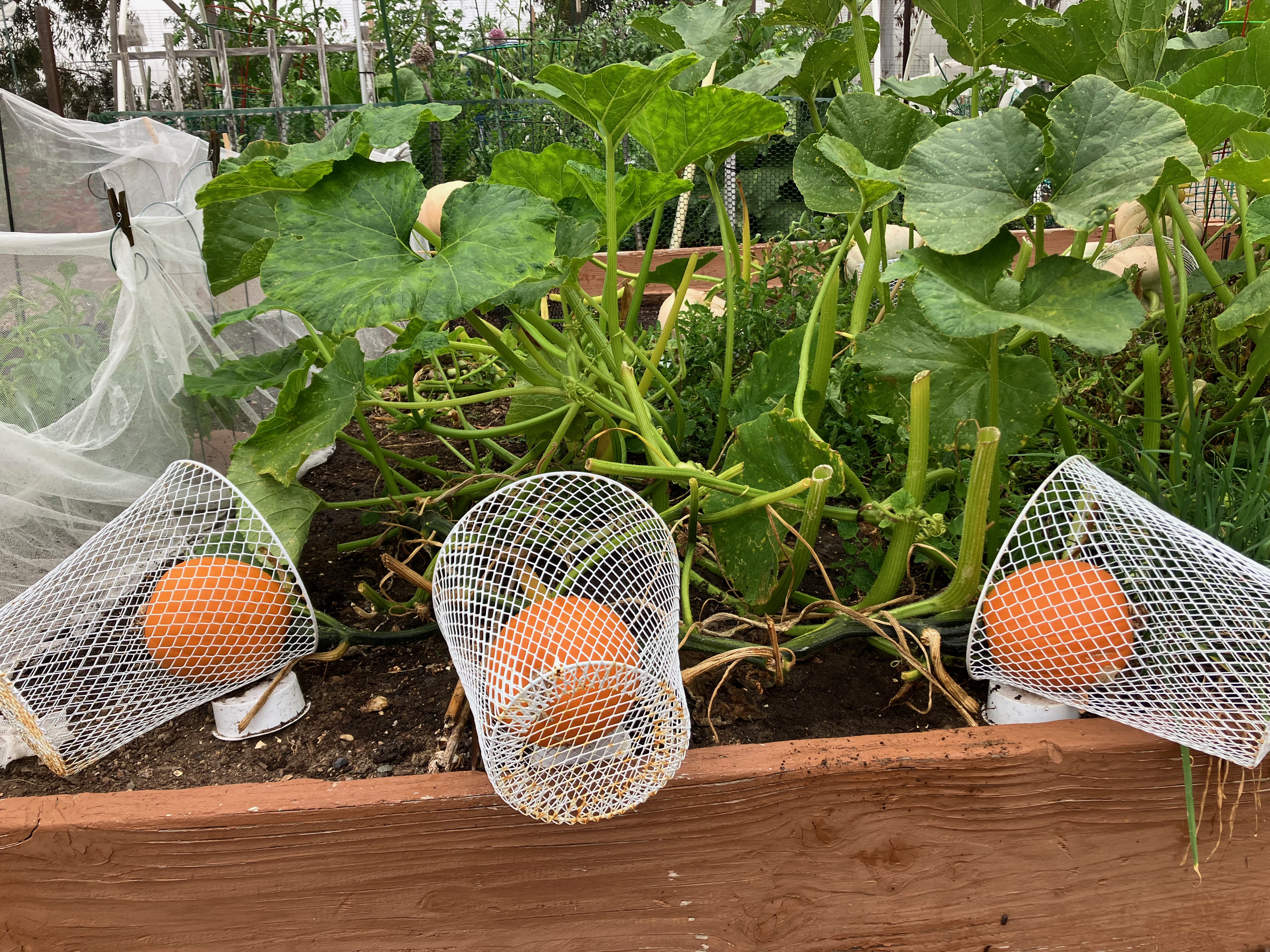
The biggest surprise, though, was a set of extensive vines spilling over all the plot’s edges. It took me a while to identify them. I hadn’t planted squash, although the previous year I’d been gifted with a single volunteer courtesy of a local bird. These plants had large squash-like leaves, with some cream-colored smallish fruit on the ground. My friend hadn’t wanted to remove them, since she wasn’t sure whether or not they were weeds.
After a couple of internet searches, I was pretty sure that the mystery vines were pumpkins. I hadn’t intentionally planted pumpkins, either. There were too many of these to have been gifts of the birds, though. Thinking back, I remembered that we’d eaten a fair amount of grocery store pumpkin the previous autumn. I’d put excess pulp and seeds into my backyard compost tumbler, then used the finished compost to fertilize my plot in the spring. Apparently the compost hadn’t ever gotten hot enough to kill the pumpkin seeds.
pumpkins on the vine in my community garden plot
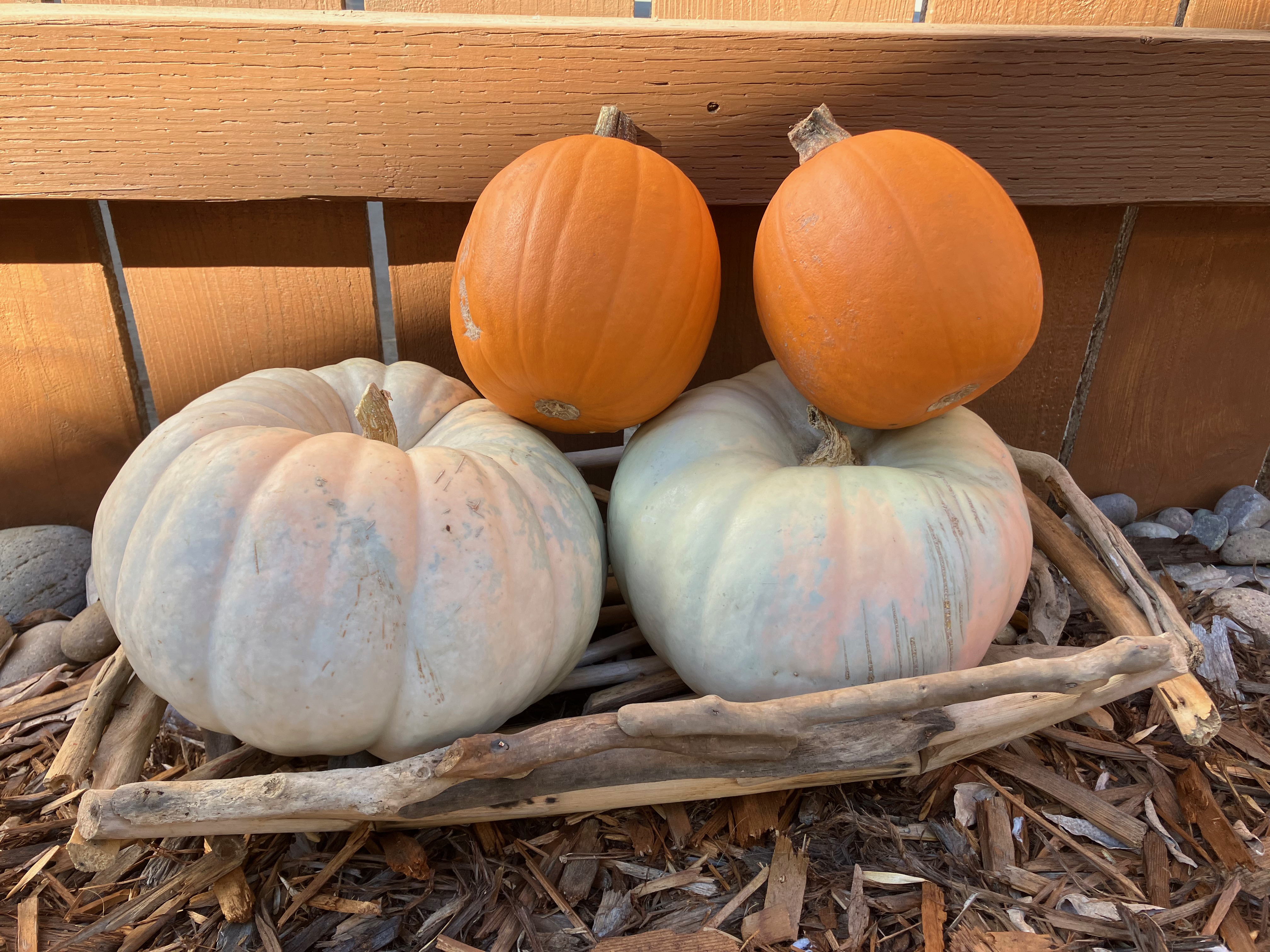
My friend and I were bemused and amused at my volunteer crop. The internet advised keeping the vines from sprawling too much, selecting the largest fruits to nurture, but clipping and discarding the smaller ones. My earliest pumpkins were ready for harvest in August. By the time pumpkin harvest was over in September, I’d gotten several traditionally skinned orange pumpkins, plus another set with cream to pale green outsides. I gave away a few to a local soup kitchen. I experimented with one of the medium-sized pale-skinned pumpkins, making its yellow-orange flesh into curries and custards to eat at home.
The largest of this year’s pumpkins weighs about 10 pounds. It’s in temporary storage, along with half a dozen others, eventually to be turned into pies, purees, and curried soups during cool weather. Compared with record-setting pumpkins, it is a midget. Per a recent internet search, the world’s heaviest pumpkin was grown in Belgium in 2016—it weighed a whopping 2,624 pounds. The heaviest U.S. pumpkin grew in New Hampshire, tipping the scales at 2,528 pounds. Ohio holds the record for biggest pumpkin pie—over 20 feet in diameter, weighing 3,699 pounds. California, though our nation’s top agricultural state, lags well behind top-ranked Illinois and second place Texas in pumpkin poundage. Still, I am glad I have 50+ pounds of pumpkin flesh to help us vary our diet during upcoming cool weather.
pumpkin quartet after harvest
On reflection, though, I think I’ll put any pumpkin seeds from this year’s crop into the municipal compost rather than my backyard tumbler. That way, I’ll reduce the chances of more “accidents” in next year’s plot.
Jimmy Carter served as our nation’s 39th president from January 20, 1977 to January 20, 1981. I voted for him in 1976 and again in 1980. During his presidency and for a number of years after that, when asked about my political affiliation, I identified myself as a “Carter Democrat.” Today, October 1, 2024, Carter turns 100. For many, his contributions to global health and progress since his presidency have been even more impressive than his accomplishments while in office. In 1982, Jimmy and his wife Rosalynn co-founded the non-profit Carter Center. In 2002, Carter was awarded the Nobel Peace Prize for his persistent efforts to promote global health and to encourage peaceful solutions to difficult problems worldwide. For over 30 years, Jimmy and Rosalynn spent at least a week each year helping build quality low-cost housing with non-profit Habitat for Humanity.
Since the beginning of the 21st century, my political trajectory has gradually diverged from official designation as a big-d “Democrat.” Turned off by increasingly shrill campaign entreaties and demonization of “the other side” from both major political parties, I now have “no political party affiliation.” However, I keep my voter registration up to date. I make it a point to vote in local, state, and national elections if at all possible, sometimes even voting absentee from places outside the U.S.
How I became a “Carter Democrat” and why I still consider myself one involves both timing and geography. In 1968, I cast my first vote in a presidential election for Richard Nixon. I believed his promises to help extricate the U.S. from involvement in the war in far-off Vietnam that his predecessor Lyndon Johnson had escalated. Partway through Nixon’s first term, in 1971, I moved from Baltimore to Vermont. I’d secured a job in its small capital city of Montpelier. The early 1970’s saw a lot of social ferment, along with burgeoning interest in caring for our natural environment. I was part of a trend of young, childless adults aiming to “go back to the land” after disenchantment with urban life.
Vermont was at the forefront of environmental legislation, including a 1970 comprehensive land use program, “Act 250,” designed to maintain Vermont’s rural flavor and natural beauty while allowing for economic growth. A different law passed at about the same time instituted graduated “pay to pollute” fees on companies who discharged waste into Vermont’s waterways. These legislative actions struck me as pragmatic efforts to deal with complex problems—rather than outright prohibitions, using financial incentives/disincentives to promote more environmentally sensitive behavior by both individuals and businesses.
As Nixon’s first term progressed, I lost confidence in his Vietnam policies. By 1972, I had become thoroughly discouraged about the lack of U.S. progress there. I also thought Nixon insensitive on environmental matters, though in 1970 he had signed into law the National Environmental Policy Act after it had overwhelmingly passed both houses of Congress.
So in 1972, I voted for Democrat George McGovern. President Nixon won reelection in a landslide, though, with over 60% of the popular vote and all but two jurisdictions’ electoral votes. Meanwhile, my idyll in Vermont proved short-lived due to unemployment and underemployment. Late 1973 found me and my husband spending our severance pay on a low-budget trip down the Mississippi River valley in our small pickup truck. We were trying to put our lives back together, to figure out what to do next.
Globally, in 1973-74 a group of oil exporting nations reduced their production levels and paused oil exports to the U.S. to retaliate for U.S. support of Israel in 1973’s Arab-Israeli war. This caused an “oil shock,” with the average price of gasoline rapidly rising over 30%. The crisis caught up with my husband and me when we were in a part of Louisiana with huge concentrations of refineries and oil transport facilities. Still, gasoline supplies were short. Tempers, too. Local gas stations sprouted long lines. Late autumn temperatures soared, threatening A/C-induced blackouts in an oil-dependent electricity grid. We were somewhat shaken by this evidence of American vulnerability to “oil blackmail.” Meanwhile, Nixon’s first vice president, former Maryland governor Spiro Agnew, was in December 1973 forced to resign after being charged with conspiracy, bribery, and tax evasion. Nixon quickly nominated Michigan Congressman Gerald Ford as Vice President. Ford was just as quickly confirmed by his Congressional colleagues.
Partway through 1974, my husband and I found good-paying jobs in the mid-sized American city of Richmond, Virginia, where my younger sister then lived and had provided us with temporary housing. We gradually put the trauma of our job reversals and subsequent relocations behind us. Then came the Watergate scandal and Nixon’s August resignation from the presidency. It flummoxed me why someone who’d won reelection so convincingly would turn out to have been a cheat who’d tried to undermine the other party’s campaign. During Congressional hearings, Nixon’s efforts to distance himself from a botched June, 1972 break-in at the Democratic National Committee in Washington, D.C. gradually collapsed. My faith in our electoral system took a hit. Gerald Ford became president.
By 1975, I was no longer paying much attention to national politics. I focussed instead on buying our first home, starting a family. I didn’t think Ford was a bad President, but I was troubled by his pardon of former President Nixon. When Jimmy Carter won the Democratic nomination for President in 1976, I was ready for a fresh face, a fresh approach. After all Nixon’s lies and evasions, Carter’s assertion that “I will never lie to you” sounded doubly refreshing. Our older son was born as Carter began his campaign; our younger son arrived partway through his term. I struggled to stay informed about local, state, and national issues while changing diapers and dreaming of some day reentering the paid work force.
When the winter of 1976-77 turned out to be more severe than most, Carter’s early “fireside chat” (February 2, 1977) calling for energy conservation and small, shared sacrifices resonated with me. My earlier experience of two Vermont winters had given me considerable respect for the vagaries of weather. Richmond, Virginia typically has mild winters, but I’d made sure to install multiple sources of heat in our house—gas, electricity, plus an efficient wood stove in our largest room. I supported Carter’s efforts to diversify the American energy supply.
In the late 1970’s I continued my efforts to become a more responsible energy user. I improved our house’s insulation, grew more of our own food, increased my use of public transportation. A second “oil shock” in the wake of the 1979 Iranian Revolution impacted me less than most. I hoped people would recognize our need to reduce our nation’s oil dependence and to become better environmental stewards. I did my best to follow Carter’s lead, even when it involved some material sacrifice. To my dismay, the combination of energy difficulties, high inflation and unemployment, plus a lengthy U.S. hostage crisis in Tehran destroyed Carter’s chances for a second term. In 1980, former California governor Ronald Reagan handily defeated Carter with just over 50% of the popular vote in a 3-way race.
If Carter was disappointed at his loss, he soon regrouped. Rather than stew over his defeat or attempt to persuade others that the 1980 election was “stolen,” he turned his considerable energies toward improving the lives of the world’s least fortunate. Over the years, the Carter Center has launched initiatives to reduce or eliminate six preventable diseases common in tropical climates. It is closing in on the elimination of guinea worm disease, having reduced the incidence of this debilitating parasitic infection from an estimated 3.5 million cases in 1986 to just 4 reported cases so far in 2024. Since 1989, the center also has monitored elections in 40 countries after having been invited in by the major political parties participating in those elections.
from a Carter Center brochure
The 2024 U.S. election will mark my 15th presidential election cycle. By now I have cast the majority of my presidential election votes. I’ve supported winning candidates about half the time. I have lived through several policy reverses that I wish had not happened. Through it all, I’ve maintained a sense of hope and a belief in the importance of sound, sensible environmental stewardship. It seems to me, as it did to Carter nearly fifty years ago, that a transition to more responsible energy use is needed. I believe that a transition to renewable energy sources will continue, regardless of the 2024 election outcome. Eventually, regardless of who occupies the White House or any other country’s leadership, the world’s oil and coal reserves will be depleted.
However, ingenuity and regard for our fellow humans and for the natural world that supports us are the ultimate renewable resource. Amidst all the hubbub and negativity, it’s important to avoid pointing fingers. It’s important to stay engaged. Democracy has always been an experiment, with some failures along with its successes.
Jimmy Carter’s faith is at the root of who he is as a person, regardless of any political position he might hold. I appreciate the bywords of this white evangelical, Naval Academy graduate, former nuclear submarine engineer, former peanut farmer, and former president from the rural U.S.: “My faith demands that I do whatever I can, wherever I am, whenever I can, for as long as I can with whatever I have to try to make a difference.”
I’m proud to have been a “Carter Democrat.” Mr. Carter, may your persistence and long-range vision continue to inspire those of us not yet to the century mark. Happy, Happy Birthday!
Nearly forty years ago, I checked out a small book from our local public library: Finite and Infinite Games, by James P. Carse, then a professor of history and religious studies. As I read through it, I noticed that many of the book’s examples drew heavily from recent U.S. experiences in Vietnam. Some of Carse’s conclusions struck me as overly simplistic. Still, I liked his basic premise, summarized as:
“ There are at least two kinds of games: finite and infinite. A finite game is played for the purpose of winning, an infinite game for the purpose of continuing the play. Finite games are those instrumental activities … in which the participants obey rules, recognize boundaries and announce winners and losers. The infinite game … includes any authentic interaction, from touching to culture, that changes rules, plays with boundaries and exists solely for the purpose of continuing the game.”
A few years before I encountered the Carse book, I’d been involved in a set of human potential workshops. One simulation near the end of a multi-day sequence had both finite and infinite game possibilities. Late into the evening of the next to the last day, we participants were divided into two teams of about fifty people each. The game was initially explained to all of us together, but its rules were kept deliberately vague. Each team was then led into its own separate soundproof room, isolated from the other team. We were very limited in our inter-team communications—only short written messages could be exchanged by “runners” between the rooms.
During successive rounds of the simulation, we could vote as a team either to cooperate with the other team, or to compete with it. We had to decide as we went how to determine our team’s vote and how to guess the other team’s strategy. We were not sure when the game would end, or even exactly what the object of the game might be. Not until after the simulation was over were we asked to consider whether the aim of the game might have been to maximize our overall results by consistently cooperating. (Similar games, often labeled “the prisoners’ dilemma,”have been used by game theorists to examine human behavior in a wide variety of circumstances.)
Later, while our children were in elementary school, I became acquainted with one of the teachers in their school system’s enrichment programs. Though John Hunter didn’t directly interact with our children, some of his ideas percolated throughout the system. Near the end of his school teaching career, he became something of a celebrity by publishing a book about a term-long simulation he had engaged in with many successive classes of students.
Hunter’s book, World Peace and Other 4th Grade Achievements, has since spawned a TED talk, a film, and a non-profit, The World Peace Game Foundation (worldpeacegame.org). To “win” his world peace game, Hunter established that by the end of the multi-round simulation, the inhabitants of his four mythical countries must not be engaged in active conflict. Also, their collective total resources must be greater than when the game started. He didn’t try to prefigure the outcome of any of the simulations. He let the students work through their own process, being available only to answer process-related questions. Often, he was sure until the very last minute that he and his students would “lose” the game. He was/is sometimes amazed at the creativity and empathy of nine and ten year olds tasked with solving 50 interlocking and mutually reinforcing problems.
By the time this blog entry gets posted, we will be less than 60 days from the 2024 U.S. elections. If this election cycle is like most recent ones, inflammatory rhetoric among candidates and their partisans will be escalating. “Facts” will be cherry-picked, sometimes not facts at all.
So I take heart from a sequel to Carse’s book that came out in 2019, Simon Sinek’s The Infinite Game. The author, a management consultant and bestselling author, begins with an acknowledgment of Carse’s precursor work. Sinek then expands on Carse’s premises with examples from his consulting practice. He also sets out five guidelines for playing an infinite game, regardless of the stances of the other players around you:
—advance a just cause (not just increasing shareholder/stakeholder wealth) —build trusting teams (partly by modeling empathy and inclusion, partly through coaching) —study your worthy rivals (they can help you improve) —prepare for high-stakes flexibility (sometimes you have to bet the ranch) —demonstrate the courage to lead (don’t expect an easy process; do your best to stay both humble and connected)
Whatever putative leaders we may choose during this election, afterwards we will each have the option to orient (and/or reorient) our life choices. We can tilt toward playing more finite or more infinite games. Maybe in the long run, whether we know it or not, we’re all playing an infinite game.