Category Archives: Uncategorized

Winter Beach Respite

Winter Beach Respite     —by Jinny Batterson

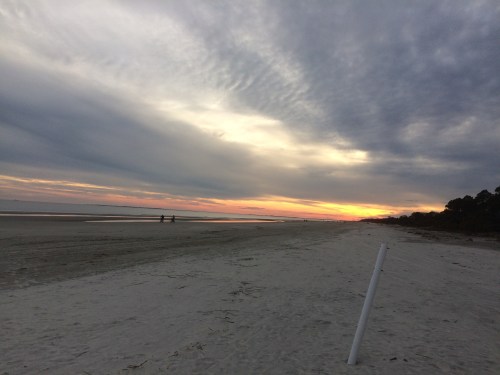
Barrier island beach at sunset

Barrier island beach at sunset

Just after New Year, we packed the car: layers and layers
Of casual clothes, plus assorted toys and games.
We headed for one of the barrier islands that
Dot the Atlantic from the Carolinas to Florida.

We’d spend a few days at the beachside condo
Of old friends, a final annual chance to reconnect
Before tax season swallowed them
And potential citizen activism swallowed us.

We arrived to balmy weather, with time for a brief
Beach stroll before sunset. Little view yet of the miles
Of downed vegetation and splintered piers and decks,
Remnants of Hurricane Matthew’s October impact.

It was after dark before our friends arrived, having
Battled urban traffic on their different trajectory east.
A brief political discussion gave way to reminiscences:
The guys had known each other since youth. 

One afternoon proved too chilly and windy for outdoor activity,
But often we walked–carrying binoculars to hone in on shore birds,
Or exclaiming as our more experienced friends pointed out the
Dolphins that sometimes trolled for fish in the breakers at low tide.

A morning guided excursion took us through parts of this island
Once owned by Gullah families descended from slaves.
Before resorts and tourism took over, they earned decent livings
Farming or fishing or ferrying neighbors to and from the mainland.

Predictions of an approaching winter storm cut our idyll short.
Several days of shivering and stabbing at recalcitrant ice have
Partially diminished our relish for January in the Southeast,
But not entirely. Our beach respite memories remain.

The Spirit of Draining the Swamp

U.S. Election Day is over a month behind us. Depending on our traditions and beliefs, we may be preparing to celebrate Christmas, Hanukkah, Kwanzaa, or just the returning of longer days. Many Americans are beginning to feel our way toward a future–a future still very unsure. During the final days of the fall campaign, I began to see a new crop of political slogans, advocating a particular vote as a way to “drain the swamp of D.C. politics.” I’ve been tossing around various dream versions of what “draining the swamp” in a wider sense might look like.

Usually I’m more of a word person than an image person, but I have several cartoon images in my mental collection that may be relevant. All are accessible via Internet. The first is a 1971 Walt Kelly panel from his long-running cartoon about Pogo the possum and his beloved swamp, a mythical variation of the Okefenokee. Pogo is treading across a morass of human-generated trash near his swamp home, stepping carefully to avoid hurting his feet. Beside him, Albert the alligator is waxing eloquent about pristine wilderness. Pogo is having none of the hype.

“We have met the enemy,” he retorts, “and he is us.”

The second cartoon is a 1976 strip by New Yorker cartoonist Dana Fradon, giving a baseball style box score for a supposed game between realists and idealists. Though some innings are scoreless, in most, the Realists make between one and six runs, while the Idealists are held to no score. However, at the end of the game’s nine innings, the final score reads: “Idealists 1; Realists 0.” The third cartoon was sent to me by a friend last summer. I haven’t yet been able to trace its original source–I believe it first appeared in 2014 in a Quebec-based news outlet. It shows an audience for a sermon or speech of some kind.

“Who wants change?” the leader intones. All hands go up. The follow-up question: “Who wants to change?” gets no hands at all, only a series of downcast looks.

Pogo and Fradon’s baseball players and the 2014 speech audience help me stay hopeful that our badly divisive election may have the unintended consequence of helping bring us together. We sorely need to drain the noxious elements of our personal and collective swamps, while retaining the generativity of the diverse wetlands they also represent.

Perhaps this election can draw us to deeper service. Our nation’s founders were realistic enough to know that we are not likely ever to create a totally perfect union, yet idealistic enough to begin our Constitution with the phrase “to create a more perfect union.”  In the best tradition of our founders, and of more recent visionary Dr. Martin Luther King, Jr., may we use the day of service we’ll celebrate as his holiday on Monday, January 16, 2017, to stop obsessing about who “won” the election. Instead, may we rededicate ourselves to the spirit of service that has meant so much for the progress and maturation of our beloved and varying country. If each of us will reach out to help and be helped by a person or group we would not normally associate with, we can begin the needed process of healing ourselves and each other, in the true spirit of draining the swamp.

Tribute to Leonard Cohen

Tribute to Leonard Cohen (1934-2016)    —by Jinny Batterson

(Leonard Cohen, peripatetic Canadian poet and singer-songwriter, died in Los Angeles on November 7, 2016, a bit too early to absorb the results of the latest U.S. election.  I’m convinced, though, that his spirit still prowls. This short tribute incorporates snippets of several of Cohen’s best-known lyrics: Anthem, You Want it Darker, Suzanne, The Story of Isaac, and Democracy)  For a picture of Cohen near the end of his long life, see:

http://www.billboard.com/files/styles/article_main_image/public/media/leonard-cohen-2013-billboard-650×430.jpg

The bells that still will ring
These post-election days are ringing darker.
Though some the victor’s fulsome praises sing,
For others, the rifts are getting starker.

I saw him only once, we both were young.
In an Expo coffeehouse near Suzanne’s river,
He curled his raspy voice, lips, teeth and tongue
Around the credo that we lean toward love forever.

Bombastic tweets of blunt and bloodied hammering
May make hate and fear here for a time hold sway.
Yet, through the crack in everything
Democracy’s still coming to the U.S.A.

The Myth of Objectivity: Choosing our Facts

The Myth of Objectivity: Choosing Our Facts     —by Jinny Batterson

This fall’s election season left me both physically and emotionally exhausted. In October, as attack advertising on all sides escalated and early voting started, I finalized plans to visit extended family on the west coast shortly after the election was over. It seemed a good way to regain some longer term perspective—the two generations that come after me would help me regain balance.

Now that I’m in sunny California, we’ve mostly avoided talking politics. I’m sure we don’t agree on everything. Avoiding hasty words is an antidote for having to take them back later. The grandkids are cute, and generally uninterested in grown-up concerns.

However, I haven’t escaped political repartee entirely.  My first Sunday here, I was sitting under a shade tree, watching the kids play as the awards ceremony for our son’s final cross country race of the season droned on. A man also watching from nearby piped up with unsolicited advice: several of the kids were playing in a way that might result in injury, he said. A friend of his had had a dangerous fall and lost an eye. I thanked him, mentioned his concern to the kids, asking them to be a little more careful, and thought that would be the end of our interaction. No such luck. 

“What do you think about the results of the election?”  he inquired.

“I’m not too happy,” I responded. “I would have preferred that the other presidential candidate had won.” 

“How could anyone support someone who violated the first tenet of public service?” he jibed. “I was in the Coast Guard. If I had sent classified information over a private email server, I’d forever have been disqualified from further service, let alone from becoming Commander in Chief.” 

Not wanting to get further enmeshed in a discussion that didn’t seem likely to have any positive result, I tried for more neutral ground.

  “Neither candidate was all that appealing,” I ventured. “I didn’t like the way Mr. Trump repeatedly insulted all sorts of people.” 

“Most of that was just bluster,” he responded. “After all, Trump is a brash New Yorker. Still, he has valid points. For example, there are over 750,000 illegal immigrants in New York City alone. That makes more than 10% of the population. They’re taking up housing that should be available to those of us who were born here or came here legally.”

Succumbing to continuing a conversation that I was pretty sure would end badly, I responded, “In the part of the country where I live, immigrant labor harvests nearly all of the crops. We need those workers.”

“Ha!” he said. “There was a time, during World War II, when there was a shortage of local workers for harvesting because so many American men were serving overseas, so immigrants were allowed in. However, once the war was over, Eisenhower sent them all back where they came from.”    

‘Look,” I said, “it seems that you and I view very different parts of reality. I respect your perspective, but I can’t agree with it.”

“Lady,” he said, “you’re entitled to choose your opinions, but you cannot choose your facts.”  With that, he strode off, triumphant. 

Not one gifted in coming up with snappy responses, I later did a bit of further research. Estimates of illegal immigrants/undocumented workers in New York vary widely, with the high-end 750,000 figure most likely coming from an online 2015  post by conservative-leaning publisher Newsmax. Every article about immigration has an editorial slant, explicit or implied—emphasizing either the costs or the contributions of this section of the American population. Some sources stress the need to keep families together, the need for skilled workers, or the aging of the U.S.’s native-born population. Others emphasize the need to reserve jobs/housing/advancement opportunities for the native-born. During the presidential transition, immigration remains a hot-button issue. 

I don’t have a pat answer. I’m not hopeful that our national immigration policies will become either more sensible or more humane for the near-term future. However, I believe that there is a way toward consensus in our nation of immigrants.  As recently as 2013, the U.S. Senate managed to pass a comprehensive immigration reform bill,  S.744, with a substantial bi-partisan majority.  No comparable bill has so far passed the House of Representatives.

To further chances for reform, I believe we’ll need to listen to each other’s stories more deeply. We’ll need to broaden our array of “facts” beyond the mostly biased reporting we’re being subjected to on all sides.

To get a more general view, I turned to a different Internet site and searched for TED talks about “search engines.” I found the following brief talk by Swedish journalist Andreas Ekstrom—“The moral bias behind your search results.”  (http://www.ted.com/talks/andreas_ekstrom_the_moral_bias_behind_your_search_results/transcript?language=en)  

Ekstrom uses two examples of image search results that got temporarily distorted by massive bias: the first, a 2009 derogatory representation of Michelle Obama, was quickly removed by Google; the second, an equally derogatory 2011 representation of mass murderer Anders Breivik, was allowed to continue until it died out on its own. Ekstrom concludes: “And I (emphasize) this because I believe we’ve reached a point in time when it’s absolutely imperative … to remind (ourselves) that that wonderfully seductive idea of the unbiased, clean search result is, and is likely to remain, a myth.” 

Let’s choose our “facts” carefully.      

Practicing Gestational Politics

Practicing Gestational Politics   –by Jinny Batterson

Now that we have apparently elected
a prime verbal ejaculator
to be our putative leader,
it will not do to turn our
hurt and anger inward,
nor will it suffice to cry
out in rage and disgust.

What we must do
instead is to take a short respite,
then to return with renewed dedication
to building bridges across the chasms of race,
class, gender, urban/rural, national origin, affection
that this retrograde campaign has opened up.
We must nurture ourselves, along with
the next generations of humans
and of other creatures
on this lovely planet.

International Day of Peace, September 21

International Day of Peace, September 21    —by Jinny Batterson

For nearly a decade, I’ve received annual reminders of a celebration of an “international day of peace” on September 21, around the time of the equinox (autumn in the northern hemisphere, spring in the southern).  I relish these reminders to refocus during what too often can be a harried and hurried time, with back-to-school events, work crises, health check-ups, omnipresent political campaigns.  So this year’s reminder was especially welcome—2016’s politics in my home country, the United States of America, appear even more ugly than usual. The timeframe for this year’s peace celebrations has expanded, I learned, now encompassing the eleven days between September 11 and September 21. This year’s celebrations focus on global development goals. 

As nearly as I can tell via online search, the United Nations began issuing annual proclamations for a day of peace in 1997 as part of a broader global effort to advance a transition to a culture of peace. Their initial resolution called for a “transformation from a culture of war and violence to a culture of peace and non-violence.” The resolution defines the culture of peace as based on “respect for human rights, democracy and tolerance, the promotion of development, education for peace, the free flow of information, and the wider participation of women,” in addition to disarmament efforts. This year’s events include several in the area of central North Carolina where I live. I hope to attend at least some of them: http://www.paceebene.org/event/cnv-actions-raleigh-areanc-peace-week/.

My understanding of peace continues to evolve from an initial aversion to my fiance’s draft status in 1969 near the height of U.S. involvement in Vietnam. Over time, I’ve come to believe that peace is much more comprehensive than the absence of armed conflict, whether among nations, among non-national groups who use violence to try to further their aims, or between individuals. It seems increasingly clear to me that peace needs to exist at all the same levels in which violence can incubate, from a single person to the entire global community. Peace grows best in an atmosphere of abundance, based partly on sharing, and partly on our inner conviction that we have, and, more importantly, ARE enough. 

One group that I support whose peacemaking involves a transition to abundance is Heifer International. First started in the wake of World War II as a way to restock farm animals to war-ravaged areas of Europe, the program now exists in 30 countries on five continents. Heifer conducts long-term efforts to alleviate poverty and promote peace through both donations of farm animals and education in sustainable farming practices. The autumn 2016 issue of their magazine, World Ark , includes an extensive interview with author/activist Frances Moore Lappe, first known for her seminal work on global food resources, Diet for a Small Planet (published in 1971). Lappe has gone on to publish fifteen more books, and to become a global activist for peace and development. Her take on what may be needed to transition toward peace and abundance resonates with me:  “While scarcity can be a lack of the physical resources that we need to thrive, such as food, water and energy, it can also be a presumption of the scarcity of goodness in human beings. Unfortunately, our media largely offers the most frightening and horrifying news, reinforcing this sense of lack of goodness in us. As you know, there are many fewer stories about our nobility, humanity, and our natural desires to help, to share and be compassionate, than there are about our brutal side.” 

Part of my individual effort this season to cultivate peace is to minimize my media exposure, while at the same time staying informed enough to function in our increasingly interconnected, interactive world. Another practice has been inspired by one of the more heartening reactions to September 11, 2001: a musical setting to a breathing meditation by a Georgia-bred songwriter who reacted to the airplane-mediated suicide bombings by creating a melody and chorus:  “When I breathe in, I’ll breathe in peace, when I breathe out, I’ll breathe out love.”  (The entire song, including verses, is online at http://www.sarahdanjones.com/music-1.html).

It turns out that the equinox here this year will not be until September 22. Peace activities in my town won’t culminate until Saturday, September 24. Still, I urge all of us who breathe to try today, as the simplest, smallest step toward peace, to take at least a couple of breaths using the “breathe in peace” refrain.   

Other Things Some Older People are Thinking and Need to Say Out Loud

Other Things Some Older People are Thinking and Need to Say Out Loud

                       —by Jinny Batterson

This spring, as the U.S. 2016 presidential campaign began heating up, I came across an interview with the daughter of former third party presidential candidate George Wallace of Alabama, most famously noted for having said in 1963, “Segregation now. Segregation tomorrow, and segregation forever.” In late April, Peggy Wallace Kennedy suggested as part of a radio interview that the 1968 third party presidential candidacy of her late father has echoes in the current campaign.

“Trump and my father say out loud what others are thinking but don’t have the courage to say. They both were able to adopt the notion that fear and hate are the two greatest motivators of voters that feel alienated from government,” she remarked.  Much of what Mr. Trump has had to say so far strikes me as racist, xenophobic, misogynistic, jingoistic, reactionary, or all of the above.

It occurs to me on the eve of the 2016 political conventions that both this year’s major party presumptive nominees are my close contemporaries—we are “leading edge boomers,” over a decade older than our current president. Donald Trump (born in June, 1946) and Hillary Clinton (born in October, 1947) are within a year of my age. So here are a few things that I remember from our mutual early adulthoods in the late 1960’s and early 1970’s, compared with our current situation. Candidates may remember them, too, even though they are generally not saying them out loud.

Work: In 1970, about 80 percent of working age men were in the paid labor force, nearly twice the rate of working age women. Since then, that gap has declined significantly. It’s estimated that by 2020, the proportions will be roughly 70% for men and 60% for women. The gender pay gap has also declined, though women’s wages have yet to reach parity with men’s for comparable jobs—an estimate in 2015 put women’s average earnings, across all occupations and wage levels, at roughly 82% of men’s. Wages for all workers, adjusted for inflation, have stagnated since the mid-1970’s.

The number of American manufacturing jobs peaked in 1979, when roughly 19.5 million workers were employed in the manufacturing sector. In 2016, roughly 12.3 million Americans (about 8% of the overall labor force) work in manufacturing. Some manufacturing job losses are the result of outsourcing to lower wage countries; many previous manufacturing jobs have been automated out of existence.

Some segments of the economy, dominant in earlier phases of American history, were at much lower levels by 2014, according to labor statistics: agriculture/forestry/fishing employed less than 1.5% of the workforce; construction accounted for just over 4%; mining only about half a percent. The fastest growing sector is health care/social assistance, which now accounts for about 12% of the labor force.  Professional/business services jobs (12.7%) are also increasing rapidly.

Immigration: The proportion of foreign-born residents in the American population hit an all-time low at the 1970 census. Just 4.7% of Americans then were foreign born.  Both numbers and proportions of foreign-born legal U.S. residents have increased dramatically since then, reaching an estimated 13.3% in 2014. The number of additional undocumented residents is in the range of 10 to 12 million, with an immigration system that nearly all agree is badly flawed.

Military: A military draft in force from 1948 through 1973 affected men aged 19 through 26.  In 1969 and 1970, during the height of U.S. involvement in Vietnam, about half a million Americans served in that country each year, many of them draftees. In late 1969, a birthday-related draft lottery was reinitiated to reduce the uncertainty for eligible young men. With about 850,000 potential draftees to be called up starting in 1970, those with low lottery numbers would be nearly certain to get drafted, while those with high numbers could resume their lives free of worry about military conscription. The draft was ended in 1973.

Active duty military personnel declined in numbers and as a proportion of the population as the Vietnam War and later the Cold War wound down. The post-World-War-II number of U.S. soldiers peaked in 1968 at about 3.5 million. Its current level is about 1.35 million, or less than half a percent of the total U.S. population. About 150,000 troops are stationed outside the U.S.

Some other areas in which substantial changes have occurred since the late 1960’s: Race Relations: major urban riots in 110 U.S. cities following the 1968 assassination of Martin Luther King, Jr. led to better, if sometimes spotty, enforcement of the1964 Civil Rights Act and 1965 Voting Rights Act; increasing numbers of minority voters and elected officials;  Environment: major periodic oil spills; Earth Day; establishment of the Environmental Protection Agency; recognition of global climate change as an issue; Women’s Rights: the Equal Rights Amendment debate; affirmation via the 1973 Roe V. Wade Supreme Court decision of a woman’s right, within limits, to choose whether or not to terminate a pregnancy; Media: from 3 commercial networks plus PBS and NPR to an Internet-laced selection of nearly infinite numbers of channels and viewpoints, many of them unsubstantiated; Political Culture:  increasing frustration with widening wealth and income gaps; lessening civility; splintering of some conventional voting blocs; extensive gerrymandering and attempts at voter suppression.

I’ll likely watch some coverage of both conventions, listening closely to what candidates actually have to say. Improvements in Americans’ lives since I was young have been substantial, but uneven, with periodic backsliding. Much more can be done, but it’s unlikely to take place in an atmosphere of fear and hatred. Much will depend not on the candidates, but on citizens’ willingness to stay engaged, informed, and civil. 

Toward a New Consensus: Voting Thumbs Side

Toward a New Consensus: Voting Thumbs Side    —by Jinny Batterson

Most Americans these days are subjected to increasingly agitated media and political environments—uneasiness about the state of our personal finances and national budgets, evidence of ethnic and racial profiling, demonstrations and counter-demonstrations, terrorism fears, an American presidential contest replete with name-calling and innuendo. A cheery attitude seems somewhat out of place. Still, I keep looking for glimmers of an emerging new consensus, both locally and beyond my geographical area. 

During the late 1970’s, I was exposed to the human potential movement. In intensive workshops, I completed solo, two-person, and group exercises to better understand what motivated me, and what might motivate all of us attendees to interact more humanely and productively with each other. One impression that has stuck with me is that individuals and groups typically exhibit agitated behavior just before transitioning to a different level of organization.

A decade later, I attended an experiential simulation of a five phase change model based on the work of family therapist Virginia Satir: 1) original, decaying status quo; 2) introduction of a “foreign element” that generates resistance; 3) chaos, resulting in a transformative understanding; 4) practice and integration of new learnings, leading to—5) a different status quo. None of us participants wanted to go through the chaos phase. Yet, as the simulation progressed, we each came to recognize that passing through chaos was the only way to transform a system that no longer worked for us, to move toward a newer, generally more inclusive state.       

About the same time, I started attending an annual week-long “un-conference” with other small-scale consultants at “consultants’ camp.”  A decade into the camp experience, an initial phase of “top down” camp leadership ended, and our group went through chaos to evolve an alternate model. Part of the revised model consisted of a single annual morning session to tend to the nurture and future of the camp community through consensus decision making.

One of the most important features in the consensus model we adopted is an open system of thumbs up/thumbs side/thumbs down voting to validate any proposal. Approval requires a strong consensus from all community members—a single “thumbs down” vote defeats a motion. However, because it is highly unlikely that any proposition will be equally pleasing to the whole community, we include a “thumbs side” option. Voting thumbs side is much more participatory than abstaining. While a “thumbs up” indicates enthusiastic support of a proposal, a “thumbs side” shows that the proposal being voted on is not the voter’s first choice, maybe even not his/her fifth or sixth.  However, by voting “thumbs side,”  the voter shows a willingness to abide by the choice of others voting either thumbs up or also thumbs side. A thumbs side voter agrees to support the proposal, if enacted, and to avoid actions that might undermine its implementation. No gossiping, no backbiting, no second-guessing, no requests for reconsideration until the succeeding year’s camp session. This kind of consensus decision-making requires much time, effort, and goodwill among participants, but it seems to generate better long-term decisions and stronger group cohesion. 

The model for our smallish camp (typically 25-35 members) likely does not scale up to broader political discourse. However, other efforts are underway in lots of places to re-establish civil discourse and downplay strictly “either/or” choices. For example, an Institute for Emerging Issues headquartered near where I live in central North Carolina has focussed for the past year on the future of work, trying to come up with long-term strategies to enable North Carolinians to earn living wages in the face of continuing automation and globalization. Localities throughout the world can now organize TEDx conferences to bring together people and “ideas worth spreading,” using a template developed by the evolving non-profit, TED (Technology, Entertainment, Design).  So I remain hopeful, I keep the television mainly off, and I practice strengthening my “thumb side” muscles.         

The Firebrand and the First Lady

The Firebrand and the First Lady     —by Jinny Batterson

The Firebrand and the First Lady: Portrait of a Friendship, published early in 2016, was written long after the deaths of its protagonists, Anna Eleanor Roosevelt and Anna Pauline Murray. Eleanor Roosevelt was the niece of President Theodore Roosevelt and the activist wife of her distant cousin, President Franklin Delano Roosevelt. She continued in her own right after her husband’s death. Pauli Murray was an activist, organizer, lawyer, writer, and eventually a priest. She dealt with the double whammy of discrimination for being black and female in a time that undervalued both.

Just after the title page, author Patricia Bell-Scott introduces the two women through quotations taken from their extensive writings and correspondence. The first listed entry, from Pauli Murray, was published over 20 years after Mrs. Roosevelt’s death in the journal of Murray’s university, The Hunter Magazine:

“For me, becoming friends with Mrs. Roosevelt was a slow, painful process, marked by sharp exchanges of correspondence, often anger on my side and exasperation on her side, and a gradual development of mutual admiration and respect.” 

Mrs. Roosevelt’s initial quotation came from an article, “Some of My Best Friends are Negro,” published in the magazine Ebony in 1953:

“One of my finest young friends is a charming woman lawyer—Pauli Murray, who has been quite a firebrand at times but of whom I am very fond.”

Over three hundred well-researched pages chronicle their developing friendship during the years when the two women’s lives intersected, and then the years after Mrs. R.’s death when Murray continued to write, speak, work for social justice, and honor Mrs. R.’s legacy.   

The two were born a generation apart—Roosevelt in 1884, Murray in 1910–to economic and social circumstances that could hardly have been more different. However, the emotional traumas of their early lives were similar. Both lost parents at a tender age. Both were shunted among relatives and schools throughout their teens.

Mrs. Roosevelt first encountered Pauli Murray on a visit to an upstate New York camp for unemployed single women in 1934 or 1935.  Murray had gone there during the depths of the Great Depression to help regain her strength after a couple of years of intermittent employment in New York City. Mrs. Roosevelt had helped finance the camp. She had insisted that it be racially integrated. During the first lady’s visit, Murray hung back and said nothing, later getting scolded by the camp director for her lack of manners.

The two women next interacted when Murray copied “Mrs. R.” on an impassioned 1938 letter to FDR criticizing his spotty civil rights record, especially his recent speech praising “liberal” University of North Carolina, which repeatedly rejected Murray’s graduate student application on racial grounds.

By the early days of 1940, Murray was executive director of a non-profit highlighting the problems of sharecroppers. She and several colleagues had a chance to meet with Mrs. Roosevelt in Mrs. R.’s Manhattan apartment. From then on, the two women carried on an irregular but spirited correspondence for the rest of their mutual lives. Mrs. R. helped when she could with some of Murray’s causes, but cautioned restraint, occasionally even upbraiding Murray’s brashness.

When Murray graduated from Howard Law School in June, 1944, ER sent a congratulatory note and a bouquet. When FDR died in April, 1945, Murray sent Mrs. R. a lengthy condolence: “…There is not one I’ve seen who has not expressed a physical illness over the disaster which has befallen each individual American today. …I pray for your strength and fortitude, because we all need you more than ever now.”   

ER went on to chair a U.N. commission that developed and got General Assembly approval for a Universal Declaration of Human Rights in 1948. She worked at the U.N. for several more years, then continued writing, speaking, and humanitarian work until her death in 1962.

Murray offered this public tribute at a 1982 conference celebrating Mrs. Roosevelt’s life:

“I learned by watching her in action over a period of three decades that each of us is culture-bound by the era in which we live, and that the greatest challenge to the individual is to try to move to the very boundaries of our historical limitations and to project ourselves toward future centuries. Mrs. Roosevelt … did just that.”

Murray attended a 1984 conference celebrating the centennial of ER’s birth, but was hospitalized soon afterward with serious health problems.  She died in 1985.

If the delay in publishing The Firebrand and the First Lady partly resides in the meticulous scholarship to track down sources and verify quotations, it seems to me that the timing of the book’s release is providential. It comes as this year’s U.S. Presidential campaign intensifies. One of the chief actors is a former first lady with extensive qualifications of her own. It comes at a time when LGBT communities, of which Murray was a closeted member, are becoming more insistent on full citizenship. It comes as we approach this year’s celebration of Mother’s Day, when we acknowledge both our physical mothers and those who have nurtured and challenged us, in the best tradition of Anna Eleanor Roosevelt and Anna Pauline Murray.


The Whole Earth Generation(s)

The Whole Earth Generation(s)   —by Jinny Batterson

April 22, 2016 was observed in many countries as “Earth Day.” This annual event, first celebrated in the United States in 1970, has gone global, drawing attention to environmental challenges and the need to cherish this planet, the only one we know can support human life.

By the late 1960’s, the excesses of unchecked industrialization and conspicuous consumption were starkly evident. Our generation, then coming of age in the U.S., had experienced less global armed conflict or material deprivation than our parents’ cohort. Instead, we’d been shaped by the political assassinations of the era, by proxy wars, by the rise of the civil rights movement, and by a growing awareness of the drawbacks of gender inequality. We had a youthful desire for meaningful change—sooner rather than later. Teach-ins were a popular tool on a variety of issues. A Wisconsin senator, Gaylord Nelson, hatched the idea for a national “teach-in” about the environment after viewing the massive 1969 oil spill off the coast of Santa Barbara, California. Twenty million Americans participated.

A little before the first Earth Day was celebrated, a low-cost, no-advertising catalog appeared: The Whole Earth Catalog. Editions were published about once a quarter during the years 1968-1972, and somewhat less regularly thereafter. Many editions carried on their front cover an image of planet Earth as seen from space. The tone of the early catalogs’ introduction was somewhat defiant: “So far, remotely done power and glory—as via government, big business, formal education, church—has succeeded to the point where gross defects obscure actual gains. …(A) realm of intimate, personal power is developing—power of the individual to conduct his(/her) own education, find his(/her) own inspiration, shape his(/her) own environment, and share his(/her) adventure with whoever is interested.” 

The catalog listed its function as “access to tools,” specifically tools that were: 1) useful; 2) relevant to independent education; 3) high quality or low cost; and 4) easily available by mail. 

It may have been through the catalog’s pages that my husband and I were introduced to the work and lives of Helen and Scott Nearing, a professional couple who left city life in Philadelphia during the 1930’s and homesteaded successfully, first in Vermont and later in Maine. The Nearings lived off the land, growing their own food, building their own shelter, writing books and articles about their successes—getting about as far from the “rat race” of corporate culture as one can. Unfortunately, when we tried a similar move in the early 1970’s, we soon learned that we lacked both the homesteading skills exhibited by the Nearings and the stamina to endure the periods of off-land unemployment that are often part of rural life. We retreated to a mid-sized urban area where jobs were more plentiful and the worst excesses of the rat race were less in evidence. We never gave up on the dream of a more sustainable lifestyle. 

Culture and technology have changed a good bit since 1970—the biggest threats to global health and stability can now be more diffuse and harder to tackle than the nation-state wars of preceding generations; civil rights and gender equality have made patchy, uneven, progress; telecommuting has made it more possible to locate in rural settings while still earning a living using mostly urban skills; the Internet has outstripped postal mail as a communications medium. However, some of the basics of human interactions have not changed all that much.

In the Next Whole Earth Catalog, put out in 1981, I found an entry that spoke to me, part of a sidebar called the “Rising Sun Neighborhood Newsletter”:

“If you notice that all the leaders who might make things better get shot you can:
1) Assume their deaths were no coincidence and give up;
2) Spend years proving their deaths were no coincidence and convincing others;
3) Need leaders less.”
When our 2016 crop of putative leaders leaves me unenchanted, I remind myself to need leaders less–some global changes require large-scale interventions, but many more can be carried out at an individual or small group level.

 The “boomer” generation I’m part of is the first to have spent our entire adult lives with images of Earth in all its splendor and fragility as seen from space. The generations coming after ours were born with these images available. I hope they have recognized both their beauty and their vulnerability.  Though we all need leadership at times, I hope that future “whole earth” generations will mature and find their paths realizing that we are all both followers and leaders, and that we need external leaders less.