Category Archives: Uncategorized

The Rest of the Story

The late 1960’s were a turbulent time, somewhat like the period we’re living through now. Starting in 1965, I attended a small liberal arts college in a mid-sized Virginia city. Through studies and socializing, I was exposed to professors and fellow students with a variety of backgrounds and opinions, some quite different from the prevailing views in the small Maryland town where I’d spent my first 18 years. Off campus in our college town, though, prevailing sentiments were every bit as conservative as those I’d grown up with. 

Sometimes as a break from my studies, I listened briefly to a local radio station. Usually I was just trying to catch a local weather report, but I often wound up exposed to all or part of a nationally syndicated news broadcast by radio announcer Paul Harvey (Aurandt). I don’t remember much specific content from Paul Harvey’s broadcasts, but I recall a general tone. In a 2009 obituary, his style was characterized as valuing “rugged individualism, love of God and country, and the fundamental decency of ordinary people.” Through my newly expanded collegiate lens, it seemed to me that Harvey was leaving out huge parts of the news—events and perspectives that did not coincide with his spin. I was learning of historic lynchings, seeing housing and employment discrimination firsthand, experiencing the escalation of the Vietnam war, noting the routine harrassment of minorities and women. None of this seemed fundamentally decent. I began to question the premises of Harvey’s perspective.  

A segment I often caught before the weather forecast was “The Rest of the Story,” typically a relatively unknown part of the life story of a famous person. One especially widely heard segment is about a high school dropout who applied in his early 20’s for an entry level job at the Swiss patent office and nearly didn’t get it. Not until the end of the segment are we told that “Al” may have suffered early life failures, but eventually went on to become world-famous as theoretical physicist Albert Einstein  

(for a rebroadcast, listen to https://www.dailymotion.com/video/x2v3sh1).  Part of the rest of Paul Harvey’s life story was a February, 1951 trespass onto the grounds of government classified research agency Argonne National Laboratory near Chicago for which he was never charged.  

These days I have a schizoid relationship with media. I need to stay informed; too often a media broadcast or internet post leaves me inflamed instead. It is very difficult to follow any news source for long without buying into some of its inherent biases. Images of a violent mob storming the U.S. Capitol are hard to ignore or stay indifferent to. Is there a rest of the story? Temporarily putting aside the role of Mr. Trump, what were the varying motivations that led some to become violent, others to remain as bystanders, and most of America’s population to stay away? Is there anything to be learned from the life histories of those who demonstrated, those who desecrated, those who tried to defuse tensions, those who attempted to report live as events unfolded? 

Few of the reports I’ve heard yet can provide much insight. Too often we get competing narratives that emphasize conflicting aspects of reality. About the only commonality seems to be that all of us are tense. 

We may never know the whole story. Imperfect, incomplete knowledge is part of the human condition. However, if we listen more and speak less, do the messy work of decoupling legitimate grievances from scapegoating and vengeance, insist on both accountability and mercy, we may learn more of the rest of the story.    

McCarthy’s Ghost, Slavery’s Ghosts, Learning All the Verses

I write this on the morning of January 7, 2021, after a 24 hours that tried American democracy in ways not seen for a while. Our electoral system has survived a challenge. Once an unruly mob was finally cleared from the U.S. Capitol, both houses of the U.S. Congress debated and then certified the electoral victory of Joseph R. Biden, Jr. to become the 46th President of the United States. However, challenges remain. Amid a global pandemic, social problems abound. The reputation of the U.S.A. as a beacon of democracy has been badly tarnished, if not destroyed.

I was born into a United States of America reeling from World War II plus the dawn of the nuclear age. My childhood was spent in the shadow of possible thermonuclear war. Our family lived close to Washington D.C.  A nuclear attack on the U.S. capital city would lead to our deaths—from the blast itself or more slowly from radiation poisoning. Nuclear danger from our postwar rival, the communist Soviet Union (USSR), was real but hard to gauge.

Postwar tensions had helped change the make-up of the U.S. Congress. During the early 1950’s, a first-term Senator from Wisconsin made headlines about the alleged presence of “Communist infiltrators” in American government and media. Joseph R. McCarthy’s initial list of possible infiltrators and spies grew, leading to the blacklisting of many left-leaning writers, artists and civil libertarians. In early 1954, hearings about McCarthy’s attempted meddling in the U.S. Army were broadcast on television, a TV first. The senator was shown, per multiple sources, as “bullying, reckless, and dishonest.” (See partial transcript, including Army Special Counsel Welch’s “Have you no sense of decency?” quote at http://historymatters.gmu.edu/d/6444/).  In retrospect, we realize that the distortions introduced by McCarthy made it more difficult to distinguish actual threats from malicious character assassination and misinformation. Later in 1954, McCarthy was censured by the U.S. Senate. Although he remained in office, his influence waned. He died of liver failure in 1957. 

One of McCarthy’s chief advisors, Roy Cohn, went on to mentor real estate developer and 45th President of the United States, Donald J. Trump, a master at social media. We still live with McCarthy’s ghost. Late yesterday, two prominent social media outlets, Facebook and Twitter, belatedly and temporarily deactivated Mr. Trump’s accounts. His posts had helped incite what became a full-blown riot and assault on the United States Capitol. He continued to spread false allegations about the election’s outcome.

Our country’s Declaration of Independence proclaims as self-evident that “all (men) are created equal, and that they are endowed by their Creator with certain unalienable Rights, that among these are Life, Liberty and the pursuit of Happiness.” We are taught from an early age to revere this founding document. What we are not taught, or taught only much later, is that about a third of the signers of the Declaration, including coauthor Thomas Jefferson, were slaveholders. 

We still live with slavery’s ghosts. The inherent contradiction between professed equality and the myth of white supremacy poisons our civic life. This past summer, widespread multiracial demonstrations against police brutality and racial injustice highlighted flaws in our criminal justice system. Since the outbreak of covid-19 related illnesses in the U.S., disparities in their impacts on communities of color have spotlighted lingering health and economic imbalances. Our education system’s attempts to adapt to remote learning further implicates the divides we’ve created in information access.

 I was brought up in a mainline Protestant congregation, taught the importance of loving our neighbors and ourselves. During the 1950’s at our small stone church, I was also exposed to lots of MAGA-style American exceptionalism and triumphalism. We frequently sang a hymn that I grew to dislike as I became a young woman, though its ghosts persist. It seemed sexist and militaristic and badly out of date:

Lead on, O King Eternal,
the day of march has come;
henceforth in fields of conquest,
thy tents shall be our home.
Through days of preparation
thy faith has made us strong;
and now, O King eternal,
we lift our battle song.

(In my initial interpretation, the third verse, about crowns and conquest and a mighty God,  seemed also to revert to militaristic themes.) 

What I much preferred was the second verse:

Lead on, O King eternal,
till sin’s fierce war shall cease,
and holiness shall whisper
the sweet amen of peace.
For not with swords loud clashing,
nor roll of stirring drums;
with deeds of love and mercy
the heavenly kingdom comes.

This morning I delved into the origins and evolution of this hymn. The lyric was composed as part of a seminary graduation ceremony, a rousing send-off for newly minted ministers. Ernest W. Shurtleff, its author, was among the graduates from Andover Theological Seminary in 1887. He served several American congregations before moving to Europe in 1905. From 1906 until the start of World War I, he was director of student activities at a Paris school. He then did war relief work in France until his death in Paris in 1917. Subsequent variations of the hymn’s lyric have adopted more inclusive language, such as one referring to the Biblical story of the exodus and “O Cloud of Presence.”  More recent interpretations make clearer that the “battles” Shurtleff envisioned were spiritual rather than temporal. (See a longer explanation in https://www.umcdiscipleship.org/articles/history-of-hymns-lead-on-o-king-eternal.)  

The inscription on Shurtleff’s tombstone ends with this summation: 

The path of the just is
as the shining light.

May we follow this light through whatever darkness lies ahead. May we react to yesterday’s travesties with outrage, yes, but also with deeds of love and mercy toward our neighbors and ourselves.  

NC Chinese Lantern Festival, 2020

This year, 2020, has been an unsettling year, burdened with more than its share of tragedy, leading up to a strange holiday season. As life got more constricted, large-scale gatherings fell by the wayside. Mid-autumn, our town announced that this year’s Chinese Lantern Festival, typically held during the shortest days of fall/winter in a large outdoor park, was reluctantly being canceled due to health and safety concerns. Bummer!  Another feel-good event fallen victim to the scourge of covid-19. 

For several previous years, winter evenings in our part of North Carolina had been brightened by the display of an abundance of LED-lit silk lanterns. The many lifelike or fanciful figures were variations on the traditional Chinese lanterns fabricated in a small Chinese city where the craft of lantern-making is centuries old. A Chicago-based affiliate helped organize and provide logistical support for American exhibits, which focussed more and more strongly on depictions of animals.

In late November, I finally got a welcome glimmer toward a pandemic-adapted “new normal.” After eight months of closures or “take-out-only books,” our regional library reopened. The spacious structure, open only a year or so when the pandemic upended life as we’d known it, had incorporated health screenings and stricter limits on the number of patrons at any given time in order to operate safely. The second or third day after the reopening, I ventured downtown to the library, passed the screening questions and the temperature check, and got my first “fix” of in-person perusal of both fiction and non-fiction titles. As I walked outdoors nearby, I noticed that a small open space (where the old library had been) had a collection of inflatable figures, being blown nearly off their moorings on this windy day—a very scaled down holiday display. It was a week or so before I had a reason to venture downtown again—to return some books.

Lo and behold, the flimsy figures in the open space had been replaced by a display of well-anchored, life-sized silk elephants, with a sign saying they were part of a diminished Chinese Lantern exhibit. I vowed to come back after dark to see them in their LED-infused glory. The display (one of seven, it turned out) had been positioned in a way that minimized the dangers of close contact. It was adorned with cautionary signs about social distancing, maximum numbers of people, and mask wearing. One weekday evening in December, my husband and I met a couple of local friends for a socially distanced ramble to see all of the animals—elephants, tigers, a rhino, red pandas, a bear and a jaguar, snakes, and eagles. 

My husband, who keeps up with local news more closely than I do but doesn’t always remember details, thought he’d seen that the figures were “on loan” from a zoo in the Midwest. Once we tracked down an appropriate reference, we found that earlier in the year they’d been part of an exhibit at the Cleveland Zoo, so hadn’t needed to make the lengthy trip from Zigong in order to enthrall North Carolina audiences.    

My hope is that the holiday season of 2021 will find the pandemic finally in our rear view mirror. Our town then may again be able to host a full (and pricier) version of the lantern festival. However, I think it’s heartening that even this year, though the lights may have been diminished temporarily, they haven’t been extinguished. Merry Christmas! Happy New Year! Happy (upcoming) Year of the Ox!

Senior Crafting

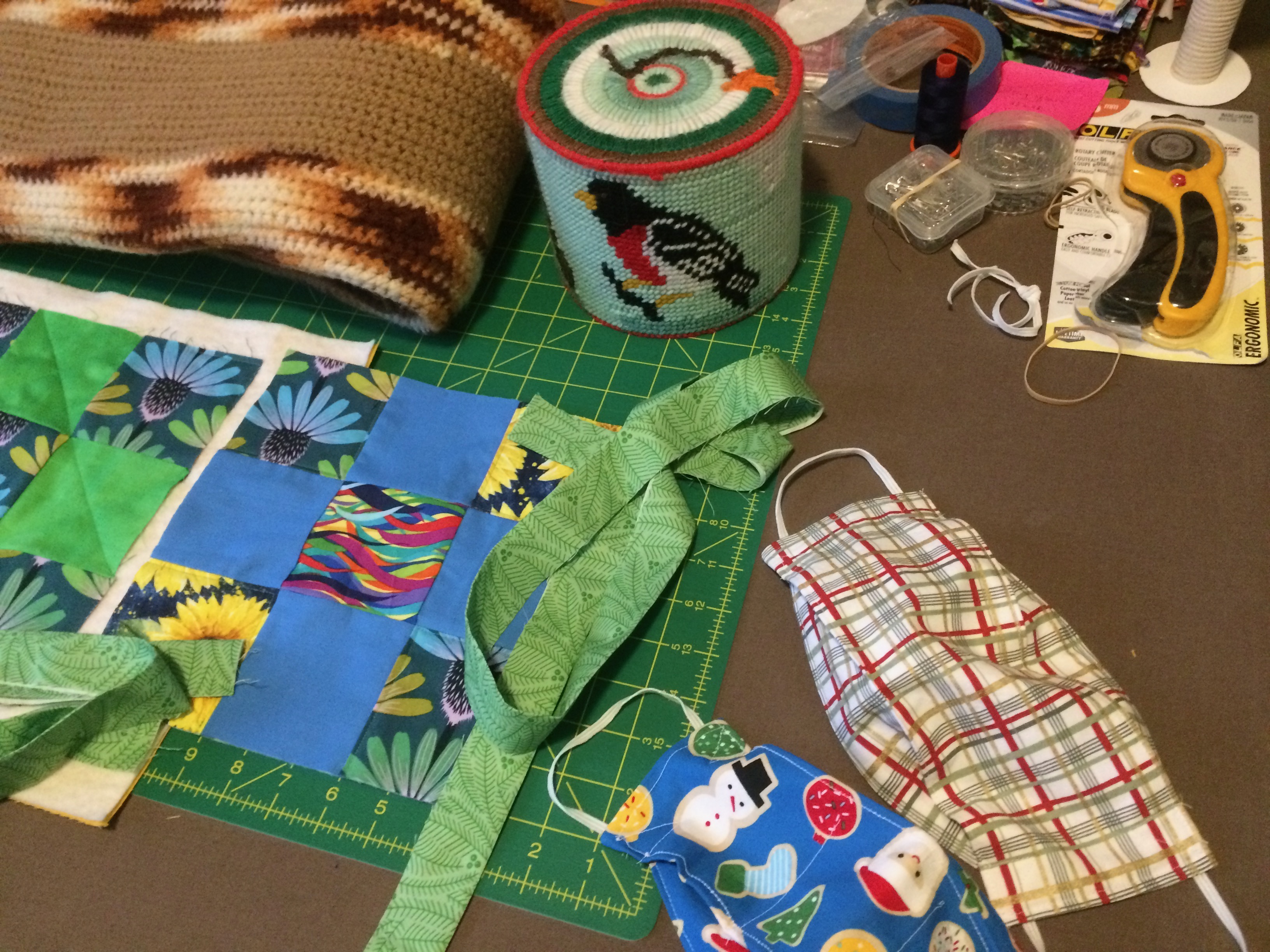
some senior crafts old and new


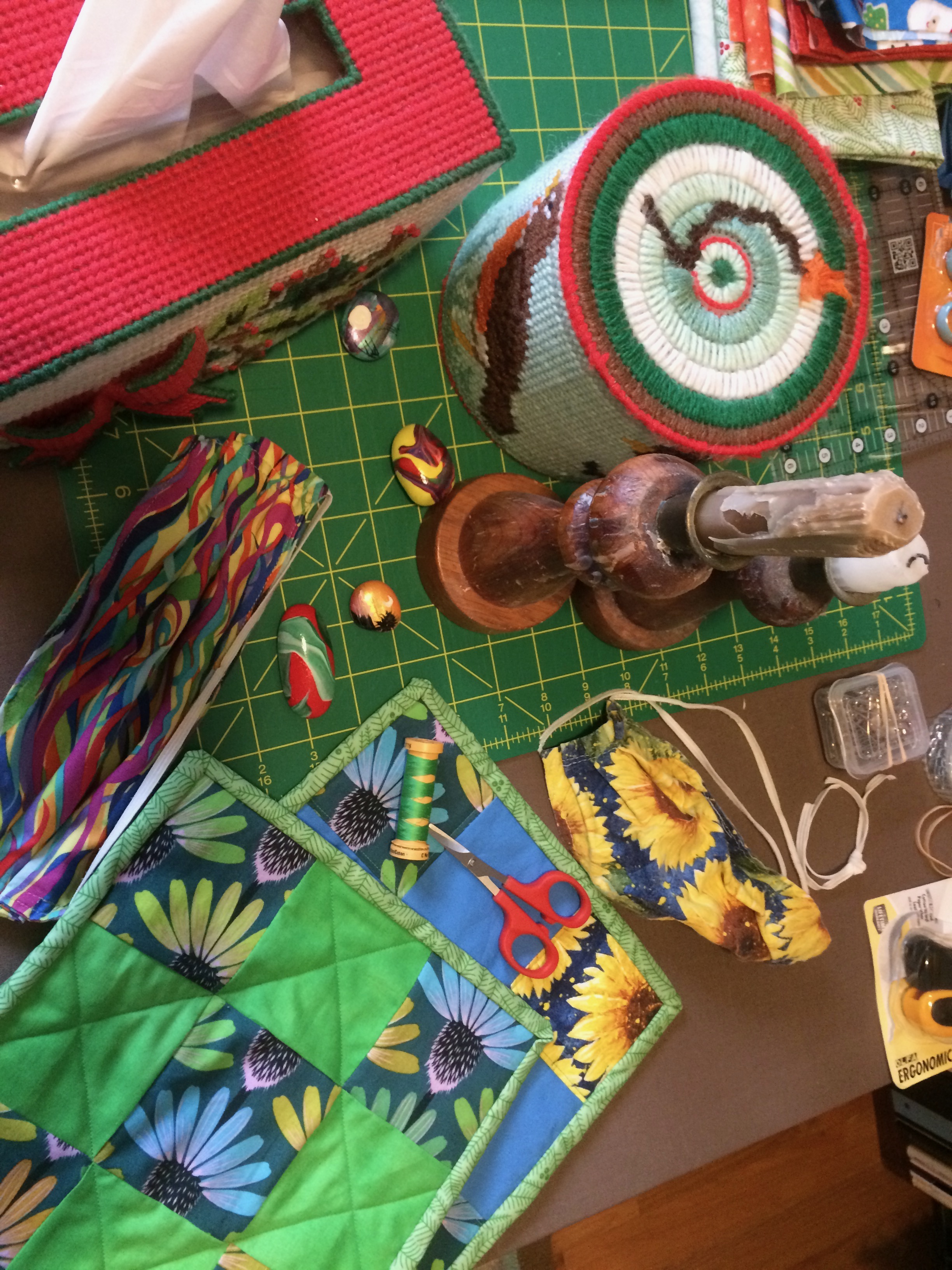
more senior crafts

One Christmas when I was in elementary school, I was among many girls my age to get a potholder loom kit as a gift, probably from a non-resident aunt.  I spent part of that winter crafting multi-colored potholders from the loops provided with the square-shaped miniature loom. My mother graciously consented to use the somewhat lumpy things in her kitchen. (Mom was not especially fussy about equipment and accessories.) As I recall, the potholders were washable. They shrank only marginally once run through our wringer washing machine. Though the one I had in childhood has long since made it to the dump, such looms are still available for purchase. The next generations of potholder-makers may be getting some as holiday gifts.  

As I grew older, I learned to sew.  As a teen, I made some of my own outfits, stretching my limited clothing allowance. My grandmother taught me to knit, though I don’t remember knitting much except for an impatiently completed sweater for my then-boyfriend-now-husband that came only partway down his midriff. 

This holiday season, hubby and I are retired, locked down, with too much time on our hands and little social life. We’ve each discovered a craft outlet that fulfills some of our need to feel connected and useful: Jim decorates sets of garden pebbles, distributing them in area tree wells and along park paths; I make small “quilt-lets” and decorative fabric face masks. 

Previous generations of our families had different craft outlets. While doing this year’s minimal straightening and decorating for Christmas, I uncovered a few “potholders” from our elders—a crocheted afghan, some wooden candlesticks that my post-retirement dad turned on a lathe in his backyard wood shop, decorative tissue holders and toilet paper holders that my mother-in-law produced as part of a yarn crafts class. Perhaps “craftiness” is a skill set that lies dormant during the busiest parts of our lives, resurfacing once we have more leisure (certainly abundant in 2020!)

We may eventually need to downsize further, discarding or recycling yesteryear’s  “potholders.” For now, their quirks provoke curiosity: the uneven dimensions of the candle holders, the “squiggly thing” atop one of the toilet paper holders. I wonder if Dad got tired, after raising twins, of “matched sets” of anything, or if it was just difficult to get his raw materials to lathe into uniform shapes.  I wonder if Mom B., somewhat bored as she completed yet another tubular shape, decided to include on the top of a bird-sided holder, a sinuous brown and orange shape that doesn’t look part of the original pattern of concentric rings—maybe the worm that got away? 

The coldest days of the year lie ahead. We’re in for a few more challenging months while we await widespread vaccinations and the end to this pandemic. Perhaps our elders were wiser and craftier than we realized at the time—when times got tough, they got creative. Whimsy matters!      

Gratitude for Late-Life Friendships

My heart goes out to the many families who will be missing a member at this year’s holiday celebrations because of a covid-induced death. I have yet to lose a family member or very close friend directly from the pandemic, though the final year of our close late-life friend, Phyllis, was impacted. She had to journey through end-stage cancer with limits on visits from loved ones, limits to her travels beyond what her illness proscribed. 

We’d known Phyllis for about a decade before her death. She was among the first non-family members to welcome us to North Carolina when we arrived here. More recently, she and her husband had finalized plans to relocate to their “retirement haven” in rural Virginia just before her diagnosis. We were very lucky that there was a summer lull in the pandemic while Phyllis was still ambulatory. She and her family visited friends in North Carolina one more time, a sort of chance to say good-bye.  

As I grieve Phyllis’s absence, I’m comforted by the example she set of dying well and of leaving a nourishing legacy. She spent as much of her final months as her energy allowed painting nature scenes, a gift she had put on hold for much of an active life. Her son just posted an image of art created by a young artist at a school to which Phyllis had bequeathed her unused paints and drawing supplies.  

At this Thanksgiving, made virtual for so many by the pandemic’s continuing spikes, I need to be especially grateful for late-life friendships like ours with Phyllis and her family. Many of our friends from earlier life stages have been work colleagues, or family members of our children’s friends, or affiliates in non-profit groups. Though genuine, these friendships were somewhat opportunistic and sometimes withered as our locations and life stages changed. By now, we’ve retired, our children are grown and establishing their own friendship networks, and more and more non-profits are conducted virtually even when there’s not a pandemic. 

This year’s limitations on in-person holiday gatherings have highlighted what connections we still can have. Not long after we’d gotten up this morning, we got a surprise phone call from a different late-life friend, a former next-door neighbor, recently retired and living across town. A confirmed “foodie,” Greg wished us a happy holiday and shared a story of a memorable Thanksgiving feast when he was living in Germany and tasked with contributing a pumpkin pie to a community celebration with his graduate student colleagues. Turns out, fresh or canned pumpkin were rarities in the part of Germany where he studied. The only variant he was able to find were jars of pickled pumpkin. Numerous iterations of rinsing the jars’ contents before cooking didn’t entirely restore the taste of a traditional pumpkin pie. 

Another set of late-life friends that I cherish are members of a pre-covid walking group, now on temporary hiatus. All of us are retired. Many of us have lost spouses. Most of us have health conditions that slow our steps and make uphills more challenging than earlier. Still, whenever I go for a walk outdoors, either with my husband or alone, I mentally have the “Tuesday morning walkers” with me. 

Even once the covid pandemic subsides, through vaccination and/or better public health preventative measures, I will remain at the stage of life when more of my contemporaries will die off. It’s important, then, to cherish them while we still can. As my husband explained on a down day for both of us, “We’re likely to spend an increasing proportion of our time mourning deaths of friends and loved ones, until it’s our turn to be mourned.”  

So let us give thanks for life, thanks for the capacity to share our stories, whatever the medium, thanks for friendships, especially those late-life friends who can help make this trying time more bearable. Happy Thanksgiving and a big set of virtual hugs!      

A Post-Election-Day View

A Post-Election-Day View from (a Small Patch of) Ground   —by Jinny Batterson

It has taken me longer than I expected to return to a non-election schedule, after several weeks as an election official, first at early voting in our part of central North Carolina, then at a new-to-me precinct on Election Day. Nearly a week after the polls closed, I’m still getting re-accustomed to unhurried breakfasts and lunches, to dinners that are not take-out from the nearest drive-through. No more masking, gloving, face shielding each morning. Just several days of nail-biting suspense as returns continue to be processed and tabulated in half a dozen “swing states,” ours included. 

My main take-away has been gratitude for the great turnout. People took this election cycle seriously. Despite the pandemic and a host of logistical challenges, nearly three-fourths of North Carolinians cast a ballot, over 4.6 million votes. As the final thousands of mail-in and provisional ballots are processed, the outcome of the presidential contest will likely not change here in North Carolina, but some of the more local races are close enough so winners may shift.  

A second take-away is gratitude at the generally smooth functioning of the election process, at least as seen from inside a polling place. Many voters came equipped with sample ballots. Some had printed off their choices by hand. Others had “slate cards” from one, the other, or sometimes both major political parties. Most abided by requests to wear face masks at polling places. Many wore what looked like handcrafted fabric masks. At the early voting site where I was assigned on a college campus, there were lots of school logo masks, even on voters much too mature to have been traditional students. From my limited perspective, the presence of “in your face” slogans and derogatory sayings on voter clothes had diminished from previous presidential contests.

Much of the time, I was too busy to notice the party affiliation of voters. Even when I was not busy, I tried to avoid making assumptions about the electoral choices anyone might make based on party label or anything else. Occasionally, the spiteful-feminist part of me wondered if some of the well-dressed 50ish white men coming through my line might be compensating for their reduced chances of snagging either a red sports car or a trophy wife by sticking with an orange president. Then I reminded myself how poorly spite performs at governing—we’ve had ample evidence of that during the past several administrations.  

This election’s outcome by itself will not come close to solving persistent problems. Whoever staffs incoming administrations at all levels will still be saddled with a virus pandemic spiraling out of control; with badly shaken economic, educational and health care systems; with increasingly erratic weather,  more frequent and more severe storms; with record levels of income and wealth inequality. During the transition to the next administration(s), we’ll need some deep breaths (grateful that we can breathe), some deeper thinking, the deepest kinds of listening, and a citizenry that stays as productively engaged in self-government as we did while voting.   

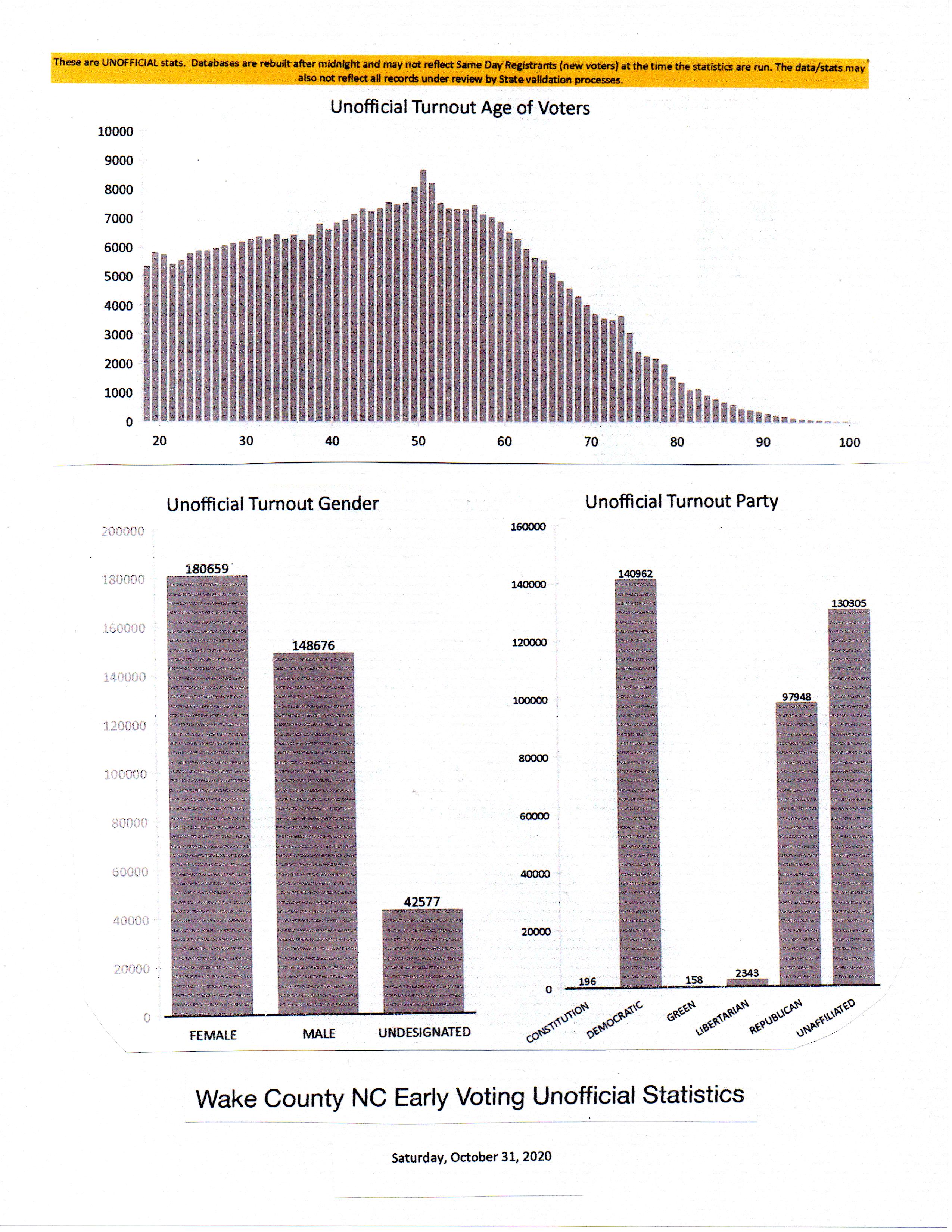
Wake County NC Unofficial Early Voting Stats

Fallow

Fallow   –by Jinny Batterson

Farmhouse in November snow, 2018

My sister’s farm lies fallow,
After an unseasonable frost
Killed off much of the late-
Season garden.

My sister’s body lies fallow
Beneath the rose bushes
She planted when she gave
The farm its name–
“White Rose”–in memory of
The father whose memory fogged
Before he could return to farming.

A fallow North Carolina morning. Foggy.
A looming work assignment
Helped chase me outdoors to unfog
My thoughts before confinement.

As the fog lifted, it gently coaxed out
Memories of a sister
Who tirelessly worked to
Improve the soil and to create
A community that, in due season,
Will birth something new.

Humble Imaginations

Humble Imaginations  —by Jinny Batterson

The times we are living through can seem overwhelming—a global pandemic that shows little signs of abating, severe economic dislocations, increases in toxic partisanship, demagoguery, distorted nationalism, militarism. It can sometimes be hard to imagine a better world, a world with more peace, more justice, more compassion. 

Current circumstances send me more and more often to prayer and to renewed study of parts of the Christian tradition in which I was raised. A verse that has long both heartened and puzzled me talks of  “scattering the proud in the imagination of their hearts.” When I’m in an especially spiteful mood, I imagine the proud being swept aside like fallen leaves during autumn’s first cold storms. 

Until I recently looked it up, I’d  forgotten this verse’s context. It’s part of a prayer attributed to Mary, the future mother of Jesus, on visiting her cousin Elizabeth when both women are pregnant, as recorded in the gospel of Luke. Often labeled The Magnificat, the passage goes like this (Revised Standard version, Luke, verses 1:46-1:53): 

“My soul magnifies the Lord,
and my spirit rejoices in God my Savior,
for he has regarded the low estate of his handmaiden.
For behold, henceforth all generations will call me blessed;
for he who is mighty has done great things for me
and holy is his name.
And his mercy is on those who fear him
from generation to generation.
He has shown strength with his arm,
he has scattered the proud in the imagination of their hearts,
he has put down the mighty from their thrones,
and exalted those of low degree;
he has filled the hungry with good things,
and the rich he has sent empty away.”

It’s not clear exactly whom Mary considers the proud or what they might have imagined in their hearts. In Palestine at the time of Luke’s Gospel, there were plenty of candidates. 

For much of my life, people have told me I have a vivid imagination. Whatever may be happening “out there” can fade in comparison with what’s going on in my thoughts, prayers,  and feelings. Some have called me naive, a bookworm, a dreamer, among other less charitable labels. My readings about imagination have also included a more contemporary rendering by essayist and retired Unitarian-Universalist minister Robert Fulghum: 

“I believe that imagination is stronger than knowledge; that myth is more potent than history. I believe that dreams are more powerful than facts; that hope always triumphs over experience; that laughter is the only cure for grief. And I believe love is stronger than death.”

I like to think that the imagination Fulghum talks about is different from the imagination in the hearts of the proud. In these fraught and fractured times, we need more humble imaginations. We need to recognize that no earthly power, however brave, wise, or fierce, can solve all our problems. It can be so tempting to believe someone has “the answer.”  It can require spiritual discipline to acknowledge the incompleteness of anyone’s “solutions,” to value the questionings and different views of others.  

Proud imaginations can be boastful, full of hyperbole and puffery. Humble imaginations are appropriately modest, without discounting their unique and real gifts. Proud imaginations want to act unilaterally; humble imaginations seek allies. Proud imaginations distrust the understandings of others; humble imaginations know that each of us can contain only partial truths. We need interaction to refine and hone our understanding. 

May we pray for discernment as we thread these challenging times together. May our imaginations be as humble as our loving is expansive.   

Happy New Year, Ruthie

Happy New Year, Ruthie   —by Jinny Batterson

Diminutive giant of the judiciary,
We mourn your passing,
Even as we celebrate
Your life and legacy.

You left us at the
Beginning of the Sabbath,
At the beginning of
Rosh Hashanah,
In Jewish tradition,
The celebration of a
New creation, of a New Year.

Those of us still on
This earthly plane
Will have a lot of work
To do later, but for now,
Grieving, rest, restoration,
Plus a heartfelt wish:
Happy New Year, Ruthie!


Goodwill

Goodwill    —by Jinny Batterson

In business dealings,
Intangible assets in excess of
The value of bricks and mortar,
In Christmas carols,
What the angels sing of
At the birth of Jesus.

In this conflicted age,
An improbable hope that
Something good will emerge
From this global pandemic:
Our acknowledgment that
Human life is uncertain
And that all life is connected.