I have a somewhat strained relationship with mobile phone directions apps. On the one hand, they can be helpful in navigating in unfamiliar locations. On the other hand, they can be infuriatingly obtuse at honoring my preferences for places I mostly know how to get to (limited or no freeway use, as few left turns as possible, a generally direct route toward my destination). The most aggravating circumstances of all are when I lack just a little knowledge at either end of the trip. I’ll be in dense traffic in the right lane when the annoying app voice tells me “in 800 feet, turn left.” Not going to happen.
Sometimes I’m able to adjust quickly enough to resume following the app’s instructions. Say, for example, there’s an almost miraculous break in traffic. At other times, there seems to be no way to adjust my driving to match the app. So I tootle along semi-lost, somewhat relieved that I’ve allowed extra time to reach any appointments with a set schedule. After a while, the app will display a message, “recentering,” then attempt to find me an alternate route to my destination based on where I currently am.
Given the present political and media climates, both in the U.S. and globally, I need to practice “recentering” often in other aspects of my life. This can involve insulating myself temporarily from most external distractions of our too often noisy lives. It can be hard to get away from the noises of airplanes overhead, leaf blowers nearby, or a neighbor’s next home improvement project. (I need to remember to be grateful that the noises surrounding me are generally benign—not bombs, not bullets, not blaring sirens.) It’s nearly always possible, though, with some effort, to find a time/place for quiet contemplation.
Both Christian and Buddhist faith traditions have evolved forms of centering. Christianity focuses on our communication with what we call God. Buddhism stresses non-attachment to external stimuli. I doubt that I’ll ever become totally adept at either practice. Still, I’ve found that taking a breather (sometimes literally focusing on my breath) can help me be less overwhelmed by what’s going on around me.
Perhaps the phone directions apps are onto something.
This January 6, I want to remember the date as my sister-in-law’s birthday, or maybe the Christian festival of Epiphany. I’ll do my best to tune out an overdose of analysis and commentary about U.S. events of January 6, 2021.
This year’s January 6 falls on a Saturday, when many of us will be experiencing a weekend, free from most work obligations and ready for a change of pace. As an inveterate player with words, I want to propose a widening “consurrection.” Taking the prefix “con,” typically meaning “with,” to replace the “in” of “insurrection,” we can create a “rising up with,” rather than the “rising up against” that occurred a few years ago. Just as “conspiring” at its root represents “breathing together,” so might “consurrecting” come to mean something like “working together to create a more humane, welcoming society.”
I would like more and more of us to spend part of January 6 each year in the sort of voluntary public service that’s become more closely associated with the MLK holiday later in January—let this Saturday be the start. Thanks to a faith community teamed with a local non-profit, I’ll have a chance on Saturday to sort produce for an area food bank’s weekly distribution, “consurrecting” on January 6 with an eclectic range of folks who work to reduce food insecurity in San Diego County.
May you find a worthwhile and fulfilling path toward “consurrection” as well.
The local church whose “back lot” has for over a decade served as a community garden also engages with the wider community in other ways. Recently, on a trip to tend my garden plot, I saw posters for a “live Nativity.” I’d not yet seen one, supposedly initiated by Saint Francis in central Italy during the 12th century as a way of teaching about Christ’s birth. The poster for the local event prominently featured a camel.
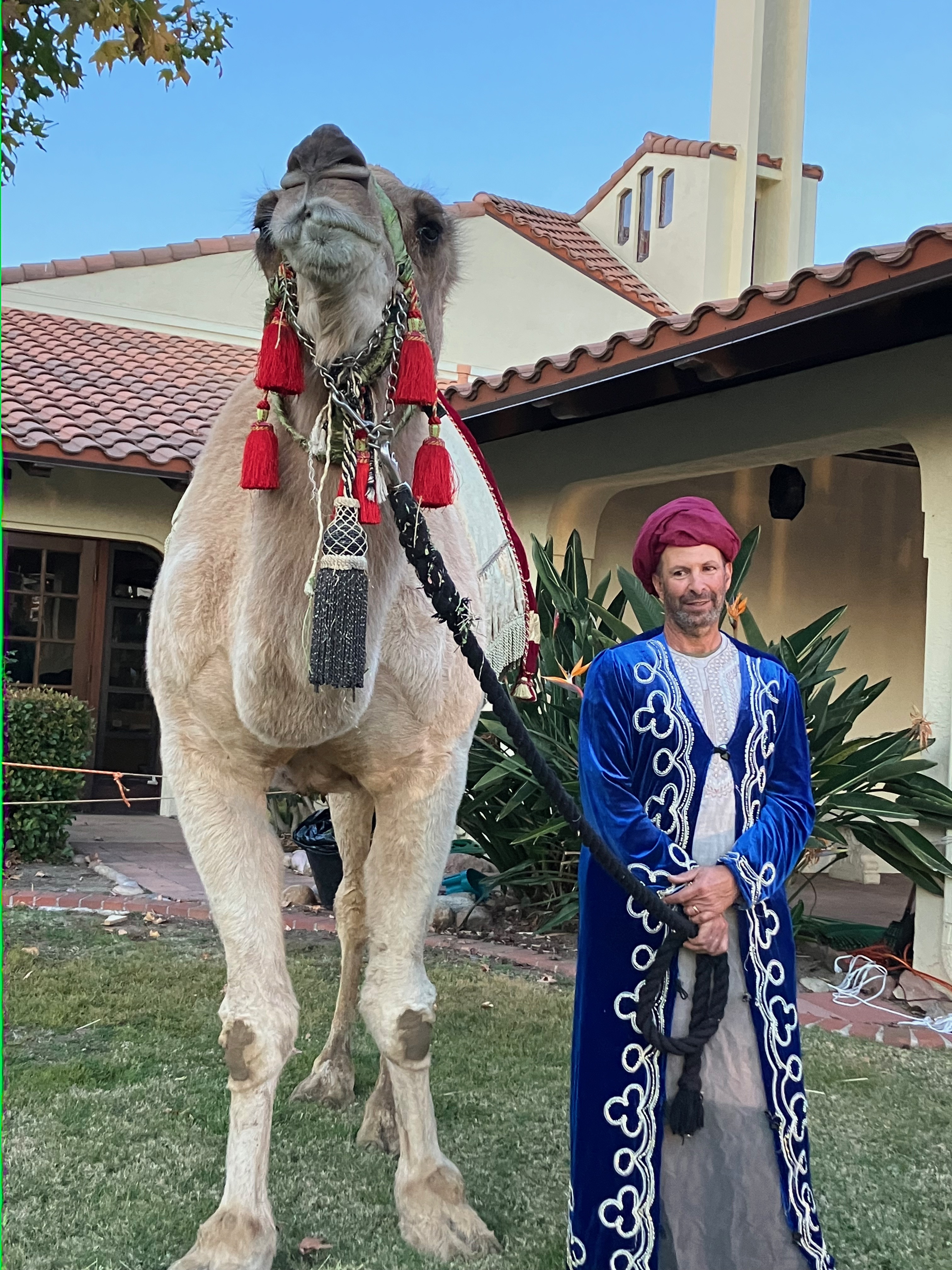
“Where would anybody find a camel around here?” I wondered. “At the zoo?” Intrigued, I showed up at the church’s front lawn just before sunset on a balmy Saturday evening to see for myself. Sure enough, there was a regal-looking camel, festooned with a decorated blanket and tassels and bells. Standing beside the camel, holding its halter, was a swarthy bearded man in a long embroidered robe. He represented one of the three kings bringing gifts for the baby Jesus. The nativity also included a couple of sheep, some goats, and a donkey, in addition to the three humans representing the Holy Family.
It was a supremely kid-friendly event. Lots of families with children were taking part—looking at the animals, petting the goats, decorating Christmas cookies, sipping cider or cocoa. I stayed long enough to chat briefly with some of the animal handlers. Turns out, the camel was from the “Oasis Camel Dairy” in a nearby farming area. She’d been rented out for the occasion.
In most years, the town of Bethlehem in Palestine, site of the original Nativity, sees a huge influx of religiously oriented tourists around Christmas. Pilgrims come from all over the world to see the Basilica of the Nativity and to visit its grotto, the oldest continuously used site of Christian worship. Many suppose it to be the place of Jesus’ birth. This year, though, according to a recent article in the Jerusalem Post, nearly all tourists have canceled, further depressing the local economy. The locality’s struggles to support itself are also complicated by a full-scale war being waged in nearby Gaza.
Even amid sadness and outrage at the ongoing carnage in the Mideast, I’m reminded by the live nativity here of one of my favorite Christmas songs, variously titled “The Gifts They Gave,” or “The Friendly Beasts.” Sung by many different soloists, one of the most popular versions is by Harry Belafonte. Listening to his mellow rendition helps calm and inspire me. In the song, a donkey, a sheep, and a dove in turn explain the gifts they brought for the Christ child: the donkey, transport for Jesus’ mother Mary to Bethlehem; the sheep, a warm blanket for the new baby; the dove, a lullaby. In current news, if we see donkeys at all, they are likely pulling carts of Palestinians fleeing in search of some area of safety.
At this holy season, may we remember the Christmas song’s friendly beasts and their simple gifts. May we imitate such wise animals more often.
Most days, I remember at some point to be grateful: —for life —for breathable air, for water that’s safe to drink —for access to food, clothing, and shelter —for health —for family and friends both near and far —for sunrises and sunsets, for clear days and for rainy ones.
It seems totally appropriate to me that we celebrate an autumn holiday in honor of gratitude, “Thanksgiving.”
Depending on what traditions we’ve been exposed to, we may think that the Thanksgiving holiday in the current territory of the U.S. originated in 1541 in Texas with Spanish explorer Coronado and the Teya Indians. We might suppose that Thanksgiving started in 1619 in eastern Virginia when some British colonists gave thanks for their safe arrival on American shores. Lots of us were taught as primary school students about the 1621 Massachusetts feast when Pilgrims and Wampanoag Indians celebrated together after the immigrants’ first successful harvest. In multiple places in the colonies and then in the U. S., Thanksgiving was celebrated locally or intermittently for a long time, but it only became fixed as a national holiday in 1863. That year, then-President Abraham Lincoln issued a proclamation making the last Thursday of November (later tweaked by Congress to the 4th Thursday) a national celebration of Thanksgiving.
November 2023 has so far often lacked for gratitude—wars and conflicts dominate our headlines; fiscal and military brinksmanship abounds; in many places there’s a general feeling of malaise and discouragement. Resentment often fills our airwaves and screens. It’s so pervasive that it can seem to poison the very air. Few of us will ever let go of our resentments entirely, be they of long-ago childhood slights or traumas, of former lovers who jilted us, or of perceived business or professional snubs. The rich and powerful are not immune, either. Some can seem resentful that they’ve not obtained even more wealth and/or power. So, especially in this fraught season, it’s important to make time for gratitude.
Fortunately, it’s nearly impossible to be resentful and grateful at exactly the same time. Thanksgiving reminds us to rearrange our lives to expand our proportion of gratitude and to diminish our corresponding “resentment quotient.” We need Thanksgivings, more than we usually admit.
Coronado’s party and the long-ago Virginians and Pilgrims had lives filled with deprivation and danger. Back then, there might have seemed little reason to be grateful. At the first national November Thanksgiving in 1863, the American Civil War raged. Though the tide of battle seemed to have turned in favor of preserving the Union, the outcome was far from sure. Deaths and injuries had touched many families both North and South. In many places, basic goods were either in short supply or totally unavailable. The ill will and resentment that had helped spark the war lingered. Even now, it sometimes darkens our politics.
Happily, for most of us in the U.S. in 2023, Thanksgiving does not equate with privation. It’s sobering, though, that over a tenth of our population fell below the official poverty line in calendar 2022. Moreover, during the period 2020-2022, there were about a million and a half excess deaths, either directly from the covid pandemic, or from other health complications. Many Thanksgiving tables this year are missing one or more previous guests.
Still, it’s my hope that this Thanksgiving many of us will have things to be grateful for. I hope that most of us will resist temptations either to settle old scores or to prefigure the next election cycle. May we, for at least the better part of a day, let gratitude overtake any resentments.
While waiting for the fever to break, I apply cold compresses and administer aspirin, trying to remember not to exceed the recommended dose. I pray, and pray, and pray some more. I tell others and myself “I love you,” over and over, fervently. I hum lullabies and songs of peace. I crave quiet. I shy away from news and opinion.
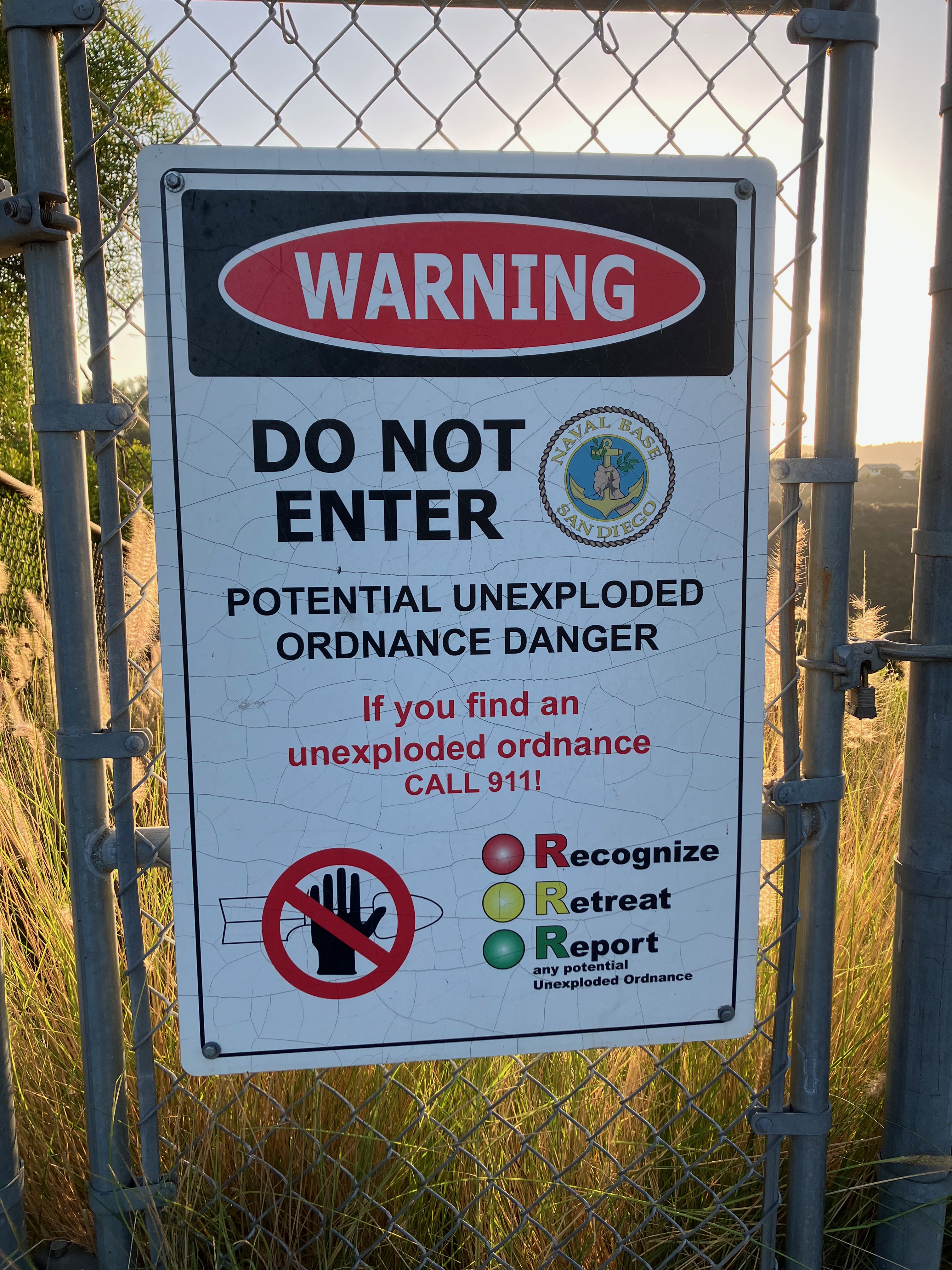
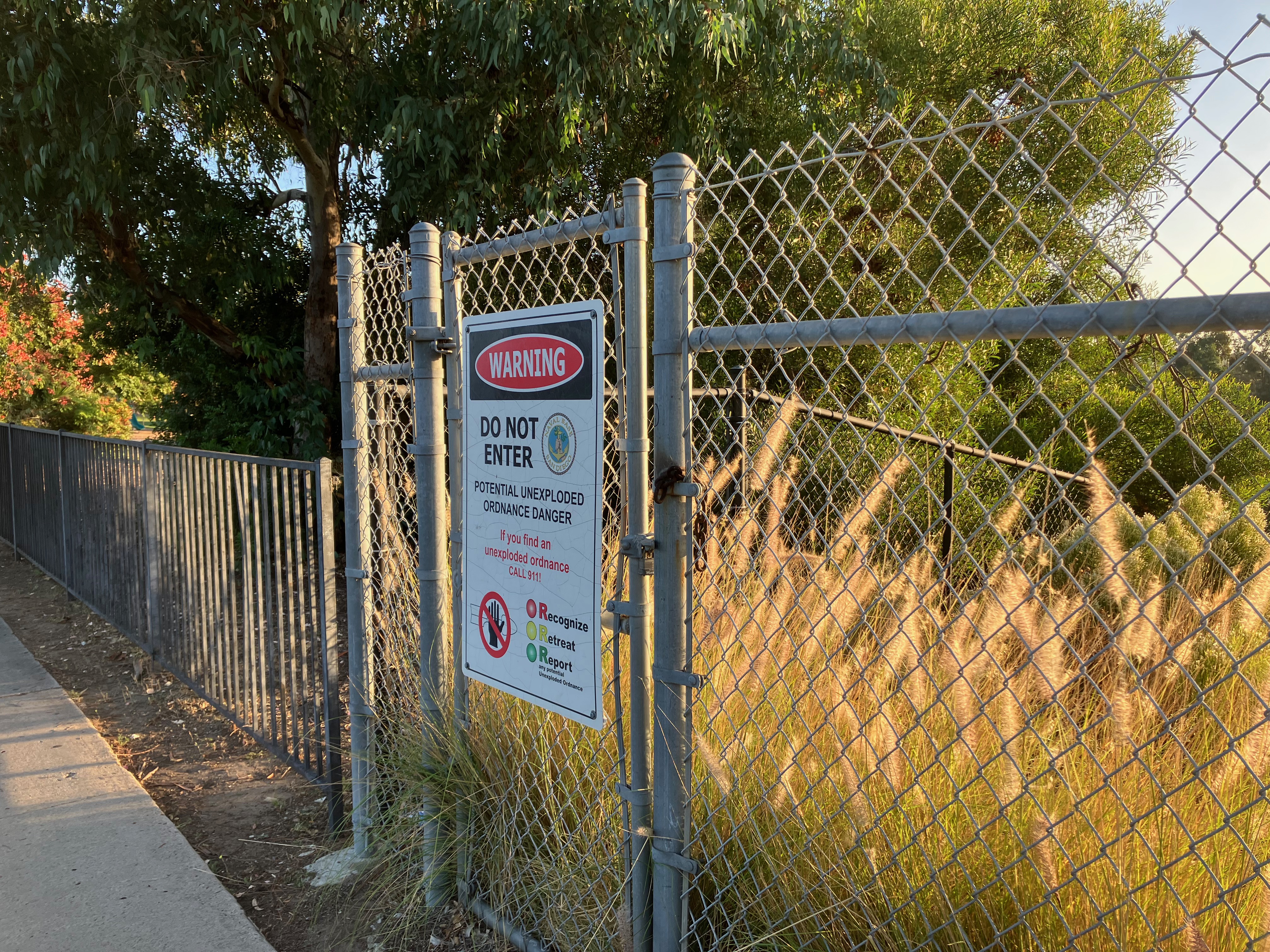
While waiting for the fever to break, I try to damp down feverish attempts to “make the world safe,” be they my own or others’. I search to find and support more measured changes toward whatever the world wants to become. I meander around the nearby detritus of prior conflicts, wondering at the residual scars. I gravitate toward the small patch of cleared ground where a group of us is learning organic gardening. Well before dawn, jarred awake by a buzzing phone, I ask the still-dark sky for wisdom. The stars shine an answer, one I’ve too often forgotten: “No one is an absolute owner; we are all, rather, temporary stewards.”
Lingering damage warning, Murphy Canyon, San DiegoWarning of unexploded ordnance near children’s playground, San DiegoEntrance to our “giving garden,” Tierrasanta, San Diego
Strung like beads near California’s coastline, they are remnants of earlier Spanish settlement. In some places abandoned, at others almost frenetically active, they speak to the tangled history of our area.
Following Columbus, Spanish explorers and soldiers took hold in the southern and western parts of North America, eventually becoming “New Spain.” At its height, Spain’s colonial empire spanned three continents: parts of North and South America plus islands in Asia.
Physical mission settlements were a later offshoot, founded during the late 18th and early 19th centuries by Franciscan missionary brothers who sometimes supported, sometimes contested the soldierly establishment.
Politics and religion got further entangled—when Mexico gained independence from Spain in 1821, some missionaries returned to Spain voluntarily. Others were expelled. Over time, most mission lands were gifted to wealthy Mexican families. Mission buildings fell into disrepair.
Following a war, a gold rush, and further immigration, California gained U.S. statehood in 1850; in 1861, the United States fractured. During the period of the U.S. Civil War, some missions again became church property. Some church buildings got rebuilt. Some religious orders returned. Schools were started.
From San Diego to Sonoma, with mission sites a long day’s walk between, these twenty-one enclaves along the Camino Real commemorate our confused and confusing history–no universally good or bad guys, no historically consistent ownership. Indigenous people sometimes benefited, but sometimes were burdened by disease, maltreatment, even slaughter. Crosses now stand sentinel. Bells ring a reminder: Few of our missions are ever neat or complete.
postcard of California’s missions
California missions (from north to south):
Sonoma, San Rafael, Dolores, San Jose, Santa Clara, Santa Cruz, San Juan Bautista, Carmel, Soledad, San Antonio, San Miguel, San Luis Obispo, La Purisima, Santa Ynez, Santa Barbara, San Bonaventura, San Fernando, San Gabriel, San Juan Capistrano, San Luis Rey, San Diego.
Easter morning, fog gradually dissipating. Soil gradually drying after a Cooler, wetter March than is Typical for this part of the world, I’m told.
My second gardening year here. Multiple seasonal harvests are possible When there’s enough moisture for irrigation.
Just ending, a Lent of voluntarily cutting back— No meat, more vegetable protein, More varied vegetables as well. Soups and stews that matched the Atypically chilly weather.
Now, a seasonal transition—more sun, Fewer storms, more widely spaced. Time to put in tomato seedlings, maybe. Time to consider what other warm season veggies Might put down roots in this nearly-new-to-me place.
After a cool season of media vitriol And exaggerated claims of victimhood And crisis, a relieved exhale at fuller reservoirs– Short-term apocalypse averted.
Whether we are transnational or transgender, Whether we’ve moved cross-country or across the street, Be we behaviorally inclined toward transactional, transitional, Or translational interactions, we each have seasons Of feeling transplanted, not quite fitting.
Then we remember, sometimes belatedly, the redemptive Character of this resurrectional season.
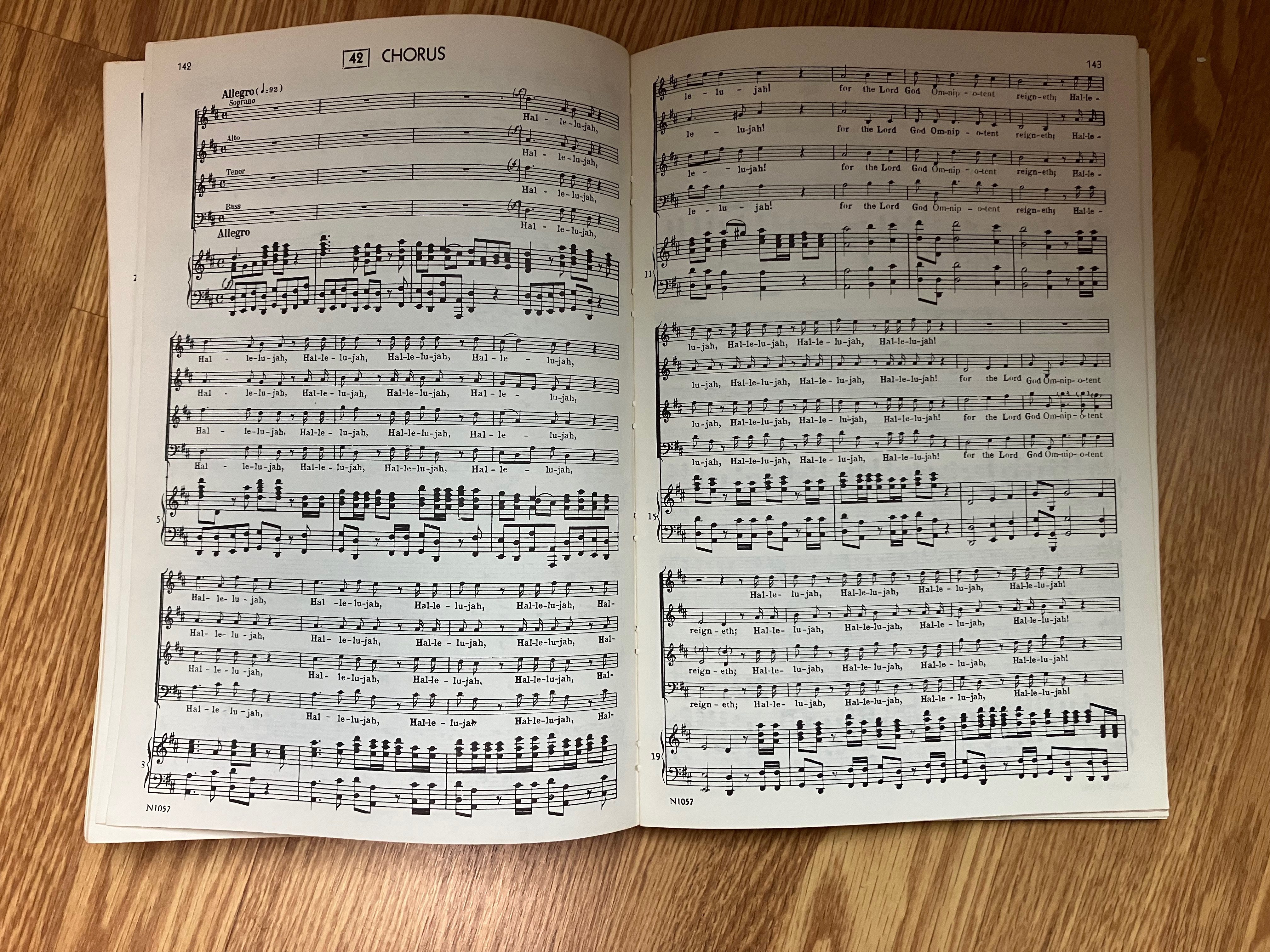
Handel’s oratorio “The Messiah,” and, in particular, its “Hallelujah Chorus,” figures largely in our family’s lore. Over the years, I’ve participated in several Handel Choirs, mostly as an alto. A vocal score of Messiah’s choruses has somehow made it through our various moves and sits, slightly musty, on a shelf in my office. Once covid concerns wane sufficiently, I hope to participate in future Messiah singalongs.
much-thumbed vocal Messiah scoreHallelujah Chorus from Handel’s Messiah
I’m not sure when I first heard this uplifting music. Because both my mother and her mother were practicing musicians, it was probably early in my life. The first time I remember being fully aware of the majesty of the piece was the Christmas season I was ten years old.
Our immediate family’s trajectory had been fairly typical of post-World War II small town America. My father came home from the Navy in early 1946, after serving the final years of that war on an aircraft carrier in the Pacific. He and my mom, who’d married during one of his home leaves in 1944, set up housekeeping in a one-bedroom cottage built by Mom’s parents next door to their own house. Mom’s parents wanted to keep their youngest close by, especially after their only other daughter and their one grandchild so far had moved cross-country to Seattle.
About a year later, I put in my appearance, followed in 1951 by a sister, then in 1953 by surprise twins—my youngest siblings, brothers to carry on the family name. Although Dad and some carpenter friends had added a second bedroom when my sister was born, it was tucked into an increasingly steep hillside. The slope precluded further expansion. Our small cottage was bursting at the seams. Dad and Mom paid a minimal monthly rent to my grandparents, more as a sop to Dad’s pride than anything approaching market rate.
Partly buoyed by this informal subsidy, by 1957 Dad and Mom had scrimped and saved enough to purchase a five acre piece of property in a wealthier part of town. Dad by then had become a small-scale residential construction contractor. He had the contacts and skills to be able to build his and Mom’s dream house on the newly purchased land at minimal cost. They would start construction in March, 1958, once the ground thawed.
For our final Christmas at the cottage, we’d shoehorned into one corner of the living room a small fir tree with presents underneath. While we went next door for breakfast at Granny and Pop-Pop’s, Santa (so the younger children believed) would leave an even bigger pile of gifts to be opened after our return.
On prior Christmas mornings, we’d been awakened by Dad’s best stentorian bellow: “Rise and shine, morning’s a’wasting!” he’d yell.
This year was different. From somewhere near the stairwell leading from the living room to our basement-level kitchen, there was music. Every bit as loud as Dad, it had a decidedly different pitch and rhythm: “Hallelujah, hallelujah, hallelujah, hallelujah, hallelujah!” As we stumbled out of our bunk beds and wiped the sleepy sand from our eyes, we wondered what was producing the music. It didn’t take us very long to locate the new walnut stereo cabinet with the record jacket to “The Messiah” placed carefully on top. Dad grinned at us, triumphant.
My father and my maternal grandmother had a respectful but sometimes strained relationship. Granny could be fussy about protocol and social niceties. Early in Dad’s and Mom’s married lives, before the arrival of children, Dad had gone out of his way one Christmas season to impress Granny. At considerable expense, he’d purchased three tickets to an evening performance of all three parts of Handel’s Messiah in downtown Baltimore. He’d arranged transportation to and from the concert hall and had put on his one good suit to escort the ladies to this holiday tradition.
As retold at subsequent holiday gatherings, Dad was so tired after a busy day of physical work that he nodded off early in part one. When the “Hallelujah Chorus” began (at the end of part two), Dad startled awake. Most in the audience were getting up, a tradition started supposedly when, at the premier London performance in 1743, King George II had stood for the “king of kings.” Other audience members had followed suit. Standing for the Hallelujah Chorus became customary whenever and wherever the oratorio was performed. Dad wrongly assumed it was the end of the performance. He went to get Granny’s and Mom’s coats, much to Granny’s chagrin.
Perhaps the 1957 hallelujahs were his way of celebrating the prospect of having a little more distance from his fussy mother-in-law. Perhaps he was just overjoyed at the prospect of a big-enough house.
After my dad’s multiple careers were over, he developed dementia. For much of his decline, he was lovingly tended by my mom, assisted by a fairly robust social safety net that included veterans’ benefits and a drop-in adult day care center. During his final few months, once the burden of his care threatened to debilitate my mother as well, he was confined to a nursing home. When my sister phoned to let me know that his body had finally died, she had the “Hallelujah Chorus” playing in the background. Somehow, it was a fitting testimony to Dad’s release from suffering.
The past couple of years have not been especially easy. Many of us have lost loved ones. The covid pandemic, in the U.S. and elsewhere, has brought into starker relief our disparities of wealth and of access to needed services. Rather than Handel, some of us may be more attuned to the darker lyrics of a recent “Hallelujah” version by singer-songwriter Leonard Cohen. Cohen continued revising the lyrics almost up until his death in 2016. After several despondent verses, he nonetheless asserts:
I’ll stand right here before the Lord of Song With nothing on my tongue but Hallelujah…
I like to think that both “Hallelujahs” are relevant. We have suffered. We will suffer again. We have known joy. We will know joy again. Hallelujah!
(Purloined and/or penned in memory of my doggerel-writing mother; posted on what would have been her 105th birthday, August 22, 2022.)
Long ago, when I was a child My parents said to memorize A set of poems, some tame, some wild, About the way time often flies.
I’ve never mastered, ’til today The longest verse that they suggested– About the “deacon’s one-hoss shay,” In days when roads were less congested.
Per Wendell Holmes, the deacon tried To craft a carriage with strengths so even It never would just lose a side, For years could remain fit for driving.
The shay survived through heat and storm, Through varied owners, steeds, it roamed, Providing rides in stellar form ‘Til at the last, per Mr. Holmes:
“There are traces of age in the one-hoss-shay,
A general flavor of mild decay,
But nothing local, as one may say.
There couldn’t be,—for the Deacon’s art
Had made it so like in every part
That there wasn’t a chance for one to start.
For the wheels were just as strong as the thills—
And the floor was just as strong as the sills,
And the panels just as strong as the floor,
And the whippletree neither less nor more.
And the back-crossbar as strong as the fore,
And spring and axle and hub encore.
And yet, as a whole, it is past a doubt
In another hour it will be worn out!
. . . . .
You see, of course, if you’re not a dunce,
How it went to pieces all at once,—
All at once, and nothing first,—
Just as bubbles do when they burst.
End of the wonderful one-hoss shay.
Logic is logic. That’s all I say.”
Some days my bones ache, Other days they feel brittle. Some days my head hurts, Other days it’s my middle.
Some days I feel fine, Other days I wither, Some days I’ve a clear mind, Other days I dither.
May specific ailments give punctuation To my inevitable disintegration. As age advances, I hope and pray I won’t go like the one-hoss-shay.
I’m not sure which of my parts will break I hope some may be left to harvest. May no internist unbeckoned make Repairs to keep me from my last rest.
I wish the Dobbs decision had never happened. For months leading up to it, I dreaded its potential impact on our fractured body politic. Now that it has happened, I am doing my best to find a forward-looking response. I doubt that any legal decision regarding abortion can satisfy anyone completely. I doubt that abortions will ever stop being performed, whether legally or illegally. I doubt we can ever reach an American (or global) polity in which every child is deeply wanted and loved, in which no mother dies from complications of pregnancy or delivery, and each new human is born into a fully functional family and society.
In the wake of Dobbs, activists on all sides of the U.S. abortion debate have increased their fundraising, outreach, and advocacy. Personally, I believe abortion prior to fetal viability should be primarily the decision of the mother-to-be, that her rights supersede any supposed state interests. However, I also believe that some common sense restrictions on abortions can be consistent with goals of family integrity and human rights. How can I best express my views? How do I act on my beliefs? When does life begin? How can we possibly know?
Headlines tend to emphasize exceptional cases—the 10-year-old girl in Ohio who in May, 2022 was raped. After seeking care in Ohio, she had to travel to Indiana for an abortion because she’d exceeded the six week gestational limit mandated by a 2019 Ohio law triggered by the Dobbs decision. Overall statistics make less absorbing headline fodder, but are still abysmal. Over the preceding five years, Ohio had an average of over one abortion per week for a child aged 15 or younger.
In ideal cases, a developing fetus is the result of consensual sexual activity between prospective adult parents. Ideally, once a woman’s egg is fertilized, the resulting zygote begins to divide, then implants and thrives in utero throughout the pregnancy, which ends when a healthy mother delivers a healthy infant. Many hazards exist between conception and birth, though—miscarriage, ectopic pregnancy, maternal health complications, lethal fetal abnormalities. The rate of spontaneous miscarriage is estimated at between 11 and 22 percent of confirmed pregnancies. Possibly over half of all pregnancies end even before pregnancy is confirmed. About 2% of pregnancies are “ectopic”—the embryo attaches outside the uterine cavity, potentially threatening the life of the mother. In 2020, the US had the highest maternal mortality rate among developed nations: 23.8 deaths per 100,000 live births. About 3% of babies born in the U.S. have birth defects of varying degrees of severity, with the most severe defects causing about 20% of deaths in infants below the age of one.
Ideally, prospective parents are financially and emotionally ready to raise to adulthood any child they conceive. However, a study from the New England Journal of Medicine in 2011 found then that nearly half of pregnancies were either “unplanned” (27%, maybe later?) or “unwanted” (18%, not now, not ever!). Per their research, unintended pregnancy rates are highest among low-income women, women younger than 24, unmarried women cohabiting with a male partner, and women of color. Economic studies repeatedly link limiting access to contraception and/or abortion to increases in child poverty and crime.
To help ground me since the Dobbs ruling, I’ve returned to my Christian roots, revisiting Biblical stories of King Solomon to try to find wisdom to help me through this most recent set of conflicts over reproductive choice. A seminal account involves Solomon deciding a difficult case shortly after he has asked God in a dream for wisdom in guiding his people. As recorded in I Kings 3:16-28, the case involves the death of a newborn and two frantic mothers’ competing claims on the one surviving child. To help determine the rightful claimant, Solomon threatens to cut the surviving child in two. The real mother cries out to let the other mother keep the child, willing to relinquish her child rather than have it killed. Through his decision, Solomon does his best to honor the mothers, the child, and the child’s future.
The Dobbs decision was injected into a United States with many festering debates. Abortion has been, and continues to be, even thornier than the dilemma posed to Solomon, with no clear one-size-fits-all answers. What seems clear so far is that many women, their families, and their doctors are fearful and upset at Dobbs’ sweeping change in national policy. The change overturned fifty years of judicial precedent, including many cases attempting to strike some sort of balance among competing rights—the mother’s, the developing fetus’s, and that of the governmental apparatus charged with supporting families and children.
I like to think that Solomon in his wisdom would have come up with ways to help us broaden our focus, leaving us less obsessed with the period between conception and birth. It is a rare pregnancy that lasts more than nine months, a rare (though tragic) instance when a life after birth lasts less than that, a strange anomaly for a girl/woman to conceive before typical puberty, which happens between ages 8 and 13.
Perhaps we can see beyond our differences to lessen the damage we are causing to the already born and to women not ready to become mothers. Our faith, our gender, our life circumstances can help impart the wisdom we need to navigate post-Dobbs America. If Solomon could consider the mothers, the child, and the future, might we be inspired to behave similarly? Are we each doing our best for the human family of which we are a part? Are we helping to preserve a livable planet for future generations? What would Solomon decide?





 Jinny's Occasional Poems