Category Archives: Quandaries and Rants

Elders, Natural Debt, Resilience…

Elders, Natural Debt, Resilience…  —by Jinny Batterson

Substantial numbers of my cohort of aging “leading edge boomers” have led charmed lives up to now. Medical advances have permitted us to live longer, with fewer health problems than our forebears’ generations. Technical advances and social policies have helped bring increased economic prosperity to those of us at upper income levels, especially those with inherited wealth and/or advanced formal educations. Yet lots of us are uneasy or depressed. What went wrong? 

As we came of age in the 1960’s, ecologists continued issuing warnings about the impacts of unbridled “growth” on the natural environments that underly all living beings, including humans. Partly due to youthful protests, governments in some economically advanced countries began passing laws to curb or criminalize the most visible environmental abuses. Cleanup funds were established. Our skies became clearer, our rivers no longer stank. Also partly due to youthful protests, American involvement in a costly war in Vietnam came to an official end. We were told there was a “peace dividend” and it was safe to start raising families. We gradually left the streets for the suburbs. 

Outsourcing and automation removed more and more routine, grimy or dangerous jobs to places most of us did not see. Occasional spot disasters like the Bhopal chemical release in India in 1984, the Chernobyl nuclear meltdown in what was then the USSR in 1986, Hurricane Katrina in Louisiana/Mississippi in 2005, or the Fukushima tsunami/power plant disaster in Japan in 2011 briefly caught our notice, but mostly we did not pay attention. Such difficulties would likely never touch us, safely ensconced in our cushy American suburban cocoons. 

Our cocoons are getting pretty toasty, abetted by record heat waves, wildfires, and tropical storms. The statistics are telling: In 2018, the U.S. suffered fourteen weather-related billion-plus dollar disasters. Bills for hurricanes Florence and Michael, already over $49 billion, are still coming in. Out west, a record-breaking wildfire season did more than $24 billion worth of damage. Here in North Carolina, I lived through my first 100 degree October day, after a record-setting dry, hot September generated a new weather label: “flash drought.”  

Fiscal conservatives have long warned of the dangers of burgeoning public debt—the U.S. national debt recently topped 22 trillion dollars, or about $56,000 for every American.  A friend and former colleague raises concerns about the hidden or belatedly recorded costs of “technical debt” (see http://techdebtpolicy.com) such as recovery from previous over-use of asbestos, whose fire-resistant properties made it desirable as an insulator before its human health impacts were fully understood. I’m most concerned about “natural debt,” a term gradually gaining currency for our drawing down of natural resources and our using our planet as a dumping ground, as in a set of posts by an India-based group, downtoearth.org.in. 

It’s not too hard to see why natural debt is a growing concern, one that has many of us elders wakeful on October nights when the air conditioning is still on. Links likely exist between natural debt and increasing instances of human protest and conflict across all parts of the political spectrum and all regions of the globe. 

People my age are closer to the ends of our lives than its beginnings. Our worst nightmares reflect the distress we’ve caused other humans and the natural world we depend on. If our imaginings goad us toward useful action rather than just handwringing, this is not necessarily a bad thing. By now, many of us have bounced back individually from financial, health, and/or family challenges. Beyond individual or family, though, we need to use the rest of our physical lives to help build more species-wide resilience. If we are to claim any prerogatives as an “intelligent species,” we’ll need to get both our individual and collective acts more thoroughly together. A compendium from our youth, The Last Whole Earth Catalog, said it on a back cover, showing a NASA photo of Earth taken from space: “We can’t put it together. It is together.” Together with or without humans, our choice. 

The PRC at 70

The PRC at 70  —by Jinny Batterson

She’s an impressive dowager,
A real rags to riches story–
Rising from the ashes of
A brutal civil war,
After a century of quasi-colonial
Oppression, she turned inward
And recreated herself.

A few convulsions temporarily
Sidelined her progress,
But now she stands proud–
The world’s greatest factory floor,
Flooding our shelves with goods
We couldn’t have imagined
A scant generation ago.

Of course she suffers from arthritis—
Twinges in her toes.
At her other extremity,
A bowl shaped desert
That refuses to be reeducated.

No pigeons or kites flock or weave
Above the scrubbed multitudes
As tanks again roll down Chang An
Avenue. Onlookers wave
Well-choreographed flags.

May she be wise and gracious
In old age. May her poets
Sleep securely in well-thatched
Cottages. Happy Birthday!
People’s Republic. 
 

Children’s Crusades and Adult Enablers

Children’s Crusades and Adult Enablers  —by Jinny Batterson

Early in the 13th century, during the summer of 1212, a pilgrimage known as the “Childrens’ Crusade” headed for the Holy Land. Many details about the crusade are disputed. It seems likely that few, if any, of the participants reached Jerusalem or anywhere close. According to information in the lead paragraph of the relevant Wikipedia article: 

“The traditional narrative is likely conflated from some factual and mythical events which include the visions by a French boy and a German boy, an intention to peacefully convert Muslims in the Holy Land to Christianity, bands of children marching to Italy, and children being sold into slavery. Many children were tricked by merchants and sailed over to what they thought were the holy lands but, in reality, were slave markets.” 

(reference the year 1212 to clarify your search at: https://en.wikipedia.org/wiki/Children%27s_Crusade)

Estimates of the number of participants are in the tens of thousands. It’s not clear what roles adults at the time may have played in assisting the young crusaders.   

A more recent “childrens’ crusade” took place in Birmingham, Alabama during May, 1963, when over a thousand students trained in non-violent protest techniques left their schools and marched toward downtown Birmingham to protest Jim Crow laws and ongoing racial discrimination. Their actions and the vicious responses of Birmingham’s law enforcement officials “went viral” over 1960’s-era media, prompting outrage that helped prepare the way for the 1964 Civil Rights Act.  

In the past year or so, we’ve seen the birth of two modern youth crusades: one concerning the U.S. epidemic of gun violence, the other spreading awareness of the need for concerted action in the face of the worsening global impacts of climate change.

After a mass shooting at Marjorie Stoneman Douglas High School on Valentine’s Day, February 14, 2018, survivors and their families held a candlelight vigil. Several students then sat up for most of the night hatching a social media campaign to help reduce gun violence. Their efforts coalesced around the hashtag #NeverAgain, which has morphed into a national movement advocating for changes in gun laws to help reduce the American gun violence epidemic. In March, 2018, over a million people showed up at events nationwide during a “March for Our Lives.” Lobbying and activism continue. Though legislation at the national level remains stalled, since the Parkland shooting over twenty states and the District of Columbia have strengthened gun violence prevention measures: “red flag laws” to temporarily remove guns from the hands of individuals in crisis, enhanced background checks, waiting periods for gun purchases.  

In August, 2018, teenager Greta Thunberg began sitting outside the Swedish Parliament building holding a sign that said “Skolstrejk för climate” (“School strike for climate”). Over time, her actions drew attention and followers. On March 15, 2019, school strikes, urging adults to take responsibility and reduce climate change, took place in over 2,000 cities worldwide. An estimated 1.4 million pupils from around the world participated. On September 20, 2019, the school strike again went global, with an estimated 4 million children and adults participating in events just before the start of a U.N. Climate Summit in New York City.

In my youth, crusades centered around bringing an end to a war in Vietnam that caused huge human and environmental devastation. Controversy also surrounded the investigation into the actions of a sitting U.S. President who had attempted to “stack the deck” in the 1972 presidential election. Both issues were polarizing and sparked big protests. Afterwards, many of us got off the streets, took jobs, raised families, and left national and global issues mostly to those in positions of putative power. Yet we did not abandon our ideals or our activism, though its form may have changed. We passed on a sense of fairness, of respect for the planet, to our children and grandchildren. We continued to lobby our elected representatives on issues of concern. We changed our personal habits to be more responsible global citizens. 

Those of us who are elders now can take heart from examples of elders and adults who were not the visible images of youth crusades, but who nonetheless furthered efforts toward human rights and planetary citizenship. One elder I hold up is Juanita Abernathy, a civil rights pioneer. Along with other brave African-Americans in Montgomery, Alabama, Ms. Abernathy played a behind-the-scenes role in organizing and furthering a 1955-56 bus boycott to get respectful treatment for the black ridership that provided most of the profits to the then-segregated bus system. She used a typewriter and carbon copies to spread initial word about the boycott in a pre-internet age. As the boycott continued, she helped organize carpools and alternative transportation to get workers to their jobs and householders to needed shopping. For decades, she worked quietly to advance civil rights. She recently died at age 88.  Another (s)hero is Rachel Carson, who died much too soon—a little shy of her 57th birthday. She battled the pesticide establishment of her day along with metastatic cancer to produce her signature work, environmental blockbuster Silent Spring, published on this day in 1962.

Climate Change Hope

Climate Change Hope  —by Jinny Batterson

It’s been over a generation since I first became concerned that human activity might irreversibly change our planet’s climate. I’ve gradually been revising my lifestyle to reduce my input to the problem. Even now, though, if I pull up an online “carbon footprint” app to measure how many earths would be required to support all humanity in the style to which I’m currently accustomed, my number is a good bit over one. I can feel anxious sometimes.

Over my lifetime so far, I’ve had chances to visit many different world regions, and to notice adaptations in other cultures that help reduce waste and emissions without causing privation. So I continue to adapt, plus I do my best to encourage others to make lifestyle adjustments that are planet-friendly without feeling like deprivation. Some I talk with are enthusiastic; others either ignore me or offer a variety of negative responses, the most common being: 

—It’s not really a problem; see this snowball? (denial)

—It’s somebody else’s problem, I didn’t cause much of it so why should I have to fix it? (projection)

—If governments and corporations won’t fix it, what can one person do? (defeatism)

Like anyone with an opinion, I have what psychologists call “confirmation bias.” Once I’m convinced of a view, I tend to pay more attention to information that supports it and to ignore or discount contradictory information. My current view is that anyone who tries to persuade you that climate change is a simple phenomenon with a single solution has likely not done much research and/or has discounted lived experience.  Do Hurricane Katrina, Superstorm Sandy, and/or major increases in the number and severity of wildfires signal global warming? Does a severe winter signal the opposite? I doubt we can ever know for sure. Given the impossibility of certainty, I think it makes sense to err on the side of conserving as much of the planet’s existing climate and species as we can. I try to listen respectfully to those with different views, and to revise my opinions when reliable new information becomes available. Most of the time I’m a “glass half full” sort of person, so I try to pay attention to efforts toward reducing or adapting to climate impacts, to applaud them and, where practical, to follow suit.

London’s transportation mix, from what I saw of it on a recent visit, encouraged me. I was amazed at the number of riders of its extensive subway (“underground”) system, plus the volume of bicycle commuters and the widespread availability of dedicated bicycle lanes and monitored bicycle parking areas. Near the rental apartment complex where I was staying was a two-tiered parking lot, for bikes.  Each weekday morning, extensive stands of standardized rental bikes near the major intersections and bridges emptied out, refilling in the evening. During some of my pedestrian sightseeing, I noticed “ULEZ zone” signs posted on major thoroughfares. Via later research, I learned that this acronym is for “ultra-low emission zone,” an area covering much of central London where vehicle traffic is restricted. Only cars, trucks, and buses which meet stringent emissions standard are allowed. The zone was activated on April 8, 2019; drivers who violate it face hefty fines.

In other reading and internet exposure, I’ve come across additional worthwhile suggestions. Given my gender, I was drawn to the recommendation in the collection Drawdown, published in 2017, about the importance of educating and empowering women as a component in reducing or adapting to climate change impacts (ranking 6th best of the 100 partial solutions suggested). Recently, I came across the results of a 2019 study of the possible impact of a massive global tree-planting effort on climate. Thomas Crowther, a climate change ecologist at the Swiss Federal Institute of Technology in Zurich, coauthored an examination of global land use and found enough suitable unused land so that a trillion trees could be planted, reforesting an area equivalent to the size of the U.S. and potentially reducing atmospheric carbon substantially. Another source of encouragement is a talk given by climate scientist Katharine Hayhoe, a Canadian who now teaches at Texas Tech in Lubbock, Texas, about productive ways of talking about climate reality: “The most important thing we can do about climate change is talk about it,” posted on the TED website in December, 2018. Please let’s keep talking!    

Layered Reality

Layered Reality   —by Jinny Batterson

Sometimes, despite fairly consistent efforts to broaden my circle of friends and acquaintances, it seems as if I’m stuck in an ever-shrinking bubble, quarantined in my own little “liberal-urban-retiree” silo. Recently I had a chance to spend a week with our out-of-town grandchildren, exploring a couple of stunning U.S. national parks via outdoor hikes. My guess is that our son and daughter-in-law had carefully coached the kids to humor grandma and grandpa by not overusing their “screens.” We watched a fair number of breakfast-time morning cartoons, but mostly we wandered outside, free from earbuds, television, or other screens. Cell phone coverage was minimal or nonexistent.

Much of our political and cultural life these days, including mine when not hiking with the grandkids, gets mediated by screens. Screen life can often seem tasteless, colorless, instantaneous, disconnected. I realize I’m getting old and slow, but I doubt this is the only cause for our disconnectedness.

I remember a story my rural sister told me. Typically apolitical, Sal had gotten sufficiently exercised in our recent hyper-charged society that she decided to become more politically active. In 2018, she campaigned for a candidate for U.S. congress in the Maryland district where she lives. She and I live in mirrored political entities—both North Carolina, where I live, and Maryland, where Sal resides, are “poster child states” for extreme political gerrymandering. I live in one of a few districts carved out to the benefit of NC’s minority party (in this case, the Democrats). Sal lives in the one district in Maryland that has been allocated to its minority party (in this case, the Republicans). Though our NC polling sites during early voting and on election day fairly consistently have longish lines, the precinct where Sal stood with her candidate’s literature wasn’t busy. Dribbles of voters came by the area where campaigners were allowed, leaving lots of down time. My sister is nothing if not gregarious, so before long she was talking with the two campaigners for the majority party candidate. Carefully sidestepping the merits of their respective candidates, Sal probed for possible common ground. Pretty soon, the three of them were discussing the uncertainty of sale prices for soybeans; the availability of rental drones for quicker, more thorough analysis of field conditions; the best area bulls for improving dairy herds; the impact of changes in agricultural regulations on small-scale farmers. Although there were certainly political opinions where the three of them likely disagreed, they found a good many areas where their interests overlapped and they could be both civil and informative. Their reality was layered with interspersed agreement and disagreement.

Last year about this time, I was in an area of rural France where human habitation goes back hundreds of thousands of years. I got a tour of an archeological site with over a dozen layers of excavation, ranging from about 40,000 to about 15,000 years ago. Now inactive, the site had been carefully dug during a human generation or so, some layers yielding little in the way of artifacts or information, others rich with both. I believe we need to remember that our social and political realities are rarely either/or, much more often layered with both conflict and agreement. Likewise, we are both independent and interdependent.  Please let’s take a bit more effort toward excavating beyond the tweets and the sound bites—our neighbors may be more layered than we know.

Coercion

Coercion   –by Jinny Batterson

You
may be
able
to coerce
my
obedience

even
to bully me
into a forced
smile

but

you
cannot
coerce
my
enthusiasm.


Different Angels from Montgomery

Different Angels from Montgomery   —by Jinny Batterson

Growing up, I wasn’t a huge country music fan. However, like a lot of folks, I developed an infatuation with the John Prine song “Angel from Montgomery” and its signature refrain: “Make me an angel that flies from Montgomery.” Who/what is the angel? There’s some dispute.  One of John’s friends insists it was an angel atop the Montgomery Ward building in Chicago, near where John was raised. Another theory is that “angel that flies” refers to a prison pardon communicated from the office of Alabama’s governor at Montgomery. Such pardons for prisoners were/are much hoped for but seldom granted, especially for those on death row. To my knowledge, Prine himself hasn’t identified the angel.

The song stayed in the back of my mind as I planned a “southern swing” in late winter. I had friends in Atlanta, relatives in southern Georgia and northern Florida. Montgomery, where I’d never before visited, was not that far out of the way.

This initial capital of the Confederacy and nexus of civil rights activism a century later had some museums I wanted to see. Near my downtown Montgomery hotel was a small museum to early country music star Hank Williams, who first rose to fame in Montgomery in the late 1930’s. Though I read the historical marker to his memory and looked at the window displays, this was not one of the museums I came for. Rather, I wanted to spend time learning more about Montgomery’s role during the civil rights era—about Rosa Parks, Martin Luther King, Jr., and the bus boycott that helped usher in a decade of civil rights activism.

In a downtown Montgomery branch of Troy University, a Rosa Parks exhibit reconstructed the events surrounding Ms. Parks’ 1955 arrest and the ensuing bus boycott, complete with a vintage bus. Having a chance to see the actual venue that had produced her and then the year-long boycott brought home her fortitude and resolve, along with the solidarity and resolve of Montgomery’s African-American community.

I’d made advance reservations for another pair of museums and memorials, recently opened by the Equal Justice Initiative. The Legacy Museum and its companion, the National Memorial for Peace and Justice (also known as the Lynching Memorial) show the enduring legacy of racial terror that continues to haunt our nation. The Legacy Museum, a block from Hank Williams’ shrine, documents the horrors of the slavery and Jim Crow eras plus some brutal variants that continue to this day.  One of the museum’s most graphic exhibits is a set of large jars of soil collected from sites of terror lynchings that occurred from the 1870’s up through 1950, peaking in the 1890’s and early 1900’s.

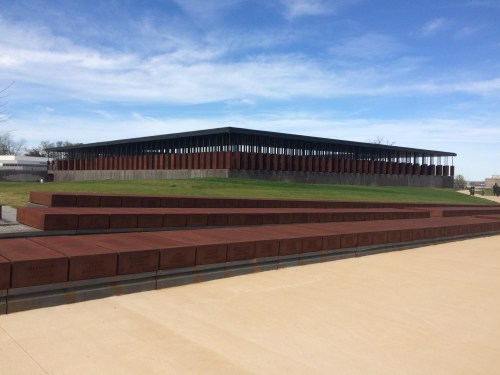
On a six acre site overlooking Montgomery’s downtown, a companion memorial contains two sets of over 800 steel columns, one for each county in the United States where documented racial terror lynchings took place. One set of columns is shielded by a roof. Viewers of the sloping site are led from an initial area where the columns are at ground level toward a section where they hang suspended, like many of the lynching victims they represent.  

Hanging columns at National Memorial for Peace and Justice in Montgomery, Alabama

Words or photos cannot convey the full impact of experiencing a walk among them. The county where I now live in North Carolina had one lynching memorialized; the county in Maryland where I was raised had two. In all, over 4,000 racial terror lynchings have been documented and verified in 20 states.

A second set of columns lies flat on the ground. Rust-colored, it reminded me of the corrosive myths many of us have told ourselves and each other for years, helping perpetuate race-based fears and hatred, going all the way back to the myth of the “happy darky.” There’s the myth of the predatory black man, with its corresponding myth of helpless womanhood. Especially pernicious and pervasive is the myth of white superiority, abetted by the myth of entirely benign police presence aimed solely at preserving “law and order.”

. The duplicate columns are designed to be brought home to the counties where lynchings occurred, as a way to help acknowledge past injustices and then help heal our enduring racial divides. The columns are way too heavy to fly, but these angels represented in Montgomery need to go home. It’s way past time.

Duplicate columns, Montgomery's memorial

duplicate columns lying outside at Montgomery memorial

By now, I’ve become an old woman. Not unlike the wife in Prine’s song, I’m named after one of my grandmothers. I may be old, but I can continue to bear witness. Again paraphrasing Prine’s lyrics—to believe in (and work toward) reconciliation is a good way to go.    

This Year’s February 14

This Year’s February 14     —by Jinny Batterson

This morning the sun rose here earlier than the day before;
The poinsettias a neighbor gave me to nursemaid
After the Christmas holidays droop a bit, but still
Lavish red and pink accents on our late-winter
Condo. My husband sneaks a colorful set of earrings
Onto my place at the breakfast table. Happy Valentine’s Day!

Only this year we add a differently sanguine tradition:
Marjory Stoneman Douglas High School Remembrance Day.
Last year, this morning in Florida started out routine,
Even joyous, until lives were shattered by gunfire.
Does it matter whether the gunman was mentally ill?
Does it matter that he had access to a military-style weapon,
Designed and sold for no other purpose than killing humans?

At 10:17 a.m., schools and workplaces will observe a moment
Of silence, remembering slain students Alyssa, Martin, Nicholas,
Jaime, Luke, Cara, Gina, Joaquin, Alaina, Meadow,
Helena, Alex, Carmen and Peter. We’ll ponder whether
Any of us have the bravery or protective instincts of staff
Members Chris, Aaron, or Scott. We’ll continue to mourn, to
Question what we can do to reduce the chances that
Future holidays will also come to hold dual meanings.
Thoughts, prayers, silent vigils help. They’re not enough.

Additional steps are required. To honor their memories,  go a little
Beyond: Send a pointed Valentine message to your legislator.
Follow up with emails, maybe even visits. Make a donation.
Register and vote. Talk with those of different views.
Find the unique, universal core deep within you,
Then share it. Some holidays exist for us to reclaim.


MLK, Jr. Reweaving the Dreams

MLK, Jr.: Reweaving the Dreams   —by Jinny Batterson

While he was alive, I knew little about him.
The mainstream press in Baltimore barely mentioned
This Negro preacher who’d helped marshal a yearlong bus
Boycott and in the mid-1960’s won a Nobel Peace Prize.
There were rumors he might be a Communist.

I was in high school, with other concerns—
Who could I get to take me to the prom?
Would my SAT scores help me get into a good college?
Would my parents take away my driving privileges
After an accident that I at least partially caused?

By the time I got to college, his star was waning,
Eclipsed by rising black militancy and a war in Southeast Asia
That dragged on and on. His tactics and pronouncements were
Less influential, less obviously successful in northern cities than in
Earlier Southern-based campaigns. Non-violence and preaching peace
Didn’t appear to work against big-city political machines and war contractors.

At first it seemed his dreams had come unraveled when his life ended.
As riots broke out in many American cities following his assassination,
I sat distracted in a secluded dating parlor on a small college campus,
My boyfriend’s bent-kneed proposal and diamond ring a pale foreground
To a muted television backdrop of Baltimore and Washington, D.C.,
Two bookends of my youth, engulfed in flames, sirens, and riot police. 

By the time his birthday was declared a national holiday
In November, 1983, I was attempting to learn and implement
Parts of his dream in rural central Africa. My efforts met with
Little success in a country whose few rich and many poor lived in vastly
Different worlds, with a minuscule middle partly made up of expatriates
Like me. I had lots of time to read the contents of a USAID library.

Martin Luther King, Jr., I learned, was a middle child, born just before
The Great Depression. His family lived in a relatively prosperous black enclave
In segregated Atlanta. During his early studies, he drifted, but partway through
High school he was inspired toward the ministry. He went north and completed
An impressive formal education, earning a doctorate by age twenty-five.

The parts we now recite in school start in Montgomery, Alabama,
Where he was nominated, as a young, little-known preacher, to give voice to the
Aspirations of people who had for too long been shunted to the back of the bus.
After the successful conclusion of the bus boycott, sixty civil rights leaders met
In Atlanta, founded the Southern Christian Leadership Conference, and elected
MLK as its first president.  Then came sit-ins, Freedom Summer, Albany,
Birmingham, Selma, Chicago, a Poor People’s Campaign, a sniper’s bullet.

Those of us who call ourselves progressives winced at subsequent American
Foreign and domestic policy, wrote letters, attended rallies and marches,
Wondered what else we might do to stop, or at least reduce, the madness.
For a while, we thought we had found an answer in another young,
Eloquent brown-skinned man. Twice we elected him national president,
Allowing complacency to creep into our ongoing efforts.

Our current national administration is more nightmare than dream.
It wants us to forget that our deepest dreams are inclusive rather
Than exclusionary, spiritual as well as material. MLK knew this.
He tried to tell us, over and over again, but we rarely listened.

We know MLK had flaws—infidelity, sometimes neglecting his family,
Carrying too much of the movement’s burden by himself.
We do not need another plaster saint, of whatever skin hue,
But Coretta was right to insist that we honor MLK with a holiday.
Though not free from sin or error, he was also a prophet
Who recalled us to our best selves. May we remember
His efforts as we redouble ours, reweaving stronger dreams.

What We Pay Attention To Matters

What We Pay Attention To Matters     —by Jinny Batterson

Here in North Carolina, we have the option of voting early—this election cycle, nearly three weeks early.  On the very first day of the eighteen days set aside for early voting in the county where I live, I cast my ballot.  I’d earlier signed up to work as a non-partisan election official at one of the early voting sites in our county.  Mostly because of this temporary job (and because I need to spend at least some of my time sleeping), I’ve been sheltered from widespread exposure to news events and negative campaign advertising. This has proved to be a real blessing. 

Once I finish my early shift at about 2 in the afternoon, I come home, take a nap, take a walk, share an evening meal with my husband, then bed down early so I can repeat the cycle, starting at about 4:30 a.m. the following day.  I’ve been vaguely aware of hateful tweets and sporadic violence, but mostly I’ve spent my after-dark hours sleeping and my before-dark hours either working or enjoying the autumn weather outdoors. 

On the job, we’re forbidden to talk politics, a wise decision, I believe. Still, from some of the partial stories other workers have shared with me, I get the impression that we represent a pretty wide range of backgrounds and political persuasions. We have younger workers, some coping with student debt, others concerned about underemployment—mismatches between the skills they’ve trained for and the jobs they’ve found so far. We have middle aged workers who worry about aging parents and/or the fluctuations in their 401Ks in a volatile stock market.

The long and short of voting at a central NC early voting site

We come in all colors, shapes, and sizes, from a petite ballot handler to a former basketball center. Some older “temps” are retirees like me; others still work part-time, sandwiching in scant time for personal lives amid hectic work schedules. One of my 60ish coworkers has a vocabulary that suggests he may not have had the same chances for formal education that I did. His line of patter can sometimes border on bigotry, yet he spent some of his off-hours last week comforting a colleague whose wife had a terminal illness. 

Our range of voters also is wide—from the just-turned-18 to a frail elderly woman whose grandson wheeled her up the elevator and into the voting area to cast her ballot one more time. She was born in 1920, the year that women in the U.S. first obtained the right to vote in national elections.  We see office workers on their lunch hours, professors eager to encourage their students to vote, students puzzled about voting procedures, custodians, construction workers, and others whose dress and demeanor defy easy labeling. 

It would be unrealistic to believe that our democracy is in great shape. Being subjected to predictably inflammatory tweets, predictably bloody lead news stories, and predictably negative campaign advertising can be discouraging. Whatever the outcome of this current voting cycle, we will have lots of work to do to help heal some of the breaches in our social fabric, whether we are citizens or elected officials. Yet I’m encouraged by the civility of the voters and polling officials in the small corner of the electorate where I work. Many people DO show up to vote, over a million so far in North Carolina. They wait in line, sometimes chatting with each other. They’re glad to get their ballots and to make their opinions known.  Perhaps if we pay more attention to what’s going well, we may be in a better position to help alleviate what’s not.