Category Archives: holidays

Playing for a Tie

Playing for a Tie…   —by Jinny Batterson

Most of the formal games I play are board games. Competitive athletics were pretty much out of the question for this lifelong klutz. Growing up, my brothers, sister and I got lots of gift games at Christmas to carry us through the cold weather months—classics like Monopoly, Clue, Stratego, plus other “big hits” of the time that haven’t aged as well. Once we got a little older, we were given word games like Scrabble. As my vocabulary grew, I got to be a pretty good Scrabble player in my first language, English. In high school, I played a few casual games in French, but English tile values for letters like “q” and “z” were inappropriate and we never got a French-based set, so the Scrabble fad in French club quickly died out. 

In my twenties, I started playing two-person Scrabble games with my husband, the super-competitor. It rarely mattered if I got better letters. He was much better at word placement, racking up double words and triple letters all over the place. Eventually, he’d beaten me so consistently that I decided I didn’t want to play him any more. Much later, we arranged a truce of sorts—we would still play each other, just not keep score. 

Several years ago, a mutual friend introduced us to the word game Quiddler, which can be played more quickly than Scrabble and requires less space, using playing card sized letters rather than tiles and a board. Hubby still beats me the majority of the time, but not by the lopsided proportions he used to tally up in Scrabble. I occasionally have a long enough winning streak so I’m willing to keep trying. We’ve adapted the original rules slightly: we play eight rounds per game, starting with a hand of four cards each, adding one card with each successive hand. The close games are more fun than the really lopsided ones—a hand with no vowels or no consonants, especially in a later round, can put you behind so far it’s almost impossible to catch up. 

Winning is fun, losing less so, but the contests I cherish most are the rarest—about once in a hundred games, we wind up with a tie score. Jim doesn’t get as much satisfaction as I do from the ties, but he humors me. 

On a whim, I decided to see if I could get an internet read on what popular physical sports allow tie games. I found the resulting gem via Wikipedia: 

“Ties or draws are possible in some, but not all, sports and games. Such an outcome, sometimes referred to as deadlock, can (also) occur in politics, business, and wherever there are different factions regarding an issue.”

“Tie” and “draw” appeal to me a great deal more than “deadlock,” which sounds unduly negative. All of us will eventually wind up dead. All of us at some point experienced birth.  While we’re in between, we’ll likely experience some wonderfully positive times (weddings, children’s births, signature achievements, reunions with long-absent friends). Other times may make us wish temporarily for death: serious illnesses or accidents, natural disasters, financial reversals, tragedies for loved ones, divorces.  

In these fraught times, when so much of our media environment can seem intent on making our circumstances feel even more fraught, I want to put in a plug for ties. If we live in the northern hemisphere, we’re approaching the winter solstice, the time of year when daylight is minimal and dark is “winning.” Starting on December 22, though, our 24-hour day/dark cycle will tend again toward balance, toward a “tie” at the equinox. Nature provides two such ties per year. 

Ties have a different connotation than deadlocks; ties can be enjoyable, special.  Let’s learn or relearn how to savor them.   


Poinsettia Day

Poinsettia Day    —by Jinny Batterson

December 12 has been proclaimed “Poinsettia Day” in the United States. The designation honors a plant brought to the U.S. by  Joel Roberts Poinsett, the first United States Ambassador to Mexico (1825-1829). Poinsett’s love of botany persisted while he trained as a physician. His career mostly went a different direction. While serving in Mexico, Poinsett continued to maintain hothouses on his Greenville, South Carolina plantations. In about 1828, he sent some poinsettias back from Mexico to be propagated. He later gave cuttings to John Bartram of Philadelphia, who introduced the plant to other nurserymen. Over time, the poinsettia in many variations has become a top selling Christmas plant,  with about 33 million poinsettias sold each year. 

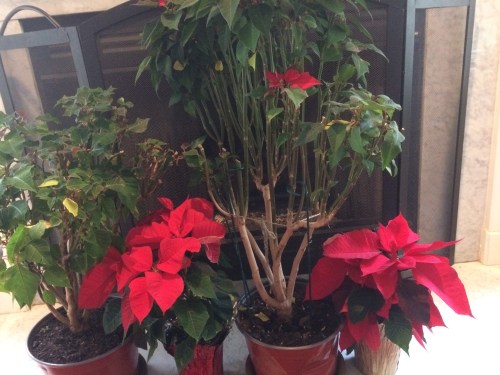
Our 2019 experiments with “forcing” the two poinsettias given us by a neighbor after last year’s holidays were not entirely successful. Although the plants survived two successive transplantings—from pot to ground once frost was finished in spring, from ground back to pot before autumn’s first frost—they didn’t produce the same beautiful red bracts as store-bought plants.  I’m not sorry we tried. Even though our “home growns” were spindly and mostly stayed green, we learned from our efforts. Any plants we carry over until next year will be treated with an enhanced regimen, though likely not quite as standardized as hothouse plants. This year, as a side benefit, the exercise of taking the plants from basement to light and back twice a day has helped keep off some of this year’s holiday flab. 

Below are pictures of the two types of poinsettias gracing our hearth this holiday season. May light and life grace your home as well!  

full store-bought poinsettias, leggy home-grown from last year

A Small White Button

A Small White Button  —by Jinny Batterson

A year or so ago, someone at an anti-racism workshop gave me a small white button: BLACK LIVES MATTER, it said in black typeface on a white background, with a small circle of red edging around the whole button. Maybe an inch across, it’s not an “in your face” kind of button, although the lettering is not what you’d typically wear to a Rotary meeting. For much of the time since the workshop, the button has sat on my bedside table. When I look at it morning or evening, it reminds me of commitments I’ve made to work harder to reduce my own and American society’s racist tendencies. Most of the time the button just sits there while I go about my business elsewhere.

As a white person in Trump-era America, I can too easily let myself be cowed by mentally replaying images of gatherings like the angry mob of white supremacists that invaded Charlottesville during the summer of 2017. I can be timid, hesitant, even cowardly. “Will I put myself in jeopardy by publicly wearing a button for a cause many may misunderstand or disagree with?”   

What is the Black Lives Matter movement, anyway? Some black friends plus a bit of remedial internet sleuthing reconfirmed that the Black Lives Matter movement was started by three black women in 2013 after the shooter who killed unarmed black teen Trayvon Martin was acquitted of all charges. Trayvon Martin’s death was just one in a long series of deaths and injuries of unarmed blacks at the hands of police or armed civilians. It followed, too, a longstanding pattern of racially or gender motivated shootings, profiling, discrimination, arrests, and jail terms for those perceived as “other.” Someone needed to protest, to promote a more just approach. The women went on social media, where much BLM activism is still promoted. It’s also where much disinformation about the group gets spread. Not all black activists agree with some of BLM’s tactics; many of all races do not understand its inclusive emphasis.  

About the time of the Trayvon Martin shooting, a white librarian friend in rural South Carolina told me she’d learned to avoid any hint of condescension or derision with white colleagues and acquaintances in her economically challenged part of the Low Country. “Of course it doesn’t help to call someone a cracker or a redneck,”  she chided. “If someone talked to you that way, wouldn’t it just make your neck go redder?”  Her remarks echo when I try to remind myself of the humanity of the angry white men who converged on Charlottesville. Some of the men may have resented the continuing winnowing out of traditional middle class jobs due to outsourcing and automation. Some may have been facing financial challenges. Many may have been taught a distorted version of maleness. Trying to identify with what motivated them, I realize that when I feel insecure, I can be tempted to blame “others.” Skin color remains one of the most visible ways to “other” someone.  

Lately I’ve started wearing my small white button occasionally, rather than leaving it in solitary confinement at home. Over time, I’m adjusting when and where I put it on—showing it off to my progressive friends is not especially useful, I’ve concluded. At the other extreme, pushing it into the notice of hard-core BLM opponents is unlikely to change any minds or hearts.  

Mostly I put it on while running the everyday errands that are part of a retiree’s life this holiday season—banking, eating out, shopping, buying stamps, sending packages. Black lives DO matter. That they matter does not make my life matter any less. Once in a while, a black postal worker, a fast food restaurant worker, a lunch companion or a store clerk will smile after noticing my button. It affirms their dignity at the same time it reminds both of us of our common humanity. 

Wisely wearing my small white button is a very small risk. Experiencing the smiles it sometimes calls forth is a reward for which I’m thankful. 

Selective Memory and Finishing the Work We are In

Selective Memory and Finishing the Work We Are In  —by Jinny Batterson

I can remember parts of events that happened when I was much younger. On Friday, November 22, 1963, I was a Maryland high school student. I remember hearing our school principal start an announcement over the school intercom that day at an unusual time for announcements. I remember coming down the stairwell between the two floors of our building along with many other students changing classes. 

I don’t remember whether the announcement I heard while going downstairs was the first—that President Kennedy had been shot—or the second—that he had shortly afterward been pronounced dead at a Dallas hospital. I don’t remember whether school that day was dismissed early or whether school was canceled the following Monday for his funeral. I don’t remember much about that year’s Thanksgiving the following Thursday. 

Earlier in 1963, there had been a tense standoff between the nuclear-armed U.S.A. under Kennedy’s leadership, and the nuclear-armed U.S.S.R. under Nikita Khrushchev about the positioning of nuclear missiles on the island of Cuba, then led by Communist revolutionary Fidel Castro. I don’t remember whether my dad built a nuclear fallout shelter in our front yard before or after Kennedy was shot.  

Parts of our education when I was a student involved memorizing famous poems and speeches. I can recite most of a short Abraham Lincoln speech from a century earlier, first spoken in November, 1863 at a dedication ceremony for a military cemetery at the site of one of the U.S. Civil War’s deadliest battles:

Four score and seven years ago our fathers brought forth on this continent, a new nation, conceived in Liberty, and dedicated to the proposition that all men are created equal. Now we are …testing whether that nation, or any nation so conceived and dedicated, can long endure.…The world will little note, nor long remember what we say here, but it can never forget what they did here. It is for us the living, rather, to be dedicated here to the unfinished work which they who fought here have thus far so nobly advanced. …It is rather for us to be here dedicated to the great task remaining before us … that we here highly resolve that these dead shall not have died in vain — that this nation, under God, shall have a new birth of freedom — and that government of the people, by the people, for the people, shall not perish from the earth.

In the tragic days after Lincoln’s 1865 assassination, his Gettysburg speech was nearly forgotten. Later, the contents of the speech took on more importance. When the current Lincoln Memorial was dedicated in Washington, D.C. in 1922, the Gettysburg Address was inscribed on one of the monument’s inside walls.  

We are now experiencing another test of the viability of our democratic institutions. Each of us brings different memories to an ongoing impeachment inquiry. Witnesses and questioners interpret incidents differently, partly based on their training and point of view. Our current President ran for office touting the belief that our nation could return to a time when the U.S. was preeminent in global affairs. As an astute businessman, he could “fix things.” Some seem to think his position grants him nearly unlimited license to promote his own interests. Attempts to remove him from office are “character assassination.” Others less charitable to the President point out that our political system is based on checks and balances designed to restrict any one person or political entity from rigging the system to his own benefit, from “fixing things.” 

Absent from the immediate debates and questioning are considerations of the impacts of global over-dependence on fossil fuels to human and planetary health. Scientists tell us that both the United States of America and the rest of the world’s nations have only a decade or so to drastically curb our output of the climate-warming gasses produced by burning fossil fuels if we are to maintain a planet capable of supporting human life as we know it.

On another wall of the Lincoln Memorial is his second inaugural, delivered in March, 1865, just over a month before his assassination. We might be wise to remember its conclusion:  

With malice toward none, with charity for all, with firmness in the right as God gives us to see the right, let us strive on to finish the work we are in, to bind up the nation’s wounds, to care for him who shall have borne the battle… to do all which may achieve and cherish a just and lasting peace among ourselves and with all nations. 

Regardless of the outcome of our immediate political crises, climate change requires all of us to strive on, using whatever tools of intellect, wealth, compassion, and ingenuity are at our disposal, to finish the work we are in.     

Building Lop-Sided Bridges

Building Lop-Sided Bridges    —by Jinny Batterson

About this time of year in 1997, I got a nasty shock. I was diagnosed with breast cancer. A set of cells had gone malignant and might soon invade the rest of my body. Several months earlier, I’d had my annual mammogram and was told it was normal. So at first, I wrote off the lump that showed up around Hallowe’en as just another annoying symptom of menopause. I was a healthy, middle-aged white woman. I ate well, exercised regularly, had gotten all my prescribed screenings. I made a comfortable living as a consultant, had two college-age sons, a husband who loved me, and no family history of breast cancer. The lump would go away on its own. It didn’t. Further tests showed an aggressive tumor. By early December, I’d had a modified radical mastectomy without reconstruction. I was pretty shaky both physically and mentally. 

As I began to heal, I tried to use my experiences as a teaching tool. Our Unitarian-Universalist congregation in Richmond, Virginia had long engaged in efforts to help promote racial healing. Each year about the time of the MLK holiday, we had a special service with a racial justice theme. This particular year, I’d been working for several months before my diagnosis on the planning committee for the service. As I began to regain strength after surgery, I asked if I could do a short talk about my “lop-sidedness,” using my body as a metaphor for the way our entire society was lop-sided and hampered by our history of individual prejudice and systemic racism. We all needed healing. I composed and rehearsed my talk. By early January I was confident that I’d have the physical stamina and the psychological strength to deliver a 10-minute talk, even with the prospect of six months of chemotherapy looming. 

Then I went to choir rehearsal. Our young choir director wanted to use spirituals to accompany the service. He’d chosen “Soon I will be done with the troubles of this world, goin’ home to live with God…” as the meditation hymn. I flinched. Jamie was a wonderful musician, but I really didn’t want to identify with that particular song at that particular time in my life. Privately, I asked if we could substitute something more upbeat. I got a reprieve. We wound up singing “I’m so busy servin’ my Master, ain’t got time to die…”  Both the congregation and I survived to continue our work. 

A decade later, I learned that my favorite college roommate had developed breast cancer. Beth had grown up near Richmond, graduated from our small liberal arts school, then gotten an advanced degree in library science. She’d moved to different parts of the country. She spent much of her career administering college libraries—first in Ohio, then South Dakota, then Florida. We kept up via holiday cards and occasional phone calls. In her 50’s, Beth had changed focus slightly and taken a post as director of a set of public libraries in an economically depressed part of lowland South Carolina. Beth had been in her new job only a year or so when the cancer hit. Her family and friends rallied to her support. Once her most intensive treatments were over, I went down for a weekend visit. We traded survivor stories. When she passed the five year mark without a recurrence, I sent hearty congratulations. Then, a couple of years later, a non-cancerous illness destroyed her kidneys and took her life with little warning. That April, I drove south through timber plantations, palmetto swamps, and railroad cuts festooned with blooming wisteria vines to get to South Carolina for Beth’s memorial service. I didn’t know much about her town, but suspected it would be as highly segregated racially as much of the South I’d previously been exposed to.

The small Methodist church was nearly full. Some of the mourners were family members I recognized, but I was surprised to see half a dozen older black women among the mostly white worshippers. I guessed at first that perhaps the women were maintenance workers at some of the libraries Beth supervised, then chided myself for stereotyping. At the reception after the service, I had a chance to talk with one of the women.

“How did you know Beth?” I asked.

“We were part of a local support group called ‘Bosom Buddies’,” the woman explained, pointing to the discrete pink lapel pin she wore. 

I never learned much about the group. Beth may have had a hand in creating this cross-racial sisters-beneath-the-skin effort in the area she’d made her home. Whatever her role, she’d reached out across any racial divide, creating enough of a bond so that six women had taken the time to attend her memorial service.

Our country remains in need of healing. Pundits of many political leanings expound on all the ways we are polarized— economically, racially, politically, spiritually. Income disparities persist; wealth gaps have gotten worse. Gun violence takes too many lives; “stop and frisk” procedures and mass incarceration further divide us. Health outcomes vary tremendously, based partly on income and ethnicity. We’re still lop-sided. We all need healing. Perhaps those of us who are physically lop-sided can continue to build lop-sided bridges.


Caramel-colored Children and Labor Day

Caramel-colored Children and Labor Day    —by Jinny Batterson

In a conversation with a good friend whose tendency to wax cynical has been reinforced by some of our recent political and media trends, I heard her lament: “Maybe we’ll finally stop dissing or shooting each other when all of us are caramel-colored.”

I admit to a good bit of prejudice not supported by reality, so I did a little research on interethnic marriages and relationships, which have become increasingly common in the U.S. over the past several generations. Since the U.S. Supreme Court ruling legalizing interracial marriage (in the 1967 case Loving vs. Virginia), the proportion of reported interracial/interethnic marriages in the U.S. has risen dramatically. As of 2017, over one in six new marriages in the U.S. were registered between spouses of different “racial” backgrounds, while about 10% of all married couples were “mixed race.” Statistical evidence for non-marriage relationships is harder to come by, though my anecdotal experiences tell me that these are also becoming more diverse.

The 2000 census marked the first time that Americans were given an option to choose multiple racial identities, not just one. By the 2010 census, people who reported multiple races had risen substantially: 9 million census respondents chose to check two or more racial groups, a 32 percent increase from 2000. (Those who reported a single race rose by 9.2 percent over the same interval.)

My extended family has at least one multi-ethnic marriage and two young adults who could choose to check more than one “race” on a census form. I’ve not delved very far into how my nephews choose to identify themselves and how this has impacted their lives; my hope is that any prejudices against them are waning as “mixed race” children become more and more common.

Intellectually I know that the whole notion of “race” is more cultural than biological. Differences in skin pigmentation bear little relationship to variations in DNA and to other supposedly ingrained characteristics. Still, like many, I’ve been socialized to view a person’s skin color as somehow indicative of their other characteristics. Not until I’d lived next to an elegant “black” neighbor for a decade did she explain to me that she did not much like to dance and had little sense of rhythm. 

Labor Day is a day set aside to honor the contributions of laborers to the overall good of American society. Those of us who are “white” (and generally privileged to do most of our labor with heads rather than hands or backs) are beginning, reluctantly, awkwardly, to enter into conversations about the labor of “non-whites” forced or coerced into doing much of the work of building this country and society. Too often we continue to dishonor their and our heritage through sentimentalizing versions of U.S. history and society that leave out or minimize the injustices and cruelty that helped and help “make America great.” 

There is much work still to be done. Let’s remember, this Labor Day, to keep laboring toward a more equitable America where all labor is valued, whatever the skin color of the laborer.

The Double Seventh Festival

The Double Seventh Festival (Qixi)    —by Jinny Batterson

The “Double Seventh” festival is celebrated in China on the seventh day of the seventh lunar month each year. Because the lunar calendar varies compared to the solar calendar used in most Western countries, the occurrence of the Double Seventh festival can come anywhere between late July and late August. In 2019, the festival falls on August 7. It has been called the Chinese “Valentine’s Day,” and is based on a famous legendary Chinese love tale:

Niu Lang (the Cowherd) was an orphan with a gift for nursing cattle back to health. After a god coaxed him into caring for cows in the heavens, Niu fell in love with the fairy Zhi Nu (the Weaver Girl) and the two started a family. However, the queen of heaven became jealous and caused a great river (the Milky Way) to come between them. The two were heartbroken. Their copious tears caused the queen to relent just a little—one day each year, on the seventh day of the seventh month, the two were temporarily reunited.

The star Vega is often cited as representing the Weaver Girl, and the star Altair represents the Cowherd. On double seventh evening, Chinese in areas with clear skies can gaze up to see Vega and Altair shining in the Milky Way, with the star Deneb forming a symbolic bridge between them.

Similar celebrations are held throughout other countries in Asia, with variations of the legend told in Korea, Japan, and Vietnam. 

In more urban areas of China, the Double Seventh festival has become less important, overshadowed by Valentine’s Day in February. In the countryside, celebrations are more likely to continue to exist, with young women exhibiting their skills in sewing and embroidery, and lovers exchanging gifts of flowers, chocolate, or decorative clothing.    

Layered Reality

Layered Reality   —by Jinny Batterson

Sometimes, despite fairly consistent efforts to broaden my circle of friends and acquaintances, it seems as if I’m stuck in an ever-shrinking bubble, quarantined in my own little “liberal-urban-retiree” silo. Recently I had a chance to spend a week with our out-of-town grandchildren, exploring a couple of stunning U.S. national parks via outdoor hikes. My guess is that our son and daughter-in-law had carefully coached the kids to humor grandma and grandpa by not overusing their “screens.” We watched a fair number of breakfast-time morning cartoons, but mostly we wandered outside, free from earbuds, television, or other screens. Cell phone coverage was minimal or nonexistent.

Much of our political and cultural life these days, including mine when not hiking with the grandkids, gets mediated by screens. Screen life can often seem tasteless, colorless, instantaneous, disconnected. I realize I’m getting old and slow, but I doubt this is the only cause for our disconnectedness.

I remember a story my rural sister told me. Typically apolitical, Sal had gotten sufficiently exercised in our recent hyper-charged society that she decided to become more politically active. In 2018, she campaigned for a candidate for U.S. congress in the Maryland district where she lives. She and I live in mirrored political entities—both North Carolina, where I live, and Maryland, where Sal resides, are “poster child states” for extreme political gerrymandering. I live in one of a few districts carved out to the benefit of NC’s minority party (in this case, the Democrats). Sal lives in the one district in Maryland that has been allocated to its minority party (in this case, the Republicans). Though our NC polling sites during early voting and on election day fairly consistently have longish lines, the precinct where Sal stood with her candidate’s literature wasn’t busy. Dribbles of voters came by the area where campaigners were allowed, leaving lots of down time. My sister is nothing if not gregarious, so before long she was talking with the two campaigners for the majority party candidate. Carefully sidestepping the merits of their respective candidates, Sal probed for possible common ground. Pretty soon, the three of them were discussing the uncertainty of sale prices for soybeans; the availability of rental drones for quicker, more thorough analysis of field conditions; the best area bulls for improving dairy herds; the impact of changes in agricultural regulations on small-scale farmers. Although there were certainly political opinions where the three of them likely disagreed, they found a good many areas where their interests overlapped and they could be both civil and informative. Their reality was layered with interspersed agreement and disagreement.

Last year about this time, I was in an area of rural France where human habitation goes back hundreds of thousands of years. I got a tour of an archeological site with over a dozen layers of excavation, ranging from about 40,000 to about 15,000 years ago. Now inactive, the site had been carefully dug during a human generation or so, some layers yielding little in the way of artifacts or information, others rich with both. I believe we need to remember that our social and political realities are rarely either/or, much more often layered with both conflict and agreement. Likewise, we are both independent and interdependent.  Please let’s take a bit more effort toward excavating beyond the tweets and the sound bites—our neighbors may be more layered than we know.

Uncle John

Uncle John   –by Jinny Batterson

Uncle John in military uniform, 1941

It’s been so long ago now that I barely remember
The annual childhood visits to Arlington’s cemetery,
To put flowers on the gravesite where your family
Eventually had you re-interred after you’d fallen
In Germany near the end of World War II.

Once I’d grown older, I asked for pictures of
What you’d looked like in life–you were blond, like
The stern dad whose name is included in yours.
You’d volunteered early for the military, convinced
That the Third Reich posed a grave danger to
Global civilization, though equally so, you thought,
Did rampant nationalism and materialism. In one of the
Pamphlets that your middle sister had printed in your
Honor and memory, you opined, “Would you die for
Your bathtub?” Perhaps somewhat germane, as I sit
In air-conditioned comfort while soldiers in distant deserts
Sweat out yet another year of armed conflict.

You were an inveterate scribbler, like this niece
You never met in life. An eldest son, one of just two
To survive to adulthood, you died in Europe a month
Shy of your thirty-fourth birthday, at about the same
Time your younger brother was among those not killed
When a kamikaze pilot damaged the aircraft carrier
Where he served in the Pacific. Dad came home and
Rarely talked about his service. He sired four children of the
Family’s next generation. In life, the two of you had argued
Passionately about politics, about human nature, but had
Worked and traveled together before war sent you to opposite
Ends of the earth. Dad had the longer physical life, and
He passed along some of your ideals along with the family genes.

You loved the outdoors, spent time on the family farm,
Went camping with friends–an heirloom snapshot shows you
Holding a coffee pot, with an improvised clothes line
Tied to a tent in the background. It’s somewhat fitting
That what physically remains of you lies among many others
On a grassy incline, partially shaded by trees, in a large area
Of “section 12” between Grant and Eisenhower Drives.

This year I won’t make it physically to your gravesite.
My worsening eyesight cannot totally decipher the
Inscription on the virtual image of your headstone
That I now can pull up thanks to a website and the
Volunteers who maintain it. Our country and others
Still engage far too often in “shooting wars,” both foreign
And domestic. Our technology now allows us to engage also
In vicious foreign and domestic cyber wars, equally dangerous.
Please rest well, Uncle John. Know that your survivors
Are doing our best to continue your legacy of service.

The Shapes of our Scars

The Shapes of Our Scars  —by Jinny Batterson

This Mother’s Day brought cards and good wishes from the next generations. Although I once in a while miss the annual homemade breakfasts I used to get years ago, having grown-up children is much less hectic. I’m very glad I’ve had chances to be a biological mom. I’m grateful that the generations after mine are coming into their own, establishing their own patterns of family and civic life.

Mother’s Day observances for me can bring comparisons with other mammalian mothers. Someone has recently started a “dog moms’ day” (celebrating the women who care for their pet dogs) on the Saturday just before (human) Mother’s Day. Lots of internet images these days feature women mothering their pet dogs, or cute dog mothers with their pups, or cat moms with their kittens. What intrigues me most, though, are humpback whale moms. 

Many members of my age cohort were introduced to the songs of humpback whales during the 1970’s, when popular singer Judy Collins produced a duet of human and whale songs based partly on humpback whale recordings captured at sea. The whale songs were haunting. The songs of the humpbacks added impetus to a movement to curtail whale hunting internationally. Humpback populations have since rebounded, though still only at about a third of their estimated 1940 levels.

Marine biologists are learning more about the migration patterns and behavior of all whale species, including humpbacks, one of the larger whale species. Mature humpbacks are about the size of a school bus, weighing 30-40 tons.  Humpbacks migrate huge distances between feeding and breeding grounds each year. Scientists are not sure all the reasons that the whales vocalize—sometimes to find a mate, perhaps to share news, perhaps at times just for fun.  Humpback whale mothers can produce a calf every 2-3 years, and nurse their new calves for up to a year. It takes about a decade for whale calves to reach adult size. A normal humpback lifespan is about 50 years, with ocean pollution, boat collisions, and fishing gear entanglements having replaced whale hunting as main sources of premature death. 

Identifying individual humpbacks can involve studying the patterns of light and dark colorations on the underside of their tail fin, or “fluke.”  Sometimes these patterns are interrupted by scars, which can also help with identification. Recent studies have indicated that many of the scars on mature whales are the result of accidents or attacks when they were calves—often during their first migration.

In a way, such news is reassuring to this fellow mammal. Regardless of my best attempts, sometimes I may have exposed my human children to harm. Sometimes that harm may even have come from me, passed down from the generations that preceded me. I’m grateful that whatever the scars I carry or have inflicted, both I and my children have survived to adulthood. With wisdom, I may be able to use the shape of my individual scars to help heal myself and others.  With wisdom (and perhaps with song), we may be able to heal ourselves and other species from the scars we have inflicted on the planet.   

For more about humpbacks, check the internet—one fairly good introduction has been posted by National Geographic: https://www.nationalgeographic.com/animals/mammals/h/humpback-whale/