At first blush, it seems a mere blot on the calendar— Wedged between the heroic hoopla of July 4 and The start of another workaday year around September’s Labor Day. People in their prime have disappeared from workplaces, Taking their camping gear, their beach bags, their teenaged offspring And their air-conditioned vans with them elsewhere.
Those of us left comfortably behind are only a little envious. We loll lazily on lounge chairs, or float face up in bathtub-warm Backyard pools, while grills entice with odors of slowly broiling brats. Vintage music plays at local festivals–Beach Boys, Beatles, Sometimes even Sinatra. Bocce tournaments bring out the Men in white. Parasols make a temporary comeback.
The furious scandals of pre-recess government seem less Pressing for the moment, the final few tomatoes extra juicy. August is not regal, not “august,” its aspect instead laid back. Sharing vowels with its mood, August is languorous. Before the rushed tumult of impending autumn, Such languor is both welcome and sorely needed.
This year’s 4th of July celebrations did little for me. Much flag waving seemed phony, some neighborhood camaraderie felt forced. I ached as U.S. ICE raids continued, as civilian deaths mounted in too many armed conflicts. I wanted to skulk away, to forego my allegiance to much of anything. But I remain part of a wider whole. Whatever my pique at political or social shenanigans, I do not have the option to resign from humanity.
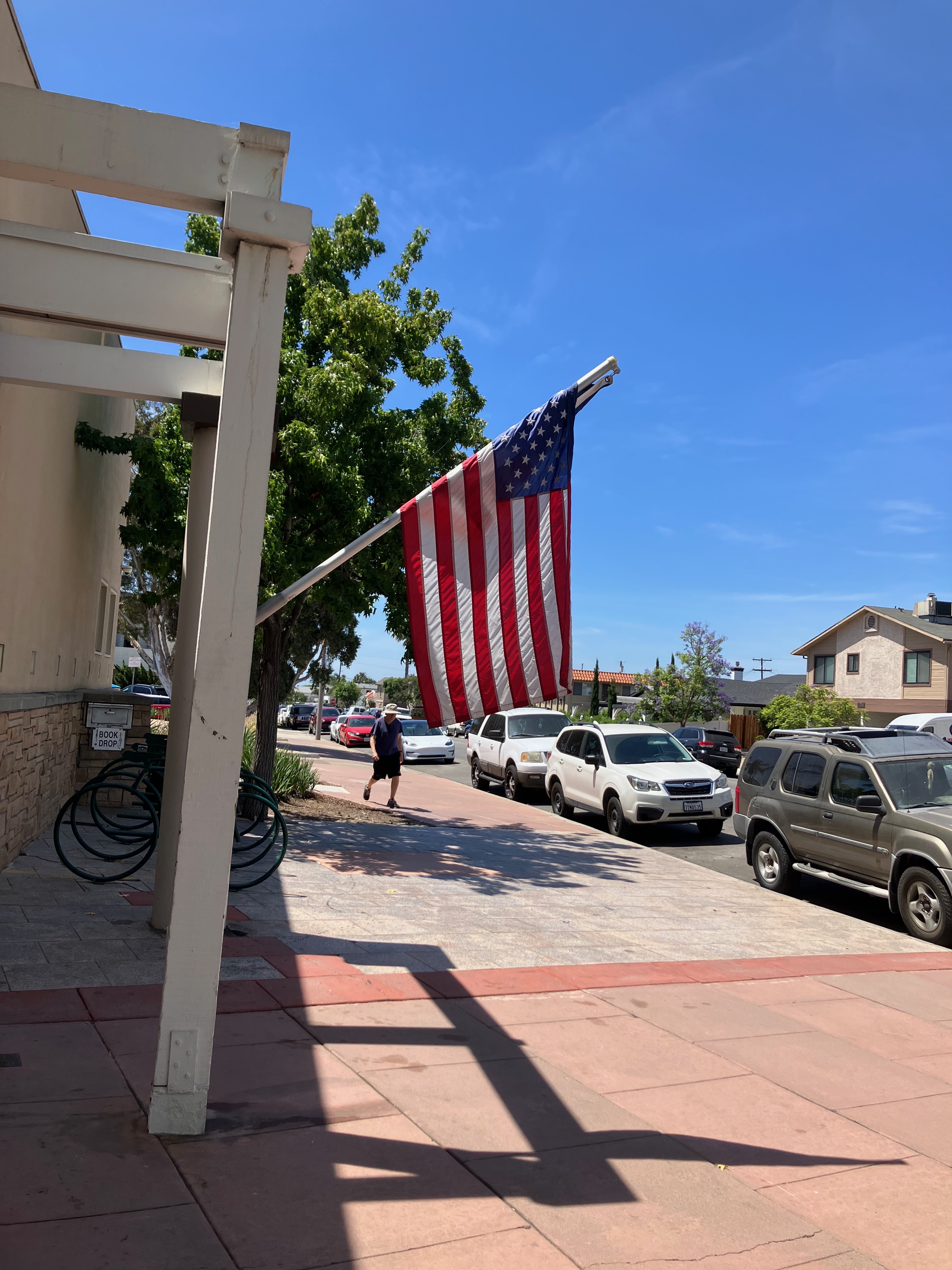
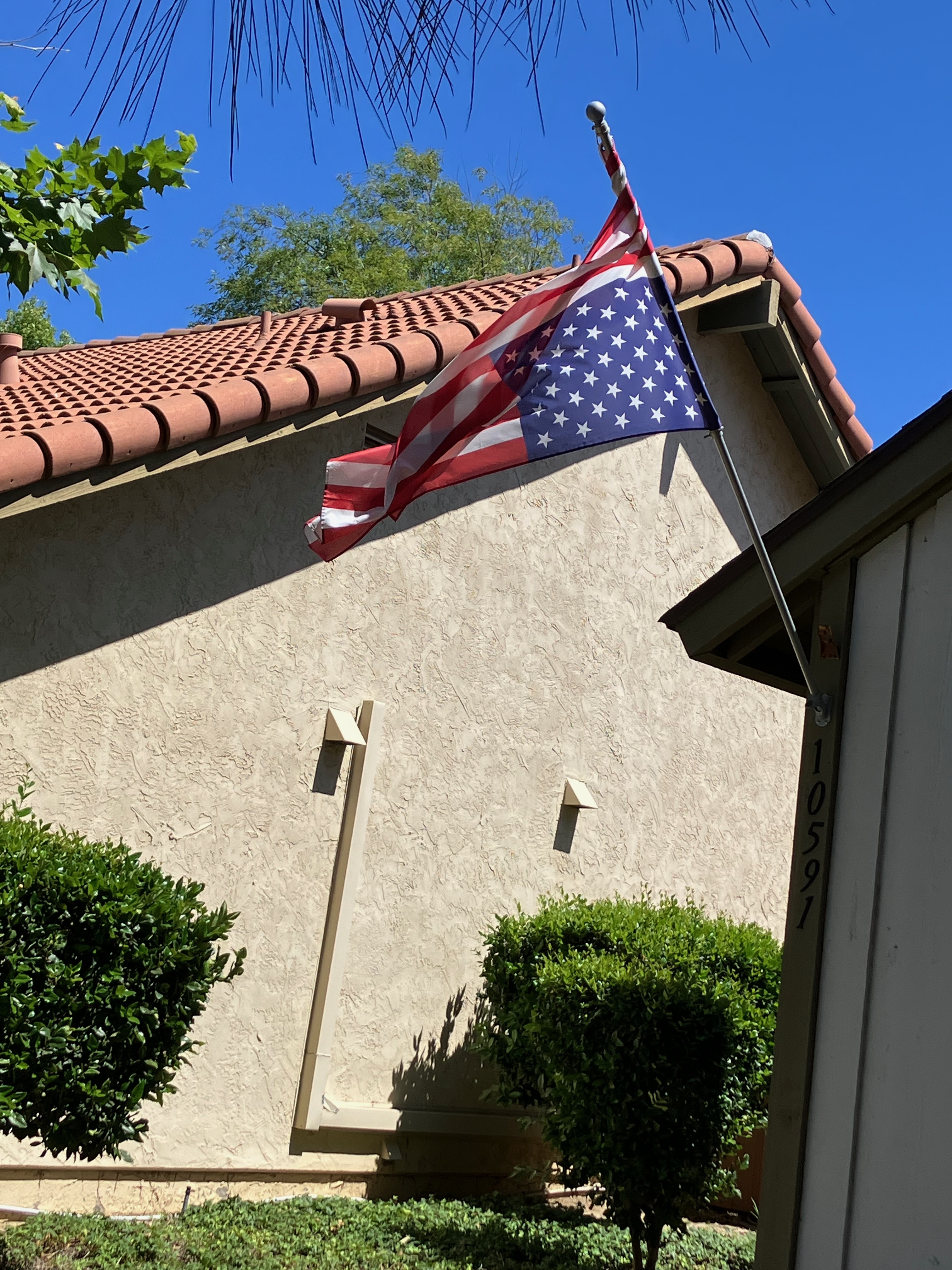
public flagdistress flag
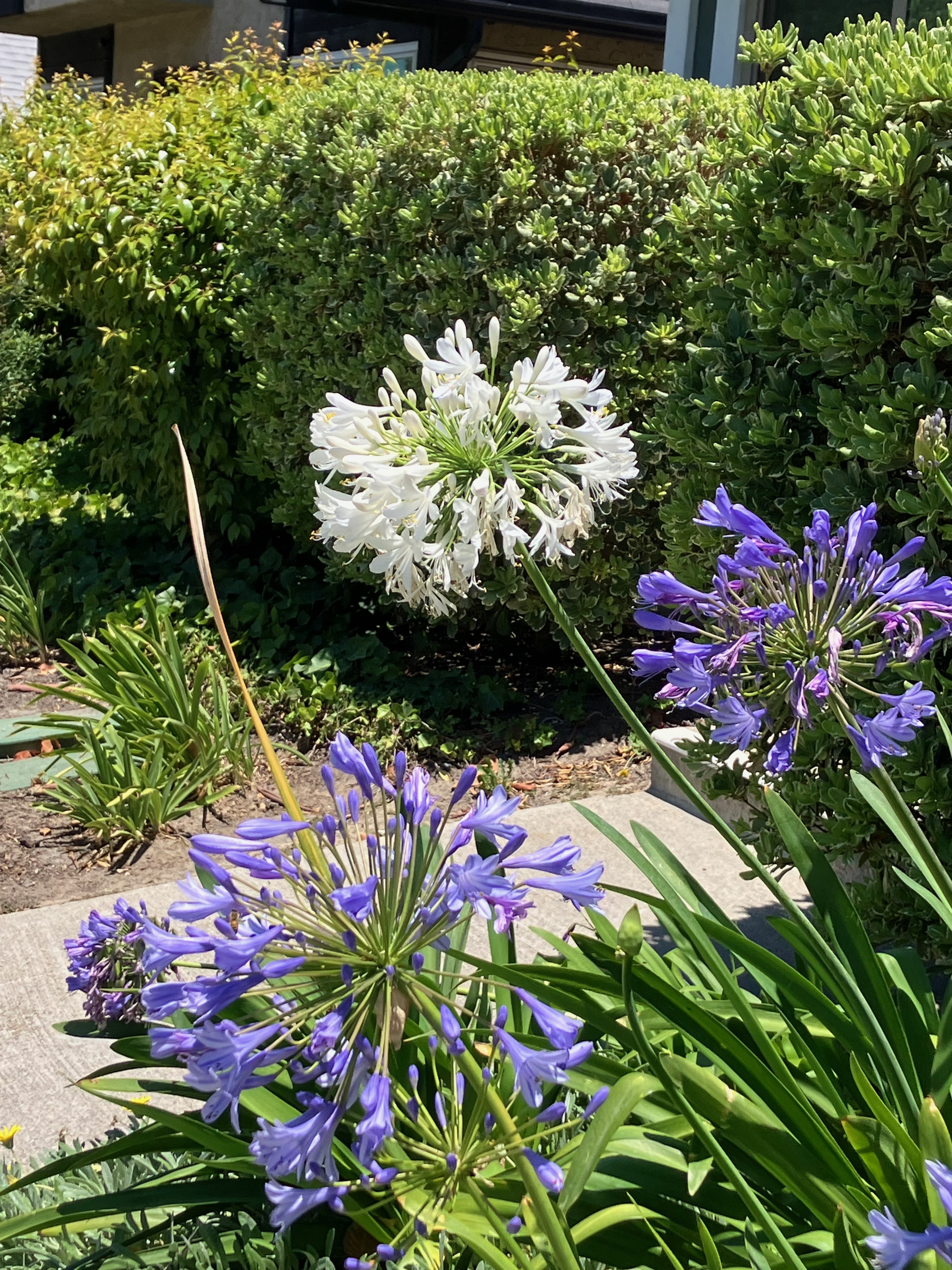
So I briefly retreated to gardens that nourish me, some of whom I tend: I admired walkway African lilies (agapanthus), most likely planted When our 1970’s housing subdivision took shape over a decommissioned firing range. This time of year, blue and white agapanthus blooms adorn our nearby streets, Their starbursts quieter, more calming, less ephemeral than fireworks.
Within my own yard, I reveled in two sets of red blooms: Along a sunny side fence, snapdragons from last year. They’d overwintered In this mild climate where distinctions between “annual” and “perennial” Get increasingly blurred.
overwintered snapdragons
shade-loving impatiens
Against the opposite fence, impatiens, cut-rate at the Distressed rack of a local garden shop, now hold forth in most-of-day shade.
One day per year serves me as reminder of our nation’s independence. On other days, I’d rather honor our interdependence with a natural world that graciously includes us.
May we continue to reconcile independence and interdependence, wherever we are. Hurrah for the red, white, and blue, whether flags or flowers!
Southern California at the start to 2025 has been the site of extensive trauma. Multiple wildfires are burning large areas around Los Angeles, abetted by fierce Santa Ana winds and a winter drought. Still not fully contained, the fires have killed dozens, forced mass evacuations, destroyed thousands of homes and businesses.
People elsewhere haven’t been immune, either. Even if we’ve tried to shield ourselves from too much media exposure, we probably have heard about the New Year’s Day killing of New Orleans revelers by a disturbed military veteran who rammed his truck into a crowd. It’s hard to remain entirely oblivious to ongoing warfare and carnage in Ukraine, in Sudan, or in Gaza, where a limited ceasefire seems finally to be taking hold.
As someone who came of age at the height of U.S. involvement in Vietnam in the late 1960’s, I’ve had long, indirect exposure to that war’s trauma. The Vietnam Veterans Memorial, dedicated in Washington, D.C. in 1982, is inscribed with the names of the over 58,000 American soldiers who lost their lives in that war. Estimates of the number of Vietnamese deaths in the period 1965-1975 range from about 750,000 to over 3 million, including both soldiers and civilians. Somewhere around a million Vietnamese survivors became “boat people,” making perilous sea journeys that eventually led many to settle in the U.S.
The more people I get to know, the more history I learn, the more I become aware of traumas that have impacted millions of Americans. The past fifty years or so have uncovered more of the pain and dislocation of the chattel slavery practiced from about 1650 until the 1865 end of the American Civil War in the territory of the U.S. Even after the legal abolition of slavery, discriminatory practices and intimidation continued to severely circumscribe the lives of many former slaves. “Generational trauma” can persist, perpetuated by the lack of respect or opportunity accorded many African-Americans for centuries.
Not all who are traumatized are black. More and more accounts are surfacing of gender-based violence, of violence in families, of mental illness or suicidal tendencies among those exposed to extended trauma. No amount of wealth, privilege, or fame seems sufficient to make one immune.
Today we celebrate a holiday in honor of Martin Luther King, Jr., considered by many to be one of the most effective civil rights leaders during the 1950’s and 1960’s. King’s life began in racially segregated Atlanta, Georgia in January, 1929. Despite the constrictions of segregation, King excelled in his studies, attended Morehouse College, and later Boston University, where he completed his doctorate in 1955. Beginning in 1954, King also served as pastor of the Dexter Avenue Baptist Church in Montgomery, Alabama. In December, 1955, King was tapped to be the public face of the Montgomery Bus Boycott, started when Rosa Parks, a black woman, declined to give up her bus seat to a white passenger who boarded the bus at a later stop. King’s oratory and his negotiating skills were important in bringing the boycott to a successful conclusion after over a year.
King became known for his espousal of nonviolence, based partly on the practices of Indian independence pioneer Mahatma Gandhi. In some of his writings, King gave six principles of non-violence:
1. Nonviolence is a way of life for courageous people. 2. Nonviolence seeks to win friendship and understanding. 3. Nonviolence seeks to defeat injustice, not people. 4. Nonviolence holds that suffering for a just cause can educate and transform. 5. Nonviolence chooses love instead of hate. 6. Nonviolence believes that the universe is on the side of justice.
King’s dedication to nonviolence was tested early during the bus boycott, when in January, 1956, his house was firebombed while he was away giving a speech at a nearby church. His wife and infant daughter were inside–fortunately they were not hurt. A mob of armed supporters later assembled bent on retribution, but King persuaded them to go home and lay down their weapons. Later, when on a book tour about the bus boycott in 1958, King was stabbed in the chest by a deranged woman. King was successfully operated on, recovered, and went on to lead further nonviolent protests. For years, he was hounded and wiretapped by J. Edgar Hoover’s FBI. He was jailed nearly thirty times, often on trumped up charges. If anyone should have become embittered or violent as a result of continued and multiple traumas, you’d think it might be MLK.
Instead, as long as he was alive, he continued to work nonviolently for social change. He was not perfect, but his example of transcending trauma through the healing power of nonviolence is one we need to remember, especially now.
The calendar year 2024 will be over in a matter of hours. If I choose to watch or listen to this evening’s media, I’ll get a variety of summaries, explanations and interpretations of the year now ending. Whenever I’ve paid attention to pundits recently, I’ve gotten at least some commentary about inflation—the rising cost of most, if not all, consumer goods.
Inflation hurts. So far, inflation has not hit me as hard as it has many others. Still, my prime earning years are long over. As time goes on, if inflation is not tamed, it will get harder for me to purchase extras. Eventually, even some things I consider basics may get priced beyond my capacity either to find less expensive substitutes or to switch some items I now buy ready-made to “make from scratch”.
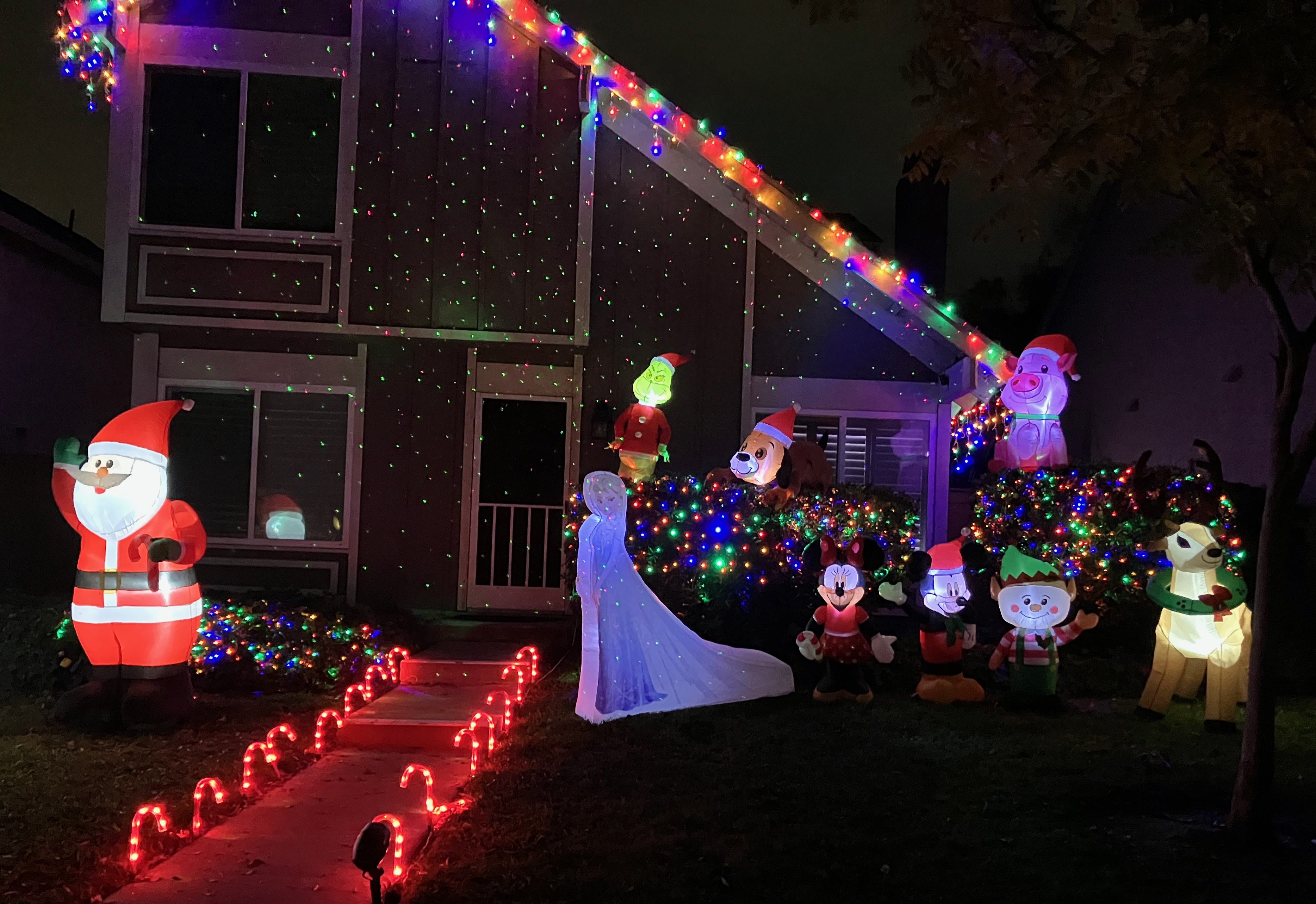
So I’m thrilled that my neighbors have provided some holiday cheer at no cost to me. One of my joys this season has been walking around our neighborhood viewing the holiday decorations in nearby houses and yards. All that this viewing requires of me is a little exertion.
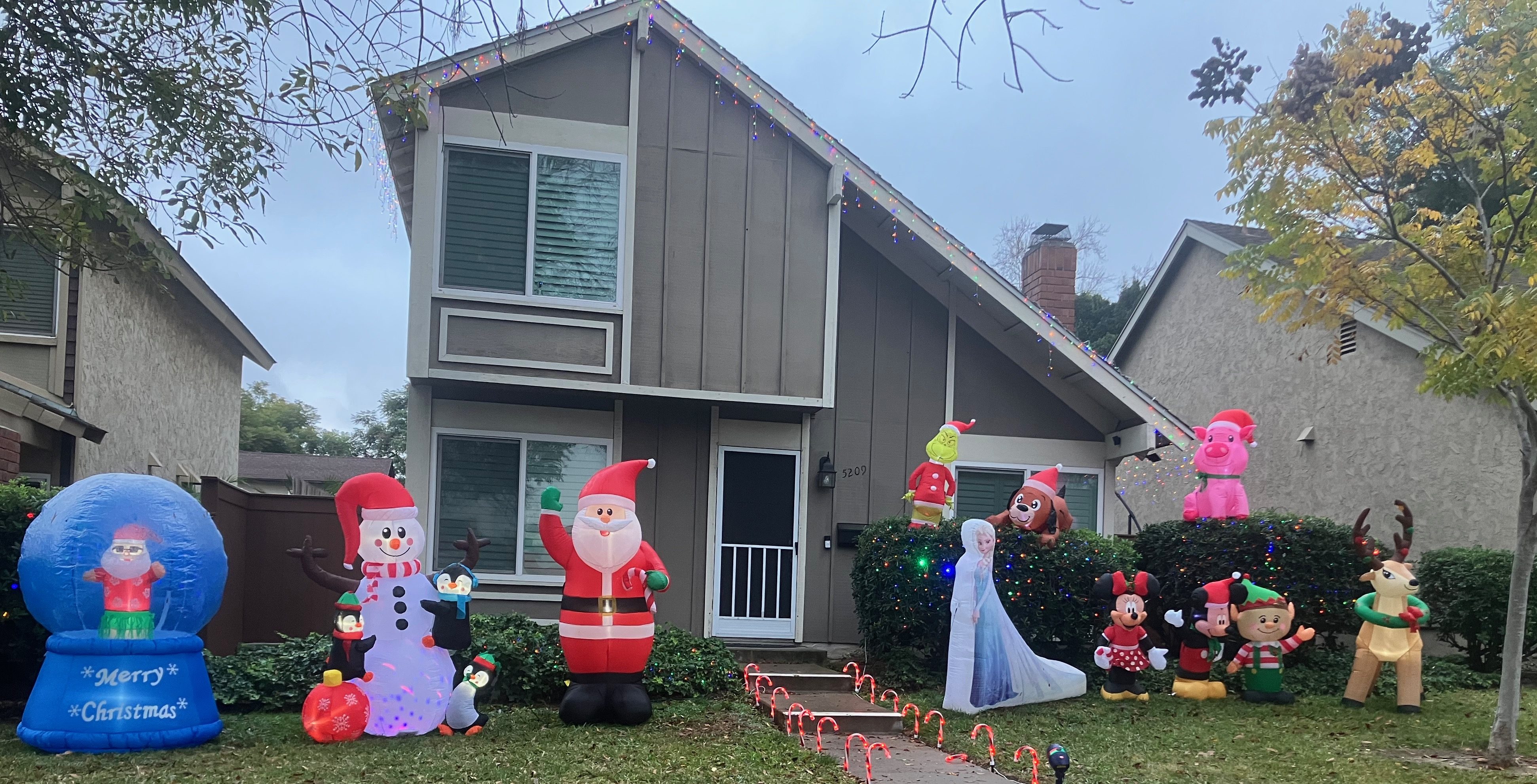
In this part of San Diego, it’s been a year of inflatables—replicas of holiday themed favorites such as Santas and elves, along with cartoon or animated film characters. Most of the figures rest in deflated sprawl during the day. As evening approaches, small electric motors kick in and the figures begin to rise, tethered and kept upright with ropes and/or anchors. It’s intriguing to see what neighbors have come up with. Because we’re in southern California’s “Disney country,” there are many Disney characters, along with Dr. Seuss Grinches. There’s been a rise in the number of “Bluey” likenesses, a recent Disney acquisition based on a children’s cartoon from Australia. Mixed in with the fantasy figures are figures of actual animals and plants. Often the displays are attached to real shrubs and trees that stay green in our mild climate in December.
Bluey and MinnieInflatables after darkInflatables before dark
In a few days, this year’s inflatables will be more permanently deflated and stored away in attics, closets, or sheds. If electricity follows our inflationary trend, next year’s crop of inflatables may be slightly smaller. Perhaps we’ll substitute more natural materials.
My wish for 2025 is that we will sooner or later succeed in reining in inflation. I think it will help if we remember that we are more stewards than owners of the natural world, that we are but one species among many. My hope is that more often than not, we’ll be able to avoid either an overinflated or an under inflated sense of our place in the grand scheme of things. Best wishes to all for a Happy New Year!
Another Thanksgiving weekend. This year no need to fight traffic To and from the grandmothers’ houses, No need to spend hours circling The parking lot at the nearest mall. No need to go anywhere at all.
Now we are the grandparents. Our muted celebration took place Around our kitchen table, with The other set of grandparents, A daughter-in-law, a teen granddaughter In attendance. Mostly vegetarian,
The feast also featured a small ham for The meat eaters of the oldest generation. We talked in pleasantries, mostly Avoiding politics. The weather was warm And sunny, as southern California often Is in late November. Tomorrow, a wintry mix may
Disrupt the other grandparents’ flights Back to the Northeast. Been there, Done that. Especially the two winters When Vermont was my, then our home. The Thanksgiving before we reconnected, a blizzard Delayed and almost sidelined Jim as he came north.
The following year, sleet and snow complicated Our southbound journey, delaying our arrival at our elders’ House in northeast Philadelphia until nearly 4 a.m. From a later home in Richmond, VA, we’d set out by car to see Grandmas and Grandpas in Maryland and New Jersey, Two growing boys sporadically squabbling in the back seat.
I watch with sometimes spiteful glee as News clips feature clogged airports, or huge Temporary parking lots on I-95 in both Directions. Yes, Virginia, it can take nearly an hour To clear the Delaware Memorial Bridge. Still, I need to remain grateful for holiday traffic.
Nearly sixty years ago, the bus ride from Baltimore to D.C. That usually lasted 45 minutes stretched to almost Three times that long, giving my college-bound seat mate And me time to thread our awkward conversation toward a Slow-budding romance. Holiday traffic helped introduce me To a future husband, children, grandchildren. Thanks be!
After another bruising electoral season, we are individually and collectively beginning to recover and move on. As an older voter, I do not expect to participate in many more presidential elections. Still, I’m concerned about the rancorous legacy our generation seems to be leaving for those who come after us.
As a grandparent, I’ve lately become one of our family’s storytellers. It’s my hope that by sharing my own family story and then by deeply listening to others, I may be able to find more common ground. I hope that we may as a community be able to diminish the worst excesses of partisan bitterness. Every family has its own instances of disasters and triumphs. My family’s stories are unique but likely not uncommon.
Some aspects of my biological family’s history remain a mystery. What has come down to me has been partially shaped by our clan’s tendency toward long generations. It’s also been shaped by a generally privileged trajectory and multiple generations of residency in what is now the United States of America.
Both sets of my grandparents were well into their sixties or seventies, living in Maryland, when I was born there in 1947. For my first eleven years, I lived next door to my maternal grandparents. That grandfather began life in 1869, so his earliest memories are from a time over 150 years ago. My other three grandparents were born in 1879. All four grandparents had stories to tell.
My maternal grandfather, the man I called Pop-Pop, was born in Mississippi just after the U.S. Civil War. He was the youngest child in a family of former slaveholders, with one older brother and five older sisters. Pop-Pop recounted being frightened of the Union troops billeted in his family home during Reconstruction. He was later able to get a good education. He spent time as a school teacher before switching to bookkeeping about the time his first child was born in 1906.
My maternal grandmother, nicknamed “Ginx,” was a 3-pound “preemie” born in January, 1879 in rural Virginia, in the days before many hospitals or “modern medicine.” Her parents later told her that for her first few months they had kept her in a makeshift incubator constructed by lining a laundry basket with warm bricks and cast-off blankets. Her father was a school superintendent in one of the counties where Pop-Pop taught school.
My paternal grandfather was the second son in a family of midwestern small-scale farmers. He met my other grandmother while both were students at a telegraphy school in Kentucky. This particular school was run by a conman whose main goal seems to have been lining his own pockets. The two lovers conducted a lengthy, partially long-distance courtship, complicated by economic struggles plus the lingering animosity between northern and southern states. Grandpa was “Yankee bred,” Grandma a Southerner. They eventually wed at my great-grandfather’s North Carolina farm at Christmas in 1907.
Grandpa and Grandma briefly attempted to homestead in Nebraska, but found the dry conditions and near-constant wind too much of a challenge. Grandpa later worked various clerical and administrative jobs, first for railroads and then for a government agency regulating interstate commerce. Grandma managed the small Maryland farm where they eventually settled and continued raising their children.
(Portraits of my grandparents that a friend of my parents painted; they hung for years in the family dining room)
My dad made his entry into the family saga in 1912. Born in Ohio, he moved with the family to Maryland in 1920. Through grade school, he attended a two-room rural schoolhouse. By the time he was ready for college, the Great Depression had set in and money for tuition was scarce. Dad and his two older siblings took turns at the University of Maryland nearby, each finding what work they could to supplement the family income. They pooled their funds, helping each other pay college costs. Dad and his older brother John sold chickens and eggs from the farm. Aunt Lucy did clerical work.
My mom showed up in 1917 as a “bonus” daughter, eleven years younger than her sister Margaret, five years younger than her brother Stuart. Family life was hectic as the “war to end all wars” came to a close in late 1918. The armistice was bracketed by a global flu pandemic that spared Mom’s family, but killed an estimated 50 million people worldwide.
Aunt Margaret and Uncle Stu attended high school in Baltimore City. Though city tuition was somewhat expensive, Baltimore’s schools at the time were considered vastly superior to the small high school in the next-county village where Mom’s family lived. Pop-Pop and Granny spent much of the 1920’s ponying up city school tuition to give their children the best educational start they could. Pop-Pop had a job as a Baltimore-based bookkeeper. Granny earned money teaching piano pupils at home or in local schools. Then, just as Mom was ready to enter high school, the Depression hit. It limited Mom’s high school choices and nearly preempted her chance to attend college.
Within seven months during 1929-1930, Mom’s family experienced a one-two punch of reversals. The stock market crash in late October, 1929 did not directly impact them—Pop-Pop and Granny owned no stocks. The family’s downward spiral started about a month later with an “upward spiral.” On an unusually cold day just after Thanksgiving, a chimney fire broke out in their recently renovated kitchen. By the time the local fire brigade arrived, the fire had started to spread. They were unable to contain the blaze. Water from their hoses froze before it could reach the house’s high roof. The entire structure burned to the ground. The family found rental lodging, hoping to rebuild later. The following June, Pop-Pop, then sixty years old, was laid off from his job. The company he had worked for replaced most of their human staff with early calculating machines to cut costs.
Somehow, Mom’s family persevered. Aunt Margaret and Uncle Stu were able to find jobs. Granny took correspondence courses in hotel management. She then got work as a full-time housekeeping supervisor at a Baltimore luxury hotel. Though she frowned at some alcohol-lubricated political shenanigans during the waning days of Prohibition, she held her tongue. Pop-Pop got what temporary work he could, once surviving a major 1933 flood while working as a night guard at a railroad construction site.
Mom finished at the top of her high school class. She scraped together earnings and loans to attend college. The Depression eventually ended. Mom and Dad eventually met and married. Their “greatest generation” was partially shaped by the eras they grew up in—one global war, then boom times, then economic depression, followed by another global war. During the post-WWII baby boom, they produced me, my sister and two brothers. We’ve so far confronted different challenges, including a recent global pandemic with its accompanying trauma and dislocations.
What have been your family’s triumphs and trials? How may they influence your experience of the world going forward?
This spring, I traveled with my husband to two European cities—our first international trip since the start of the covid pandemic. Judging by the crowds we encountered at prime tourist sites, we were far from the world’s only “post-covid tourists.” We were lucky enough to be able to afford about a month each at small rental apartments in Barcelona and then Paris—a wonderful chance to get some different perspectives about how a more resilient human world might work.
Both Barcelona and Paris get considerable income from tourism. According to official figures, almost 26 million visitors made an overnight stay in the Barcelona region in 2023, spending 12.75 billion euros ( or 13.8 billion dollars). About 100 million visitors come to France in non-covid years, making it the most visited country in the world, with Paris one of its most visited cities. In 2023, Parisian tourism generated revenues of 63 billion euros. Tourism in each city employs over ten percent of the work force—an important component of their overall economies.
The proprietors of our rental units were accommodating and helpful. Our lodgings contained useful tour guides with hints to optimize our access to both famous and lesser known sites. In both cities, there were many restaurants and food choices, including some at affordable prices. During our journey, we did not encounter any personal rudeness or threatening behavior. However, there were a few worrisome signs in our surroundings.
One day in Barcelona, we visited its museum of contemporary art, tucked away along a side street an easy walk from our apartment. The building itself is a work of art, filled with adaptable exhibit spaces and easy access ramps. Outside is an extensive plaza where we watched young men and women practicing their skateboard moves. As we left the area, I noticed a large mural on an adjacent wall. The overall wording was beyond my elementary Spanish or my even more limited Catalan, but the message was clear. The accompanying graphic, a “welcome mat” inscribed in English with “Not Welcome,” told me what I needed to know.
tourist caution in Barcelona
Recently, some locals expressed similar sentiments by going to prime tourist venues and squirting patrons with water pistols.
Protests in Barcelona are partly due to the way tourist lodging seems to distort available housing stocks. Though the rental income from our apartment helped sustain our proprietor’s family, it may also have helped drive up longer term rental prices for local residents. Not just in Europe, but in resort areas in the U.S. as well, we’ve heard laments by long-term residents about the hollowing out of local cultures and services when a town or region becomes too dependent on tourism.
A ski resort, a summer retreat, a place to go to view autumn colors, a city with an abundance of museums and historic sites—none of these by themselves support local transportation infrastructure, schools, or other public services. Tax revenue can fall short of providing the level of services wanted. If too many non-tourism-related locals leave, the networks of volunteer groups that help make a community thrive can wither and die. Similarly, becoming too dependent on tourism can exacerbate income and wealth inequalities. Service workers crucial to successful tourism can find it impossible to afford housing near where they work. Long-distance commutes, sub-standard housing, and exhausted workers then can blemish even the poshest resort.
Tourism-driven economies can also generate excess trash and pollution. The streets of old town Barcelona were sometimes cramped, loud, and dirty. Traffic jams all over the area were getting more frequent and disruptive. In Paris, tourist taxis sped by our building nearly 24/7, along with police cruisers, sometimes with sirens blaring. They made it more difficult for visitors and locals alike to get needed rest.
Finally, as covid so dramatically showed us, tourism is not a “core” industry. In a health crisis, millions of erstwhile tourists will stay home, leaving hotels and restaurants standing vacant, their staffs suddenly unemployed.
An appropriate level of tourism will vary from place to place. Paris, for centuries a tourist magnet, may be more robust than most in its efforts to be a “host city” that works. In a week or so, it will become the site of the 2024 Olympic games, estimated to bring in about half again as many as its already abundant annual influx of tourists.
While governments and economists continue to wrestle with how to “solve” the tourism conundrum, those of us who travel and/or host can help make tourism more mutually rewarding. As travelers, we can prepare with some basic education about the places we plan to visit, make responsible choices in itineraries and accommodations, use our best manners and be respectfully curious about habits and customs different from what we’re used to “back home.” As hosts, we can be more patient than we might be with fellow locals, do our best to assume positive intent by our visitors, and provide clear instructions about the use of available services.
Whatever our role of the moment, we can acknowledge both the value and the limitations of tourism.
For many of us, especially those of us who are older, this is our first fully “post-pandemic” Independence Day. Although the pandemic in the U.S. was declared officially over in May, 2023, last July many were still somewhat nervous about indoor gatherings or large crowds. This year I still didn’t venture out into large crowds, but not because of covid concerns. The prospect of driving through heavy traffic to crowded beaches or our area’s evening fireworks venues was unappealing. I spent a fairly quiet, but nonetheless enjoyable 4th, no longer isolated by a nasty virus and the worldwide fear it had engendered. Later, as I drifted off to sleep, I could hear the muffled hisses and booms of the closer fireworks displays.
Early in the morning, I’d gone to my small plot at our neighborhood community garden. Our most consistent volunteer was already there, watering some shrubs and flowering plants that were stressed from our recent heat wave. I wished her a Happy 4th. I quickly drew some water from the communal water barrel to help coax the bean seeds I’d recently planted into sprouting. As I was leaving the garden, I ran across a group of local men who volunteer at holidays to place American flags in the medians of our major streets. At 7 in the morning, they had just finished their work, and were headed to a local donut shop to have breakfast together.
Once home, I phoned my brothers, who both live on the East Coast, three time zones later than here. I wished each of them a Happy 4th. The brother who still lives in the neighborhood where we all grew up was getting ready to head to the potluck lunch that’s been a local tradition since long before we were born. He said attendance might be down some due to their latest heat wave—the historic community center, built in the 1870’s, has multiple fans but is not air conditioned. We reminisced about our childhood 4ths at “the hall”— the turtle race, the ample lunch with ice cream for the children, the parade featuring patriotic floats and decorated bicycles, the general fellowship and good feeling.
Later in the morning, before the sun got too high, I went for a walk with my husband through our suburban housing complex. Heading uphill to a favorite overlook, we met a stream of elementary-school-age children riding bicycles festooned with red, white, and blue streamers. They were accompanied by several adults, probably parents. All seemed headed toward festivities in our community park. Different neighborhood, different times, similar traditions. To some, it might seem a little contradictory to celebrate “independence” by having community gatherings, community gardens, community flag displays. Perhaps not.
I didn’t remember exactly what I’d done last Independence Day, so I checked a previous journal for July 4, 2023: my husband and son’s family were away; turns out I’d gone to a small outdoor barbecue at a next-door neighbor’s. More journals helped me recall prior 4ths during the pandemic:
At July 4, 2020, daily life was totally upended. In the neighborhood in North Carolina where we then lived, few were in a holiday mood. Infections, serious illness and deaths were climbing. There was not yet a vaccine or reliable treatment. Most of us were hunkered down, even disinfecting our postal mail before bringing it indoors. Libraries and other public venues were closed indefinitely. There was a dire shortage of protective gear of any kind. Social activities that still occurred were probably virtual. In-person activity had ground to a screeching halt.
In 2021, we had relocated to be close to a grown son and his family in southern California–the prospect during a pandemic of continuing to make long-distance plane trips to visit the grandchildren seemed foolhardy. In early spring we’d gotten our vaccinations, further downsized, and driven cross-country to our lives’ next stage. I spent July 4 trimming hedges at our son’s house while he and his family took a much-needed vacation.
On July 4, 2022, we were recovering from mild cases of covid. We’d most likely become infected while traveling by plane back and forth in June to visit a “bonus” grandchild born in Ohio in late May.
This July 4th, I relished my encounters with those celebrating where I live now. It was fun, too, to share long-ago memories with family and friends. I hope we never have to go back to the isolation of the worst of covid times. I hope that we never forget the medical researchers who helped develop vaccines and treatments, the health care workers who sometimes risked their own health to care for the rest of us, all the “essential workers” who kept us fed, clothed, and provisioned during the pandemic’s darkest days. I hope we avoid conflating independence with isolation.
On July 4th and on other days, let’s keep in mind the moving balance between our independence and our mutual dependence. A worthwhile paradox. Happy belated In(ter)dependence Day!
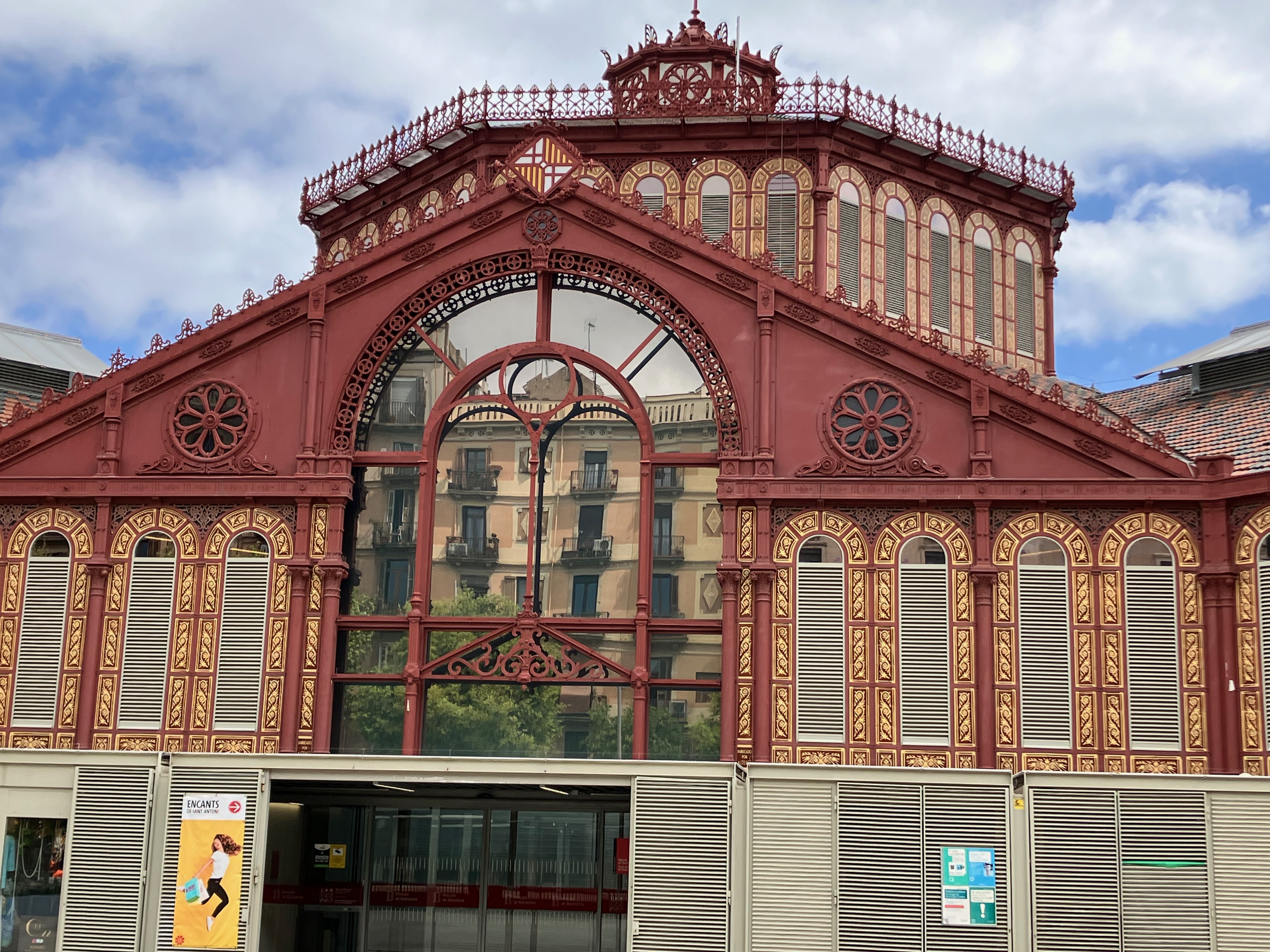
renovated Sant Antoni Market, Barcelona, Catalonia, Spain
This past spring, I had the good fortune to embark on my first overseas trip since the covid-19 pandemic. I spent a month each in two different European cities, Barcelona and Paris. Their time zone is quite different from where I live in southern California. After my return, it took me a week to adjust my sleep and waking schedules to my home time zone—jet lag. It’s taking me even longer to readapt to the culture of my home city. I’m still suffering from a touch of “culture lag.”
Getting readjusted to a car-dependent city like San Diego is taking some time. The volume of automotive traffic, both in my neighborhood and on area freeways, continues to amaze me—Barcelona and Paris, at least at their cores where I stayed, had proportionally much less vehicular traffic. Paris has been installing dedicated bicycle lanes at a great rate as part of an aggressive strategy to reduce air pollution and make the city more livable. There’s now even a bicycle rush hour; per a recent (2024) survey, in central Paris more people bicycle than drive. In the run-up to its hosting of the 1992 Olympic Games, Barcelona, the largest city of the Spanish region known as Catalonia, totally revamped its formerly shabby waterfront to create a 2-plus-mile-long stretch of walkable, easily accessible public beach.
Both Barcelona and Paris have robust, easy to use, inexpensive public transportation systems that serve most of their metropolitan areas. Paris is upgrading its metro (subway) in anticipation of increased ridership during the Olympic Games it will host next month. I wish our city could become less dependent on “car culture,” especially as I continue to age and my driving skills continue to diminish.
On the other hand, I’m relieved to experience my lower exposure to tobacco smoke here in San Diego. Outside our Barcelona rental apartment, the sidewalk was always full of cigarette butts. At all hours of the day or night, people sitting on some of the local public benches periodically lit up. Staying upwind of the secondhand smoke was an ongoing challenge. Paris has banned indoor smoking in public places, but nearly every restaurant or cafe has alluring sidewalk tables where non-smokers may try to “dodge the smoke.”
Both European cities have ongoing recycling efforts, with large, labeled bins for different recyclables at every block or apartment building. The neighborhood market near our Barcelona apartment even had a staffed drop-off location for food waste. Recycling volumes were lower because less plastic or other packaging was used to begin with. In Barcelona, people wheeled small fabric-covered carts to carry their groceries from shop to home. In Paris, cloth shopping bags were more common.
Living spaces were smaller than ours here, with each of our rental apartments measuring less than 500 square feet. Partly because of limited space, partly because of different cultural norms, appliances were more compact and less extensive than ours—“half size” refrigerators, no automatic dishwashers, limited clothes driers. Drying racks and sunny windows served nearly as well. People shopped several times each week, if not daily. Specialty shops could provide cheeses, meats, fruits and vegetables, or baked goods. There were no “big box” stores. Across the street from our Barcelona apartment was a recently renovated 19th century market with over a hundred stalls selling all sorts of food and clothing. American-style grocery stores were generally smallish, had no parking, and coexisted with living spaces. In both cities we could easily walk to groceries, bakeries, restaurants, book shops, and newsstands. Delivery services were more often by bicycle or covered tricycle than by motorized vehicle.
My “culture lag” after this most recent trip has been less severe than on earlier occasions. During my work life, I’d spent longer periods of work and/or travel in areas more “exotic” than western Europe. Still, San Diego is different from what I’d become used to in Barcelona and Paris. I’m not yet sure how long this episode of “culture lag” will last.
I’m very glad to have a San Diego home to return to. Perhaps some of the better parts of Catalan and Parisian cultures will outlast culture lag to work their way pemanently into my life here.
Sailors in a foreign port get a late night start to their next voyage. Just settling into their departure routines, they’re at first flustered by the Flickering of the ship’s lights, then alarmed by more serious Malfunctions. Their pilots issue an international distress call, then Desperately drag anchor to try to avoid lumbering into a major bridge.
Young girls in frilly frocks, some with flowers in our hair, Dance around a maypole, skipping in and out, Weaving intricate patterns with suspended colored Streamers as we twirl in the iridescent sunshine.
Distress calls and maypole dances— Mayday! May Day!





 Jinny's Occasional Poems