A few days ago, I had a morning commitment in downtown San Diego. To avoid the hassle of having to park downtown, I had driven from my suburban house to our nearest trolley stop, next to a local shopping center. After I’d parked, as I was approaching the stop, an outbound trolley disgorged its passengers.
One, a middle aged woman, took a look at the pre-dawn sky just beginning to lighten and remarked to no one in particular, “Ah, crow o’clock, my favorite time to get off the trolley and be out in nature.”
As I followed her gaze, I noticed over a hundred crows circling. Intrigued, I blurted out, “Do they do this every morning?”
“Yeah, it’s their time to get up after roosting in surrounding trees overnight.”
Days are short this time of year. In our part of southern California, we get about 10 hours of daylight. As luck would have it, my downtown stint lasted most of the day, so I returned to my trolley stop just at dusk. The crows again were circling, this time preparing to roost. I’d gotten to see two “crow o’clocks” in a single day.
My neighborhood doesn’t have as many crows as the valley where the trolley runs, but enough of the glossy black birds hang out here to provide near-constant background noise during daylight hours. I’d not paid too much attention, but after my encounter with the “crow o’clock” trolley rider, I decided to do a little online research.
Among the tidbits I picked up: crows make a variety of vocalizations, up to 20 different sounds. Along with the “caw, caw” we typically associate with crows, I’ve started to notice a less loud sound our area birds sometimes make—sort of a cross between a chuckle and the noise of a can being opened with a manual can opener.
Crows mate for life. Both partners participate in building a nest, a new one each breeding season. Once the baby birds hatch, both parents help feed them. Crows typically lay just one set of eggs per year. Out of a clutch of up to six eggs, three or four nestlings may make it to their first birthday. Older crow offspring sometimes stick around for a few years to help with younger nest mates. Crows that survive more than a year may live ten to fifteen years, with the oldest wild crow ever formally banded and studied surviving to nearly thirty. One captive bird in New York lived to be 59.
There are over forty varieties of crows globally, one being the American crow, which ranges through much of the U.S. and parts of Canada. A variety of professionals and amateurs study crows, which have had legal protection since 1972, except when landowners believe the birds are damaging property or livestock (think scarecrows?).
If you are a glutton for crow knowledge, you can find a 90-minute presentation about crows, “To Know the Crow,” on the site of the Cornell Ornithology Lab, allaboutbirds.org. My favorite crow video is a much shorter snippet posted by author Kira Jane Buxton, about a female crow she’s named “Sharkey” who often accompanies her on daily walks.
I’m not motivated to become a serious crow researcher, nor am I likely to develop a crow walking companion like Kira Buxton’s Sharkey. However, as the days slowly lengthen and also become chillier, I think I’ll arrange at least a few more trolley rides to correspond with “crow o’clock.”
Another Thanksgiving weekend. This year no need to fight traffic To and from the grandmothers’ houses, No need to spend hours circling The parking lot at the nearest mall. No need to go anywhere at all.
Now we are the grandparents. Our muted celebration took place Around our kitchen table, with The other set of grandparents, A daughter-in-law, a teen granddaughter In attendance. Mostly vegetarian,
The feast also featured a small ham for The meat eaters of the oldest generation. We talked in pleasantries, mostly Avoiding politics. The weather was warm And sunny, as southern California often Is in late November. Tomorrow, a wintry mix may
Disrupt the other grandparents’ flights Back to the Northeast. Been there, Done that. Especially the two winters When Vermont was my, then our home. The Thanksgiving before we reconnected, a blizzard Delayed and almost sidelined Jim as he came north.
The following year, sleet and snow complicated Our southbound journey, delaying our arrival at our elders’ House in northeast Philadelphia until nearly 4 a.m. From a later home in Richmond, VA, we’d set out by car to see Grandmas and Grandpas in Maryland and New Jersey, Two growing boys sporadically squabbling in the back seat.
I watch with sometimes spiteful glee as News clips feature clogged airports, or huge Temporary parking lots on I-95 in both Directions. Yes, Virginia, it can take nearly an hour To clear the Delaware Memorial Bridge. Still, I need to remain grateful for holiday traffic.
Nearly sixty years ago, the bus ride from Baltimore to D.C. That usually lasted 45 minutes stretched to almost Three times that long, giving my college-bound seat mate And me time to thread our awkward conversation toward a Slow-budding romance. Holiday traffic helped introduce me To a future husband, children, grandchildren. Thanks be!
After another bruising electoral season, we are individually and collectively beginning to recover and move on. As an older voter, I do not expect to participate in many more presidential elections. Still, I’m concerned about the rancorous legacy our generation seems to be leaving for those who come after us.
As a grandparent, I’ve lately become one of our family’s storytellers. It’s my hope that by sharing my own family story and then by deeply listening to others, I may be able to find more common ground. I hope that we may as a community be able to diminish the worst excesses of partisan bitterness. Every family has its own instances of disasters and triumphs. My family’s stories are unique but likely not uncommon.
Some aspects of my biological family’s history remain a mystery. What has come down to me has been partially shaped by our clan’s tendency toward long generations. It’s also been shaped by a generally privileged trajectory and multiple generations of residency in what is now the United States of America.
Both sets of my grandparents were well into their sixties or seventies, living in Maryland, when I was born there in 1947. For my first eleven years, I lived next door to my maternal grandparents. That grandfather began life in 1869, so his earliest memories are from a time over 150 years ago. My other three grandparents were born in 1879. All four grandparents had stories to tell.
My maternal grandfather, the man I called Pop-Pop, was born in Mississippi just after the U.S. Civil War. He was the youngest child in a family of former slaveholders, with one older brother and five older sisters. Pop-Pop recounted being frightened of the Union troops billeted in his family home during Reconstruction. He was later able to get a good education. He spent time as a school teacher before switching to bookkeeping about the time his first child was born in 1906.
My maternal grandmother, nicknamed “Ginx,” was a 3-pound “preemie” born in January, 1879 in rural Virginia, in the days before many hospitals or “modern medicine.” Her parents later told her that for her first few months they had kept her in a makeshift incubator constructed by lining a laundry basket with warm bricks and cast-off blankets. Her father was a school superintendent in one of the counties where Pop-Pop taught school.
My paternal grandfather was the second son in a family of midwestern small-scale farmers. He met my other grandmother while both were students at a telegraphy school in Kentucky. This particular school was run by a conman whose main goal seems to have been lining his own pockets. The two lovers conducted a lengthy, partially long-distance courtship, complicated by economic struggles plus the lingering animosity between northern and southern states. Grandpa was “Yankee bred,” Grandma a Southerner. They eventually wed at my great-grandfather’s North Carolina farm at Christmas in 1907.
Grandpa and Grandma briefly attempted to homestead in Nebraska, but found the dry conditions and near-constant wind too much of a challenge. Grandpa later worked various clerical and administrative jobs, first for railroads and then for a government agency regulating interstate commerce. Grandma managed the small Maryland farm where they eventually settled and continued raising their children.
(Portraits of my grandparents that a friend of my parents painted; they hung for years in the family dining room)
My dad made his entry into the family saga in 1912. Born in Ohio, he moved with the family to Maryland in 1920. Through grade school, he attended a two-room rural schoolhouse. By the time he was ready for college, the Great Depression had set in and money for tuition was scarce. Dad and his two older siblings took turns at the University of Maryland nearby, each finding what work they could to supplement the family income. They pooled their funds, helping each other pay college costs. Dad and his older brother John sold chickens and eggs from the farm. Aunt Lucy did clerical work.
My mom showed up in 1917 as a “bonus” daughter, eleven years younger than her sister Margaret, five years younger than her brother Stuart. Family life was hectic as the “war to end all wars” came to a close in late 1918. The armistice was bracketed by a global flu pandemic that spared Mom’s family, but killed an estimated 50 million people worldwide.
Aunt Margaret and Uncle Stu attended high school in Baltimore City. Though city tuition was somewhat expensive, Baltimore’s schools at the time were considered vastly superior to the small high school in the next-county village where Mom’s family lived. Pop-Pop and Granny spent much of the 1920’s ponying up city school tuition to give their children the best educational start they could. Pop-Pop had a job as a Baltimore-based bookkeeper. Granny earned money teaching piano pupils at home or in local schools. Then, just as Mom was ready to enter high school, the Depression hit. It limited Mom’s high school choices and nearly preempted her chance to attend college.
Within seven months during 1929-1930, Mom’s family experienced a one-two punch of reversals. The stock market crash in late October, 1929 did not directly impact them—Pop-Pop and Granny owned no stocks. The family’s downward spiral started about a month later with an “upward spiral.” On an unusually cold day just after Thanksgiving, a chimney fire broke out in their recently renovated kitchen. By the time the local fire brigade arrived, the fire had started to spread. They were unable to contain the blaze. Water from their hoses froze before it could reach the house’s high roof. The entire structure burned to the ground. The family found rental lodging, hoping to rebuild later. The following June, Pop-Pop, then sixty years old, was laid off from his job. The company he had worked for replaced most of their human staff with early calculating machines to cut costs.
Somehow, Mom’s family persevered. Aunt Margaret and Uncle Stu were able to find jobs. Granny took correspondence courses in hotel management. She then got work as a full-time housekeeping supervisor at a Baltimore luxury hotel. Though she frowned at some alcohol-lubricated political shenanigans during the waning days of Prohibition, she held her tongue. Pop-Pop got what temporary work he could, once surviving a major 1933 flood while working as a night guard at a railroad construction site.
Mom finished at the top of her high school class. She scraped together earnings and loans to attend college. The Depression eventually ended. Mom and Dad eventually met and married. Their “greatest generation” was partially shaped by the eras they grew up in—one global war, then boom times, then economic depression, followed by another global war. During the post-WWII baby boom, they produced me, my sister and two brothers. We’ve so far confronted different challenges, including a recent global pandemic with its accompanying trauma and dislocations.
What have been your family’s triumphs and trials? How may they influence your experience of the world going forward?
Shortly after moving to San Diego in mid-2021, I discovered a nearby community garden. I put my name on a waiting list for a plot, then made frequent visits to the 45-plot garden to see what was growing in others’ spaces. As the weather cooled and days shortened, I watched others’ cool weather crops take hold. Being someone who’d never before gardened in a frost-free area, I marveled. During my first Southern California “winter,” lots of cabbages and broccoli came to maturity. Come February, I was able to rent a seven by twelve foot raised bed for the next gardening year, starting March 1. The following winter, I had my own Brussels sprouts plus lettuce and arugula in January and February. What a treat!
Fellow community gardeners often share chores, pinch-hitting for each other during vacations or other interruptions. So this past April, I arranged with a friend whose plots are near mine to water when needed while my husband and I took an extended trip out of the country. I returned in June to find my plot filled to overflowing.
After I trimmed back excess growth, I discovered that the seedling celery plants I’d put out just before I left had by mid-June matured and gone to seed. Plants were nearly shoulder high. The two pear tomato plants, barely leafed out when I’d planted them, had outgrown their tomato cages and were sprawling across the plot’s middle.
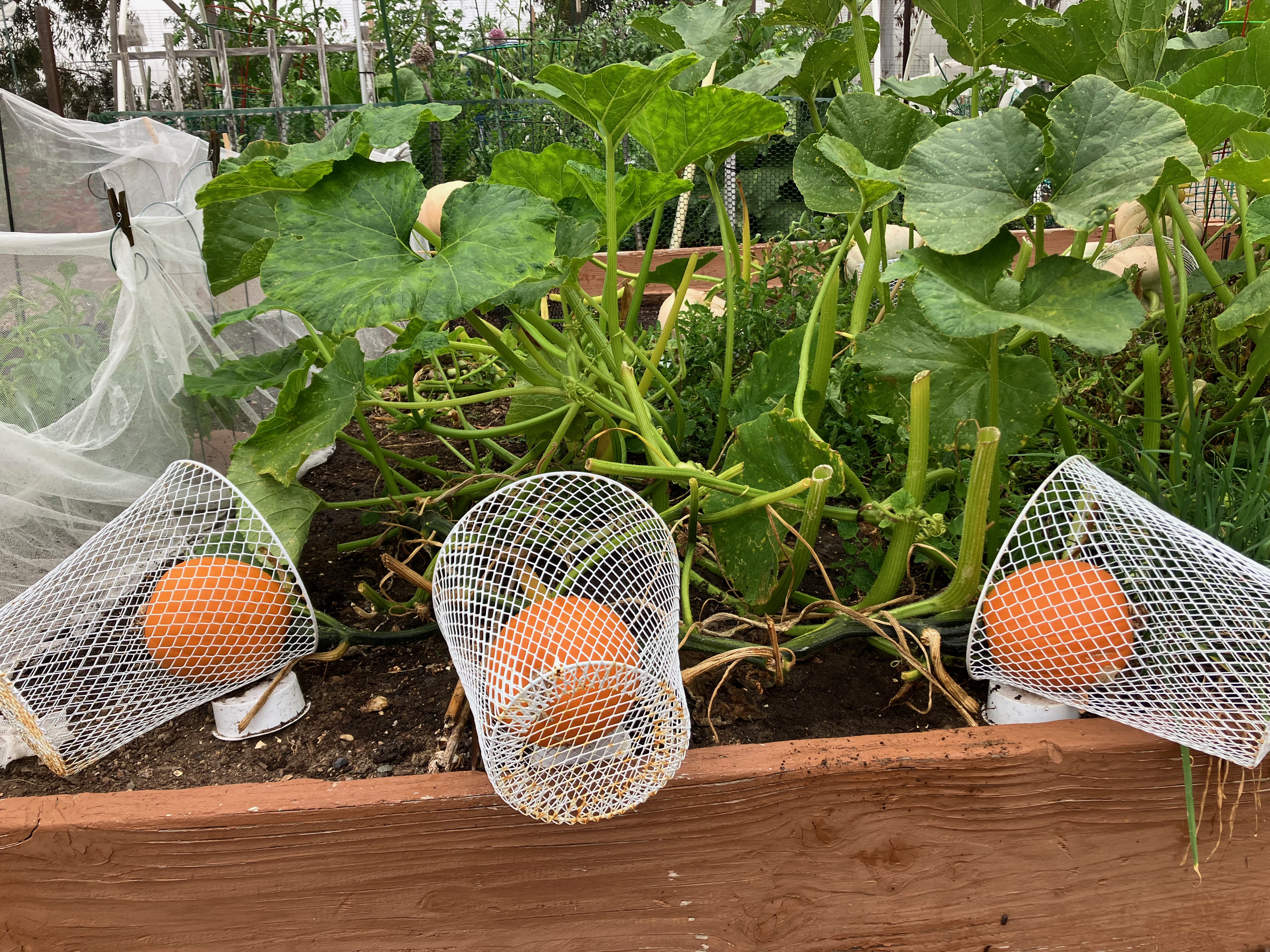
The biggest surprise, though, was a set of extensive vines spilling over all the plot’s edges. It took me a while to identify them. I hadn’t planted squash, although the previous year I’d been gifted with a single volunteer courtesy of a local bird. These plants had large squash-like leaves, with some cream-colored smallish fruit on the ground. My friend hadn’t wanted to remove them, since she wasn’t sure whether or not they were weeds.
After a couple of internet searches, I was pretty sure that the mystery vines were pumpkins. I hadn’t intentionally planted pumpkins, either. There were too many of these to have been gifts of the birds, though. Thinking back, I remembered that we’d eaten a fair amount of grocery store pumpkin the previous autumn. I’d put excess pulp and seeds into my backyard compost tumbler, then used the finished compost to fertilize my plot in the spring. Apparently the compost hadn’t ever gotten hot enough to kill the pumpkin seeds.
pumpkins on the vine in my community garden plot
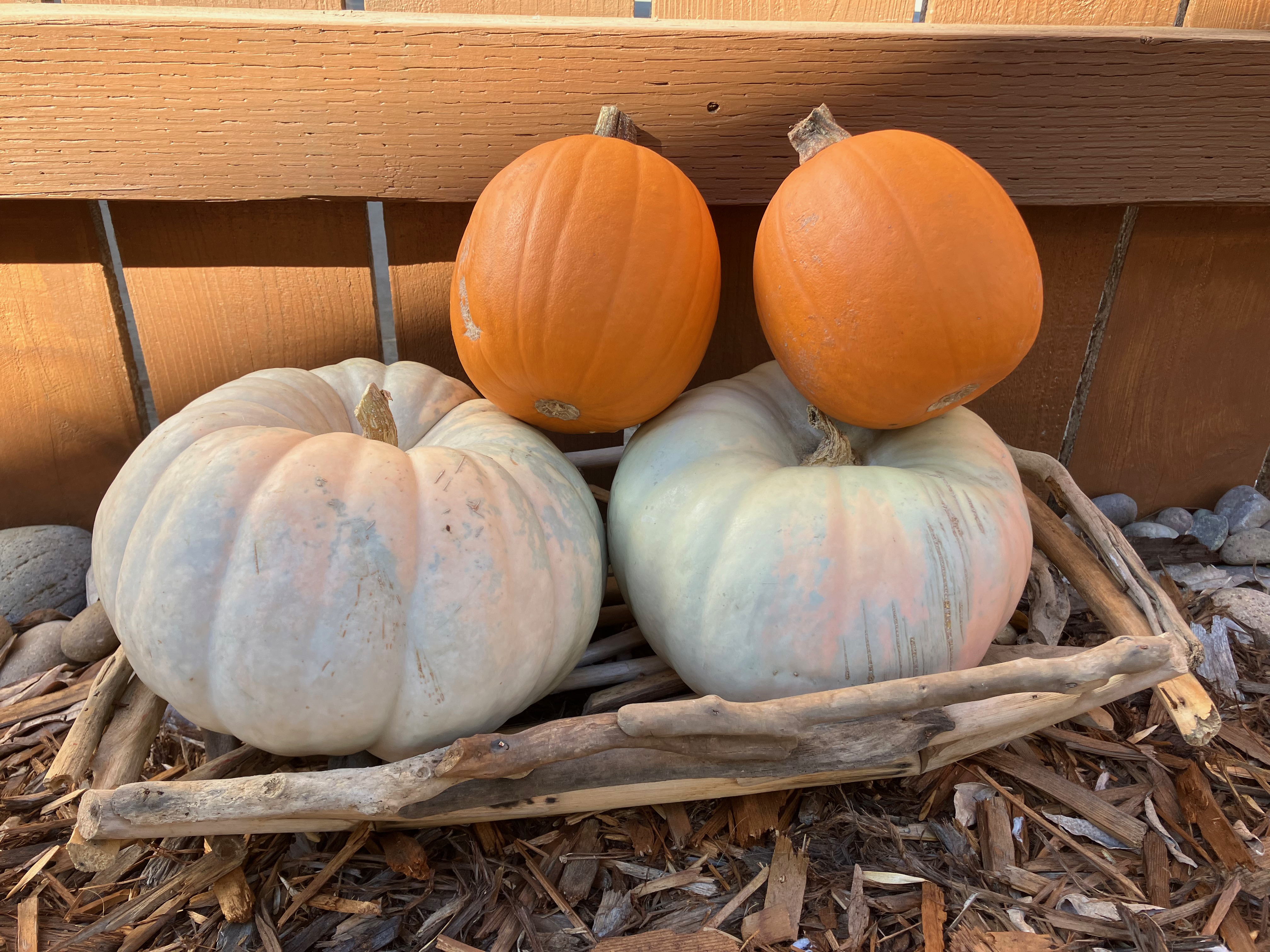
My friend and I were bemused and amused at my volunteer crop. The internet advised keeping the vines from sprawling too much, selecting the largest fruits to nurture, but clipping and discarding the smaller ones. My earliest pumpkins were ready for harvest in August. By the time pumpkin harvest was over in September, I’d gotten several traditionally skinned orange pumpkins, plus another set with cream to pale green outsides. I gave away a few to a local soup kitchen. I experimented with one of the medium-sized pale-skinned pumpkins, making its yellow-orange flesh into curries and custards to eat at home.
The largest of this year’s pumpkins weighs about 10 pounds. It’s in temporary storage, along with half a dozen others, eventually to be turned into pies, purees, and curried soups during cool weather. Compared with record-setting pumpkins, it is a midget. Per a recent internet search, the world’s heaviest pumpkin was grown in Belgium in 2016—it weighed a whopping 2,624 pounds. The heaviest U.S. pumpkin grew in New Hampshire, tipping the scales at 2,528 pounds. Ohio holds the record for biggest pumpkin pie—over 20 feet in diameter, weighing 3,699 pounds. California, though our nation’s top agricultural state, lags well behind top-ranked Illinois and second place Texas in pumpkin poundage. Still, I am glad I have 50+ pounds of pumpkin flesh to help us vary our diet during upcoming cool weather.
pumpkin quartet after harvest
On reflection, though, I think I’ll put any pumpkin seeds from this year’s crop into the municipal compost rather than my backyard tumbler. That way, I’ll reduce the chances of more “accidents” in next year’s plot.
For many of us, especially those of us who are older, this is our first fully “post-pandemic” Independence Day. Although the pandemic in the U.S. was declared officially over in May, 2023, last July many were still somewhat nervous about indoor gatherings or large crowds. This year I still didn’t venture out into large crowds, but not because of covid concerns. The prospect of driving through heavy traffic to crowded beaches or our area’s evening fireworks venues was unappealing. I spent a fairly quiet, but nonetheless enjoyable 4th, no longer isolated by a nasty virus and the worldwide fear it had engendered. Later, as I drifted off to sleep, I could hear the muffled hisses and booms of the closer fireworks displays.
Early in the morning, I’d gone to my small plot at our neighborhood community garden. Our most consistent volunteer was already there, watering some shrubs and flowering plants that were stressed from our recent heat wave. I wished her a Happy 4th. I quickly drew some water from the communal water barrel to help coax the bean seeds I’d recently planted into sprouting. As I was leaving the garden, I ran across a group of local men who volunteer at holidays to place American flags in the medians of our major streets. At 7 in the morning, they had just finished their work, and were headed to a local donut shop to have breakfast together.
Once home, I phoned my brothers, who both live on the East Coast, three time zones later than here. I wished each of them a Happy 4th. The brother who still lives in the neighborhood where we all grew up was getting ready to head to the potluck lunch that’s been a local tradition since long before we were born. He said attendance might be down some due to their latest heat wave—the historic community center, built in the 1870’s, has multiple fans but is not air conditioned. We reminisced about our childhood 4ths at “the hall”— the turtle race, the ample lunch with ice cream for the children, the parade featuring patriotic floats and decorated bicycles, the general fellowship and good feeling.
Later in the morning, before the sun got too high, I went for a walk with my husband through our suburban housing complex. Heading uphill to a favorite overlook, we met a stream of elementary-school-age children riding bicycles festooned with red, white, and blue streamers. They were accompanied by several adults, probably parents. All seemed headed toward festivities in our community park. Different neighborhood, different times, similar traditions. To some, it might seem a little contradictory to celebrate “independence” by having community gatherings, community gardens, community flag displays. Perhaps not.
I didn’t remember exactly what I’d done last Independence Day, so I checked a previous journal for July 4, 2023: my husband and son’s family were away; turns out I’d gone to a small outdoor barbecue at a next-door neighbor’s. More journals helped me recall prior 4ths during the pandemic:
At July 4, 2020, daily life was totally upended. In the neighborhood in North Carolina where we then lived, few were in a holiday mood. Infections, serious illness and deaths were climbing. There was not yet a vaccine or reliable treatment. Most of us were hunkered down, even disinfecting our postal mail before bringing it indoors. Libraries and other public venues were closed indefinitely. There was a dire shortage of protective gear of any kind. Social activities that still occurred were probably virtual. In-person activity had ground to a screeching halt.
In 2021, we had relocated to be close to a grown son and his family in southern California–the prospect during a pandemic of continuing to make long-distance plane trips to visit the grandchildren seemed foolhardy. In early spring we’d gotten our vaccinations, further downsized, and driven cross-country to our lives’ next stage. I spent July 4 trimming hedges at our son’s house while he and his family took a much-needed vacation.
On July 4, 2022, we were recovering from mild cases of covid. We’d most likely become infected while traveling by plane back and forth in June to visit a “bonus” grandchild born in Ohio in late May.
This July 4th, I relished my encounters with those celebrating where I live now. It was fun, too, to share long-ago memories with family and friends. I hope we never have to go back to the isolation of the worst of covid times. I hope that we never forget the medical researchers who helped develop vaccines and treatments, the health care workers who sometimes risked their own health to care for the rest of us, all the “essential workers” who kept us fed, clothed, and provisioned during the pandemic’s darkest days. I hope we avoid conflating independence with isolation.
On July 4th and on other days, let’s keep in mind the moving balance between our independence and our mutual dependence. A worthwhile paradox. Happy belated In(ter)dependence Day!
According to an essay I wrote in eighth grade, I wanted to grow up to become an airline stewardess or a simultaneous translator for the United Nations or a circus trapeze artist. As I got older, I began to realize that these initial dreams were unlikely to get fulfilled, at least not in the way my thirteen-year-old self had imagined. I might need to create alternatives.
For starters, stewardesses (the profession then was almost entirely women) were required to have 20/20 vision without eyeglasses. In those days before the availability of contact lenses, my severe myopia would disqualify me as a prospective flight attendant. Later in high school, I began to meet other students who had been raised bilingually. It gradually sank in to me that my simultaneous translation prospects were slim. Regardless of how much I studied, I was unlikely to become as proficient as others who’d learned two languages (or sometimes more) from birth. Finally, although I’d been a “queen of the jungle gym” in elementary school and loved going to the circus, I began to appreciate how much additional training I’d need to reach professional level on a trapeze. I also noticed that over time circus crowds were getting sparser. More and more “big tops” were folding.
So I began formulating “Plan B’s.” Even if I couldn’t become a stewardess, I might be able to arrange other ways to travel widely as an adult. I might not be able to do simultaneous translations, but perhaps I could teach foreign language skills to those with less exposure than I had. I might not ever become a circus entertainer, but I could create verbal sketches and skits to amuse people.
By the time I completed college, I’d had my first international work experience—preparing and selling Belgian waffles at a bilingual snack bar at the 1967 World’s Fair in Montreal, Québec, Canada. I’d enrolled in an advanced program to get a teaching credential for French language instruction. From Montreal, I’d sent a summer’s worth of weekly humorous travel sketches to our small-town Maryland newspaper.
I was about to become a newlywed, at a time when American young men were susceptible to being drafted into the military. Some of them were then sent to participate in a far-off war in Vietnam. A few days before our wedding, my groom-to-be got his notice to report for induction into the army. Rats! Time for “Plan C.”
My only future brother-in-law was already serving in Vietnam. Worst case, my future husband might soon join him. Knowing my tendency to “awfulize,” I figured I could keep my stress level somewhat in check by staying busy. I applied for and got a part-time clerical job in addition to my full-time academic course load.
Several weeks later, a surprise phone call from my now-husband relayed most welcome news: a minor congenital back abnormality had reclassified him as less fit for military service. He could return home and resume his non-military career. “Plan D” found both of us happy to be together, but very, very busy. I made it through a hellish school year of teaching beginning French to 187 rambunctious adolescents, then embarked on “Plan E,” what turned out to be a lengthy career in commercial information systems.
Over the course of the next fifty years or so, I fulfilled additional alternate versions of my adolescent dreams: for a couple of years in my thirties, I was on the staff of the U.N. in a French-speaking African country; in my forties, I created holiday programs spoofing local politics for an area non-profit; in my fifties, I survived a serious health scare partly by becoming more adept at yoga and a graceful Asian exercise practice called “qi gong.” I also traveled widely and spent multiple semesters teaching English as a foreign language in rural China.
At my current life stage, I get much incoming mail either promoting various burial services or suggesting worthy causes I should include in my “estate plans.” As the end of my planning alphabet approaches, I face ongoing uncertainties and anxieties, including pandemics, climate change, massive human migrations, escalating housing costs and homelessness. My coping skills are sometimes challenged. I hope that younger generations will expand newer coping tools and use them wisely.
Should anyone ask, I’d suggest that it’s great both to have dreams and to have some “plan B’s” (and C’s, D’s, etc.). Life is apt to adjust your original plans over and over again.
It was bound to happen sooner or later. One of the groceries nearest me installed several “self-checkout” stations, replacing a couple of previously staffed grocery check-outs. Unluckily for me, I discovered the change on a recent Sunday morning when, as later became evident, the only in-person checkout clerk was temporarily on break. With some grumbling and some help from another grocery purchaser, I eventually managed to get my substantial order through the self-checkout station, bagged into the reusable cloth bags I’d brought with me, and back into my grocery cart to be wheeled out to my car. On my way out the door, I happened to see someone at the customer service station. I complained about the lack of in-person service.
“We only do that during slow periods,” she told me. “Had you waited ten minutes, there would have been someone to serve you in person.” Not entirely mollified, I wheeled my cart out to the car, loaded my groceries in the trunk, and then replaced the cart in the outdoor cart enclosure.
The next time I did battle with the self-checkout was fairly early on a Saturday morning. This time, my order was much smaller. There was a single in-person clerk helping other customers, but the line to his station was long. A couple of the self-service checkouts were out of service. Still, I lined up to get the next available station, figuring it could be faster than waiting for in-person service. Wrong.
The items I’d purchased were on special, with a substantial discount for buying in quantity. I thought my purchases qualified, but the price shown at the self-checkout station was the “non-quantity” price. Reluctant to pay “extra,” I pushed the “get help” icon, only to learn from the somewhat harried in-person checkout clerk that the only person authorized to help me was on bathroom break. Eventually, this store manager returned and explained the somewhat convoluted programming of self-help pricing, which could only validate quantities once one hit “finish and pay.” It sort of made sense, so I’ll be somewhat better prepared on any further self-checkout encounters.
Of course, staffing and customer service practices have been evolving for a long time. You might need to be beyond retirement age to remember when banks had only in-person tellers, none of the now-ubiquitous automated teller machines (ATMs). You might need to be even older, and an urban dweller, to remember an early experiment in “automated food,” a series of Horn and Hardart restaurants that served both hot and cold fresh meals via a set of coin-operated vending machine windows. The restaurants thrived in the early part of the twentieth century, but went out of business later when changing demographic patterns and widespread moves to the suburbs made much center-city dining obsolete.
A while ago, I ran across the term “prosumer” in an article in a popular magazine. The article’s author contended that much of what we used to expect as “consumers” of services had now been built into automated processes. The “consumer” was now expected to do parts of the work previously performed by a live person, a “producer”—perhaps a grocery store clerk, a bank teller, or a mail carrier. As I read, it occurred to me that the “people in your neighborhood” sung about in an earlier children’s television show, Mr. Rogers’ Neighborhood, might no longer exist for contemporary children.
I’m realistic enough to know that any sort of imagined personal service utopia is just that—a situation that never totally existed. In the “old days,” you might be likely to encounter a crabby or clueless clerk or server in person. Having to “do battle” with some of our overly impersonal “automated service providers” now is only a difference in degree. Still, I relish the encounters I have with our neighborhood’s in-person providers—the mail carrier who knows my name and habits and watches out for me, the bank clerk who walks me through a complex transaction, the grocery checkout staffer who chats with each customer when time allows, and always sends us off with his signature, “Have a grateful day!” Yes!
It’s nearly the end of 2023, a time for looking back and for looking ahead. I’m grateful to have made it through another year with most of my faculties intact. I’m blessed to have a warm, supportive network of family and friends. Over the holidays, I’ve managed to spend some extended family time in person and to avoid an excess of media. I’ve (mostly) avoided discussing politics, but still have heard the word “polarization” more times than I care to count.
I like to think that many of us, despite all the rhetoric and doom-saying, are more centrist than otherwise, with overlapping multi-layered allegiances—to family, to work group, to neighborhood, to profession, to age-mates, to craft groups. To varying degrees, many of us also affiliate with politically oriented groups at various levels. I think it does us a disservice to try to reduce anyone to a single level of allegiance, politically or otherwise.
Nonetheless, our current “in between” media environment, an evolving mix of broadcast, print, and internet-driven content, is surfeited with polling that purports to pigeonhole us by political allegiance and/or some aspect of our demographics. I could make a bonfire with all the pieces of campaign literature I’ve received warning of the end of the world if “the other side” wins. Though checking boxes on surveys may relieve a few of my frustrations, it does little to create or reinforce connections. Indulging my anger may feel righteous for a time, but it likewise does little toward solving problems. Nuanced discussions and concerted actions are needed and seem in short supply.
Many years ago, I applied to the United States Peace Corps. Once accepted, I was offered a two-year assignment with a United Nations agency, providing technical assistance in an economically struggling country. Over the course of the recruitment process, I was asked to affirm my allegiance both to the U.S. government and to the principles of the U.N. This was at a time during the 1980’s when there was serious talk of cutting off U.S. support for many international organizations. (Echoes of the same tendency are again current.)
I crossed my fingers that there would not be a serious conflict between the stated purposes of the U.S. and those of the U.N. I wondered where my allegiance would lie if such a breach occurred. Luckily, it was a choice I did not have to make. I think my assignment helped persuade some of my in-country coworkers that there was more to Americans than bellicosity or arrogance. The work done by our multi-national staff made a small but positive impact on the lives of the mostly peasant families we interacted with. Once my assignment was over and I returned to the U.S., I bought two flags—a U.S. flag and an “earth flag,” showing our blue-green planet as viewed from space. On holidays, I gladly flew both. (An image of the earth flag is on Wikimedia Commons as File:Earth flag PD.jpg)
Unless our lives have been exceptionally tranquil, we’ve sometimes been faced with potentially conflicting allegiances. What seems dangerous to me about our current era is that much of our public sphere seems intent on collapsing the many overlapping layers of allegiances of healthy societies into strictly “us versus them” categories.
I draw some solace from a recent experience of our soccer playing granddaughter. The school league in which she plays consists of several smallish secondary schools. At a recent game, the opposing team was short a couple of players at the start of play. It would have been perfectly acceptable, per the league’s rules, for our granddaughter’s team to claim a win by forfeit. Instead, our granddaughter and another player with friends on both teams added a layer of soccer jersey and played for the “opposing” team until enough of their players arrived to complete the rest of the game “normally.” I doubt anyone kept very close track of who “won.”
So here’s a wish that your 2024 will be multi-layered and nourishing, that you’ll have chances to experience some of the “win-win” results that can come from recognizing how multi-faceted and interconnected all of us are.
Another day of late July swelter in southern California. News brays out temperature records tied or broken. I turn off the TV–conserving both electric and psychic energy. Just before sunset, evening cools to tolerable levels. I go outdoors, briefly sharing the patio with pesky mosquitos. Then fairly early to bed, after opening all windows wide.
I awaken to artificial light from the alley, Nature still full dark. Mostly quiet. Nearly a mile away, a few trucks downshift On the uphill grade of the nearest freeway.
Later, an early-rising human roars by on his motorcycle. In his wake, an early-rising bird begins tuning up.
The pre-dawn air is cool. A beneficent breeze through My bedroom window wafts me back toward slumber.
Perhaps another record-setting hot day on tap. Grateful for indoor shelter, for cooling fans, I luxuriate in bed a little longer.
In a while, I’ll rise to greet the dawn. For now, the breeze brings its pre-dawn greeting.


 Jinny's Occasional Poems