Tag Archives: James Weldon Johnson

Stony the Road…

This MLK weekend, I didn’t feel much like celebrating. It seemed as if much of the civil rights progress of the past half century and more was being erased as quickly as our national executive could flourish his sharpie and sign yet another exclusionary and/or incendiary executive order. 

Still, I wanted to show solidarity with the activists and citizens who for years have been calling our country to live up to its ideals, so I got a ride to downtown San Diego to walk in Sunday’s MLK 5K. There were a lot of other walkers and runners, most more fit than I was. I figured I could probably go the distance, if somewhat slowly. 

It was a gorgeous day—sunny, with a light breeze and pleasant temperatures. Along the way, I got to hear snippets of conversations among those who also took a slower pace. The atmosphere was congenial, most of us opting to enjoy the walk and the weather more than just stewing about the sorry state of our republic. Someone probably “won” the race, but all of us got some worthwhile exercise in a friendly environment.  

Later, I stayed for part of the annual parade that’s been held in San Diego for many years, beginning even before the MLK holiday was enacted nationally. Some of the groups marching were predominantly black, but many were mixed, with high school and college bands, various professional associations, and contingents from area employers.  Most of the early groups were generally apolitical. I enjoyed the colors, the festive mood, a few of the gift items thrown from passing floats. Before I left, some more militant marching groups appeared—I took a picture of a set of local activists whose banner intrigued me.
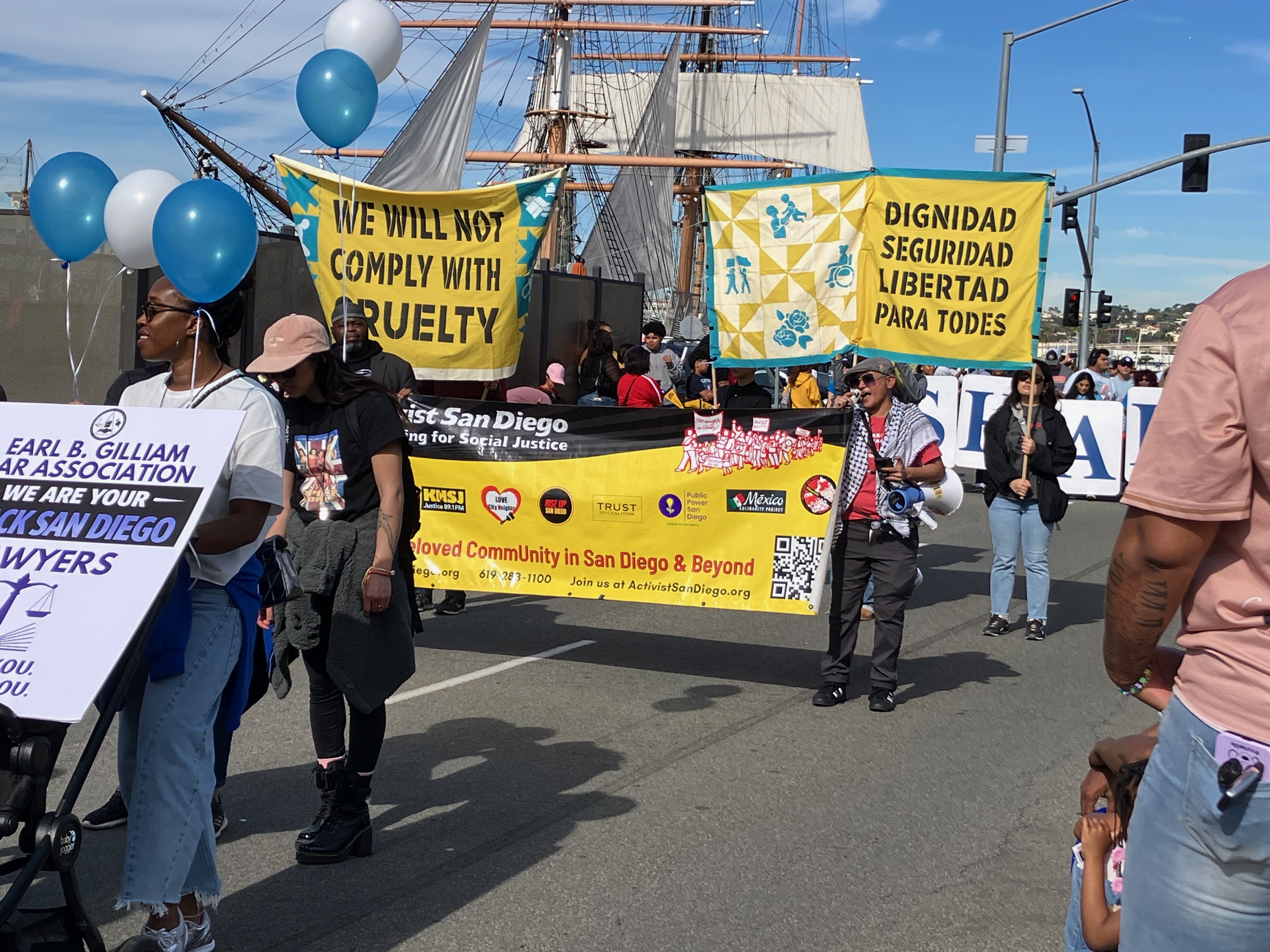
Activists in MLK Parade, 2026

What combination of tactics could work best to slow or reverse our slide into increasingly authoritarian rule, I wondered? I wished I were a better writer, able to craft a rallying cry that would re-inspire me and others. Then I remembered a poem written during a previous dark time for the disinherited, James Weldon Johnson’s 1900 “Lift Every Voice and Sing.” 

A black friend had delved deeper into the words to this three verse civil rights poem during a workshop nearly thirty years ago on building the beloved community. The first verse stresses harmony and rejoicing, a needed uplift for the students at the segregated black school in Florida where Johnson was then principal. But the poem doesn’t sugar coat either the realities of prior slavery or the challenges of the Jim Crow era then unfolding. Its second verse lays it all out: 

Stony the road we trod, bitter the chastening rod,
Felt in the days when hope unborn had died,
Yet with a steady beat, have not our weary feet
Come to the place for which our fathers sighed?
We have come over a way that with tears has been watered
We have come, treading our path through the blood of the slaughtered.

Johnson’s brother Rosamond crafted music to go with the poem. A school chorus first performed it at a school ceremony later that year. A generation later, the hymn was adopted as an official anthem of the NAACP. The song has become an enduring symbol of the struggle for civil rights—its mandate expanding to include equal rights for all. 

There’s a lot more work to be done before the ideals expressed in our nation’s founding documents are fully realized. The work will not get done solely with marches or protests, though they may help. Sometimes the road ahead will be stony, but gentle perseverance can get us to a better place again. We’ve been working at perfecting our union for 250 years—with luck and fortitude, we’ll have a better nation and a better, more peaceful world before the next 250 years are done. Then, we will truly be able to lift every voice.  

A Different National Anthem?

As a former Baltimorean, I was exposed early to stories of the origin of the “Star-Spangled Banner.” It was part of our history lessons starting in elementary school. Later, I got to visit Fort McHenry, a national park on the site of now-obsolete fortifications at the entrance to Baltimore’s harbor. In September, 1814, the shelling of this fort by British warships was the inspiration for a Francis Scott Key poem, later set to music and dubbed “The Star-Spangled Banner.” During the day-and-night-long battle, Key had been held as a prisoner of war on one of the British ships. When, the following morning, Key saw the fort’s large flag hoisted at dawn, it meant that the British bombardment had failed to overcome the fort’s defenses. An exultant Key penned three verses of a poem whose first stanza now fills our ears at nearly every sports event or civic celebration. This song was officially designated our national anthem in 1931.

As our country has matured and begun to come to terms with the full complexity of our history, some commentators have pointed out that “The Star-Spangled Banner” is at best obsolete. It was composed during the War of 1812, when our then-young nation was under attack by a much stronger former colonial overlord. Its third verse, though almost never sung, contains allusions to then-legal slavery, wishing that “No refuge could save the hireling and slave from the terror of flight or the gloom of the grave.” 

Last November, I tried writing for myself a daily series of appreciations of anthems or hymns that have grown to have special meaning for me. One of these is “Lift Every Voice and Sing” (for fellow Unitarian-Universalists, #149 in the hymnal Singing the Living Tradition). This hymn/anthem originated in Florida at the turn of the twentieth century, written by the principal of a segregated school as a poem to honor Abraham Lincoln’s birthday. A tune was later created by the principal’s younger brother. In 1919, the fledgeling NAACP dubbed the piece the “Negro National Anthem,” a dozen years before “The Star-Spangled Banner” became our official national song. 

Brothers James Weldon Johnson and J. Rosamond Johnson, who wrote the words and music to “Lift Every Voice,” were upwardly mobile Negroes born a few years after the end of legal slavery in the United States of America. At the time he wrote the lyrics, James Weldon Johnson was principal at the Stanton School in Jacksonville, Florida, where he and his younger brother had earlier attended school and where their mother taught for many years. J. Rosamond Johnson had studied music at the New England Conservatory and in London. After teaching stints in Jacksonville, both brothers moved to New York City and participated in the flowering of art and music that became known as the Harlem Renaissance. 

The poem was first performed on February 12, 1900, by all 500 or so students at James Weldon Johnson’s school. The musical version that followed spread mainly by word of mouth from school to school. It has become a staple of choirs at historically black colleges and universities, often performed at commencements and other ceremonies. In September 2020, singer Alicia Keys performed it in a prelude to a National Football League game (see www.youtube.com/watch?v=i30SdcfEpSE), partially in response to a series of racially motivated killings and resurgent white nationalism that has transfixed our nation’s attention.  

“Lift Every Voice” was written just as the strictures of Jim Crow were circumscribing the ability of African-Americans to advance. It is as much aspirational as “factual.” A black or mixed choir can often bring a depth of meaning and history to the anthem that those of us who have benefited from white advantage may lack. I have not had to live the trauma of so many who “…have come over a way that with tears has been watered; 

… have come, treading our path thru the blood of the slaughtered…” 

though I am gradually learning the extent and persistence of that trauma. 

As debates continue about which parts of our nation’s tangled history get taught, which parts get emphasized and which parts get marginalized, a choice of national anthem sometimes becomes part of the conversation. As a former Baltimorean and Fort McHenry visitor, I know the background of our official national anthem better than most. As a student of America’s broader history, I can also share the story of “Lift Every Voice,” especially with white friends and acquaintances. 

Having spent most of my adult life in the U.S. South, I’ve reluctantly concluded that Americans are unlikely to agree completely on the “true” history of our diverse society.  I doubt it would be wise to entirely replace “The Star-Spangled Banner” as our nation’s song. Over time, though, we can learn to be more nuanced and inclusive in our presentations. The rousing sentiments of a newly defended nation, as expressed by Francis Scott Key, are laudable, but the enslavement, sweat and toil of the many Key left out or vilified, need to be remembered as well.

Music is a truly universal language, if one with lots of local dialects. Whatever our background or life station, it behooves us to remember to

“Lift every voice and sing, till earth and heaven ring,
Ring with the harmonies of liberty,
Let our rejoicing rise high as the listening skies,
Let it resound loud as the rolling sea.”